This blog was a backup for American Indian Adopteesblog
USE THE SEARCH BAR or SEARCH TOPICS at bottom of this blog
If you need support
Support Info: If you are a Survivor and need emotional support, a national crisis line is available 24 hours a day, seven days a week: Residential School Survivor Support Line: 1-866-925-4419. Additional Health Support Information: Emotional, cultural, and professional support services are also available to Survivors and their families through the Indian Residential Schools Resolution Health Support Program. Services can be accessed on an individual, family, or group basis.” These & regional support phone numbers are found at https://nctr.ca/contact/survivors/ .
MY EMAIL: tracelara@pm.me
Chief James H. Red Cloud, grandson of the famous Chief Red Cloud who allowed the Jesuits to set up a school on Lakota land, addresses the 1958 graduating class of Holy Rosary Mission and a Jesuit father. Credit: Courtesy of the Red Cloud Indian School and Marquette University Holy Rosary Mission/Red Cloud Indian School records
Buried Secrets: America’s Indian Boarding Schools
This week on Reveal, we’re bringing back a two-part investigation with ICT (formerly Indian Country Today) about boarding schools for Native children and the United States’ effort to come to terms with an educational system that was designed to “kill the Indian and save the man.”
ICT reporter Mary Annette Pember has been reporting on these boarding schools for more than 20 years. Much of her work focuses on the role the Catholic Church played in shaping federal policy toward Native people. The church was given more than 10,000 acres of tribal land by the federal government, as well as access to money that had been given to tribes through treaties with the U.S. government to build and operate the schools.
In part one of this investigation, Pember takes us to the Catholic-run Red Cloud Indian School on the Pine Ridge Reservation in South Dakota, which is now trying to bring truth and healing to its community despite the open wound from the school’s history.
Minnesota was already among the 12 states with a law that mirrors some or all of the protections of the Indian Child Welfare Act (ICWA), federal legislation passed decades ago to protect Indigenous families from unnecessary family separation.
But the state Legislature went further this year with enhancements to the Minnesota Indian Family Preservation Act, which was originally passed in 1985. The bill moves to Gov. Tim Walz’s desk as the nation waits for a ruling from the Supreme Court on a case called Brackeen v. Haaland, which could decide the fate of ICWA as a national law. A decision in the case is expected this summer.
“This bill says that we agree on Minnesota land that our children deserve the opportunity to have access to their family, their culture, their beliefs, and what I believe is the most beautiful part of Minnesota,” Rep. Heather Keeler told lawmakers in advance of the floor vote.
A group of leading organizations in child welfare is working to build a new path for quickly licensing kin as foster parents.
The Imprint Weekly Podcast
Episode 122: We Were Once a Family, with Journalist and Author Roxanna Asgarian
On this week’s podcast we discuss some updates on the Indian Child Welfare Act front, Minnesota becoming a trans youth refuge, and the blind spot in America’s knowledge of youth justice.
Imprint alum Roxanna Asgarian joins to discuss her new book, “We Were Once a Family: A Story of Love, Death, and Child Removal in America,” which traces the lives and families of six children killed by their adoptive parents in March of 2018. HERE
On this week’s podcast, we begin a two-part interview between Imprint reporter Nancy Marie Spears and Sandy White Hawk, author of the recently released memoir A Child of the Indian Race: A Story of Return. White Hawk’s recounts her own adoption story, which began in 1955, decades before the Indian Child Welfare Act was passed to protect Indigenous families from being separated.
This conversation comes just months after the Supreme Court heard arguments in a case called Brackeen v. Haaland, in which several non-Indigenous families and the State of Texas have claimed that ICWA is unconstitutional. A decision in the case is expected to be delivered this summer.
Guest Interview: Sandy White Hawk is a Sicangu Lakota adoptee from the Rosebud Reservation, South Dakota. She is the founder and director of First Nations Repatriation Institute
Last November I wrote a post: WE ARE NOT GOING BACK and ended the post with: If the Indian Child Welfare Act (ICWA) fails we will write a stronger law. I meant it, and states are enacting their own laws right now to protect Indian children from the predatory billion-dollar Adoption Industry.
I had a friend, Jagade, who dreamed for others. (Yes, that is a real thing. Sadly she passed on a few years ago.) She told me about a dream she had that many more adoptees were coming. I didn't want to believe her. She told me that is why I was directed to do the anthologies, so that future adoptees would know the history of the Indian Adoption Projects and what happened. And how to return to their tribes as adults.
This dream can means two things: There is still too much poverty in Indian Country and the authorities (social workers) will come for Native children, judging families based solely on living conditions. It's happened before. They need an excuse to remove children so the judges and lawyers and adoption industry can continue making profits. (It also means that there are not enough Native people to foster and adopt children, and become adoptive parents.)
Individuals with little exposure to or experience with American Indian communities would have little to no knowledge of these forms of social safety nets (ie. kinship care).
Second: The other thing her dream might mean is: adoption will not be closed, and people who are adopted will know the truth when they become adults, and access and open their adoption file. And then have a reunion.
Yes, adoption has changed that much since I started studying it back in 2004/5.
Terry L. Cross, executive director of the Portland-based National Indian Child Welfare Association and an enrolled member of the Seneca Nation New York, said the results have their roots in cultural backgrounds.
“Cultural norms, including sustaining strong extended families, handing down of culture and traditions, and establishing a positive identity, contribute to perceptions of our foster care system and notions of your place within that system. What is missing from the survey is how many people would support ‘kinship care,’ or relative care, over foster care placements in a stranger’s home,” Cross said.
Cross said kinship care is considered by most to be a cultural norm of Indian Country, and when a crisis arises other family members step in to share the burden of taking care of the children. Given a choice of a child being removed from a home due to maltreatment and being placed in a licensed foster home with strangers in a new community, Cross said, it appears most Indians will choose informal kinship care arrangements, even if it means little financial support for the kinship caregivers.
Editor Note: The government takes the land AND causes the poverty, then they want more LAND and take the children to achieve this goal. The genocide cycle never ends... That is the sport of colonization and empire. Trace
Just another reminder how the #Adoption industry, parasitic of vulnerable women to take their children for financial gain, also lurks in the shadows on social media to borrow the language of adopted persons to promote its brand of #FamilySeparation as "love." There is no bottom. pic.twitter.com/R7sLQrmNOv
Adoption is racist. Adoption is classist. Adoption is a tool of genocide. It is a white savior delusion to think that you are saving a baby through legally dismantling their family. #AdopteeVoices#adopteetwitter
Adoption Mosaic this Saturday has a great program discussing an alphabet of laws that control many aspects of adoptions, particularly transracial adoptions and adoptions from Native American communities. Featuring Sandy White Hawk, Jordan Davis, Torie DiMartile, Daryle Conquering Bear Crow, and Summer Sullivan, the program discusses the Multi Ethnic Placement Act, Inter Ethnic Placement Act, and the Indian Child Welfare Act and their impact on adoption, communities, and adopted people.
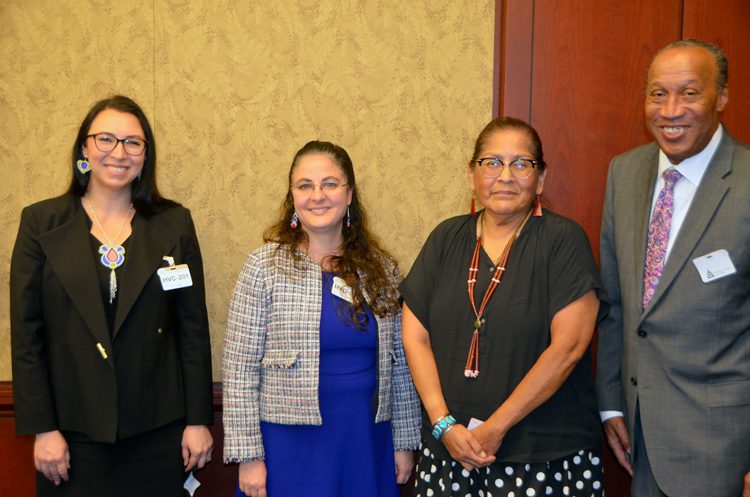
On September 20, 2022, social workers, advocates, and Hill staffers gathered in Room HV201 in the Capitol Visitor Center to discuss how Congress might respond if the United States Supreme Court rules the Indian Child Welfare Act (ICWA) is unconstitutional. Co-hosted by CRISP and the National Foster Youth Initiative, the briefing was held in conjunction with the Congressional Social Work Caucus and the Congressional Caucus on Foster Youth. Congresswoman Barbara Lee (D-CA-13), chair of the Social Work Caucus, provided a video greeting to set the tone for the briefing.
CRISP Legislative Director Angelique Day, an associate professor at the University of Washington School of Social Work and a descendant of the Ho Chunk nation, consisted of Kathryn Isom-Clause, Bureau of Indian Affairs Deputy Assistant Secretary for Policy and Economic Development; Kristen Torres, MSW, child welfare legislative aide for Rep. Judy Chu (D-CA-27); and Sonia Begay, a member of the Navajo Nation and grandparent caregiver who provided compelling testimony about her experiences with ICWA during the time she sought parental custody of her grandchildren who attended the briefing.
The briefing began with opening remarks from CRISP director Dr. Charles E. Lewis Jr., followed by remarks from Rebecca Louve Yao, executive director of the National Foster Youth Institute, a nonprofit organization founded by Rep. Bass to
From left: Kathryn Isom-Clause, Bureau of Indian Affairs; Dr. Angelique Day, Sonia Begay, and Dr. Charles E. Lewis Jr.
revolutionize the foster care system. Camille Loya provided remarks on behalf of Rep. Bass.
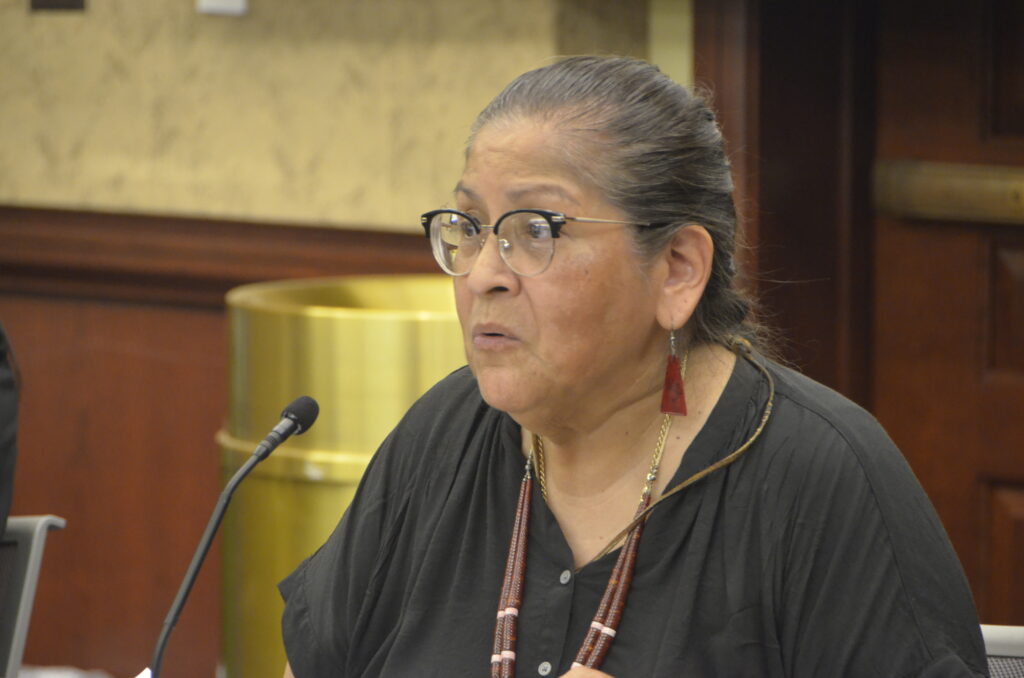
The most compelling testimony was delivered by Sonia Begay. She told her story about how her oldest son was struggling with substance abuse and temporarily lost custody of his three children to the Kentucky foster care system. She was not granted custody of the children and was appalled when she arrived at the state office and her grandson’s hair had been cut. His hair had never been cut before because of traditional culture. She said it reminded her of the photos she had seen of native children being taken into boarding schools in the 1940s and 50s. His hair had been cut within the span of 12 hours of him going into state care. She then contacted the Navajo Nation social services and the Kentucky social services refused to grant her custody despite the Navajo representative citing the need to comply with ICWA. She said the trauma of those events still haunts her. She was not living on the reservation, so she did not have access to local resources but turned to organizations and social workers seeking help and guidance. She discovered bruises on the back and buttocks of her youngest granddaughter. When social services saw the injuries, they accuse the grandmother of abuse. The tribe went into action, sending a legal team to help get the children released to their grandmother. The process took more than nine months. Eventually, she received a formal apology from Kentucky social services. She credits the ICWA for allowing her to take custody and care for her grandchildren.
The focus of the briefing was to discuss how Congress might respond should the Supreme Court declare ICWA to be unconstitutional.
Several bills have been introduced in the House of Representatives to protect the well-being of Native American families: H.R.1688, the Native American Child Protection Act was introduced on March 21 by Reps. Ruben Gallego (D-AZ-7), Sharice Davids, and Dusty Johnson (R-SD) and passed in the House on May 12, 2021; H.R.4348, the Tribal Family Fairness Act, was introduced by Rep. Bass on July 7, 2021; and H.R.8954, the Strengthening Tribal Families Act, was introduced by Reps. Judy Chu, Don Bacon (R-NE-2), Raul Ruiz (D-CA-36), and Tom Cole (R-OK-4) on September 23, 2022.
On November 9, 2022, the Supreme Court heard Brackeen v. Haaland and three other cases challenging the constitutionality of the Indian Child Welfare Act passed in 1978 giving tribal governments primary jurisdiction over the removal of Native American children in custody, foster care, adoption cases, and their placement in appropriate homes. The Fifth Court of Appeals issued a divided ruling in April 2021. Defenders of ICWA point to a report recently released by the U.S. Department of the Interior detailing atrocities committed at boarding schools against Indigenous children as justification for needing ICWA’s federal protections.
The Department of Interior report showed that between 1819 and 1969, the United States operated or supported 408 boarding schools across 37 states, including 21 schools in Alaska and 7 schools in Hawaii. The report described the boarding school environment, housing Native American children as young as four years old, as fostering “rampant physical, sexual, and emotional abuse; disease; malnourishment; overcrowding; and lack of health care.”
Sonia Begay provided emotional testimony.
Thirty-three Senators and 54 Members of the House of Representatives filed an amicus brief in support of the constitutionality of Congress’s authority to legislate the affairs of Native American tribes and their people and urged the Supreme Court to “uphold the Indian Child Welfare Act’s constitutionality in all respects.” Numerous amici briefs have been filed supporting ICWA’s constitutionality, including briefs by several tribal nations and the American Civil Liberties Union.
442 PAGES - 10 year review after ICWA was passed into federal law
Indian Child Welfare Act. Hearing on Oversight Hearings on the Indian Child Welfare Act, before the Select Committee on Indian Affairs. United States Senate, One Hundredth Congress, First Session (November 10, 1987).
Congress of the U.S., Washington, DC. Senate Select Committee on Indian Affairs.
This Senate hearing produced testimony on how the Indian Child Welfare Act of 1978 (ICWA) has been administered by government agencies and the courts. Three members of the Select Committee on Indian Affairs presented background information on the act's intent to confirm the tribe as the primary authority in matters involving an Indian child's relationship to parents or extended family. Seven tribal members from Washington, Montana, Alaska, Oklahoma, California, and Arizona discussed the importance to Indian children of maintaining contact with their cultural roots; the high rates of placement of Native children in non-Native foster and adoptive homes, particularly in Alaska; and the problems of vague wording in ICWA and poor funding for tribal child welfare activities. A witness from the Bureau of Indian Affairs (BIA) testified about the extent of the BIA's role in child placement proceedings and its funding and monitoring of tribal child welfare activities. State officials from Washington and Alaska described problems of inadequate funding and lack of Native foster homes. A Canadian speaker reported the unique problems of tribes that straddle the border. The Association on American Indian Affairs submitted proposals for two bills, one to fund Indian social services out of four existing federal programs, and the other to amend ICWA by clarifying and expanding its coverage, increasing tribal involvement and control, keeping families intact when possible, providing quicker proceedings, and creating compliance monitoring mechanisms. An advocacy group proposed an ICWA amendment that would extend coverage to indigenous Hawaiians. Twelve additional tribal groups submitted recommendations. (SV)
At age nine, tragedy struck Autumn Adams’ life. Her father passed away and her mother was deemed unfit to care for her, leaving Adams with an uncertain future.
Adams, who is a member of the Yakama Nation, a federally recognized Native tribe, recalls overhearing officers from Child Protective Services discuss the possibility of moving her to a non-Native home if they couldn’t soon find a Native family to place her with. The idea terrified her.
“At that point in my life, I had everything I recognized as home ripped away from me," she tells Teen Vogue. "I had to bury my father. I had to be ripped from my mother's arms. The only thing that was left that gave me that connection was my extended family and culture.”
Adams was eventually placed with family in a multigenerational home that included her maternal aunt and grandmother. Now a law student, Adams credits this upbringing with enabling her to stay close to her culture and achieve success. “I was directly able to learn from my aunt, my cousins, my grandmother, my other aunts and uncles during that time — what it means to have perseverance, what it means to have responsibility and respect, the definition of grit,” she explains. “It's through those lessons that I've broken every negative statistic not only about former foster youth but about Native former foster youth.”
In November, the Supreme Court heard arguments for a case that could forever change the landscape of adoption for Native youth like Adams.
By Trace L. Hentz, Blog Editor and Adoptee (video editor from 2014)
I have been rereading TWO WORLDS: Lost Children of the Indian Adoption Projects (second edition). It's first person accounts of adoptions by non-Native parents and our history.
What was life like pre-ICWA?
Can we please look at the impact of closed adoptions through the eyes of the adoptee-adult? We are called the Stolen Generation, remember that.
The word often used about being adopted is “cultural genocide and culture loss.”
If we lose ICWA, we go back to that earlier form of genocide: Less Indians on the rolls, less people on the rez, and the adoptee will lose years of ancestral knowledge and history and language we would have received from our relatives. (There are very few adoptees back on their rez.)
This cultural knowledge is not found in books. It’s learned at a kitchen table, in the kitchen cooking, hunting or gathering with your parents, at a beading circle, at a memorial/funeral, or at a social gathering like a powwow, on in ceremony. It’s learned walking the land. It’s learned hearing your grandparents tell stories. It’s learned over years of contact, contact with your people, your clan, your cousins, your tribal nations.
That knowledge is your inherent sovereign right as a sovereign citizen of your TRIBAL NATION, that lies within the boundaries of America or Canada.
Babies and children adopted by non-Natives, this ancient ancestral knowledge and language is gone, erased. Your tribal history is gone.
YOU ARE GONE.
Do you think the Supreme Court knows anything about this cultural genocide? Do you think they know about 1,000 Indian Wars? No treaty went unbroken. Do you think it matters to them what happened 100 years ago, or since ICWA was passed in 1978 to stop the adoption industry and the united states funding child trafficking?
Do adoptive parents know about cultural loss? What do they plan to do when the child asks about their tribe, or their parents, or their history, or their language?
“What is my language,” a child might ask. “Where are my people?”
If We Lost ICWA?
Think about Arnold Lyslo who ran the Indian Adoption Projects in America. He was busy selling his story ideas to magazines so white readers would feel sympathy and want to help. He counted his successes in how many Indian children were placed with white families. (Success? Erased: off the rez, off the rolls.)
It was the perfect storm. The adopters were not told there was a massive inter-country genocidal project going on. They just thought: “Hey, were doing a good thing (adopting a Native kid.)”
How many of these adoptions failed? (I wanted to know that. I asked adoptees to write their stories in the anthologies Two Worlds, Called Home and Stolen Generations.) I sent a bunch of questions to each adoptee.
How many adoptees committed suicide? We don’t know.
How many adoptees acted out and were sent to prison? Too many actually, quite a few I heard about.
Nobody wants Indians to have anything – especially good-sized populations – that would not work for the people who make sure “Indians stay poor.”
What happens if ICWA fails, and adoption goes widespread again and there is some new method of closed adoptions, like the earlier INDIAN ADOPTION PROJECT(s), or ARENA? What if they open new boarding schools and force Indian children to attend? The governments of Canada and America funded them, gave the churches money to take Indian kids, some literally abducted off the rez at gunpoint?
To be continued
If you cannot afford to buy the book Two Worlds, please email Trace (tracelara@pm.me)
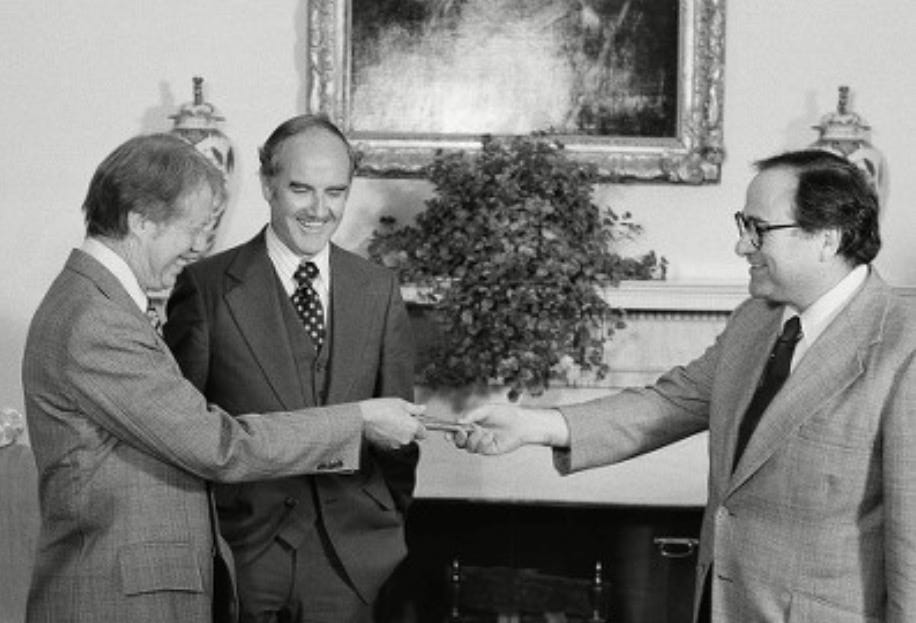
Sen. James Abourezk, right, with President Jimmy Carter, left, and Sen. George McGovern, center.
James Abourezk, a former senator who was a staunch supporter of tribes and shepherded the passage of the Indian Child Welfare Act, died last week on Feb. 24, his 92nd birthday.
Abourezk, the first Arab American to serve in the U.S. Senate, represented South Dakota in both houses of Congress in the 1970s. Having grown up on the Rosebud Indian Reservation, where his parents had landed after immigrating from Lebanon, he was an early champion of Indigenous rights and sponsored ICWA and other laws that reshaped the federal government’s tribal relations.
During the early years of Abourezk’s tenure in the Senate, the Association on American Indian Affairs released the results of a 5-year study that found as many as one-third of Native children were being taken into foster care, nearly all of them being placed with non-Native foster or adoptive families, permanently severed from their tribal communities.
“Those kids were my playmates,” Abourezk told The Imprint in 2018. “A friend helped me see that that was my responsibility. We have an obligation to do right by them.”
The late congressman — who was described by colleagues as courageous, outspoken and funny — was arguably a catalyst for getting Native issues on the minds of federal lawmakers following the transformational civil rights movement and amid growing turbulence and activism around Indigenous rights.
Abourezk pushed for the creation of and co-chaired the American Indian Policy Review Commission, which conducted an in-depth analysis of federal law regarding tribes, with the express purpose of soliciting recommendations to improve tribes’ self-determination and participation in making the policies that impact them.
The commission collected testimony from more than 90 tribes and heard 28 days of hearings before releasing a final report in 1976, which covered a range of issues from hunting and fishing laws to child custody rights.
The findings of this report, along with the data revealing the alarming number of children being taken from their families, paved the way for the ICWA’s 1978 passage.
As chair of the newly created Senate Committee on Indian Affairs, Abourezk presided over ICWA hearings, where Indigenous activists, social workers and parents who had lost children testified to the irreparable generational trauma caused by federal child welfare policy in tribal communities.
The landmark legislation — aimed at reducing the number of Native children separated from their families through foster care and keeping Native foster youth in tribal homes — faced enormous opposition, including by the Bureau of Indian Affairs. It passed at the 11th hour, just as the 95th Congress was coming to a close on October 24, 1978 — only months before Abourezk retired from office.
The commission sparked several other reforms, including Abourezk’s American Indian Religious Freedom Act and the Indian Self-Determination and Education Assistance Act, which he co-sponsored, that allowed tribes to receive and administer federal grants for education and social programs.
Ultimately, at least six of Abourezk’s bills relating to tribal sovereignty would become law in his eight years in Congress. He also took his commitment to tribal advocacy beyond the Senate chambers, traveling to Wounded Knee to negotiate between law enforcement and activists from the American Indian Movement who, in the late 60s and 70s, occupied that and other historic sites in protest of the federal government’s treatment of tribes.
Abourezk left the Senate in 1979, deciding not to run for reelection. He focused on advocating for civil rights for Arab Americans, creating the American-Arab Anti-Discrimination Committee. His work in this realm was not without controversy: In 2007, he told a Hezbollah-backed TV news station that Zionists had helped orchestrate the 9/11 attacks as a plot to sow Islamophobia, and that Zionists controlled the U.S. Congress.
He also continued to advocate for Native rights, and spoke out against lawsuits seeking to have ICWA overturned.
Abourezk was interviewed by The Imprint in 2018, just as the current threat to his landmark legislation was ballooning into national concern. In the midst of a district judge deeming ICWA unconstitutional in the Brackeen v. Haaland case — then called Brackeen v. Zinke, named for the Interior Secretary at that time — Abourezk spoke to the measured improvements the bedrock law had created for the nation’s first people. The case is now being decided by the Supreme Court.
“There’s still a lot of suffering on reservations, and mean treatment by governments,” he said, “but it’s been cut down by ICWA.”
With the fate of the Indian Child Welfare Act in the Supreme Court’s hands, a new think tank has formed to advance legal and political strategies to protect tribal sovereignty.
“The adoption system traditionally requires that children disavow reality.” BJ Lifton, adoptee, author (1994)
By Trace L Hentz, Blog Editor
Lying in bed last night I was writing this post "WHAT IF WE LOST ICWA?" (Most of my ideas got wiped out by sleep.)
Here is some of what I remember:
For the last few days I've been cleaning my Outlook email inbox. (Hundreds and hundreds of emails are kept in folders, for safe keeping. Just in case: If I need to ask something, find something or someone.) I thought I'd be more organized if I kept everything, to remember names. (I'm talking HUGE FILES and lists and replies and adoptee stories and so many requests for help.)
I started rereading. Shockingly: I found emails from 2004-5, from old email addresses I used, and of course I found people I don't have contact with anymore. (Some only use their cellphone and don't email, of course.) I found adoptees asking for help, and many were helped... (Several people opened their adoption files and some went into reunions. Some were enrolled with their tribes, eventually. Karen Vigneault was a miracle worker. Then we lost her in 2020. Here is an article about her: https://www.sandiegouniontribune.com/sdut-war-vets-great-niece-rights-great-wrong-2010jan24-story.html)
Looking back: I left Facebook (META) in 2018 after my cancer surgery and there are so many people on there I lost touch with... who I still miss ... but they are there and I'm not. I lost friends, all across the country and world. (Yes, I regret it but the loss of privacy was a much bigger concern. WHY? My life was invaded by the Cambridge Analytica data hack.)
Looking back, I never would have found so many adoptees without Facebook. I wrote two newspaper articles GENERATION AFTER GENERATION WE ARE COMING HOME. Both publications are gone now. The spark that lit a fire, that 2005 article started me on a new path and new journey to find adoptees. (I have not found the article online but if I can, using the Wayback Machine, I will post a link. It may be in this computer somewhere.)
Social media helped to create this global circle of adoptees, Native American and First Nations Adoptees, like our own universe. Facebook connected us to each other. Emails came in. This blog/website began in late 2009.
Now my inbox has taken on a life of its own. And this blog has taken on a life of its own, too. (2,264 posts so far...) (That is BIG)
What if we lose ICWA? What if the Indian Child Welfare Act gets wiped out? What will happen?
One Good. We mentioned South Dakota’s equal rights bill last week. We have some additional fantastic news. HB1231 yesterday passed the Senate, and it will be transmitted to Governor Kristi Noem soon, who is widely expected to sign it into law. Once enacted, it goes into effect on July 1, 2023, restoring the right of all South Dakota-born adult adopted people to apply for and obtain their own original birth certificates. That is, apply, pay a few bucks, get it.
Two Good. Georgia’s SB64 got over its first legislative hurdle yesterday, receiving a unanimous DO Pass recommendation from the Senate Children and Families Committee. It heads to a vote now by the full Senate, which has to occur no later than March 6. Sign up with the Georgia Alliance for Adoptee Rights if you want to stay informed or get involved.
Two Bad. The bad news comes from two bills pending in West Virginia and Mississippi, though the bills are still far from being enacted. As we produce this newsletter the West Virginia bill has been passed by the Senate and is headed for the House. It has a whole host of problems, including educational requirements, redactions, and your mom’s permission to get your OBC.
Mississippi’s bill is a bit more complicated because, while at one point it was a bad bill, it is now a completely different and unrelated bill, thanks to a maneuver called a “strike all.” It may be dead because of the strike all, but then again the Mississippi legislature has not yet uttered the magic words to truly signify the end of a bill: dead, dead, dead.
Mapping the Life Course of Adoption Project Launch and Survey. Adoption professionals all agree that adoption is life long -- and no one knows this better than adoptees. And yet, our collective knowledge about the life course of adoption does not exist. This is what the MAP project is seeking to change.
As hurtful truths come to light regarding historically operated Federal Indian boarding schools in the United States, many Native Nations are reclaiming their voices.
For the Upper Sioux Community (“Yellow Medicine Nation”) living in Minnesota, these historical truths are known to have cast profound ripples that impact their present.
This mini documentary explores community interpretations of this boarding school past and offers hope for justice and healing.
For a list of self-care and trauma resources, click here.
T he Métis National Council and the Government of Canada will be working collaboratively, Nation-to-Nation, to develop a process to engag...
To Veronica Brown
Veronica, we adult adoptees are thinking of you today and every day. We will be here when you need us. Your journey in the adopted life has begun, nothing can revoke that now, the damage cannot be undone. Be courageous, you have what no adoptee before you has had; a strong group of adult adoptees who know your story, who are behind you and will always be so.
OUR HISTORY
BOOK 5: Lost Children of the Indian Adoption Projects


%20on%20Twitter.png)