BACK UP BLOG (no longer updating)

This blog was a backup for American Indian Adoptees blog
USE THE SEARCH BAR or SEARCH TOPICS at bottom of this blog

If you need support

Support Info: If you are a Survivor and need emotional support, a national crisis line is available 24 hours a day, seven days a week: Residential School Survivor Support Line: 1-866-925-4419. Additional Health Support Information: Emotional, cultural, and professional support services are also available to Survivors and their families through the Indian Residential Schools Resolution Health Support Program. Services can be accessed on an individual, family, or group basis.” These & regional support phone numbers are found at https://nctr.ca/contact/survivors/ . MY EMAIL: tracelara@pm.me

Search This Blog

Showing posts with label Ottawa. Show all posts

Wednesday, September 27, 2023

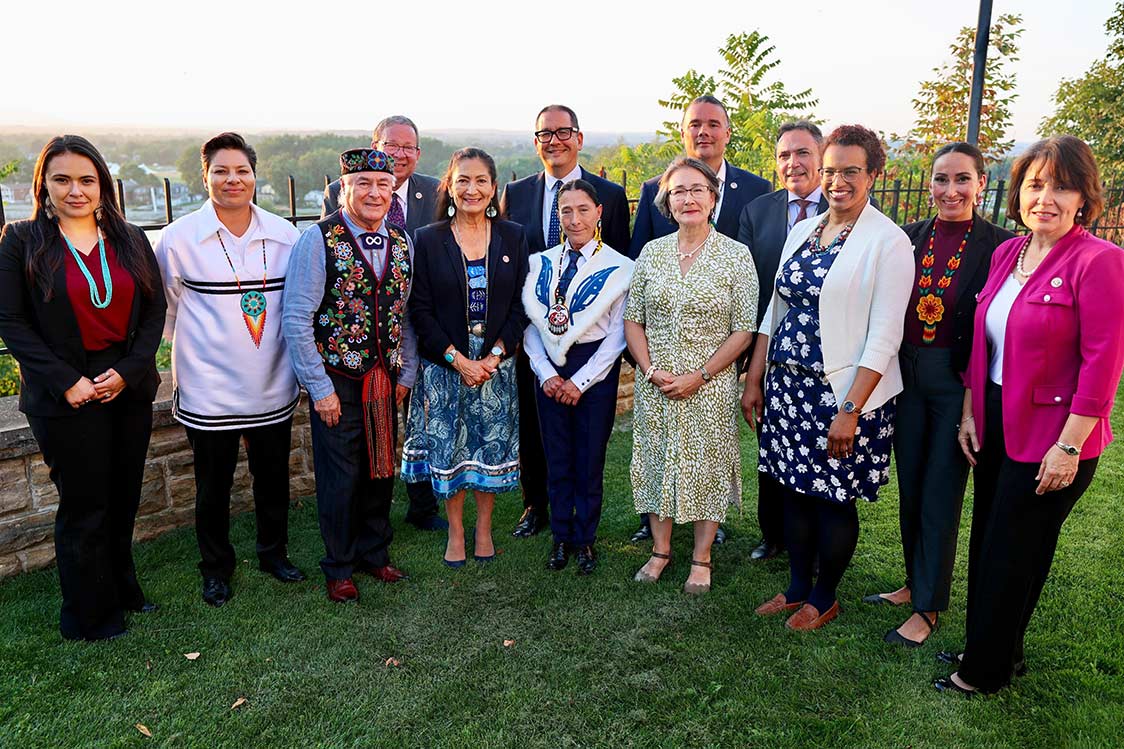
Secretary Haaland Highlights Work To Strengthen Indigenous Communities in Ottawa Visit


Haaland Ottawa visit

OTTAWA, CANADA – Secretary of the Interior Deb Haaland, Assistant Secretary for Insular and International Affairs Carmen G. Cantor, and Assistant Secretary for Indian Affairs Bryan Newland visited Ottawa, Canada, to highlight the United States’ ongoing work with Canadian leadership to ensure that Indigenous and First Nations communities have the support and resources they need to prosper.

Secretary Haaland represented the United States during the fifth convening of the Trilateral Working Group (TWG) on Violence Against Indigenous Women and Girls, which was started by leaders from the United States, Canada and Mexico. The Interior Department is working with tribal governments, law enforcement agencies, survivors, families of the missing, and all communities impacted to coordinate interagency and international collaboration to address this crisis.

“No country is more important for the Department of the Interior’s international work than Canada,” said Secretary Deb Haaland. “The relationship we share is extensive and defined by our deep economic ties and shared cultural heritage. Our work on behalf of Indigenous communities is expansive, but our enduring success depends on our international partnerships. The Biden-Harris administration, in collaboration with our colleagues in Canada and Mexico, is putting the full weight of the federal government into pursuing justice for missing or murdered Indigenous peoples so that that current and future generations of Native communities can enjoy a future free from the violence that has plagued our countries for too long.”

Hosted by U.S. Ambassador to Canada David Cohen, the delegation met with Canadian government officials to discuss issues of shared importance and highlight continued collaboration to invest in United States and Canadian communities. This included meetings with Minister Gary Anandasangaree, Crown-Indigenous Relations; Minister Patty Hajdu, Indigenous Services; and Minister Dan Vandal, Northern Affairs. The delegation also met with Mary Simon, Governor General; Chris Forbes, Deputy Minister of Environment and Climate Change Canada; and Michael Vandergrift, Deputy Minister of Energy and Natural Resources Canada.

Ambassador Cohen, Secretary Haaland and the delegation hosted a roundtable discussion with Indigenous leaders and stakeholders regarding economic development issues in Indigenous communities. 

During the discussion, Secretary Haaland highlighted how funding from President Biden’s Investing in America agenda is making historic investments in Indigenous communities in the U.S., including for Indigenous economic empowerment, sovereignty, and tribal climate resiliency.

Wednesday, August 18, 2021

NEWS: Million Pledged, Unmarked Graves, Secretariat Investigation


Wauzhushk Onigum receives 'long overdue' $3M to search for unmarked burials at former residential schools - read here

(August 14, 2021) The chief of Wauzhushk Onigum says elders in the northwestern Ontario First Nation have been telling stories for decades about unmarked graves and the children who never came home from St. Mary's Indian Residential School.

"It's time to listen to their stories and educate non-Indigenous Canada, educate the world on what happened to our people," Chief Chris Skead told CBC News.

He hopes the $2.9 million in funding announced Thursday by the federal and provincial governments will help the First Nation find "the entire truth."

**

Former TRC director to head 'secretariat' investigation

(August 13, 2021)
Kimberly R. Murray
Kimberly R. Murray

The former executive director of the Truth and Reconciliation Commission of Canada has been hired to help create a “survivors’ secretariat” to oversee a search for graves at the former Mohawk Institute residential school.  Kimberly R. Murray, a Mohawk of Kanehsatake, will act as executive oversight lead. In addition to her work with the Truth and Reconciliation Commission, Murray was the first assistant deputy Attorney General of the Indigenous Justice Division at the Ontario of the Attorney General.

Six Nations has put $1 million into the creation of the survivor secretariat.

The Mohawk Institute operated for 142 years from 1828 to 1970. More than 15,000 children, most of them from Six Nations, were forced to attend.


MORE NEWS:

Indigenous leaders, community bless site for national TRC centre |Winnipeg Free Press

Indigenous art show explores role of kinship in culture while works convey pain, hope, beauty

A description of this painting reads: 'Unmarked depicts the loss of culture, language and of course children through the historical implementation of the Residential School system in Canada. It was created as a reflection of my own feelings of sadness resulting from this loss and has become a timely harbinger of what is currently occurring with the increased discovery of children's Unmarked graves on the grounds of Canadian Residential Schools.' (D. Ahsén:nase Douglas) READ MORE


Saturday, April 30, 2016

#60s Scoop adoptees rally on Parliament Hill in Ottawa

More than 20,000 Indigenous children removed from their families from 1960s to 1980s

By Waubgeshig Rice, CBC News | Posted: Apr 29, 2016  Sixties Scoop adoptees gathered for a rally on Parliament Hill on Friday.
60s Scoop adoptees gathered for a rally on Parliament Hill on Friday. (Waubgeshig Rice/CBC)
Indigenous people who were adopted during the Sixties Scoop rallied on Parliament Hill Friday in solidarity with other adoptees across Canada, and to put pressure on the federal government to reform the Indigenous child welfare system.
"We are here to celebrate our survival of the child welfare (system), and to raise those issues," said organizer Duane Morrisseau-Beck. "The message to those survivors is that you're not alone, and that we're really working hard to find some answers."
From the 1960s to the 1980s, an estimated 20,000 Indigenous children were removed from their families and placed with non-Indigenous families — often far from their home communities — during what's known as the Sixties Scoop.
Duane and mom
Duane Morrisseau-Beck reconnected with his birth mother, Geraldine Beck, in 1997. (Waubgeshig Rice/CBC)

Morrisseau-Beck was apprehended by child welfare authorities in Manitoba at birth in 1968. In 1977 he reconnected with his birth mother, Geraldine Beck, who joined him at the Ottawa rally.
"It's almost like I was away for a long time, and then I returned home," he said. "It was a seamless process, it just took time to get to know who I was and who my community is, and just sort of go through that validation. And some days I continue to do that."
KEEP READING

Related Stories


External Links

Thursday, August 13, 2015

Indigenous Adoptee Gathering in Kemptville is about healing and cultural realignment

Kemptville Advance
 
 
The children of the ’60s Scoop, traumatized after being taken from their families and culture, are now working on building a family of their own – with each other.
The second Indigenous Adoptee Gathering, to be held at Rideau Hill Camp in Kemptville from Aug. 25 to 27, is about healing - a safe place for adoptees to come together and share stories.
The gathering was organized by a group of four adoptees.
“A lot of us were traumatized,” said Colleen Cardinal, one of the organizers, who was taken from her indigenous home in Alberta at the age of three and adopted out to a family in Sault St. Marie.
“My three sisters and I were adopted into the same family,” said Cardinal. 
She explained the adoption impacted all three of their lives. One of her older sisters was murdered and the other lives out in Edmonton.
“There was so much trauma from those homes,” said Cardinal. “Not everyone had a good home. Some had terrible experiences.”
Cardinal was amongst the long list of adoptees who ended up in an abusive situation.
“Even one of my teachers knew we were being abused and did nothing,” said Cardinal. “When I was 10, my sisters and I ran away.  We walked to the Children’s Aid Society and told them about the abuse.  They brought us back to the house – we thought we were getting our clothes – and they left us there.”
She said both her sister eventually did manage to run away from the abusive home and she ended up having to go to the police and charging her adoptive father.
“A lot of adoptees had that same experience with physical and sexual abuse and we’re still dealing with that trauma,” said Cardinal.
She said she didn’t know she was indigenous until she was a teenager.
“The damage was already done,” she said. “My view of indigenous people was already poor from listening to mainstream media.”
She said when her adopted mother told her she was indigenous, matter-of-factly, she was offended because she internalized a lot of that racism until early adulthood.
“I didn’t understand what happened to my people and my family,” said Cardinal. “Residential schools is something no one talked about.”
She said she never knew about her biological mother’s experience in residential schools and how it impacted her parenting until much later in life.
“She never lived to tell me,” said Cardinal.
Cardinal and her sisters were removed from their mother at a young age because her mother was deemed unfit. The report for her adoption listed the reason for her removal was neglect due to a drinking problem.
“She grew up in poverty, was institutionalized and never taught how to cope,” said Cardinal. “She didn’t know how to take care of us.”
Cardinal is now in the process of researching her family history, to uncover what happened to her family. She was reunited with her mother in 1989, which proved to be a culture shock.
“I went from Sault St. Marie to Alberta – the wild, wild west – I’ve never seen so much poverty,” said Cardinal. “For a long time, I was very angry at her.”
She said understanding the impact of residential schools has helped her to see the trauma experienced by her mother.
“She had her three young daughters taken from her,” said Cardinal. 
Her mother passed away in 1999, at the age of 43, from cancer, after abusing solvents for years.
Cardinal said she, herself, was not one of the fortunate adoptees to be placed in a loving home.
“My sisters and I grew up feeling like second class citizens in our own home,” said Cardinal, who was adopted in 1975.
She said it is common to hear stories from other adoptees of physical and sexual abuse.
“Drinking and drugs are used as coping mechanisms to forget,” said Cardinal, who suffered from a drinking problem until one day realizing that she didn’t want her own kids to grow up with alcohol and violence.
“In 1998, I quit drinking and went back to school,” said Cardinal. “I focused on raising my kids and healing. The more I’ve healed, the more I’ve learned.”
She said being separated from her culture at a young age has had a resounding effect on her life.
“Even though I look indigenous, I am different,” said Cardinal. “Not fitting in anywhere is a common thing. Now we’ve created a place where we all fit in together. It’s a community of adoptees and we support each other.”
She said the adoptees are coming from all across Canada for the gathering.
The funds to make the gathering possible are being raised by the adoptees themselves, in conjunction with a grant from the United Church Healing Fund.
“We are trying to be a beacon for other adoptees and build awareness,” said Cardinal. 
She said it’s an ongoing battle to stay well.
“We come together to promote wellness and learn our culture and be able to practice is safely,” said Cardinal. “We created a family for ourselves.” 
She said if anyone is interested in offering in kind donations for the gathering, such as food or fire wood, to visit http://indigenousadoptee.com.
The inaugural indigenous adoptee gathering, the first of its kind in Ontario, took place in Ottawa at the end of Sept., 2014. Roughly 65 adoptees attended the gathering last year. 
“There are a lot of us adoptees in the Ottawa area and we wanted to come together to share our stories,” said Cardinal. “Because it was such a success, we decided to have another gathering this year.”
The gathering will feature sweat lodges, drum making, multicultural activities, art therapy and workshops.
“It’s about realigning with our culture,” said Cardinal.
She said the ’60s Scoop resulted in between 10,000 and 20,000 indigenous children being taken from their homes and adopted out.
“It was a huge loss of culture,” said Cardinal. “We are now in our 40s and 50s and realizing just how big a loss it was. We want to realign and heal.”
Rideau Hill Camp was chosen as the venue for the gathering due to the infrastructure, privacy and connection to nature.
“We wanted the opportunity to return to the land for our gathering,” Cardinal said, “even though most of us were raised in urban centers.”
Thursday, February 12, 2015

Aboriginal adoptees sue Ottawa for loss of culture, emotional trauma


Aboriginal adoptees sue Ottawa for loss of culture, emotional trauma

Photo: The StarPhoenix, file photo

Almost 1,200 adoptees in Saskatchewan have filed a class-action lawsuit seeking compensation for their loss of culture and emotional trauma. Starting in the 1960s, thousands of aboriginal children were taken from their homes by Canadian child welfare services and placed with non-aboriginal families.


Aboriginals who were adopted into white families during the so-called '60s Scoop are suing the federal government for their loss of culture and emotional trauma.
Almost 1,200 adoptees have filed a class-action lawsuit in Saskatchewan seeking compensation from Ottawa for "cultural genocide."

From the 1960s to the 1980s, thousands of aboriginal children were taken from their homes by child-welfare services and placed with non-aboriginal families, some in the United States. Many consider the adoptions as an extension of residential schools, which aimed to "take the Indian out of the child."
David Chartrand, who joined the lawsuit, was taken from his Manitoba family at the age of five and moved to Minnesota.

"They wanted maids, butlers. They wanted slavery and to do it legally. We just fit that criteria," said the 52-year-old Metis man. "I was made to clean the house, be their slave, be the punching bag."
Chartrand said Canada had a duty to protect him and others like him. Although he returned to his home community of Camperville, Man., in his 20s, he lost everything, he said.

"I lost my life, my childhood." he said. "We want to put it behind us so we can move on."

The lawsuit, which was filed last month, is seeking unspecified damages for everything from loss of identity to sexual and physical abuse. Regina lawyer Tony Merchant said many of the children who were adopted weren't in unsafe homes but were taken simply as another way to assimilate aboriginal people.

"It was a part of taking red babies and trying to make them into white adults."

Having been raised by a white family with no cultural support, many survivors have struggled to reclaim their roots, Merchant said.

"They've just been lost from their culture."

People who were part of the '60s Scoop have been calling for a formal apology from Ottawa. They also want compensation for their experience, which many argue was just as traumatic as that suffered by residential school survivors. But while those who were sent to residential schools have had a formal apology and have been able to participate in the Truth and Reconciliation Commission, '60s Scoop adoptees haven't been formally recognized.

Other lawsuits have been filed on behalf of adoptees. A class-action lawsuit by some survivors in Ontario in 2009 is still making its way through the courts.

Chartrand worries any resolution to this lawsuit will come too late for many adoptees who are aging and suffering from increasing ill health. For those adoptees who ended up in prison or committed suicide, Chartrand said, any resolution comes too late.

"As an Indian, you have a spirit. That spirit has to come back home.
"It's not about the money. It's about these kids that are dead out there."
SOURCE

Friday, February 1, 2013

Ottawa ordered to find and release millions of Indian residential school records


By GLORIA GALLOWAY, OTTAWA — The Globe and Mail


The federal government must scour its archives for millions of documents related to the Indian residential schools that operated in Canada for more than century – institutions where physical and sexual abuse was rampant and from which many students never returned.

An Ontario Superior Court judge ruled on Wednesday (Jan. 30) that it is not good enough for Ottawa to provide the Truth and Reconciliation Commission (TRC) with records that can be found in the active files of departments.

Most of the relevant documents were long ago sent to Library and Archives Canada (LAC) for storage, and Mr. Justice Stephen Goudge said the government must now retrieve them so that the commission can fulfill its mandate of compiling a historical record of the residential-schools experience.

Canada’s obligation under a settlement agreement signed in 2006 with the school survivors, the government, the churches that ran the institutions, and others, is straightforward, Judge Goudge wrote.

“It is to provide all relevant documents to the TRC,” which was created as part of the settlement agreement, he wrote. “The obligation is in unqualified language unlimited by where the documents are located within the government of Canada.”

The department of Aboriginal Affairs has turned over a million records and promises hundreds of thousands more. But 23 other departments have refused to do likewise. It is estimated that millions of school-related documents in the archives could occupy 6.5 kilometres of shelf space, and finding them could cost as much $100-million.


The only thing I can add is America needs to do the same - and if it's up to me, we will have the records released in my lifetime for the residential schools here and the genocidal Indian Adoption Projects...Trace


Ottawa ordered to find and release millions of Indian residential school records

By GLORIA GALLOWAY, OTTAWA — The Globe and Mail
The federal government must scour its archives for millions of documents related to the Indian residential schools that operated in Canada for more than century – institutions where physical and sexual abuse was rampant and from which many students never returned.
An Ontario Superior Court judge ruled on Wednesday (Jan. 30) that it is not good enough for Ottawa to provide the Truth and Reconciliation Commission (TRC) with records that can be found in the active files of departments.
Most of the relevant documents were long ago sent to Library and Archives Canada (LAC) for storage, and Mr. Justice Stephen Goudge said the government must now retrieve them so that the commission can fulfill its mandate of compiling a historical record of the residential-schools experience.
Canada’s obligation under a settlement agreement signed in 2006 with the school survivors, the government, the churches that ran the institutions, and others, is straightforward, Judge Goudge wrote.
“It is to provide all relevant documents to the TRC,” which was created as part of the settlement agreement, he wrote. “The obligation is in unqualified language unlimited by where the documents are located within the government of Canada.”
The department of Aboriginal Affairs has turned over a million records and promises hundreds of thousands more. But 23 other departments have refused to do likewise. It is estimated that millions of school-related documents in the archives could occupy 6.5 kilometres of shelf space, and finding them could cost as much $100-million.
 
The only thing I can add is America needs to do the same - and if it's up to me, we will have the records released in my lifetime for the residential schools here and the genocidal Indian Adoption Projects...Trace

Tuesday, October 2, 2012

Victory for First Nations could cost Ottawa billions

Ottawa spends $3 million to battle First Nations child welfare case

 
OTTAWA - The federal government has been billed more than $3 million for its unsuccessful attempts to keep a high-stakes battle over First Nations child welfare out of the courts.
Invoices obtained through Access to Information show the Justice Department, acting on behalf of Aboriginal Affairs, paid out at least $3.1 million for legal services between 2007 and June 2012.
Government lawyers were trying to quash claims from First Nations child rights advocates that Ottawa is short-changing native communities by funding child welfare services at 22 per cent below provincial levels.
The First Nations Child and Family Caring Society and the Assembly of First Nations launched a human rights challenge that dates back to 2007.
They say the federal government is discriminating by not providing the same level of child welfare support to First Nations children as other children in Canada receive from provincial governments.
Ottawa has challenged the advocates with legal technicalities at every step along the way, arguing that the case does not belong in the court system.
After much back and forth, and more than $3 million later, the Federal Court rejected the government's arguments, ordering a full hearing at the Canadian Human Rights Tribunal.
"They've spent that trying to avoid this hearing on the truth," said Cindy Blackstock, the society's executive director.
"That really raises the question of what they're trying to hide. All we've wanted from the get-go is a factual hearing on whether they're discriminating or not."
Indeed, last week, the tribunal decided to set aside several weeks of hearings on the issue in February and March.
"I'm expecting Canada to really drag it out and use about any tactic they can to drag it out," said Blackstock.
Blackstock obtained the federal invoices through an Access to Information request and provided the documents to The Canadian Press.
At stake is far more than federal funding for child welfare.
If the First Nations advocates win the day, the case will put pressure on Ottawa to increase child welfare funding, as well as to match provincial funding in other areas of First Nations services, such as schooling, special education, policing and health.
Already, First Nations have started legal action on special education and policing in Ontario, using similar arguments to the child welfare case.
Victory for the First Nations could cost Ottawa billions.
"We think that after these cases go through, the federal government's programs for First Nations people will need a drastic overhaul in order to deliver services equal to what other Canadians receive," said Kent Elson, a Toronto lawyer who is involved in the policing and special education challenges.
But if the government wins, recently won powers for First Nations to launch human rights complaints would be severely restricted, the acting head of the Canadian Human Rights Commission has said.
"We think this is one of the most important human rights issues this decade," Elson added.
Aboriginal Affairs officials said Monday they don't intend to speculate on how much the case will cost at the end of the day, but spokeswoman Genevieve Guibert said in an email that the government hopes the tribunal will dismiss the complaint, putting an end to litigation.
The government has increased the funding from $449.5 million a year in 2006-07 to its current level of $580 million, Guibert said.
A spokesman for Aboriginal Affairs Minister John Duncan said last week that the federal government does not believe the courts are the proper forum for differences over child welfare.
"We believe that the best way to ensure First Nations children and families get the supports and services they need is by working together — with First Nations, provinces and territories — and not through the Canadian Human Rights Tribunal," Jan O'Driscoll wrote in an email.
"Our commitment to supporting First Nations children and families is clear."
O'Driscoll said funding for family services has "significantly increased" and the quality of such services has improved to focus on preventing the problems that jeopardize the welfare of native children.
"As this matter is before the courts, it would be inappropriate to comment further."
But Blackstock said she and the AFN worked for 10 years behind the scenes to negotiate a compromise with the government, before turning to legal action.
"The bigger question is, do we want to be a country where racial discrimination is a way that we save the government money? This case is fundamentally about the type of Canada we want," she said.
"It's not a legitimate fiscal restraint measure."
First Nations children are dramatically over-represented in the child welfare system, mainly because of poverty, overcrowded housing and poor parenting linked to substance abuse and neglect, research shows.
Recent census data shows there were nearly 30,000 children in foster care in Canada on a given day. Other research suggests about 70,000 children pass through foster homes at some point in a given year.
Up to 40 per cent of those children are First Nations kids, Blackstock said.
Last week, the United Nations committee on the Convention of the Rights of the Child took Canada to task over its treatment of aboriginal, immigrant and disabled children.
When asked about the criticism in the House of Commons, Conservative parliamentary secretary Bob Dechert lashed out at the UN committee rather than address the child welfare matter.
"The sad reality is that Syria is a member of this committee," Dechert said.
"Syria, a country whose rulers are stealing the innocence of an entire generation of its children, is criticizing Canada. Imagine that. This is no doubt to distract from the atrocities that Syrian children are currently facing every day."


Read it on Global News: Global News | Ottawa spends $3 million to battle First Nations child welfare case

CLICK OLDER POSTS (above) to see more news

CLICK OLDER POSTS  (above) to see more news

MEGWETCH THANK YOU

HUGE Thank you for visiting this blog and sharing this with your kin. It's appreciated. Contact Trace anytime! Use the form below.

BOOKSHOP

Please use BOOKSHOP to buy our titles. We will not be posting links to Amazon.

Popular Posts

To Veronica Brown

Veronica, we adult adoptees are thinking of you today and every day. We will be here when you need us. Your journey in the adopted life has begun, nothing can revoke that now, the damage cannot be undone. Be courageous, you have what no adoptee before you has had; a strong group of adult adoptees who know your story, who are behind you and will always be so.

OUR HISTORY

OUR HISTORY
BOOK 5: Lost Children of the Indian Adoption Projects