This blog was a backup for American Indian Adopteesblog
USE THE SEARCH BAR or SEARCH TOPICS at bottom of this blog
If you need support
Support Info: If you are a Survivor and need emotional support, a national crisis line is available 24 hours a day, seven days a week: Residential School Survivor Support Line: 1-866-925-4419. Additional Health Support Information: Emotional, cultural, and professional support services are also available to Survivors and their families through the Indian Residential Schools Resolution Health Support Program. Services can be accessed on an individual, family, or group basis.” These & regional support phone numbers are found at https://nctr.ca/contact/survivors/ .
MY EMAIL: tracelara@pm.me
Native American children in California's foster care system are frequently placed in non-relative, non-native homes. Although the U.S. Supreme Court upheld the 1978 Indian Child Welfare Act, ensuring child welfare agencies investigate ancestry, contested cases still emerge. This story explores the long-standing issues and the ongoing fight to protect Native foster care rights in California.
Minnesota was already among the 12 states with a law that mirrors some or all of the protections of the Indian Child Welfare Act (ICWA), federal legislation passed decades ago to protect Indigenous families from unnecessary family separation.
But the state Legislature went further this year with enhancements to the Minnesota Indian Family Preservation Act, which was originally passed in 1985. The bill moves to Gov. Tim Walz’s desk as the nation waits for a ruling from the Supreme Court on a case called Brackeen v. Haaland, which could decide the fate of ICWA as a national law. A decision in the case is expected this summer.
“This bill says that we agree on Minnesota land that our children deserve the opportunity to have access to their family, their culture, their beliefs, and what I believe is the most beautiful part of Minnesota,” Rep. Heather Keeler told lawmakers in advance of the floor vote.
A group of leading organizations in child welfare is working to build a new path for quickly licensing kin as foster parents.
The Imprint Weekly Podcast
Episode 122: We Were Once a Family, with Journalist and Author Roxanna Asgarian
On this week’s podcast we discuss some updates on the Indian Child Welfare Act front, Minnesota becoming a trans youth refuge, and the blind spot in America’s knowledge of youth justice.
Imprint alum Roxanna Asgarian joins to discuss her new book, “We Were Once a Family: A Story of Love, Death, and Child Removal in America,” which traces the lives and families of six children killed by their adoptive parents in March of 2018. HERE
On this week’s podcast, we begin a two-part interview between Imprint reporter Nancy Marie Spears and Sandy White Hawk, author of the recently released memoir A Child of the Indian Race: A Story of Return. White Hawk’s recounts her own adoption story, which began in 1955, decades before the Indian Child Welfare Act was passed to protect Indigenous families from being separated.
This conversation comes just months after the Supreme Court heard arguments in a case called Brackeen v. Haaland, in which several non-Indigenous families and the State of Texas have claimed that ICWA is unconstitutional. A decision in the case is expected to be delivered this summer.
Guest Interview: Sandy White Hawk is a Sicangu Lakota adoptee from the Rosebud Reservation, South Dakota. She is the founder and director of First Nations Repatriation Institute
Left to right: Jeff Sarro and Victor Walter (Bois Forte Ojibwe) are foster parents to Native children. Photo courtesy of The Circle.
Although the Indian Child Welfare Act requires the state to place Native children with family or kin when possible, there is a severe shortage of Native foster homes to accommodate this need. Staff in the Native foster care network stress the importance of giving Native children homes that can address their culture, teach traditions and help them learn to navigate the world as a Native person. Placing children in Native homes will also serve to prevent cultural erasure. “It’s really a difficult task to figure out what they know and how you can support it,” said Victor Walter (Bois Fort Ojibwe), foster parent. “Whether it’s going to powwows, putting out a spirit plate at meals, smudging or sweat lodges…you really have to find out what the kids are used to and at least support that. If you can, surpass it.” Read more at The Circle.
Native parents vote on efficacy of American Indian Education in schools In 2015, the state of Minnesota established an American Indian Education Aid program in order to provide more culturally informed teaching to Native students. The program includes an American Indian Parent Advisory Committee in each district comprised of Native parents and students who cast a yearly vote on whether or not the program is meeting cultural needs. Many Native parents have expressed enthusiasm for having a vote on the educational programming for their children, especially around Native representation in American history and sufficient cultural trainings for teachers. “What it amounts to is there’s a mistrust of the education system by Native Americans because it’s been used as a weapon of assimilation. So when parents are distrustful of a system that in the past has not treated their students well, it’s hard for them to advocate and be proponents of educational change,” said Jane Harstad, director of the Office of Indian Education at the state Department of Education. Read more on this story at MinnPost.
Making matters more urgent are the strict requirements under the Indian Child Welfare Act, which strongly favors placement in tribal households like the Tointighs’. The family said the fact that John Tointigh and their three biological children are members of the Apache tribe increased their appeal in the eyes of DHS. The foster kids they took in come from a different tribe.
Since the latter half of 2016, the percentage of children placed first in a kinship foster home by the state has increased, according to Oklahoma Department of Human Services data. Under DHS' definition, kinship can include not only close blood relatives but also more distant relatives, family friends, community members who have played an important role in the child's life, and others.
Month
Children Placed in Kinship as First Placement
Children Removed from Family Home and Eligible for Placement
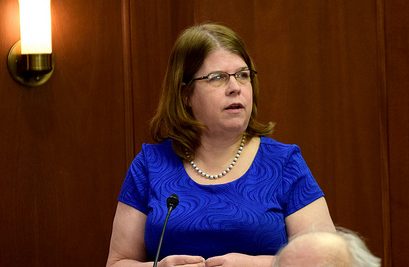
Rep. Tammie Wilson, R-North Pole, addresses the Alaska House of Representatives, April 8, 2015. She is calling for an investigation into the Office of Children’s Services. (Photo by Skip Gray/360 North)State Representative Tammie Wilson of North Pole continues to press for reform of the State Office of Children’s Services. Wilson cited a 30 percent growth in the number of reportedly endangered kids being removed from parents in recent years, and some constituents unhappy with how the system has treated them.
Wilson wants the Office of Children’s Services to refocus on parental treatment and assistance, instead of removing kids from homes. Wilson has resubmitted a bill that would adopt a uniform standard for when and how children can be removed, based on federal law.
”And that would be the Indian Child Welfare Act,” Wilson said.
Wilson said the federal ICWA standard, which currently only applies to Alaska Native and American Indian children, is a better formula for addressing parental behavior, and keeping kids home or with extended family.
”It also doesn’t allow as much hearsay as it does now,” Wilson said. “You actually have to have proof that something is happening within the family unit. And it also encourages more of keeping the child in the home and putting the resources there – working with the parents versus taking the children out. ICWA is largely known as the gold standard when it comes to best practices.”
Alaska OCS Director Christy Lawton said the department is officially neutral on Wilson’s bill, but acknowledged that ICWA policy mandates beneficial services.
”We have to demonstrate that we’ve provided active efforts to prevent removal or active efforts to promote reunification,” Lawton said.
That means actually taking family members to substance abuse treatment, counseling or other help, not just recommending they get it. Lawton said it would be great to do that for all families, but notes ICWA was established to address systematic racism.
”It’s almost as if you’re saying that ICWA isn’t really needed anymore because the playing field is level, which unfortunately is still not the case in Alaska, or in many other parts of the country,” Lawton said.
Lawton also pointed to potential loss of federal support for cases involving Alaska Native families, funds contingent on meeting strict ICWA requirements the financially strapped state may struggle to achieve if applied in all child welfare cases. Representative Wilson maintained the state has enough money and just needs to do a better job.
"My aspect is if we weren’t taking children that we should not be taking, we would be able to use the resources into families that really do need those resources,” Wilson said. “Cause, it’s much cheaper and it’s better for the family to be able to keep the children in the home. And then if you need the parents to do certain types of classes, then you have those worked out at the same time”
Wilson’s take is based on case records obtained through constituents critical of OCS practices. Wilson is awaiting response from the State Department of Law on a request for a grand jury investigation of OCS, and is holding three public hearings on the agency in coming weeks. OCS Director Lawton said she’ll continue to work with Wilson to improve agency practices.
UPDATE Submitted by mbowen on 01/20/2017
The state office of children's services is being investigated. State Representative Tammie Wilson said last week that she had requested a grand jury investigation, but had heard nothing back from the state. The Department of Law now says that recommendations from a grand jury have been unsealed, and will be looked at by the Alaska citizen review panel and the state ombudsman. The Citizen Review Panel meets four times a year, and its next meeting is in March. Representative Wilson, who started the process that led to the investigation, has also introduced legislation concerning the office of children's services: "We have draft legislation to see what's going on with OCS by bringing the standards up. We have the Indian Child Welfare Act right now for Native children, not for those other children. We've got to make sure that the higher standards are for everyone. The facts are [that] we're taking more children out of the homes, and parents never get their children back. That's just wrong."
T he Métis National Council and the Government of Canada will be working collaboratively, Nation-to-Nation, to develop a process to engag...
To Veronica Brown
Veronica, we adult adoptees are thinking of you today and every day. We will be here when you need us. Your journey in the adopted life has begun, nothing can revoke that now, the damage cannot be undone. Be courageous, you have what no adoptee before you has had; a strong group of adult adoptees who know your story, who are behind you and will always be so.
OUR HISTORY
BOOK 5: Lost Children of the Indian Adoption Projects