This blog was a backup for American Indian Adopteesblog
USE THE SEARCH BAR or SEARCH TOPICS at bottom of this blog
If you need support
Support Info: If you are a Survivor and need emotional support, a national crisis line is available 24 hours a day, seven days a week: Residential School Survivor Support Line: 1-866-925-4419. Additional Health Support Information: Emotional, cultural, and professional support services are also available to Survivors and their families through the Indian Residential Schools Resolution Health Support Program. Services can be accessed on an individual, family, or group basis.” These & regional support phone numbers are found at https://nctr.ca/contact/survivors/ .
MY EMAIL: tracelara@pm.me
Search This Blog
Showing posts with label cultural genocide. Show all posts
Showing posts with label cultural genocide. Show all posts
Going Home: How the land back movement is reclaiming ancestral lands.
The Land Back movement reflects the global efforts of Indigenous people
to reclaim ancestral territories and sovereignty over public lands.
Through a combination of military force, broken treaties, and
discriminatory policies, Native communities have been stripped of 99% of
their historical land base in the U.S., reduced from nearly 2.3 billion
acres to just 56 million acres today. Here are some ways this has been
codified in state and federal policy:
The Indian Removal Act of 1830
led to the forced relocation of southeastern tribes like the Cherokee,
Muscogee (Creek), Seminole, Chickasaw, and Choctaw Nations along the
brutal Trail of Tears, where thousands died during the journey westward.
In the Great Plains, the U.S. government repeatedly violated treaties like the Fort Laramie Treaty of 1868, seizing the Black Hills from the Great Sioux Nation after gold was discovered.
The Dawes Act of 1887
dispossessed tribes by breaking up communally held reservation lands
into individual allotments, many of which were then sold to non-Native
settlers.
Military campaigns and massacres, like the Sand Creek Massacre of 1864
where U.S. troops killed hundreds of peaceful Cheyenne and Arapaho
people, were used to terrorize Indigenous communities and drive them
onto increasingly smaller reservations.
The California Gold Rush led to state-sponsored genocide
of Native peoples, with the state paying bounties for Indian scalps and
heads in the 1850s and forcing survivors onto small rancherias.
Unlike what some might assume, the movement doesn't seek to displace
current residents from their homes. Instead, it focuses on returning
decision-making power to Indigenous communities and addressing the
historical injustices of colonization that led to their dispossession.
Here are four examples of what land back work looks like in action:
In 2020, the Esselen Tribe regained 1,200 acres
of their ancestral homeland in Big Sur, California, after 250 years of
displacement. Through a $4.5 million grant and partnership with Western
Rivers Conservancy, the land, which includes sacred sites and endangered
species, is now being used for traditional ceremonies and ecological
conservation.
The Bois Forte Band of the Minnesota Chippewa Tribe, in partnership
with The Conservation Fund, the Indian Land Tenure Foundation and the
Indian Land Capital Company, purchased 28,089 acres of ancestral land
within the Nett Lake and Deer Creek sections of the Bois Forte
Reservation.
The Confederated Salish and Kootenai Tribes (CSKT) regained control
of the National Bison Range in Montana in 2020. This 18,800-acre
wildlife refuge, which was taken from them in 1908, is being used for
bison conservation efforts while expanding public education about their
cultural connections to the land.
In Maine, the Penobscot Nation has worked with conservation groups to reclaim over 100,000 acres
of their ancestral territory along the Penobscot River since 2000,
helping restore both tribal sovereignty and the river's ecological
health, including critical salmon habitats.
In South Dakota, the Rosebud Sioux Tribe reacquired 28,000 acres of land
in 2020. This prairie land is now being used for buffalo conservation,
food sovereignty initiatives, and teaching traditional land management
practices to tribal youth.
Indigenous communities’ approach to land stewardship goes beyond simple
ownership, emphasizing a deep, complex relationship with the
environment. As tribes reclaim more of their ancestral lands, they're
leading innovative climate adaptation efforts and restoration projects,
demonstrating how traditional Indigenous knowledge can help create a
more sustainable future.
Support the work of NDN Collective,
an Indigenous-led organization dedicated to building Indigenous power
through organizing, activism, philanthropy, grantmaking,
capacity-building and narrative change. You can make a donation or follow the action items for their specific initiatives.
Learn whose ancestral land you live onand
pay real estate taxes to those Indigenous nations. Many tribes and
Indigenous organizations have established voluntary land tax programs
where residents can contribute a portion of their income or property
value to support Indigenous land reclamation efforts, like the Shuumi Land Trust in the East Bay of Northern California.
Support Indigenous-led land conservation efforts
and organizations working to protect sacred sites and expand tribal
land holdings. This could mean donating to Indigenous land trusts,
advocating for the return of public lands to tribal management, or
backing specific land return campaigns.
Call on your local, state and federal representatives to honor treaties, expand tribal sovereignty, and return public lands to tribal nations.
The latest on the Land Back movement, in which Native American tribes reclaim land. Two reporters take a look at where it’s worked and where it hasn’t at reservations in Minnesota. NPR >
The Land Back movement is also about foodways.
When Native peoples' land was stolen, they lost important hunting and
fishing grounds and myriad places to gather and prepare food. Civil Eats >
Tribal lands were stolen. What happens when those ancestral territories are returned? The Land Back movement is long-overdue justice. It’s also a climate solution. Vox >
The Land Back Movement Unravels Manifest Destiny. Across Indian Country, tribal nations are buying back their land one parcel at a time. Sierra Club >
On Vancouver Island, Land Back Looks Like Going Home.
Indigenous-led land back efforts are underway on Canada’s Vancouver
Island while the land’s original stewards protect forests from logging. Atmos >
Land
Rematriation: A Conversation with Cyndi Suarez, Donald Soctomah, Darren
Ranco, Mali Obomsawin, Gabriela Alcalde, and Kate Dempsey. Kate
Dempsey, state director of The Nature Conservancy in Maine, discuss the
future of Tribal sovereignty, Land Back, and rematriation of the planet.
NPQ >
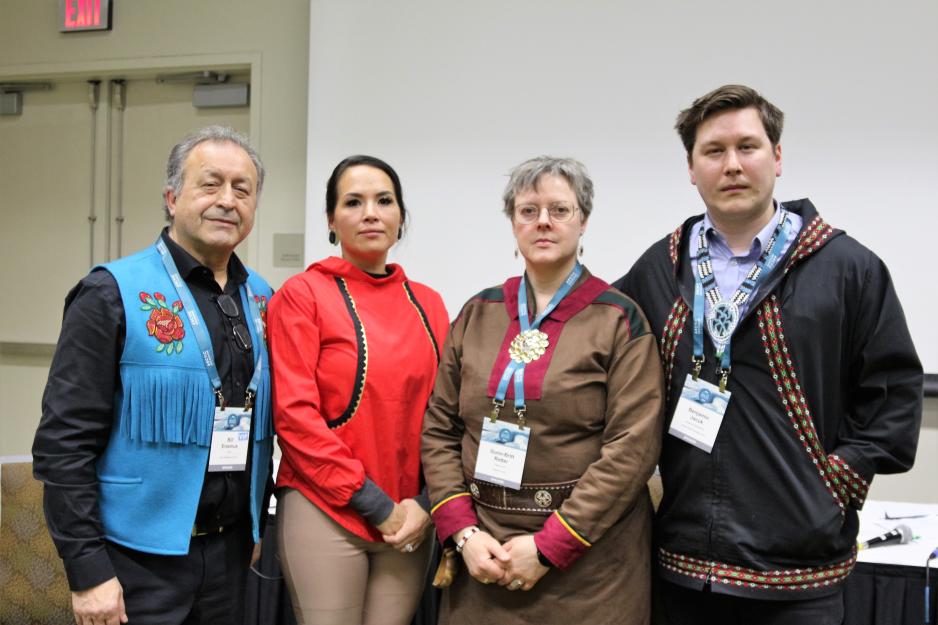
"They always go for our babies." -Emily Edenshaw, President & CEO at Alaska Native Heritage Center
Chief Bill Erasmus, Emily Edenshaw, at the Alaska Native Heritage Center, Gunn-Britt Retter at the Saami Council and Benjamin Jacuk at the Alaska Native Heritage Center. (Photo: Trine Jonassen)
Anchorage Alaska (High North News):
He admitted that this was genocide. -Chief Bill Erasmus
Most Arctic nations have been affected by assimilating and oppressive boarding school policies. Now indigenous community leaders are looking for healing as they brace for the dark truth of a government-led genocide.
Ground zero
The boarding school practice started in Alaska in 1879, 12 years after the USA purchased the Arctic state from Russia without consulting the indigenous population.
Maybe that is also where the healing has to start.
"Alaska may be ground zero for all of this. But ground zero can also be the place of healing for indigenous peoples from all over the world," Jacuk concludes.
In 2015 the Truth and Reconciliation Commission of Canada concluded what happened was "cultural genocide". It identified more than 3,000 children who died from disease due to overcrowding, malnutrition, and poor sanitation or died after being abused or trying to run away.
Most schools had their own cemeteries, and sometimes when children died, their parents were never informed.
By Trace L. Hentz, Blog Editor and Adoptee (video editor from 2014)
I have been rereading TWO WORLDS: Lost Children of the Indian Adoption Projects (second edition). It's first person accounts of adoptions by non-Native parents and our history.
What was life like pre-ICWA?
Can we please look at the impact of closed adoptions through the eyes of the adoptee-adult? We are called the Stolen Generation, remember that.
The word often used about being adopted is “cultural genocide and culture loss.”
If we lose ICWA, we go back to that earlier form of genocide: Less Indians on the rolls, less people on the rez, and the adoptee will lose years of ancestral knowledge and history and language we would have received from our relatives. (There are very few adoptees back on their rez.)
This cultural knowledge is not found in books. It’s learned at a kitchen table, in the kitchen cooking, hunting or gathering with your parents, at a beading circle, at a memorial/funeral, or at a social gathering like a powwow, on in ceremony. It’s learned walking the land. It’s learned hearing your grandparents tell stories. It’s learned over years of contact, contact with your people, your clan, your cousins, your tribal nations.
That knowledge is your inherent sovereign right as a sovereign citizen of your TRIBAL NATION, that lies within the boundaries of America or Canada.
Babies and children adopted by non-Natives, this ancient ancestral knowledge and language is gone, erased. Your tribal history is gone.
YOU ARE GONE.
Do you think the Supreme Court knows anything about this cultural genocide? Do you think they know about 1,000 Indian Wars? No treaty went unbroken. Do you think it matters to them what happened 100 years ago, or since ICWA was passed in 1978 to stop the adoption industry and the united states funding child trafficking?
Do adoptive parents know about cultural loss? What do they plan to do when the child asks about their tribe, or their parents, or their history, or their language?
“What is my language,” a child might ask. “Where are my people?”
If We Lost ICWA?
Think about Arnold Lyslo who ran the Indian Adoption Projects in America. He was busy selling his story ideas to magazines so white readers would feel sympathy and want to help. He counted his successes in how many Indian children were placed with white families. (Success? Erased: off the rez, off the rolls.)
It was the perfect storm. The adopters were not told there was a massive inter-country genocidal project going on. They just thought: “Hey, were doing a good thing (adopting a Native kid.)”
How many of these adoptions failed? (I wanted to know that. I asked adoptees to write their stories in the anthologies Two Worlds, Called Home and Stolen Generations.) I sent a bunch of questions to each adoptee.
How many adoptees committed suicide? We don’t know.
How many adoptees acted out and were sent to prison? Too many actually, quite a few I heard about.
Nobody wants Indians to have anything – especially good-sized populations – that would not work for the people who make sure “Indians stay poor.”
What happens if ICWA fails, and adoption goes widespread again and there is some new method of closed adoptions, like the earlier INDIAN ADOPTION PROJECT(s), or ARENA? What if they open new boarding schools and force Indian children to attend? The governments of Canada and America funded them, gave the churches money to take Indian kids, some literally abducted off the rez at gunpoint?
To be continued
If you cannot afford to buy the book Two Worlds, please email Trace (tracelara@pm.me)
For as long as I can remember, my father, uncles and grandfather — who immigrated to Canada from Italy 55 years ago — have spent weeks away hunting moose, deer, turkey, rabbits, and if you consider fishing hunting, they do that, too.
I’ve thought about joining them on hunts for years — heading to Bass Pro to deck myself out in hunting gear, sitting with them in tree stands in the bush and scoping out a deer or moose to bring back to my grandfather’s house to process after a week or so of outdoor living in their trailer. Usually, the hides would be chopped into bits and discarded in the compost while they masterfully sliced the meat into different cuts.
But as someone who is not keen on sharing close quarters with men in the trailer, and whose understanding of Italian is dismal, I’m starting another tradition this year: I asked them to save me the skins to transform into usable leather — something long practised by generations of my mother’s side of the family who are Anishinaabe.
I gave themspecific instructions to remove as much of the flesh as they could, and to save me the brain and legs — the brain to soften the hide, the legs to make tools with if my experience permits.
In May, I spent a week at Niizh Manidook Hide Camp — a Two Spirit hide-tanning camp in aptly-named ‘Bucktown,’ or Delaware Nation at Moraviantown in southwestern Ontario. The goal wasto learn and reclaim traditional hide-tanning techniques lost in my family through the ‘60s Scoop and residential schools.
I grew up and continue to live two hours from my community of Chippewas of the Thames First Nation, and as the first generation in my immediate family not to be raised to feel ashamed of being Anishinaabe, the importance of reclaiming these practices is not lost on me.
I wouldn’t have known about the camp had it not been for my friend Kierstin Williams, an Anishinaabekwe herself from Garden River First Nation and Batchewana First Nation, up north in Sault Ste. Marie — “Moose Country,” as a mug in her apartment refers to it.
“Want to go to a camp to tan hides?” she asked me earlier this spring. “I’m in,” I replied, still unsure of what a hide camp actually entailed, but I was excited to learn once we got there.
I packed camping gear, drawing inspiration from my dad’s pre-hunt shops, picking up a fisherman’s hat from Canadian Tire just in case. And while I didn’t make that trip to Bass Pro, I did make one to Walmart’s men’s section to stockpile T-shirts I wouldn’t mind ruining.
As I prepared for the trip, I was filled with self-doubt. I feared I wouldn’t belong amongst the group and questioned why the hosts, Beze Gray and Hunter Cassag, both experienced hide-tanners, artists and advocates — with Gray being one of a group suing the provincial government over climate change — approved my application.
“Surely they didn’t mean to accept me,” I thought.
Really, it was a projection of me not always accepting myself.
Fletcher and Singel’s paper, “Lawyering the Indian Child Welfare Act,” has been published in the Michigan Law Review. We’re honored to be part of a symposium on civil rights lawyering!
Our abstract:
This Article describes how the statutory structure of child welfare laws enables lawyers and courts to exploit deep-seated stereotypes about American Indian people rooted in systemic racism to undermine the enforcement of the rights of Indian families and tribes. Even when Indian custodians and tribes are able to protect their rights in court, their adversaries use those same advantages on appeal to attack the constitutional validity of the law. The primary goal of this Article is to help expose those structural issues and the ethically troublesome practices of adoption attorneys as the most important Indian Child Welfare Act (ICWA) case in history, Brackeen v. Haaland, reaches the Supreme Court.
“I feel shame and pain. I ask forgiveness of God,” Pope Francis said on Friday as he apologized for the “deplorable” abuses of Canada’s First Nations children.
Between the 1880s and the 1990s, the government ran a system of compulsory boarding schools which a National Truth and Reconciliation Commission (TRC) recently dubbed ‘cultural genocide’,” The New York Times reported. The Catholic church operated about 70 percent of those schools, where about 150,000 children were placed and “where abuse, both physical and sexual, was widespread, along with neglect and disease,” The Times said. A former judge, Murray Sinclair, who headed the commission, estimated that at least 6,000 children went missing.
The TRC, established as part of a government apology and settlement over the schools, concluded that at least 4,100 students died from mistreatment, neglect, disease or accident. The Tk’emlups te Secwepemc First Nation in British Columbia, using ground penetrating radar, discovered the remains of 215 of them buried near the Kamloops Indian Residential School which opened in 1890 and closed in the late 1970s, The Times reported. “It’s a harsh reality and it’s our truth, it’s our history,” Chief Rosanne Casimir told a news conference.
Children were also placed with non-Native families, a policy which Ontario Superior Court Justice Edward Belobaba denounced as he ruled in a class action lawsuit, The Guardian reported. “There is … no dispute that great harm was done,” Belobaba wrote. “The ‘scooped’ children lost contact with their families. They lost their aboriginal language, culture and identity. Neither the children nor their foster or adoptive parents were given information about the children’s aboriginal heritage or about the various educational and other benefits that they were entitled to receive. The removed children vanished ‘scarcely without a trace’.”
In Australia, Kevin Rudd, as prime minister, apologized in 2008 for this "great stain on our nation’s soul." He was referring to more than 100,000 Aboriginal and Torres Strait Islander children being placed in institutions or foster homes or adopted by nonIndigenous families between 1900 and 1970.
New Zealand tried to “civilize” Māori children, starting in 1840. “Boarding schools initially taught in the Māori language but soon qualified for subsidies only if lessons were in English. By 1960, only 26 percent of children could still speak their native language,” the Toronto Globe and Mail reported.
Denmark’s Prime Minister Mette Frederiksen apologized for the treatment of 22 Inuit children from Greenland, then a Danish colony, more than 70 years ago, Agence France Press reported. Frederiksen told the six survivors at a ceremony in the Danish capital Copenhagen, “What you were subjected to was terrible. It was inhumane. It was unfair. And it was heartless.”
Norway, Sweden and Finland are supporting initiatives to protect the culture of the Sami people living in Sápmi — formerly Lapland — following efforts to force them to culturally assimilate, The Guardian reported.
In the United States, the Trump administration’s seizing of 2,300 refugee children from their parents recalled a history of African and Indigenous family separation. The Washington Post recalled this tweet from the African American Research Collaborative: “Official US policy. Until 1865, rip African American children from their parents. From 1870s to 1970s, rip Native American children from their parents. Now, rip children of immigrants and refugees from their parents.” The Post drew attention to “The Weeping Time” exhibit at the Smithsonian’s National Museum of African American History and Culture documenting the story of children sold away from their enslaved families.
The government sent thousands of Indigenous children to government or government-funded, church-run “Indian schools” between the 1800s and the 1970s. Richard Pratt, who founded the first one, the Carlisle Indian School in Pennsylvania on Nov. 1, 1879, described his philosophy as: “All the Indian there is in the race should be dead. Kill the Indian in him and save the man.”
“While the government believed a white youth’s ‘moral character and habits are already formed and welldefined, when he leaves for school, a Indigenous youth was thought to be ‘born a savage and raised in an atmosphere of superstition and ignorance’,” The Equal Justice Initiative reported. “The government believed that ‘if [an Indigenous child] is to rise from his low estate the germs of a nobler existence must be implanted in him and cultivated.’”
As the boarding schools began closing, the government launched the Indian Adoption Project to promote European American adoption of Indigenous children, Vox reported. “The data showed that 25 to 35 percent of Native children around the country were being taken from their homes, and that 85 to 95 percent of those kids ended up in non-Native homes or institutions,” Vox stated.
Elizabeth Williams, who had been sold twice since she last saw her children, placed an ad in the Christian Recorder newspaper in Philadelphia in 1866 to try to locate them, The Post said. And Sandy White Hawk, a Sicangu Lakota adoptee from the Rosebud Reservation in South Dakota, founded the First Nations Repatriation Institute to help adoptees reunite with their tribes and families.
WGBH noted in a 2015 documentary that Maine had set up its own TRC – an approach which South Africa started in 1995 to try to forge unity after apartheid ended. The commission heard Indigenous testimony such as this: “All we did was beg for our foster mothers to hug us and say they loved us. My baby sister and I sat in a tub of bleach one time trying to convince each other that we’re getting white.”
The struggle continues with a federal lawsuit challenging as racially discriminatory the 1978 Indian Child Welfare Act (ICWA), which deals with child separation, filed by a European American couple in Texas, joined by their state, Indiana and Louisiana. The National Indian Child Welfare Association says the law addresses a crisis affecting Indigenous children, families and tribes. Invalidating the ICWA, its supporters say, would have far-reaching consequences for Indigenous peoples, including the issue of tribal sovereignty.
Pratt’s racism and White Hawk’s lament notwithstanding, it is hard to miss the defiance in the song “Drums” written by Peter LaFarge which Johhny Cash sang 58 years ago:
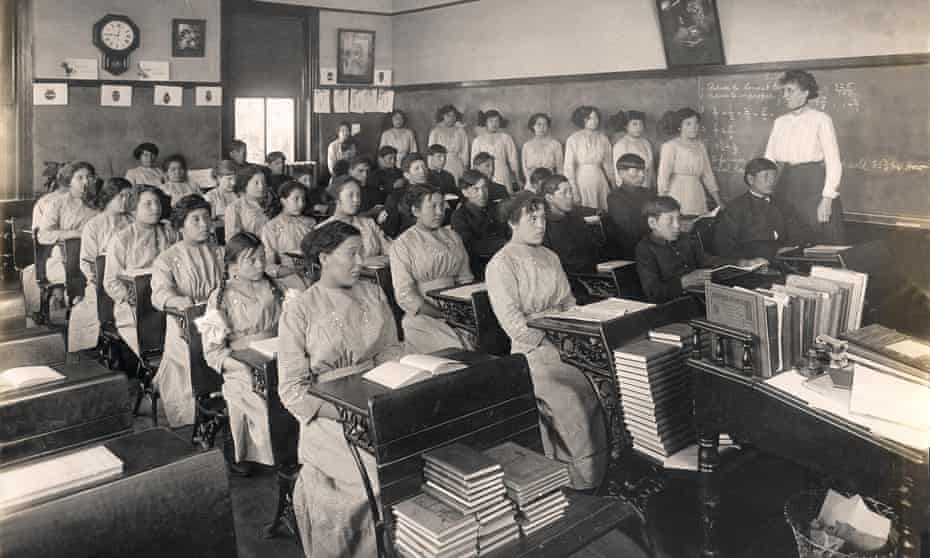
In this 1910s photo provided by the United Church of Canada Archives, students write on a chalkboard at the Red Deer Indian Industrial School in Alberta. In Canada, where more than 150,000 Indigenous children attended residential schools over more than a century, a National Truth and Reconciliation Commission identified 3,201 deaths amid poor conditions. (Credit: United Church of Canada Archives via AP.)
ROME – A group of Canadian indigenous persons traveling to Rome to meet the pope this month said they will ask for an apology and an admission of guilt for the Catholic Church’s role in the “genocide” of their people, and that they’ll demand papal edicts endorsing colonization be rescinded.
A joint delegation of Canadian bishops and three different indigenous communities in Canada will travel to Rome March 28 – April 1, where they will hold both individual and group meetings with Pope Francis.
Among the indigenous communities are the Assembly of First Nations (AFN), the Métis National Council, and the Inuit Tapiriit Kanatami. Delegates include elders, “knowledge keepers,” residential school survivors, and youth.
It’s not a secret that I love studying history; I believe it is a vital discipline for understanding and transforming the world. And as shocking and terrifying as human cruelty has been throughout recorded history, it’s also heartening to observe, time and time again, the movements opposing oppression that have always existed. This is also important to remember if you are tempted to excuse the complicity of people in the past by insisting that they were just products of their time. By studying history, we also become more aware of our own responsibilities and possibilities in the present.
A Legacy of Failure, Cruelty, and War
One of these important historical moments in US history, when there were multiple and large movements to either oppose or work for social justice, followed the American Civil War.
Optimism that Reconstruction would bring about true and lasting healing and change in a nation ravaged and traumatized by the horrors of slavery and war, were combined with optimism that there could be a change in the government’s policies regarding Native peoples.
President Ulysses S. Grant and the events that took place in his administration are a good example of these trends. The Enforcement Acts of 1870 and 1871, for example, were aimed at providing federal support to protect the rights of Black Americans and oppose the Ku Klux Klan. Under the direction of Attorney General Amos Ackerman, hundreds of Klansmen were tried, often by Black juries, and imprisoned. Thousands more received fines or warnings, or even fled to escape prosecution. As a result, the KKK as a formal organization was in wreckage by 1872.
Optimism that Reconstruction would bring about healing were combined with optimism that there could be a change in the government’s policies regarding Native peoples.
At the same time, Grant wanted to find a different approach to US relations with Native peoples. He worked closely with his longtime friend and colleague, Ely S. Parker, and made Parker his Commissioner of Indian Affairs. Parker, whose Native name was Donehogawa, was a member of the Seneca nation and the first Indigenous person to hold the post of Commissioner. Together, they developed policies that included providing federal troops to protect reservation borders from settlers and that ultimately would have provided a pathway to citizenship for Indigenous people.
These plans were vehemently opposed and undermined, and opponents eventually falsely accused Parker of embezzling money. He was exonerated, but Congress stripped power from the office of Commissioner of Indian Affairs, and Parker resigned in 1871.
Plans and relationships fell apart, and Grant ended up waging war against the very people he had thought he would protect, including “the Modoc War in 1873, the Red River War in 1874, and the Great Sioux War in 1876.”
By 1885, the year Grant died, Donehogawa, once Grant’s enthusiastic colleague, described the fate of Indigenous peoples in North America. Resisting the racist idea that blamed Indigenous people for their troubles, he wrote:
“The disabilities, disadvantages and wrongs do not result, however, either primarily, consequently or ultimately from their tribal condition and native inheritances, but solely, wholly and absolutely from the unchristian treatment they have always received from Christian white people … . The tenacity with which the remnants of this people have adhered to their tribal organizations and religious traditions is all that has saved them thus far from inevitable extinguishment.”
Grant’s campaign slogan had been “Let us have peace,” and he seemed sincere in his vision to reform federal Indian policies. So how did it happen that, as Alysa Landry pointed out, “some of the worst massacres and grossest injustices in history [occurred] while Ulysses S. Grant was in office”? This is an important question to ask, if we want to avoid the kind of pitfalls that kept others’ from true healing and change.
In Grant’s case, central to his failures was “the development of millions of acres of federal public lands” and “the private acquisition of land by pioneers, spectators and railroad and mining companies,” made possible by Grant’s approval of the Timber Culture, General Mining, and Desert Lands Acts, which all expanded the land available to homesteaders and settlers – at the expense of Native peoples. In the end, Grant’s hopeful slogan, “Let us have peace,” was no match for the reality of expansionism. In Landry’s words,
“Grant realized that his expansionist goals required the removal of Indians from desirable land. His Indian Peace Policy, designed to reform the Indian Bureau and remove corrupt agents, also called for rigorous agricultural training on reservations and established schools and churches that would transform Indians into Christian citizens.”
Cultural Genocide by Another Name
This tension is the US setting for residential schools. Even though some people, like Grant and Donehogawa, wanted to promote and protect the rights of the Original Nations, that hope was always in second place to the relentless westward push of land-grabbing and violent displacement.
A cluster of ideas have especially supported and justified this kind of colonization. First, the dominating power believes in its own superiority. Members of this society, then, are entitled to rule and profit from that superiority, even if it comes at the expense of others.
This is especially the case when the people harmed are categorized as inferior. Moreover, because the dominating power believes in its superiority, it can reframe the harm it causes to others as ultimately in their best interest.
Those that survive will reap the benefits of being assimilated into the superior culture. It’s a tidy system that excused hundreds of years of oppression and continues to do so today.
The residential school emphasis on agricultural training, education, and conversion fits this pattern. But forced assimilation could only be viewed as moral and good from the vantage point of superiority.
Unfortunately, the settlers of North America never lacked that character trait. Captain Richard H. Pratt, who was a founder and superintendent of the infamous Carlisle Indian Industrial School in Pennsylvania, gave a speech in 1892 that showed how a person could justify even the most cruel actions under the guise of racist and paternalistic generosity and care. He began by stating that:
“A great general has said that the only good Indian is a dead one, and that high sanction of his destruction has been an enormous factor in promoting Indian massacres. In a sense, I agree with the sentiment, but only in this: that all the Indian there is in the race should be dead. Kill the Indian in him, and save the man.”
Amazingly and horrifyingly, Pratt would then use the enslavement of Africans as a positive example of how assimilation could work. Rather than recognize the courage, persistence, creativity, and love that marked Black resistance to slavery and its descendants, such as Jim Crow and mass incarceration, Pratt gave all the credit to the White people who enslaved them. In Pratt’s view, “the care and authority of individuals of the higher race” was a blessing in disguise.
“Horrible as were the experiences … of slavery itself, there was concealed in them the greatest blessing that ever came to the Negro race—seven millions of blacks from cannibalism in darkest Africa to citizenship in free and enlightened America … .” (ibid)
In contrast, Pratt saw the wars fought against Native peoples and concluded that forced assimilation was more effective. “We have never made any attempt to civilize them with the idea of taking them into the nation,” Pratt wrote, “and all of our policies have been against citizenizing and absorbing them.” Boarding schools were Pratt’s answer:
“It is a great mistake to think that the Indian is born an inevitable savage. He is born a blank, like all the rest of us. … Transfer the infant white to the savage surroundings, he will grow to possess a savage language, superstition, and habit. Transfer the savage-born infant to the surroundings of civilization, and he will grow to possess a civilized language and habit.” (ibid)
This is what White supremacy looks like, dressed up in schoolmaster’s robes. The unmistakable goal was to eliminate Indigenous nations, communities, customs, languages, and life.
School was operated by the federal government between 1884 and 1934 and was known for brutal punishments and hard labour
A fifth-grade class is seen at the Genoa US Indian Industrial School in Nebraska in 1910. Photograph: National Archives and Records Administration
Researchers say they have identified more than 100 students who died at a harsh residential school for Native Americans in Genoa, Nebraska. The search for the cemetery where many are believed to be buried continues.
The Genoa US Indian School was operated by the federal government between 1884 and 1934. Brutal punishments and hard labour were commonplace for students, large numbers of whom were removed from their families and homelands against their will, prohibited from speaking tribal languages and forced to convert to Christianity in an effort to subdue or eliminate Indian culture.
The names of 102 deceased students were gathered from sources including newspaper archives and school newsletters, according to the researchers who say official records were destroyed or scattered when the school closed.
While some names are likely to be duplicates, the death toll from the school which enrolled thousands from more than 40 tribal nations in its 50-year history is probably far higher, said Margaret Jacobs, professor of history at UNL and project co-director.
She said the names would be released after consultation with tribal leaders and after efforts to trace living relatives of the deceased were exhausted.
“These children died at the school,” Jacobs told the Omaha World-Herald. “They didn’t get a chance to go home. I think that the descendants deserve to know what happened to their ancestors.”
Some of the students, aged four to 22, died in accidents, by drowning or by shooting and in one case reportedly after being hit by a freight train. But most died from disease. Tuberculosis and pneumonia were rife in the federal Indian school system set up in the 1860s with the intention of educating tribal youth in the English language.
The system took a dark turn in 1879 when a US army brigadier general, Richard Henry Pratt, founded Pennsylvania’s Carlisle Indian Industrial School, the first off-reservation boarding school for Native Americans, with the motto: “Kill the Indian, save the man.”
In a harsh era, thousands of children were forced to leave their families and travel to schools in other states, to “remove them from tribal influences”. Many teachers forced students to speak only English, and many schools imposed military style rules. Braids were cut off and students given “white” names.
Some graduates said they benefited from the experience and educational opportunities they would not otherwise have received, but numerous other accounts record harsh discipline, abuse and exploitation, the Genoa project says.
One descendant claimed his great-grandmother was blinded while a student at Genoa, likely by having lye soap rubbed into her eyes as a punishment.
The search for the school’s cemetery is continuing in partnership with the Nebraska Commission on Indian Affairs and the state archaeology office. Maps from the 1920s marked a plot of the 640-acre campus where it was believed to exist but ground-penetrating radar has failed to find any graves, project leaders said.
“If we’re not able to find them, I think we need to do something to recognize that they lost their lives there,” Judi gaiashkibos, a citizen of the Ponca Tribe and the commission’s executive director, told the World-Herald.
The troubled legacy of Native American boarding schools became a focus of Joe Biden’s administration in June when the interior secretary, Deb Haaland, announced an investigation into “horrific assimilation policies”.
It followed the discovery of the graves of more than 200 children at an Indigenous residential school in Canada in May. In the US, Haaland, a Laguna Pueblo tribe member, said her maternal grandparents were among those forcibly removed, her grandfather to the Carlisle school.
“Many Americans may be alarmed to learn that the United States has a history of taking Native children from their families in an effort to eradicate our culture and erase us as a people,” Haaland wrote in an opinion piece in the Washington Post.
“It is a history that we must learn from if our country is to heal from this tragic era.”
The Federal Indian Boarding School Truth Initiative will investigate allegations of abuse and assist efforts to locate burial sites.
“I’m looking to see something good come out of this,” gaiashkibos said. “Perhaps we will find some way to restore language, to restore some of the culture that was stripped from us.
“Everyone needs to learn the stories and say, ‘America did this and we can do better’.” SOURCE
Editor Note: I have said this before in a non-fiction book I wrote in 2018. We are not supposed to know or care about Native People. It's obvious we have a century of bad history to rewrite and write right...
Why Do Native People Disappear From Textbooks After the 1890s?
Joshua Ward Jeffery, who is not Native, is an assistant professor of history and Diné studies at Navajo Technical University, a public, tribally-controlled university of the Navajo Nation in Chinle, Ariz., and the editor of H-High-S, a national online network of high school social studies educators, historians, social scientists, and K-12 teacher educators. He also is the academic coordinator for the Navajo Nation Police Academy.
OPINION
The current manufactured controversy over critical race theory in American schools that has been roiling parts of the nation this summer has exposed two truths: Most K-12 teachers do not teach CRT, but they absolutely should. And while anti-education conservatives claim that CRT teaches things like “race essentialism” and that all white people are racist, the academic framework does nothing of the sort.
What it does is demand that we compare our ideals about law, justice, and the way government works with the lived experience of racial and ethnic minorities within those systems.
CRT, then, examines how America actually is in comparison with how we think it ought to be. When applied to history, critical race theory demands that we examine the American reality instead of the American mythology that has often masqueraded as history in classrooms.
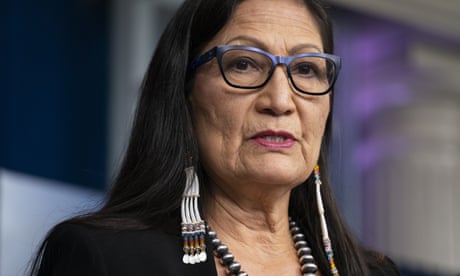
U.S. Secretary of the Interior Deb Haaland’s recent visit to the former site of the government-run Carlisle Indian School highlights some of that destructive American mythology. Haaland, an enrolled member of the Laguna Pueblo of New Mexico, is the first Native Cabinet secretary in U.S. history. Last month, Haaland visited the graveyard on the U.S. Army’s Carlisle Barracks in Pennsylvania during a ceremony to repatriate the disinterred remains of nine Rosebud Sioux children who died over a century ago at the school.
Historically, the United States committed itself to a policy of cultural genocide in the early part of the 19th century, and it created an education program for which Native children were removed from their parents—sometimes violently. The schools then compelled the children to give up their culture in favor of American norms, including by forcibly cutting students’ hair, replacing their names, prohibiting them from speaking their own language, and restricting their visits home. This boarding school period of Indian education continued until the passage of the Indian Child Welfare Act in 1978, a law aimed at preventing the forced removal of Native children from their families and tribes. Understandably, many Native people remain skeptical of educational systems designed and run by the federal government.
Further, because of the lack of funding, only a small percentage of Native students have access to important early-learning programs, meaning that Native students are already struggling to “play catch up” when they arrive in kindergarten. This early disadvantage could be ameliorated if Congress were to fund Head Start and similar programs on reservations at the same rate it does elsewhere.
In fact, many students are actually surprised to learn that Native peoples still exist."
In addition to present-day educational disparities, Native American history is neglected in most K-12 classrooms. In fact, many students are actually surprised to learn that Native peoples still exist. It is almost as if Gen. Richard H. Pratt, the founder of the Carlisle School, was successful in his attempt to “Kill the Indian, and save the man.” Many non-Native students assume Native people must have died off since they largely disappear from textbook narratives after the 1890s. (They also make up about 1 percent of the national student population, so it’s possible that many non-Native students might not have been exposed to their Native peers.)
Students do not learn that many Native people don’t have access to running water or electricity. They do not learn that the U.S. Supreme Court has limited how tribes can exercise their governmental power—such as police power—to serve and protect their citizens. They certainly do not learn about the inequalities in the educational system between predominantly white schools and those serving Native students. If they did, then they might question how we treat our Native neighbors.
Where I live on the Navajo Nation—which straddles Arizona, Utah, and New Mexico and is about the size of West Virginia—about a third of the population lives without running water or electricity. In 1936, when President Franklin D. Roosevelt created the Rural Electrification Administration, the program only offered electrification loans to states and counties, not to tribal governments. The result was that while most rural Americans quickly gained electricity in the next decade or so, many living on reservations did not.
Even before the pandemic, my college students told me stories about charging their laptops in their cars overnight and then traveling to the closest town for Wi-Fi to turn in their homework. These same students travel 20 miles to the closest gas station to get ice to keep food cold, which they cook on gas-powered camping stoves. They use outhouses. They drive several miles to windmill-powered water tanks. They drive 30 miles to the closest truck stop about once a week to take a shower. While this is difficult under normal circumstances, it is nearly impossible to overstate the burden that a lack of electricity and running water has created during the ongoing spread of COVID-19 on the reservation.
Like much of America, my neighbors also have urgent, albeit different, complaints about the police. The Navajo Police Department does not employ a single white officer, so racism in law enforcement on the reservation manifests itself in different ways from how it does in the rest of the country. Instead, Navajo people complain about a lack of police because of funding and the fact that the U.S. Supreme Court has limited the effect of tribal criminal jurisdiction on non-Native Americans. So, when someone on the Navajo Nation dials 911, there is a high probability that police will be unavailable for help. And, if officers are available, in most cases, they are limited in their ability to arrest and charge non-Native suspects for violations of tribal law.
Policymakers have good reason to protect the mythological narrative of America that their political power is rooted in. If American K-12 teachers used critical race theory to inform their social studies curriculum, students might learn the real truth about the country’s failures to live up to its own ideals.
T he Métis National Council and the Government of Canada will be working collaboratively, Nation-to-Nation, to develop a process to engag...
To Veronica Brown
Veronica, we adult adoptees are thinking of you today and every day. We will be here when you need us. Your journey in the adopted life has begun, nothing can revoke that now, the damage cannot be undone. Be courageous, you have what no adoptee before you has had; a strong group of adult adoptees who know your story, who are behind you and will always be so.
OUR HISTORY
BOOK 5: Lost Children of the Indian Adoption Projects





 edweek.org


