BACK UP BLOG (no longer updating)

This blog was a backup for American Indian Adoptees blog
USE THE SEARCH BAR or SEARCH TOPICS at bottom of this blog

If you need support

Support Info: If you are a Survivor and need emotional support, a national crisis line is available 24 hours a day, seven days a week: Residential School Survivor Support Line: 1-866-925-4419. Additional Health Support Information: Emotional, cultural, and professional support services are also available to Survivors and their families through the Indian Residential Schools Resolution Health Support Program. Services can be accessed on an individual, family, or group basis.” These & regional support phone numbers are found at https://nctr.ca/contact/survivors/ . MY EMAIL: tracelara@pm.me

Search This Blog

Showing posts with label Missionary Oblates of Mary Immaculate. Show all posts

Friday, July 9, 2021

Grave Digger Bishop and Architect of some Residential Schools (Canada)

 (written by historian Raymond Huel, Professor of history, University of Lethbridge, Alberta.)

Original title:  Mgr. Émile Legal, OMI, [1897-1920]. (OB3272 - Oblate Collection at the PAA)

Source: Link

LEGAL, ÉMILE-JOSEPH, Roman Catholic priest, Oblate of Mary Immaculate, and bishop; b. 9 Oct. 1849 in Saint-Jean-de-Boiseau, France, son of Julien Legal and Perrine David, millers; d. 10 March 1920 in Edmonton.

Émile-J. Legal studied at the petit and grand séminaires in Nantes, the Collège de Machecoul, and the Université de France. He was ordained on 29 June 1874 and served in the diocese of Nantes prior to entering the Oblate noviciate in Nancy in 1879. As a result of restrictive state legislation governing religious orders, he was sent to Lachine, Que., where he completed his probationary year and made his perpetual vows on 24 Sept. 1880. Before being posted to the Canadian northwest, he served in Plattsburgh, N.Y., Montreal, and Buffalo, N.Y., where he studied English.

Legal arrived in St Albert (Alta) in August 1881 and was sent to minister to the Peigan in October. He spent the winter of 1881–82 on the Peigan Indian Reserve and visited other Blackfoot camps in the summer months in addition to ministering to the needs of Catholics in nearby Fort Macleod. In 1886 Legal opened a small school on the Peigan reserve and, two years later, he organized missions among the Blood. In 1889 he founded Saint-François-Xavier mission at Stand Off on the Blood Indian Reserve. He succeeded in having the Department of Indian Affairs build a hospital there in 1893 and confided its administration to the Grey Nuns of Nicolet, Que.

In the mid 1890s the health of Bishop Vital-Justin Grandin* of St Albert was causing concern among the clergy of the diocese, who believed that the appointment of a coadjutor was crucial. Legal’s candidacy had been suggested earlier by Father Albert Lacombe. On 29 March 1897 Legal was named titular bishop of Pogla and coadjutor of St Albert. He received the news of his nomination on 6 May, shortly after having personally buried a young resident of the Blood reserve, and thus the influential La Croix (Paris) referred to him as “the grave-digger bishop.” He was consecrated in St Albert on 17 June 1897 and chose as his episcopal motto Nos autem in nomine Domini (“As for us, we speak in the name of the Lord”). The Blackfoot named him Sspomitapi, meaning “he who sits on high.” Upon the death of Grandin on 3 June 1902, Legal became bishop of St Albert; he was made archbishop of Edmonton on 30 Nov. 1912.

As both missionary and prelate, Legal demonstrated remarkable intellectual and creative talents. He designed and constructed many buildings while serving in the Blood and Peigan missions. As bishop, he drew plans for numerous churches and carefully scrutinized those that were submitted by parish priests. He designed residential schools at Brocket, Stand Off, Blackfoot Crossing, and Saint-Paul-des-Métis (St Paul). He also marked out construction sites, purchased materials, and obtained the necessary authorizations to build. His plans for the cathedral in St Albert combined Gothic, neo-Roman, neo-Baroque, and Moorish styles. Construction began in 1902 but Legal had to modify his design to reduce costs in view of local economic conditions. With the creation of the archdiocese of Edmonton in 1912 and the subsequent transfer of the episcopal seat to that city in 1917, a cathedral in St Albert was no longer necessary and Legal turned his attention to constructing one in Edmonton.

Legal’s creative activities found expression as well in numerous studies of the traditions and customs of the Blackfoot and their language, including articles published in Les Missions catholiques (Lyon), the Catholic encyclopedia (New York), and the Bulletin of the Société de Géographie de Paris. He also collaborated with Lacombe in the preparation of a Blackfoot, Blood, and Peigan vocabulary. In addition, he undertook geological studies and corresponded with the Smithsonian Institution. He was awarded an lld honoris causa by the University of Alberta in 1915.

Upon being named coadjutor in 1897, Legal had assumed responsibility for the expansion of the diocese of St Albert, especially the creation of new parishes and institutions to serve a rapidly growing immigrant population. These activities he later recalled in Short sketches of the history of the Catholic churches and missions in central Alberta. As bishop, Legal also concerned himself with the status of Catholic schools in his diocese and he communicated with federal and territorial officials. 

In 1904, prior to the creation of the provinces of Alberta and Saskatchewan, he was asked by the apostolic delegate, Donato Sbarretti y Tazza, to prepare a draft clause for the Autonomy Bills safeguarding the principle of denominational schools in the new jurisdictions. Legal felt that the compromise clause negotiated between the apostolic delegate and Prime Minister Sir Wilfrid Laurier was inadequate: although it conferred separate-school privileges on the religious minority in any district, it did not define precisely the school system that was to be established. Nevertheless, since the apostolic delegate approved of it, Legal believed that it had to be upheld. In February 1905 Legal was interviewed for the newspaper United Canada (Ottawa). He expressed his hope that separate schools would be maintained and that Catholics would take action to support them. The published version, however, indicated that Legal was satisfied with the educational clause of the bills, and this allegation outraged other members of the hierarchy such as Archbishop Adélard Langevin of St Boniface. Undoubtedly the bishops did not appreciate Legal giving an interview to a non-Catholic paper on such a delicate issue. They were, moreover, anxious to present a united front.

In the last years of Legal’s life his fellow French-speaking prelates were concerned over his succession. With the appointment of an English-speaking bishop, John Thomas McNally*, in Calgary in 1913 and the creation of the archdiocese of Winnipeg out of the archdiocese of St Boniface in 1915, ethnic rivalries had become a matter of fact in western episcopal nominations. Despite his declining health – he was a diabetic – Legal had not secured the appointment of a coadjutor and, in 1920, there were fears that Rome rather than the bishop himself would choose a successor or that it would appoint an English-speaking auxiliary. Legal died on 10 March 1920 and both French- and English-speaking factions of the hierarchy made representations to Rome on behalf of appropriate candidates. The appointment of Henry Joseph O’Leary* as archbishop of Edmonton in September seriously undermined the domination of the French element in the western sees.

WRITTEN BY Raymond Huel

Legal’s compilation of Short sketches of the history of the Catholic churches and missions in central Alberta was published in Winnipeg around 1914. Archival material concerning the subject is found in the collections of the Arch. Deschâtelets, Oblats de Marie-Immaculée (Ottawa), the Arch. Générales des Oblats de Marie-Immaculée (Rome), the Arch. des Oblats de Marie-Immaculée (Montreal), the Arch. de la Prov. Grandin (St Albert, Alta), and the Arch. of the Oblates of Mary Immaculate, Prov. of Alberta-Saskatchewan, held at the PAA.

Gilles Cadrin, “Émile Legal: de l’architecture des missions à l’architecture monumentale,” in Western Oblate Studies 2: proceedings of the second symposium on the history of the Oblates in western and northern Canada . . . , ed. R. [-J.-A.] Huel with Guy Lacombe (Lewiston, N.Y., 1992), 237–19. Gaston Carrière, Dictionnaire biographique des oblats de Marie-lmmaculée au Canada (4v., Ottawa, 1976-89). R.[-J.-A.] Huel, “The Irish French conflict in Catholic episcopal nominations: the western sees and the struggle for domination within the church,” CCHA, Study sessions, 42 (1975): 51–70. 

BIOGRAPHY

Tuesday, June 29, 2021

Intergenerational Trauma | Hitler | Whitewashing our history | Churches Burning

 Woke to the Truth

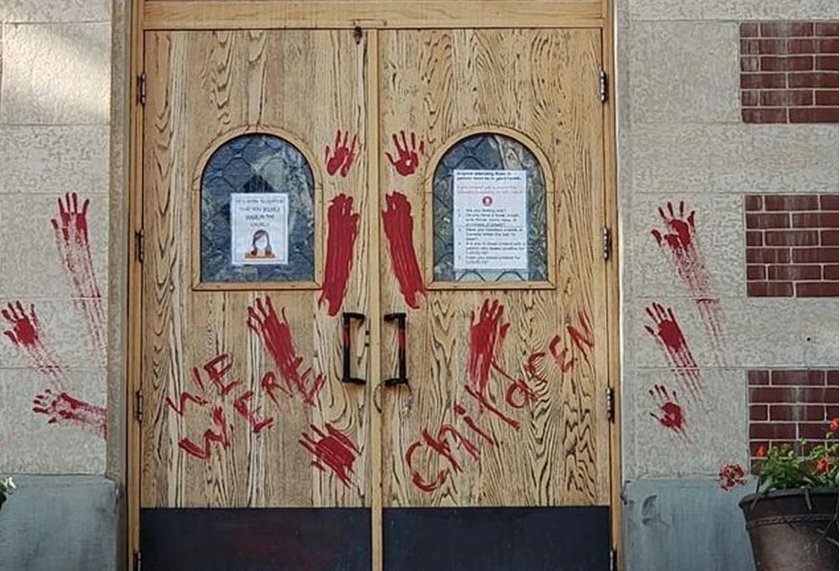
The doors of a Catholic church in Canada were marked with red paint on June 24 after the announcement from Cowessess First Nation that up to 751 unmarked graves graves had been identified near the former Marieval Residential School. (Photo/Facebook – Donna Heimbecker)


While the emerging stories about Indian residential school cemeteries in Canada are shocking to many, they are not to many Native Americans and First Nation citizens. 

When I wrote my master’s thesis for my first master’s degree in public administration 30 years ago in 1991, it was focused on federal Indian policy. It focused all of the Indian policy periods throughout U.S. history. 

Included in the various periods was the Indian boarding school era. It was by far the hardest part of my thesis. Because I was interested in understanding this fully, I read all kinds of accounts of the experience lived from individuals who were part of this dark chapter in history. It took me two and a half years to write my thesis because it was heartbreaking to delve deep into the boarding school experience.

One of the most psychologically challenging accounts to read was how the missionaries used wooden blocks to stop Indian children from speaking their language. Some of the Indian boys and girls were told their parents had died so they wouldn’t try to escape the boarding school. When these children tried to mourn their parents because they believed they had died, the missionaries prohibited them from exercising their traditional funeral rituals.

Many American Indian boarding schools have their own cemeteries. Could you imagine sending your child off to a boarding school today if they had a graveyard in the backyard? 

For all of those counterculture people or those who claim that critical race theory should not be taught, they are on the side of whitewashing American history. In psychology and sociology there is a term called cognitive dissonance. Those terms as well as the concept of collective denial, is why we don’t learn about these facts in American history.

Most aspects of American Indian history are not taught in schools. Certainly, the Indian boarding school era is not part of the curriculum.

Did you know U.S. Japanese internment camps were modeled after the first Indian reservation experience?

Did you know that germ warfare and ethnocide was born in American Indian history?

Did you know the concept of Indian blood quantum, the amount of Indian blood you have, initially a system the federal government placed on tribes in an effort to limit their citizenship, was created to under count and eventually eradicate the American Indian population?

Did you know that Hitler modeled the Jewish concentration camps after the American practice of concentrating American Indians onto a reservation and introducing disease by gifting Tribes with smallpox infected blankets?

Each of these experiences of genocide at the hands of the American government over the generations explains what is called historical and intergenerational trauma. This explains in large part why tribal governments are sometimes openly hostile towards their own people. It also explains why American Indians have the worst of the worst statistical outcomes on every dimension. This includes the lowest high school graduation rate, the highest rates of suicide, the highest rates of drug and alcohol addiction, the highest rates of unemployment. 

Whitewashing our history and these facts is intended to suggest there is something inferior about American Indians. That we are intellectually inferior to other races. Early scholars in anthropology wrote about our ancestors as if they were less than human and not civilized. We didn’t even have the right to vote until 1924. We were the last of Americans to be granted this right. Our religious practices were illegal until 1978. Our children were stolen from our families until the Indian Child Welfare Act was passed in 1978. Even today—in certain states and jurisdictions—Indian children are still stolen from their families.

None of this is intended to blame anyone who is alive today. But we all have a duty to understand the facts, our history, and how this impacts us today. One important reason is so that we don’t repeat history. Immigrant children locked in cages and disconnected from their parents is the same as the Indian boarding school experience. The atrocity of separating a child from their family is inexcusable and unforgivable. No matter who is president or who locked up these children, it is really no different than the Indian boarding school experience. Those who argue cancel culture would have you believe this is no big deal. Again, if we don’t know our own history, we are doomed to repeat it.

So while I am grateful that the world is becoming “woke” to the experience of Indian children being slaughtered, beaten to death, or driven to suicide based on a broken heart at these boarding schools, we have known this for some time but we’re just unwilling to look more closely. 

I appreciate Secretary Deb Haaland’s commitment to go back and examine these boarding schools to get an account of how many Indian children were murdered at the hands of the American government. It is my hope that this will lead to repatriation of the remains of these children back to the respective families and tribes.

Finally, the concept of critical race theory is not about blaming anyone. It’s about understanding the truth and looking for explanations for why certain populations have the worst of the worst statistical outcomes. 

As documented in the U.S. Commission on Civil Rights Broken Promises report, American Indians have the worst of the worst statistical outcomes. 

Aaron A. Payment is Tribal Chairperson of the Sault Ste. Marie Tribe of Chippewa Indians. Payment holds a doctorate degree in education, a master’s in education specialist, a master’s in education administration and a master’s in public administration. He also serves as the 1st Vice President of the National Congress of American Indians, President of the Midwest Alliance of Sovereign Tribes, and President of the United Tribes of Michigan.

+++

After Graves Were Discovered at Residential Schools in Canada, Catholic Churches are Burning Down

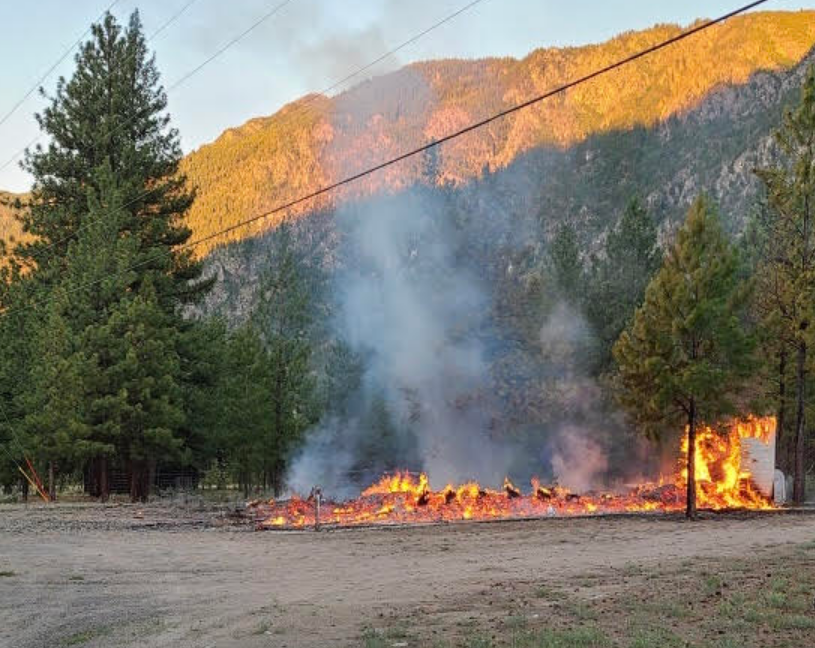
The remains of the Chopaka Church on Lower Similkameen land on Saturday morning. (Photo/Courtesy of Chief Keith Crow) 

BRITISH COLUMBIA, Canada — Two more Catholic churches burned down in western Canada early Saturday. The churches were located near Indigenous communities at St. Ann’s Church and Chopaka Church, which are located within an hour of each other in British Columbia.

Want more Native News? Get the free daily newsletter today.
In All This Darkness, Taking Back Our Stolen Children Can Offer Hope


Wednesday, June 23, 2021

Quebec government, Catholic oblates still haven't delivered key residential school records #TRC


As First Nations in Quebec plan possible searches of former residential school sites, documents that could help that process have still not been turned over by the Quebec government and the Missionary Oblates of Mary Immaculate.

"Recent events have definitely given some urgency to the
situation," he said, adding the oblates seem willing to work on
releasing more records and that a meeting has already been set up.

"I expect there will be some movement on this very shortly."

WARNING: DISTRESSING CONTENT: Quebec government, Catholic oblates still haven't delivered key residential school records | CBC News


The central repository of oblate records on Quebec's
residential schools is the Archives Deschâtelets in Richelieu, about 35
kilometres east of Montreal.
Students and staff of the Fort George Roman Catholic Indian Residential School, Fort George Que., Aug. 8, 1948. (National Centre for Truth and Reconciliation / Deschatelets-NDC Archives )

Quebec government, Catholic oblates still haven't delivered key residential school records #TRC


As First Nations in Quebec plan possible searches of former residential school sites, documents that could help that process have still not been turned over by the Quebec government and the Missionary Oblates of Mary Immaculate.

"Recent events have definitely given some urgency to the situation," he said, adding the oblates seem willing to work on releasing more records and that a meeting has already been set up.

"I expect there will be some movement on this very shortly."

WARNING: DISTRESSING CONTENT: Quebec government, Catholic oblates still haven't delivered key residential school records | CBC News


The central repository of oblate records on Quebec's residential schools is the Archives Deschâtelets in Richelieu, about 35 kilometres east of Montreal.
Students and staff of the Fort George Roman Catholic Indian Residential School, Fort George Que., Aug. 8, 1948. (National Centre for Truth and Reconciliation / Deschatelets-NDC Archives )

CLICK OLDER POSTS (above) to see more news

CLICK OLDER POSTS  (above) to see more news

MEGWETCH THANK YOU

HUGE Thank you for visiting this blog and sharing this with your kin. It's appreciated. Contact Trace anytime! Use the form below.

BOOKSHOP

Please use BOOKSHOP to buy our titles. We will not be posting links to Amazon.

Popular Posts

To Veronica Brown

Veronica, we adult adoptees are thinking of you today and every day. We will be here when you need us. Your journey in the adopted life has begun, nothing can revoke that now, the damage cannot be undone. Be courageous, you have what no adoptee before you has had; a strong group of adult adoptees who know your story, who are behind you and will always be so.

OUR HISTORY

OUR HISTORY
BOOK 5: Lost Children of the Indian Adoption Projects