BACK UP BLOG (no longer updating)

This blog was a backup for American Indian Adoptees blog
USE THE SEARCH BAR or SEARCH TOPICS at bottom of this blog

If you need support

Support Info: If you are a Survivor and need emotional support, a national crisis line is available 24 hours a day, seven days a week: Residential School Survivor Support Line: 1-866-925-4419. Additional Health Support Information: Emotional, cultural, and professional support services are also available to Survivors and their families through the Indian Residential Schools Resolution Health Support Program. Services can be accessed on an individual, family, or group basis.” These & regional support phone numbers are found at https://nctr.ca/contact/survivors/ . MY EMAIL: tracelara@pm.me

Search This Blog

Showing posts with label Dept. of Indian Affairs. Show all posts

Wednesday, February 5, 2025

If confirmed, Kirkland will replace Bryan Newland


Wednesday, February 5, 2025

Navajo Nation council speaker Crystalyne Curley and Billy Kirkland shake hands with guests at the Navajo Nation Washington Office.  Kirkland was honored at the office during a reception in January. (Photo: Antonia Gonzales)

A Navajo Nation citizen has been nominated by President Donald Trump to serve as Assistant Secretary for Indian Affairs.

The nomination of William “Billy” Kirkland was sent to the U.S. Senate on Monday, according to the Congressional database.

The Navajo Times reports Kirkland is a political strategist from Georgia who’s worked in the state’s political landscape. He also served in various positions during the first Trump administration.

Kirkland is said to have played a role working with tribes on the issue of missing and murdered Indigenous women helping with the Trump administration’s response through Operation Lady Justice.

He was honored during a reception at the Navajo Nation Washington Office in January on the night before President Trump took office.

Navajo Nation council speaker Crystalyne Curley and Billy Kirkland shake hands with a guest at the Navajo Nation Washington Office. Kirkland was honored at the office during a reception in January. (Photo: Antonia Gonzales)


Kirkland gave brief remarks at the reception, in an audio recording provided by Indianz.com.

“Anytime we can get Indian Country more involved in anything we’re doing, whether it’s here in Washington or in the states or policy wise or the inaugural ceremonies taking place tomorrow, the inauguration ball, we definitely want to do so. The White House will continue to have an open-door policy with all the tribal nations.”

If confirmed, Kirkland will replace Bryan Newland (citizen of the Bay Mills Indian Community), who resigned at the end of the Biden administration.

Tuesday, June 14, 2022

Healing, remembrance as former boarding school crumbles


sclark@record-eagle.com |  

MOUNT PLEASANT — Children ran along the grounds, playing on the former grounds of the Mount Pleasant Indian Industrial Boarding School.

Long braided hair, ribbon skirts, and the practice of Anishinaabek ceremony such as smudging would have not been allowed 88 years ago.

On the anniversary of the institution’s closure, more than 100 community members gathered to recognize the suffering, strength and resilience of the children through a day of memoriam and fellowship.

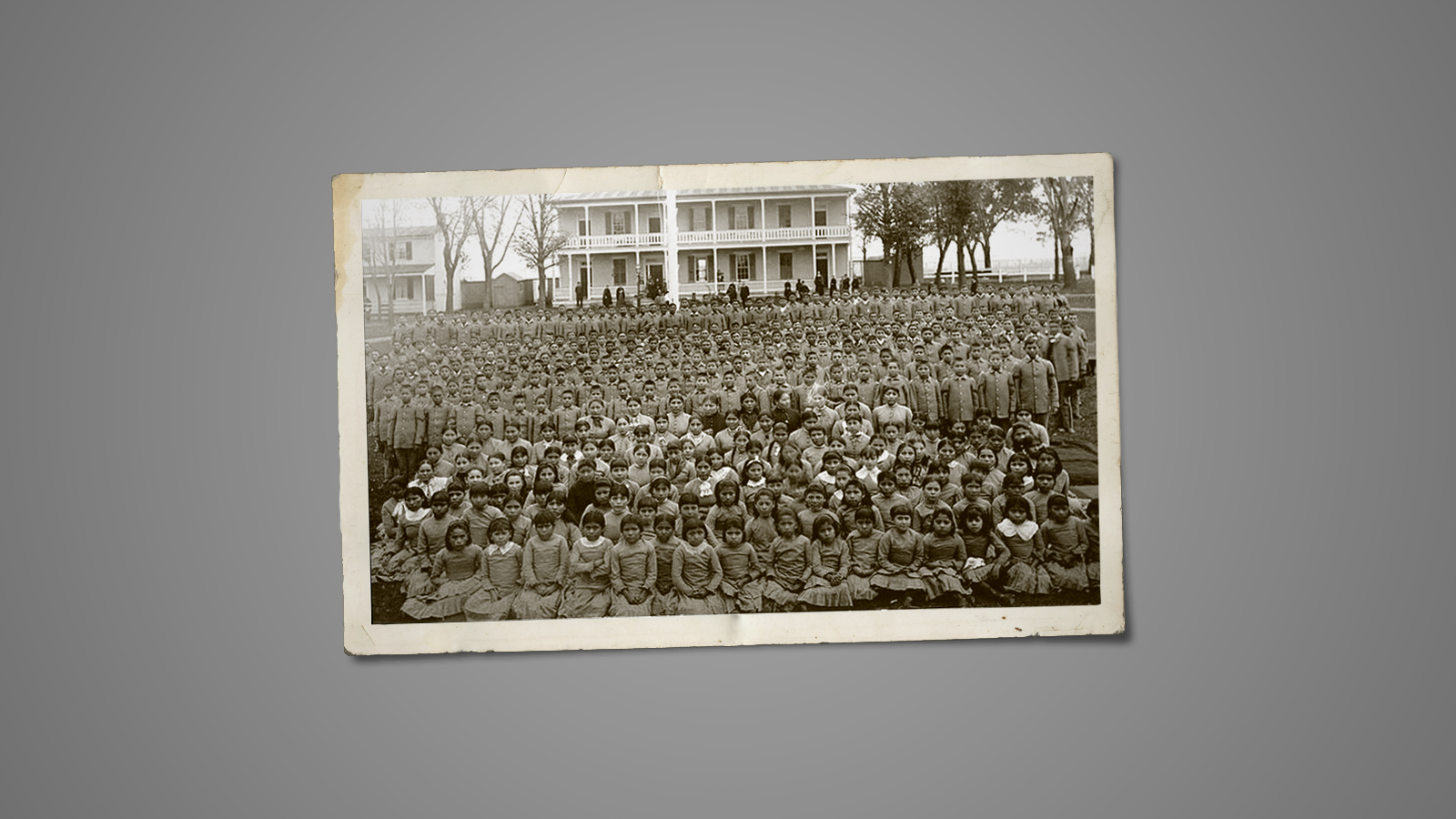
The Mount Pleasant Indian Industrial Boarding School operated for more than four decades starting in 1893, before its closure on June 6, 1934.

Now, seven crumbling buildings are all that physically remain of the institution which once kept thousands of Native American children.

Despite boarded windows and deteriorating brick, the structures remain standing, to give testimony of the legacy of the boarding schools felt deeply across Indian Country throughout generations.

Eleven-year old Harmony Wethington, a citizen of the Nottawaseppi Huron Band of Potawatomi, stood along the former girl’s dormitory.

She tiptoed on her white moccasins, and peeped through a window, hoping to catch a glance of the interior.

She could have been kept there prior to the passage of the Indian Child Welfare Act in 1978 — it wasn’t until then Native American parents gained the legal right to deny their children’s placement in off-reservation schools.

Wethington said it was her second year coming to the memoriam.

“It’s a sad experience, but I am here to remember my family and all other families,” Wethington said.

Her great-great grandparents attended MIIBS, and other families also went to other boarding schools in the U.S.

The culturally significant clothing Harmony donned proudly was made by her grandmother, Jennifer Wethington, who said coming to the grounds is a visual reminder of what their family overcame from boarding schools.

MIIBS was just one of over 497 federally funded institutions identified that operated under U.S policies for more than 150 years where children as young as 4 were forced from their families, prohibited from speaking their languages and often abused.

According the first volume of the Federal Indian Boarding School Initiative Investigative Report, these institutions used “militarized” tactics to assimilate Native American children in environments described as fostering “rampant physical, sexual, and emotional abuse; disease; malnourishment; overcrowding; and lack of health care.”

Many children never returned home, and the Interior Department said that, with further investigation, the number of known student deaths could climb to the thousands or even tens of thousands.

“Each of those children is a missing family member, a person who was not able to live out their purpose on this Earth because they lost their lives as part of this terrible system,” said Interior Secretary Deb Haaland, whose paternal grandparents were sent to boarding school for several years.

As previously reported, the U.S. documented five deaths of Indigenous children at MIIBS from 1893 to 1934.

But after the land was returned to the Saginaw Chippewa Indian Tribe of Michigan in 2010 by the state, volunteer researchers from the Ziibiwing Cultural center found evidence of 227 deaths attributed to MIIBS that were not reported in the school’s archives.

The search for the missing children remains underway, said Marcella Haden, SCIT Tribal Historical Preservation officer.

She said that plans under an amended deed agreement between the city of Mount Pleasant and the tribe will begin ground-penetrating radar on the land, but no exact date was given

Federal government used money from Indian Trust Funds to pay schools — even those run by religious organizations, the report stated.

While it doesn’t say how many were church-run. An earlier report by the National Native American Boarding School Healing Coalition found that more than 150 were, about half each by Catholic and Protestant groups.

Further details state the government provided funding and other support to religious boarding schools for Native children in the 19th and early 20th centuries to an extent that normally would have been prohibited under rules of separation between church and state.

The Interior Department report, quoted a 1969 Senate investigation, acknowledged that “federal policy toward the Indian was based on the desire to dispossess him of his land. Education policy was a function of our land policy.”

Churches had clout with the government as well, it adds, and were able to recommend people for appointments to federal positions on Native affairs.

“We do this because they couldn’t,” said Lacey Kinnart, citizen of the Sault Ste. Marie Tribe of Chippewa Indians and descendant of boarding school survivors.

Her grandmother and great-aunts attended Holy Childhood as children, and other family members attended MIIBS.

“It is important that we recognize the generational trauma but it’s also just as important to remember the generational resilience and wisdom,” Kinnart said.

Kinnart serves as the programs and operations coordinator for the Native American Boarding School Healing Coalition. It was her and her mother’s first year coming to the grounds.

“I’m humbled to be here among our community,” she said.

The day closed in front of the former boys dormitory, with traditional Anishinaabek jingle dress dancing, led by Punkin Shananaquet, citizen of the Match-e-be-nash-she-wish Band of Potawatomi Indians.

Shananaquet said the time was now to come together for the healing and protection of the future generations,

The Associated Press contributed to this report.

Sunday, July 4, 2021

The investigation that will change how America thinks about its past

In truth, the 367 boarding schools in operation in the U.S. were camps of strategic cultural genocide: This is what achieving civilization looked like in practice: 

Students were stripped of all things associated with Native life. 

Their long hair, a source of pride for many Native peoples, was cut short, usually into identical bowl haircuts. 

They exchanged traditional clothing for uniforms, and embarked on a life influenced by strict military-style regimentation.

Students were physically punished for speaking their Native languages. 

Contact with family and community members was discouraged or forbidden altogether. 

Survivors have described a culture of pervasive physical and sexual abuse at the schools. 

Food and medical attention were often scarce; many students died. 

Their parents sometimes learned of their death only after they had been buried in school cemeteries, some of which were unmarked. -The Atlantic

  Jeva Lange | July 2, 2021

Uncovering the abuses of Indigenous boarding schools will be Deb Haaland's most important legacy...

The horrors of the boarding school system are an open topic in Canada where, earlier this year, the remains of 215 Indigenous children were found in a mass grave at the Kamloops Indian Residential School in British Columbia. That sickening announcement was followed last week by the report of an additional 751 unmarked graves of children found near a residential school in Saskatchewan. Already this week, another 182 graves were found at a former school east of Vancouver, Canada. In total, an estimated 6,000 children are thought to have died at schools in Canada, while "it's likely that the number of students who died in the United States is much higher," Christine Diindiisi McCleave, the executive director of the National Native American Boarding School Healing Coalition (NABS), told High Country News.

GOOD READ: The investigation that will change how America thinks about its past

**

(click headlines)

ABC News
There were reports from the TRC -- a commission funded by the Canadian government as part of a legal settlement to address the wrongs of the system ...
 
TownandCountrymag.com
In 2015, the Truth and Reconciliation Commission identified this as "cultural genocide," and national anger has been mounting ever since. 

"We Were Children" trailer 2012


New legislation strengthens Oregon’s commitment to help preserve Tribal families

Oregon is the seventh state to pass a state-based ICWA in alignment with the federal act, joining states such as Minnesota and Tennessee. Before the federal act passed in 1978, generations of Tribal children across the country were removed from their families and communities, often placed without connection to their Tribal culture. 

“The passage of the Oregon Indian Child Welfare Act (ORICWA) in 2020 spoke to the State of Oregon’s commitment to protecting and preserving Tribal children and families,” said Adam Becenti, ODHS Tribal Affairs Director. “The recent changes to ORICWA will now enhance how Child Welfare engages with Tribal families and strengthen partnership with Oregon Tribal Nations. This is a significant step forward in repairing historical wounds and honoring the government-to-government relationship with Tribal Nations.”  MORE

Tuesday, November 3, 2015

Duncan Campbell Scott plaque now includes his past creating residential schools

Duncan Campbell Scott plaque now includes his past creating residential schools
For many Canadians, Duncan Campbell Scott was a renowned poet and public servant — but a new plaque unveiled Sunday at his Ottawa grave site will also let visitors know about his role creating Canada's residential school system.
The revised text on the plaque that now stands beside his Beechwood Cemetery grave points out Scott's "notorious" 52-year career in what was then known as the Department of Indian Affairs.
"As Deputy Superintendent, Scott oversaw the assimilationist Indian Residential School system for Aboriginal children, stating his goal was 'to get rid of the Indian problem,'" the new plaque reads. "In its 2015 report, Canada's Truth and Reconciliation Commission said that the Indian Residential School system amounted to cultural genocide."
The previous plaque, erected in 2011, was almost entirely devoted to lionizing Scott's career as a poet, calling him "one of the outstanding figures in Canadian poetry." The new plaque also mentions his recognition of one of Canada's so-called "Confederation poets."
The new plaque was spearheaded by Cindy Blackstock, executive director of the First Nations Child and Family Caring Society of Canada. She said when she learned about Scott in high school, she was taught nothing about his residential schools legacy.
"I think when we look at Duncan Campbell Scott, many more of us are impacted by ... his residential schools than by his literary contributions," Blackstock told Ottawa Morning host Robyn Bresnahan in an interview on Monday.
"It was about setting the history right, and about giving all Canadians a better understanding of what we need to do in this country to restore justice. ... If we really want to be a country then we must learn from our past, both the celebratory times and the times of struggle, too."
Born in Ottawa in 1862, Scott joined the Department of Indian Affairs as a 17-year-old.
He became the department's deputy superintendent in 1913 and his travels with the department across Canada served as the inspiration for much of his poetry.
Literary critics have pointed out the irony that, at the same time Scott's poetry lamented the decline of First Nations in Canada, his own department was actively working to eradicate those same cultures.
Scott retired from his position as deputy superintendent in 1932 and died in Ottawa in 1947 at the age of 85.
"We realize that his resting place here can serve as a teaching tool for the generations in our midst and the generations to come, that the plaque ... can serve to tell the more complete history that most of us grew up not knowing," said Marie Wilson, commissioner of the Truth and Reconciliation Commission of Canada, at the plaque unveiling on Sunday.

CLICK OLDER POSTS (above) to see more news

CLICK OLDER POSTS  (above) to see more news

MEGWETCH THANK YOU

HUGE Thank you for visiting this blog and sharing this with your kin. It's appreciated. Contact Trace anytime! Use the form below.

BOOKSHOP

Please use BOOKSHOP to buy our titles. We will not be posting links to Amazon.

Popular Posts

To Veronica Brown

Veronica, we adult adoptees are thinking of you today and every day. We will be here when you need us. Your journey in the adopted life has begun, nothing can revoke that now, the damage cannot be undone. Be courageous, you have what no adoptee before you has had; a strong group of adult adoptees who know your story, who are behind you and will always be so.

OUR HISTORY

OUR HISTORY
BOOK 5: Lost Children of the Indian Adoption Projects