This blog was a backup for American Indian Adopteesblog
USE THE SEARCH BAR or SEARCH TOPICS at bottom of this blog
If you need support
Support Info: If you are a Survivor and need emotional support, a national crisis line is available 24 hours a day, seven days a week: Residential School Survivor Support Line: 1-866-925-4419. Additional Health Support Information: Emotional, cultural, and professional support services are also available to Survivors and their families through the Indian Residential Schools Resolution Health Support Program. Services can be accessed on an individual, family, or group basis.” These & regional support phone numbers are found at https://nctr.ca/contact/survivors/ .
MY EMAIL: tracelara@pm.me
The Vatican’s recent repudiation of the Doctrine of Discovery has been described as a “major step” by some Indigenous leaders, but for others, the Holy See has a long way to go before it can heal the centuries of pain caused by the doctrine’s colonization and control. Today on Native America Calling, we speak with Steve Newcomb (Shawnee and Lenape), author of Pagans in the Promised Land: Decoding the Doctrine of Christian Discovery and cofounder and director of the Indigenous Law Institute, and Bruce McIvor (Métis), lawyer and partner at First Peoples Law.
We meet the author behind the book aiming to support young women called 'Sisterhood.' A short film explores the legacy of the Rapid City boarding schools. The Vatican has repudiated the Doctrine of Discovery. We discuss its influence on tribal sovereignty ... The Vatican officially repudiated the Doctrine of Discovery on Thursday morning. This comes after Indigenous peoples across the world demanded this action. The Doctrine of Discovery originated in the late 1400s, as justification by the Catholic Church to seize lands that were not inhabited by Christians. continue reading
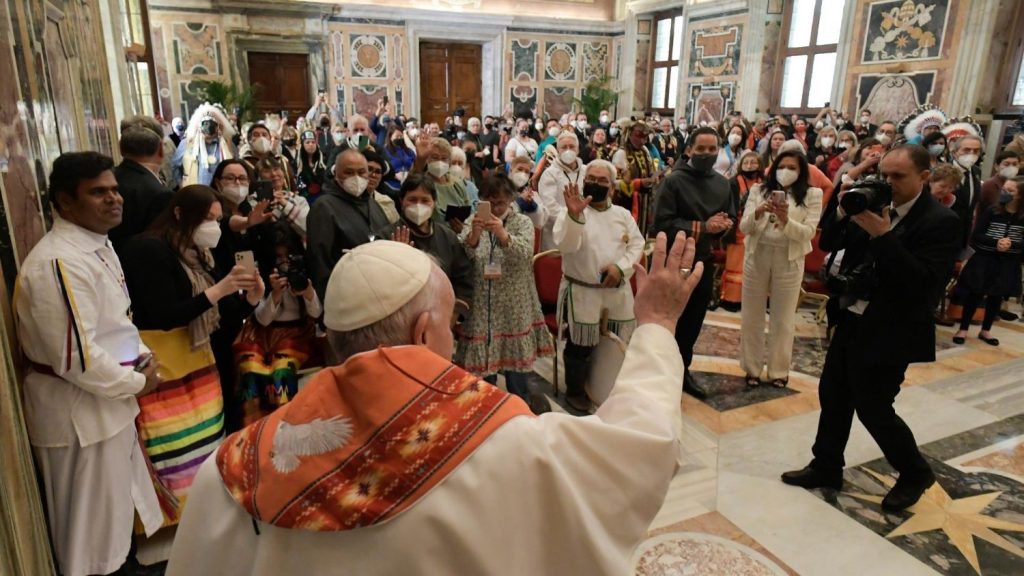
The Pope seems to not know about the Doctrine, according to a twitter Native.
Nederlands: Paus Nicolas V oil on panel 1612-1616 (Photo credit: Wikipedia)
Volume 2, Issue #11, American Logo newsletter by Bill Annett
We are not descended from men who kept silent. -Edward R. Murrow
Ask an average American (or Canadian): “What is the Doctrine of Discovery?” You’re likely to get a blank stare, an uncomfortable pause, the changing of the conversation to politics or rock stars, or perhaps the stuttered response: “You mean like Dr. Oz?”
And yet the DoD, as it is referred to by academics, unsuccessful politicians, native people and others on the receiving end, is a basic legal assumption, born of Holy Writ and therefore both sanctified and legal, 500 years ago, when the sun rotated around the European world and the earth was flat. Was it just a naïve part of that past, that ignorant and illiterate peasant flotsam of Western Europe, and now long forgotten?
Hell, no. That incredible, inhuman law, mindset and modus operandiis still alive and well, solidly embedded in the ubiquitous practice of governing law. And where? Today, it dominates, subtly but pervasively as a daily fact of life, over 1.5 million people in Canada, three million in the U.S., six million in Mexico and a massive population in the rest of the Hemisphere, as well as in Australia, New Zealand and large swatches of Southeast Asia and Oceania. Perhaps 400 million people in total, more than the entire U.S. population.
What is it and how did it get its start?
Pope Nicholas V, on the 18th of June, 1452, stamped his bulla, or papal seal, on the bottom of a document, a papal bull known as Dum Diversas. Dumb indeed, but with enormous ramifications.
Actually, Pope Nicholas V was a builder, and like Hitler’s autobahns in the Thirties, he repaired infrastructure such as aqueducts destroyed during the collapse of the Roman Empire. That construction, as a matter of fact, was analogous to the Roman Church’s succeeding the Roman Empire as the confluence and tributary conveying the brutality of empire masquerading as civility and Christian humanism.
But Nicholas is best remembered for his political balancing act between the Portuguese king and the threat of the Ottoman Empire. One element was the papal bull Dum Diversas, which granted Portugal “full and free power”:
to invade, search out, capture, and subjugate the Saracens and pagans and any other unbelievers and enemies of Christ wherever they may be… and to reduce their persons into perpetual slavery.
A follow-up document, Romanus Pontifex, allowed that same empire to seize for itself the lands of any non-Christians they encountered. The Doctrine of Discovery was established.
After Columbus’s “discovered” the New World, (although indigenous people had practised Occupy Turtle Island for some 10,000 years) Pope Alexander VI in 1493 issued another bit of papal bull known as Inter Caetera, commanding Spain
“to instruct the aforesaid inhabitants and residents and dwellers therein in the Catholic faith, and train them in good morals…”
opening the way for Catholic missions to conquer everything and anybody in the new world, except for the newly arrived Portuguese.
England quickly got into the act four years later, when King Henry VII granted John Cabot rights to possess all lands in the New World not already claimed by Portugal and Spain. In return, John Cabot, like an obedient Mafia soldier, wet the beak of his king with 20% of the total take. All of which not only legitimized but commanded the enslavement, pillaging and killing of millions of indigenous peoples all over the world. The toll (as we palefaces like to journalize) so far for the Western Hemisphere alone totals around 100 million people. According to one academic, (Anthony Hall of the University of Lethbridge) “the greatest re-engineering of a civilization in history.”
Does the DoD still live? One early Supreme Court case, Johnson v. M’Intosh in 1823, according to Robert Miller,* resolved a tribal land dispute, ruling that Native American land is inalienable. They cited the Doctrine of Discovery, which stated that Christian Europeans owned all land explored and claimed, and in any event, only the federal government could buy land occupied by Native Americans, meaning that the federal government could therefore pretty much name its own price.
Supreme Court cases as recent as 1973 and 1990 have used the Doctrine of Discovery to delimit native rights to prosecute any individuals on their lands for crimes. In 2005, certain tribes were denied sovereignty and the ability to repurchase traditional land previously held.
“Apparently, Euro-Americans possessed the only valid religions, civilizations, governments, laws, and cultures, and Providence intended these people and their institutions to dominate the North American continent. The human, governmental, and property rights of Native Americans were almost totally disregarded as Discovery and then Manifest Destiny directed the United States’ expansion. Under Manifest Destiny it was ‘clear’ that God wanted Indians to get out of the way of American progress.”
In other words, a significant part of American political practice blindly follows the Doctrine of Discovery, that ancient tossing off of political intervention by the Roman church we all accept whether we want to or not. (It’s part of of the Holy Church’s Concordat with all civilized nations.) American acceptance of this Doctrine is a modern world atrocity that parallels a universe of conflicting opinion, often denied, pernicious in its global fact.
Slavery, war, genocide are all facts that flow from this medieval nonsense. It defined the treatment of the world’s indigenous people that remains today in all but the most enlightened societies. It has even – in a minor key – warped our confusion about immigration, notably the migration of indigenous peoples in the Americas, many of whom are in constant flux (perennially fluxed) and on the move because U.S. policy vis-a-vis Latin America has delimited economic opportunity.
Professor Miller has delineated and compared the Doctrine’s effects as well as practice in Australia, Brazil, Canada, Chile, England, New Zealand, Portugal, Spain and (of course) the United States.
*The International Law of Colonialism: A Comparative Analysis, Robett J. Miller, Lewis & Clark Law Review
QUEBEC, CANADA - JULY 27: One-year-old Yonnan Flamand is lifted into the air by his father Alland Flamand of Manawan as Pope Francis delivers remarks at the Citadelle of Quebec on the Plains of Abraham on July 27, 2022 in Quebec, Canada. Pope Francis is traveling across Canada for a “pilgrimage of penance,” to meet with and apologize to Indigenous communities for the abuse at Catholic-run residential schools. (Photo by Chip Somodevilla/Getty Images)
Canadian Indigenous peoples face a reckoning after being granted an audience with a major symbol of their oppression.
Indigenous peoples’ most progressive hope for his trip was that he would rescind the 1493 Papal Bull and related Doctrine of Discovery, which served as the historical Church-sanctioned policy rationale for destroying and subverting Native culture in the so-called New World. But he has not done that — and even the most idealistic of Indigenous advocates suspected he would not.
To do that would have undermined a foundational principle of Christian, colonial and capitalistic ideology, and few contemporary world systems seem prepared for the possible ramifications — financial, social and otherwise.
The Papal Bull "Inter Caetera," issued by Pope Alexander VI on May 4, 1493, played a central role in the Spanish conquest of the New World. The document supported Spain’s strategy to ensure its exclusive right to the lands discovered by Columbus the previous year. It established a demarcation line one hundred leagues west of the Azores and Cape Verde Islands and assigned Spain the exclusive right to acquire territorial possessions and to trade in all lands west of that line. All others were forbidden to approach the lands west of the line without special license from the rulers of Spain. This effectively gave Spain a monopoly on the lands in the New World.
The Bull stated that any land not inhabited by Christians was available to be "discovered," claimed, and exploited by Christian rulers and declared that "the Catholic faith and the Christian religion be exalted and be everywhere increased and spread, that the health of souls be cared for and that barbarous nations be overthrown and brought to the faith itself." This "Doctrine of Discovery" became the basis of all European claims in the Americas as well as the foundation for the United States’ western expansion. In the US Supreme Court in the 1823 case Johnson v. McIntosh, Chief Justice John Marshall’s opinion in the unanimous decision held "that the principle of discovery gave European nations an absolute right to New World lands." In essence, American Indians had only a right of occupancy, which could be abolished.
Questions abound: Will the papal bull ever be rescinded? If so, what will that mean? Will the Pope make a similar visit to the U.S. and to Latin America, which both experienced similar atrocities to the Indigenous peoples of Canada? Will anything really change as a result of this sorry snapshot?
**
Papal Visit
The historic visit by Pope Francis to Canada this week drew thousands of Indigenous people from across Turtle Island to hear the apology they had been expecting for the Catholic Church’s role in the ugly residential school history.
ICT’s special correspondent Miles Morrisseau, Métis Nation, based in Manitoba, Canada, was among them. He witnessed the apology in Maskwacis, Alberta, on the grounds of the former Ermineskin Indian Residential School. He was there for the applause, for the tears and the emotional protest song.
And he was there to gather reaction to the long-awaited penance, from tribal leaders who gathered and the First Nations, Métis and Inuit people who made a pilgrimage to see the Pope.
He followed the Pope to Lac Ste. Anne where the Pontiff sat silently looking toward the lake before blessing the crowd with its sacred waters. And he was there to talk to the Cree woman whose tearful song on Monday brought an outpouring around the world.
ICT National Correspondent Mary Annette Pember also joined the coverage, gathering perspectives from Indigenous people in the United States who hope the Pope will make a similar “penitence pilgrimage” to apologize for the U.S. boarding school system. She explored Indigenous demands that the Catholic Church return the tens of thousands of sacred artifacts stored in Vatican museums.
ICT gave readers the Indigenous perspective of a story that is very personal for many of us..
Here’s a round-up of ICT’s coverage of the papal visit:
By Miles Morrisseau and Mary Annette Pember A six-day swing through the heart of Indigenous Canada is meant to be a ‘penitential voyage’ ... continue reading
By ICT Pope Francis arrived Sunday in Canada to high expectations that he will apologize for the Catholic Church’s role in operating Indigenous residential schools ... continue reading
Indigenous leaders and residential school survivors in Saskatchewan called on Pope Francis to rescind the Doctrine of Discovery. The Archbishop of Canterbury, one of the highest officials in the Church of England, also recently promised to see what he could do about the doctrine. (Gregorio Borgia/The Associated Press)
When the Archbishop of Canterbury visited Saskatchewan earlier this month, those who spoke with him made him aware of the damage caused by the Doctrine of Discovery.
Many survivors tie its existence to the creation and presence of residential schools, and a commissioner of the Truth and Reconciliation Commission recently said its ripple effect is still being felt in schools today.
The commission's findings, as survivors told the archbishop during his visit, show residential school policy could be traced back to the doctrine and the papal bulls.
Chiefs and leaders who attended the archbishop's visits in James Smith Cree Nation and Prince Albert commended the promise to discuss the doctrine with the Roman Catholic Church.
"How can we dismantle the Doctrine of Discovery in a way so it can never be used again?" Rev. Justin Welby asked the crowd who gathered to meet him in James Smith Cree Nation.
Rev. Justin Welby visited the James Smith Cree Nation to listen to residential school survivors earlier this month. He promised to aid in dismantling the Doctrine of Discovery by engaging with local officials and with the Roman Catholic Church. (Bryan Eneas/CBC)
The doctrine and its powers
The Doctrine of Discovery's supposed power came from the Roman Catholic Church.
Papal bulls, edicts from the pope guiding colonial powers on the treatment of Indigenous people, were issued in the 15th century.
The bulls, which empowered Christian colonial expansion, said any land "discovered" by colonial powers could be claimed as their own.
They also stated Indigeneous people who inhabited those lands were not Christian and could be subjugated and converted to Christianity.
Sol Sanderson, a Federation of Sovereign Indigenous Nations senator and former chief, says colonial powers and nations eventually formed via the doctrine would create their own policies designed to terminate the rights of Indigenous people.
Only Pope Francis can rescind the papal bulls issued in the 15th century that gave colonial nations the power to ignore the rights of Indigenous people. (Vatican Media/Reuters)
In Canada, the termination of Indigenous rights came through the Indian Act, and policies within the act led to the creation of residential schools in Canada — a system, the Truth and Reconciliation Commission says, was designed to destroy Indigenous people's sense of cultural identity.
Sanderson says as he sees it, historically, the Canadian government has made numerous attempts to diminish Indigenous rights, based on the ideas passed through the generations that colonial powers are better suited to govern Indigenous people, thanks to the doctrine.
But Sanderson says Indigenous people's inherent rights aren't and weren't ever superseded by the doctrine, just ignored by it.
"People don't know nothing about inherent rights … they supersede everything, but what are they, where do they come from?" Sanderson said.
"When you look at the inherent rights we have, the inherent sovereignty of our nations and inherent rights to self-determination, the inherent right to education, health, social development, lands, resources, economics, justice … that's the inherent rights we have."
Sanderson says he hoped the Archbishop of Canterbury would come to an agreement with the pope to implement a plan and put teeth into a strategy resulting in the rescinding of the doctrine.
He says such an agreement should recognize the sovereignty of Indigneous people, their natural power to govern, their natural power to make treaties and their natural power to legislate internally and externally both at home and abroad — terms he says need to be dictated by Indigenous people.
Old history, modern effects
The doctrine itself might seem like a relic of the past but retired Senator Murray Sinclair, a commissioner of the Truth and Reconciliation Commission, says its effects are still very much being felt today.
There's no doubt the doctrine contributed to the creation of residential schools, Sinclair says.
But the doctrine also allowed for and created the thinking that colonial powers could occupy Indigenous lands and territories — and in turn the thinking that Indigenous people are inferior to non-Indigenous people, particularly European settlers.
Thinking that colonial powers are superior to Indigenous people is something he says permeated the education system even beyond residential schools and is still being felt today, even if schools have taken a "softer, more gentle approach" to Canada's history.\
"They still talk about the beauty of colonialism, the beauty of European growth, the wisdom and intelligence of the leaders of Confederation, the wisdom and intelligence of the people who've been in charge of government over the years," Sinclair said.
"It's Indigenous people who are made to look bad in the history books in this country and that not only has a negative effect on the Indigenous children, it also has a negative effect on non-Indigenous children."
He says non-Indigenous children taught in school early on to believe they're superior are potentially jeopardizing their relationship with Indigenous people.
Sinclair says that factor is something that affected him and other Indigenous people as children and caused a deep distrust of all levels of non-Indigenous society — churches, educational systems, government and many others.
'A matter of time'
The Archbishop of Canterbury himself can't rescind the papal bulls making up the Doctrine of Discovery.
His promise to survivors gathered in James Smith Cree Nation and Prince Albert earlier this month was to engage in discussions with the Pope about the harms he learned about the doctrine while in Saskatchewan.
Rescinding of the document would come down to the Pope.
Murray Sinclair says he expects the Doctrine of Discovery will be rescinded in the near future. (Darin Morash/CBC)
Sinclair says that's something this generation could see in its lifetime — and it's something that needs to be done now for survivors' sake.
"I think it's a matter of time before the Doctrine of Discovery is ruled as being an irrelevant doctrine," Sinclair said.
He says the question of what legal basis the Crown has to justify its legal title over Indigenous people has appeared in the Supreme Court of Canada a number of times, but hasn't been properly answered.
In reading through legal decisions, he says, he's seen justices point out the major act of reconciliation that needs to happen in Canada is reconciling Crown sovereignty and Indigenous sovereignty.
"We're hoping that the parties can do that, but if they leave it to the courts to do that, then they may not be happy with the result," Sinclair said.
"The power to commit horrible crimes against children, and others, and then absolve itself and the rapists and killers it shields within its ranks, has made the Vatican a criminal, rogue body under every international standard of law and morality."
Read about the Papal Bull and what it means to federal laws here today in the US in the article "Ending Catholicism And Related U.S. Imperialism" by Thomas Ivan Dahlheimer at http://www.towahkon.org/endofimperialism.html
Papal Bull declares the legitimacy of Christian domination over (Indian) pagans, sanctifying enslavement and expropriation of property:
Romanus Pontifex, January 8, 1455 - …We bestow suitable favors and special graces on those Catholic kings and princes, …athletes and intrepid champions of the Christian faith… to invade, search out, capture, vanquish, and subdue all Saracens and pagans whatsoever, and other enemies of Christ wheresoever placed, and… to reduce their persons to perpetual slavery, and to apply and appropriate… possessions, and goods, and to convert them to… their use and profit.* (European Treaties bearing on the history of the United States and its Dependencies to 1648, Editor Francis Gardiner Davenport, pages 20-26)
HISTORY: Papal Bulls are the fabric of United States and International law. Papal authority is the basis for United States power over Indigenous peoples, not generally understood. The Doctrine of Discovery is still being used as an active legal principle by the United States Supreme Court in the twentieth-first century, revealed in the case City of Sherrill v. Oneida Indian Nation of New York decided in March 2005. The case involved a dispute over taxation of ancestral lands of the Oneida Indian Nation. During oral arguments, it became clear that the case would hinge on whether, in the opinion of the Court, the Oneida Indian Nation “has sovereignty status” with regard to the ancestral lands the Oneida Nation had reacquired. To decide the sovereign status of the Oneida Indian Nation, the Supreme Court relied upon the Doctrine of Discovery. Revealed in footnote number one of Justice Ruth Bader Ginsbergʼs decision for the Court majority: “Under the Doctrine of Discovery,” wrote Justice Ginsberg, “... fee title to the lands occupied by Indians when the colonists arrived became vested in the sovereign — first the discovering European nation and later the original states and the United States... The Supreme Courtʼs reference to the Doctrine of Discovery places the context for the Courtʼs decision in Sherrill v. Oneida Indian Nation of New York within the Framework of Dominance, dating back to the era of the Vatican Papal Bulls.”
Empire attitudes and dominance are not dead. ----Trace
T he Métis National Council and the Government of Canada will be working collaboratively, Nation-to-Nation, to develop a process to engag...
To Veronica Brown
Veronica, we adult adoptees are thinking of you today and every day. We will be here when you need us. Your journey in the adopted life has begun, nothing can revoke that now, the damage cannot be undone. Be courageous, you have what no adoptee before you has had; a strong group of adult adoptees who know your story, who are behind you and will always be so.
OUR HISTORY
BOOK 5: Lost Children of the Indian Adoption Projects