BACK UP BLOG (no longer updating)

This blog was a backup for American Indian Adoptees blog
USE THE SEARCH BAR or SEARCH TOPICS at bottom of this blog

If you need support

Support Info: If you are a Survivor and need emotional support, a national crisis line is available 24 hours a day, seven days a week: Residential School Survivor Support Line: 1-866-925-4419. Additional Health Support Information: Emotional, cultural, and professional support services are also available to Survivors and their families through the Indian Residential Schools Resolution Health Support Program. Services can be accessed on an individual, family, or group basis.” These & regional support phone numbers are found at https://nctr.ca/contact/survivors/ . MY EMAIL: tracelara@pm.me

Search This Blog

Showing posts with label Stephanie Woodard. Show all posts

Saturday, May 28, 2022

Exposing and Repairing the Devastation Caused by the Indian Adoption Project

repost from December 2011


St. John, snatched from his family when he was 4, says he was raised without his culture.


.
I’m an angry Indian,” Roger St. John, Sisseton Wahpeton Oyate, told the First Nations Repatriation Institute’s second annual adult adoptees summit. The elite panel included child-welfare specialists, judges, lawyers, community activists and scholars. The most important experts, according to the organization’s founder/director, Sandra White Hawk, Rosebud Sioux Tribe, were adult adoptees—such as St. John—who related their experiences at the three-day meeting at the University of Minnesota, Twin Cities in St. Paul in 2011.

 
“I’m more than glad to tell you I’m pissed off,” continued St. John, a 49-year-old truck driver with dark hair pulled back in a ponytail. “I was the youngest of 16 children, grabbed at the age of 4, along with three older brothers—no paperwork, nothing. The other kids in the family escaped because they took off.”  Soon, St. John and his siblings ended up in New York City at Thanksgiving time. The year was 1966: “We were on the front page of the newspaper, along with lots of good talk about the holiday and adoption. We were brought up without our culture, which took a terrible toll on our lives. I grew up angry and miserable.”
 
St. John’s experience was replicated all over Indian country in the mid-to-late 20th century. The boarding-school era that had begun in the late 1800s was winding down and the abusive residential schools set up to isolate and assimilate Native children were being closed down or turned over to the tribes, a process that was largely completed by the 1970s. Meanwhile, another means of separating Native children from their communities was gathering steam.
 
The Indian Adoption Project was a federal program that acquired Indian children from 1958 to 1967 with the help of the prestigious Child Welfare League of America; a successor organization, the Adoption Resource Exchange of North America, functioned from 1966 until the early 1970s. Churches were also involved. In the Southwest, the Church of Jesus Christ of Latter Day Saints took thousands of Navajo children to live in Mormon homes and work on Mormon farms, and the Catholic Church and other Christian denominations swept many more Indian youngsters into residential institutions they ran nationwide, from which some children were then fostered or adopted out. As many as one third of Indian children were separated from their families between 1941 and 1967, according to a 1976 report by the Association on American Indian Affairs.
 
“People have heard of the boarding-school era and know it was bad, but they don’t know our adoption era even exists,” said White Hawk, who was taken from her family on the Rosebud reservation as a toddler in the mid-1950s. “A few small studies of adult adoptees have been done, and we’re just learning how to talk about what happened. We need think tanks and conferences and scientific research to explore what occurred and how it affected us.”
 
Then, White Hawk said, that information can inform current Indian child-welfare cases. “When experts take the stand to testify in a child-welfare hearing [about placement of a child or termination of parental rights, for example], they need academic backup to explain the relationship between, for example, suicide and being disconnected from your culture,” she explained. “The courts want Ph.D.-level research to back up what we tell them.”
 
A paper by Carol Locust, Cherokee, describes Native adoptees suffering from what she calls Split Feather Syndrome—the damage caused by loss of tribal identity and growing up “different” in an inhospitable world. Lost Bird is another term researchers have used to refer to the group, recalling one of the earliest Indian adoptees. A Lakota infant who survived the 1890 massacre at Wounded Knee sheltered by the frozen corpse of her mother was claimed as a war trophy by a general who named her Lost Bird, according to her biographer, Renée Sansome Flood in Lost Bird of Wounded Knee.
Thanks to copious newspaper coverage of the massacre and its aftermath, Lost Bird became her generation’s celebrity adoptee, but fame did not save her from a fate that was a harbinger for too many Native children. She endured intolerance and isolation, and when she rebelled as a teenager, was shipped back to her birth family, where she no longer fit in. After a stint in Buffalo Bill’s Wild West Show and the loss of three children—two died and she gave away the third, according to Flood—Lost Bird was felled by influenza in 1920, at the age of 30. “Throughout her life of prejudice, exploitation, poverty, misunderstanding and disease, she never gave up hope that one day she would find out where she really belonged,” Flood wrote.
 
At the summits and other events White Hawk has organized or spoken at since 2003, modern-day adoptees have recounted their dramatic life journeys, sometimes for the first time. “The stories vary from the most abusive to the most beautiful, but that’s not the point,” she said. “Even in loving families, Native adoptees live without a sense of who they are. Love doesn’t provide identity.”
 
“I never felt sorry for myself,” said St. John, “but if I ever got hurt, it wounded me to my soul, because I felt no one was there for me.” In recent years, he has found his birth mother and connected emotionally with his adoptive parents. “They were so young, in their 20s, when a priest convinced them to adopt four Sioux boys from South Dakota. It was too much—for all of us.”
 
During the adoption era almost any issue—from minor to serious—could precipitate the loss of an Indian child. Two Native people interviewed prior to the summit said they were separated from their families after hospital stays as young children, one for a rash, the other for tuberculosis. A third was seized at his baby-sitter’s home; when his mother tried to rescue him, she was jailed, he said. A fourth recalled that he was taken after his father died, though his mother did not want to give him up. A fifth described being snatched, along with siblings, because his grandfather was a medicine man who wouldn’t give up his traditional ways. As in St. John’s case, no home studies or comparable investigations appear to have been done to support the removals. “Indians had no way to stop white people from taking their kids,” said yet another interviewee. “We had no rights.”
 
Eighty-five percent of the Native children removed from their families from 1941 to 1967 were placed in non-Indian homes or institutions, said the Association on American Indian Affairs report. The aim, said White Hawk, was assimilation and extinction of the tribes as entities, as their younger generations were removed, year after year—just as it had been with the boarding schools.
 
“We can’t be afraid to use words like genocide,” said summit participant Anita Fineday, White Earth Band of Ojibwe, managing director of Casey Family Programs’ Indian child-welfare programs and a former chief judge at White Earth Tribal Nation. “The endgame, the official federal policy, was that the tribes wouldn’t exist.”
 
As Native adoptees struggle to recover their identities, some have trouble accessing their original birth certificates. Many states seal adoption records to protect the confidentiality of the process. “In a state that does this, you have to be a detective to find out where you’re from,” said White Hawk.
Or lucky. According to Sharon Whiterabbit, Ho-Chunk Nation, a business consultant and internationally known rights advocate, the son she’d given up as a teen mother found her because he lost his social security number. To get a new one, he had to petition the courts for his original birth certificate and, using the information he found there, tracked her down.
 
Could something be done on a tribal level to keep adoption records open and available for those who want them? Whiterabbit asked the group. This summit was about solutions, as well as problems, and Fineday had an answer: “Tribes have a right to know their members, so we can demand the records. We’re not requesting, though. We’re demanding. At White Earth, we were successful with this tack in a couple of cases. When the [adoption] documents arrived, I got goose bumps.”
 
Carrie Imus, director of social services for and former chairwoman of the Hualapai Tribal Nation, suggested that tribes do pre-enrollment of children who are being adopted out, to ease their return.
According to Terry Cross, Seneca Nation of Indians and founder and executive director of the National Indian Child Welfare Association, nontribal child-welfare workers usually did not recognize the large support network that Native children enjoy: “In the 1950s, 1960s and 1970s, children were removed from Indian families because auntie was taking care of them, and the system called that neglect. But it was simply a different cultural way of meeting the child’s needs. To this day, social workers who remove Native children don’t know what an Indian family is and what supports are available
in the extended family and tribe.”
 
Decades of stolen children caused unresolved personal and community-wide grief and high rates of alcoholism, suicide and other social ills that stalk individuals and tribes to this day. “It took me years to realize nothing was wrong with me and the response I had to the trauma I’d experienced as an adoptee,” said Sandra Davidson, White Earth Band of Ojibwe and a program manager for Praxis International, a nonprofit dedicated to eliminating violence toward women and children.
 
Often referred to as “historical trauma,” the pain can’t be cured with quick-fix programs, said Cross. “In Canada, we looked at places where suicide is the highest, and it’s where the culture is most broken down,” he said. “In such cases, do you start suicide-prevention programs, or do you restore balance in the community through more self-governance? I have found that unless you change a community systemically, you can’t affect the symptoms of imbalance, such as suicide.”
 
Linear thinking—see a problem, apply a solution—is ineffective, he added. “Mainstream society’s services are so fractured. Medical doctors get the body, psychologists get the mind, judges get the social context, and clergy get the spirit. But, in fact, we are all whole people, and real solutions have to address that.”
 
Cross pointed to the sweat lodge as a way of caring for the whole person. “It’s done in groups and includes teachers, stories and protocols for how to conduct oneself, which relate to the social context,” he said. “You sweat, and you experience aromatic herbs, which heal the body; you participate in prayers and songs, which are in the realm of spirit; and when you come out, you feel better and have moments of clarity that are aspects of mind.”
 
That type of healing is required for entire communities, as well as for individuals, and is a part of what Cross called the “remembering” of indigenous cultures. Colonization has pulled indigenous cultures apart worldwide, as colonizers have taken land and resources. “They also usurp sovereignty and attack spirituality,” he said. “The last item is removal of children to educate them in the language and worldview of the colonizer. Now, though, we Native people are remembering our traditions and remembering our communities. We’re healing from within.”
 
The adoptees’ stories must be articulated so they can heal, so their communities can be restored, and so the experiences can help remedy Indian country’s ongoing child-welfare crisis, said White Hawk. The percentage of Native children cared for outside the home remains disproportionately high across the nation, despite the Indian Child Welfare Act (ICWA), a 1978 law that sought to ameliorate the situation—but has yet to do so.  In Alaska, Native children make up 18 percent of the child population but 55 percent of the children in foster care; in South Dakota, Indian kids are 15 percent of the state’s youngsters, but 53 percent of those in foster care. Other states topping the list for skewed numbers include Minnesota—where the overrepresentation of Native kids in foster care increased substantially from 2004 to 2009—Montana, Nebraska and North Dakota.
 
Another summit attendee, Gina Jackson, Te-Moak Tribe of Western Shoshone Indians, is educating judges through a model-court program of the National Council of Juvenile and Family Court Judges, in Nevada. The program helps jurists understand ICWA and relevant best practices. “We’ve signed up 66 jurisdictions and will help them work for compliance,” she said.
 
Education of the judiciary is crucial, said Arizona state judge Kathleen Quigley: “ICWA cases are not the bulk of a judge’s work, so many are not familiar with the law.” And the concept of the “active efforts” needed under ICWA to find and notify a child’s tribe of a possible removal from the family is not dealt with sufficiently in case law, she said.
 
“At this meeting, it has been critical for me to hear from folks who’ve been in the system and to understand how being taken from their families and communities affected their lives,” Jackson said. “I want everyone who works with kids and families to hear these voices.” Michael Petoskey, Grand Traverse Band of Ottawa and Chippewa Indians and chief judge of the Pokagon Band of Potawatomi Indians, agreed. “Thank you for sharing your stories,” he told the survivors of the adoption era. “We judges may underestimate the impact on people’s lives when we terminate parental rights.”
 
“Your saying that is medicine for those of us who’ve been through this,” White Hawk responded. Going forward, the repatriation institute will work to affect policy and will organize a day of prayer and healing for Friday, November 2, 2012. “We’re hoping to have events at state capitols nationwide,” said George McCauley, Omaha, head of the Institute’s board of directors.
 
Jerry Dearly, the renowned Oglala Lakota storyteller and educator who serves as White Hawk’s advisor, informed the group that healing is about identity, understood on a profound level. “You have to find out who you really are, who you really were,” he said. “Go to a quiet place where it’s just you and the Creator. All of us are beautiful, but you have to believe in yourself.”
 
“Now I have cancer and am waiting for an operation,” St. John told the summit. “But I believe in myself, and I can survive anything.”

SOURCE: https://indiancountrytoday.com/archive/native-americans-expose-the-adoption-era-and-repair-its-devastation


[And each story like this one will finally change this devastating history... Megwetch everyone...Trace]

Thursday, October 20, 2016

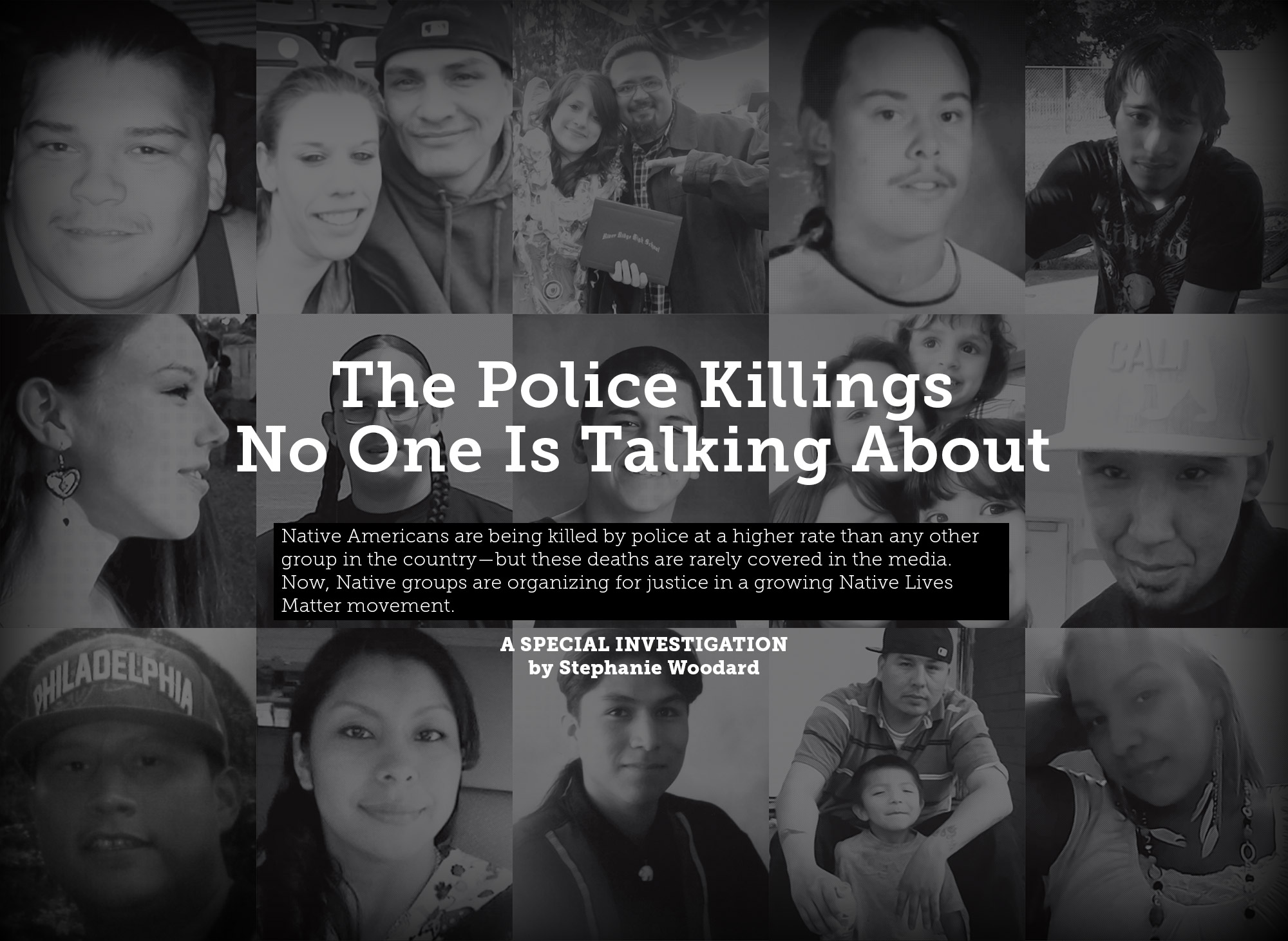
Stephanie Woodard: The Police Killings Noone is Talking About


Native Americans killed by police (L to R) from top: Marcus Lee, Lance McIntire, Daniel Covarrubias, Raymond Eacret, Jessie Lee Rose, Jacqueline Salyers, Mah-hi-vist Goodblanket, Richard Estrada, Jeanetta Riley, Larry Kobuk, Jamie Lee Brave Heart, Loreal Tsingine, Corey Kanosh, Allen Locke, Sarah Lee Circle Bear
Hi Readers,
You may recall Stephanie Woodard for her excellent writing in the anthology TWO WORLDS.
She has reported on adoptees many times.

This new report is just as disturbing. Please read. 

"The Police Killings No One Is Talking About": Native Americans Most Likely to be Killed by Cops

A new investigation by In These Times explodes myths about who is most likely to die at the hands of police by revealing that, compared to their percentage of the U.S. ... Read More →


You may recall I wrote about Alan Locke (above), who is a relative in my Lakota Tiyóspaye. Read about him and The Phone Call here.

Friday, December 28, 2012

Rough Justice in Indian Country

By Stephanie Woodard, Published in Native Americans (100 Reporters website)
http://100r.org/2012/12/rough-justice-in-indian-child-welfare/#more-8122


In a basement interrogation room in South Dakota, agents of the state’s Department of Criminal Investigation were on the firing line. A group of Native American children were claiming sexual and physical abuse by their white adoptive parents, whose home they first entered as foster children.
South Dakota was already under Congressional scrutiny for the high number of Native children it takes from their homes and tribes and then places, for the most part, with white foster families or in white-run group homes—seemingly to claim a higher share of federal foster care funding. Though Native children make up about 13 percent of South Dakota’s child population, they are typically more than 50 percent of those in care, according to federal figures.

The state’s response to the Native children’s accusations against their white parents offers a rare look into South Dakota’s foster care system, which places 9 in 10 Native children in state foster care with white families or white-run group homes. The state’s actions also raise questions about the commitment of officials to protect Native children taken from their natural families, particularly when homes that are presented as safe havens turn into places of abuse.

Startlingly, the agents who summoned the children to the interrogation that day in November 2011 were working hard to get the youngsters to recant their abuse claims. State officials also brought charges against the deputy state’s attorney and a child welfare advocate, Brandon Taliaferro and Shirley Schwab, who moved to stop the abuse. Their trial on charges of getting the children to lie about the abuse is set for January 7, 2013.

That day, Sheriff’s deputies had taken the children out of school, court records show, and brought them to the basement room, with its table, chairs, one-way mirror, and recording equipment. One by one, the children faced Agent Mark Black of the Department of Criminal Investigations and a partner. The children were each alone, without an adult present on their behalf.

While being questioned by the agents, the children became fearful and wept, according to someone familiar with the case who asked not to be identified for fear of retribution. The youngsters were apparently not told they were being recorded. While left alone for a time, one explored the room, discovered the camera equipment behind a peephole, and began to cry.

The DCI video of the interrogation is now a court document. In a four-minute excerpt that can be seen on YouTube, the agents are taking a break. They’re off-camera, apparently unaware that the microphone is still picking up their voices as they plan their strategy.

One agent says the children “have been f—ing with us.” The men talk about questioning the therapist to whom the children described the sexual assaults. Agent Black says, “I guarantee we put [her] in here. Put the f—ing hot screws in her. Bitch you’re in f—ing deep shit. You better start talking.” Later Black says, “At least we f— with Brandon.”

Taliaferro had brought charges against the adoptive parents in 2010, following a police investigation of the children’s abuse allegations. He charged the parents nearly three dozen felonies, including incest, rape, sexual exploitation and cruelty toward five children, the youngest 5 years old when the alleged abuse started in 2003. Schwab, the children’s court-appointed special advocate, supported Taliaferro’s action. Local news media followed the case avidly as it developed.

Since the interrogation, Agent Black has testified multiple times that his questioning aimed to get the children to recant their abuse claims and to say that Taliaferro and Schwab had encouraged them to lie about the abuse, but the youngsters never did. Nevertheless, the state moved on the two whistleblowers, raiding their homes and offices and hitting them with felony and misdemeanor charges related to persuading the children to lie. Later testimony would indicate that investigators had turned up no evidence of this.

In May 2012, Michael Moore, the state’s attorney prosecuting the case against the adoptive parents, dismissed charges against the mother. She had been accused of witnessing sexual assaults on the children and failing to protect them. The state returned the children to her and gave the father a deal. He admitted to one count of raping a child younger than 10 and was ordered to serve 15 years in prison, making him eligible for parole after seven and one half years. (100Reporters is withholding the parents’ identities to protect the children’s privacy.)

Frank LaMere, director of the Four Directions Community Center. / PHOTO: STEPHANIE WOODARD

Frank LaMere is a prominent Indian child welfare advocate and director of Four Directions Community Center, a Native nonprofit in Sioux City, Iowa. He called for a federal investigation into South Dakota’s foster care system and predicted that this latest situation may become South Dakota’s Penn State. “This is a scandal of the highest order,” said LaMere.

A Very Bad Year
Late 2011 was a difficult time for South Dakota’s foster care system. In addition to facing this latest abuse case, the state was working out a financial settlement in the so-called Jane Doe lawsuit. It had been brought on behalf of a 9-year-old foster child who was reportedly sexually abused over a period of two years in a group home. Schwab was one of the whistleblowers for that case as well, she said.
Then, days before Black’s interrogation of the Native children and the searches of Taliaferro’s and Schwab’s premises, National Public Radio broadcast a scathing report, charging South Dakota with rampant taking of American Indian children into foster care. The network said the state receives $100 million dollars annually in federal funds on behalf of foster children of all races, giving it an incentive to keep the numbers of children in care high. Alarmed, six House members had asked the federal Bureau of Indian Affairs to look into possible violations of the 1978 Indian Child Welfare Act, intended to keep Native children within their Indian families and communities.

A new report by South Dakota tribal officials also confirms the findings of the earlier NPR report, which state officials had contested. The tribal report accuses the state of “willfully” and “systematically” violating the Indian Child Welfare Act (ICWA) and taking Indian children “at least partly to bring federal dollars into the state.” The document came from a committee of ICWA directors in South Dakota, the tribal child welfare officials tasked with enforcement of the Indian Child Welfare Act.

On December 7, Congressmen Ed Markey (D.-MA) and Ben Ray Lujan (D.-NM) sent a tough letter to the Bureau of Indian Affairs. Markey is the ranking Democrat on the House Natural Resources Committee, which has jurisdiction over Indian affairs, and Luhan is ranking member of the subcommittee on Indian and Alaska Native affairs.

Citing the tribal report, the congressmen pledged to renew an earlier request for the House to investigate South Dakota for possible “misappropriation of federal dollars to state coffers.”
“This has gone on long enough,” said Markey.

Markey and Lujan also reminded the Bureau of Indian Affairs that 14 months ago, House members asked the agency to hold a “summit” on the situation. Congressman Tom Cole (R.-OK) and three others had gone even further. In a move reminiscent of Robert Kennedy sending federal marshals to enforce civil rights in Mississippi in 1962, they proposed in late 2011 sending federal attorneys to South Dakota tribes to help them enforce the Indian Child Welfare Act. At that time, the Bureau of Indian Affairs announced it was looking into these suggestions, but took no action.

The bureau has been closely following events in South Dakota, said spokeswoman Nedra Darling. “The BIA supports the ongoing tribal efforts to resolve this matter, and we stand ready to participate in future forums,” she said.

Millions at Stake
South Dakota is not the only state that removes Native American children from their families and tribes in disproportionate numbers, but its numbers are among the most skewed, according to the National Indian Child Welfare Association.

The federal dollars South Dakota receives on behalf of all children—Native and non-Native—are considerable. They flow onward to state agencies, foster and adoptive parents, and group homes, as well as to any employees and suppliers. This movement of money has “a measurable effect” on a state’s economy, according to the healthcare consumer group Families USA.

Department of Social Services spokeswoman Kristin Kellar said the agency complies fully with the Indian Child Welfare Act and does not take children to attract federal dollars. Removing a child from the home harms society economically, she said, no matter what “paltry amount of funding the federal government expends to support foster care.” She challenged NPR’s $100-million figure, saying the agency would like to see the numbers on which it is based.

Attorney Daniel Sheehan, general counsel of the Lakota People’s Law Project, an advocacy group, disputed the “paltry” characterization and noted the importance of federal funding to South Dakota. An analysis from the Tax Foundation, a nonpartisan research group, reveals that South Dakota is third in the nation for dependence on the federal government, with 45.6 percent of its total expenditures covered by the federal subsidies.

Sheehan pointed to the state’s 2012 budget, which reveals that Washington’s share of South Dakota social services skews even higher, to about two-thirds of the total—$660 million in federal funding, out of the $1 billion in total state spending on all social services. That means Native foster children, who are more than half of all kids in care in the state, could be responsible for significant portions of several federal funding streams, according to Sheehan.

“They would bring the state chunks of the $30 million in federal money for child protective services; the $67 million for nutrition, health, and other economic assistance; the $37 million for behavioral health; and the $19 million for Department of Social Services administrative costs,” said Sheehan. “We could be looking at substantial federal funding captured by Native children once they are in the custody of a state that relies heavily on it.”

Orders from Above
As the most recent South Dakota child-abuse case unfolded, top state officials appear to have been closely involved. While raiding Schwab’s premises and seizing computers and other items, DCI Agent Black told Schawb that his orders came from the highest echelons of state government.
“The attorney general himself has told me to work on this until I am done with it,” Black can be heard saying in an audiotape he made, which has now been turned over to the courts. “This is my priority case right now. Short of a homicide happening.”

Along the way, Taliaferro lost his job as deputy state’s attorney. Taliaferro’s former boss told local media multiple times that the firing was done “with the support of the attorney general.”

The South Dakota attorney general’s office referred a request for a comment to the Department of Social Services.

The head of that agency was apparently directly involved as well. In a preliminary hearing for Taliaferro and Schwab’s case, the presiding judge interrupted Black’s testimony to ask him a question: “It just popped into my mind. How did you get the kids out of school?” Black responded that the social services department’s director had given permission for deputies to take the children from school so agents could question them.

Kellar said the social services agency “cannot comment on specific abuse and neglect cases, due to confidentiality reasons.”

Schwab and Taliaferro say they fear for their safety. Said Schwab: “Knowing Pierre [South Dakota’s capitol] is calling the shots on this is terrifying. We have no one to turn to.” Their trial is set for January 7, 2013.

State’s attorney Moore is also prosecuting the Taliaferro-Schwab case; he said he could not talk about a pending lawsuit, but that the case against the lawyer and child advocate would be made clear in court next month. In addition, Moore insisted that in the parents’ case, the only abuse charge against them that stuck—the single count of rape—is the one that should have.

Moore conceded that Black and his fellow officers were “unprofessional” during the break in questioning. However, Moore said, they had behaved differently during the questioning itself: “The interviews weren’t in any way consistent with what was on camera. If you’ve been around law enforcement, you know they swear a lot, they make statements they may regret.”

Moore also said that children who are being questioned do not need to be accompanied by an attorney or guardian when they are witnesses, not defendants.

O.J. Semans, a Rosebud Sioux and former chief public defender for the tribe, took a different view. “Ordinarily, children are interviewed alone when there’s an indication that they were victims of a family member who should not know of the interview. If the interview is to determine whether the children provided false statements, which is a crime, they should have representation.”

Semans went on to say, “And, by the way, any law enforcement officer knows the difference between an interrogation, with tough questioning in an intentionally stressful environment, and an interview, which elicits a narrative. Because children can be easily influenced, the latter more accurately reflects a child’s perception of a situation.”

Sara Rabern, spokeswoman for the Department of Criminal Investigation, said the agency could not comment on an ongoing prosecution. Neither the agency nor Black responded to requests for an interview with him; however, Black has testified that he made the recorded statements attributed to him here.

Bad Outcomes Rising
In the first decade of the 21st century, figures from the federal Administration for Children and Families show a fivefold increase in the percentage of Native foster children in South Dakota whom the system failed, the tribal report found. During that period, the percentage of children who were transferred to correctional or mental health facilities, or who died or ran away, soared to 36 percent in 2010 from 6.9 percent in 1999. During the same period, reunifications with family dropped. The percentage of white children leaving under the same circumstances grew much more slowly during those years, from 6.3 percent to 11.4 percent; and the share reunified with their families increased.
“Native American foster children,” the report concluded, “are becoming an increasingly important attractor of federal corrections dollars to South Dakota.”

“Our Native children feed the system. They always have,” said LaMere, a member of the Winnebago Tribe of Nebraska. He added that tribes share responsibility for the exodus of Native children into care. “Many of our tribal leaders have been lax in protecting our greatest resource—our children.”
The tribal child-welfare officials’ report also confirmed that last year almost all Indian children in state foster care were in non-Native homes and white-run group facilities. That’s despite the availability of relatives willing to take the children in and Native foster homes, some of which sit empty on reservations, the directors said.

The Indian Child Welfare Act encourages kinship care, which involves placing children who have been taken from their families with relatives. Tribes favor it, because it preserves the children’s culture and maintains the community. “In our families, there’s always room for one more,” said Terry Yellow Fat, ICWA director for the Standing Rock Sioux Tribe and co-chair of the committee that produced the tribal report.

But tribal members have testified at a 2005 hearing before state lawmakers that social workers for the state routinely rebuffed them when they offered to house young relatives who were being taken into care. One Native American woman asked why she was never considered as a candidate to care for her sister’s children.

Another, whose family had not been allowed to keep a cousin’s children, said the state Department of Social Services, which manages this process, was overwhelming to parents, who generally did not understand the often-changing requirements in child-care plans. A DSS representative at the hearing said that these decisions are made, sometimes quickly, to ensure the safety of the child.

Disappearing into the System
Congress passed Indian Child Welfare Act in 1978 to stop the massive removals of Indian children that had taken place over the preceding century, first to notoriously violent boarding schools, then to foster care and adoption in white homes and group settings. During the mid-20th century, as many as 35 percent of Native children were taken from tribes nationwide under federal-, state- and church-run programs, according to testimony Congress gathered while considering the legislation. Sheehan called this “the intentional disassembling of Native American communities through the seizure of their children.”

In South Dakota, Native children are often taken for “neglect,” according to Yellow Fat. “The prevailing attitude on the part of the state is that poverty is a crime,” he said.

“A federal law is being flouted—and frankly, it’s happening in courts all over our state,” said Diane Garreau, ICWA director for the Cheyenne River Sioux Tribe, in South Dakota, who also worked on the report.

The result can be devastating for parents and children, according to attorney Brett Lee Shelton. “Frequently, the kids have already undergone a lot of trauma. Then, when things they don’t understand happen to them, it only adds to their pain,” said Shelton, a member of the Oglala Sioux, another South Dakota tribe, and principal of the Colorado law firm Smith Shelton Ragona.

When tribal youngsters are being removed, time is of the essence, according to Garreau: “If we are not watching, if we don’t start hustling as soon as we hear there’s a problem, if we don’t fight for every single child, they’re lost to us forever. Can you imagine how frightened they must be?”
LaMere charged that the Indian children’s odyssey through the foster care system as it unfolded in the most recent South Dakota abuse case is not an anomaly.

“As outrageous as it is, it is the sad reality for Native children in South Dakota and around the country,” said LaMere. “That father will walk free long before these Indian kids begin to think about recovery.”

Bits of interogation transcript on YouTube: http://youtu.be/Ev1mLcuVMe4

Stephanie Woodard is a member of 100Reporters who writes about Native American issues.

Tuesday, December 6, 2011

Indian Country Today coverage | Exposing and Repairing the Devastation Caused by the Indian Adoption Project

Exposing and Repairing the Devastation Caused by the Indian Adoption Project
 
St. John, snatched from his family when he was 4, says he was raised without his culture.


I’m an angry Indian,” Roger St. John, Sisseton Wahpeton Oyate, told the First Nations Repatriation Institute’s second annual adult adoptees summit. The elite panel included child-welfare specialists, judges, lawyers, community activists and scholars. The most important experts, according to the organization’s founder/director, Sandra White Hawk, Rosebud Sioux Tribe, were adult adoptees—such as St. John—who related their experiences at the three-day meeting at the University of Minnesota, Twin Cities in St. Paul.
“I’m more than glad to tell you I’m pissed off,” continued St. John, a 49-year-old truck driver with dark hair pulled back in a ponytail. “I was the youngest of 16 children, grabbed at the age of 4, along with three older brothers—no paperwork, nothing. The other kids in the family escaped because they took off.” Soon, St. John and his siblings ended up in New York City at Thanksgiving time. The year was 1966: “We were on the front page of the newspaper, along with lots of good talk about the holiday and adoption. We were brought up without our culture, which took a terrible toll on our lives. I grew up angry and miserable.”
St. John’s experience was replicated all over Indian country in the mid-to-late 20th century. The boarding-school era that had begun in the late 1800s was winding down and the abusive residential schools set up to isolate and assimilate Native children were being closed down or turned over to the tribes, a process that was largely completed by the 1970s. Meanwhile, another means of separating Native children from their communities was gathering steam.
The Indian Adoption Project was a federal program that acquired Indian children from 1958 to 1967 with the help of the prestigious Child Welfare League of America; a successor organization, the Adoption Resource Exchange of North America, functioned from 1966 until the early 1970s. Churches were also involved. In the Southwest, the Church of Jesus Christ of Latter Day Saints took thousands of Navajo children to live in Mormon homes and work on Mormon farms, and the Catholic Church and other Christian denominations swept many more Indian youngsters into residential institutions they ran nationwide, from which some children were then fostered or adopted out. As many as one third of Indian children were separated from their families between 1941 and 1967, according to a 1976 report by the Association on American Indian Affairs.
“People have heard of the boarding-school era and know it was bad, but they don’t know our adoption era even exists,” said White Hawk, who was taken from her family on the Rosebud reservation as a toddler in the mid-1950s. “A few small studies of adult adoptees have been done, and we’re just learning how to talk about what happened. We need think tanks and conferences and scientific research to explore what occurred and how it affected us.”
Then, White Hawk said, that information can inform current Indian child-welfare cases. “When experts take the stand to testify in a child-welfare hearing [about placement of a child or termination of parental rights, for example], they need academic backup to explain the relationship between, for example, suicide and being disconnected from your culture,” she explained. “The courts want Ph.D.-level research to back up what we tell them.”
A paper by Carol Locust, Cherokee, describes Native adoptees suffering from what she calls Split Feather Syndrome—the damage caused by loss of tribal identity and growing up “different” in an inhospitable world. Lost Bird is another term researchers have used to refer to the group, recalling one of the earliest Indian adoptees. A Lakota infant who survived the 1890 massacre at Wounded Knee sheltered by the frozen corpse of her mother was claimed as a war trophy by a general who named her Lost Bird, according to her biographer, Renée Sansome Flood in Lost Bird of Wounded Knee.
Thanks to copious newspaper coverage of the massacre and its aftermath, Lost Bird became her generation’s celebrity adoptee, but fame did not save her from a fate that was a harbinger for too many Native children. She endured intolerance and isolation, and when she rebelled as a teenager, was shipped back to her birth family, where she no longer fit in. After a stint in Buffalo Bill’s Wild West Show and the loss of three children—two died and she gave away the third, according to Flood—Lost Bird was felled by influenza in 1920, at the age of 30. “Throughout her life of prejudice, exploitation, poverty, misunderstanding and disease, she never gave up hope that one day she would find out where she really belonged,” Flood wrote.
At the summits and other events White Hawk has organized or spoken at since 2003, modern-day adoptees have recounted their dramatic life journeys, sometimes for the first time. “The stories vary from the most abusive to the most beautiful, but that’s not the point,” she said. “Even in loving families, Native adoptees live without a sense of who they are. Love doesn’t provide identity.”
“I never felt sorry for myself,” said St. John, “but if I ever got hurt, it wounded me to my soul, because I felt no one was there for me.” In recent years, he has found his birth mother and connected emotionally with his adoptive parents. “They were so young, in their 20s, when a priest convinced them to adopt four Sioux boys from South Dakota. It was too much—for all of us.”
During the adoption era almost any issue—from minor to serious—could precipitate the loss of an Indian child. Two Native people interviewed prior to the summit said they were separated from their families after hospital stays as young children, one for a rash, the other for tuberculosis. A third was seized at his baby-sitter’s home; when his mother tried to rescue him, she was jailed, he said. A fourth recalled that he was taken after his father died, though his mother did not want to give him up. A fifth described being snatched, along with siblings, because his grandfather was a medicine man who wouldn’t give up his traditional ways. As in St. John’s case, no home studies or comparable investigations appear to have been done to support the removals. “Indians had no way to stop white people from taking their kids,” said yet another interviewee. “We had no rights.”
Eighty-five percent of the Native children removed from their families from 1941 to 1967 were placed in non-Indian homes or institutions, said the Association on American Indian Affairs report. The aim, said White Hawk, was assimilation and extinction of the tribes as entities, as their younger generations were removed, year after year—just as it had been with the boarding schools.
“We can’t be afraid to use words like genocide,” said summit participant Anita Fineday, White Earth Band of Ojibwe, managing director of Casey Family Programs’ Indian child-welfare programs and a former chief judge at White Earth Tribal Nation. “The endgame, the official federal policy, was that the tribes wouldn’t exist.”
As Native adoptees struggle to recover their identities, some have trouble accessing their original birth certificates. Many states seal adoption records to protect the confidentiality of the process. “In a state that does this, you have to be a detective to find out where you’re from,” said White Hawk.
Or lucky. According to Sharon Whiterabbit, Ho-Chunk Nation, a business consultant and internationally known rights advocate, the son she’d given up as a teen mother found her because he lost his social security number. To get a new one, he had to petition the courts for his original birth certificate and, using the information he found there, tracked her down.
Could something be done on a tribal level to keep adoption records open and available for those who want them? Whiterabbit asked the group. This summit was about solutions, as well as problems, and Fineday had an answer: “Tribes have a right to know their members, so we can demand the records. We’re not requesting, though. We’re demanding. At White Earth, we were successful with this tack in a couple of cases. When the [adoption] documents arrived, I got goose bumps.”
Carrie Imus, director of social services for and former chairwoman of the Hualapai Tribal Nation, suggested that tribes do pre-enrollment of children who are being adopted out, to ease their return.
According to Terry Cross, Seneca Nation of Indians and founder and executive director of the National Indian Child Welfare Association, nontribal child-welfare workers usually did not recognize the large support network that Native children enjoy: “In the 1950s, 1960s and 1970s, children were removed from Indian families because auntie was taking care of them, and the system called that neglect. But it was simply a different cultural way of meeting the child’s needs. To this day, social workers who remove Native children don’t know what an Indian family is and what supports are available
in the extended family and tribe.”
Decades of stolen children caused unresolved personal and community-wide grief and high rates of alcoholism, suicide and other social ills that stalk individuals and tribes to this day. “It took me years to realize nothing was wrong with me and the response I had to the trauma I’d experienced as an adoptee,” said Sandra Davidson, White Earth Band of Ojibwe and a program manager for Praxis International, a nonprofit dedicated to eliminating violence toward women and children.
Often referred to as “historical trauma,” the pain can’t be cured with quick-fix programs, said Cross. “In Canada, we looked at places where suicide is the highest, and it’s where the culture is most broken down,” he said. “In such cases, do you start suicide-prevention programs, or do you restore balance in the community through more self-governance? I have found that unless you change a community systemically, you can’t affect the symptoms of imbalance, such as suicide.”
Linear thinking—see a problem, apply a solution—is ineffective, he added. “Mainstream society’s services are so fractured. Medical doctors get the body, psychologists get the mind, judges get the social context, and clergy get the spirit. But, in fact, we are all whole people, and real solutions have to address that.”
Cross pointed to the sweat lodge as a way of caring for the whole person. “It’s done in groups and includes teachers, stories and protocols for how to conduct oneself, which relate to the social context,” he said. “You sweat, and you experience aromatic herbs, which heal the body; you participate in prayers and songs, which are in the realm of spirit; and when you come out, you feel better and have moments of clarity that are aspects of mind.”
That type of healing is required for entire communities, as well as for individuals, and is a part of what Cross called the “remembering” of indigenous cultures. Colonization has pulled indigenous cultures apart worldwide, as colonizers have taken land and resources. “They also usurp sovereignty and attack spirituality,” he said. “The last item is removal of children to educate them in the language and worldview of the colonizer. Now, though, we Native people are remembering our traditions and remembering our communities. We’re healing from within.”
The adoptees’ stories must be articulated so they can heal, so their communities can be restored, and so the experiences can help remedy Indian country’s ongoing child-welfare crisis, said White Hawk. The percentage of Native children cared for outside the home remains disproportionately high across the nation, despite the Indian Child Welfare Act (ICWA), a 1978 law that sought to ameliorate the situation—but has yet to do so. In Alaska, Native children make up 18 percent of the child population but 55 percent of the children in foster care; in South Dakota, Indian kids are 15 percent of the state’s youngsters, but 53 percent of those in foster care. Other states topping the list for skewed numbers include Minnesota—where the overrepresentation of Native kids in foster care increased substantially from 2004 to 2009—Montana, Nebraska and North Dakota.
Another summit attendee, Gina Jackson, Te-Moak Tribe of Western Shoshone Indians, is educating judges through a model-court program of the National Council of Juvenile and Family Court Judges, in Nevada. The program helps jurists understand ICWA and relevant best practices. “We’ve signed up 66 jurisdictions and will help them work for compliance,” she said.
Education of the judiciary is crucial, said Arizona state judge Kathleen Quigley: “ICWA cases are not the bulk of a judge’s work, so many are not familiar with the law.” And the concept of the “active efforts” needed under ICWA to find and notify a child’s tribe of a possible removal from the family is not dealt with sufficiently in case law, she said.
“At this meeting, it has been critical for me to hear from folks who’ve been in the system and to understand how being taken from their families and communities affected their lives,” Jackson said. “I want everyone who works with kids and families to hear these voices.” Michael Petoskey, Grand Traverse Band of Ottawa and Chippewa Indians and chief judge of the Pokagon Band of Potawatomi Indians, agreed. “Thank you for sharing your stories,” he told the survivors of the adoption era. “We judges may underestimate the impact on people’s lives when we terminate parental rights.”
“Your saying that is medicine for those of us who’ve been through this,” White Hawk responded.  Going forward, the repatriation institute will work to affect policy and will organize a day of prayer and healing for Friday, November 2, 2012. “We’re hoping to have events at state capitols nationwide,” said George McCauley, Omaha, head of the Institute’s board of directors.
Jerry Dearly, the renowned Oglala Lakota storyteller and educator who serves as White Hawk’s advisor, informed the group that healing is about identity, understood on a profound level. “You have to find out who you really are, who you really were,” he said. “Go to a quiet place where it’s just you and the Creator. All of us are beautiful, but you have to believe in yourself.”
“Now I have cancer and am waiting for an operation,” St. John told the summit. “But I believe in myself, and I can survive anything.”


Read more: http://indiancountrytodaymedianetwork.com/2011/12/06/exposing-and-repairing-the-devastation-caused-by-the-indian-adoption-project-65966#ixzz1fmoTlQPf


[And each story like this one will finally change this devastating history... I will be posting more on this after the holiday season ends... Megwetch everyone...Trace]

CLICK OLDER POSTS (above) to see more news

CLICK OLDER POSTS  (above) to see more news

MEGWETCH THANK YOU

HUGE Thank you for visiting this blog and sharing this with your kin. It's appreciated. Contact Trace anytime! Use the form below.

BOOKSHOP

Please use BOOKSHOP to buy our titles. We will not be posting links to Amazon.

Popular Posts

To Veronica Brown

Veronica, we adult adoptees are thinking of you today and every day. We will be here when you need us. Your journey in the adopted life has begun, nothing can revoke that now, the damage cannot be undone. Be courageous, you have what no adoptee before you has had; a strong group of adult adoptees who know your story, who are behind you and will always be so.

OUR HISTORY

OUR HISTORY
BOOK 5: Lost Children of the Indian Adoption Projects