BACK UP BLOG (no longer updating)

This blog was a backup for American Indian Adoptees blog
USE THE SEARCH BAR or SEARCH TOPICS at bottom of this blog

If you need support

Support Info: If you are a Survivor and need emotional support, a national crisis line is available 24 hours a day, seven days a week: Residential School Survivor Support Line: 1-866-925-4419. Additional Health Support Information: Emotional, cultural, and professional support services are also available to Survivors and their families through the Indian Residential Schools Resolution Health Support Program. Services can be accessed on an individual, family, or group basis.” These & regional support phone numbers are found at https://nctr.ca/contact/survivors/ . MY EMAIL: tracelara@pm.me

Search This Blog

Showing posts with label An interview with Daniel Ibn Zayd. Show all posts

Friday, November 1, 2019

#NAAM2019: National Adoption Awareness Month begins today

I plan to share posts from other adoptee bloggers all month...

Click and read:

These are great books and helpful:

Saturday, September 21, 2019

How Do We Mend The Hoop?

REBLOG FROM 2018

By Trace Hentz (Winyan Ohmanisa Waste La Ke)

This is an essay I wrote in the anthology The Lost Daughters: Writing Adoption From a Place of Empowerment and Peace was edited by Amanda H.L. Transue-Woolston, Julie Stromberg, Karen Pickell, and Jennifer Anastasi. (published in 2011)

Years ago I was embarrassed to say I was adopted. I did not feel lucky. I did not have a clue that my adoption hurt me so badly, its tentacles reached into every aspect of my life, even as an adult. My hoop, my connection to my ancestors, was broken by my adoption.
I ached to know my own mother, the woman who created me.
One expert wrote, “Loss of the most sacred bond in life, that of a mother and child, is one of the most severe traumas and this loss will require long-term, if not lifelong, therapy.” (now called toxic stress)
Really?  No one helped me with this. I had therapy twice. The counselling I received in my 20s or 30s concerned my dysfunctional childhood and yet all my issues stemmed from my adoption wound and loss. They missed it or didn't inquire or connect the dots. Why is that?
For close to 20 years, on my own I searched and simply wanted to find answers and the truth. I made calls before I showed up anywhere; I did not disrupt anyone’s life.  If I was invited to meet relatives, I went. In 2011 alone, two cousins have filled giant gaps in my ancestry. Prayers are answered, even the unspoken ones.
I can see how adoption loss can last a lifetime. For some friends, they're stalled with sealed adoption records, not knowing which tribe, and suffer greatly with grief and depression.
For them, I wrote my book as a journalist and adoptee and now I write a blog for other American Indian adoptees, raised by non-Indians.
For those who attempt to open their own adoption, or simply want to understand, I explain many stages, steps I had taken: some good, some hard. 
Sharing stories is how we heal, how we mend the hoop.
Even now there is persistent rampant poverty in Indian Country. Even now it isn’t easy being Indian, on and off the reserves. But it is definitely better to know who you are, which tribe, and not live in a mystery. 
Someone needs to build a bridge for these adoptees. 
Open adoption records will accomplish this.
It's hard to admit but adoptees with Indian blood find out soon enough their reservations are closed to strangers. Without proof, without documents, you’re suspect.
We don’t always get our proof since state laws prevent it.  Just one Minnesota tribe, White Earth, decided to call out to its lost children/adoptees; this made news in 2007.  Just a few adoptees showed up. Why? Adoption records are still sealed in Minnesota.
America’s Indian Adoption Project was not publicized or well known, just like a few more secrets I found out. Congress heard Indian leaders complain in 1974, “In Minnesota, 90 percent of the adopted Indian children are placed in non-Indian homes.”
I was born in Minnesota.
For any adoptee going back to their tribe, this requires a special kind of courage. Adoptees know this. Rhonda, a Bay Mills Tribal member, an adoptee friend of mine, was told early on – be happy, be white.  Ask yourself, how would you react?
When did Indian Country become such a bad place to be from? When did this happen? How did this happen?

My mission is to find these answers and build new bridges... it is time to mend the hoop for all adoptees.

The Hoop symbolizes the never ending circle of life which starts with birth, then goes to maturity, then to old age and death with the completion of the hoop in rebirth here or in the spiritual world. The individual who has his life in order stands in the center of the hoop to see, to understand, and to be guided by the various paths of life around him. The best compliment one can pay an individual is to say that he stands in the center of the hoop of life or that he lives on the correct path of life. http://www.grandfathersspirit.com/Hoop-of-Life-Buffalo-Skull.html

A MUST READ BLOG POST:

#Adoption911 • decolonizing adoption

by Daniel Drennan ElAwar


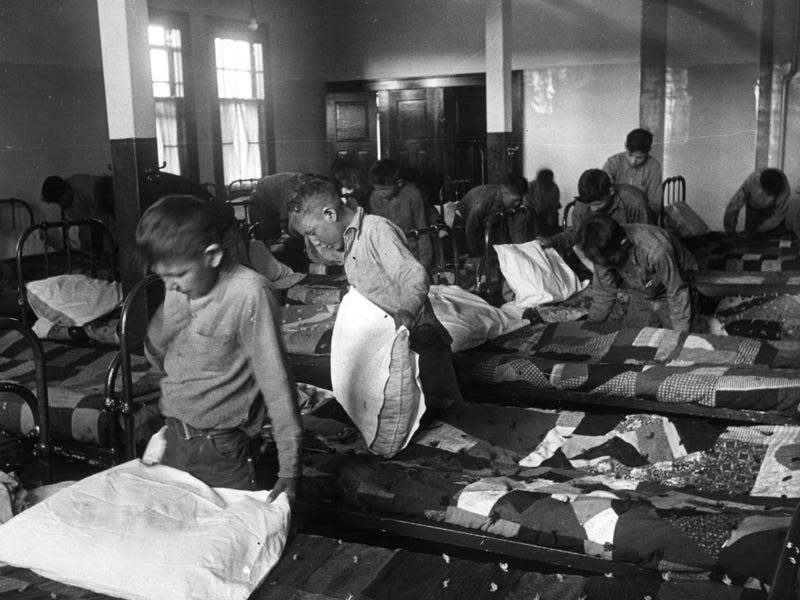
The experiments aren't the earliest record of abuse; as far back as 1928, Indian schools in Canada were forcibly sterilizing First Nations girls. And as a 2007 Amnesty International report lays out, severe abuse was widespread at Indian schools in both Canada and the U.S., where children were forbidden to speak their language (to "civilize" them) and used in "experiments" that were sometimes fatal: there is ample evidence and testimony, as Amnesty says, of "beating, poisoning, electric shock, starvation, prolonged exposure to sub-zero cold while naked, and medical experimentation, including the removal of organs and radiation exposure."
Source: Canadian Scientists Did Psychic Experiments on First Nations Kids 


MORE:
Fighting toxic stress in children is tough but possible | MIT ...

MDHHS - Trauma & Toxic Stress

Trauma and Its Impact on Children and Their Families . Information about trauma/toxic stress and their impact; the ACEs study & building resilience

Monday, February 23, 2015

Reinventing a better world for all children #AbolishAdoption

By Trace Hentz (adoptee-author)

Years ago doing research for my memoir, I spoke with a friend in Austria who told me about SOS VILLAGES. I had never heard of this or such a concept. It's so good it has spread to the US. READ HERE

We know that in Indian Country, taking children and placing them in adoptive homes was to assimilate them, erase them from tribal rolls, an act of genocide motivated by greed and for the taking of more land. We can't change the past in North America. It has already taken place. We are the survivors, the adoptees, left to cure ourselves but also to see to it that this doesn't happen to more children.

In 2015, I will say this: the adoption industry is like a very large building that employs thousands (if not millions) of people -- real people who collect a paycheck. They are lawyers, judges and social workers.  History shows us that children needed more than an orphange and thus began the system we have today - tiers of bureaucracy, unregulated agencies rife with corruption and kickbacks, the trafficking of children internationally to meet the supply and demand here in the US and even the black-marketing of babies. Read about one evil baby trafficker here.

We have to invent something better here in the US. We can't change what exists. We have to replace it and make the old adoption system obsolete!

If ONE TRIBE could make this happen and do this SOS VILLAGE concept in 2015, the word would spread and children would be saved. Children would not lose their tribe, culture or language. Isn't that the purpose and the reason for adoption - saving children's lives?

If someone wants my help to create this new reality in Indian Country, email me.

***************

Adoption is, in and of itself, a violence based in inequality. It is candy-coated, marketed, and packaged to seemingly concern families and children, but it is an economically and politically incentivized crime. It stems culturally and historically from the “peculiar institution” of Anglo-Saxon indentured servitude and not family creation. It is not universal and is not considered valid by most communal cultures. It is a treating of symptoms and not of disease. It is a negation of families and an annihilation of communities not imbued with any notion of humanity due to the adoptive culture’s inscribed bias concerning race, class, and human relevancy.

Wednesday, November 26, 2014

Daniel Ibn Zayd on answering questions #flipthescript #Adoption

I would give anything for one minute of one day to not think about adoption...

- Daniel Ibn Zayd
By Trace

I'm rereading Daniel's blog... from last year. He did a series on 30 answers to 30 questions which should be viewed as the BIBLE of adoptee literature. For example:

Why are adoptees never asking, always answering questions?


This is the final question in the series: “Anti-adoption month: 30 answers to 30 questions on adoption” [link].

This is the “meta” question that is only revealed after years spent answering such questions as represented by the past month of answers, and which themselves only skim the surface of what need be discussed. Reframed, this might be asked thusly:
When is it our turn to ask the questions? When is it our turn to find answers? At long last, at what point do we assume any kind of position of strength among all of this seemingly endless back and forth, both with others, and among ourselves?


[Note: the comments on his blog are often made by adoptees who offer amazing reflections as well... so go over and read up... It's Adoption Awareness Month! Trace]

Tuesday, November 5, 2013

Fake identity?


Adoptee Daniel Ibn Zayd chose to answer 30 questions...

The follow question originally appeared on Yahoo!Answers1:
Why would someone think that Adoption erases a child's identity and replaces it with a fake one?

Answer: First, we need to define our terms: what do we mean by "identity"? Adoption laws, courts, agencies, and most any and all other agents involved in adoption have a clear interest in rupturing all ties of a child with its progenitors and community, and replacing them with others, as defined by the legal system that they control on all levels. To do this, myths have been built up concerning adoption that, when challenged, place those in power, those in control of the situation—including parents—in a moral dilemma: Even if they agree with what is being said—theoretically, morally, ethically—the circumstances of their lives, the weight of their laws, the preponderance of notions of property in their legal system, as well as the sheer desire to make it so, all result in questions such as this one being asked, as well as in the way the question is framed. In purely legal terms, due to the fact that for the majority of states in the U.S. a child's birth certificate is sealed by the courts, or that for most of us adopted overseas our birth documentation is completely falsified—an avalanche of bogus paperwork in order to shuttle us out of the country—then yes, I think it is fair to say that an adopted child's identity, as defined in this legalistic manner, is not his or her real or true identity.

Second, what strikes me particularly strange about having growing up in the United States is the attention given to all aspects of, say, the immigrant experience, and genealogy, and "roots", and ethnicity, such that everyone gets a "hyphen" attached to their country of origin—Polish-American, Italian-American, and in my case, Lebanese-American—except for the true-blue Americans, who are simply "all-American". Given this pride taken in ethnicity, and the obvious hierarchy it establishes in terms of racism, xenophobia, and the like, how is it possible to claim some kind of ethnicity—or other marker of identity—for any child who has not grown up in his or her culture? Eating falafel does not make me "Lebanese", and I still do not claim to be Lebanese now that I'm living here. Why allow such pretension in the States? So in this case as well, I think that my American identity was not "true"—it was instead a series of masks, of affectations—both in terms of my adoptive family, and in terms of my birth country.

Third, and as an elaboration of this, I would admit to having an identity, that is made aware to me when I am around people from where I grew up—our speech patterns, our cultural references, our way of seeing things—all are reflective of a time in U.S. history when individual and local areas all had their own manners and mores, quirks, and culture. This of course has now been paved over, suburbanized, and WalMartized. This truly local culture has been replaced by a strange globalized and globalizing hodgepodge of references to superficial trappings of ethnic "style", such that a child's identity is not formed in a local town, say, but from a Mountain Dew commercial instead. Perhaps this is what is meant by "identity" in this question?

Fourth and finally, I think there is a hypocrisy within the American view of itself in terms of adoption, in the sense that society and culture in general make reference to blood lines, ancestry, familial ties, and the "nurture" aspect of family relationships, such that we have no problem saying, "he's a chip off the old block" or else, "she takes after her grandmother on her mother's side", or "he's the spitting image of his father." Why should it be, then, that all of a sudden the adopted child is supposed to believe that in his or her case, this doesn't matter? That there is no nature, only nurture? How is it not possible to understand that each and every one of these references might seem slight in and of their own selves, but in the aggregate, they are like being bled to death from a million tiny cuts?

The problem here is much deeper than portrayed, because it isn't a bunch of so-called anti-adoption activists that have made suicide the number one cause of death for adopted Korean males in certain adoptive countries, for example. It isn't "bad answers" on this bulletin board that have driven hundreds if not thousands of adopted children from Korea, Taiwan, Lebanon, etc., in progressive waves of generations of dispossessed children who vainly attempt to reverse their exodus and return to their lands of birth, in a useless but necessary attempt to re-establish some vague sense of what we currently refer to as "identity". In 10, 15, and 20 years, it will be the turn of Ukraine, and Russia, and Guatemala, and Ethiopia, and Kenya, and Kazakhstan, and and and...., until such a day, God willing, that the injustice of adoption, and thus this destruction of identity, can be definitively stopped, once and for all.

And so you can challenge this "revolt", with a kind of haughtiness that I'm sure is not normally of you, and thereby risk alienating your adopted child, or you can make the huge leap necessary in your worldview in order to attempt to finally understand, instead of simply imposing on him or her, and by extension, on all of us, these myths that we simply wish to point out as being such; in an effort to clear the air; to breathe. To start a process of healing. To know who we are.

References:
Cold War Orientalism2, by Christina Klein.
Race, Nation, Class3, by Etienne Balibar and Immanuel Wallerstein.
The Karma of Brown Folk4, by Vijay Prashad.
National Identity5, by Anthony D. Smith.
More books6 on the subject...

Debate Tactic: There are two sides to this debate. The first is about "claiming" identity; the second is about "assigning" identity. Both are fraught with peril, because the proud claiming of the first maps too well onto the pejorative assigning of the second. By this I mean to say that my "pride" is someone else's "epithet", or tool of destruction. Like much that is currently taken for granted within an acculturation of individualization, the fact is that "identity" is not a function of an individual, but of a community and a society. The first step to break out of this debate is to drive it away from its usual reductiveness. To do so, we need to consider what the prevailing formative norms of language and culture are, and where they come from. So even when I claim to be a "Jersey boy", I need to really say "North Jersey", and then "suburban" (as opposed to rural or urban), etc. To resist along these lines requires us to question any effort to define and delimit us. Checkboxes on government forms, placement in certain lines at the border screening within an airport, replacing an entire culture with a discussion of certain foodstuffs: We must challenge a reductive idea of what identity is. Adoption, in and of itself, is designed to destroy identity. But too often the stunted and crippled shoot that comes from such a pile of rubble is, itself, a Frankensteinian construct. Ironically, it is perhaps in not claiming an identity that we find ourselves.

1 http://answers.yahoo.com/question/index;_ylt=ApRgTyl6Xek.VS0AyBJJX5vty6IX;_ylv=3?qid=20090831231050AANGvaW
2 http://www.ucpress.edu/book.php?isbn=9780520232303
3 http://www.versobooks.com/books/510-race-nation-class
4 http://www.upress.umn.edu/book-division/books/the-karma-of-brown-folk
5 http://www.unpress.nevada.edu/Search/Title/national/Titles/National%20Identity;1545?1
6 http://www.inquisitor.com/pcgi-bin/media.cgi?NA=Media&AC=List&SC=All&DI=Books&SU=culture&SO=sort_date

Beirut Diary Online (Formerly New York Diary Online) [Writing, photography, and artwork] Copyright © 1995-2013 Daniel Ibn Zayd [or as otherwise noted], all rights reserved.

Thursday, August 23, 2012

The New Abolition: Ending Adoption in Our Time


Here is more from my brilliant articulate adoptee friend Daniel Ibn Zayd, a follow-up to my interview (on August 13).  He posted The New Abolition: Ending Adoption in Our Time on the website DISSIDENT VOICE... Here are a few quotes that resonated with me... He is working on a book!


"The implication here is that the adoptee also traverses the phases of being “colonized”: coddled by the seeming safety of his new-found place, seduced by the imposed mythology of a dominant culture, and abetted by the willfully distanced memory of his generational past. ...a clear definition for what is often referred to within adoptee circles as “the fog”, or “drinking the Kool-Aid”: the acceptance of a fragile notion of security sustained by a false sense of self within an alien and alienating environment....


"As our activism has grown over this near decade, I have been greatly inspired by adoptees in South Korea, for just one example, who have helped shut down adoption in that country as of this year. Other source countries are following suit, and I am further heartened to see an expansion of this activism, here citing just a few examples: mothers in Guatemala, demanding the repatriation of their kidnapped children; in Argentina, demonstrating for an accounting of the infants born to the imprisoned and then disappeared; in Spain, investigating the stolen children of the Franco era and beyond; in Russia, criticizing the despicable treatment of their children exported abroad; in indigenous American Nations, parents reclaiming their stolen progeny. This list grows longer every day.


"I invoke this term (abolition) fully aware of its weight as concerns the movement to abolish slavery, and to clarify this usage, I define adoption as follows:


Adoption is, in and of itself, a violence based in inequality. It is candy-coated, marketed, and packaged to seemingly concern families and children, but it is an economically and politically incentivized crime. It stems culturally and historically from the “peculiar institution” of Anglo-Saxon indentured servitude and not family creation. It is not universal and is not considered valid by most communal cultures. It is a treating of symptoms and not of disease. It is a negation of families and an annihilation of communities not imbued with any notion of humanity due to the adoptive culture’s inscribed bias concerning race, class, and human relevancy...

 "...And thus American Indian reservations, secret bases of extradition, Japanese internment camps, urban and rural ghettoes, the corporate-industrial prison complex, vigilante terrorism directed against immigrants, the aftermath of Katrina in New Orleans. Shamefully added to this list are the children sent to adoption rehabilitation camps in Montana, Russian boys returned alone on airplanes, disrupted adoptions, deported adoptees, the stockpiling of children by adoptive collectors and hoarders, RAD therapies, rebirthings and other pseudo-treatments bordering on outright torture, over-medication of our “mental illnesses”, as well as our “treatment” and study by an army of therapists, social workers, academics, assorted quacks and other misery-industry profiteers. The very existence of this cavalcade of systemic jerry-builders is a greater condemnation of the dysfunctional societal structures undergirding the industry of adoption than anything possibly expressed by the critics thereof. This, in and of itself, should give us great pause...."


http://dissidentvoice.org/2012/08/the-new-abolition-ending-adoption-in-our-time/


Daniel Ibn Zayd currently lives in Beirut.  This article is distilled from a book in progress comparing the political and economic aspects of adoption. He can be reached by email at:daniel.ibnzayd@inquisitor.com. Read other articles by Daniel, or visit Daniel's website.

The New Abolition: Ending Adoption in Our Time

Here is more from my brilliant articulate adoptee friend Daniel Ibn Zayd, a follow-up to my interview (on August 13).  He posted The New Abolition: Ending Adoption in Our Time on the website DISSIDENT VOICE... Here are a few quotes that resonated with me... He is working on a book!

"The implication here is that the adoptee also traverses the phases of being “colonized”: coddled by the seeming safety of his new-found place, seduced by the imposed mythology of a dominant culture, and abetted by the willfully distanced memory of his generational past. ...a clear definition for what is often referred to within adoptee circles as “the fog”, or “drinking the Kool-Aid”: the acceptance of a fragile notion of security sustained by a false sense of self within an alien and alienating environment....

"As our activism has grown over this near decade, I have been greatly inspired by adoptees in South Korea, for just one example, who have helped shut down adoption in that country as of this year. Other source countries are following suit, and I am further heartened to see an expansion of this activism, here citing just a few examples: mothers in Guatemala, demanding the repatriation of their kidnapped children; in Argentina, demonstrating for an accounting of the infants born to the imprisoned and then disappeared; in Spain, investigating the stolen children of the Franco era and beyond; in Russia, criticizing the despicable treatment of their children exported abroad; in indigenous American Nations, parents reclaiming their stolen progeny. This list grows longer every day.
"I invoke this term (abolition) fully aware of its weight as concerns the movement to abolish slavery, and to clarify this usage, I define adoption as follows:
Adoption is, in and of itself, a violence based in inequality. It is candy-coated, marketed, and packaged to seemingly concern families and children, but it is an economically and politically incentivized crime. It stems culturally and historically from the “peculiar institution” of Anglo-Saxon indentured servitude and not family creation. It is not universal and is not considered valid by most communal cultures. It is a treating of symptoms and not of disease. It is a negation of families and an annihilation of communities not imbued with any notion of humanity due to the adoptive culture’s inscribed bias concerning race, class, and human relevancy...
 "...And thus American Indian reservations, secret bases of extradition, Japanese internment camps, urban and rural ghettoes, the corporate-industrial prison complex, vigilante terrorism directed against immigrants, the aftermath of Katrina in New Orleans. Shamefully added to this list are the children sent to adoption rehabilitation camps in Montana, Russian boys returned alone on airplanes, disrupted adoptions, deported adoptees, the stockpiling of children by adoptive collectors and hoarders, RAD therapies, rebirthings and other pseudo-treatments bordering on outright torture, over-medication of our “mental illnesses”, as well as our “treatment” and study by an army of therapists, social workers, academics, assorted quacks and other misery-industry profiteers. The very existence of this cavalcade of systemic jerry-builders is a greater condemnation of the dysfunctional societal structures undergirding the industry of adoption than anything possibly expressed by the critics thereof. This, in and of itself, should give us great pause...."

http://dissidentvoice.org/2012/08/the-new-abolition-ending-adoption-in-our-time/

Daniel Ibn Zayd currently lives in Beirut.  This article is distilled from a book in progress comparing the political and economic aspects of adoption. He can be reached by email at:daniel.ibnzayd@inquisitor.com. Read other articles by Daniel, or visit Daniel's website.

Monday, August 13, 2012

An interview with Daniel Ibn Zayd

Transracial Eyes logo
The following interview is with Daniel Ibn Zayd, an adoptee and contributor to a collective of transracial adoptees called TRANSRACIAL EYES. He was kind to answer some questions for me via email. His bio follows this interview.

Tell us about you, what you do, where you are, and how did you come to know so much about adoption:
Daniel: I was born in Lebanon in 1963 and almost immediately adopted to the United States. At the age of 40, I decided to return, determined to find family, and if not that at least a sense of culture, language, and perhaps identity in returning to my place of birth. As I met adoptees from other countries, as well as domestic adoptees in the States, I became more active in adoptee rights. I was most struck in Lebanon by those who didn't get why I was searching, or who were most critical of it; they happened to be of the class I was adopted into. Those on the other hand who did get it, were likewise dispossessed and displaced: migrant workers, refugees, marginalized communities, etc. I took this as a focal point to try and understand economically and politically adoption as a process and as an industry. My first breakthrough was connecting international and domestic adoption, and from there examining similar human traffickings. I adamantly avoid the personal aspect of it because I see this as a diversion to the discussion that must take place. It's like abolitionists focusing on the narratives of slaves, discussing whether they could be "happy" on the plantation -- it avoids the bigger economic and political picture that adoption, like slavery, perfectly fits into, unfortunately.

I was impressed you have been covering the issues surrounding the Christian group in Montana who is advocating for changing the Indian Child Welfare Act and lobbying legislators in the US. How did you come to learn about American Indian adoptees and the ICWA? 

Daniel: When I arrived in Beirut I was working in academia, and I took advantage of this position to further research aspects of resistance to the above economic and political realities that govern our lives. Much of this research focused on groups who culturally expressed their resistance, for example, the artists of the Mexican Revolution or the Black Panther Party (I was teaching graphic design and illustration). In expanding on notions of dispossession and the like, the Indigenous Nations of the Americas came into focus, especially concerning the political changes in South America, but also in terms of attempts to reclaim culture, language, and community. It was an obvious addition to such research. More personally, my parents had retired to a town in the southwest next to a large Navajo reservation, and an old school to "deculture" Indian children existed near their house. 

I am obsessed by the benign destruction that such "innocent" places represent, and the economic and political position such "adoptions" hold in the imperial forays of the U.S. In one of my classes I used the case of Leonard Peltier and the movie "Incident at Oglala" to portray much of this, making parallels with the local occupation of Palestine. I've also had many debates with those tribal members who reflect locally here in Lebanon what Frantz Fanon calls "native intellectuals": those who advocate for their own oppression and domination, and who take on the colonizing narrative as their own. It is absolutely imperative that we understand historically speaking the derivations of adoption, and its use as a tool by imperial nations against their former/current colonies, and how this relates to the destruction of indigenous peoples in the Americas, Australia, as well as in French overseas territories for just a few examples. This reflects more the true basis of what adoption was designed to do.

Are you a journalist by trade? Tell us about your activism:


Daniel: I'm not a journalist by trade, but have published a fair bit of writing. My activism is currently tending to mix the visual, written, and philosophical realms. In 2009 I started a collective of artists that we called Jamaa Al-Yad; roughly translated it means "Clenched Fist", which we take as a sign of resistance. Much of our initial work required of us bylaws and charter that would pass evaluation by the Lebanese government. We were given a template to use that in many ways reflected French and American influence on the country, taking for granted such things as parliamentary procedure, fifty-percent plus one voting; hierarchies of officers/members, etc. We took almost two years to write from scratch bylaws and charter that avoided all of this. We based them in research gleaned from Iroquois sources and the methodology of Quaker meetings to very local ways of communal associations; the best of many worlds. We received our approval three years ago, and many other non-profit and non-governmental organizations (NGOs) have adapted our charter and bylaws for their own use, which is very satisfying. My sense of activism is that it must be lived, not just theorized or super-mediated. Anything else is just preaching or hypocritical advocacy.

Have you been able to find your natural family and reconnect? What was that like for you?

Daniel: I haven't. I have instead been introduced to a bottomless abyss of trafficking, displacement, dispossession, and marginalization the knowledge of which I wouldn't wish on my worst enemy. I have managed to integrate myself into my neighborhood as well as various communities that I never expected would welcome me back, and this along with the support of my adoptive family allows me to persevere here.

For adoptees out there who are transracial (adopted outside of your culture), many who read this blog are Split Feathers who have questions about this, have you any suggestions on how we can change the views on international adoption and adoption in general:

Daniel: I'm actually writing a book on this subject that shifts the burden here. Why try and change an inherently broken and corrupt system? In my research it quickly becomes apparent the uses of adoption originally were never for family creation, but for everything having to do with political and economic domination, including indentured servitude, emptying of poorhouses, populating of colonies, destruction of tribes and indigenous peoples, etc. So for us to go along with the "lie" that adoption is about family creation is to be accomplices in our own dehumanization. Much more important is our own grounding not in terms of our adopting class but in that of our originating communities. Even if we are transracially "American" or acculturated "American", what does this mean when many groups who have managed to assimilate were formerly considered Other within American society? 

These groups were forced to give up their language, culture, and identity that, when studied, are amazing sources of resistance, strength, and self-awareness. This is hard work because none of this is part of the dominant cultural mode, and we have to go out of our way to find such material. But it's out there, and it is much more grounding than pretending to be "American", whatever that even means these days. I'm not advocating claiming this or that identity; actually I'm saying the opposite: Find the cultural roots of resistance that existed in communities before they were assimilated into dominant societies, themselves historically full of mixes, overlaps, and interconnections. This gives us much more in the way of common cause, and will do more to bring us back to a sense of community than walking around manifesting affected cultural references that the dominant mode deigns allows us. 

BIO:
Daniel Ibn Zayd currently lives in Beirut; in 2009 he founded the artists' collective Jamaa Al-Yad, http://www.jamaalyad.org. He has helped form a collective of transracial adoptees, Transracial Eyes, at http://www.transracialeyes.com, and he is also active on the discussion boards of Adult Adoptees Advocating for Change at http://www.adultadoptees.org.  He is currently working on a book that examines the political and economic aspects of human trafficking including adoption.  He can be reached by email at: daniel.ibnzayd@inquisitor.com or his blog: http://danielibnzayd.wordpress.com/ 


Visit Daniel's blog. It is eye-opening and thought-provoking! There is so much we learned from this interview... Thank you Daniel.... Trace

CLICK OLDER POSTS (above) to see more news

CLICK OLDER POSTS  (above) to see more news

MEGWETCH THANK YOU

HUGE Thank you for visiting this blog and sharing this with your kin. It's appreciated. Contact Trace anytime! Use the form below.

BOOKSHOP

Please use BOOKSHOP to buy our titles. We will not be posting links to Amazon.

Popular Posts

To Veronica Brown

Veronica, we adult adoptees are thinking of you today and every day. We will be here when you need us. Your journey in the adopted life has begun, nothing can revoke that now, the damage cannot be undone. Be courageous, you have what no adoptee before you has had; a strong group of adult adoptees who know your story, who are behind you and will always be so.

OUR HISTORY

OUR HISTORY
BOOK 5: Lost Children of the Indian Adoption Projects