This blog was a backup for American Indian Adopteesblog
USE THE SEARCH BAR or SEARCH TOPICS at bottom of this blog
If you need support
Support Info: If you are a Survivor and need emotional support, a national crisis line is available 24 hours a day, seven days a week: Residential School Survivor Support Line: 1-866-925-4419. Additional Health Support Information: Emotional, cultural, and professional support services are also available to Survivors and their families through the Indian Residential Schools Resolution Health Support Program. Services can be accessed on an individual, family, or group basis.” These & regional support phone numbers are found at https://nctr.ca/contact/survivors/ .
MY EMAIL: tracelara@pm.me
Hundreds of Sixties Scoop survivors who attended a Winnipeg conference on Sunday to share their stories, reconnect with their communities and access support. The event, hosted by the Southern Chiefs' Organization and the Anish Corporation — which promotes health, wellness and emotional support for Indigenous peoples — is welcoming survivors from across Canada and from the U.S.
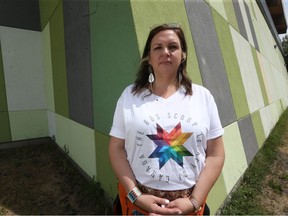
Katherine Strongwind is raising awareness of the 60s Scoop, and is photographed in Winnipeg on June 24, 2023.Photo by Chris Procaylo /Winnipeg Sun
Survivors
of the Sixties Scoop gathered in Winnipeg on Saturday for the Manitoba
Sixties Scoop Conference and share their stories and experiences of
being taken from their families.
“Since the apology of 2015, there
really hasn’t been a bigger gathering of Sixties Scoop Survivors to talk
about some of the issues that we’re still working our way through,”
said 60s Scoop Legacy of Canada Director and spokesperson Katherine
Strongwind. “We’ve had about 23 smaller healing gatherings, mostly in
Winnipeg and some across western Canada and we thought it was really
important to pull everybody together today to say, ‘You know, we are
still here, we’re still healing ourselves.’ The province really needs to
step up their game in terms of really how they’re going to be helping
us.”
The
“Sixties Scoop” refers to the large-scale forced removal or “scooping”
of Indigenous children from their homes, communities and families of
birth through the 1950s, 60s, 70s and 80s, and the subsequent adoption
into predominantly Caucasian, Christian, middle-class families across
Canada, the United States and overseas.
Many
adoptees and Survivors were left with a lack of or poor sense of
cultural identity. The forced physical and emotional separation from
their birth families by the government’s assimilationist policies
continues to affect adult adoptees and Indigenous communities to this
day. Many Survivors had parents, grandparents, and extended families who
were forced to attend Indian Residential Schools.
“The
purpose this afternoon is to pull people together and get some feedback
from them on some of the very specific issues that adoptees and folks
who have been through child welfare have such as name changes, child
welfare records, adoption records, all of those sorts of pieces,” said
Strongwind.
Organizers plan to draft a report for the provincial government but also for Indigenous leaders.
“I’m
not sure (Indigenous leaders) really know what to do with us,” said
Strongwind. “We’re coming home and we’re trying to reconnect our
families and our communities but they don’t always have the best
understanding of how to support us.”
Some 120 Scoop
Survivors attended the one-day gathering. Half of the cost of the
gathering was covered by the provincial government with the remainder
covered by fundraising. City of Winnipeg donated the space at Sergeant
Tommy Prince Place in the North End for the gathering through the
Indigenous Liaison Unit.
“We invited a couple of
speakers to share part of their story this morning and there’s
definitely some similarities among all of us but also we wanted to talk
about inspiring stories and ‘What’s worked best for you on your healing
journey and how can we support each other?’ because so far we don’t have
any kind of healing program specifically for Sixties Scoop Survivors,”
said Strongwind. “So we’re supporting each other.”
Katherine Strongwind.Photo by Chris Procaylo /Winnipeg Sun
In
2015, then-Manitoba Premier Greg Selinger apologized on behalf of the
province. Six years later, the 60s Scoop Legacy of Canada and Manitoba
Senator Murray Sinclair called for a federal inquiry.
“We
still don’t know how many kids were taken, where they were taken to,
where they are now, how many died in care and those kind of pieces,”
said Strongwind on what an inquiry would uncover. “We also know that
people want to share their stories and their testimonies before they
pass away. Over the next year or so, we’ll focus on that but also
gatherings like this are really important to get people together and
learn from each other on how we can support each other on some of these
pieces when we’re not be recognized, we’re not being acknowledged.
“We’re really out here on our own it seems like.”
The
provincial government needs to provide funding for these sorts of
gatherings but also provide a unit or some sort of fund available for
Survivors to be able to access some of the services that they offer such
as the post-adoption registry and child welfare records, Strongwind
said. Even something as seemingly simple as making it easier for
Survivors to legally change back to their traditional names.
“The
province did the dirty work of the Sixties Scoop,” said Strongwind, who
legally changed her name in November. “They were given jurisdiction in
1951 from the federal government and they really took that and ran and
decided they were going to scoop up entire families off reserves and
they thought they were going to make us into upstanding Christian
citizens. In some respects, they were successful but we know that many
of us ending up leaving that lifestyle and our families and ended up
coming home to our biological families and communities. Culture plays a
huge role in our healing.
“There’s all of these sorts of pieces that the province could be helping with but really aren’t.”
City could participate by providing spaces for gatherings and a memorial of some sort.
“All levels of government I feel have a part to play in this,” Strongwind said.
With
some 10,000 Indigenous children in care in Manitoba, Strongwind
believes Sixties Scoop Survivors can have role in preventing a
recurrence of what happened to them.
“We want to use our
experience as best practices to prevent that from happening in the
future,”Strongwind said. “That’s part of the purpose that the 60s Legacy
of Canada works towards every day.”
— a mote of dust, suspended on a sunbeam (@CarlaHolley) December 2, 2022
Sadly, as @r_bergen reports in this piece in June, Jeremy Skibicki was already on the police radar for domestic violence charges. https://t.co/pgS7NdAEht
Alleged serial killer in custody and charged in killings of 4 Indigenous women in Canada, police say
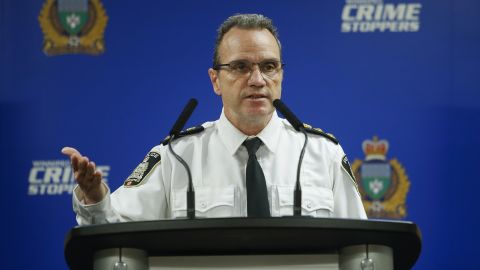
Winnipeg Police Chief Danny Smyth provides an update Thursday to the homicide investigation. John Woods/AP
CNN —
Authorities in Winnipeg, Manitoba, believe the murders of four Indigenous women came at the hands of an alleged serial killer now in custody in Canada.
Jeremy Anthony Michael Skibicki, 35, of Winnipeg, has been charged with four counts of first-degree murder for the deaths of the women, a news release from the Winnipeg Police Service states. It is not clear if he has an attorney.
The investigation dates to May 16, when Winnipeg police shared information on the murder of 24-year-old Rebecca Contois, of the Crane River First Nation, after her partial remains were discovered.
Skibicki was arrested May 18 by the agency’sHomicide Unit and charged with first-degree murder, the release says.
During the investigation, detectives established three more victims murdered between March and May – before Contois’ death.
Morgan Beatrice Harris, 39, is believed to have been killed on or around May 1, and Marcedes Myran, 26, is believed to have been killed on or around May 4. Both women were members of the Long Plain First Nation, according to the release.
A fourth victim also is confirmed but not yet identified. She is believed to be an Indigenous female killed on or around March 15, police said.
And the investigation is not over, Winnipeg Police Inspector Shawn Pike said Thursday during a news conference.
Bodies of those three new victims haven’t been recovered, said Winnipeg Police Chief Danny Smyth, noting police have enough evidence to charge Skibicki in their killings.
“Our officers will continue to search for information with the goal of identifying this fourth unknown victim,” Pike said, adding DNA has helped in their probe without saying how.
Meantime, Winnipeg must better address the safety concerns of the community, Mayor Scott Gillingham said at Thursday’s news conference.
“As a city, we must all grieve their loss and recognize that we have much more work to do to protect the lives of Indigenous women and girls,” Gillingham said.
Skibicki is being held at the Milner Ridge Correctional Centre in Manitoba.
In his Facebook bio, Skibicki described himself as an "official member of 'Holy Europe,'" which is a small faction of a broader far-right movement, an anti-facism expert told CBC last June.
Jeremy Skibicki is now facing four first-degree murder charges in connection with the deaths of four women, including Rebecca Contois, Morgan Beatrice Harris and Marcedes Myran. (Jeremy Skibicki/Facebook)
Support is available for anyone affected by details of this case. If you require support, you can contact Ka Ni Kanichihk's Medicine Bear Counselling, Support and Elder Services at 204-594-6500, ext. 102 or 104, (within Winnipeg) or 1-888-953-5264 (outside Winnipeg).
Support is also available via Manitoba Keewatinowi Okimakanak's Missing and Murdered Indigenous Women and Girls Liaison unit at 1-800-442-0488 or 204-677-1648.
‘Growing up I kind of thought, why am I this lone person…”
Leah Ballantyne was just 11 days old when she was adopted out to a Scottish family in Winnipeg – by the time she was 13, she was already searching for her birth parents.
Riding the bus to school through Winnipeg’s downtown core, she would see Indigenous people and wondered if they were relatives.
“Growing up, I kind of thought, why am I this lone person and adopted into a family? Why didn’t my family want me and what were the circumstances? And as I learned that the ‘60s Scoop was actually a part of a process that started with reservations, and the Indian Act, and residential schools, and day schools,” she says on the latest episode of Face to Face.
“Then I realized that I was part of something that was a separation that was going on through government policy.”
The push to finally find out where she came from came after an event in Vancouver.
She says she was inspired by speeches by former Assembly of First Nations national chief Ovide Mercredi and Mohawk Council of Kahnawake grand chief Joe Tokwiro Norton
After, she went digging into her past.
Ballantyne’s birth mother had registered her for a status number at birth so she knew she was from Mathias Colomb Cree Nation. She wrote the chief at the time, the late Pascal Bighetty, asking for help.
Not long after, Ballantyne received a call from Bighetty, who, as it would turn out, was her uncle, telling her he knew who she was and to come home.
Advocating for her community
Ballantyne says the rally and reunification with her community, a “light went on” and she decided she would push for positive changes in law and policy by becoming a lawyer.
To this day, Ballantyne remains the only member of Mathias Colomb Cree Nation to become a lawyer. She is currently working with her nation on child welfare laws and bringing children home, whether they were part of the 60s Scoop, aged out of the care, or still in care.
Ballantyne is vocal about representation and believes those who falsely claim Indigenous identity, should face criminal charges.
“There is a couple of sections in the Criminal Code of Canada for identity and identity fraud and so Indigenous identity fraud is very much a charge that could be laid by any institution that has addressed this kind of issue and people that are claiming false Indigenous identity,” she says.
“And there is no statute of limitation on this type of identity fraud within the Criminal Code.”
Sixties Scoop survivor hopes momentum builds on National Day for Truth and Reconciliation
Thousands of people in orange shirts flocked to the Canadian Museum for Human Rights SEPT 30 in Winnipeg to honour residential school survivors and the children lost to them.
Leading that march was 7-year-old Tatum Mentuck.
“My grandpa was in residential and I’m walking for him and for all the kids who didn’t make it home,” said Tatum.
The trail of orange shirts made their way down Portage Ave. and ended at St. John’s Park, with powwows going all day.
Lori Abraham is the Indigenous program director at 1justcity – a drop-in centre for disenfranchised people.
Abraham helped organized transportation for those people yesterday and said she was moved to tears by all the people.
“Being a witness for what is happening here today has moved me to understand that our community and our nation is moving forward in compassion and understanding,” said Abraham.
Throughout the day, many survivors told their stories.
“This is just part of a bigger picture of what we’ve lost,” said Marcel French, a ‘60s Scoop survivor. (video)
French says he hopes the sea of orange shirts and momentum from National Day for Truth and Reconciliation continues.
“My hope is that it doesn’t end after today,” he said. “And when they leave here, they can remember in the following days and weeks.
The First Nations Family Advocate Office (FNFAO) is hosting "Bringing Our Children Home" National Conference November 25-27, 2019 with a Gala Event on the evening of November 26, 2019
Marla Gordon says she hopes to travel to Manitoba from Saskatoon to meet her birth mother in person. (Marla Gordon)
A woman born in Winnipeg and put up for adoption as a child is one step closer to meeting her biological mom.
Last month, the Manitoba government pushed through new legislation that makes it easier for children put up for adoption to find out the identities of their birth parents.
Making adoption records publicly available has helped lead Marla Gordon from Saskatoon, where she grew up, back to Manitoba, where she was born, to search for answers about her blood-relatives. It didn't take long before Gordon discovered the name of her birth mother and that she once lived in a home on Coventry Road in Charleswood.
And last week, with a simple call to 411, Gordon came away with a phone number that turned out to belong to her biological aunt. She told Gordon her birth mother would give her a call.
That call came Sunday night, and during the conversation, Gordon learned she also has two full siblings. She and her mom are now arranging a reunion to bring everyone together.
"I was pretty shocked. It hasn't sunk in yet," said Gordon. "I just couldn't believe it after this much time."
Gordon said her mom was 17 when she became pregnant and wasn't in a position to raise her. "I understand why she gave me up, I have no grudge against her or anything," said Gordon. "I think it's a good thing; if you can't take care of a child, it's probably the most unselfish thing to give a baby a better life."
Over the years in Saskatoon, where Gordon still resides, she felt out of place and often wondered who her biological family was.
"I'm so different from my siblings; there was nobody like me," she said.
It was that sense of curiosity, paired with the new legislation, that motivated Gordon's search for answers.
Royden Kading with LINKS Post Legal Adoption said he sympathizes with people like Gordon. He, too, was put up for adoption as a child.
"An adoptee sort of lives a lie all their life," said Kading. "To find out what your background is means a lot to people."
T he Métis National Council and the Government of Canada will be working collaboratively, Nation-to-Nation, to develop a process to engag...
To Veronica Brown
Veronica, we adult adoptees are thinking of you today and every day. We will be here when you need us. Your journey in the adopted life has begun, nothing can revoke that now, the damage cannot be undone. Be courageous, you have what no adoptee before you has had; a strong group of adult adoptees who know your story, who are behind you and will always be so.
OUR HISTORY
BOOK 5: Lost Children of the Indian Adoption Projects