BACK UP BLOG (no longer updating)

This blog was a backup for American Indian Adoptees blog
USE THE SEARCH BAR or SEARCH TOPICS at bottom of this blog

If you need support

Support Info: If you are a Survivor and need emotional support, a national crisis line is available 24 hours a day, seven days a week: Residential School Survivor Support Line: 1-866-925-4419. Additional Health Support Information: Emotional, cultural, and professional support services are also available to Survivors and their families through the Indian Residential Schools Resolution Health Support Program. Services can be accessed on an individual, family, or group basis.” These & regional support phone numbers are found at https://nctr.ca/contact/survivors/ . MY EMAIL: tracelara@pm.me

Search This Blog

Showing posts with label AFN. Show all posts

Sunday, March 10, 2024

‘Appalling’: AFN Chief says Indigenous youth shouldn’t be placed in for-profit care


SOURCE

Assembly of First Nations National Chief Cindy Woodhouse Nepinak says First Nations children shouldn’t be placed with for-profit companies in Ontario’s child-welfare system.

She made her remarks in an exclusive interview with Global News after the broadcast and publication online of a year-long, multi-part investigation that revealed allegations of targeting and mistreatment of Indigenous youth by some group homes.

“That’s appalling to hear,” Chief Woodhouse Nepinak told Global News. “We’ve always known that our kids were a target.

“I don’t think our children should be for-profit at all,” she said.

“It’s time that we give our children back to the people that have cared for them for thousands and thousands of years.”

Chief Woodhouse Nepinak said she would be renewing calls for Prime Minister Justin Trudeau to apologize in the House of Commons to all the Indigenous youth who’ve been wronged by Canada’s child-welfare systems.

“Unfortunately, our kids have been taken away since residential schools, day schools, the ’60s Scoop and now the child welfare system,” she said.

The Global News investigation revealed how Indigenous youth from remote communities in Northern Ontario and Nunavut are allegedly targeted by some for-profit group home companies because their owners can charge more for Indigenous children or because the kids provide a steady source of revenue, according to interviews with more than 50 former group home workers, former children’s aid employees and child-welfare experts.

The results are horrendous experiences some likened to the abuse that took place during the residential schools era, according to some workers, child-welfare experts and youth.

In northern Ontario, Indigenous child-welfare agencies care for kids who have experienced family crises or abuse or who have complex needs.

These agencies serve some of the most resource-starved communities located near the Manitoba border all the way up to Attawapiskat on James Bay, which can lack basic services like housing, running water, or mental health care.

Faced with few options, these Indigenous children’s agencies are often sent to group homes thousands of kilometres away in cities in southern Ontario — separating them from family, friends and culture.

A Global News analysis of spending data by children’s aid societies (CAS) across Ontario revealed that northern Indigenous agencies are paying higher daily fees for such care than their non-Indigenous counterparts.

On average, northern Indigenous children’s aid societies paid 26 per cent more per day for a child to live in a group home, not run by a CAS, compared with their non-Indigenous counterparts between 2012/2013 and 2021/2022.

This discrepancy meant Indigenous children’s agencies in northern Ontario spent nearly $28 million more over 10 years than if they’d been charged the average rate paid by non-Indigenous agencies across the province.

Chief Woodhouse Nepinak called the situation “disgusting.”

“It’s hurtful to communities, it’s hurtful to families, it’s hurtful to the next generation.”

Global News also spoke with multiple former workers from group homes across Ontario who said that staff and management at some companies allegedly referred to Indigenous youth as “cash cows,” “money-makers,” or even “paycheques.”

“It’s disgusting. … How could you label children like that?” Chief Woodhouse Nepinak said. “They’re our children. They’re First Nations children. And to treat them less than is horrific.” 

She said child welfare should be under the jurisdiction of First Nations, pointing to a recent Supreme Court of Canada ruling that upheld the federal government’s Indigenous child welfare law.

VIDEOS AND MORE: https://globalnews.ca/news/10335930/afn-chief-says-indigenous-youth-shouldnt-be-placed-in-for-profit-care

 

Wednesday, December 28, 2022

Advocate asks AFN chiefs to ensure $40B settlement deal leaves no child behind

OTTAWA — A First Nations child welfare
advocate on Wednesday implored chiefs to ensure "no child is left
behind" in a landmark $40-billion settlement agreement with the federal
government.


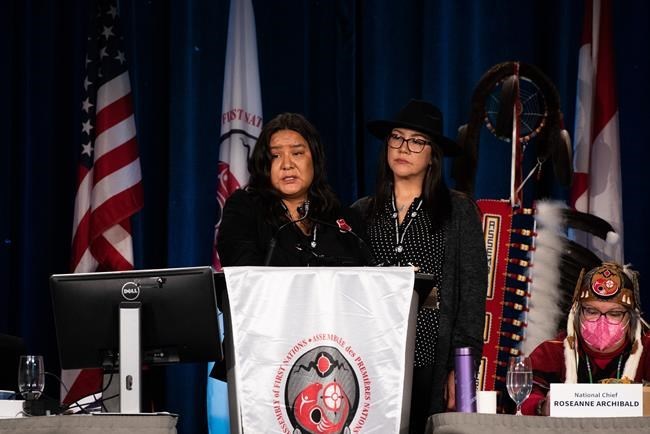
20221207171244-639117adf758715d065bd867jpeg
Karen
Osachoff, left, speaks as Melissa Walterson stands beside her during
the Assembly of First Nations special chiefs assembly in Ottawa on
Wednesday, Dec. 7, 2022.  Chiefs at the assembly heard from the two women
about the harms caused by the child-welfare system and are expected to
vote on how the AFN should move forward with a landmark settlement. [THE
CANADIAN PRESS/Spencer Colby]


OTTAWA — A First Nations child welfare advocate on Wednesday
implored chiefs to ensure "no child is left behind" in a landmark
$40-billion settlement agreement with the federal government.


Cindy Blackstock delivered the message to an Assembly of First
Nations gathering in Ottawa, after being invited to take the stage by
Cindy Woodhouse, regional chief in Manitoba who helped negotiate the
agreement, which had been thrown into question since being rejected by
the Canadian Human Rights Tribunal. 


The AFN, representing more than 600 First Nations across the country,
had asked the tribunal to approve the settlement deal, which would see
the government spend $20 billion to compensate families and children for
systemic discrimination in the Indigenous child welfare system.It would
also spend another $20 billion on making long-term reforms. 


Blackstock, the executive director of the First Nations Caring
Society who first lodged the complaint at the heart of the issue, raised
concerns that the agreement wouldn't provide $40,000 in compensation to
all eligible claimants, which is the amount the tribunal ruled they
should get. 


"We can make sure that in our First Nations canoe of justice, no
child has to see their money go away and no child is left behind in
justice," she said Wednesday. 


"We are capable of that."


Following the tribunal's decision in October, the federal government filed for a judicial review of some parts of its decision. 


Endorsing the settlement agreement loomed as one of the biggest items
on the assembly's agenda, with chiefs being asked to vote on what the
organization should do next. 


The chiefs had been preparing to vote on conflicting resolutions,
with one asking them to support the final settlement agreement, while
another sought to see the organization not appeal the tribunal decision
and renegotiate the deal. 


But on Wednesday, further talks between both sides took place,
assisted by former senator and judge Murray Sinclair, who helped the
AFN, federal government and lawyers for two related class-action
lawsuits reach the $40-billion agreement in the first place, which was
formally announced in January. 


Chiefs ultimately voted late Wednesday against re-entering
negotiations but to instead support compensation for victims outlined in
the agreement and "those already legally entitled to the $40,000 plus
interest under the Canadian Human Rights Tribunal compensation orders."


It also included a provision that AFN leaders must regularly return
to chiefs to provide it with progress updates and "seek direction" from
chiefs on implementing the final agreement. 


Many chiefs thanked Blackstock, who was greeted with applause after
further agreement was met and said she was honoured to see people come
together for children harmed by Ottawa's discrimination. 


"We have had too many apologies, we've had too many compensation
deals, we've had too many kids hurt. And this has got to be it," she
said. 


She added more discussion on the long-term reform part of the deal would be presented to chiefs on Thursday.


Earlier in the day, the assembly heard from sisters Melissa Walterson
and Karen Osachoff, plaintiffs on the case, about the impact the foster
care system had on their lives. 


Osachoff said she had been in the child welfare system since she was born and didn't have a chance to grow up with her sister. 


"Had it not been for the '60s Scoop and the child welfare (system), her and I would have grown up together."


She said she understands why the tribunal characterizes those like
her as "victims," but told chiefs to instead think of them as survivors.


"I am not a victim and our claimants are not victims."


This report by The Canadian Press was first published Dec. 7, 2022.


Wednesday, December 8, 2021

AFN postpones trip to meet Pope, plans to file complaint with UN

A trip that Indigenous leaders were supposed to take to Rome later this month for a meeting with the Pope has been postponed because of the pandemic, said RoseAnne Archibald, National Chief for the Assembly of First Nations, on Tuesday.

Leaders with the Assembly of First Nations (AFN) were scheduled to meet with Pope Francis on Dec. 20 to seek an apology for the Roman Catholic Church’s role in running residential schools. The Métis and Inuit were supposed to meet the Pope earlier that week.

Hundreds of unmarked graves were discovered earlier this year at former residential schools across the country. The schools — sponsored by the government and mostly run by the Catholic Church — were set up to assimilate Indigenous youth into Canadian culture by removing them from their families and communities. Many Indigenous children were abused and/or died at the schools.

In September, the Canadian Conference of Catholic Bishops apologized for “grave abuses that were committed by some members of (the) Catholic community” at the schools.

Archibald told First Nations leaders who’d gathered virtually for three days that the AFN has asked the church to: return diocese lands to Indigenous Peoples; increase the $30 million the church announced in September for long-term healing; and encourage the Pope to meet with Indigenous leaders on traditional lands when he visits Canada. The Pope has agreed to meet with Indigenous Peoples when he travels to Canada, but no date has been set for his visit.

Archibald went on to tell attendees that the AFN plans to hold the government to account for forcing Indigenous children to attend residential schools.

“We continue to call for accountability,” she said. “Someone must be charged for the deaths of our children. There must be examinations to determine if our children were murdered. Canada must be held to account, and they have to be held responsible for their genocidal laws and policies.”

Archibald said Canada shouldn’t be allowed to investigate itself, and that the AFN would be reaching out to the Special Rapporteur on the Rights of Indigenous Peoples to file a human-rights complaint, and to pursue remedies “for the victims of genocide.”

“We need to know the truth before we can walk the road to reconciliation,” she said.

SOURCE

Thursday, July 22, 2021

BACKGROUND: painful month for Canada's Indigenous communities

 HERE AND NOW | JULY 0, 2021 | BACKGROUND

Indigenous Kids' Bodies Recovered — Not Discovered, Says Canada's Assembly Of First Nations Chief


It’s been a painful month for Canada's Indigenous communities.

RoseAnne Archibald was recently elected Canada's first female national chief of the Assembly of First Nations, leading more than 900,000 Indigenous people in 634 First Nations Communities.

Just days later, another 160 unmarked graves were uncovered at a former Indigenous residential school site on a Southern Gulf Island off of British Columbia. This discovery adds to the more than 1,000 graves believed to contain remains of children forcibly taken from their families and housed in the so-called schools from the late 1880s to the 1990s.

Survivors describe horrific mental and physical abuse at the sites, including the prohibition of any Indigenous cultural practices such as the use of their own languages.

“I don’t like to call them schools — they were institutions of assimilation and genocide,” Archibald says. “And our survivors said that for the longest time they were told stories of the deaths and murders that happened in these schools.”

The investigation and location of the mass graves were conducted with the use of ground penetrating radar technology.

Less than a week ago, members of the Tk’emlúps te Secwépemc First Nations held a day of testimony about the findings at the Kamloops Residential School in British Columbia where the remains of 215 children were discovered in late May.

“It was extraordinarily emotional and heartbreaking,” Archibald says. “And as I was sitting in the room, I was watching other people and many of them were triggered into their old trauma.”

Archibald describes the powerful testimonies by elders who were only 5 or 6-years-old when they were taken to the schools, eliciting tears from fellow survivors in the audience. Many survivors still suffer from post-traumatic stress disorder, she says.

“That’s where the majority of Canadians have been deeply affected by this,” Archibald says, “because they see their own children and they understand that now, No. 1, that genocide did happen in Canada and that our children were targets of that.”

"I don’t like to call them schools — they were institutions of assimilation and genocide."

RoseAnne Archibald, national chief of the Assembly of First Nations

Elder Evelyn Camille, a survivor of the Kamloops boarding school, said that fellow students had attempted to warn the authorities about the atrocities against children at the schools but their words fell on deaf ears.

“We tried to mention over, and over, and over, ‘there are many children missing,’ ” she told the audience. “Many of our children tried to cross the river to swim across, many were lost in the water, many of our children who ran away during the winter froze to death on their way home. The black robes start lying about the children.”

Archibald says cultural genocide — the refusal to let kids speak their own languages — was one aspect of the abuse. One survivor told her about being forced to eat soap. Others were beaten.

But she says there were also horrific examples of physical genocide that the children were forced to witness.

“One of the worst stories I heard was a survivor saying that babies were put into incinerators in the schools,” she says. “These are crimes against humanity and crimes against children.”

It’s important that people hear about these atrocities, she says, because truth must proceed reconciliation. As Canadians learn and process this chapter in history, she says survivors can focus on healing the intergenerational trauma they experience.

And the government, she says, needs to be part of the healing by creating programs that provide funding and resources to the community.

“Reparations have to happen to communities [and] to families right across Canada,” she says. “When you think of mental health and addiction issues, almost all of that comes out of the colonization experience, particularly the fact that every family has just had to send their children to school.”

Archibald points to the research of Dr. Pamela Toulouse who says that 100% of First Nations people suffer from intergenerational trauma.

“That’s the impact of these institutions,” Archibald says.

Shoes, flowers, and stuffed animals sit outside the former Kamloops Indian Residential School where flowers and cards have been left as part of a growing makeshift memorial to honour the 215 children whose remains have been discovered buried near the facility in Kamloops on June 5, 2021. (Photo by Cole Burston / AFP) (Photo by COLE BURSTON/AFP via Getty Images)

Archibald is calling for an independent criminal investigation into the church organizations that operated these institutions. She says the investigation should also delve into the role of the Royal Canadian Mounted Police in removing the children from their families and policing the schools.

As to what she wants from a criminal investigation, she says the answer is simple: “justice.”

“That’s what these children deserve,” she says. “It is the government of Canada that has to be accountable for this.”

So far the remains of more than 1,600 children have been located, and she anticipates that “thousands upon thousands more” will be located as investigations continue.

Because she says there’s a conflict of interest in Canada investigating its own wrongdoing, Archibald and the Assembly of First Nations want outside help from the United Nations International Criminal Court.

Another issue for First Nations survivors is the complicity of the Catholic church in the operation of the schools, Archibald says.

A First Nations delegation will be headed to the Vatican this December to meet with Pope Francis, who has not apologized for the church’s role. Archibald has said she would not participate in the trip.

“We need more than an apology. We need reparations. We need justice,” she says. “We’re not going to get that by having a lovely visit with the pope in the Vatican.”

Since the first graves were discovered in May, at least five Catholic churches were set on fire in protest.

“I get it, there is so much hurt,” Archibald says. “You’re talking about thousands of children.”

She explains Canadians need to do more than destroy or burn the symbols and edificies of colonization. The entire system needs to be decolonized, she says.

“First Nations need to live in a world that our spirituality, that our culture and our language are respected and lifted up,” she says. “This whole genocide process was about destroying everything about us — including taking the lives of our children.”

What needs to happen now, she concludes, is to address the systemic issues that affect Indigenous people — racism, hatred and condescension.

“We can lift each other up,” Archibald says, “and live in a world where everyone is safe and loved and respected and deemed worthy.”


Karyn Miller-Medzon produced and edited this interview for broadcast with Todd Mundt. Camila Beiner and Miller-Medzon adapted it for the web.

CLICK OLDER POSTS (above) to see more news

CLICK OLDER POSTS  (above) to see more news

MEGWETCH THANK YOU

HUGE Thank you for visiting this blog and sharing this with your kin. It's appreciated. Contact Trace anytime! Use the form below.

BOOKSHOP

Please use BOOKSHOP to buy our titles. We will not be posting links to Amazon.

Popular Posts

To Veronica Brown

Veronica, we adult adoptees are thinking of you today and every day. We will be here when you need us. Your journey in the adopted life has begun, nothing can revoke that now, the damage cannot be undone. Be courageous, you have what no adoptee before you has had; a strong group of adult adoptees who know your story, who are behind you and will always be so.

OUR HISTORY

OUR HISTORY
BOOK 5: Lost Children of the Indian Adoption Projects