This blog was a backup for American Indian Adopteesblog
USE THE SEARCH BAR or SEARCH TOPICS at bottom of this blog
If you need support
Support Info: If you are a Survivor and need emotional support, a national crisis line is available 24 hours a day, seven days a week: Residential School Survivor Support Line: 1-866-925-4419. Additional Health Support Information: Emotional, cultural, and professional support services are also available to Survivors and their families through the Indian Residential Schools Resolution Health Support Program. Services can be accessed on an individual, family, or group basis.” These & regional support phone numbers are found at https://nctr.ca/contact/survivors/ .
MY EMAIL: tracelara@pm.me
A
small group of community members met at the Minneapolis American Indian
Center in July to share information about how adopted adults can claim
items left for them by their birth parents.
The conversation about
the ability to retrieve personal effects came to the forefront with the
law that went into effect July 1 — where birth records held by the
state can be obtained by adopted adults.
The Northfield History Center has repatriated a number of items from its collection to the Prairie Island Indian Community.
The
Northfield History Center voluntarily invited the Prairie Island Tribal
Historic Preservation Office (THPO) to review its collection and then
took steps for the THPO to take immediate possession of the items. In a
process that has been historically fraught with difficulties for tribes,
the willingness of the Northfield History Center made it a positive
experience and cemented a foundation for future collaborations between
the two entities.
“Oftentimes, it’s a
struggle to get some of these objects returned so whenever we have a
volunteer and cooperating partner, it makes the process so much easier
and in this instance, we found a true partnership that we are building
upon with our friends over at Northfield History Center,” said Franky
Jackson, Prairie Island’s tribal historic compliance officer.
The
Northfield History Center announced Nov. 18 that its Board of Directors
approved the deaccessioning of the items. The items are sacred Native
American items that have significance to local Indigenous people,
according to the announcement.
“These items
have been in the Northfield History Center collection for many years,
but they do not belong to the Northfield community. They belong to the
people that lived in this area long before us, and that made and used
these items,” Executive Director Sean Allen said in a statement. “Today
we are proud to be able to repatriate these important pieces to their
rightful owners and to build a lasting partnership with the Prairie
Island Indian Community.”
New federal rules
It’s
important to tribes to identify which institutions have their items and
which people within the tribe can benefit from having the items
returned, Jackson said.
“When it comes to
our sacred items, this is part of how we heal our hoop. This is part of
how we heal our communities, is by capturing and bringing home these
sacred items that help us with our ceremonies,” Jackson said.
Repatriation
is also related to the tribe’s cultural revitalization. It’s “crucially
important” for Prairie Island’s artists to have access to the items to
have a connection to their relatives’ handiwork, carry forward the
artistry and pass it down to next generations, Jackson said.
“That’s
a big part of what we’re doing with our Tribal Historic Preservation
Office here. As we accession in items, it’s our goal to allow our
community-based artists to have access to those items,” Jackson said.
The
process for institutions to repatriate items to tribes is regulated by
the federal Native American Graves Protection and Repatriation Act
(NAGPRA) of 1990,which requires institutions that receive
federal funding to transfer Native American human remains and objects of
cultural patrimony to lineal descendants and culturally affiliated
tribes. Despite the law, thousands of Native American human remains and
artifactsremained in museums.
Arevision of NAGPRA went into effect in Januarythat
streamlines the repatriation process, gives tribes the power to define
what is a sacred object and gives tribes more jurisdiction over the
institutions’ use of human remains and objects. It also requires
institutions to inventory all of their Native American artifacts within
the next five years.
Under the revised
law, an institution has 90 days to respond once a claim has been filed.
Prior to the change in January, "institutions could drag their feet and
take as long as they wanted. In some instances, it has taken us
literally years to reconcile some items,” Jackson said.
An
example of that is the noose that was known as the Mankato Hanging Rope
in the Minnesota Historical Society’s collection. The noose was used in
the hanging of Wicanhpi Wastedanpi (Good Little Stars) on Dec. 26, 1862
in Mankato as part of the largest mass execution in U.S. history. TheMinnesota Historical Society returned the nooseearlier
this year after Prairie Island submitted a claim under the new NAGPRA
rules. The repatriation of the noose this year came after Dakota tribes’
“11-year struggle” to have it returned, Jackson said.
“With
some of the new legislation that took place with the law, that
strengthens the tribal voice when it comes to certain things and it
allows us to have this done in a way that’s timely for us,” Jackson
said.
Often, Prairie Island learns of an object belonging to the tribe when a museum contacts the THPO or theobject is put up for auctionto the highest bidder. Both can be a “tumulteous” process for the tribe, Jackson said.
Museums
who received the federal funding appropriated by Congress during the
Covid-19 pandemic are now required to inventory their collections under
the revised law. The Prairie Island THPO is seeing an influx of
inquiries from institutions across the United States to review items in
their collections that they believe belong to Prairie Island. Noah
White, Prairie Island’s tribal historic preservation officer, estimates
they’ve heard from 30-35 institutions since the beginning of the year.
“Nobody ever really reached out to us in the past. We’d always find out from a different source,” White said.
After
Prairie Island’s struggles to reclaim items, they had “jubilation and
excitement” when the Northfield History Center reached out and the THPO
was able to easily bring the items home, Jackson said.
“They
looked within their collection, identified some items that they knew
were going to be controversial, some that may have fallen under the
federal definition of that law, and they were proactive,” Jackson said.
The process with the Northfield History Center moved quickly.
“They rolled the doors open. They greeted us, they were very welcoming,” Jackson said.
After
Allen and the Board of Directors reached out, the Prairie Island THPO
visited the Northfield History Center to inventory its collection and
identified several items that met the definition as a sacred object or
object of cultural patrimony under NAGPRA, Jackson said.
Prairie
Island had to formally file a NAGPRA claim on the items, but on the
THPO’s second visit, the Northfield History Center established a
temporary loan agreement to allow the THPO to take possession of the
objects immediately.
“That is very rare. That doesn’t happen often,” Jackson said.
When
a tribe reviews a museum’s collection and identifies items it wants
returned, it can create a lot of “anxiety” and “angst” for the tribe,
Jackson said.
“To have this institution
introduce a loan agreement as part of the solution just demonstrated
beyond measures that they had more than a passing interest to return
these objects to the appropriate people,” Jackson said. “That really
demonstrated that we have a trusted partner at the table that wanted to
do the morally right thing.”
Repatriated items
Most
of the items that were returned by the Northfield History Center will
be held by the tribe as objects of cultural patrimony, meaning that they
belong to the broader tribe, Jackson said.
The
items included two large ceremonial headdresses made of eagle feathers,
handmade beads and other materials, according to the Northfield History
Center. The headdresses are “exquisite,” Jackson said. The repatriation
helps bring those items back into the Prairie Island community so they
can view them and learn the story of the repatriation, he said.
Some of the objects are considered sacred and won’t have public access, he said.
There
were several “wonderful and beautiful” sacred pipes in the collection,
Jackson said. The provenance on some of the pipes was detailed and the
THPO was able to identify the families to whom the pipes need to be
returned.
“That’s a wonderful, wonderful
experience for us to be able to work with this institution to be able to
find that pathway home for some of these objects,” Jackson said.
Prairie
Island is also working with several other museums in Minnesota on
voluntary repatriation and to create repatriation policies. The
cross-cultural exchange and collaboration with the Northfield History
Center shows what’s possible. Prairie Island plans to collaborate with
the history center on its exhibits and history center staff plans to
visit Prairie Island to see their collection and buffalo herd, Jackson
said.
“The partnership with Northfield is going to go much deeper,” he said.
More than 2,800 Minnesota adoptees
have already requested copies of their original birth records. Very few
are finding contact preferences from their birth parents.
MINNETONKA, Minn. — From the moment a law change
gave Minnesota adoptees the right to access their original birth
records, Lisa Belknap knew she'd be applying the first chance she got.
She just never imagined it would arrive in her mailbox on her birthday.
"I'm shaking," said Belknap, who invited KARE11 to be there as she
opened her birth record. "I thought... just how remarkable that is, to
get your birth certificate on your birthday, for the first time. The
real one."
Like many Minnesotans who were involved in closed adoptions, Belknap
spent most of her life with very little information about her birth
parents. Limited information about their medical history, along with a
few baby photos from her six weeks in foster care, were her only clues
to her past.
But while she always wondered where she came from, she wants to make
it clear that she never wondered who her family is. She was quickly
adopted by loving parents, and an older brother.
"Do they feel uncomfortable about the fact that I might find my birth
family? Absolutely not. No," Belknap said. "I think the main thing my
parents have always been concerned about is what I might find."
Birth Parent Contact Preference
Because any Minnesota adoptee who is 18 or older can now request
their birth record and attempt to find their birth parents, the state
spent a year trying to publicize the changes and give birth parents a
chance to offer their contact preferences.
"We asked them to fill out a Birth Parent Contact Preference form,"
said State Registrar, Molly Mulcahy Crawford. "There's a space where
they can share anything they want. Maybe their address, maybe how to get
ahold of me if they want contact, maybe to explain why I don't want
contact."
Despite those efforts, and a potential pool of 175,000 Minnesota
adoptions, fewer than .5% of birth parents have returned that form in
the last year.
Mulcahy Crawford: "In total, we've received 377 birth parent contact preference forms."
Erdahl: "Do you know how many said? Yes, I can be contacted versus I prefer not to?"
Mulcahy Crawford: "It's about 50/50, but regardless of that
preference, if an adopted person makes a request under the new law,
they're going to get a copy."
Erdahl: "In other words, noboby can stop them from still contacting them."
Mulcahy Crawford: "Right."
Please Respect My Request
Despite the minuscule odds of encountering one of those forms, Belknap found one tucked behind her birth certificate.
"She marked that she prefer not to be contacted at this time," she
said, with tears in her eyes. "And she wrote, 'Just please respect my
request of no contact.'"
As a mother herself, it's a request she can't fathom.
"One of the probably most profound moments of my life was when my
daughter was born and I just remember looking at her and that was the
first person in my entire life that I had a biological connection with,"
Belknap said. "It's disappointing to know that there's that much
forethought into not wanting to know me."
Searching for Clues
Knowing her birth mother's preference didn't stop Belknap from trying to find her online.
"It's not her choice anymore," she said. "She made her choice for me
when I was a baby and I didn't have a say in that. As an adult now it's,
it's my decision on how I wanna handle this."
Within just a few minutes of searching Facebook, Belknap and her
husband were very confident that they had found her birth mother.
"She seems to be a really proud grandma," Balknap said, looking
through several photos publicly available on Facebook. "I can relate
because my mom is really proud of my kids too."
That realization is a major reason why her search stopped there.
"I don't think I would be true to myself if I disrespected her
wishes," Belknap said. "As much as I want to, my parents didn't raise me
to be that way."
Still a Gift
Despite her disappointment in her birth mother's reply, Belknap says she's still grateful for her records.
"Any information to connect me to my past is a gift," she said. "What
I would want birth parents to know is - at least for me as an adoptee
and other adoptees that I've spoken to - is we're not trying to get
something from someone. I think most people just want to know their
origin story."
For more information on the state law change, and how to request birth records, click here.
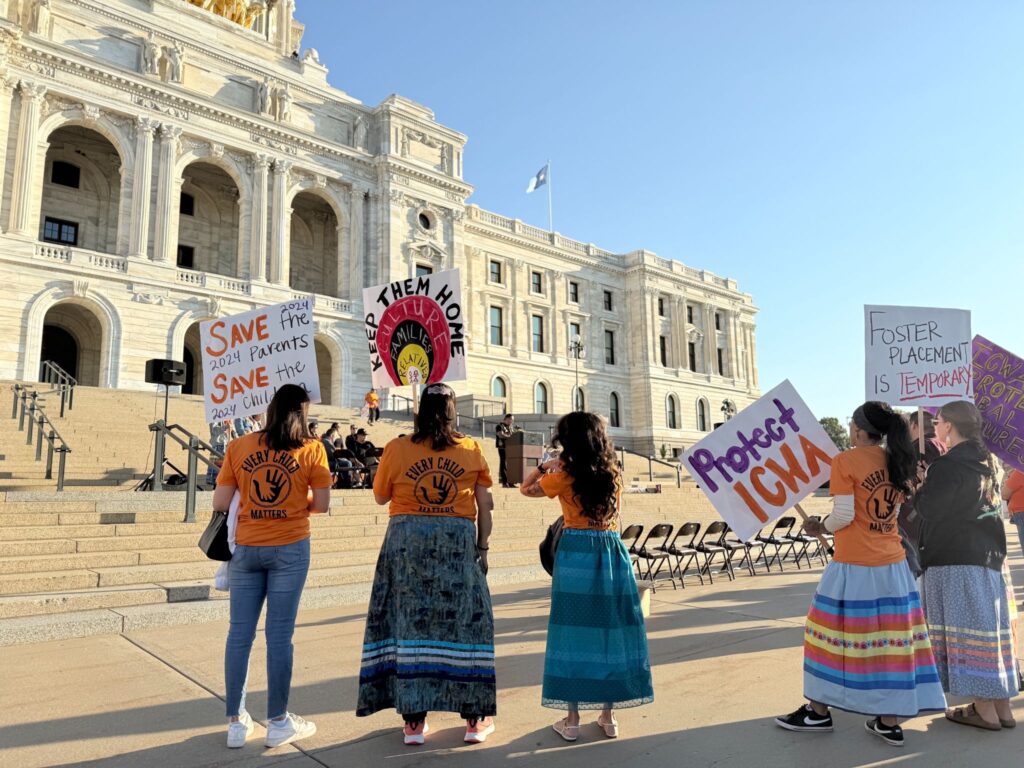
As rally preparations were underway, early arrivals showed their support for ICWA with signs in hand. Photo by Alex Perez.
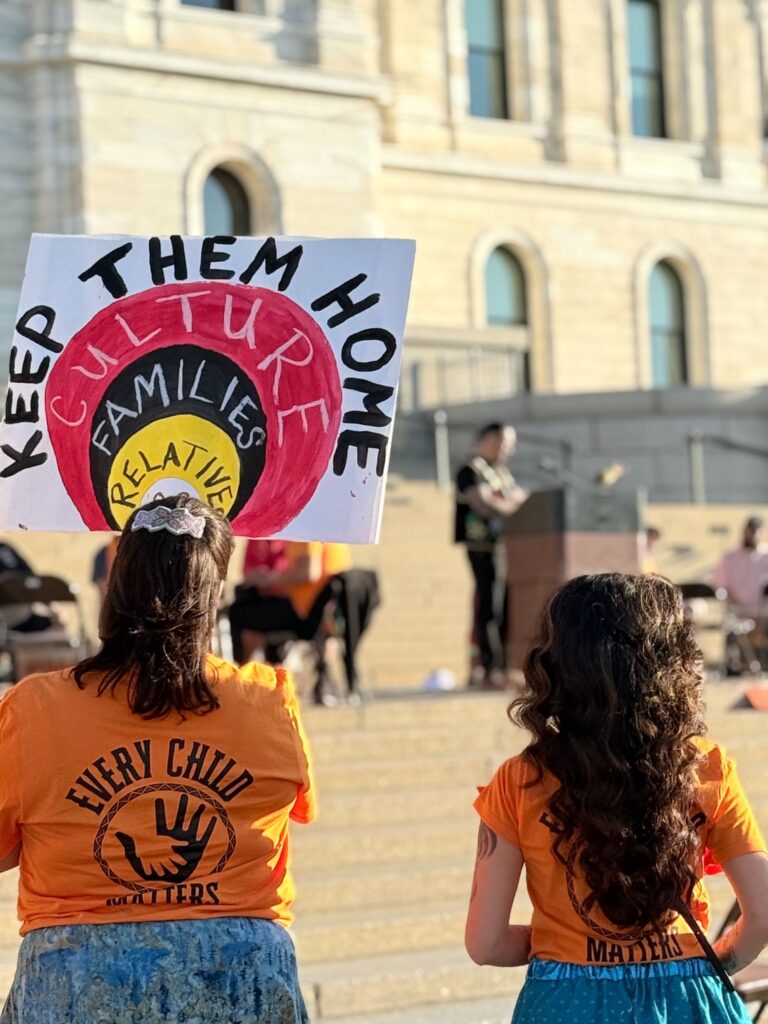
Amid drums, smudging and chants to “bring our
children home,” supporters of the Indian Child Welfare Act gathered
early this morning outside the Minnesota Capitol building, as the
state’s highest court considered the latest legal threat to the bedrock
1978 law.
The rally outside the Supreme Court today was deeply personal for
Korina Barry, of the Leech Lake Band of Ojibwe. After losing her
siblings to foster care, now she worries that her 2-year-old daughter
could be taken from her by child welfare workers.
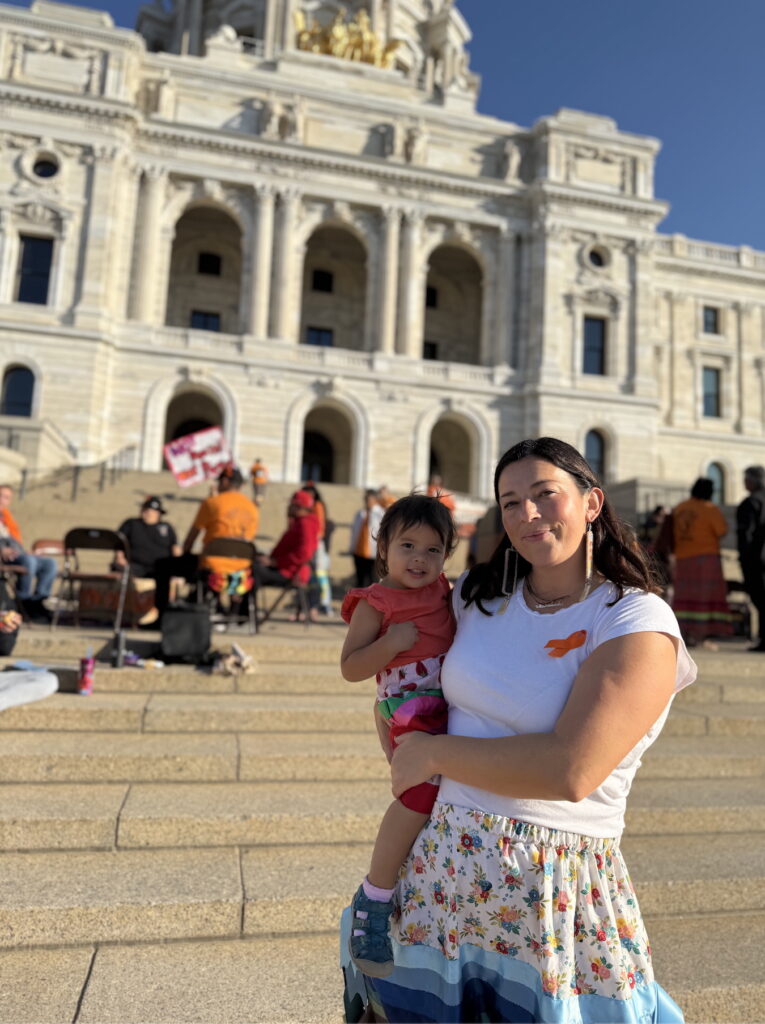
Korina
Barry and her daughter joined those rallying in support of the Indian
Child Welfare Act and the Minnesota Indian Family Preservation Act.
Photo by Alex Perez.
“For me that trauma is very real,” she said. “And that’s why I’m here
because we should be pushing back against these attorneys who are
challenging ICWA’s constitutionality.”
A crowd of more than 50 people attended what became part celebration,
part protest — including state lawmakers, activists, mother-daughter
pairs and county workers, some wearing regalia and dancing, others
pushing strollers.
“We’re all part of the solution,” state Rep. Heather Keeler, a member
of the Yankton Sioux Tribe, told the assembled. “If we’re mad that
Native children are getting placed outside of our homes, that means we
need more of us to step up — it’s a job for the entire community.”
Keeler, in an orange dress, joined others wearing the color to mark
Canada’s Indigenous holiday marking National Day for Truth and
Reconciliation, which commemorates survivors of Indian boarding schools
and their descendants.
Rose, a young Lakota woman, said she showed up to dance for children
“dealing with generational trauma.” Tamra Edwards, who works with
Minnesota’s ICWA Guardian Ad Litem program described herself as an
“ally,” working “to keep children with their families and relatives.”
Red Lake Nation case
Inside the Capitol building later that morning, Supreme Court justices heard oral arguments in the case named
for parents L.K. and A.S., which centers on two Red Lake Nation foster
children. The case is before the state supreme court following a June appeals court ruling.
Plaintiffs Kellie and Nathan Reyelts of Fairmont, a white couple,
seek custody of twins who now live with their maternal grandmother.
The Fairmont couple say they should have custody of the twins, who
lived with them for more than a year shortly after they were born in
2022. Their legal argument centers on a constitutional challenge to the
Indian Child Welfare Act, as well as the local version of the law, the
1985 Minnesota Indian Family Preservation Act, or MIFPA.
“What
ICWA was all about was because our country had proceeded along a path
designed to disrupt the tribes. It’s about the tribes being able to
control their future and their children.”
– Minnesota Supreme Court Justice Natalie Hudson
The justices did not rule from the bench today. A lower court has already struck down
the couple’s claim that the two laws — which seek to ensure the
preservation of tribal families — discriminated against them because of
their white race.
The Fairmont couple, who have fostered more than 30 children, are
represented by the same attorneys who took a similar challenge all the
way to the U.S. Supreme Court in the Brackeen v. Haaland case. Thus the case is being closely watched by legal experts across the country.
The Reyelts’ attorney, Mark Fiddler of the Turtle Mountain Band of Chippewa Indians, has devoted much of his legal career
to dismantling the 45-year-old ICWA law. In this case — similar to
Brackeen v. Haaland — his clients are white foster parents who allege
that ICWA’s provisions are discriminatory. In a previous interview,
Fiddler said when the twins went to live with their relative, they “were
harmed by ICWA by being removed from a loving home where they were
thriving.”
The Reyelts continue to request the children be returned to their
custody. Arguing on their behalf alongside Fiddler is attorney Timothy
Sandefur, the vice president of legal affairs for Goldwater Institute.
The Arizona-based Libertarian think tank has opposed ICWA in more than a
dozen cases since 2015.
They are opposed in court by attorneys for the Red Lake Nation, and the Minnesota Attorney General.
They’re joined by the biological mother of the two children at the
center of the case. She is being named only by her initials, L.K., to
protect her confidentiality.
But a statement sent by her attorney Ryan Gustafson reads:
“The Mother wants it to be known that she is grateful for the
protections of the Indian Child Welfare Act and the Minnesota Indian
Family Preservation Act. She recognizes that these laws have helped her
Native community and its children, both in Minnesota and elsewhere.”
Gustafson further stated that “the children’s Mother agrees with her
tribe and the state of Minnesota that ICWA and MIFPA are constitutional”
and remains opposed to the current attempts to dismantle them. She said
remaining with her children’s relatives is in their best interests and
they are thriving, even as “this litigation has dragged on.”
In oral arguments, the Minnesota Supreme Court justices queried both
sides intently, at times having heated debates during the hour-long
proceeding.
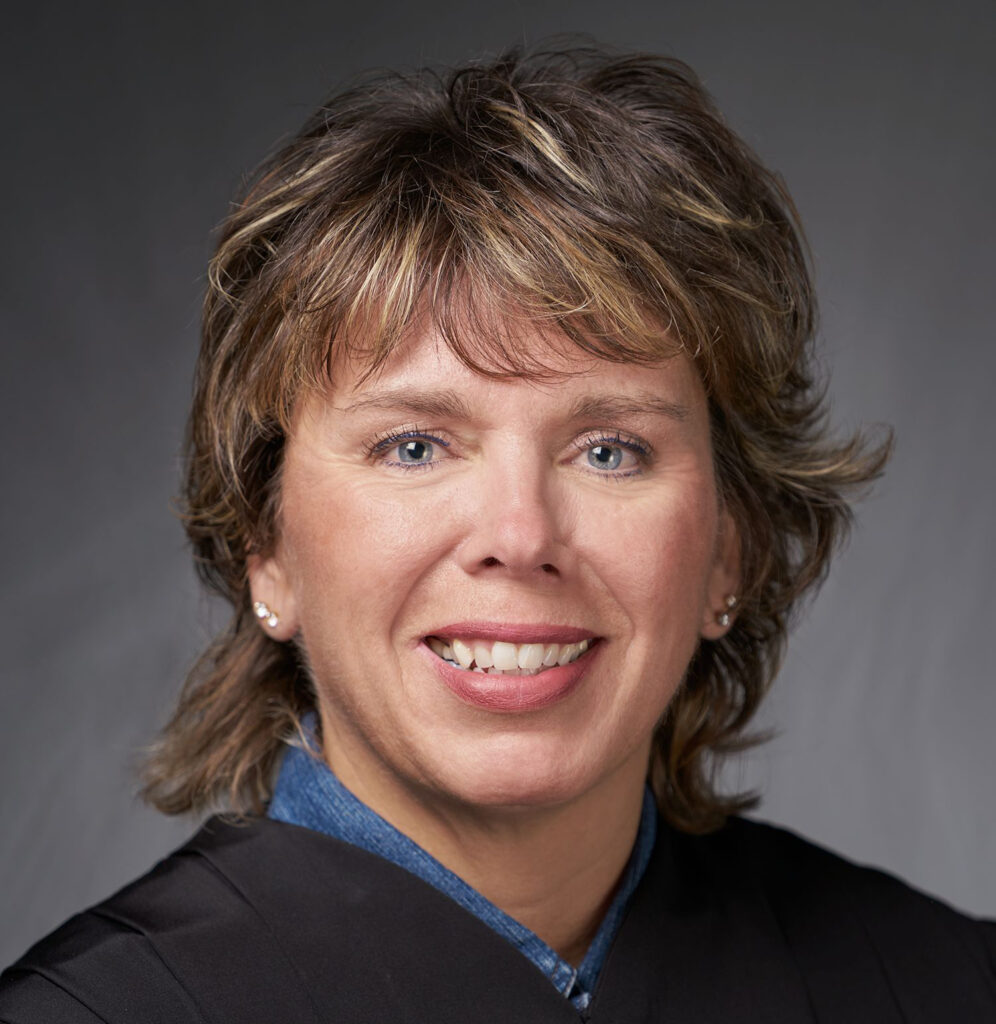
Minnesota Supreme Court Justice Anne McKeig. Provided photo.
Chief Justice Natalie Hudson and Associate Justice Anne McKeig, a descendant
of the White Earth Nation, questioned Sandefur on a number of his
arguments. There was particular focus on whether his clients, the
Reyelts, had “standing” in the case — in essence, whether they had
grounds to bring the constitutional issue before the court.
McKeig wondered aloud whether ICWA opponents had larger aims — and
were using the state court as an “avenue to try to get the issue of
constitutionality of the Indian Child Welfare Act before the United
States Supreme Court.”
The justices also debated why the court should, or could, review the
challenge to the U.S. Constitution’s equal protection clause, based on
the claim of racial discrimination before the court today. Both ICWA and
MIFPA grant special status for people who are members of tribes or who
are eligible for membership, not because of their race, but because they are citizens of sovereign nations within this country.
In his opening remarks, Sandefur said due to ICWA and MIFPA, his
clients “compete on an unequal playing field when they pursue their
custody petition, and they are currently injured because of this pending
matter.” He maintained that the laws were based on “biological” and
“immutable characteristics determined by the accident of birth.”
Justices Hudson and McKeig repeatedly challenged that assertion.
“Your argument appears ahistorical to me, when you’re talking about
federally recognized sovereign tribes,” Chief Justice Hudson said.
“There is a history there that we cannot ignore, but I hear you
minimizing that history.”
Sandefur shot back: “These children are citizens of the United States
and citizens of the state of Minnesota,” Sandefur said, “and they are
entitled to the same equal protection rights as all other children.”
Hudson had another quick retort:
“But that undercuts the whole purpose of ICWA,” she said. “What ICWA
was all about was because our country had proceeded along a path
designed to disrupt the tribes. It’s about the tribes being able to
control their future and their children.”
Attorney Joe Plumer, representing Red Lake Nation said that to date,
the Reyelts have not been granted standing by lower courts, have been
unable to establish any injury, and have not explained how the bench
could redress their grievances.
Like some of the justices, Plumer pointed to the appearance of a
larger aim sought by the plaintiffs, one that goes well beyond the best
interests of the Red Lake Nation twins.
“We believe the appeal on the constitutionality should be dismissed
because it’s not properly before the court,” Plumer said. “This Court’s
not in the business of issuing advisory opinions, and that’s exactly
what they would be issuing.”
ICWA supporters vow to fight on
Dozens of ICWA supporters who rallied in the early morning on a
bright and windy day say they will be watching intently for the state
Supreme Court’s decision, which is expected in the coming months.
Rep. Keeler said her Native-rich state continues to be a battleground
for opponents of the laws that preserve Indigenous families, and she
pointed to the toll that takes.
“Minnesota is a stomping ground for cases against ICWA and it’s just
really exhausting and harmful,” Keeler said in an interview.
Dozens
of ICWA supporters rallied today outside the Minnesota state Supreme
Court, after Fred Desjarlait led them in prayer. Photo by Alex Perez.
Those who gathered alongside her wore orange to honor Phyllis Webstad,
the inspiration behind the “Orange Shirt Day” campaign and ongoing
efforts to honor and preserve the legacy of boarding school survivors.
Their centuries-long history is closely connected to the forced removal
of tribal children into white foster and adoptive homes.
Webstad’s orange shirt movement is represented by a wound she
suffered. Her grandmother gave her an orange shirt to wear on her first
day at the Canadian boarding school that she was forced to attend. It
was snatched from her the day she arrived. That shirt never made its way
back to the family.
Rep. Alicia Kozlowski, who is of Ojibwe descent, and state Sen. Mary
Kunesh, who is of Standing Rock Lakota descent, also attended the rally.
“When they come to us and say ICWA and MIFPA are unacceptable, we
have to fight back and educate them — it’s not a racial issue,” Sen.
Kunesh told the crowd gathered on the Capitol steps.
Some of the assembled came to honor family members who they’ve lost
contact with in the child welfare system, and to reflect on ongoing
attempts to erase Indigenous culture. Chairman Faron Jackson of the
Leech Lake Band of Ojibwe noted his personal loss.
“My brothers were in foster care — taken away from our families
before ICWA was established,” he said. “That law was put in place to
keep our families together, learn the language, learn to trap, learn to
hunt.”
Now, it’s up to supporters to teach the public on the vital importance of the law, he added.
“We’re going to keep educating and we’re going to talk about things
that are important to us — and most of all, we’ll never leave our
children behind.”
Oct. 1 correction: This story has been revised to clarify that the twins’ current placementis with their maternal grandmother.
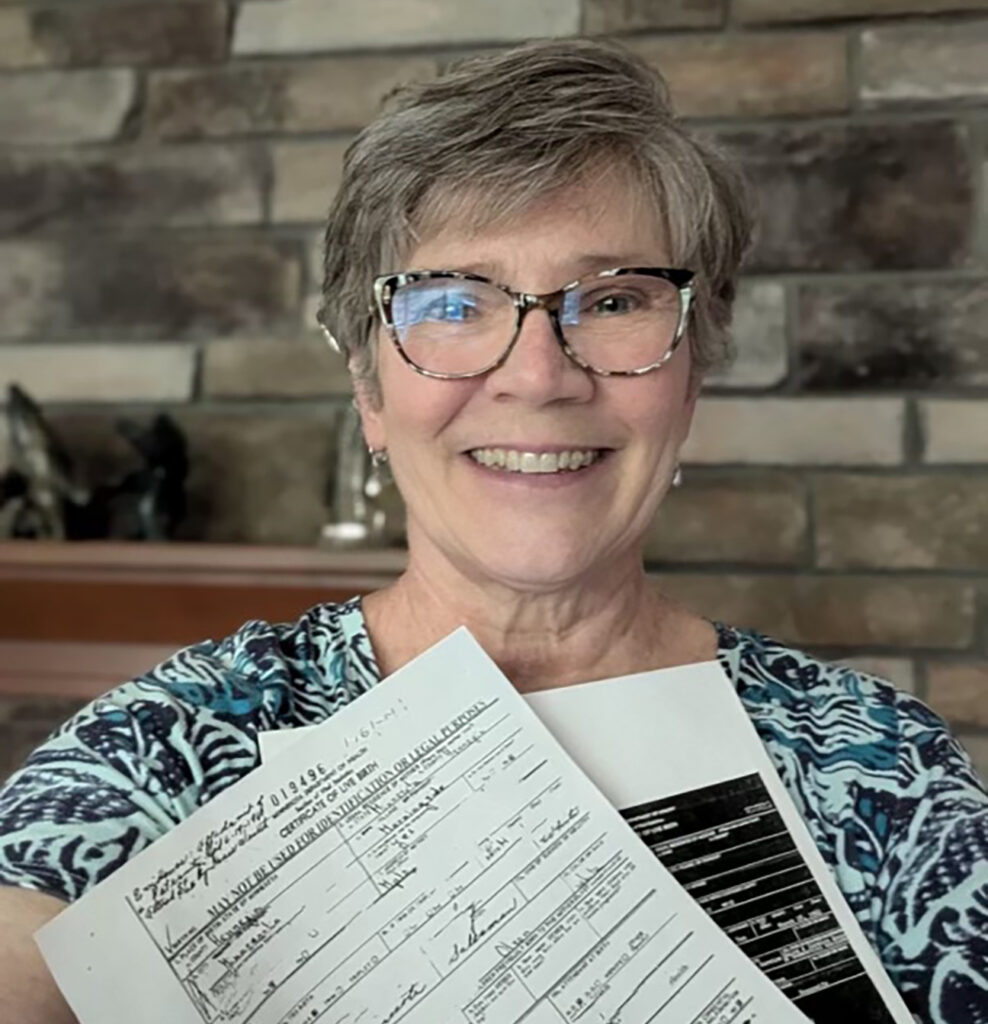
Sheri
Sheeks quickly obtained her original birth certificate under
Minnesota’s new law. (Note: some personal information on the document
has been digitally redacted.) Provided photo.
For decades, U.S. adoptions were steeped in
secrecy — private arrangements struck between parents and caseworkers.
Pre-adoption birth certificates sealed in government archives often left
the origin stories of adoptees undisclosed and inaccessible.
Finding long-lost relatives through DNA testing and social media have
upended that legacy. But confidentiality laws across the country have
not kept pace.
This summer, following decades of advocacy, Minnesota joined a
growing number of states lifting all restrictions. Since enactment of a
new law July 1, thousands of adoptees born in the state have received
vital records that contain the once-concealed details of their birth. As
of August 30, Minnesota’s Office of Vital Records had processed all
2,349 requests it had received, according to a spokesperson.
Sheri Sheeks, a 63-year-old retiree in the Minneapolis area, was one
of the first Minnesotans to seek her original birth certificate after
the law took effect just over two months ago.
She said she had always puzzled over the “very bizarre” gaps in the
birth certificate she’s had since childhood. No name of the hospital
where she was born, no time of birth.
Five years ago she learned why: a genetic test turned up a
half-sister from the second marriage of a birth father she had never
known. Sheeks had been adopted, and her birth certificate was an
“amended” version of the original. The parents who raised her never
shared that vital information before they died.
Sheeks said she had great adoptive parents, but often wondered
whether they were told to keep the adoption secret, perhaps to protect
her from being teased by other kids. Yet she remained acutely aware of a
“key missing piece” in her life: the name of her biological mother.
“I’d look in the mirror and say ‘Who the heck are you’?” she said.
So she faxed a request to the Minnesota Department of Health on the
morning of July 1, the same day the new law went into effect. She was
thrilled to see her birth certificate in the mail two days later.
Her birth mother would be 95 today, and Sheeks is hoping to confirm whether or not she isalive.
In the meantime, she said she has a new sense of closure — simply
seeing her mother’s name and address on a formal document.
“Now,” Sheeks added, “when I look in the mirror, I feel more grounded
in who I am. I don’t have these loose threads hanging out.”
The Minnesota reform represents the latest win for a loosely knit national movement.
The number of states granting adoptees unrestricted access to original
birth certificates has nearly doubled since 2019, from eight to 15. It’s
a quiet but momentous change for millions of American families with
some connection to an adoption, including some 172,000 adoptees born in
Minnesota alone, according to an estimate by the state Department of
Health. Previously, the documents were only made available with a court
order or affidavits of permission from biological parents, who could be
unreachable or deceased.
Private adoption agencies have also remained reluctant to release their internal case files to adoptees, but some agencies have begun to reconsider longstanding practices.
Under the recently enacted bill authored by Sen. Erin Maye Quade and
Rep. Steve Elkins, people over age 18 and who were adopted in Minnesota
can access an original, pre-adoption birth certificate that typically
includes biological parents’ names, birth location and time — with
little hassle. Requests to the state are handled after applicants fill
out a simple notarized form and pay a $40 fee. Wait times may be between a few days and a few weeks.
One leading national advocate for adoptees marveled at the progress.
“It’s been crazy,” said Greg Luce, the Minneapolis-based founder of
the Adoption Rights Law Center. “Minnesota is my state. I live and vote
in this state and advocate in it — to say that it can be done, that you
can undo an incredibly complex law like Minnesota’s, it’s incredibly
fulfilling to see that.”
For decades, some Catholic groups, adoptive parents and adoption agencies
opposed granting adoptees unfettered access to their vital records,
raising concerns about the privacy of birth mothers or pain and
confusion for adoptees. In a 2017 Minnesota Star-Tribune article, a
state lawmaker pointed to opposition from the anti-abortion group Citizens Concerned for Life.
“I
saw some students who just wanted to know: ‘Where did I come from?’
That’s a universal question we all have. There’s grief at the bottom of
this.”
— Penelope Needham, adoptee, advocate and teacher
Despite passage of Minnesota’s new law, two prominent and
long-practicing Minnesota charitable nonprofits that work together on
adoptions — Lutheran Social Service of Minnesota (LSS) and Children’s
Home Society of Minnesota — listongoing concerns.
“Overall, Children’s Home and LSS support adult adoptees gaining access to their original birth record,” the groups’ website states.
But they also warn the new law “may be difficult for some birth parents
who believed their identity would remain confidential.”
Adoptees cite a range of reasons for seeking their original birth
certificates. Like Sheeks, some want answers to gnawing questions, their
parents’ names and medical history, the ability to complete a family
tree, or to learn more about the circumstances of their birth. Others
hope to reunite, or to meet extended family members.
Others are driven less by an interest in personal details or a
hoped-for reunion than by their belief that they have a right to these
records like any other American citizen — that these personal records
belong to them, and that accessing them is a matter of equal rights.
Penelope
Needham, speaking in support of Minnesota’s new law at a hearing last
year. Screen capture from Minnesota Senate Media Services.
Penelope Needham spent three decades helping lead the Minnesota
Coalition for Adoption Reform — a group that includes adoptees, birth
parents, adoptive parents, and adoption professionals — and pressing
lawmakers to change state policy that dates back to 1939.
“We shouldn’t be discriminated against because we were adopted as
children,” said Needham, a former school teacher, 75. “It should be ours
upon request.”
Needham, who was adopted as an infant, said having her own children
as well as her elementary, middle and high school students motivated her
to trek repeatedly to St. Paul to testify before lawmakers about the
need for reform. She and other advocates have long sought to overturn
legislation that previously only provided the “amended’’ birth
certificates to adoptees, with no details about their births such as
birth weight, location, time, parents’ addresses and occupations.
After a costly and lengthy process with her adoption agency, she had
reunited with some family members decades ago and gained her mother’s
consent for the state to release her own birth certificate. She knew the
importance of family origin, and as a result, she later organized
adoptee support groups for her students. Each school year, whenever she
stood before a class of new students, she said she could sometimes guess
who had been adopted.
“When you’re adopted, you can be really good at adapting to other
things, too. There’s a flexibility you can learn,” she added. “But I saw
some students who just wanted to know: ‘Where did I come from?’ That’s a
universal question we all have. There’s grief at the bottom of this.”
In recent years, both Republican and Democratic-controlled
legislatures nationwide have approved birth certificate bills that
eliminate all restrictions on adoptees’ access. Advocates in Minnesota
say even though they have also had bipartisan support, Democratic
control of both statehouses and the governors’ office since 2022 eased
passage of its law.
Needham and Luce said passage of a similar hard-fought reform law
in New York in 2019 also helped. Since taking effect four years ago,
nearly 37,000 people who had been adopted in the state have received
original birth certificates, according to data provided to The Imprint
by the vital records agencies for New York State and New York City.
Since then, in addition to New York and Minnesota, Connecticut,
Louisiana, Massachusetts, Vermont, and South Dakota have made similar
reforms, often with strong bipartisan support.
“Now when I look in the mirror, I feel more grounded in who I am. I don’t have these loose threads hanging out.”
— Adoptee Sheri Sheeks
Republican Rep. Marty Overweg, an adoptive father in the South Dakota
Legislature, testified at a 2023 hearing in support of a bill signed by
the Republican Gov. Kristi Noem a month later.
“When my son went to get his, he ran into more roadblocks than you
can even imagine,” Overweg said. “And then, throwing $2,000 fees at them
just to find out where they came from — who they originally were —
that’s not fair.”
Overweg testified that said fears about the emotional fragility of
adoptees uncovering painful family history tend to be overblown.
“Most of the time when they go back and look, it’s a good thing,” he said. “It’s not a scary thing.”
Advocates for adoptees and birth parents have argued that the availability of DNA testing, onlinegenealogical
archives and public social media accounts have rendered any assurances
of birth mothers’ secrecy all but obsolete. In her examination of dozens
of adoption case files from the mid-20th century, the legal scholar
Elizabeth Samuels found little evidence that mothers who placed children for adoption were even given explicit offers of lifelong secrecy.
Professional services are also widely available to assist with
nationwide searches. In the 1980s, Needham paid hundreds of dollars for
the agency’s staff to help find her birth mother — a process that
required intensive questioning and a letter expressing her intentions.
The contact information later trickled out “in little pieces,” she said.
“They wouldn’t allow contact — only through the social worker. And
then it was only by mail, and then it was a phone call,” she said. “But
nobody gave identifying information. It was very controlled. I think
they wanted to evaluate if you were ‘competent’ for a reunion.”
Only after the eventual reunion did Needham obtain her mother’s sign-off for her birth certificate.
She said she will never forget finally meeting her biological sisters
when she was 39. They had similar musical skills. They were teachers,
just like her. And when the siblings sat down together, there were other
traits they shared. They took off their shoes and socks and compared
toes, happily noting remarkable similarities.
Vice
President Kamala Harris announced Tuesday her selection of Gov. Tim
Walz (D-MN) as her running mate in the 2024 presidential election. Their
victory in November would make Lt. Gov. Peggy Flanagan (White Earth
Nation/D-MN) the first Native female governor in the U.S. history.
I had no clue that Minnesota kept mother's gifts to their child lost to adoption!
What kind of system is this? REALLY?
YOU KNEW Minnesota opened all sealed adoption records July 1. Yes, I sent in a check but sent the wrong form (and it costs $40) so I am
reapplying to get my original birth certificate (OBC). I have waited
over 65 years to hold this stinking piece of paper in my hands. It will
say my mother is HELEN THRALL. I know that. But it will be nice to
have physical paper proof. Many adoptees are not given access to their
own OBC.
Here is the shocker: This story hit Minnesota newspapers this week.
If you were adopted out of that state like me, the state has been
holding mementos from mothers to give to their child given up for
adoption.
ARE YOU KIDDING ME? Where did they store all this stuff?
Thousands, maybe a million babies were adopted out of Minnesota… What about other states? OMG!
‘Minnesota could actually be the leader in figuring this out’ - OH REALLY!?!
WHO KNEW? The change in state law — which went into
effect on July 1 — has brought renewed attention to personal effects
kept in adoption files. The agency which once placed children will now
support adopted people in claiming these gifts. WHAT THE HELL?
No one, including me, knew anything about this… I
knew an adoptee who said her mother sent letters to the adoption agency
in Mississippi to give to her but the adoptee never knew, and only got
the letters years later, after she met her biological mom. Her mom told
her she sent several.
Personal histories, items can be claimed by adult
adoptees from Minnesota’s DHS files
Permanency Supports Grant Manager
Crystal Graves explains the concept of personal effects during an informational
gathering about recent adoption law changes at the Minneapolis American Indian
Center on July 11.
MINNESOTA PUBLIC RADIO
On a warm July evening, a group of
fewer than a dozen people met at the Minneapolis American Indian Center to
share information about how adopted adults can claim personal items left for
them at the time of their adoption by their birth parents.
Ann Haines Holy Eagle searched and
found her birth family many years ago and now advocates for Native American
children and families, including fellow adoptees.
Ann Haines Holy Eagle (center),
Minneapolis urban representative for the Indian Child Welfare Advisory Council,
speaks with adoptee advocate Sandy White Hawk during a gathering at the
Minneapolis American Indian Center on July 11. Ben Hovland | MPR News
“If I would have had something from
my mom ... just to know that my mom loved me, you know, or thought enough to
send something with me to fight in this world. It would have made a huge
difference,” said Haines Holy Eagle.
For the past several decades
activists have pushed for access to birth and adoption records. Last year, the
state Legislature answered those calls, making state birth records available to
adoptees for the first time.
The change in state law — which went
into effect on July 1 — has brought renewed attention to personal effects kept
in adoption files. The agency which once placed children will now support
adopted people in claiming these gifts.
Haines Holy Eagle and members of the
Indian Child Welfare Act Advisory Council, which advises DHS, first learned
about personal effects kept by agency this past spring during a routine
meeting. She says they learned about items kept in storage for decades — items
of personal value, including photos, family heirlooms and small keepsakes.
Haines Holy Eagle said she and others
were taken by surprise.
“We were just kind of shook,” said
Haines Holy Eagle.
Haines Holy Eagle and members of the
advisory group invited DHS representatives to present that same information to
members of the community.
Piikuni adoptee Kirk Crow Shoe
smudges DHS employee Crystal Graves (left) with eagles feathers and sage during
a healing ceremony at the Minneapolis American Indian Center on July 11. Ben Hovland | MPR News
At the public event in July, adult
adoptees let DHS staff know they’d like to approach the process not as a
private matter, but as a community.
Haines Holy Eagle said she’s
prepared to use the wisdom gained through her personal experience to lead the
process of claiming personal effects.
She says the work should center on
the experiences of adopted people in connection with their birth and adoptive
communities.
“It’s time for us to be at the
forefront of our healing and truth and reconciliation,” said Haines Holy
Eagle.
DHS staff member Crystal Graves
began her presentation to the community by explaining that she’s
handled these personal effects going back 20 years. Throughout the
evening, Graves told everyone she welcomes input from the adoption
community in re-thinking how DHS can help adoptees request their belongings.
She explained to the small gathering
how adopted adults can make a request to claim their belongings — what
paperwork to fill out and where to send it.
Few
adoptees know personal effects exist
Adoptees have been able to recover
personal effects for years. DHS says they have followed statutory
requirements that mandate confidentiality of adoption records, and they say
it’s likely most adoptees don’t know they might have a personal effect in their
file. DHS says only a few adoptees recover personal effects from their
adoption files every year.
DHS provided MPR News with general
information about the personal effects associated with adoption files but
declined to make a staff member available for interview.
The agency estimates approximately
7,500 adoption files contain personal effects — less than 10 percent of all the
adoption files kept by the agency.
The handwritten words
“For-Get-Me-Not” appear in an Easter greeting card addressed to “Bobby”
displayed on a table in the Minnesota Department of Human Services building in
St. Paul. Photographed on July 5. Ben Hovland | MPR News
Haines Holy Eagle says she believes
it’s possible that DHS has held onto these personal effects because they
prioritized the wishes of adoptive parents over those of adoptees.
“You want it to be respectful of the
adoptive parents, you didn’t want to disrespect them because you want them to
feel like this is my new start. This is my new family,” said Haines Holy Eagle.
DHS estimates about ninety percent
of the personal effects associated with adoption files are photos and the
remaining ten percent are family documents.
DHS did allow MPR News to document a
small number of personal effects in files over 100 years old. A black and white photo shows a baby
in a pram. Another black and white photo shows a group of three siblings
standing in front of a farm building. One of the personal items is a
handcrafted Easter card. Inside is a hand pasted image of forget-me-not
flowers, the signature page signed by the child’s birth parent.
Another item is a family document,
an ornate baptismal certificate in the adoption file dating from just before
1920.
DHS points out the agency no longer
places children up for adoption, following changes to adoption law in the
1980s. Still, as a state agency, DHS receives adoption files from placing
agencies that have closed. DHS says its staff are still cataloging
thousands of files, some of which contain still more personal effects.
DHS says it’s likely that current
adoption placing agencies have adoption files, and those may contain more
gifts.
Seventy-three-year-old Lakota
adoptee Pearl Brave Heart fills out post adoption search forms during the
adoptee law informational gathering on July 11. Ben Hovland | MPR News PHOTO: Lakota adoptee Pearl Brave Heart,
73, shares the story of her adoption into a family of German descent as DHS
employee Crystal Graves listens during a gathering at the Minneapolis American
Indian Center on July 11. Ben Hovland | MPR News
‘Minnesota
could actually be the leader in figuring this out’
One adoptee advocate says Minnesota
could be the first in the country to help people recover their
belongings.
Attorney Gregory Luce is the
executive director of the Adoptee Rights Law Center and sometimes helps
adoptees obtain court orders to open their adoption files.
“It’s taken 80 years to talk about
personal effects,” said Luce. “[Adoptees] have become inured to this idea that
you’re entitled to nothing.”
Luce, who is also an adoptee,
applauds the state for its renewed effort at helping adoptees claim their
belongings.
“It’s huge, because it didn’t take a
court order to make them do this. And so, Minnesota could actually be the
leader in figuring this out.”
The beginning of the work to recover
these personal effects was marked with a ceremony held during the July meeting
at the Minneapolis American Indian Center. An elder performed a healing
ceremony first for DHS staff member Crystal Graves and then invited members of
the adoption community to join.
DHS says it will reconvene
workgroups with members of the adoption community this fall.
Individuals interested in initiating
a search can fill out the post adoption search form at the Foster
Adopt Minnesota website.
T he Métis National Council and the Government of Canada will be working collaboratively, Nation-to-Nation, to develop a process to engag...
To Veronica Brown
Veronica, we adult adoptees are thinking of you today and every day. We will be here when you need us. Your journey in the adopted life has begun, nothing can revoke that now, the damage cannot be undone. Be courageous, you have what no adoptee before you has had; a strong group of adult adoptees who know your story, who are behind you and will always be so.
OUR HISTORY
BOOK 5: Lost Children of the Indian Adoption Projects