This blog was a backup for American Indian Adopteesblog
USE THE SEARCH BAR or SEARCH TOPICS at bottom of this blog
If you need support
Support Info: If you are a Survivor and need emotional support, a national crisis line is available 24 hours a day, seven days a week: Residential School Survivor Support Line: 1-866-925-4419. Additional Health Support Information: Emotional, cultural, and professional support services are also available to Survivors and their families through the Indian Residential Schools Resolution Health Support Program. Services can be accessed on an individual, family, or group basis.” These & regional support phone numbers are found at https://nctr.ca/contact/survivors/ .
MY EMAIL: tracelara@pm.me
Search This Blog
Showing posts with label U.S. Interior Secretary Deb Haaland. Show all posts
Showing posts with label U.S. Interior Secretary Deb Haaland. Show all posts
April Wazhaxi-Jones’ planning for the Trump administration centers
around maintaining her personal safety and the well-being of other
Indigenous people. She lives in Oklahoma and is a member of the Osage
Nation, but the area where she resides is mostly White.Throughout this year’s presidential campaign season, she saw Trump signs and flags sprinkled throughout neighborhood yards.
She recalled times when she and her husband greeted neighbors passing
by and were met with silence or stares. Just a few days before speaking
with The 19th, Wazhaxi-Jones said she was at Home Depot and a man
wearing a Trump hat and shirt stared at her as he blocked her way down
the aisle.
“You’re excused,” she remembered the man saying sarcastically as Wazhaxi-Jones stepped around him to walk by.
As an Indigenous woman in the United States, she knows well that
threats of violence and the erasure of history are nothing new for the
country. But this moment feels different for her.
“I feel as though we as Indigenous people
were finally having a voice, finally being heard,” she said. “We had Deb
Haaland as secretary of interior and now that’s gone. And not only is
that gone, but my rights as a woman, the right to love who you want are
under attack. We Native Americans take care of each other — and these
policies don’t take care of people.”
In the past, Wazhaxi-Jones said she did what she could to educate
people who expressed political opinions that conflicted with her own.
She won’t be doing that moving forward. Her focus now is self-care and
making sure her Indigenous and two-spirit friends and family have
resources they need.
She knows someone who had breast reduction surgery while it was still
covered by their insurance. She knows people who are trying to get
alternative forms of gender-affirming care lined up and others who are
stocking up on plan B. For her own peace of mind, Wazhaxi-Jones is in
counseling, deleted social media and is limiting her consumption of news
about Trump and his administration. She also does not go out as much as
she used to.
“Everything I believed in is being torn
down. I’m exhausted and it’s all just too much. I am one voice and it
has been stomped out,” she said.
VANITY FAIR: WHAT IS COMING in Trump's Second Term?
"...We’re talking about how the television world vowed to change after the murder of George Floyd
in 2020 and the protests that followed. Entertainment conglomerates
promised to slay systemic racism and knit diversity, equity, and
inclusion (DEI) into the fabric of the industry.
"We are now closing in on the fifth anniversary of those vows. So how’s that going?
“It not only didn’t change, but in some ways it kind of got worse,” says Simien, who created Dear White People and directed Haunted Mansion and the recent doc series Hollywood Black.
President
Joe Biden took the historic step to formally apologize for the
federal government’s role in the failed Indian Board School era. The
first-of-its-kind acknowledgement comes after Department of Interior
Secretary Deb Haaland released the final report from a three-year investigation
that included formal listening sessions from boarding school survivors
and their relatives. The report documented at least 18,000 Native
children who were sent to distant live-in schools where they were forced
to abandon their languages and cultures. They were subjected to
extensive physical and sexual abuse. Nearly 1,000 children died while
attending the institutions far from their families. We’ll hear from Sec.
Haaland and others who have been working on building the infrastructure
of healing from the Boarding School Era.
President Joe Biden’s remarks from the Gila River Indian Community, Arizona and Remarks from Interior Secretary Deb Haaland before Pres. Biden’s boarding schools apology:
President Biden to Make Historic Apology for Federal Indian Boarding School System
The presidential apology fulfills the first of eight recommendations made in the Federal Indian Boarding School Investigative Report, Volume II,
released by the Interior Department in June 2024. The 105-page report
was penned by Assistant Secretary of Indian Affairs Bryan Newland (Bay
Mills Indian Community) at the direction of Interior Secretary Deb
Haaland (Laguna Pueblo), the first ever cabinet secretary in U.S.
history.
“This is incredibly meaningful to have a sitting president admit the
wrongdoings of the government, and I'm just honored to see this happen
during my lifetime,” Haaland said in an interview with Native News Online. “I'm incredibly grateful to the president. He is courageous, he's kind, and he really is committed to Indian Country.”
Nearly 1000 Native American Children Died in Abusive US Boarding Schools, Report Finds
Angie Jaime8/1/2024
An investigation commissioned by U.S. Interior Secretary Deb Haaland found graves at 65 of the more than 400 U.S. boarding schools where Native American
children were forced to assimilate into white, American society. While
the report found that at least 973 Indigenous children died while
attending schools in the system, it also acknowledges that the actual
number of deaths is likely higher.
“The
federal government – facilitated by the Department I lead – took
deliberate and strategic actions through federal Indian boarding school
policies to isolate children from their families, deny them their
identities, and steal from them the languages, cultures and connections
that are foundational to Native people. These policies caused enduring
trauma for Indigenous communities that the Biden-Harris administration
is working tirelessly to repair,” Haaland said in a statement.
In
the 150 years between 1819 and 1969, thousands of Native children and
youths were forcibly taken from their homes, as part of systemic efforts
from the federal government and Christian religious leaders to
eradicate Indigenous culture and identity. The report estimates the U.S.
federal government spent $23.3 billion in inflation-adjusted dollars
over the 150 years that the government supported the boarding school
system and similar assimilation policies.
It
wasn’t until 1975 that tribal nations received the right to manage
tribal schools, many of which were on tribal land, and parents could not
prevent their children’s placement in off-reservation schools until the
Indian Child Welfare Act passed in 1978.
“For
the first time in the history of the United States, the federal
government is accounting for its role in operating historical Indian
boarding schools that forcibly confined and attempted to assimilate
Indigenous children,” Assistant Secretary and citizen of the Bay Mills
Indian Community (Ojibwe) Bryan Newland said in the same statement.
“This
report further proves what Indigenous peoples across the country have
known for generations – that federal policies were set out to break us,
obtain our territories, and destroy our cultures and our lifeways. It is
undeniable that those policies failed, and now, we must bring every
resource to bear to strengthen what they could not destroy. It is
critical that this work endures, and that federal, state and Tribal
governments build on the important work accomplished as part of the
Initiative.”
The
findings follow listening sessions held by Haaland throughout the U.S.
over the past two years, in which dozens of boarding school survivors
described what they endured while separated from their families.
“I thought there was no God, just torture and hatred,” Whirlwind Soldier testified during a 2022 event
on the Rosebud Sioux Reservation led by Interior Secretary Deb Haaland.
“The only thing they didn’t do was put us in (an oven) and gas us,” she
said, invoking Holocaust atrocities.
Within
the report, Assistant Secretary Newland includes a number of steps that
aim to support a path to healing the nation, including among its
recommendations: issuing a formal apology from the U.S. government and
“investing in remedies to the present-day impacts of the federal Indian
boarding school system.”
The report, Haaland said, just the beginning of a long road to healing.
LISTEN to our special AFN coverage: Alaska’s Native Voice with Antonia Gonzales
U.S.
Interior Secretary Deb Haaland (Laguna Pueblo) was greeted with a
standing ovation at the Alaska Federation of Natives, when she addressed
the convention Friday.
From subsistence to Native veterans, Sec. Haaland touched on a range of topics.
But one issue on this trip to Alaska will get a lot of her attention.
On Sunday, Sec. Haaland held a listening session in Anchorage on the trauma caused by Native boarding schools.
“We
must reckon with the past to address the injustices we still face,
because we know that intergenerational trauma connects so much of what
hurts us.”
Sec. Haaland
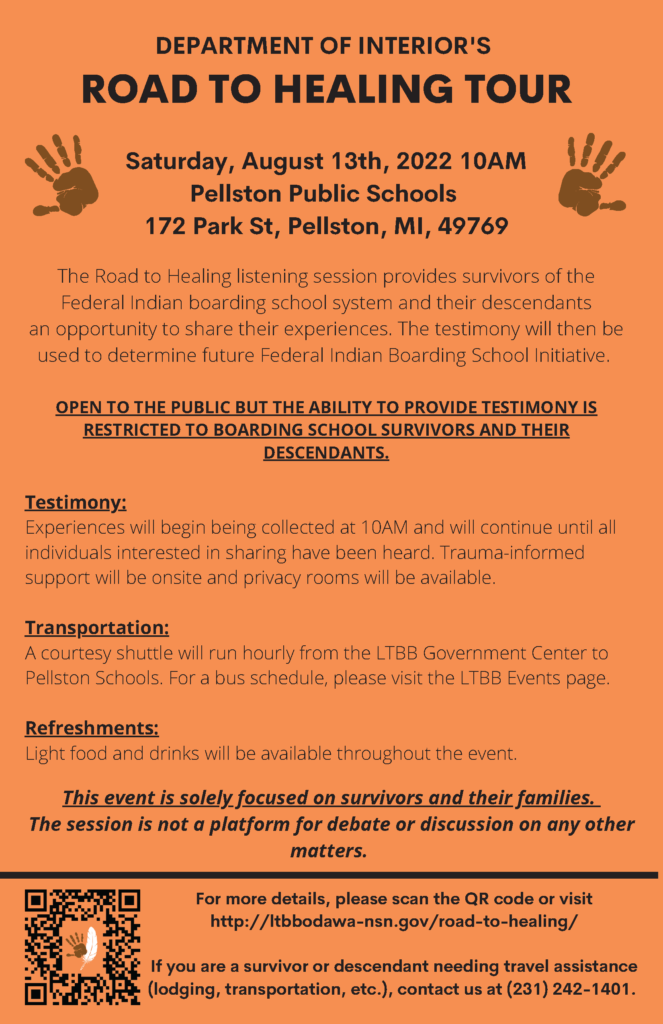
has been traveling the country on what she calls a “Road to Healing
Tour,” taking testimony on the boarding school era about the damage it
caused.
“My grandma used to share stories about this trauma with
me about how a priest showed up one day in her village, took her and
other children away from her parents and families, and sent them on a
train to a Catholic boarding school, when she was only eight years-old.”
Sec. Haaland’s listening session was held at the Alaska Native Heritage Center and followed by the raising of a healing totem.
The Heritage Center has been investigating church records to learn more about how Alaska Natives were impacted.
Benjamin
Jacuk (Kenaitze Indian Tribal Member), one of the researchers, says his
grandfather is a boarding school survivor, which got him interested in
learning more.
“The road to healing is going to be a very, a very
emotional event, because it’s a lot of people, actually telling their
stories. Some maybe before, some for the first time. One thing you know,
is never leave people in that space.”
The healing totem is the work of two Haida master carvers – Joe and T.J Young.
An elder developed the concept for the design.
The
totem pole depicts mother bear, who is holding two cubs, while the
father, in human form, sits above her, embedded in a Raven’s tail.
Two children rest comfortably in Raven’s ear.
The
totem raising, which was followed by a potlatch, was open to the
public, but the Road to Healing Tour was closed to the general public,
to give boarding school survivors and their famiies some privacy.
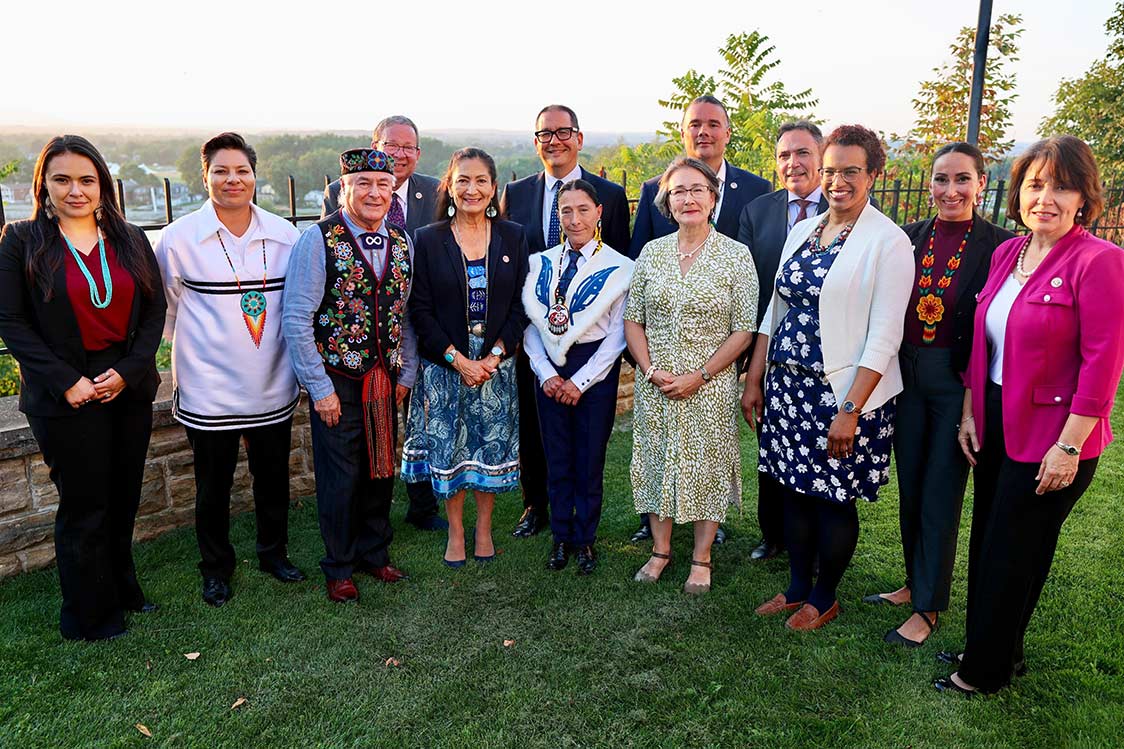
OTTAWA, CANADA – Secretary of the Interior Deb Haaland, Assistant
Secretary for Insular and International Affairs Carmen G. Cantor, and
Assistant Secretary for Indian Affairs Bryan Newland visited Ottawa,
Canada, to highlight the United States’ ongoing work with Canadian
leadership to ensure that Indigenous and First Nations communities have
the support and resources they need to prosper.
Secretary Haaland represented the United States during the fifth
convening of the Trilateral Working Group (TWG) on Violence Against
Indigenous Women and Girls, which was started by leaders from the United
States, Canada and Mexico. The Interior Department is working with
tribal governments, law enforcement agencies, survivors, families of the
missing, and all communities impacted to coordinate interagency and
international collaboration to address this crisis.
“No country is more important for the Department of the Interior’s
international work than Canada,” said Secretary Deb Haaland. “The
relationship we share is extensive and defined by our deep economic ties
and shared cultural heritage. Our work on behalf of Indigenous
communities is expansive, but our enduring success depends on our
international partnerships. The Biden-Harris administration, in
collaboration with our colleagues in Canada and Mexico, is putting the
full weight of the federal government into pursuing justice for missing
or murdered Indigenous peoples so that that current and future
generations of Native communities can enjoy a future free from the
violence that has plagued our countries for too long.”
Hosted by U.S. Ambassador to Canada David Cohen, the delegation met
with Canadian government officials to discuss issues of shared
importance and highlight continued collaboration to invest in United
States and Canadian communities. This included meetings with Minister
Gary Anandasangaree, Crown-Indigenous Relations; Minister Patty Hajdu,
Indigenous Services; and Minister Dan Vandal, Northern Affairs. The
delegation also met with Mary Simon, Governor General; Chris Forbes,
Deputy Minister of Environment and Climate Change Canada; and Michael
Vandergrift, Deputy Minister of Energy and Natural Resources Canada.
Ambassador Cohen, Secretary Haaland and the delegation hosted a
roundtable discussion with Indigenous leaders and stakeholders regarding
economic development issues in Indigenous communities.
During the
discussion, Secretary Haaland highlighted how funding from President
Biden’s Investing in America agenda is making historic investments in
Indigenous communities in the U.S., including for Indigenous economic
empowerment, sovereignty, and tribal climate resiliency.
The first-ever Indigenous member of the U.S. cabinet is in Canada to
talk about how best to help First Nations, Inuit and Métis Inuit
communities across the continent.
Interior Secretary
Deb Haaland, a member of New Mexico’s Laguna Pueblo tribe, has made
missing and murdered Indigenous women and girls a top priority of her
department.
While in Ottawa, she will take part in a trilateral working group set
up in 2016 to address the problem, a crisis in all three countries in
North America.
Haaland is also
expected to meet with a number of federal officials and dignitaries in
the national capital, as well as David Cohen, the U.S. ambassador to
Canada.
In 2021, Secretary of the Interior Deb Haaland announced the Federal Indian Boarding School Initiative. This initiative, which includes gathering records from the boarding school era, and compiling an official list of boarding school sites, makes visible on a national scale the intergenerational impact federal Indian board schools have had on tribal communities. Currently, there are five schools in the state of Michigan that were identified from the federal investigation process (Holy Childhood Boarding School, Baraga Chippewa Boarding and Day School (Holy Name), Mount Pleasant Indian Industrial Boarding School, Mackinac Mission School, and Catholic Otchippewa Boarding School). This is not an extensive list of all the other entities, schools, and programs that operated in Michigan through the Indian Civilization Act of 1819.
The Native Justice Coalition’s Truth and Reconciliation Commission (TRC) was launched in July 2022. It seeks to expand its reach to strengthen relationships between Indigenous and non-Indigenous people in an effort to seek the truth behind the Indian boarding school policies and corresponding actions taken by the government and church. Through this work, the NJC provides safe, supportive, and culturally competent spaces that offer opportunities for healing and uniting our Native communities on this journey. Our goals are to create an Indigenous-led process that is grounded in mutual respect, culturally sensitive, and focused on meeting clearly defined, jointly agreed upon metrics. Our key four priorities are truth and reconciliation, healing our people and our communities, strengthening ICWA and ensuring a cultural identity for our children, and building a strong ecosystem through investment in the Native Justice Coalition.
Without support from community partners such as the Indigenous Law & Policy Center, Native American Institute, and American Indian and Indigenous Studies at Michigan State University, this work would not be possible. This one-day symposium honors that work on a local scale, providing Michigan State University, and the greater Lansing community an opportunity to learn about the intergenerational trauma caused by federal Indian boarding school policies. Attendees will hear first-hand accounts from boarding school survivors and others who can provide the legal, social, and historical context of the Indian boarding schools. By joining together in community to share stories and voices, the symposium provides a space for knowledge and healing.
Secretary of Interior Deb Haaland is doing such vital, historic, decolonizing, spiritual work. The next stop on her ‘Road to Healing Tour’ is in Pellston, Michigan on August 13. All 35 Tribal Nations from MI, MN, WI, & IA have been invited to participate. https://t.co/8RHGJjww9e— Ruth H. Robertson (Red Road Woman) (@Ruth_HHopkins) August 3, 2022
Young and old, descendants and survivors, crowded into the gymnasium of Riverside Indian School in Anadarko, Oklahoma, to share their experiences as the kickoff to U.S. Interior Secretary Deb Haaland’s Road to Healing tour. https://t.co/CEIDsmuCrS
Deb Haaland, a Laguna Pueblo member from New Mexico and the nation’s first Indigenous cabinet secretary, has embarked on her year-long Road to Healing Tour. https://t.co/ZrcuBxyXyOpic.twitter.com/rFI196g25G
She has to race because so many of the boarding school survivors from the worst of the era up to mid 70s are passing away. Their stories must be told and recorded so the world knows what happened to them. https://t.co/aDMFSukzzV
— Dr. Denise Lajimodiere (@DLajimodiere) July 20, 2022
We stand with @SecDebHaaland in what has been an historic year for truth, justice, and healing from boarding schools. In this moment, we honor the generations of relatives who have fought and persisted in advocating for accountability. Please Watch/Share: https://t.co/2wbye4gAi0pic.twitter.com/caci5YjO3D
Today: @Interior The Road to Healing Tour (Oklahoma) with @SecDebHaaland & Assistant Secretary Newland. This year-long tour across the country to provide survivors of the Federal Indian boarding school system and their descendants an opportunity to share experiences. pic.twitter.com/XltcXTgaXN
The city of Palmdale, California is moving forward on a housing project that keeps siblings in foster care housed together. Photo by Annie Spratt via unsplash.com.
If children must enter foster care while their parents sort out mental health crises, violent relationships or addiction, the trauma of abuse and neglect, and the pain of separation can be long-lasting. But there’s one clear way to minimize the impact: keeping siblings together.
Public officials in a high-desert bedroom community north of downtown Los Angeles have committed to building housing that facilitates those critical family ties. Within a year, according to local and county officials, the city of Palmdale will be the first site in California to begin construction of a development built specifically for sibling groups in foster care.
The aim of these temporary homes and the staff who will oversee them, said Mike Miller, director of neighborhood services for the city of Palmdale, is to get the children safely back to their families once problems at home have been sorted out.
“They’re helping the children, but they’re also working with the parents because ultimately I think our wish for all foster kids and parents is that this family stays together,” he said. “These aren’t kids just getting thrown into a home somewhere,” he added. “This is also about valuing the family, and keeping the kids together. That’s transformational.”
The $19 million project will include a dozen three-bedroom townhomes. Up to six siblings will live in each home, together with a specially trained professional caregiver. The housing project will also include two units for young adults transitioning out of foster care, and offices for case managers and support staff.
Last week, in accordance with its goal of creating “quality affordable housing” for “low, very low and extremely low-income” residents, the Palmdale City Council and Housing Authority authorized a $1.2 million “acquisition and pre-development” loan for the project. The Los Angeles County Development Authority has also committed to a $500,000 loan, with the remaining costs covered by private financing, according to a city staff report.
The project, which will be constructed on the north side of McAdam Park on 30th St. East in Palmdale, is being developed by SOS Children’s Villages. The more than 70-year-old agency describes its aim as building families for orphaned, abandoned and other vulnerable children in 135 countries, including the United States.
SOS Children’s Villages is now a global organization, but it began humbly, its first “village” built in 1949 in Imst, Austria to house children left behind during World War II. The group now operates more than 550 “villages” serving approximately 13 million children, youth and families.
Los Angeles County Supervisor Kathryn Barger
Palmdale will be the first location of its type to open in California, but the developer of the site runs three similar housing projects in Illinois, and one in Florida.
“I’m a proud supporter and funder of the SOS Children’s Villages project in Palmdale,” L.A. County Supervisor Kathryn Barger said in an email to The Imprint, adding that she met with the project’s leadership at length. “I’m impressed by their long-standing commitment to family reunification efforts, and to providing compassionate care to foster youth and those at risk of entering the system.”
Keeping siblings together
The hazards of failing to keep siblings in foster care are widely acknowledged, and “placing siblings in the same home should always be the priority,” states a 2019 federal Children’s Bureau bulletin.
Although the relationships can be expansive in definition — biological siblings, step siblings, foster siblings, or other close relatives or nonrelatives with whom they have lived, even siblings they’ve never met — maintaining an attachment is essential to the children’s well-being.
“For some siblings in care,” the bulletin says, “their separation or infrequent visiting can cause those relationships to wither, sometimes to the point of permanent estrangement.”
When foster children stay close to their siblings, they are more likely to remain in stable homes, and more likely to “achieve permanency” through family reunification, adoption or legal guardianship. The pairing of siblings helps them adapt to new living situations, whatever they may be, in part because they are less worried about where their other family members are and how they are doing.
Researchers have also found that contact with brothers and sisters soothes the trauma of childhood abuse and neglect, as well as the traumatic experience of being separated from parents and the only home a child has ever known. Children who have positive relationships with siblings are less likely to suffer behavioral problems, such as anxiety and depression.
For siblings who can’t be housed together, child welfare experts encourage close placement, frequent visits and ongoing contact through letters, email, social media, cards and phone calls.
Numerous federal laws aim to promote sibling connections.
The Fostering Connections to Success and Increasing Adoptions Act of 2008 was the first federal law stressing the importance of sibling relationships in the foster care system. It requires that any child welfare agency relying on federal funding to seek placements that keep siblings in the same home or, if that’s not possible, provide ongoing contact and visits.
In 2014, the Preventing Sex Trafficking and Strengthening Families Act required that the parents of siblings be included as people to be notified when a child needs placement, as a means to keep children within extended kin networks.
Four years later, the Family First Prevention Services Act passed, allowing states to waive the number of children who can be placed in a single foster home, as a way to better accommodate sibling groups.
Changing the profile of Antelope Valley
The region known as the Antelope Valley — which includes the cities of Palmdale and Lancaster — has some of the highest poverty and child maltreatment rates in Los Angeles County. Three horrific and highly publicized child deaths in the area over a six-year period put the child welfare agency’s delayed response to household warning signs under a harsh spotlight. The area has also experienced a relatively high level of turnover among social workers and CPS line staff.
Referring to the torture and killing of 8-year-old Gabriel Fernandez in 2013 — crimes committed by his mother and her boyfriend — Miller said the tragedy also spurred action.
“It really heightened our community to tell us that we need to do more,” he said. “And the community’s really stuck to that promise of trying to do more for the kids. So this SOS project is just right on that path of commitment that came as a result of that tragedy.”
Miller said the sibling housing project will take some time to complete, given the complexity of the project’s funders, agencies involved and unique requirements. But he expects construction will begin within a year.
“These projects really do take time but this one just strikes to the heart and it has such momentum and support,” Miller said. “What we’re hoping is that this is a model that other government entities here in California will use to do the exact same thing up and down the state.”
Tim McCormick, CEO of the SOS Children’s Villages Illinois, got esoteric in describing the project. He said it’s meaningful that the site will be located in the high desert, and the architecture will be environmentally friendly and reflect the region’s natural colors and hues.
“There’s really an intrinsic beauty of life out there,” McCormick said. “It’s kind of a hidden gem.”
McCormick also noted that the sibling groups who will live at the site more than likely will have come from impoverished households. But once built, their temporary home will serve as a resource center for these low-income children and families. It will also nourish cultural life, with an outdoor theater for the arts, music and spoken word — “almost like a Greek auditorium,” McCormick described. “So that’s what we hope to do there, is to bring in resources that are outside Palmdale and inside Palmdale, to blend them together and create and strengthen a narrative of a child’s life and a family’s history.”
Opened in 1871 by Quaker missionaries, Riverside is the nation’s oldest boarding school operated by the federal government. It is one of the 408 across the U.S. identified in Haaland’s recently launched Federal Boarding School Initiative — described by the Department of the Interior as the government’s first comprehensive attempt “to shed light on the troubled history of Federal Indian boarding school policies and their legacy for Indigenous Peoples.”
Haaland has pledged to document the schools’ troubled pasts, address their intergenerational impact and fully account for the trauma they inflicted throughout Indian Country.
Donald Neconie, 84, Kiowa, testifed on Saturday, July 9, 2022, as part of the U.S. Interior Secretary Deb Haaland's Road to Healing tour of the brutality he suffered while attending Riverside Indian School in Anadarko, Oklahoma, in the 1940s. Haaland, Laguna Pueblo and the first Indigenous person to sit in a presidential cabinet, kicked off the yearlong tour in Anadarko to hear testimony from survivors and descendants of Indian boarding schools. (Photo by Mary Annette Pember/ICT)
Road to Healing: Deb Haaland pledges boarding school truths will be uncovered
WARNING: This story has disturbing details about residential and boarding schools. If you are feeling triggered, here is a resource list for trauma responses from the National Native American Boarding School Healing Coalition in the US. The National Indian Residential School Crisis Hotline in Canada can be reached at 1-866-925-4419.
ANADARKO, Oklahoma — A journey like no other began at last Saturday for survivors of U.S. Indian boarding schools.
Young and old, descendants and survivors, crowded into the gymnasium of Riverside Indian School in Anadarko, Oklahoma, to share their experiences as the kickoff to U.S. Interior Secretary Deb Haaland’s Road to Healing tour.
Until now, former boarding school students were largely ignored, forced to survive brutality and separation from family, culture and language, and deal with childhood traumas as best they could.
Finally, the world is listening.
“I still feel that pain,” said Donald Neconie, 84, Kiowa, who attended Riverside school in the 1940s.
Neconie, a former U.S. Marine, described physical and sexual abuse at the hands of school employees. School leaders knew of the abuse but did nothing to stop it, he said.
“You couldn’t cry or tell anyone, because if you did, you knew it would be worse,” he said. “I will never forgive this school for what they did to me.”
T he Métis National Council and the Government of Canada will be working collaboratively, Nation-to-Nation, to develop a process to engag...
To Veronica Brown
Veronica, we adult adoptees are thinking of you today and every day. We will be here when you need us. Your journey in the adopted life has begun, nothing can revoke that now, the damage cannot be undone. Be courageous, you have what no adoptee before you has had; a strong group of adult adoptees who know your story, who are behind you and will always be so.
OUR HISTORY
BOOK 5: Lost Children of the Indian Adoption Projects


 Sec. Haaland
has been traveling the country on what she calls a “Road to Healing
Tour,” taking testimony on the boarding school era about the damage it
caused.