BACK UP BLOG (no longer updating)

This blog was a backup for American Indian Adoptees blog
USE THE SEARCH BAR or SEARCH TOPICS at bottom of this blog

If you need support

Support Info: If you are a Survivor and need emotional support, a national crisis line is available 24 hours a day, seven days a week: Residential School Survivor Support Line: 1-866-925-4419. Additional Health Support Information: Emotional, cultural, and professional support services are also available to Survivors and their families through the Indian Residential Schools Resolution Health Support Program. Services can be accessed on an individual, family, or group basis.” These & regional support phone numbers are found at https://nctr.ca/contact/survivors/ . MY EMAIL: tracelara@pm.me

Search This Blog

Showing posts with label Canada settlement. Show all posts

Thursday, February 9, 2023

60s Scoop, #TRC, Racism Apology, Day Scholars and more (Canada)

VIDEO


Residential school, day school and Sixties Scoop survivors gather at conference


There were many emotional moments as residential school survivors gathered in Winnipeg this week.  Around 1,700 people took part in Wa-Say Healing Centre’s conference. 
**

The Physicians College of Manitoba apologizes for current and past racism against Indigenous peoples

 It also said that pledging to end racism would not be enough.

“Recognizing racism in itself will neither be spontaneous nor easy.
We are committed to working with Indigenous healers, scholars, elders
and knowledge bearers, as well as the legal and ethical requirements to
provide respect, dignity and equitable health care for Indigenous Will
ask and intend to guide you along.” 

Four months after the apology, Indigenous leaders and politicians
signed a declaration calling for an end to anti-Indigenous racism in
northern Manitoba’s health care system.


The College of Practitioners Regulating Manitoba begins work in 2021
to address the call to action from the Truth and Reconciliation
Commission. The apology is one action the college is taking as a result
of those discussions, the Assembly of Manitoba Chiefs said in a
statement released late Tuesday.

**


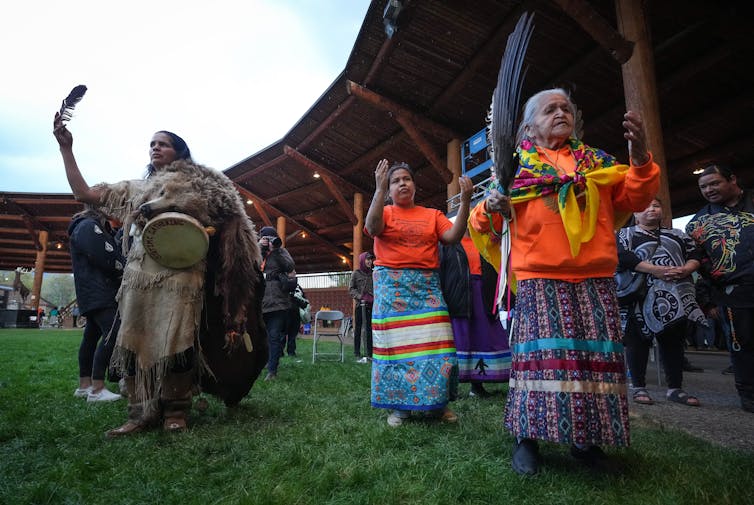
In photos: Pow Wows across Treaty #3 and Treaty #1 territories

“The pow wow is a living cultural
expression of song, dance, and art which brings people together, and
through the drum, reminds us of our connection to Mother Earth. […] pow
wows are a time to put differences aside and to celebrate traditions,
mostly it is the time to celebrate life. A pow wow strengthens an entire
race of people. To be Anishinabe is to be proud, to know who you are,
and where you came from.” – Harold Flett

**

Only 13 T&R Calls to Action achieved over seven years: report - rabble.ca

2023 marks the eighth year since the Truth and Reconciliation Commission released a list of 94 Calls to Action.
 
**


Canada’s $2.8 billion settlement with Indigenous "Day Scholars" is a long time coming


  F


Eleven years.  That’s how long it took the federal government to
agree with 325 First Nations over the collective loss of language and
culture suffered by Day Scholars in the Residential School system in Canada that existed between the mid 1800s until 1996.


Day scholars attended a Residential School during the day but didn’t sleep there overnight.


While Day Scholars settled an individual compensation package for just $10,000 each earlier in 2022,
this new agreement is specifically aimed at rectifying the systematic
and forced removal of language and culture through these institutions.


Left out of original agreement


In 2012, members of the Tk'emlúps te Secwépemc and shíshálh Nation led by Shane Gottfriedson and Garry Feschuk launched a national class-action lawsuit for Day Scholars who were left out of the original Indian Residential School (IRS) Settlement Agreement (2006).

READ


Monday, January 9, 2023

Scooped not shattered: I am a Sixties Scoop survivor


Mike (O'dah ziibing/Heart of the river) Ashkewe
Opinion

I
want you to consider building a better future for the next seven
generations, writes Mike "O'dah ziibing (Heart of the river) Ashkewe

By Mike "O'dah ziibing / Heart of the river) Ashkewe
Guelph Mercury |  January 3, 2023

O'dah
ziibing indizhinikaaz. I am Heart of the river. I am also a Sixties
Scoop survivor, and I am a product of Canada’s violence and colonization
against its Indigenous population.

I
was raised as someone who only knew being Indigenous as a hustle, and
it was something not to be proud of, but rather hidden and shameful. I
was stripped of my culture, my language and the very core of my Ojibwe
identity. I would not begin to explore who I was until I started to
attend college in 2006. Even then I would face racism and I was
relatively alone there. I started to talk with people who looked like
me, had the same experiences as me from rural Ontario, but also I would
be exposed to new things. I was exposed to compassion, understanding,
and empathy. I was welcomed as an Indigenous student and I could be
proud of where I came from.

It
would take the lawsuit against Canada regarding the Sixties Scoop for
me to really begin to explore my roots, discover who I was, and what my
blood was calling to. My biological mother, Kim gave me up when she was a
teenager and as a result, we didn’t have a traditional relationship and
she never told me about where I really came from. She told me about the
lawsuit and what it meant. She told me that I was illegally adopted by
the people I thought were my parents, and she told me that a lot of my
childhood was a lie that was wrapped in an alleged compassion.

I
would meet a group known as the 60s Scoop Legacy of Canada and that
would prove to be an amazingly transformative experience. I would learn
about the true horror of the scoop but most importantly, I would learn
that I was not alone, and that my story was not unique. I had brothers
and sisters who were united in a painful experience that was considered
completely legal and only spoken about in hushed tones, hidden in plain
sight.

This
is where I would begin my journey in earnest and I would talk to
elders, advocates, politicians and others in asking hard questions but
chiefly among them,

“Why?”

A
lawsuit would be filed against Canada and it would be settled and it
was determined that our stolen childhoods, cultures and languages were
worth a paltry $25,000.  Our very identity was determined to be worth
less than the poverty level for a single family of two.  This hardly
seems fair but then again, when has Canada ever been fair to the
country’s original inhabitants?

I
decided that my trauma could be something I could harness and use to
fight back for a better tomorrow for my people. We have a belief in our
culture that speaks of seven generations and that our actions will echo
forward seven generations. There is an opportunity to rebuild, grow and
change the future of our shattered cultures and fractured relationships.
I look back at all the wrongs that have been done, and I have promised
that I would not willingly allow that to happen to another person again
regardless of what colour their skin was.

My
Indigenous spirit name translates to “Heart of the river” in Ojibwe.  My
name means that I build community and like the river, I can connect all
things and be the flow of life itself. Water connects all living things
and is the essence of life, it is necessary to all things and it is
necessary to build successful communities.

We
can’t change the past but we can change what happens in the future and
we can promise that we won’t willingly visit those wounds upon future
generations.

O'dah
ziibing indizhinikaaz. I am Heart of the river. I am a Sixties Scoop
survivor and I want you to consider building a better future for the
next seven generations.

Mike "O'dah ziibing / Heart of the river) Ashkewe
is from Neyaashiinigmiing, Ontario. Mike is a disability and Indigenous
activist in the city of Guelph. Mike has had a career in the media
since 2007 in a variety of different roles such as commentator, reporter
and podcaster.


He also wrote:

WHAT IS THE 60s SCOOP: https://www.parrysound.com/news-story/10806584-what-is-the-sixties-scoop-the-story-of-indigenous-children-taken-from-their-families-across-canada/

Wednesday, December 28, 2022

Advocate asks AFN chiefs to ensure $40B settlement deal leaves no child behind

OTTAWA — A First Nations child welfare
advocate on Wednesday implored chiefs to ensure "no child is left
behind" in a landmark $40-billion settlement agreement with the federal
government.


20221207171244-639117adf758715d065bd867jpeg
Karen
Osachoff, left, speaks as Melissa Walterson stands beside her during
the Assembly of First Nations special chiefs assembly in Ottawa on
Wednesday, Dec. 7, 2022.  Chiefs at the assembly heard from the two women
about the harms caused by the child-welfare system and are expected to
vote on how the AFN should move forward with a landmark settlement. [THE
CANADIAN PRESS/Spencer Colby]


OTTAWA — A First Nations child welfare advocate on Wednesday
implored chiefs to ensure "no child is left behind" in a landmark
$40-billion settlement agreement with the federal government.


Cindy Blackstock delivered the message to an Assembly of First
Nations gathering in Ottawa, after being invited to take the stage by
Cindy Woodhouse, regional chief in Manitoba who helped negotiate the
agreement, which had been thrown into question since being rejected by
the Canadian Human Rights Tribunal. 


The AFN, representing more than 600 First Nations across the country,
had asked the tribunal to approve the settlement deal, which would see
the government spend $20 billion to compensate families and children for
systemic discrimination in the Indigenous child welfare system.It would
also spend another $20 billion on making long-term reforms. 


Blackstock, the executive director of the First Nations Caring
Society who first lodged the complaint at the heart of the issue, raised
concerns that the agreement wouldn't provide $40,000 in compensation to
all eligible claimants, which is the amount the tribunal ruled they
should get. 


"We can make sure that in our First Nations canoe of justice, no
child has to see their money go away and no child is left behind in
justice," she said Wednesday. 


"We are capable of that."


Following the tribunal's decision in October, the federal government filed for a judicial review of some parts of its decision. 


Endorsing the settlement agreement loomed as one of the biggest items
on the assembly's agenda, with chiefs being asked to vote on what the
organization should do next. 


The chiefs had been preparing to vote on conflicting resolutions,
with one asking them to support the final settlement agreement, while
another sought to see the organization not appeal the tribunal decision
and renegotiate the deal. 


But on Wednesday, further talks between both sides took place,
assisted by former senator and judge Murray Sinclair, who helped the
AFN, federal government and lawyers for two related class-action
lawsuits reach the $40-billion agreement in the first place, which was
formally announced in January. 


Chiefs ultimately voted late Wednesday against re-entering
negotiations but to instead support compensation for victims outlined in
the agreement and "those already legally entitled to the $40,000 plus
interest under the Canadian Human Rights Tribunal compensation orders."


It also included a provision that AFN leaders must regularly return
to chiefs to provide it with progress updates and "seek direction" from
chiefs on implementing the final agreement. 


Many chiefs thanked Blackstock, who was greeted with applause after
further agreement was met and said she was honoured to see people come
together for children harmed by Ottawa's discrimination. 


"We have had too many apologies, we've had too many compensation
deals, we've had too many kids hurt. And this has got to be it," she
said. 


She added more discussion on the long-term reform part of the deal would be presented to chiefs on Thursday.


Earlier in the day, the assembly heard from sisters Melissa Walterson
and Karen Osachoff, plaintiffs on the case, about the impact the foster
care system had on their lives. 


Osachoff said she had been in the child welfare system since she was born and didn't have a chance to grow up with her sister. 


"Had it not been for the '60s Scoop and the child welfare (system), her and I would have grown up together."


She said she understands why the tribunal characterizes those like
her as "victims," but told chiefs to instead think of them as survivors.


"I am not a victim and our claimants are not victims."


This report by The Canadian Press was first published Dec. 7, 2022.


Monday, January 17, 2022

Largest settlement in Canadian history: Feds release details of $40B deal

 SOURCE


The federal government has unveiled its $40-billion agreement in principle to provide compensation to First Nations children and their families harmed by an underfunded child welfare system and establish long-term reform.

As a result of the largest class action lawsuit in Canadian history, Ottawa will provide $20 billion to children on reserve and in the Yukon who were unnecessarily removed from their homes between April 1, 1991 and March 31, 2022. This extends to their parents and caregivers. Compensation will also be provided to those impacted by the narrow definition of Jordan’s Principle between Dec. 12, 2007 and Nov. 2, 2017.

Children who didn’t receive essential public services between April 1, 1991 and Dec. 11, 2007 will also be eligible for financial reparation.

The second half of the funding will go towards reform of the First Nations Child and Family Services Program, to be spread out over five years.

Approximately $20 billion will support young First Nations adults transitioning out of the child welfare system, as well as bolster prevention mechanisms to keep children at home, in their communities – work that’s expected to start in April, 2022.

KEEP READING 

**

Indigenous child welfare settlement leaves out Sixties Scoop survivors: advocate

Reaction to $40B settlement not all positive
A settlement that may become the largest ever in the history of Canada is raising concern among some over the specific date of April 1, 1991 being the cut-off point for Indigenous people to be eligible for compensation. Mark Neufeld reports.

By Mark Neufeld

Summary

  • Ottawa secured agreements in principle to compensate First Nations children harmed by its underfunding of child welfare
  • If the $40 billion agreement is approved, it would represent the largest settlement in Canadian history
  • But an advocate says the cut-off dates for the potential settlement excludes Sixties Scoop survivors

While welcoming an agreement in principle to compensate children harmed by Canada’s underfunding of child welfare, an Indigenous organization says it also excludes many Indigenous people – specifically Sixties Scoop survivors.

The federal Liberal government says of the $40 billion earmarked to be spent on the matter, $20 billion will pay for compensation and the other $20 billion will be spent on reforming the system over five years.

It says First Nations children living on reserve and in the Yukon who were removed from their homes between April 1, 1991, and Mar. 21, 2022, are set to be compensated, along with their parents and caregivers.

If the agreement is approved, it would represent the largest settlement in Canadian history.

But not everyone agrees with the cut-off dates for the potential settlement.

“I feel like they could have expanded it a little bit more to include those of us taken before 1991 and those of us taken off reserve,” said Katherine Legrange, the director of 60s Scoop Legacy of Canada.

“I think overall it’s a good thing, I just wish they had consulted with Sixties Scoop survivors and our families to include us if possible.”


RELATED:


The Sixties Scoop is when an estimated 20,000 Indigenous children were taken from their families and placed in non-Indigenous homes over a period of about three decades.

The Canadian government maintained it was acting in the best interests of the children.

Some survivors remain displaced and disconnected from families and their home communities to this day.

For First Nations children and families that are included in the settlement, Legrange cautions there could be a reopening of old wounds and relived traumas over the historical harms done to them.

She believes the guidance of First Nations elders and caregivers will be needed to prevent more pain as people come forward in the settlement.

“We need to, as Indigenous people, need to lead what that looks like,” said Legrange. “Have an advisory committee and figure out what’s the best way. How do we do this while mitigating the risks and harm to people?”


CLICK OLDER POSTS (above) to see more news

CLICK OLDER POSTS  (above) to see more news

MEGWETCH THANK YOU

HUGE Thank you for visiting this blog and sharing this with your kin. It's appreciated. Contact Trace anytime! Use the form below.

BOOKSHOP

Please use BOOKSHOP to buy our titles. We will not be posting links to Amazon.

Popular Posts

To Veronica Brown

Veronica, we adult adoptees are thinking of you today and every day. We will be here when you need us. Your journey in the adopted life has begun, nothing can revoke that now, the damage cannot be undone. Be courageous, you have what no adoptee before you has had; a strong group of adult adoptees who know your story, who are behind you and will always be so.

OUR HISTORY

OUR HISTORY
BOOK 5: Lost Children of the Indian Adoption Projects