BACK UP BLOG (no longer updating)

This blog was a backup for American Indian Adoptees blog
USE THE SEARCH BAR or SEARCH TOPICS at bottom of this blog

If you need support

Support Info: If you are a Survivor and need emotional support, a national crisis line is available 24 hours a day, seven days a week: Residential School Survivor Support Line: 1-866-925-4419. Additional Health Support Information: Emotional, cultural, and professional support services are also available to Survivors and their families through the Indian Residential Schools Resolution Health Support Program. Services can be accessed on an individual, family, or group basis.” These & regional support phone numbers are found at https://nctr.ca/contact/survivors/ . MY EMAIL: tracelara@pm.me

Search This Blog

Showing posts with label Indian adoption project. Show all posts

Thursday, February 13, 2025

‘Ambiguous Loss’ — A Team of Researchers is Learning From Indigenous Women Whose Children Were Adopted

Illustration by Christine Ongjoco.

Hoping to offer a rare in-depth look into how placing children for adoption impacts the lives of Indigenous birth mothers, a group of researchers is continuing efforts to document the experiences of American Indian and Alaska Native women. 

Their study, believed to be the first of its kind, focuses on mental health and grief. The research is being carried out in stages and has already surfaced several themes, including “ambiguous loss” — “a stressful and traumatizing’’ event that occurs when there is “no verification, closure, rituals for support, or resolution.’’

A small sample of Indigenous birth mothers informed the study’s initial findings, originally published in a 2022 peer-reviewed article in the Family Process journal. Now, researchers intend to expand their work by surveying a larger number of Indigenous mothers and further examining the roles of culture and history. Participants are being recruited online, and through word of mouth and flyers being distributed throughout rural and urban Indigenous communities. 

Understanding the systemic challenges that lead to Indigenous women’s children being placed for adoption might ultimately help inform future child welfare and adoption practices, said Sicangu Lakota elder Sandy White Hawk, lead investigator. Such insights might also lead to a better understanding of the specific support Native birth mothers need during and after an adoption, researchers said. 

 “It is my hope that it will motivate policy change on child removal — that child welfare will begin to focus on family healing rather than child removal,” White Hawk said.
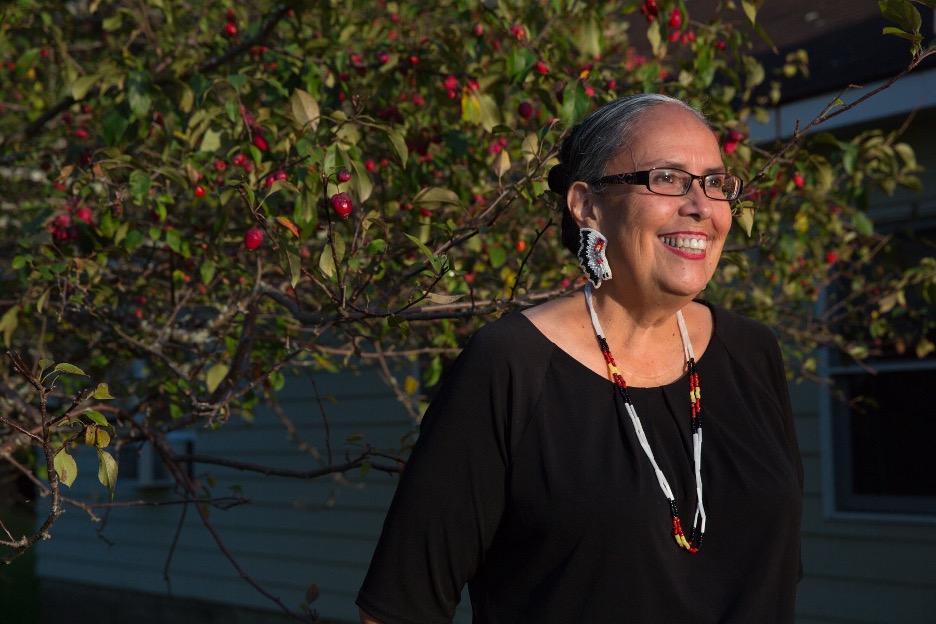
Sandy White Hawk. Provided photo.

White Hawk’s interest comes from a personal place — she was adopted at 18 months old.  She is the founder and director of the Minnetonka-based First Nations Repatriation Institute, which helps Indigenous people impacted by adoption or foster care reconnect with their families and identities. 

For the study’s initial phase, her team interviewed eight women from Minnesota, Washington, New Mexico, North Dakota, Alaska, Oregon and Wisconsin. Researchers acknowledged the small sample size but said the interviews yielded “rich data’’ nonetheless.

Researcher Ashley Landers said previous studies involving the impact of foster care and adoption on birth mothers have mainly centered on the lives of white mothers.

“I don’t think it’s by chance that no Native birth mothers were included in birth parent research prior to this,” said Landers, an associate professor in the Department of Human Sciences at Ohio State University. “Their part of the story has been largely omitted — Native birth fathers have also been omitted, and the larger Native family impact is oftentimes not part of adoption research.”

History weighs heavily on the experiences of Indigenous birth mothers, making them “distinct from other races as they have been disproportionately exposed to systemic practices of forced child removal,’’ White Hawk’s team posited in the 2022 published article.  Culprits include U.S. policies that coerced parents into relinquishing their children to boarding schools, and the Indian Adoption Project — a federally funded effort in the mid-20th century to force the assimilation of Native American children into white families. 

Also harmful, they wrote, is the ongoing disproportionate removal of Native children from their parents through the country’s child welfare systems.

Taking this broader cultural context into account is crucial to understanding how adoption impacts the well-being of Native women, whose grief may be complicated by intergenerational trauma, researchers wrote. Two of the original study participants grew up in foster care, and one is a descendant of boarding school survivors.

Ashley Landers. Provided photo.

In all, the eight study participants were between the ages of 33 and 77 at the time of the survey.  Each had experienced separation from a child through adoption or foster care between 1959 and 2010.

Birth moms bear witness

The eight birth mothers lost a combined 10 babies under age 1 to adoption. Most of the children were placed in adoptive homes at birth. Only two children grew up in a Native adoptive home.

A majority of those interviewed were 23 years old and younger when they gave birth. A Washington state birth mother was 13 years old and in foster care when she became pregnant.  Her foster mother put her into a home for “unwed mothers,” the woman reported. 

Some tried to hide their pregnancies out of a sense of shame or fear of repercussions.  They lacked essential resources, such as income and family support. Some had struggled with homelessness. 

Many women said they “felt expected” to give up their babies and reported being pressured by parents or partners, according to the published study.  Others were afraid to keep their infants because they were in an abusive relationship. 

In terms of the events that contributed to a sense of ambiguous loss’ among the women, several recalled being denied the opportunity to say goodbye.  A lack of closure also occurred in cases in which mothers said they were told the adoption would be “open,’’ but those agreements were not upheld. Some reported being confused. It didn’t occur to them that their time after giving birth would be the final moments they would see their babies. 

Researchers also queried the women about their mental health and well-being following the adoptions. Feelings expressed included guilt and unresolved grief that lasted years. A Minnesota woman shared how her experience led to a lifetime of self-imposed isolation.

“I don’t have a lot of people close to me — from that fear of losing family and fear of losing my daughter, and I don’t have the best relationship with my kids,” she said.

Depression and anxiety were common, and some reported substance abuse challenges that were either pre-existing and exacerbated by the adoptions, or began afterwards. 

“I wasn’t a drug user or an alcohol user until that happened,” a birth mother from Oregon said. “This was drinking to get so drunk that you fall asleep or getting high and just throwing yourself into really bad situations because you don’t want to deal with what you’ve been through.”

Not every experience reported was negative. Some mothers said the schools, social services agencies or churches facilitating their child’s adoption were helpful. A woman from New Mexico said in her case, they “made all the arrangements.” 

And a few birth mothers reported feeling “relief” after the adoption, and that they had done “the right thing.’’

“I was so young, and I was like, can I really be a parent…I think adoption might be the best route,’’ one woman said. “I think about it now, and how brave I was to do that.’’

Five women voiced a common belief that “culture as medicine” allowed them to assuage the pain of giving up their children and was a key component of their resilience.

“As an adult I got back into my culture and, fortunately, when I got back into my culture was when I started speaking candidly about my past,” the Minnesota mother said. “So, I think it’s helped.” 

Next steps in the research

Landers said the next phase of research will document additional instances of perceived coercion and examine how birth mothers navigated their lives over time. The goal is to recruit at least 20 participants for the new survey, but researchers have the capacity to include up to 50 women, she said. 

Opinions from birth mothers about how best to facilitate healing will also be solicited. “Talking circles,” which are built around women with shared experiences, was one example mentioned in the 2022 article.

Landers said, researchers want to know how to help Indigenous birth mothers recover from ambiguous loss.  This information will be presented to tribal leaders and the larger Native community, through national conferences and other forums.

“We forget about our birthmothers,” Landers said. “They carry tremendous guilt and shame, many of them for being in the wrong place at the wrong time, when they were targeted by institutions and professionals disguised as helpers.

“I am not sure there is a way to right the wrongs that have been done to Indigenous birth mothers and their children,’’ she continued, “but acknowledging their suffering is a step in the right direction.”

LINK: https://imprintnews.org/top-stories/ambiguous-loss-a-team-of-researchers-is-learning-from-indigenous-women-whose-children-were-adopted/258290

Thursday, July 4, 2024

Almost Dead Indians (excerpt)


What did tribes make of the INVASION?

“Try as he might to comprehend the life on the far side of the ocean that the white man described, the brown man was unable.  Such a life was beyond belief.  He could not envision one man or a small group of men and women owning all the land, all the animals, all who dwelt upon it, all the produce, man’s labor and his harvest, and men’s lives. But he felt sorry for his friend.” – Basil Johnston, THE MANITOUS (1995), Chapter 11, AUTTISSOOKAUNUK, describing the strangers with light complexions who landed on the brown man’s land and described Europe.  Tribes had no concept for what he described, which was colonization and slavery.

(👆this is my favorite quote)

What has been written about the European’s arrival is for the most part sinister.  In rock art, scrolls and oral history, tribes recorded, understood and remembered the events of early colonial contact by means of symbolic images: Manitous (or spirits), floating islands, flying and underwater ships, giant birds, thunder and lighting, sounds of music in the air, a strange white whale, dreams, premonitions and warnings.  Early tribes viewed Puritan disregard for ritual to mean earthly disaster and punishment.  The tribes believed these aliens were Manitous possessing a powerful spirit.  (This is according to missionaries who knew the tribes here in the northeast.  And of course, this was written from their perspective…) (I use “Indian” in this text, as they did.)

Anishinaabe say:  After the French came the Zhaaganaash (“Off-shore ones”) of Great Britain.  But out of the Zhaaganaash came the Gichi-ookomaan (“Big-Knives”)—the Virginians (i.e. pre-Americans) via WIKI   Wonder if the Anishinaabe have a word for serial killers?

The Indians lack of material wealth and simple lifestyle was viewed as a character flaw; Puritans could not comprehend their apparent lack of interest in wealth.  (The “Indian” had no concept of being owned or owning land.)

**

You and me: we are not supposed to know.    

President Thomas Jefferson


The Papers of Thomas Jefferson, December 29, 1813  

 “This unfortunate race, whom we had been taking so much pains to save and to civilize, have by their unexpected desertion and ferocious barbarities justified extermination and now await our decision on their fate.”  

Jefferson owned many slaves, had offspring with slaves, and had a fancy plantation, of course. (In Virginia)

These are real crimes and real atrocities against Indigenous First Nations People yet no one involved has been charged or put in prison?  Their goal? 

When details of the Indian Adoption Projects were sealed and files were closed after adoptions, a child would not have his/her name or tribal identity anymore, with their birth certificate altered and falsified.  Tribal membership might exist for some adoptees on paper but with secrecy and sealed files, the adult adoptee would never know or be able to find out.  

It appears that was the plan.   


Friday, July 7, 2023

Identity: One man’s search after adoption

Thomas with this adoptive parents (family photo)
REBLOG

An interview with Thomas H. Pierce (Menominee)
By Trace (blog editor)

Thanks to a growing community of adoptees on Facebook and the internet, I interviewed Thomas H. Pierce, now 58, a member of Menominee tribe of Keshena, Wisconsin.

Thomas explained that he is listed on their descendent roll (there is a 1/16 blood quantum requirement) though his tribal brother told him he has more. Like many adoptees learn, it’s a matter of proof and finding lost relatives after years of being lost and separated by a closed adoption.


The following testimony is graphic but very important as it’s related to the Indian Adoption Projects and their intended outcomes. Thomas is not the only adoptee I know from a Wisconsin reservation, including his Menominee rez, who was taken to Pennsylvania for a closed adoption.

Tell us a bit about your tribal affiliations…

Thomas: I am 3/16 Menominee and also 3/16 Stockbridge-Munsee Mohican. I believe my father was Native American but I can't find him, even though I know his name. I lack the 1/16 each tribe requires for minimum full tribal status.

Do you know why you are adopted?
Thomas: I was adopted when I was 5 days old. I found out my adoption was due mostly because my grandfather would not allow my birthmother to bring me home. My mother was a Navy Corpsman. (My birthfather may have been also.) I was born at the Naval Hospital in Camp Pendleton on the Marine Corps military base in California.

 What was your childhood like?

I was adopted by a career Marine, Lt. Col. Herbert E. Pierce, a soft spoken “hero” in every respect. My adoptive dad was Cherokee, 1/4 blood, but his family denied it because of racism in Oklahoma. He was a WWII and Korean veteran and highly decorated.

Then there is my adoptive mother, an alcoholic, pill popper, ETOH abuser. (ETOH Abuse: When it is said that an individual is suffering from ETOH abuse what it means is that they are abusing alcohol. Most people have not heard of alcoholism being referred to as ETOH abuse and this is because this phrase is predominantly used in the medical and rehabilitation sector. The word ETOH is short for ethanol, which is the primary ingredient in alcohol.)

My mother, I believe, just hated kids. She treated us shabbily but she held a special hate for me. When she was angry, she sailed on about me being a bastard.

My father wasn't around much due to his postings so I was raised by my older sister who was eleven years older than me. When I was about 8 years old, she went off to school.

Because of my mother’s ETOH abuse, she slept in everyday until 10 a.m., so I never had anyone to rely on for getting breakfast, getting dressed or ready for school. As a result, I was a wild child, feral in some ways.

I do remember my adoptive parents were going to adopt a Navajo boy but he was violent - he grew up on the street eating from garbage cans, taking care of his younger brother, so they sent him back. I took that to heart and realized my tenure with my family was tenuous at best.

They always seemed to be sending me off somewhere, every summer vacation. I went to camps or to relatives and finally to a children's home where corporal punishment was practiced liberally.

I even made many trips to psychologists, until they told me my mother was to blame for my problems. I don't blame my Dad though he enabled her and then he was dying, very sick, and passed away at age 54. At that time, I lost my only defender. Then my relationship with my mother turned for the worse, if that was even possible.

She sent me for a summer to an acquaintance where I was sexually abused and where my own alcohol abuse started. She would do things out of spite, like setting me up with a friend for a weekend, telling this friend of hers I was gay, which I am not; but at least by this time I was old enough to fight off my attacker.

Then later, she phoned child authorities telling them I was abusing my own son, all proven untrue.

I was written out of the family will and received no inheritance or money. She gave away land which we had bought but by then I didn't care. Our relationship was irretrievable. I just wanted the few possessions my father bequeathed to me, the only things that would have mattered; and she ignored my sons with their inheritance.

But believe it or not, I mourned at her passing, mostly for the lost opportunity of a decent relationship she threw away.

 Did you have any Indian friends growing up?

I had no Indian friends growing up; there are not many Indians in the snooty environs of Wyomissing, Pennsylvania, known for its wealth and society types. In fact, Wyomissing was a great place to learn how to fight. I was teased relentlessly. I learned to fight three or four guys at a time, just to survive as my tormentors waited for me with a beating and racial slurs.

But I was proud to be an Indian and I knew I was adopted from my first recollections. Despite the denials of being Indian from my father’s side of the family, they told me to be mum because they were still hanging Native Americans in Oklahoma and Missouri.

 What did you learn about your adoption and your adoptive parents?

Thomas:  I was adopted nine years after the end of World War II and my adoptive parents had been trying to have other children. My father wanted a boy. Since he was part Cherokee, a Native child seemed natural. One of my two sisters (their biological children) looked particularly Native American. After I was adopted, many of my father’s friends remarked, in their words, “You certainly can't deny him, Herb.”

We looked remarkably alike, even when I was in my 40s. I wished I was his but alas I am not.

I was told by my mother that due to father’s military service (malaria/jungle fevers) my dad was lacking enough sperm. I believe it was her who had medical problems and she had a hysterectomy in 1956-57. With her alcohol and drug abuse, as well as deep-seated psychological problems, perhaps she felt inadequate.

I was psychoanalyzed three times. The psychologists keep saying my problems were a result of her. She had a vicious temper and would assault me many times over the years, like a woman possessed, often when she visibly intoxicated.

My father and I had a good relationship, he was a mellow thoughtful man whom I could confide anything.

After my father died no one could modify her behavior. She kept an article on a blackboard about a theory that some children are “Bad Seeds.” This was pointed out to me constantly. She even blamed me for my father’s death.

She also had a way of pitting sibling against sibling to achieve her aims.

In early 1977, when she accused me of child abuse, I got so angry I threatened to kill her if she ever stuck her nose in my business again. I was written out of her will and had no contact with any family until the early 90s.

It was established there was no abuse of my children. I have raised six and never raised a hand in anger to any of them. I became my adoptive father.

There was not religious or financial reasons for them adopting me. When they sent that Navajo boy packing, that did affect me. I knew I could also be sent away. I acted out in my older years. I felt my mother just did not want me around.

 What’s your life like now and what type of work are you in?

Thomas: I have been married three times. It took me three to get it right.

I have been clean and sober for 18 years now.  I served in the military, Marines and Navy, as a corpsman. I boxed as an amateur. I love fast cars and motorcycles. I was Pre-Med in college but ran out of money. I’m studying for my Masters in Labor management, converting credits from my B.S. degree in nursing.

I have worked at everything: carpenter, boilermaker, sheet metal journeyman, and have lived all over this country. I’ve visited 49 of 50 states, lived in 15 states, and visited 25 different countries, as military, or working in the trades, or just for fun. One can never get enough travel, knowledge or evolve and involve oneself politically.

All the lessons I learned from the Colonel, early life with him, was a great civics lesson. He was a born teacher. He taught at Yale and had his PhD in History and also taught ROTC. He taught high school after he retired.

When did you decide to open your adoption or did your adoptive parents have info for you?

Thomas: I always knew my first mother’s maiden name and was curious in 1995. I felt I wasn’t disrespecting my adoptive parents. When I finally found her, my mother and I corresponded, wrote letters. She never told anyone about me so I never met her in person while she was alive, so as not to embarrass her.

Can you tell us a little about your tribal family reunion?

Thomas: About four years ago I reached out to my family in Keshena. Our reunion was grand. I come from such a proud and large family. I am still getting to know them and regret not doing it sooner.

Dr. Verna Fowler is a nun and she started the tribal college. I greatly respect my aunt and admire how she helped Native colleges everywhere. She’s truly a beautiful strong woman.

Also, my Aunt Shirley was instrumental in regaining our Nationhood back. (The Menominee were terminated but it was restored.) *see history below

I learned my own mother took in and adopted many children, as well as raising my two other half-brothers.

Unfortunately, due to many health issues and funds, I haven’t been able to travel back to my rez often. Mostly it’s my health. I almost died a year ago which awakened me to my own mortality, realizing I may have waited too long. It took many attempts to unseal my records and finally be recognized by my tribe.

One of my aunts thought I might be after something. She was right: I wanted my identity. My only regret is not starting this process sooner. I am fortunate to have such a wonderful family.

 Any advice for other adoptees…

Thomas: My advice to adoptees is “be persistent.” The laws are there but it’s just getting the system to work for you and it is slow. Yes, you might not be as fortunate as I was. My Aunt Verna gathered up as many relatives as she could and gave me a wonderful homecoming, catered at the College of the Menominee. I was and still am humbled by her kindness and warmth. I am still awaiting my naming ceremony, mostly due to health reasons, but I have no regrets.


HISTORY:

The Menominee Indian Tribe’s rich culture, history, and residency in the area now known as the State of Wisconsin, and parts of the States of Michigan and Illinois, dates back 10,000 years. At the start of the Treaty Era in the early 1800’s, the Menominee occupied a land base estimated at 10 million acres; however, through a series of seven treaties entered into with the United States Government during the 1800’s, the Tribe witnessed its land base erode to little more than 235,000 acres today. The Tribe experienced further setbacks in the 1950’s with the U.S. Congress’ passage of the Menominee Termination Act, which removed federal recognition over the Tribe and threatened to deprive Menominee people of their cultural identity. Fortunately, the Tribe won back its federal recognition in 1973 through a long and difficult grassroots movement that culminated with the passage of the Menominee Restoration Act, Public Law 93-197, on December 22, 1973.

Read more here: http://www.menominee-nsn.gov/MITW/aboutUs.aspx

Tuesday, August 30, 2022

Still Adoption Warriors: Remember Von Hughes

 REBLOG FROM 2017

Still #Adoption Warriors

Archive photo
By Trace Hentz  (Blog Editor)

Hi everyone. Huge thanks for visiting this blog and reading this blog.  In case you don't know, I started this blog back in Dec. 2009.  I didn't know what I was doing but I had the notion to find more adoptees like me. Well, well, well... it worked.

Even in 2005 when I was writing and doing research for my memoir ONE SMALL SACRIFICE, I had no idea how many adoptees there are or were... not exactly easy to find out.  There could be up to 7 million in the US right now, maybe even more.  That's not counting our relatives in Canada.

Along the way I found others who were blogging their experiences, like Von Coates in Australia.  She educated me, and helped me become a better adoptee-activist-blogger.  We became friends and Von and I emailed, and both of us contributed our writing to the LOST DAUGHTERS blog.

Read this latest update from Von HERE  (she started this blog in 2012)

From her blog:
In the world of adoption, there are many phrases and words for describing adoption, the process of adoption or parts of it, adoptees and other characters appearing with regularity. So called experts write books about acceptable adoption language and there are regularly arguments in various venues around social medias sites on correct useage, offensiveness, unacceptability and who is right/wrong/indifferent....

Von had her Blogger blog that was taken down. Someone complained about her posts and Google shut her down.  But she is a warrior and didn't stop. She moved her writing over to Wordpress.

After time and so much experience, the activism and blogging changed us.  We may not write as often.  We see the same battles, the same ignorance and we see the same propaganda.  We see over and over how the billion dollar adoption industry silences the adoptee.  In many ways we are seen as the commodity - the one they made their money on... today adoptees are still in the SILENT MAJORITY.

In many states in the United States, adoptees still cannot request their original birth certificate (OBC) or their sealed adoption files. See what states have access in 2016 HERE.

For the past 7+ years doing this blog, I saw that other adoptee blogs were firing up fighting this, as more and more adoptees found their voice. 

And they voiced their anger.  And their disappointment.

And they told their stories of reunions with their first families, or if they were not able to meet their mom or dad, because they were too late, because their parent had already died.

Why?  These adoption laws are archaic and ridiculous. They were written to protect the people who adopted us.

I have talked to adoptees about the anguish of not knowing who they are. And some tell me about reunions that started great and went silent.  (If you don't live close to your relatives, travel and jobs can make reunions very difficult to keep going.)

Adoptees know we have two families to find, our mother and our father's people. We may find one side and go into reunion, after we open our adoption records. The other side of our family might wait years to be found.

I was telling my friend Maggie yesterday (February 6, 2017) that I have not met my two half-sisters on my mother's side.  (2022 - still have not met them)

So I am still an adoption warrior but not as vocal as I had been when I started this blog.  It's time for others to FIND THEIR VOICE and write their truths and BLOG too.

If you are an adoptee and you have a blog and you are writing about adoption, please leave a comment here (below.) Tell us the blog address so we can read you and support you.

We have a long way to go... The Indian Adoption Projects took thousands of us... and many adoptees still need to find our way home.

Sunday, August 28, 2022

"The Trauma and Tragedy of Breaking Up Families via Adoption" #WhyICWAMatters


By Minnesota Adoptee

Being removed from biological family is trauma.  In my first family, it happened to every child at different ages.  It leaves a deep wound and a separation from our relatives who are like us.  They look like us, they have mannerisms like us, they have ancestors who are like us.  With our Indigenous heritage, we lost the connection to our culture as well, and are floating between two worlds not fitting into either one.

It took decades for me and my siblings to find each other again.  To start with, the adoption agency had some incorrect information about birth family.  And I was told I was removed from my mother’s care when I was a newborn, but it was not true, and she actually had taken me home for several months.  I became a ward of the state and I was also in foster care for some months until I was adopted.  It was clear I was not the top class of available adoptable children, not newborn and first mother with severe mental health problems.

For those reasons the agency may have let me go to a family that said they were only adopting to have help.  Help with a blind brother who was a natural child of theirs, help with adoptive mother’s diabetes, help with housework and yardwork.  My adoptive father later laughed about this being naïve when they went in looking for a child only for their own needs.  Then he told me they did not know they couldn’t bond to someone else’s child and did not love me.  They were told they had a one-year trial period and could give me back if it didn’t work out.  They seriously considered it.  They were very abrupt.  But then they were also abusive in so many ways.  I often wondered if I would have been better off with my first family.

My siblings had similar stories.  Next born was my brother.  Our mother signed relinquishment papers and he became a ward of the state when he was just under a month old.  He grew up in foster care and was not adopted.  Though there was one family he thought were his ‘real’ parents, and one morning when he was about 5 years old, his suitcase and shoes were by the door, and his ‘mother’ told him he would be going to another family home.  That was the most traumatic part of his childhood.  He lost a mother, father and brother (their own), he felt loved there and didn’t know what he had done wrong.  He had seizures however, and we guessed that they couldn’t handle that.  He died when he was 38 of a seizure.  I often think he would have lived longer if he had a permanent home.

Next my two sisters lived with our first family for a year and a half to two years. They were removed to foster care and, in the records, it says they were neglected. Our first parents did not visit them, then after about a year, our mother went to see them and they cowered behind the foster parent and appeared afraid of her.  They were placed together in an adoptive home.

Finally, our youngest sister was born in our family’s apartment, an ambulance was called, and she was apparently not taken home again.  Her history is the most obscure of any of us.

It took decades to find each other.  My brother and I found each other coincidentally by contacting the same search person.  Our last name was unusual, and so she thought he might be my brother.  His birth certificate was not altered, so when he got it, I could see we were siblings.  Our mother also signed so I could get my original birth certificate too, and everything matched up perfectly.  We were so happy to have a biological sibling.  For many years we had him join my husband, daughter and me for holidays. It was wonderful.

The others took longer, though I met our 3rdsibling for a few minutes when the state contacted me about her.  It’s really a blur, because it seemed so unreal that there were more siblings.  I learned that she had grown up with our 4th sibling, a sister.

Then when I was living in Europe after our daughter was grown, our 5th sister called me and said her son was being checked for a genetic condition and the state gave her my name and contact information because of the serious nature of the condition. She had grown up in Germany with her adoptive family and couldn’t believe I was now living there in the area she felt was home.

It was a strange and twisted story, but it meant that we all grew up in very different families, with different culture and values than our first family.  We missed out on connections to relatives and our tribe.  And for some of us even lacking the recognition that we all have Indigenous heritage from both sides of our birth family.

We were welcomed home in a wonderful ceremony and teachings from tribal members.  Though only two of five siblings had that opportunity.  It was one way to heal.

Being taken from our first family was a traumatic loss that we have spent most of our lives working to heal.  It’s been stressful and difficult to make connections with relatives, our tribe, and even with siblings at times.  Because we feel like outsiders to them and to ourselves.

This is why ICWA Indian Child Welfare Act is an important law even now.    

***

If you wish to contribute a story to Why ICWA Matters, please email tracelara@pm.me and we will publish it on this website.

CLICK OLDER POSTS (above) to see more news

CLICK OLDER POSTS  (above) to see more news

MEGWETCH THANK YOU

HUGE Thank you for visiting this blog and sharing this with your kin. It's appreciated. Contact Trace anytime! Use the form below.

BOOKSHOP

Please use BOOKSHOP to buy our titles. We will not be posting links to Amazon.

Popular Posts

To Veronica Brown

Veronica, we adult adoptees are thinking of you today and every day. We will be here when you need us. Your journey in the adopted life has begun, nothing can revoke that now, the damage cannot be undone. Be courageous, you have what no adoptee before you has had; a strong group of adult adoptees who know your story, who are behind you and will always be so.

OUR HISTORY

OUR HISTORY
BOOK 5: Lost Children of the Indian Adoption Projects