BACK UP BLOG (no longer updating)

This blog was a backup for American Indian Adoptees blog
USE THE SEARCH BAR or SEARCH TOPICS at bottom of this blog

If you need support

Support Info: If you are a Survivor and need emotional support, a national crisis line is available 24 hours a day, seven days a week: Residential School Survivor Support Line: 1-866-925-4419. Additional Health Support Information: Emotional, cultural, and professional support services are also available to Survivors and their families through the Indian Residential Schools Resolution Health Support Program. Services can be accessed on an individual, family, or group basis.” These & regional support phone numbers are found at https://nctr.ca/contact/survivors/ . MY EMAIL: tracelara@pm.me

Search This Blog

Showing posts with label Oblate of Mary Immaculate. Show all posts

Thursday, April 21, 2022

NAN’s search at notorious residential school continues #TRC


NAN’s search at notorious residential school continues

Written by Ryan Forbes Wednesday, Apr 20 2022, 4:55 AM
Students at St. Anne’s Indian Residential School in Fort Albany First Nation. Photo courtesy of Algoma University.

If you are a residential school survivor, you are able to contact the 24-hour National Crisis Line at 1-866-925-4419 for support. Indigenous people can also access the Hope for Wellness Help Line at 1-855-242-3310 or online chat at www.hopeforwellness.ca.


The provincial governent is committing nearly $500,000 to support community members in the Nishnawbe Aski Nation area with the region’s search of one of the most notorious Indian Residential School locations in Canada.

Ontario and Ottawa have committed $475,000 over two years to support survivors affected by the six former Indian Residential Schools in the NAN territory, including those of St. Anne’s Indian Residential School in Fort Albany First Nation.

Records from the federal government show students at St. Anne’s were subjected to a homemade electric chair, with survivors describing physical, mental and sexual abuse. Legal battles over compensation for survivors continue to this day.

“This funding will help us develop healing initiatives to support our families and communities through community-driven initiatives as they search for their loved ones,” said NAN’s Deputy Grand Chief, Anna Betty Achneepineskum.


“The search for these innocent children will be a painful experience and needs to be done with great care and respect. We look forward to implementing our Reclamation and Healing Strategy and will continue to develop and implement cultural and spiritual mental health supports to support all those who undertake this important work,” she adds.

Achneepineskum adds the strategy will be developed with survivors and will include recommendations from the Truth and Reconciliation Commission’s 94 Calls to Action of 2015. Funding will also support communications and technical supports, as well as public education and awareness initiatives.

St. Anne’s Indian Residential School was run by the Oblates of Mary Immaculate Catholic Church and the Grey Nuns of the Cross in Fort Albany First Nation between 1906 and 1976, with support from the federal government.

Records show that the school was originally located at the Fort Albany Mission on Albany Island in Treaty #9, before relocating to the banks of the Albany River in 1932. The school burned down in 1939 and was later rebuilt.

First Nations youth from Fort Albany, Attawapiskat, Weenusk, Constance Lake, Moose Fort and Fort Severn all attended the school.

 KEEP READING

Monday, July 12, 2021

Chief Louis of Kamloops


EN:UNDEF:public_image_official_caption Chief Louis Clexlixqen

Source: Link

CLEXLIXQEN, LOUIS (Xlexxle’xken, Klicktickkun, Tlihtlihen, Hatakun, Little Louis, Petit Louis), HBC employee, farmer, and Shuswap chief; b. 1828 at Tk’emlul’pe7 (Kamloops, B.C.); m. first Eugenie, and they had two daughters; m. secondly Marie, widow of Abraham Larue, who had six children; d. 12 April 1915 in Kamloops.

As a young man, Little Louis occasionally worked for the Hudson’s Bay Company. He is mentioned in the journals of Thompson’s River Post (Kamloops) as an express rider, guide, and trader. A horse owner as early as 1855, he had begun farming by 1863, when he first traded potatoes to the HBC; in 1874 he threshed 16 tons of grain. In 1877, when the Indian reserve commission [see Gilbert Malcolm Sproat] took an inventory of farm stock and equipment, he appears as one of the wealthiest members of the Kamloops band of the Shuswap (an Interior Salish tribe). He owned 30 horses, 25 cattle, 30 pigs, and 50 hens.

Louis had become chief of the Kamloops band about 1852 and would serve as hereditary chief (a classification made by the Department of Indian Affairs) until his death. He converted to Roman Catholicism in the early 1860s and about 1866 he became a church chief (an appointment within the village council system instituted by Oblate missionaries). That year Oblate priest Pierre Richard commended him for cooperating in the enforcement of church precepts. 

In 1872 Father Florimond Gendre reported that Louis had raised the money to build a church on the Kamloops Reserve. Louis consistently supported education: he had encouraged Shuswap children to attend the residential school at the Okanagan mission in the late 1860s, assisted the Oblates in establishing a day-school on the Kamloops Reserve in 1880, and initiated the residential school built there in 1890. It was likely his influence that allowed the Oblates to assume control of it in 1893. 

Louis learned to write the Chinook Jargon in shorthand from Father Jean-Marie-Raphaël Le Jeune* and was taken to Rome to display his abilities to the pope. As church chief, he presided over the village council under the assumptive authority of the church. The relationship, however, was not always smooth. In a series of letters between 1873 and 1877 to Oblate superior Bishop Louis-Joseph d’Herbomez*, Father Charles Grandidier had noted the poor example Louis set by his fondness for drinking, gambling, and horse-racing, and by his irresponsibility in performing church duties. Fearful of violence, Grandidier was also alarmed at Louis’s persistent role in the native agitation surrounding land claims.

Shuswap and other interior Indians had accepted reserves in 1861 but in 1866 saw them cut in size by Joseph William Trutch*, chief commissioner of lands and works for British Columbia. This reduction, combined with gold-mining, immigration to the Kamloops district, and diminished access to grazing lands, caused significant dissatisfaction. Although Louis was responsive to the opportunities which these changes offered, he was also constantly vigilant, one of a handful of interior chiefs, among them Johnnie Chilleheetsa of Douglas Lake and Basil Dick of Bonaparte, who would persistently attempt to protect the interests of their bands. 

The first recorded meeting of protest by the Shuswap was held on 16 Nov. 1873 at the Bonaparte Reserve. For the next four years Louis was unflagging in his efforts to forge a confederacy or, if necessary, a military alliance of the Shuswap, Thompson River, and Okanagan tribes to obtain justice on the land issue. In 1876 Grandidier, who warned of “a plot between the Similkameen, Okanagan, and Shuswap to put all to blood and fire” if the question was not resolved, identified Louis as a leading provocateur. Louis had the opportunity to lay his case before Governor General Lord Dufferin [Blackwood*] in September 1876 when he visited Kamloops. The next summer the Indian reserve commission met with him and other band members and agreed to enlarge their reserve to meet the band’s requirements for stock raising and farming. Thereafter, to support their claim of title, Louis represented the interior Indians in Ottawa on numerous occasions and was part of a delegation sent to present the case to Queen Victoria. He was active in the establishment in 1909 of the Interior Tribes of British Columbia, which petitioned Prime Minister Sir Wilfrid Laurier on the matter at Kamloops the following year, and he signed the organization’s petition of 10 May 1911 to Minister of the Interior Frank Oliver*. Because the royal commission on Indian affairs for the province of British Columbia refused to discuss the issue of title in its hearings in 1913 [see James Andrew Joseph McKenna], Louis focused his testimony on the inviolability of the reserve boundaries established in 1877.

Louis was a highly public figure in both the Indian and the white communities of Kamloops. He enjoyed racing and parading his well-bred horses, participating in sporting events, and meeting, in full equestrian display, visiting dignitaries. Louis died in 1915 and was buried on his reserve in the cemetery of St Joseph’s Church. In a display of respect not often accorded native leaders, the Kamloops Standard described him as “a man of keen intelligence, [who was] very diplomatic in all business connected with the interests of his people.”

Written by Duane Thomson

[Details concerning the Kamloops band were provided by Dr Marianne Boelscher Ignace, a linguist fluent in the Shuswap language and married to a Shuswap native.  d.t.]

Arch. Deschâtelets, Oblats de Marie-Immaculée (Ottawa), records of the Oblate missions in British Columbia (mfm. at Univ. of B.C. Library, Vancouver). BCARS, A/B/20/K12; A/C/20/K12. Kamloops Museum and Arch. (Kamloops, B.C.), Mary Balf, “Chief Louis of Kamloops” (1971). NA, RG 31, C1, 1881, 1891, Kamloops (mfm. in Okanagan Univ. College Library, Kelowna, B.C.). Union of British Columbia Indian Chiefs (Vancouver), “Evidence submitted to the royal commission on Indian affairs for the province of British Columbia” (typescript, [1913–16]; photocopy in Okanagan Univ. College Library), Kamloops, 28 Oct. 1913. Kamloops Standard, 12 April 1915. Kenneth Favrholdt, Kamloops, meeting of the waters: an illustrated history (Burlington, Ont., 1989).

BIOGRAPHY 

Sunday, July 11, 2021

Vicar of Oblate of Mary Immaculate Missions and St Joseph’s Industrial School (Canada)

(WHO RAN THESE RESIDENTIAL BOARDING SCHOOLS?? It is important to remember that early Church missionaries were actively raising money to run schools to educate savages and ultimately kill children in the process. The Oblates are still in business!  TLH)


GRANDIN, HENRI (named at birth Henri-François), Roman Catholic priest, Oblate of Mary Immaculate, and educator; b. 20 May
1853 in Sillé-le-Guillaume, France, son of Florent-Thomas Grandin, a
butcher, and Modeste-Françoise Morin; nephew of Vital-Justin
Grandin*; d. 16 Feb. 1923 in Paris.


Like his uncle, the bishop of St Albert
(Alta), Henri Grandin attended the Petit Séminaire de Précigné and the
Grand Séminaire du Mans. On the occasion of the Oblates’ general chapter
in France in 1873, Bishop Grandin spoke at the seminary attended by his
nephew and persuaded the young man to accompany him to Canada. After
his arrival the following year, Henri attended the noviciate of
Notre-Dame-des-Anges at Lachine, Que., and he made his perpetual
profession of faith on 27
 May 1875. He then journeyed to St Albert, where he was ordained by his uncle on 30 November. The young priest celebrated his first mass the following day and his first high mass on 5 December.


Henri Grandin was immediately placed in charge of the minor seminary established by Bishop Grandin in St Albert;
he also taught there. As an administrator, he demonstrated qualities
that soon ensured his appointment to positions entailing more
responsibility. In 1880 he was made superior of the Lac Ste
 Anne
mission, where he provided instruction to novices who were completing
their theological studies prior to ordination. Three years later he was
appointed the first resident priest in Fort Edmonton (Edmonton) and
curate of St
 Joachim’s parish. In 1889 he became superior of the Lac la Biche mission, which had been transferred from Bishop Grandin’s jurisdiction to that of Bishop Henri Faraud*
of Athabasca-Mackenzie. The status of the mission had been a constant
source of controversy between the two bishops, and Henri Grandin was
sent there to ensure that the interests of the diocese of St
 Albert
were protected when Faraud relinquished control. In 1897 he was named
superior of the Saddle Lake district, and he later became temporary
curate of Saint-Paul-des-Métis (St
 Paul, Alta), where he built a new church. He returned to Lac la Biche as superior for the years 1903–5.


In the latter year Bishop Émile-Joseph Legal* of St Albert
decided that the Oblates serving in his diocese should have their own
organization, distinct from that of the diocese, and he asked to be
replaced as vicar of missions, that is, superior of all the Oblates in
the diocese
. Consequently, on 8
 Sept. 1905 Grandin was appointed to this position. The following year, Bishop Albert
Pascal of Saskatchewan also asked to be relieved of his
responsibilities as vicar of missions, and Grandin assumed charge as
well of the Oblates serving in the vicariate apostolic (soon to be the
diocese of Prince Albert). When the Oblate province of
Alberta-Saskatchewan was created in 1921, he would be appointed
provincial.


As Oblate superior,
Henri Grandin was responsible for, among other things, recruiting and
preparing new members. To this end, he inaugurated the Juniorat de
Saint-Jean l’Évangéliste in Pincher Creek, Alta, in 1908; two years
later this institution was moved to Edmonton. He was also
instrumental in establishing the Scholasticat de Marie-Immaculée in
Edmonton in 1917 to enable western candidates for the priesthood to
study in the west, rather than have to complete their theological and
philosophical studies in Ottawa. Grandin had to deal with John Thomas McNally*,
bishop of Calgary from 1913, who felt that there were too many French
orders in his diocese. As part of his solution to what he regarded as
the legacy of a “dead and useless past,” McNally ordered the Oblates to
vacate their parish in his episcopal city and St Patrick’s parish in Lethbridge. The question of ethnicity also involved Grandin and McNally in a controversy over St Joseph’s
Industrial School
for native students at Dunbow, which was having
serious problems attracting and retaining pupils from southern Alberta. 

The school was under the jurisdiction of the Oblates, and McNally
alleged that it was not being properly conducted because none of the
staff was English-speaking or competent to teach that language. 

For his
part, Grandin argued that some of the institution’s problems resulted
from the fact that the Department of Indian Affairs and its agents were
not assisting the Oblates with recruitment. He would not bow to pressure
from McNally to close the school, and he informed the bishop that he
alone would have to make the decision as to the institution’s future.


In his capacity as
religious superior, Grandin devoted much time and energy to overseeing
the efficient management of the Indian residential schools administered
by the Oblates
. He was aware of the necessity of maintaining harmonious
relations between the missionaries attached to these institutions and
the female religious communities who performed certain functions in the
schools. 

As a missionary and an administrator, Grandin was also
concerned with the welfare of the native populations served by the
Oblates. He made representations to the federal authorities for the
services of a doctor to treat the Indians and asked that the Oblates be
provided with medicines and instructions on how to dispense them. 

In his
report to the general chapter in 1908, Grandin expressed the fear that
the native population in his vicariate was on the verge of extinction as
a result of epidemics and diseases. 

He was supportive of continuing the
Oblate ministry among the Métis, even when their economic and spiritual
welfare declined as a result of contact with whites.


In the last years of his
life Henri Grandin suffered ill health, and in January 1923 he returned
to France to seek medical attention. He died in Paris after undergoing
surgery and was buried in the Oblate vault in Montmartre. A skilled
administrator, as evidenced by his many years as religious superior, he
had also demonstrated a keen interest in education. Grandin was a warm
and generous individual, and his personal charm endeared him to everyone
who knew him. Unfortunately, he remains relatively unknown and his
contribution largely ignored because he has been eclipsed by both his
uncle and the legendary Albert Lacombe*.


Written by Raymond Huel


Arch.
Départementales, Sarthe (Le Mans, France), État civil,
Sillé-le-Guillaume, 20 mai 1853. Arch. of the Roman Catholic Diocese of
Calgary, Bishop J. T. McNally papers. PAA, Arch. of the Oblates of Mary
Immaculate, Prov. of Alberta-Saskatchewan, 71.220, items 3376, 7732;
84.400, items 883, 893–95, 898, 900. “Alberta et Saskatchewan,” Missions de la Congrégation des missionnaires oblats de Marie Immaculée (Rome et Bar-le-Duc, France), 47 (1909): 133–34. P.-É. Breton, “Histoire du collège,” in Collège Saint-Jean: cinquantième anniversaire, 1911–1961, ed. A. Duhaime (Edmonton, [1961]), 32–33. Gaston Carrière, Dictionnaire biographique des oblats de Marie-Immaculée au Canada (4v., Ottawa, 1976–89), 2: 105–6. The diaries of Bishop Vital Grandin, 1875–1877, trans. A. D. Ridge, ed. B. M. Owens and C. M. Roberto (Edmonton, 1989). “Feu le R.P. Henri Grandin, o.m.i.,” Les Cloches de Saint-Boniface
(Saint-Boniface [Winnipeg]), 22 (1923): 51–54. R.[-J.-A.] Huel, “La
mission Notre-Dame-des-Victoires du lac la Biche et l’approvisionnement
des missions du nord: le conflit entre Mgr V. Grandin et Mgr H. Faraud,”
in Western Oblate Studies 1: proceedings of the first symposium on the history of the Oblates in western and northern Canada . . . , ed. R.[-J.-A.] Huel et al. (Edmonton, 1990), 17–36. “Jubilé d’or du R.P. Gabillon, o.m.i.,” Missions de la Congrégation des missionnaires oblats de Marie Immaculée (Rome), 65 (1931): 755–58. “Lettre du R.P. Leduc au P. Aubert,” Missions de la Congrégation des missionnaires oblats de Marie Immaculée (Paris), 15 (1877): 297–306. “Oblations,” Missions de la Congrégation des missionnaires oblats de Marie Immaculée (Paris), 14 (1876): 562–66. “Le premier siècle de Saint-Joachim,” Missions de la Congrégation des missionnaires oblats de Marie Immaculée (Rome), 87 (1960): 70. “Le R.P. Grandin, vicaire des missions de Prince-Albert,” Missions de la Congrégation des missionnaires oblats de Marie Immaculée (Rome et Bar-le-Duc), 44 (1906): 469. “Rapports au chapitre général de 1908: Alberta et Saskatchewan,” Missions de la Congrégation des missionnaires oblats de Marie Immaculée
(Rome et Bar-le-Duc), 47 (1909): 133–41. [E.] B. Titley, “Dunbow Indian
Industrial School: an Oblate experiment in education
,” in Western Oblate Studies 2: proceedings of the second symposium on the history of the Oblates in western and northern Canada . . . , ed. R.[-J.-A.] Huel with Guy Lacombe (Lewiston, N.Y., and Queenston, Ont., 1992), 95–113. M. B. Venini Byrne, From the buffalo to the cross: a history of the Roman Catholic diocese of Calgary (Calgary, 1973).
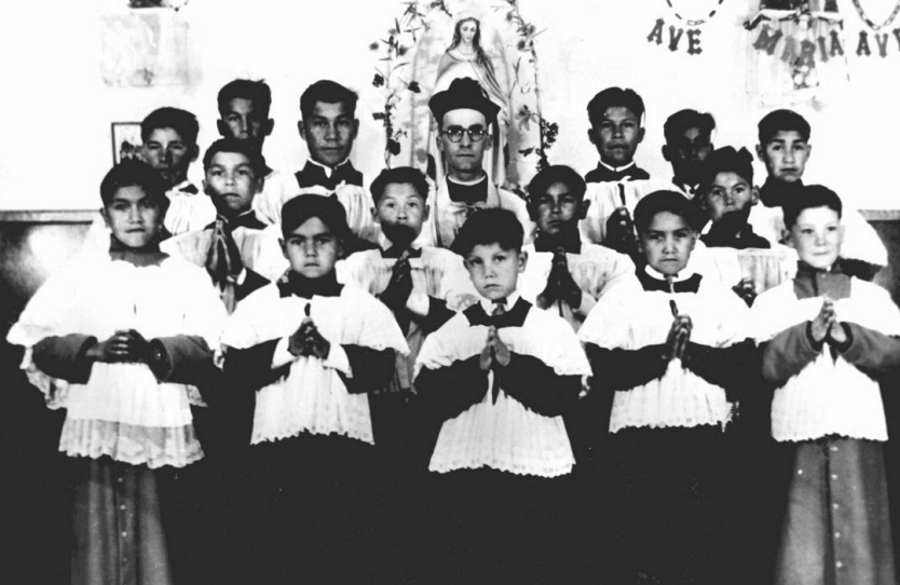

Vicar of Oblate of Mary Immaculate Missions and St Joseph’s Industrial School (Canada)

(WHO RAN THESE RESIDENTIAL BOARDING SCHOOLS?? It is important to remember that early Church missionaries were actively raising money to run schools to educate savages and ultimately kill children in the process. The Oblates are still in business!  TLH)


GRANDIN, HENRI (named at birth Henri-François), Roman Catholic priest, Oblate of Mary Immaculate, and educator; b. 20 May 1853 in Sillé-le-Guillaume, France, son of Florent-Thomas Grandin, a butcher, and Modeste-Françoise Morin; nephew of Vital-Justin Grandin*; d. 16 Feb. 1923 in Paris.

Like his uncle, the bishop of St Albert (Alta), Henri Grandin attended the Petit Séminaire de Précigné and the Grand Séminaire du Mans. On the occasion of the Oblates’ general chapter in France in 1873, Bishop Grandin spoke at the seminary attended by his nephew and persuaded the young man to accompany him to Canada. After his arrival the following year, Henri attended the noviciate of Notre-Dame-des-Anges at Lachine, Que., and he made his perpetual profession of faith on 27 May 1875. He then journeyed to St Albert, where he was ordained by his uncle on 30 November. The young priest celebrated his first mass the following day and his first high mass on 5 December.

Henri Grandin was immediately placed in charge of the minor seminary established by Bishop Grandin in St Albert; he also taught there. As an administrator, he demonstrated qualities that soon ensured his appointment to positions entailing more responsibility. In 1880 he was made superior of the Lac Ste Anne mission, where he provided instruction to novices who were completing their theological studies prior to ordination. Three years later he was appointed the first resident priest in Fort Edmonton (Edmonton) and curate of St Joachim’s parish. In 1889 he became superior of the Lac la Biche mission, which had been transferred from Bishop Grandin’s jurisdiction to that of Bishop Henri Faraud* of Athabasca-Mackenzie. The status of the mission had been a constant source of controversy between the two bishops, and Henri Grandin was sent there to ensure that the interests of the diocese of St Albert were protected when Faraud relinquished control. In 1897 he was named superior of the Saddle Lake district, and he later became temporary curate of Saint-Paul-des-Métis (St Paul, Alta), where he built a new church. He returned to Lac la Biche as superior for the years 1903–5.

In the latter year Bishop Émile-Joseph Legal* of St Albert decided that the Oblates serving in his diocese should have their own organization, distinct from that of the diocese, and he asked to be replaced as vicar of missions, that is, superior of all the Oblates in the diocese. Consequently, on 8 Sept. 1905 Grandin was appointed to this position. The following year, Bishop Albert Pascal of Saskatchewan also asked to be relieved of his responsibilities as vicar of missions, and Grandin assumed charge as well of the Oblates serving in the vicariate apostolic (soon to be the diocese of Prince Albert). When the Oblate province of Alberta-Saskatchewan was created in 1921, he would be appointed provincial.

As Oblate superior, Henri Grandin was responsible for, among other things, recruiting and preparing new members. To this end, he inaugurated the Juniorat de Saint-Jean l’Évangéliste in Pincher Creek, Alta, in 1908; two years later this institution was moved to Edmonton. He was also instrumental in establishing the Scholasticat de Marie-Immaculée in Edmonton in 1917 to enable western candidates for the priesthood to study in the west, rather than have to complete their theological and philosophical studies in Ottawa. Grandin had to deal with John Thomas McNally*, bishop of Calgary from 1913, who felt that there were too many French orders in his diocese. As part of his solution to what he regarded as the legacy of a “dead and useless past,” McNally ordered the Oblates to vacate their parish in his episcopal city and St Patrick’s parish in Lethbridge. The question of ethnicity also involved Grandin and McNally in a controversy over St Joseph’s Industrial School for native students at Dunbow, which was having serious problems attracting and retaining pupils from southern Alberta. 

The school was under the jurisdiction of the Oblates, and McNally alleged that it was not being properly conducted because none of the staff was English-speaking or competent to teach that language. 

For his part, Grandin argued that some of the institution’s problems resulted from the fact that the Department of Indian Affairs and its agents were not assisting the Oblates with recruitment. He would not bow to pressure from McNally to close the school, and he informed the bishop that he alone would have to make the decision as to the institution’s future.

In his capacity as religious superior, Grandin devoted much time and energy to overseeing the efficient management of the Indian residential schools administered by the Oblates. He was aware of the necessity of maintaining harmonious relations between the missionaries attached to these institutions and the female religious communities who performed certain functions in the schools. 

As a missionary and an administrator, Grandin was also concerned with the welfare of the native populations served by the Oblates. He made representations to the federal authorities for the services of a doctor to treat the Indians and asked that the Oblates be provided with medicines and instructions on how to dispense them. 

In his report to the general chapter in 1908, Grandin expressed the fear that the native population in his vicariate was on the verge of extinction as a result of epidemics and diseases. 

He was supportive of continuing the Oblate ministry among the Métis, even when their economic and spiritual welfare declined as a result of contact with whites.

In the last years of his life Henri Grandin suffered ill health, and in January 1923 he returned to France to seek medical attention. He died in Paris after undergoing surgery and was buried in the Oblate vault in Montmartre. A skilled administrator, as evidenced by his many years as religious superior, he had also demonstrated a keen interest in education. Grandin was a warm and generous individual, and his personal charm endeared him to everyone who knew him. Unfortunately, he remains relatively unknown and his contribution largely ignored because he has been eclipsed by both his uncle and the legendary Albert Lacombe*.

Written by Raymond Huel

Arch. Départementales, Sarthe (Le Mans, France), État civil, Sillé-le-Guillaume, 20 mai 1853. Arch. of the Roman Catholic Diocese of Calgary, Bishop J. T. McNally papers. PAA, Arch. of the Oblates of Mary Immaculate, Prov. of Alberta-Saskatchewan, 71.220, items 3376, 7732; 84.400, items 883, 893–95, 898, 900. “Alberta et Saskatchewan,” Missions de la Congrégation des missionnaires oblats de Marie Immaculée (Rome et Bar-le-Duc, France), 47 (1909): 133–34. P.-É. Breton, “Histoire du collège,” in Collège Saint-Jean: cinquantième anniversaire, 1911–1961, ed. A. Duhaime (Edmonton, [1961]), 32–33. Gaston Carrière, Dictionnaire biographique des oblats de Marie-Immaculée au Canada (4v., Ottawa, 1976–89), 2: 105–6. The diaries of Bishop Vital Grandin, 1875–1877, trans. A. D. Ridge, ed. B. M. Owens and C. M. Roberto (Edmonton, 1989). “Feu le R.P. Henri Grandin, o.m.i.,” Les Cloches de Saint-Boniface (Saint-Boniface [Winnipeg]), 22 (1923): 51–54. R.[-J.-A.] Huel, “La mission Notre-Dame-des-Victoires du lac la Biche et l’approvisionnement des missions du nord: le conflit entre Mgr V. Grandin et Mgr H. Faraud,” in Western Oblate Studies 1: proceedings of the first symposium on the history of the Oblates in western and northern Canada . . . , ed. R.[-J.-A.] Huel et al. (Edmonton, 1990), 17–36. “Jubilé d’or du R.P. Gabillon, o.m.i.,” Missions de la Congrégation des missionnaires oblats de Marie Immaculée (Rome), 65 (1931): 755–58. “Lettre du R.P. Leduc au P. Aubert,” Missions de la Congrégation des missionnaires oblats de Marie Immaculée (Paris), 15 (1877): 297–306. “Oblations,” Missions de la Congrégation des missionnaires oblats de Marie Immaculée (Paris), 14 (1876): 562–66. “Le premier siècle de Saint-Joachim,” Missions de la Congrégation des missionnaires oblats de Marie Immaculée (Rome), 87 (1960): 70. “Le R.P. Grandin, vicaire des missions de Prince-Albert,” Missions de la Congrégation des missionnaires oblats de Marie Immaculée (Rome et Bar-le-Duc), 44 (1906): 469. “Rapports au chapitre général de 1908: Alberta et Saskatchewan,” Missions de la Congrégation des missionnaires oblats de Marie Immaculée (Rome et Bar-le-Duc), 47 (1909): 133–41. [E.] B. Titley, “Dunbow Indian Industrial School: an Oblate experiment in education,” in Western Oblate Studies 2: proceedings of the second symposium on the history of the Oblates in western and northern Canada . . . , ed. R.[-J.-A.] Huel with Guy Lacombe (Lewiston, N.Y., and Queenston, Ont., 1992), 95–113. M. B. Venini Byrne, From the buffalo to the cross: a history of the Roman Catholic diocese of Calgary (Calgary, 1973).

CLICK OLDER POSTS (above) to see more news

CLICK OLDER POSTS  (above) to see more news

MEGWETCH THANK YOU

HUGE Thank you for visiting this blog and sharing this with your kin. It's appreciated. Contact Trace anytime! Use the form below.

BOOKSHOP

Please use BOOKSHOP to buy our titles. We will not be posting links to Amazon.

Popular Posts

To Veronica Brown

Veronica, we adult adoptees are thinking of you today and every day. We will be here when you need us. Your journey in the adopted life has begun, nothing can revoke that now, the damage cannot be undone. Be courageous, you have what no adoptee before you has had; a strong group of adult adoptees who know your story, who are behind you and will always be so.

OUR HISTORY

OUR HISTORY
BOOK 5: Lost Children of the Indian Adoption Projects