BACK UP BLOG (no longer updating)

This blog was a backup for American Indian Adoptees blog
USE THE SEARCH BAR or SEARCH TOPICS at bottom of this blog

If you need support

Support Info: If you are a Survivor and need emotional support, a national crisis line is available 24 hours a day, seven days a week: Residential School Survivor Support Line: 1-866-925-4419. Additional Health Support Information: Emotional, cultural, and professional support services are also available to Survivors and their families through the Indian Residential Schools Resolution Health Support Program. Services can be accessed on an individual, family, or group basis.” These & regional support phone numbers are found at https://nctr.ca/contact/survivors/ . MY EMAIL: tracelara@pm.me

Search This Blog

Showing posts with label 60s Scoop Legacy of Canada. Show all posts

Sunday, January 19, 2025

It's believed somewhere between 11,000-20,000 children were removed from their homes

From 2021

'Canada must own up': Manitoba First Nations leaders call for national inquiry into Sixties Scoop

Beginning in the mid-1950s and lasting until the early 1980s, a series of policies enacted by provincial child welfare authorities saw thousands of First Nations children taken from their homes and families, placed in foster homes, and eventually adopted out to white families from across Canada and the United States. (Sheila North/CBC)

First Nations leaders in Manitoba are adding their voices to the call for a federal inquiry into a dark history known as the Sixties Scoop.

Beginning in the mid-1950s and lasting until the early 1990s, a series of policies enacted by provincial child welfare authorities saw thousands of First Nations and Inuit children taken from their homes and families, placed in foster homes, and eventually adopted out to white families from across Canada and the United States.

The children lost their names, their languages and connections to their heritage.

"The Sixties Scoop legacy was just a continuation of violent and ignorant policies that were designed by Canada to disrupt and destroy First Nations families and communities," Grand Chief Jerry Daniels of the Southern Chiefs' Organization in Manitoba said Monday at press conference at the Canadian Museum for Human Rights in Winnipeg.

He called the practice, which began in the mid-1950s and lasted until the early 1980s, the definition of state-sponsored violence.

"By attacking the family structures and incentivizing the apprehension of our families by not only the church, but now Canadian and foreign families, they made everyday citizens complicit in the violence and reliant on the financial compensation it came with," Daniels said.

'Trauma, hurt, pain to children'

Manitoba Keewatinowi Okimakanak Grand Chief Garrison Settee said parents who had their children taken suffered deeply while their children were used as commodities without any explanation from the government, he said.

"There were commercials — government commercials — to advertise for the adoption of First Nation children. What kind of mentality goes into that kind of mindset to actually use our children as commodities?" Settee asked.

"The people that were behind this policy are responsible for trauma, hurt, pain to children. And Canada must own up to that. That's why there should be an inquiry."

Former Canadian senator Murray Sinclair and a group called 60s Scoop Legacy of Canada first issued the call in early August for an inquiry.

Daniels and Settee said their organizations held a summit in September and unanimously passed a resolution in support of the inquiry call as well as long-term funding support for survivors.

"It's important that Canada understands what happened to every single one of the children that were impacted by this. Until that's done I think we haven't really done justice for Canadians and for all the children that were taken away," said Daniels.

They also want to see the immediate release of any records held by state or church-run entities "to expedite the process of bringing families back together and to bring some closure."

The SCO represents 34 Anishinaabe and Dakota communities in southern Manitoba while MKO represents 26 First Nations in the province's north.

It's believed somewhere between 11,000 and 20,000 children were removed from their homes and placed with new families in Canada, the U.S. and Europe.

Need to analyze numbers, effects of scoop

The estimates vary greatly because many children are believed to have not been recorded as status Indian in their child services records.

There is a need to determine exactly how many children were taken, where they were taken to and the longterm effects of the trauma they have suffered, said Katherine Legrange, a scoop survivor who became the founder and director of 60s Scoop Legacy of Canada, a peer support and advocacy group based in Manitoba.

Katherine Legrange is a scoop survivor and director of 60s Scoop Legacy of Canada, a peer support and advocacy group based in Manitoba. (CBC)

"Our parents and grandparents need to know that this was not their fault, that this was a result of [government] policies," she said.

"This was not our fault. We did nothing wrong as children. And so that's what I really want to emphasize in this inquiry going forward."

Legrange was taken just after birth from a Winnipeg hospital. By the time she learned, as an adult, that her birth family was from Crane River, it was too late to seek them out.

Both parents died before she turned 10, "so I'm still struggling to put the pieces of my birth story together," she said.

She has four siblings — one who died this past summer in Winnipeg of an overdose, and three who are reluctant to meet.

Sixties Scoop survivor Teri Starr was taken from her family at three months old. She said she was raised in a really good home but many of the other adoptees cannot say that. (CBC)

"I was told that was one of the reasons why I was scooped is because my parents didn't love me, or that community didn't love me," said Teri Starr, who was taken from her family in Sagkeeng First Nation at three months old.

"But it was due to a policy and other peoples' hand that was able to scoop the children. Those questions need to be asked: Why? Why was that all right?"

Between two worlds

She said there is a feeling for many adoptees of being untethered once they are made aware they were part of the scoop. It's a feeling of being between two worlds and trying to balance that out. 

"You try to go back and learn your culture, but that's been taken away. Where do you start and where do you go? Who do you ask?" she said.

Starr said she was raised in a really good home but still faced difficult question from herself and others as a dark-haired, dark-skinned, dark-eyed girl in a family with light features.

Now as she begins her search for the past, she faces difficulties in trying not to hurt those who adopted her, she said.

"I want to respect the family that raised me, and I don't want to disrespect them [by] going and trying to find my family, but that piece is important to me as well," she said.

 

Tuesday, July 11, 2023

#60sScoop Survivors gather in Winnipeg for conference

 'STILL HEALING'

Survivors of the Sixties Scoop gathered in Winnipeg on Saturday for the Manitoba Sixties Scoop Conference and share their stories and experiences of being taken from their families.  

“Since the apology of 2015, there really hasn’t been a bigger gathering of Sixties Scoop Survivors to talk about some of the issues that we’re still working our way through,” said 60s Scoop Legacy of Canada Director and spokesperson Katherine Strongwind. “We’ve had about 23 smaller healing gatherings, mostly in Winnipeg and some across western Canada and we thought it was really important to pull everybody together today to say, ‘You know, we are still here, we’re still healing ourselves.’  The province really needs to step up their game in terms of really how they’re going to be helping us.”

The “Sixties Scoop” refers to the large-scale forced removal or “scooping” of Indigenous children from their homes, communities and families of birth through the 1950s, 60s, 70s and 80s, and the subsequent adoption into predominantly Caucasian, Christian, middle-class families across Canada, the United States and overseas.

Many adoptees and Survivors were left with a lack of or poor sense of cultural identity. The forced physical and emotional separation from their birth families by the government’s assimilationist policies continues to affect adult adoptees and Indigenous communities to this day.  Many Survivors had parents, grandparents, and extended families who were forced to attend Indian Residential Schools.

“The purpose this afternoon is to pull people together and get some feedback from them on some of the very specific issues that adoptees and folks who have been through child welfare have such as name changes, child welfare records, adoption records, all of those sorts of pieces,” said Strongwind.

Organizers plan to draft a report for the provincial government but also for Indigenous leaders.

“I’m not sure (Indigenous leaders) really know what to do with us,” said Strongwind. “We’re coming home and we’re trying to reconnect our families and our communities but they don’t always have the best understanding of how to support us.”

Some 120 Scoop Survivors attended the one-day gathering.  Half of the cost of the gathering was covered by the provincial government with the remainder covered by fundraising.  City of Winnipeg donated the space at Sergeant Tommy Prince Place in the North End for the gathering through the Indigenous Liaison Unit.

“We invited a couple of speakers to share part of their story this morning and there’s definitely some similarities among all of us but also we wanted to talk about inspiring stories and ‘What’s worked best for you on your healing journey and how can we support each other?’ because so far we don’t have any kind of healing program specifically for Sixties Scoop Survivors,” said Strongwind. “So we’re supporting each other.”


Katherine Strongwind
Katherine Strongwind. Photo by Chris Procaylo /Winnipeg Sun

In 2015, then-Manitoba Premier Greg Selinger apologized on behalf of the province. Six years later, the 60s Scoop Legacy of Canada and Manitoba Senator Murray Sinclair called for a federal inquiry.

“We still don’t know how many kids were taken, where they were taken to, where they are now, how many died in care and those kind of pieces,” said Strongwind on what an inquiry would uncover. “We also know that people want to share their stories and their testimonies before they pass away.  Over the next year or so, we’ll focus on that but also gatherings like this are really important to get people together and learn from each other on how we can support each other on some of these pieces when we’re not be recognized, we’re not being acknowledged.

“We’re really out here on our own it seems like.”

The provincial government needs to provide funding for these sorts of gatherings but also provide a unit or some sort of fund available for Survivors to be able to access some of the services that they offer such as the post-adoption registry and child welfare records, Strongwind said. Even something as seemingly simple as making it easier for Survivors to legally change back to their traditional names.

“The province did the dirty work of the Sixties Scoop,” said Strongwind, who legally changed her name in November. “They were given jurisdiction in 1951 from the federal government and they really took that and ran and decided they were going to scoop up entire families off reserves and they thought they were going to make us into upstanding Christian citizens. In some respects, they were successful but we know that many of us ending up leaving that lifestyle and our families and ended up coming home to our biological families and communities. Culture plays a huge role in our healing.

“There’s all of these sorts of pieces that the province could be helping with but really aren’t.”

City could participate by providing spaces for gatherings and a memorial of some sort.

“All levels of government I feel have a part to play in this,” Strongwind said.

With some 10,000 Indigenous children in care in Manitoba, Strongwind believes Sixties Scoop Survivors can have role in preventing a recurrence of what happened to them.

“We want to use our experience as best practices to prevent that from happening in the future,”Strongwind said. “That’s part of the purpose that the 60s Legacy of Canada works towards every day.”

[gdawkins@postmedia.com]

Tuesday, April 11, 2023

#60sScoop Interactive project raises awareness, creates connections and reunites long-lost relatives

From Île-à-la-Crosse to Brighton, England: '60s Scoop survivors map journey of reconnection

Daniel Frost seated in a hotel boardroom.
Daniel Frost is Métis and Cree. Born in northern Saskatchewan, he was adopted by British parents in 1968 at just two years old. (Francis Ferland/CBC)

Thinking
about meeting his sister Patsy for the first time seven years ago is
still tough for Sixties Scoop survivor Daniel Frost.

"All I could
do was look at her hands," he recalled, still overwhelmed with emotion
as he remembered how much those hands looked like his.

"I couldn't look at her eyes."

Frost
is Métis and Cree, one of about 22,000 Indigenous kids who were torn
from their homes and placed in foster care or adopted into
non-Indigenous families between 1951 and 1991, a system known today as
the Sixties Scoop.

He came to Ottawa this week to share his story with the interactive mapping project, In Our Own Words.

Coloured arrows dart all over a map of Canada shown on a projector screen.
The In Our Own Words map tracks where Indigenous kids were taken after being torn from their families. (Francis Ferland/CBC)

Born
in Île-à-la-Crosse in northern Saskatchewan, two-year-old Frost was
adopted by British parents in 1968, taken to White Rock, B.C., and then
finally to Brighton, England. He now lives in Spain.

He spoke with
CBC News at downtown Ottawa's Novotel Hotel, where Sixties Scoop
survivors gathered this week from far-flung places all over the world to
share stories and connect.

Frost explained how a federally funded
Saskatchewan-based organization, Adopt Indian Métis (AIM) scooped seven
youngsters from his 13-sibling family. The organization is known for
placing ads in newspapers and aggressive public relations campaigns.

Frost began learning his history by reading legal documents,
including the court files that tell how his mother ran out of the
courtroom when she learned her children were being taken.

"What
they were saying in the 1960s and '70s was, 'We're not going to help
you. We're just going to take your children,'" Frost said.

"I don't know if I'll heal from it, but I think being able to work my way through it is something which is necessary."

He
visited Île-à-la-Crosse in 2016 and met his family, which he said
changed him from a scared outsider to a man deeply proud of his
Indigenous identity, and this trip to Ottawa includes a hop across the
river to Gatineau, Que., to pick up a copy of his first Indian status
card.

KEEP READING

Thursday, March 23, 2023

APTN Investigates: Indigenous people in Canada behind bars | Jesuits of Canada release names of priests 'credibly accused' of sexually abusing minors


Episode 2: John Derek Mills is a ‘60s Scoop survivor from Waterhen Lake
First Nation with a long juvenile record and a lifetime of crime that
culminated in a botched armed robbery in 1996. Originally sentenced to
seven years in prison, Mills is still behind bars nearly three decades
later. In this episode, reporter Rob Smith talks to Mills to uncover why
he has fallen through every crack in the justice system. 

For more information, visit www.aptnnews.ca. 


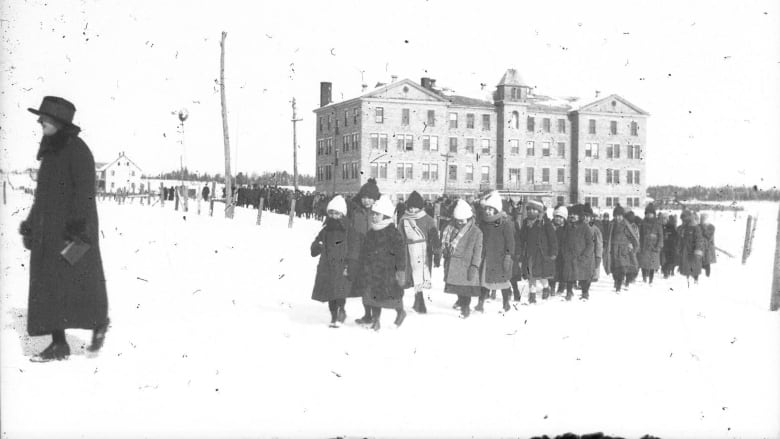
A black and white photo shows children in coats and hats walking through the snow in front of large brick building, following a person wearing a dark coat and wide-brim hat.
The
Spanish Indian Residential School for Boys was managed by the Jesuits,
while the girls school was managed by a Roman Catholic teaching order,
the Daughters of the Heart of Mary. (Shingwauk Residential Schools Centre, Algoma University)


✔Indigenous

10 out of 27 Jesuits 'credibly accused' of abusing minors worked at a residential school or a First Nation

Over a third of the Jesuits who are "credibly accused" of sexually
abusing minors worked in First Nations or at the Spanish Indian
Residential School in Spanish, Ont.

The religious order released a list of names, along with the places they were assigned to work, on Monday as part of an attempt to be more transparent and accountable. 

Crown-Indigenous Relations Minister Marc Miller said the revelations bring about mixed feelings.

"Largely, the Jesuit fathers identified there have passed, I think robs people of an opportunity to get accountability," he said.

"I
do understand that just seeing people's names on this list can be quite
triggering for a number of people but I think at the end of the day
that in the spirit of better late than never, it is nice to see the
Jesuits taking some accountability and transparency in this."

He
said from a government perspective, there is a continued need to
support communities with wellbeing, language, and culture as they
grapple with the "pattern of predation on Indigenous communities."

"We know that a lot of the harm that has occurred has harmed communities as a whole," said Miller.

"We
are not dealing with acts of individuals in isolated circumstances. I
think that is an important truth that we have to keep at the top of our
mind because it goes to the institutional nature of this for which there
needs to continue to be accountability."

Wednesday, May 4, 2022

‘60s Scoop survivor Leah Ballantyne grew up thinking she was the only one

 VIDEO

‘Growing up I kind of thought, why am I this lone person…”


Leah Ballantyne was just 11 days old when she was adopted out to a Scottish family in Winnipeg – by the time she was 13, she was already searching for her birth parents.

Riding the bus to school through Winnipeg’s downtown core, she would see Indigenous people and wondered if they were relatives.

“Growing up, I kind of thought, why am I this lone person and adopted into a family? Why didn’t my family want me and what were the circumstances? And as I learned that the ‘60s Scoop was actually a part of a process that started with reservations, and the Indian Act, and residential schools, and day schools,” she says on the latest episode of Face to Face.

“Then I realized that I was part of something that was a separation that was going on through government policy.”

The push to finally find out where she came from came after an event in Vancouver.

She says she was inspired by speeches by former Assembly of First Nations national chief Ovide Mercredi and Mohawk Council of Kahnawake grand chief Joe Tokwiro Norton

After, she went digging into her past.

Ballantyne’s birth mother had registered her for a status number at birth so she knew she was from Mathias Colomb Cree Nation. She wrote the chief at the time, the late Pascal Bighetty, asking for help.

Not long after, Ballantyne received a call from Bighetty, who, as it would turn out, was her uncle, telling her he knew who she was and to come home.

Advocating for her community

Ballantyne says the rally and reunification with her community, a “light went on” and she decided she would push for positive changes in law and policy by becoming a lawyer.

To this day, Ballantyne remains the only member of Mathias Colomb Cree Nation to become a lawyer. She is currently working with her nation on child welfare laws and bringing children home, whether they were part of the 60s Scoop, aged out of the care, or still in care.

Ballantyne is vocal about representation and believes those who falsely claim Indigenous identity, should face criminal charges.

“There is a couple of sections in the Criminal Code of Canada for identity and identity fraud and so Indigenous identity fraud is very much a charge that could be laid by any institution that has addressed this kind of issue and people that are claiming false Indigenous identity,” she says.

“And there is no statute of limitation on this type of identity fraud within the Criminal Code.”

KEEP READING

Friday, January 21, 2022

FILM: This is Not A Ceremony

 Sundance Film Festival: This Is Not a Ceremony is having its world premiere at the Sundance Film Festival (January 20–30, 2022).

‘This Is Not A Ceremony’
Ahnahktsipiitaa (Colin Van Loon)

Canadian Ahnahktsipiitaa, also known as Colin Van Loon, is Blackfoot and Dutch, hailing from The Piikani Nation.

His cinematic virtual reality production, “This is Not A Ceremony,” part of the Sundance New Frontier program, is described as “darkly humorous and occasionally caustic,” telling the story of Adam North Peigan, Robert Sinclair and others, and the struggles and conflicts of growing up as an Indigenous man, according to the Sundance website.

Van Loon is the lead artist, and the production included key collaborators Olivier Leroux, James Monkman and Jessica Dymond.

He grew up with his mother in Lethbridge and other southern Alberta towns in Canada.

“I really love our people, and when I say ‘our’ I mean Piikani and Niitsitapi as a whole,” he told Indian Country Today. “I am Blackfoot/Niitsitapi as well as Dutch. I am very Blackfoot-centric but try to remain inclusive to other nations and their ways. I wanted everyone to feel they were represented fairly.”

The virtual reality production, "This is Not a Ceremony," by lead artist Ahnahktsipiitaa (Colin Van Loon), is an official selection of the New Frontier Program at the 2022 Sundance Film Festival. (Photo courtesy of Sundance Institute)

He was raised by his mother and grandmother, Edith North Peigan, whose name later became Van Loon.

“Edith was very much a victim of disenfranchisement, even though her husband, my grandfather Buddy Van Loon, was also Blackfoot through his mother, and our Kainai relations, the Holloway family,” he said.

Van Loon said nonetheless they remained close to their kin in the North Peigan family.

“When I was a younger man I was very close with Jimmy Small Legs, a cousin to Edith and me," he said. “Jim was able to show me a great deal of our Piikani traditions. This had major impacts on me growing up and it often shows up in my work. Jimmy and his wife Joanne adopted me in our Niitsitapi tradition, so I also refer to Jim as my grandfather and Joanne as my grandmother, as is common practice within The Blackfoot confederacy Piikani, Siksika and Kainai and Aamskapi Pikuni.”

The importance of family is evident in his work, he said.

Ahnahktsipiitaa (Colin Van Loon), Blackfoot and Dutch, is lead artist of the cinematic virtual reality production, "This is Not a Ceremony," an official selection of the New Frontier section at the 2022 Sundance Film Festival. (Photo by Luis Alvarez, courtesy of Sundance Institute)

“Family, kinship and reciprocity are values that show up in my work,” he said. “Adam North Peigan is my relation, and I wanted to showcase his story, as these moments are clear examples of systematic racism in Canada, and it’s an important story to tell in the framework of reconciliation.”

He continued, “There can be no reconciliation without truth, and both stories, Robert Sinclair and Brian Sinclair’s, and Adam North Peigan’s, are part of this. Additionally, Adam is a political advocate, working for our people and Survivors within the Sixties Scoop Indigenous Society of Alberta and the Legacy of Hope Foundation. I wanted to support him and his work in some small way.”

He wants the audience to leave with a sense of the impact of the virtual reality storytelling experience.

“I wanted both Indigenous and settler audiences to see the strength and resilience of Adam North Peigan and Robert Sinclair,” he said. “For White settlers specifically, I hope it affects them and they feel compelled to bear witness and try to make changes within the national community of Canada, to do something about systemic racism and discrimination.

“Virtual reality (VR) brings the audience closer to the storytellers,” he said. “hey can see them up close, hear what they have to say, and feel it not only in their minds, but viscerally and in their hearts as well. I want settler audiences to feel uncomfortable, and I want them to take that discomfort and think about it and act on it. I hope this connection makes audiences feel more compelled to uphold their responsibility as a witness.”

He continued, “I am hoping that Indigenous audiences will see the incredible strength, dedication and tenacity of Adam North Peigan and Robert Sinclair, with their continued efforts.”

Van Loon is the operations manager for the Indigenous Matriarchs 4 AR/VR media lab (IM4-Lab), and he sits on the Telefilm Indigenous Working Group, among others. He works to elevate the voices and stories of Indigenous peoples in his community by creating spaces for youth works in the Talking Stick’s Festivals REEL Reservation: Indigenous Cinematic Indigenous Sovereignty Series, or through his company, Blackfoot Nation Films.

Sundance Institute Meet the Artist: Ahnahktsipiitaa (Colin Van Loon)

Monday, January 17, 2022

Alberta not included in ‘Sixties Scoop’ Healing Foundation inaugural grant funding


WEBSITE


The Sixties Scoop Indigenous Society of Alberta (SSISA) feels it was left out when it comes to accessing new funding.


In December 2021, the Sixties Scoop Healing Foundation
announced eight Indigenous organizations will get just over $1 million
in funding under the foundation’s 2021 Pilot Grant Program.

The SSISA, however, was not one of them.

“We’re
talking about thousands of people in Alberta shut out of a process that
nobody was aware of,” said Sandra Relling, president of the SSISA.

“We
thought that perhaps it might be upcoming, so we were waiting for some
sort of feedback either on their website or through the emails we sent
to the organization looking for information on the process.”


Read more:

Indigenous organizations call for national inquiry into ’60s Scoop


Tuesday, October 26, 2021

After an early forced adoption, an Indigenous man rediscovers his identity #60sScoop


Eric Wardell, an Indigenous man from Canada’s Northwest Territories, was taken from his parents at just three weeks old, in what is known in Canada as the “sixties scoop.” In this first-person story, Wardell explores his identity — what it means to discover who you are, and how your past can shape your future. This story is part of the ‘Turning Points’ series: stories told by Indigenous people from Yellowknife, Canada in partnership with the Global Reporting Centre.  Transcript Audio

WATCH 

Turning Points

Eight short films about alcohol use, addiction, and healing in Yellowknife, directed by the storytellers themselves. WATCH

PBS NewsHour Global Reporting Centre


Tuesday, September 7, 2021

Province acknowledges Day for Truth and Reconciliation (September 30) #OrangeShirtDay


The province (Manitoba) has decided to acknowledge and observe the National Day for Truth and Reconciliation (NDTR) on Sept. 30.

Observance of the holiday, which will see Manitoba public schools closed and non-essential public servants off work, will advance reconciliation, and allow residents time to reflect on the residential school experiences of First Nations, Métis and Inuit, Alan Lagimodiere, Indigenous Reconciliation and Northern Relations Minister announced Friday.

“We all have a role to play in reconciliation,” he said in a statement. “We can all listen, learn, and support the healing needed to address the intergenerational trauma caused by the residential school system. Reflecting on our tragic history by recognizing the National Day for Truth and Reconciliation provides an opportunity for Manitobans to learn about the ongoing legacy of residential schools.”

The NDTR was instituted as a federal statutory holiday in June by the federal government in recognition of Indigenous families and communities harmed by Canada’s residential schools, which existed up to 1996.

“Thanks to the hard work of survivors, who pushed for the recognition of the National Day for Truth and Reconciliation as a provincial holiday, Manitobans can have the chance to learn, grow, and move toward reconciliation,” provincial NDP leader Wab Kinew said in a statement on Friday. “In 2017, I introduced a bill to recognize this day in Manitoba, which was one step, and our NDP team has been honoured to work alongside survivors and communities who pushed the PCs to take this latest step.”

Katherine Legrange, director of 60s Scoop Legacy of Canada, said the provincial recognition is a good first step. She said real reconciliation can only come with the truth.

“We encourage all Manitobans to take this day to learn the truth behind the terrible IRS (Indian Residential Schools), Day Schools, and Sixties Scoop policies of the federal and provincial governments that continue to affect our families today,” she said in a statement. “We encourage the minister to engage with survivors with lived experience in amending Wab Kinew’s 2017 Bill for Orange Shirt Day to acknowledge this day as a general holiday in Manitoba, and support our healing, going forward.”

Grand Chief Arlen Dumas of the Assembly of Manitoba Chiefs said on Friday his organization appreciates the province’s decision.

“There are some provinces that will not be observing the national holiday,” he said. “We all look forward to September 30 and paying our respect to the former IRS students and helping this government to move forward on the path to reconciliation with First Nations in Manitoba.”

Sept. 30 will also see flags on all provincial government buildings lowered to half-mast in observance of National Day for Truth and Reconciliation.

Nova Scotia also said Friday that it will recognize the day. British Columbia and the Northwest Territories have already indicated they will observe the day.

CLICK OLDER POSTS (above) to see more news

CLICK OLDER POSTS  (above) to see more news

MEGWETCH THANK YOU

HUGE Thank you for visiting this blog and sharing this with your kin. It's appreciated. Contact Trace anytime! Use the form below.

BOOKSHOP

Please use BOOKSHOP to buy our titles. We will not be posting links to Amazon.

Popular Posts

To Veronica Brown

Veronica, we adult adoptees are thinking of you today and every day. We will be here when you need us. Your journey in the adopted life has begun, nothing can revoke that now, the damage cannot be undone. Be courageous, you have what no adoptee before you has had; a strong group of adult adoptees who know your story, who are behind you and will always be so.

OUR HISTORY

OUR HISTORY
BOOK 5: Lost Children of the Indian Adoption Projects