This blog was a backup for American Indian Adopteesblog
USE THE SEARCH BAR or SEARCH TOPICS at bottom of this blog
If you need support
Support Info: If you are a Survivor and need emotional support, a national crisis line is available 24 hours a day, seven days a week: Residential School Survivor Support Line: 1-866-925-4419. Additional Health Support Information: Emotional, cultural, and professional support services are also available to Survivors and their families through the Indian Residential Schools Resolution Health Support Program. Services can be accessed on an individual, family, or group basis.” These & regional support phone numbers are found at https://nctr.ca/contact/survivors/ .
MY EMAIL: tracelara@pm.me
Sixties
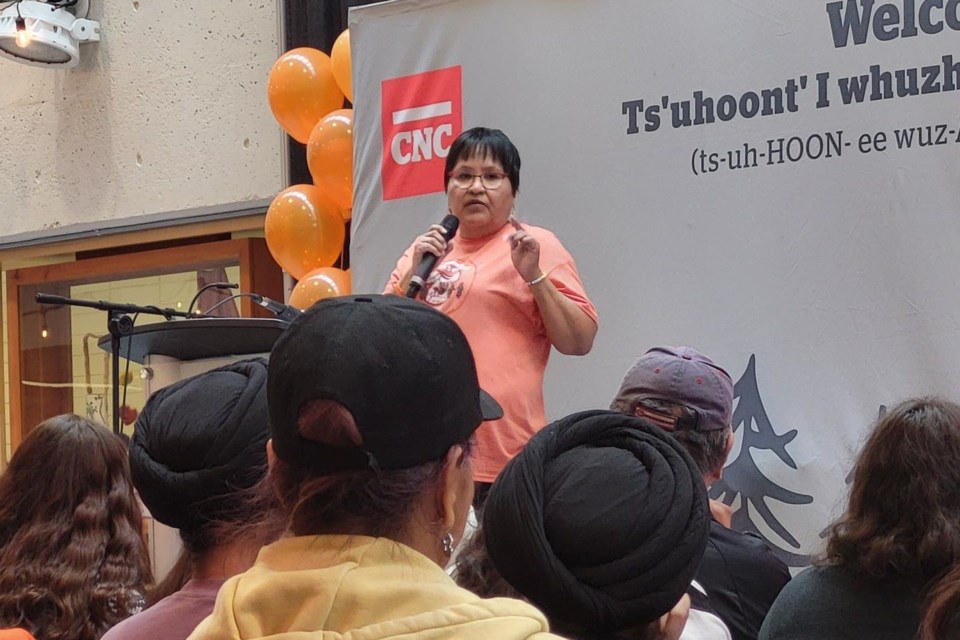
Scoop survivor and CNC social work student, Sherry Hunter, shared her
story during the college's Calling for Action: Honouring Truth event
held Wednesday, Sept. 25 ahead of the National Day of Truth and
Reconciliation that will be celebrated at Lheidli T'enneh Memorial Park
on Monday, Sept. 30. Citizen staff photo
Sixties Scoop survivor Sherry Hunter shared her story during
the College of New Caledonia’s Calling for Action: Honouring Truth
event.
“Truth and Reconciliation means to me as a First Nations person that
we are finally being recognized and acknowledged for the horrific
atrocities that are happening to our First Nations people across
Canada,” said Hunter, a CNC social worker diploma program student
heading for a social work bachelor’s degree.
She talked about her experiences at the event, held Wednesday, Sept. 25
ahead of the National Day for Truth and Reconciliation Day that will be
celebrated at Lheidli T’enneh Memorial Park on Monday, Sept. 30 from 2
to 4 p.m.
“I have learned so much here at CNC,” Hunter said.
During her learning she discovered the nature of colonialism, which
is part of her own personal story as a '60s Scoop survivor, and has
acknowledged the injustices she has experienced because of it.
Between about 1951 and 1984, an estimated 20,000 or more First
Nations, Métis and Inuit infants and children were taken from their
families by child welfare authorities and placed for adoption or in
foster care in mostly non-Indigenous households. This mass removal of
Indigenous children from their homes, supported by a series of
government policies, became known as the Sixties Scoop, according to the
Indian Residential School History and Dialogue Centre website at UBC.
“Some of the injustices include my loss of my language, my culture and my heritage,” Hunter said. “Most importantly I feel my loss of connection to my family and my homeland.”
Besides the loss of her First Nations roots, she also felt like she did not belong with the new white family, she added.
“I was stuck in the middle trying to find a sense of belonging,”
Hunter said. “My story is sad but typical that we all hear too often
from First Nations across Canada that should never have happened to me
and to many, many others.”
Hunter said her experience had a profound impact on her life that she carries with her to this day.
“I know what it’s like to be abused,” Hunter said. “I was taken as a
young child and put into two different foster homes. I arrived in the
second foster home when I was three. Little did I know what would happen
to me there. I was physically, mentally and sexually assaulted from the
time I was seven years old until I was 13. These years are important
for all our development and if we are not nurtured in a positive
environment our later years are a hot mess.”
Because of what Hunter experienced as a young child she said she fell into drug misuse and alcoholism.
During her healing journey she has learned to overcome these
addictions and learned a new way in order to become successful, she
added.
“My healing journey has been bittersweet,” Hunter said. “The bitter
is I am 61 years old getting an education, trying to make a difference. I
should’ve had this life when I was 20. The sweet is I am here. I am
healthy. I’m getting a good education and I will make a difference.”
“Try as he might
to comprehend the life on the far side of the ocean that the white man
described, the brown man was unable.Such a life was beyond belief. He
could not envision one man or a small group of men and women owning all the
land, all the animals, all who dwelt upon it, all the produce, man’s labor and
his harvest, and men’s lives. But he felt sorry for his friend.” – Basil
Johnston, THE MANITOUS (1995), Chapter 11, AUTTISSOOKAUNUK, describing the
strangers with light complexions who landed on the brown man’s land and
described Europe.Tribes had no concept
for what he described, which was colonization and slavery.
(👆this is my favorite quote)
What has been written about the
European’s arrival is for the most part sinister.In rock art, scrolls and oral history, tribes
recorded, understood and remembered the events of early colonial contact by
means of symbolic images: Manitous (or spirits), floating islands, flying and
underwater ships, giant birds, thunder and lighting, sounds of music in the
air, a strange white whale, dreams, premonitions and warnings.Early tribes viewed Puritan disregard for
ritual to mean earthly disaster and punishment.The tribes believed these aliens were Manitous possessing a powerful
spirit.(This is according to
missionaries who knew the tribes here in the northeast. And of course, this was written from their
perspective…) (I use “Indian” in this text, as they did.)
Anishinaabe
say:After the French came the
Zhaaganaash (“Off-shore ones”) of Great Britain.But out of the Zhaaganaash came the
Gichi-ookomaan (“Big-Knives”)—the Virginians (i.e.
pre-Americans) via WIKIWonder if the Anishinaabe have a word for
serial killers?
The Indians
lack of material wealth and simple lifestyle was viewed as a character flaw; Puritans
could not comprehend their apparent lack of interest in wealth.(The “Indian” had no concept of being owned
or owning land.)
**
You
and me: we are not
supposed to know.
President Thomas Jefferson
The Papers of Thomas Jefferson, December 29, 1813
“This unfortunate race, whom we had
been taking so much pains to save and to civilize, have by their unexpected
desertion and ferocious barbarities justified extermination and now await our
decision on their fate.”
Jefferson
owned many slaves, had offspring with slaves, and had a fancy plantation, of
course. (In Virginia)
These are real crimes and real atrocities
against Indigenous First Nations People yet no one involved has been charged or
put in prison?Their goal?
When details of the Indian Adoption Projects
were sealed and files were closed after adoptions, a child would not have
his/her name or tribal identity anymore, with their birth certificate altered
and falsified.Tribal membership might
exist for some adoptees on paper but with secrecy and sealed files, the adult
adoptee would never know or be able to find out.
To go even further back one hundred years. The Bureau of Indian Affairs
was in stark contrast in 1824 when federal Indian policy was rooted in
war, blood, and death. It’s not surprising that the bureau was first
planted in the War Department before being rooted permanently in the
U.S. Department of the Interior in 1849.
As many celebrate the defense of ICWA, we also must recognize the colonial violence that has demanded and produced it.
ICWA was passed in 1978 due to the rampant genocidal white christian
driven legal practice of taking Indigenous children from their homes and
placing them with white christian families. The law was created to
resolve a problem colonialism created. The settler colonial state didn’t
become interested in “keeping Indigenous children with their Tribes”
until it was assured that those children would be passively assimilated
into its “civilized” order.
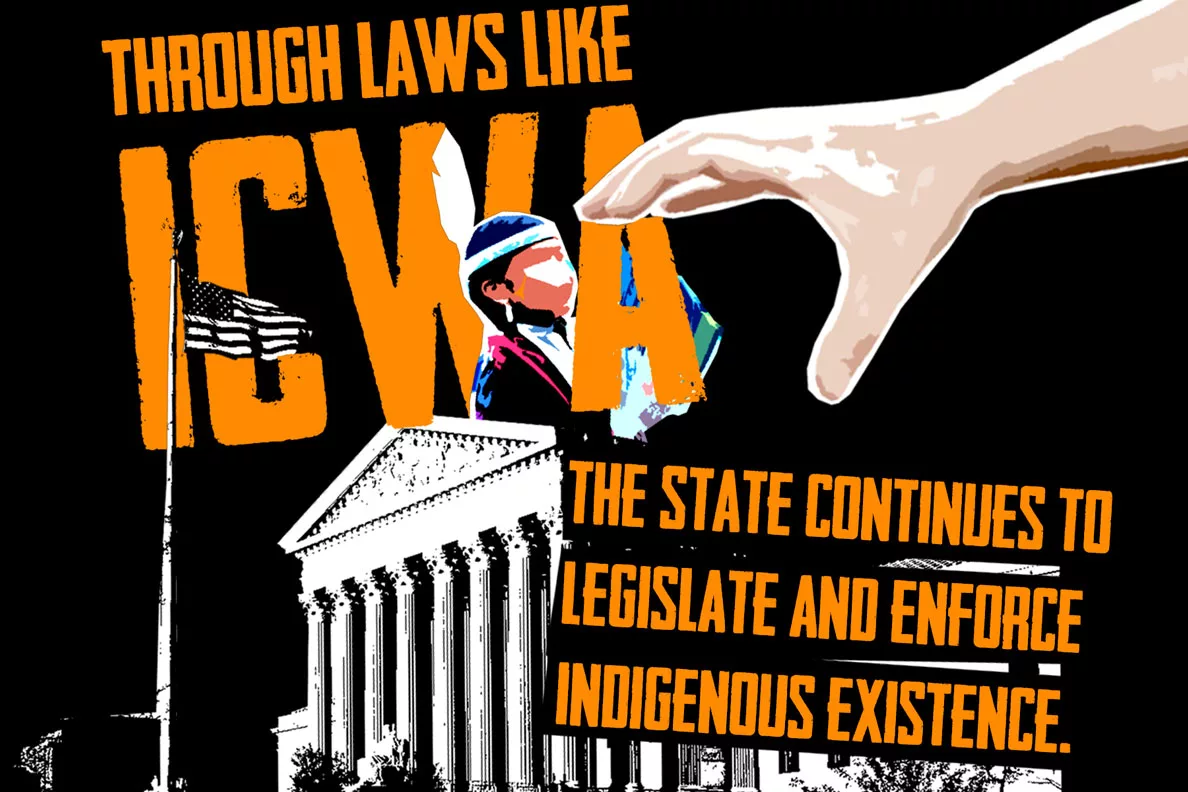
Through laws like ICWA, the State continues to legislate and enforce Indigenous existence.
White families stealing Indigenous children should be a non-issue. That any argument for justification for keeping Indigenous children with
their peoples is occurring is part of the larger issue of white
supremacy, cis-heteronormativity, and Indigenous genocide.
Before ICWA was enacted in 1978:
– 25%–35% of all Native children were being removed from their homes;
– of these, 85% were placed outside of their families and communities—even when fit and willing relatives were available.
– Today, Native families are 4x more likely to have their children
removed and placed in foster care than their White counterparts.
Before 1492 Indigenous children weren’t stolen by colonizing predators.
While ICWA is celebrated as an affirmation of Indigenous sovereignty,
in actuality it affirms congressional power to regulate commerce (The
Commerce Clause) with Indigenous Peoples and plenary power over “Indian
affairs.” A plenary power or plenary authority is a complete and
absolute power to take action on a particular issue, with no
limitations.
The legal battle over ICWA erases Indigenous children who are not
from federally recognized tribes, border communities, & migrants
doesn’t address issues of dis-enrollment. Particularly as ICWA
specifically “sets federal requirements that apply to state child
custody proceedings involving an Indian child who is a member of or
eligible for membership in a federally recognized tribe.” ICWA
reinforces “Indian” citizenship policies that some Tribal governments
have used to exclude mixed race descendants. Regardless of ICWA, child
theft still occurs within the foster care system, where Indigenous youth
still are most likely to end up.
The discourse around ICWA is also inherently cis-heteronormative as
it doesn’t support queer & two-spirit family formations. ICWA
defines Indian child as “any unmarried person who is under age eighteen
and is either (a) a member of an Indian tribe or (b) is eligible for
membership in an Indian tribe and is the biological child of a member of
an Indian tribe…”
What justice can we expect from a colonial system that also maintains
anti-Indigenous laws sanctioning desecration of sacred lands and
attacks bodily autonomy?
Are our cultures and communities so desperate and broken that we
celebrate that colonizers can determine if our children belong with us?
The apparent “necessity” of ICWA demonstrates the fallacy of colonial
laws and the predatory white supremacist violence that constantly looms
outside our homes.
That colonial laws are required to stop white people from outright
stealing Indigenous babies is the result of a much deeper systemic
problem than laws like ICWA can address.
Many of our families & homes are broken due to colonization, more colonial laws won’t fix that.
What are culturally-rooted non-state based solutions to keeping Indigenous children with our families?
Sure everybody struggles. But to be born an Indigenous person, you
are born into struggle. My struggle. Your struggle. Our struggle. The
colonial struggle. There are many layers to this struggle. For the
longest time, I didn’t even know what the true struggle was about yet I
couldn’t escape it. It consumed me. Colonialism, as I have been forced
to discover, is like a cancer. But instead of the cells in your body
betraying itself, the thoughts in your mind work against you and eat you
up from the inside out. You’re like the walking dead and you don’t even
know it because you are so blinded. You can’t see the truth.
Here are some of the perverted ways colonialism infects the mind:
• With a colonized mind, I hate being Indian.
• With a colonized mind, I accept that I am Indian because that’s who the colonizer told me I am.
• With a colonized mind, I don’t understand that I am Anishinaabe.
• With a colonized mind, I believe I am inferior to the white race.
• With a colonized mind, I wish I was white.
• With a colonized mind, I draw pictures of my family with peach
coloured skin, blonde hair and blue eyes because I’ve internalized that
this is the ideal, what looks good and what is beautiful.
• With a colonized mind, I keep my feelings of inferiority to white people a secret from others and even from myself.
• With a colonized mind, I try diligently to mirror white people as closely as I possibly can.
• With a colonized mind, I desperately want to be accepted by white people.
• With a colonized mind, to gain the acceptance of white people, I will
detach myself from all that does not mirror acceptable “white”
standards, whether it is how one dresses, one speaks, or one looks.
• With a colonized mind, I feel as though I am swearing when I say “white people” in front of white people.
• With a colonized mind, I believe there is no racism.
• With a colonized mind, I believe that racism does not impact me.
• With a colonized mind, I deny my heritage and proudly say, “We are all just people.”
• With a colonized mind, when discussing issues pertaining to race, I try desperately not to offend white people.
• With a colonized mind, I do not know who I am.
• With a colonized mind, I believe I know who I am and do not understand
that this isn’t so because I’ve become the distorted image of who the
colonizer wants me to be and remain unaware of this reality.
• With a colonized mind, I could care less about history and think that our history don’t matter.
• With a colonized mind, I do not understand how the history created the present.
• With a colonized mind, I do not see how I have been brainwashed to be
an active participant in my own dehumanization and the dehumanization of
my people.
• With a colonized mind, I do not recognize how others dehumanize me and my people.
• With a colonized mind, I devalue the ways of my people- their ways of
seeing, their ways of knowing, their ways of living, their ways of
being.
• With a colonized mind, I cannot speak the language of my ancestors and do not care that this is so.
• With a colonized mind, I am unaware of how colonization has impacted my ancestors, my community, my family, and myself.
• With a colonized mind, I think that my people are a bunch of lazy, drunk, stupid Indians.
• With a colonized mind, I discredit my own people.
• With a colonized mind, I think that I am better than ‘those Indians’.
• With a colonized mind, I will silently watch my people be victimized.
• With a colonized mind, I will victimize my own people.
• With a colonized mind, I will defend those that perpetrate against my people.
• With a colonized mind, I will hide behind false notions of tradition
entrenched with Euro-western shame and shame my own people re-creating
more barriers amongst us.
• With a colonized mind, I tolerate our women being raped and beaten.
• With a colonized mind, I tolerate our children being raised without their fathers.
• With a colonized mind, I feel threatened when someone else, who is
Anishinaabe, achieves something great because I feel jealous and wish it
was me.
• With a colonized mind, when I see an Anishinaabe person working
towards bettering their life, because my of my own insecurities, I
accuse them of thinking they are ‘so good now’.
• With a colonized mind, I am unaware that I was set up to hate myself.
• With a colonized mind, I do not think critically about the world.
• With a colonized mind, I believe in merit and do not recognize unearned colonial privilege.
• With a colonized mind, I ignorantly believe that my ways of seeing,
living and believing were all decided by me when in reality everything
was and is decided for me.
• With a colonized mind, I am lost.
• With a colonized mind, I do not care about the land.
• With a colonized mind, I believe that freedom is a gift that can be bestowed upon me by the colonizer.
• With a colonized mind, I believe that I am powerless and act accordingly.
• With a colonized mind, I do not have a true, authentic voice.
• With a colonized mind, I live defeat.
• With a colonized mind, I will remain a victim of history.
• With a colonized mind, I will pass self-hatred on to my children.
• With a colonized mind, I do not understand the term “self-responsibility.”
• With a colonized mind, I do not recognize that I have choice and do
not have to fatalistically accept oppressive, colonial realities.
• With a colonized mind, I do not see that I am a person of worth.
• With a colonized mind, I do not know I am powerful.
The colonial struggle, as I said earlier, has many layers. I am no
longer being eaten from the inside. Yet it is no less painful. What is
different today is that I am connected to a true source of power that
was always there. It’s like my friend once said, “I come from a
distinguished people whose legacy shines on me like the sun.” I now
understand this and it is because of this understanding that my mind and
my soul are freer than they have ever been. It is because of that gift-
that awakening which came through struggle- that I will proudly
continue to struggle for freedom.
My freedom. Your freedom. Our freedom.
Jana-Rae Yerxa, is Anishinaabe from Little Eagle and Couchiching
First Nation and belongs to the Sturgeon clan. Activist. Social Worker.
Former professor. Current student. She is committed to furthering her
understanding of Anishinaabe identity and resurgence as well as
deconstructing Indigenous/settler relations in the contexts of
colonization and decolonization. Jana-Rae is currently enrolled in the
Indigenous Governance Program at University of Victoria.
Looting - that is just one of the topics I research beyond adoption. It's a pattern really: Looting, Mass Murder, Theft, Mining, Profits, Taking Land, Taking Kids... all of it. It combines into colonization and all the other terms they use to describe the "making of America" and Canada.
It is very interesting that we are finding out through press releases what was actually looted. I am still disturbed it took so long.
What did we lose? Pretty much everything: tribes were herded onto reservations, kids taken by gunpoint to residential schools, lands were seized, graves robbed, burial mounds looted and destroyed, and on and on.
WHAT IS NAGPRA? NAGPRA is the Native America Graves Protection and Repatriation Act.
Since 1990, Federal law has provided for the repatriation and disposition of certain Native American human remains, funerary objects, sacred objects, and objects of cultural patrimony. By enacting NAGPRA, Congress recognized that human remains of any ancestry "must at all times be treated with dignity and respect." Congress also acknowledged that human remains and other cultural items removed from Federal or tribal lands belong, in the first instance, to lineal descendants, Indian Tribes, and Native Hawaiian organizations. With this law, Congress sought to encourage a continuing dialogue between museums and Indian Tribes and Native Hawaiian organizations and to promote a greater understanding between the groups while at the same time recognizing the important function museums serve in society by preserving the past. (US Senate Report 101-473).
A museum can fail to comply with the requirements of NAGPRA and may be assessed a civil penalty by the Department of the Interior.
But there are problems, of course, explained on Native American Calling, when a Lakota elder said their tribal members cannot touch the remains - and the TVA needs to rebury them. Listen
WHAT HAPPENED:
More than three decades ago, Congress passed a law calling for museums and other groups to return the human remains of Native Americans in their possession. For years, two major East Tennessee institutions reflected the failure of that law, according to a joint investigation published in March by ProPublica and NBC News.
The investigation found that institutions were failing on a massive scale to return remains to tribes — and that half of the still-unreturned remains are held by a small minority of these institutions. This list is populated in part by prestigious universities like Berkeley and Harvard. But Tennessee was the only state for which multiple institutions — the University of Tennessee in Knoxville and the Tennessee Valley Authority — ranked among the top 10.
Both have, however, made recent progress, well after the law in question was passed.
After years in which it returned only a small fraction of the Native American remains in its possession, University of Tennessee (UT) has, like many other institutions, lately returned remains at a far faster pace.
In 2019, for example, it made nearly 2,000 Native American remains taken from what is now South Dakota available to tribal descendants, according to data maintained by the National Park Service.
Still, these and other remains the university has made available to tribes account for just 34% of the 6,000-plus Native American human remains the university reported to be in its possession, according to the database.
The university is committed to fulfilling its obligations under the law, spokeswoman Kerry Gardner said by email, adding that it cannot file a notice with the government listing a set of remains as available to be returned until a tribe files claims for them.
Gardner said the school is working on the claims of several tribes.
The Tennessee Valley Authority, for its part, once reported having the remains of more than 12,800 Native Americans — generally found in modern day Alabama and Tennessee — in its possession.
This remained the case until recently, when TVA, like UT, made a significant portion of these available for return: 72% in its case.
The utility said it will soon relinquish these possessions entirely. Agency spokesman Scott Fiedler said by email that TVA recently determined that all Native American remains still in its possession should be made available — and that they will be, whenever the Federal Register publishes TVA’s public notice of this.
RESEARCH AND INFRASTRUCTURE
UT’s and TVA’s holdings of unrepatriated Native American remains are uncommonly large. But they are just two among about 600 institutions that have reported possessing what still amount to well over 100,000 unreturned Native American human remains.
In some cases, the excavated remains and other artifacts arrived via a kind of sanctioned looting by researchers probing old burial sites. For example, around the 1900s, archaeologists excavated burial mounds on a widespread basis in the Southeast. As the ProPublica/NBC News investigation noted, several of the institutions with the most unrepatriated Native American remains in their possession — the Universities of Alabama and Kentucky also made the top 10 list — are based in the region.
Similar research took place in other parts of the nation as well.
“We never ceded or relinquished our dead,” one Arizona State University professor, a member of the Pawnee Nation, told ProPublica/NBC News reporters. “They were stolen.”
Other Native American remains, such as those generally in the possession of TVA, were dug up amid massive infrastructure projects.
“When we constructed reservoirs in the ’30s and ’40s, a tremendous amount of human remains and funerary objects were removed,” TVA has quoted its archaeologist and tribal liaison, Marianne Shuler, as saying on its website.
More than 20 federally recognized Indian tribes attach religious and cultural significance to land TVA manages, Fiedler said.
As a result of the 19th century Indian Removal Act, many — though not all — of these tribes are now based far away. Efforts to reach repatriation specialists at the Cherokee Nation, the Chickasaw Nation, the Muscogee Nation and the Eastern Band of Cherokee Indians by press time were unsuccessful.
CULTURAL CONNECTION
Tribal activism paved the way for the Native American Graves Protection and Repatriation Act passed by Congress in 1990. The law sought to make universities, museums and other institutions inventory their artifacts and human remains and consult with Native American groups.
The basic premise was that institutions had to publicly report their holdings and coordinate with tribes to determine to whom the remains should be returned. If a connection was established between the remains and the tribe, the institution would publish a notice on the Federal Register, making the claims available to be repatriated.
Ultimately, few of the institutions with Native American remains in their possession relinquished their holdings in the years following the law’s passage.
Some people resisted the law, sometimes arguing that the remains should stay in museums and universities or that specific modern tribes lack proof that they are the rightful stewards. UT was among those that avoided the law in the 1990s by categorizing everything in its collection as “culturally unidentifiable,” according to the ProPublica/NBC News investigation.
Asked about this, Gardner, the university spokeswoman, focused on the more recent past, in which the school hired anthropologist Ellen Lofaro in part to spearhead its efforts, and the university’s repatriations increased from 4% to 34% of its holdings.
“Over the last six years, the university has continued to build a program that underscores our commitment,” Gardner said. “We are actively building relationships with and consulting with tribal communities. This work is important, and we are dedicated to continuing to make progress.”
The Tennessee Valley Authority, for its part, began actively consulting with tribes in the 2000s, Fiedler said. He said tribes prioritized the repatriation of ancestral remains — and that the TVA hired its first Native American Graves Protection and Repatriation specialist in 2009 to focus on the matter.
Since then, the federally-owned utility has made remains available to 11 tribes.
There are thousands of remains left to be passed along. But everything the utility has made available thus far, tribes have taken, Fiedler said.
***
March 31, 2023
I was searching for a great great grandmother Sarah A Sparks (on the Cherokee Baker Roll) and up pops Tennessee Valley Authority – which got me very confused – why would they have her name?? – then I googled TVA. I am SO ANGRY. I cannot find where she is buried. Maybe TVA dug her up?
She was married to CHRISTOPHER H HARLOW, a great-great granddad. TLH
Mouhamad Rachini (2022). Why a small British museum went out of its way to repatriate Haida Nation artifacts Social Sharing Facebook Twitter Pinterest Reddit LinkedIn. CBC. 30 September.
T he Métis National Council and the Government of Canada will be working collaboratively, Nation-to-Nation, to develop a process to engag...
To Veronica Brown
Veronica, we adult adoptees are thinking of you today and every day. We will be here when you need us. Your journey in the adopted life has begun, nothing can revoke that now, the damage cannot be undone. Be courageous, you have what no adoptee before you has had; a strong group of adult adoptees who know your story, who are behind you and will always be so.
OUR HISTORY
BOOK 5: Lost Children of the Indian Adoption Projects