BACK UP BLOG (no longer updating)

This blog was a backup for American Indian Adoptees blog
USE THE SEARCH BAR or SEARCH TOPICS at bottom of this blog

If you need support

Support Info: If you are a Survivor and need emotional support, a national crisis line is available 24 hours a day, seven days a week: Residential School Survivor Support Line: 1-866-925-4419. Additional Health Support Information: Emotional, cultural, and professional support services are also available to Survivors and their families through the Indian Residential Schools Resolution Health Support Program. Services can be accessed on an individual, family, or group basis.” These & regional support phone numbers are found at https://nctr.ca/contact/survivors/ . MY EMAIL: tracelara@pm.me

Search This Blog

Showing posts with label Two Worlds. Show all posts

Saturday, November 23, 2024

Two Worlds: What Really Happened?

BUY NOW http://amzn.to/2CjtyRr

reblog from 2017

(The first edition came out in 2012)

GREENFIELD, MA (2017) Tragic, true, heartbreaking, astonishing... those words have been used to describe the anthology Two Worlds, the first book to expose in first-person detail the adoption practices that have been going on for years under the guise of caring for destitute Indigenous children in North America.

What really happened and where are these Native children now? 


The new updated Second Edition of TWO WORLDS (Vol. 1), with narratives from Native American and First Nations adoptees, covers the history of Indian child removals in North America, the adoption projects, their impact on Indian Country, the 60s Scoop in Canada and how it impacts the adoptee and their families.

"This book changed history," say editor Trace Hentz. "There is no doubt in my mind the adoption projects were buried and hidden... we adoptees are the living proof."

The Lost Children Book Series includes: Two Worlds, Called Home: The Roadmap, Stolen Generations, In The Veins: Poetry and ALMOST DEAD INDIANS (2024). The book series is an important contribution to American Indian history.

Trace Hentz (formerly DeMeyer) located other Native adult survivors of adoption and asked them to write a narrative for the first anthology.  These adoptees share their unique experience of living in Two Worlds, surviving assimilation via adoption, opening sealed adoption records, and in most cases, a reunion with their tribal relatives. Indigenous identity and historical trauma takes on a whole new meaning in this adoption book series.

As Hentz writes in the Preface, "The only way we change history is to write it ourselves." This book is a must read for all that want the truth, since very little is known or published on this history.
"I was asked to update this book by one adoptee contributor and I added a new narrative by Levi Eagle Feather, and more information on the 60s Scoop. Please tell your friends and other adoptees," Trace Hentz says. "One day in America, we Lost Children will have our day in court."

(Since 2012, this anthology has traveled the world, and I hope it helped you!)

 On BOOKSHOP: https://bookshop.org/p/books/two-worlds-lost-children-of-the-indian-adoption-projects-vol-1-second-edition-trace-l-hentz/11587960?ean=9780692372104

On Amazon, Kindle, Kobo...

Wednesday, December 21, 2022

Missed By Years


Missed by years

by Suzie Smith Fedorko


Fedorko 1.jpg


Being an adult Indigenous reunited adoptee has left a time stamp on me. It will take many years to recover the connections lost in adoption and I will have to work at it very hard for the rest of my life to reestablish roots which I was torn from at an early age. There are moments when I see the bonds forged over years between cousins and aunts and uncles and feel they’re in some invisible clique and I’m an outsider.

When I first began reconnecting, most of my native family members were accepting and curious about my life before coming home to them. But I often felt judged on so many levels. I remember having a cousin ask me how far I made it with my Education? A response following that he had obtained his master’s degree, letting me know that he made it further that I did.

My Indigenous biological family certainly had struggles in life. Most of them struggled with addictions, gambling, and money trouble—all so foreign to me. I had been raised in an upper middle class white family. I grew up with many nice things and a Private Catholic school upbringing. We always had meals and I never had any worries while I was an adolescent. I cringed when I heard stories about some of the things my cousins went through when they were young.

I grew up knowing I was adopted, as I did not resemble anyone in my immediate family. I had black hair and olive skin unlike my Polish & German adopted parents. I always stood out in the Elementary Catholic School I attended. I felt like I was treated differently by the Teachers and Nuns. The Teachers/Nuns always picked me last for lining up for school tasks and learning.

One day I found a birth certificate on our dining room table, and I asked who was baby Veronica? The birth certificate was quickly snatched out of my hand by my adopted Mom Virginia. I was told that evening that I was adopted into the Smith family. I do not recall my age, but I do remember the moment. I felt a disconnect with the Smith family. From that point on, I was always reminded that I was adopted.

At Doctors’ appointments, I remember my adopted Mom telling the Doctors that, "Suzie does not have any medical records as she is adopted." A long heavy silence would overcome me. An awkward silence reminding me that I am adopted.

As my late teen years approached, I always wondered who my biological parents were? What did they look like? I had dreams about being parked out in a car on their street, watching them coming and going into their house. At that time, I didn’t have a desire to meet them, I just wanted to watch them from afar.

My biological birth family found me when I turned forty years old. I started my search for them when I turned eighteen and waited over twenty-two years for one phone call from just one of my biological parents. Instead, I got a voicemail from a Sarah Knestrick. Her gentle, sweet, accented voice said she was “calling for Susan Fedorko who was adopted, and would love to connect with her.” I immediately thought this person leaving this message was my biological Mom.

After some niceties, my half-sister Sarah left contact information for me to call her back. I hung up the phone thinking to myself. “I have waited a lifetime for that call.” Years before, I had posted details of what I knew about my adoption on some Internet Search boards. Mainly the year I was born, what State my adoption took place in, and other details I had obtained from the Adoption Agency, which they call “Non-Identifying Information.”

I composed myself and called the number back after a ten-minute pause to catch my breath. Sarah, I learned, was my birth mother’s second daughter, and I was her first daughter. She said she was very disappointed to have to tell me that our Mother had passed away in 1997. Excitement drained from my face. I realized that I would never have the opportunity to talk with my birth mother. I would never get answers to my questions I had. I would never be able to look upon her face and see how proud she was with me. I would never get to hear her voice.

Sarah was able to tell me that my birth mother’s name. Catherine Dahmen (Sachs). She said it as if I was supposed to recognize the name? I told her that I was unfamiliar with that name. Sarah then went onto to say that Cathee Dahmen was a “huge, huge model.” I was not sure what she was trying to tell me? At first, I thought she was telling me that our Mother was a plus-sized model?

But Sarah was trying to tell me that Catherine Dahmen was a famous Supermodel, who graced the cover of Vogue and Harper’s Bazaar and Elle magazines during the late 1968 era. She was one of Eileen Ford’s top earners back in the late sixties. And would also be recognized as the first Native American Supermodel.

Cathee was once married to a famous British actor Leonard Whiting – Romeo from “Romeo and Juliet.” Cathee was also married to a musician by the name of Alan Merrill, who co-wrote the song that Joan Jett sings, “I Love Rock n Roll.” She went onto to have three additional children after me.

Cathee’s whole career teetered because of my adoption. The family story was that Cathee’s mother, my grandmother Mary Morrison was the native visionary of the family. She saw great things to happen to Cathee. She believed, I was in her way of having the great things to happen. Cathee gave birth to me at the young age of sixteen years old. She was not the only daughter this would happen to. Mary’s three oldest daughters all had children at an early age, all out of wedlock. Mary saw that Cathee was going to be famous and make lots of money in her career where she would be recognized all over the world.

One day, while Cathee was attending regular High School classes, Mary packed me up and adopted me out without Cathee knowing anything about this plan. She came home one day from School to find me gone, at her Mothers hand. This angered Cathee and it was decided that Cathee move out to the East Coast to live with her Uncle George, renowned Native American Artist-George Morrison.

Cathee could finish up her schooling and being away would help her overcome losing her daughter Veronica Rose, aka “Cricket.” Cathee nicknamed me “Cricket” and the rest of the family called me “Cricket” as well.

Cathee finished her High School academic career at Hope High School in Rhode Island. She is remembered by High School friends as being reclusive and on the shy side. Cathee’s Uncle George Morrison was an accomplished Artist at this time. He had several friends who would sketch and paint Catherine as she made the perfect still life model.

Fashion Illustrator Antonio Lopez recognized Cathee’s portrait. He was drawn to the model in the painting. He asked George who the model was in the painting? George had responded with “my Niece Cathee.” Antonio asked if Cathee had wanted a career as a Fashion Model? Antonio was in a place to be able to see this become a reality. He began sketching Cathee’s portrait in Haute Couture. Cathee became an instant sensation and was signed as an Eileen Ford Model. She was photographed for many magazine covers all over the world. She would travel the world having her photo taken over and over again for many Fashion magazines. Her face is recognized from being a model during that era, however, her name is not as recognized as her face was.

Uncle George Morrison is considered one of the greatest Native American Artists of the twentieth century. He has had pieces in the White House and all over the world, and most recently he was one of the two main featured Artists when they opened the National Smithsonian of the American Indian Museum in 2004.

Once I discovered who Cathee was I was elated that she became a success with her life after our separation. I also knew that it was at my expense. It is bittersweet to see her photographs on the covers of well know magazines back in that era.

I am so happy that she made a great life for herself and her other kids. I always wonder if I ever crossed her mind at times. Did she wonder where I was? Where I landed? Was I loved? All questions I would never hear answers to. In one tiny sentence from my half-sister Sarah, informing me that our Mother has passed. I lost so much.

It has left me with distrust, abandonment issues, and fear of belonging. I have always had anxiety and issues with social skills. I often feel out of place and thought people would surely recognize that I didn’t belong. Every year for my birthday I was reminded that I wasn’t wanted. It was hard to be excited for my birthday when I was always reminded that somebody did not want me.

I am now fifty-eight years old, and I am still at war with myself. Adoption for me has taken a lifetime of adjustments. The older I get the less painful it is for me. I have bonds with my biological birth families now, however there are still struggles being accepted by certain people.

It is painful to know that I have had two biological brothers turn their backs on me. My brother on my biological Fathers side was very upset that I was corresponding with his soon to be ex-wife. I tried to tell him, when I met his family, I met them as a whole family, and established a great bond with his wife. It was hard not to keep in touch with her. He viewed this as a betrayal and cut me out of his life.

My little brother on my biological Mom’s side really never accepted me as his long-lost sister. He always put up road blocks and actually believes I am posing to be the real daughter, he even demanded that I get a DNA test. Once it was confirmed that I am Cathee’s daughter he still to this day wants nothing to do with me.

This same brother believes that Cathee was a private person. She would not like this adoption reunion aired in public. I believe this is my story too, and I want the world to know about both of us.

My thought is that, it is because of me that he exists. Had the family decided for me to stay with Cathee, she would have never moved out to the east coast to live with Uncle George. She would have never been in the right place at the right time, to be discovered as a Fashion Model. She would have never married Leonard Whiting or Alan Merrill. Cathee would not have been discovered as the first Native American Supermodel had she stayed on the Grand Portage reservation.

I no longer have the energy to try to gain their acceptance. I merely think that someday they will have to face the music with our Mother/Father. They will be held accountable for their actions toward me during our lives. They will be judged at some point on how they treated me. I always tried to fit in with them, and it was their decision to act like I didn’t exist, or acted like I was a fake Cricket.

I am so glad that I wasn’t located until I was at an age I could handle learning about what happened to me. If I had been located when I first started searching for either biological parent, the outcome would have been different. There would have been things that would have been hard to swallow at the age of eighteen.

To this day, I always have distaste for my Grandmother Mary Morrison. It was not her place to make decisions on my life. I hope that she sees the wonderful successful human being I turned out to be. I want nothing to do with her ever, even in death. I see cousins who brag about what a great Grandmother she was. She will never be anything but the evil person who casted me out of the family circle. I realize that it takes a long time for forgiveness to pour out of me.

I was also able to connect with my biological Birth Fathers side of the family as well. I was elated to learn that I was the oldest sister to his children. My birth Fathers name is Thomas Conklin; he is enrolled in the White Earth Nation in Minnesota.

Tommy Conklin also passed away before I had the chance to meet him. He passed in 2001 of colon cancer.

Tommy Conklin was about seventeen years old when I was born. There was no contact with my Birth Mother shortly before I was born in 1962. Tommy had left Cathee on her own to have/care for me.

I have heard when he was on his deathbed, he tried to tell his children about me, but he held back the information. My brother Thomas Jr. told me that he was certain our Father was trying to tell them about me, he said it was too hard for him to let it out.

It has now been eighteen years since I have been in reunion. I have established relationships with immediate family members. It took time to find my place at the family table. When I was first located the initial shock of realizing my loss in place was so hard to accept. I didn’t realize that it would take a tremendous amount of time to plant some roots in the family circle. I have lost three significant relationships of the Dahmen family. I lost my Aunties Elaine and Barbara and an Uncle Peter. All three I met and established relationships a short time, only to lose them to sickness.

My Adopted family has disintegrated and crumbled. My adopted Father Lloyd died in 2013. My Father, my adopted brother Steve and my Husband Tim are the three men in my life that I set the bar for in men. Each of them has captured my heart in their own way. I am protective of my heart.

My husband and I have lived in the same house for over thirty-four years. When I was found in 2002, I realized that Cathee died a little over thirty miles away from my home. I waited a lifetime to meet her, yet she was so close!

I have had a pretty good upbringing; both Adoptive Parents did their best in raising me. I tried to inherit Antiquing from my Adopted Mother Virginia. One of the things I started collecting was old Vogue and Harper’s Bazaar and Life Magazines.

When I was informed who my Birth Mother was, I went to my bedroom closet where I stashed my collection. I found photos of my Birth Mother within the pages of those Magazines. Not only did she die over thirty miles away from me, Cathee was with me for years on the pages of the Magazines within my own closet.


Author’s Bio:

A lifelong resident of Minneapolis, Minnesota, Suzie Smith Fedorko (Grand Portage Band of Chippewa - Oijbwe) has contributed her writing to two anthologies (Two Worlds, left photo) on the subject of being adopted and has done numerous media interviews. Her most recent memoir “Cricket: Secret Child of a Sixties Supermodel” details her astonishing 22-year search for answers and describes touching reunions with both of her birth-families in two Minnesota tribal nations. 

SOURCE: https://nativeskinonline.com/creative-nonfiction-february-2021/missed-by-years 


AND OTHER STORY SUZIE WROTE: https://livingthesecondact.com/2019/09/24/my-adoption-reunion-story/ 


Saturday, April 30, 2022

Newspaper Editorials Perpetuate Misinformation on ICWA


Two Worlds is for sale at Walmart.com

Sarah Deer, Elise Higgins & Thomas White on Racist Editorializing about ICWA

Sarah Deer, Elise Higgins, and Thomas White have published “Editorializing ICWA: 40 Years of Colonial Commentary” in UCLA’s Indigenous Peoples’ Journal of Law, Culture & Resistance.

An excerpt:

Despite studies concluding ICWA has been a successful law to curb the crisis of child removal in Indian country when implemented correctly, a significant number of attorneys, think tanks, and politicians argue that ICWA actually harms Native children and should be repealed. Others argue that ICWA has served its purpose and is no longer necessary. This article considers how newspaper editorials perpetuate misinformation about ICWA, its history and its purpose. Moreover, we explore how anti-ICWA authors employ “words of colonialism”—in particular, the use of derogatory words and phrases to portray Native people as bad parents and Tribal Nations as dysfunctional. Providing inaccurate and racist characterizations of ICWA is one of the primary tactics used by editorials to delegitimize ICWA. Emotionally triggering and wholly inaccurate language is often employed as a sensationalist method to grab the reader’s attention by presenting the law in terms of clear-cut morality.

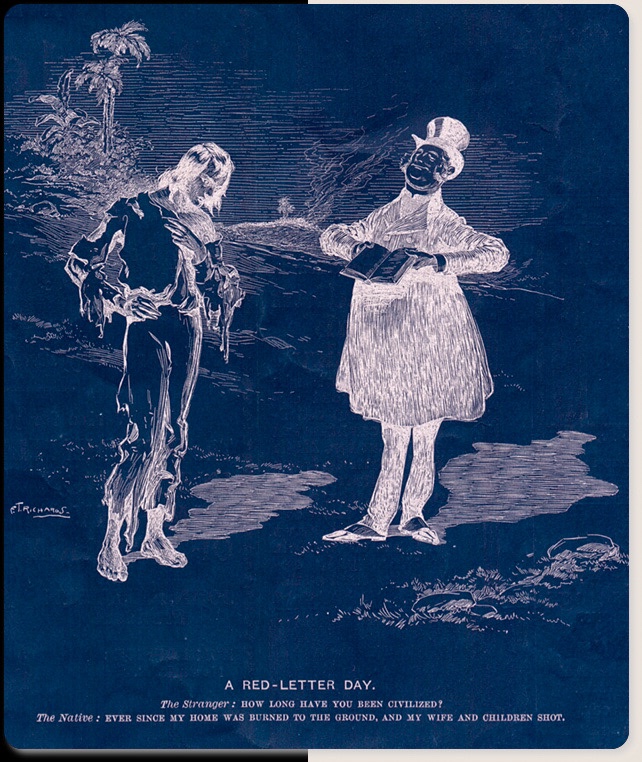
Frederick Thompson Richards, Life Magazine, 1900  (How long have you been civilized?)

Tuesday, October 9, 2018

The Manipulation and Distortion of Public Opinion to Overthrow #ICWA

Lost Children, adopted out
CITATION
Bual, Harman (2018) "Native American Rights & Adoption by Non-Indian Families: The Manipulation and Distortion of Public Opinion to Overthrow ICWA," American Indian Law Journal: Vol. 6 : Iss. 2 , Article 6.
Available at: https://digitalcommons.law.seattleu.edu/ailj/vol6/iss2/6 

Excerpt:


The public’s general lack of knowledge regarding the history of ICWA and the standards set up by ICWA allows for easy manipulation by adoption agencies and ICWA opponents. A lack of understanding and sensationalized media supports a negative image of Indian tribes that overshadows the protections offered by ICWA, and the improper behavior of adoption agencies and attorneys who encourage adoptive parents to go against the clear standards set out in ICWA.117 
This is a difficult situation to address, given the U.S. Supreme Court ruling in Baby Veronica, because it fails to acknowledge the historical reasoning for ICWA and maintaining a relationship between an Indian child and its tribe.118 
However, the behavior of these adoption agencies and attorneys who are creating delays in the system, and actively working the system to get around ICWA statues, should face some sort of monetary fine. Fines would need to be determined on a case by case basis, but could be based on whether there were improper delay tactics, the length of time the litigation took due to improper delay tactics, and whether the adoption agency knew or had reason to know the child was an Indian. Policies surrounding the custody of children as a whole are inconsistent and create conflicting goals and procedural issues when applied.119 
To overcome these issues, it is necessary that both legislators and ICWA supporters find a common ground where the agencies responsible for determining a child’s membership status are able to do so in a timely manner and hold foster families and Indian families accountable if they fail to follow reunification plans set by these state agencies.

Despite the intent of Congress, state courts have continuously interpreted ICWA in a variety of ways that has created loopholes around the mandates.121 
Large cases in front of the Supreme Court of the United States has brought attention to ICWA on a national level.122 
However, ICWA is often portrayed as a set of rules that ignores the best interest of the Indian child in favor of satisfying the demands of Indian tribes who may not be capable of taking care of the Indian child as well as an already established home with an adoptive family.123 
This perception has been further manipulated within the media by ICWA opposition in an effort to dismantle ICWA.
The history and purpose of ICWA has been misinterpreted by courts applying it within custody cases of Indian children. For ICWA to be successful, it is necessary that states and courts identify
the child’s tribe and give proper notification to the tribes. ICWA was established to stabilize the growth of tribes that had diminished after decades of assimilation of tribal members into mainstream American society. Despite the set guidelines within ICWA, states apply ICWA differently within each court, which creates disproportionate protection to Indian children, parents, and tribes.124  
To combat improper application of ICWA it is necessary that clarification of ICWA is provided to state child welfare workers, adoption agencies, judges, and society. 

Media uses the emotional pull within ICWA adoption cases between Indian tribes and non-Indian adoptive families to undermine the protection given to tribes under ICWA and limit tribal rights.

Proper application of ICWA would prevent many of the cases being reported on by news media because many years of litigation would be avoided. And most importantly, the Indian child developing ties to a family the child should not have legally been placed with could be prevented because many years of litigation would be avoided. And most importantly, the Indian child developing ties to a family the child should not have legally been placed with could be prevented.

Use the search bar on this blog to find #ICWA and stories about lost children of the Indian Adoption Projects and Programs and 60s Scoop... Thousands of children were stolen by the govt's of Canada and the US and adopted out - this blog is about survivors.
 

Thursday, December 14, 2017

Two Worlds: new and updated!

BUY NOW http://amzn.to/2CjtyRr
For Immediate Release


GREENFIELD, MA (2017) Tragic, true, heartbreaking, astonishing... those words have been used to describe the anthology Two Worlds, the first book to expose in first-person detail the adoption practices that have been going on for years under the guise of caring for destitute Indigenous children in North America.

What really happened and where are these Native children now? 

The new updated Second Edition of TWO WORLDS (Vol. 1), with narratives from Native American and First Nations adoptees, covers the history of Indian child removals in North America, the adoption projects, their impact on Indian Country, the 60s Scoop in Canada and how it impacts the adoptee and their families.

"This book changed history," say editor Trace Hentz. "There is no doubt in my mind the adoption projects were buried and hidden... we adoptees are the living proof."

The Lost Children Book Series includes: Two Worlds, Called Home: The Roadmap, Stolen Generations, and In The Veins: Poetry. The book series is an important contribution to American Indian history.

Trace Hentz (formerly DeMeyer) located other Native adult survivors of adoption and asked them to write a narrative for the first anthology. The adoptees share their unique experience of living in Two Worlds, surviving assimilation via adoption, opening sealed adoption records, and in most cases, a reunion with their tribal relatives. Indigenous identity and historical trauma takes on a whole new meaning in this adoption book series.

Since 2004, award winning journalist Hentz was writing her historical biography “One Small Sacrifice: A Memoir.” She was contacted by many adoptees after stories were published about her work. More adoptees were found after “One Small Sacrifice” had its own Facebook page and the American Indian Adoptees blog started in 2009. In 2011, Trace was introduced to Patricia Busbee and asked her to co-edit the first edition of Two Worlds.

As Hentz writes in the Preface, "The only way we change history is to write it ourselves." This book is a must read for all that want the truth, since very little is known or published on this history.

"I was asked to update this book by one adoptee contributor and I added a new narrative by Levi Eagle Feather, and more information on the 60s Scoop. Please tell your friends and other adoptees," Trace Hentz says. "One day in America, we Lost Children will have our day in court."

Patricia Busbee is writing a new chapter on her adoptee reunion in the anthology CALLED Home in 2018.

READ A FREE PREVIEW

On Amazon, Kindle, Kobo... For links and more information, to order copies, bulk orders, etc:  www.bluehandbooks.org

Tuesday, December 5, 2017

What do you call THIS?


By Trace Hentz  (adoptee and editor of the book series Lost Children of the Indian Adoption Projects)


What do you call it when a woman has a baby and a social worker/ judge/ government has pre-judged her, then decides to take that baby, then it happens again and again… each and every time she gets pregnant. What if this happened 5 times, or 9 times? What do you call that?

Debby, Mitzi, Elizabeth (and countless other Native adoptees) your mothers lost you and other children.  What do you call this?  How do you tell people or explain to people a history like this?   
What did they call your mother? Did they demean her, label her crazy, to justify this?

How does anyone define genocide?  What is Human Trafficking?  Choosing one segment of the population for this treatment? Placing American Indian First Nations Indigenous babies with a non-Indian family? This had a purpose. The government paid for this. And until the Indian Child Welfare Act, thisdecimated tribes to near extinction.

We know with slaves, children were sold. Families separated. Rebellions quashed. Resistors hung from trees. Millions of dollars were made selling human life, with fortunes created, mansions built, and enough wealth for generations.

Who in their right mind would find this acceptable?

What do you call taking babies from their own mothers? Do you give this a name, like adoption. Do you market it as something else? How do you sell people on this? Why did people accept this? 

How did mothers survive losing their children? How do children survive without them?

If this feels like slavery and heinous and insanity and genocide and cruelty, that’s because it is. It is all this.


I will be publishing a new updated second edition of TWO WORLDS this month!  Please tell your friends and other adoptees.  We'll post more on this blog when it comes out.  Please get in touch if you are an adoptee and still searching. Pray for mothers across the planet that they can keep and raise their children.

CLICK OLDER POSTS (above) to see more news

CLICK OLDER POSTS  (above) to see more news

MEGWETCH THANK YOU

HUGE Thank you for visiting this blog and sharing this with your kin. It's appreciated. Contact Trace anytime! Use the form below.

BOOKSHOP

Please use BOOKSHOP to buy our titles. We will not be posting links to Amazon.

Popular Posts

To Veronica Brown

Veronica, we adult adoptees are thinking of you today and every day. We will be here when you need us. Your journey in the adopted life has begun, nothing can revoke that now, the damage cannot be undone. Be courageous, you have what no adoptee before you has had; a strong group of adult adoptees who know your story, who are behind you and will always be so.

OUR HISTORY

OUR HISTORY
BOOK 5: Lost Children of the Indian Adoption Projects