BACK UP BLOG (no longer updating)

This blog was a backup for American Indian Adoptees blog
USE THE SEARCH BAR or SEARCH TOPICS at bottom of this blog

If you need support

Support Info: If you are a Survivor and need emotional support, a national crisis line is available 24 hours a day, seven days a week: Residential School Survivor Support Line: 1-866-925-4419. Additional Health Support Information: Emotional, cultural, and professional support services are also available to Survivors and their families through the Indian Residential Schools Resolution Health Support Program. Services can be accessed on an individual, family, or group basis.” These & regional support phone numbers are found at https://nctr.ca/contact/survivors/ . MY EMAIL: tracelara@pm.me

Search This Blog

Showing posts with label Navajo. Show all posts

Monday, January 27, 2025

Navajo Nation leaders raise alarm over reports of Indigenous people being questioned and detained during immigration sweeps

 WHAT?  MORE WILL HAPPEN with the Real ID ACT as well... Trace

Speaker of the Navajo Nation Council Crystalyne Curley speaks about the Radiation Exposure Compensation Act during a news conference on Capitol Hill in Washington, Tuesday, Sept. 24, 2024. (AP Photo/Jose Luis Magana)
CNN  — 

At least 15 Indigenous people in Arizona and New Mexico have reported being stopped at their homes and workplaces, questioned or detained by federal law enforcement and asked to produce proof of citizenship during immigration raids since Wednesday, according to Navajo Nation officials.

The reports, which have caused panic amongst tribal communities in both states, come amid the Trump administration’s attempt to ramp up undocumented immigrant arrests nationwide and amass a larger force to carry out the president’s deportation pledge. CNN has reached out to the White House for comment.

The reported raids and the exact number of Diné/Navajo and other Indigenous tribal citizens who were apprehended are still under investigation, Navajo Nation Council Speaker Crystalyne Curley told CNN. It is unclear if Immigration and Customs Enforcement or other law enforcement entities were conducting the apprehensions. ICE has not responded to CNN’s request for comment.

Navajo Nation officials have contacted the Department of Homeland Security, the governors of Arizona and New Mexico, and ICE to address the reports, the Office of Navajo President Buu Nygren said in a news release Friday.

“My office has received multiple reports from Navajo citizens that they have had negative, and sometimes traumatizing, experiences with federal agents targeting undocumented immigrants in the Southwest,” Nygren said in the release.

Justin Ahasteen, executive director of the Navajo Nation Washington Office, said his office has not confirmed any reports of ICE action against Navajo citizens.
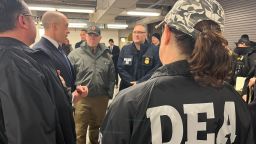
According to Ahasteen, one tribal member was involved in a raid in Phoenix. Ahasteen told CNN the incident was a “wrong place, wrong time” situation and the tribal member, who presented their tribal identification and was questioned while in custody, was not the intended target.

The person was released, Ahasteen said.

CNN has also contacted New Mexico State Police, the Navajo County Sheriff’s Office and the Navajo Nation Police Department for comment.

Arizona state Sen. Theresa Hatathlie, who is Diné/Navajo, told CNN she received a report from the family of a Navajo woman who said she was questioned by ICE and asked to show proof that she was Native after her workplace was raided Wednesday morning.

The woman says she was at her work site in Scottsdale, Arizona, when she and seven other Indigenous citizens were lined up behind white vans and questioned for two hours without their cell phones or a way to contact their families, according to Hatathlie.

“Now is it ICE or some other entity, I don’t know,” said Hatathlie, who represents Legislative District 6, which encompasses the Navajo Nation. “I did work with some individuals to confirm whether or not ICE did do that work site raid, but the communication back to me was that it’s not a normal practice for ICE to confirm a raid or not.”

The woman says she was eventually permitted to use her cell phone and text family members, who sent her a photo of her Certificate of Degree of Indian Blood (CDIB), and she was then allowed to leave, Hatathlie said. It is unclear what happened to the seven other Indigenous people who were questioned.

The Navajo Nation Council received the reports through social media and calls to council delegates from families who said they were visited by ICE at their apartments and place of work, Curley said.

“There’s a lot of fear, and I know they’re probably feeling frustrated knowing that they don’t feel safe in the country where they were born or where their ancestors come from and there’s a lot of frustration of them being stereotyped,” Curley told CNN.

“I think there’s a confusion with other races, maybe just because having a brown skin, automatically being profiled or stereotyped to be in a certain group of race.”

Hatathlie pointed to the double standard of Indigenous people welcoming settlers who later colonized their lands, forced Native children into violent boarding schools and banned displays of Native cultural practices, only to be victims of practices such as immigration raids – when the law enforcement officials’ ancestors were immigrants themselves, she said.

”If you can’t say, ‘we’ve been here for time immemorial,’ then you’re an immigrant. You’re not from here, so who are you to classify our Indigenous people? These lands have been a melting pot for many ethnicities,” Hatathlie said.

“It’s too kind to say it’s racism or discrimination. It’s disrespect for humanity.”

Indigenous people urged to carry their documentation

Operation Rainbow Bridge, a nonprofit that supports Navajo citizens who are victims of Medicaid fraud in Arizona, has launched the Immigration Crisis Initiative to assist Indigenous people impacted by federal law enforcement raids.

Diné, which means “The People” and is how Navajo people refer to themselves, and other Indigenous tribal members are being advised to carry state-issued identification along with their Certificate of Degree of Indian Blood in preparation of possible run ins with federal immigration officials and other law enforcement.
The initiative has a hotline for people to call so Diné and other Indigenous citizens who are being questioned or detained can call for immediate assistance, and to help government officials identify the documents they are being presented with.

Although a person might be carrying their certificates and tribal identification cards, many of the reports said the agents who detained or questioned them didn’t acknowledge the documents as valid proof of citizenship, Hatathlie said.

“With the way things are going right now and these types of situations, we have to put measures in place in order to help our constituents and government entities so that they can be a resource,” Hatathlie said.

“Tribes should communicate to Homeland Security and say, ‘This is a sample of our travel enrollment card. This is the sample of our Certificate of Indian Blood. If you have any questions to verify, here is a hotline. Here is a website,’” Hatathlie added.

The Navajo Nation Office of the President released a tip guide for Diné who are confronted by immigration agents. The guide advises them to request to see the agents’ identification to confirm their legitimacy, exercise their right to remain silent and speak to an attorney if they are arrested or detained, and to document the interaction if possible so they can later report the encounter.

Navajo Nation officials urged Diné and other Indigenous tribal citizens to apply for tribal ID cards, such as the Navajo Nation Identification card, if they don’t have one. Families are also being urged to educate their children on the ongoing incidents.

The guidance also advises against opening their doors if immigration agents show up at their homes without showing a valid warrant signed by a judge.

“Some public sites, organizations, and restaurants are being raided by ICE,” Operation Rainbow Bridge states on its website. “As a precaution, your children should memorize your phone number and their (Social Security Number), and everyone should have current, valid documentation on them” including Social Security cards, Navajo Nation Identification cards, Certificate of Degree of Indian Blood or passports, according to the statement.

‘No one is illegal on stolen land’

For Indigenous peoples who inhabited the Americas for thousands of years before the colonization of their lands and the brutal treatment of their people, the recent sweeps have reopened old wounds.

Diné elder James Jackson, an honored activist in the Navajo community, told CNN the recent immigration raids and their impact on his community are “shameful.”

“It’s making people hyperaware of their surroundings, limiting their travel in their daily lives because they worry they will get stopped,” said Jackson, who lives in Tuba City between the four Sacred Mountains of Navajo 90 miles north of Flagstaff, Arizona.

Although he worries for his community, Jackson says he also feels anger on behalf of immigrants from other countries who came to the US to escape violence and economic hardship for the sole sake of their families’s survival.

“No one is illegal on stolen land,” Jackson said. “It really goes back to the Indigenous way of life, that everything is made for the people. People have to understand that this is not the way to live or to be honorable and neighborly with each other.”

Anti-immigration tactics like the recent raids, Hatathlie and Jackson said, go against Indigenous values and their ways of life which allowed Native people to prosper and live in harmony with the land for thousands of years before American colonization.

“We always talk about the environment and how we belong to the earth,” Hatathlie said. “That sets the groundwork for having respect for what’s around us, especially for our children and our great grandchildren, and they’re the future.”

There are concerns for the safety of multiple Native tribes who live in areas near the border, including Tohono O’odham, who have been in the Sonoran Desert for thousands of years and live on both sides, regularly traveling back and forth, Jackson said.

The reported raids have triggered panic and anger stemming from generational trauma endured by Native people whose ancestors and elders like Jackson had to fight to take back mere fragments of their land and reclaim their language and culture, which they had so long been forbidden from practicing, according to Hatathlie.

“We’ve come a long way building relations, but these initiatives of the current administration are a huge step backwards,” Hatathlie said. “These are the attitudes and the mindset of privileged individuals.”

“The settlers showed up sick, they were hungry, they were lost, and then all of a sudden, they were given a place to eat and sleep, and they ended up taking more than than they were provided,” she said. “They wore out the welcome mat at this point.”

CNN’s Andi Babineau contributed to this report.

LINK:  https://www.cnn.com/2025/01/27/us/navajo-detained-ice-indigenous-immigration-trump/index.html 

Thursday, December 12, 2024

Teaching Indians how to do stuff (1950s)

WATCH:

The Indian Sanitarium Will Help You (?)

A 1940s U.S. Department of Interior film produced by the Office of Indian Affairs. A film about health practices and hospitals:

https://archive.org/details/TheIndianSanitariumWillHelpYou

During the 1950s in the USA, a large amount of prescriptive material appeared in the form of magazines, handbooks, and guidance films, teaching proper manners and good behavior in a rapidly evolving post-war society.  In this context, the U.S. Department of the Interior commissioned two short films produced by the Bureau of Indian Affairs in 1952 aimed at teaching young Native Americans how to properly use a telephone and answer calls.
The political context of the era is key here, as the 1950s represented a kind of pinnacle in the federal government's assimilationist intentions about Native American communities, whether it be the attempt to abolish protected reservation territories or the forced teaching of Anglo-American values in federal residential schools.
These short films, which at first seem to resemble the innocuous orientation films of the time in their format and approach, in fact aim not simply at the acquisition of new cultural codes, but at the complete rewriting of the most traditional thought patterns.  Analyze their scenography and purpose in the light of ethnographic and anthropological data, as specifically relevant to the Navajo culture, as the students and the examples in the movie are clearly aimed at this community. 

Two short films here: 

Telephone Etiquette
Receiving a Telephone Call

We didn't need their help.


Friday, July 7, 2023

BAD OUTCOMES: Brackeen Case | New York Times and #ICWA


 reblog from 2019 & 2022

By Trace Hentz (blog editor)  
 
FIRST UP:  The New York Times headline June 5, 2019:   
Who Can Adopt a Native American Child? A Texas Couple vs. 573 Tribes  Here
 
I posted my comment which became a NYT Pick:

I am an adoptee and journalist who has documented the history and narratives of Native adoptees in three Lost Children anthologies. If the Brackeens had done any research prior, they would know the outcomes for Native adoptees are not good. Adoption gets pretty ugly when it doesn't work. Once kids are out of diapers, they start noticing and feel the isolation without kin. There are medical terms for our damage. The adoption industry will not advertise that most patients in psychiatric care are adoptees. They don’t warn adoptive parents their new child will suffer from “Severe Narcissistic Injury” or “Reactive Attachment Disorder.” This news would not be welcome. LINK

Of course some readers slam me for using the word "kin" ...or ask how do I know about the damage we suffer...  No shock... I get it: they don't get it and they don't know the history or the Native adoptees I  know personally... (There were 775 comments before they shut it off today and many are amazingly correct!)
 
An earlier comment from Ellen gets it:

This country has a long brutal history of removing Native children from their families with the intent of culture genocide. There is nothing different about this case. I am sure that the Brackeens are lovely (wealthy) people who care for Zachary, and the new baby they selfishly wrested from her family. Still, it does not undo the damage done to the Navajo nation, in losing 2 precious children, not to mention the damage done to the children in growing up apart from their culture...while being quite different in appearance from the rest of this family. But skin color is not the issue - the erasure of culture and sense of self is.

After reading the NYT story I am not surprised that the Navajo tribe and the Brackeens will share custody, as Judge Kim declared, but the Brackeens would have primary possession.  Taking Indian children off the rez and changing their identity to white and ending their sovereignty and treaty rights and a connection to tribal lands:  the old playbook is the new playbook.
It is always about possession.
 
We have covered this case on this blog (AMERICAN INDIAN ADOPTEES) for the past few years. (please look at Goldwater Institute (34+ posts) for more insight on this case.)

Hundreds of tribal nations vehemently oppose the lawsuit Brackeen v. Bernhardt that splits Texas, Indiana, Louisiana and a coalition of conservative legal groups, including the Goldwater Institute, against the federal government, hundreds of tribal nations, 21 state attorneys general, Native American civil rights groups and child welfare organizations, including the Annie E. Casey Foundation and the Children’s Defense Fund.
 
The NYT story reports:
So much remains suspended.
The decision about the act’s fate from the Court of Appeals for the
Fifth Circuit is imminent.
The Navajo are appealing Judge Kim’s custody order. 


What about the BRACKEENS?

Potential Adoptive Parents (PAPS) Chad and Jennifer Brackeen might want to learn Navajo history during this lengthy court battle in Texas. (Try this one in 2011: Illegal aliens? Deported adoptees?)

The total population of the Navajo people residing in their land is approximately 180,462 having a median age of 24 years old.   Navajo Nation is situated over a 27,000 square miles of large land within the vicinity of the state of Arizona, Utah and New Mexico. It is considered to be the largest land that is primarily covered by the jurisdiction of the Native American within the territory of the United States.

What most people don't know:  The Navajo are survivors of a barely-known Mormon assimilation program from 1947 to the mid-1990s. 
Year after year, missionaries of the Church of Jesus-Christ of Latter-day Saints approached Navajo families and invited children into Mormon foster homes.  As part of the Mormon Indian Student Placement Program, children would live with Mormon families during the school year to “provide educational, spiritual, social, and cultural opportunities in non-Indian community life,” according to the Church.  
Typically, the Mormon foster families were white and financially stable.  Native American children who weren’t already Mormon were baptized.  Although the LDS Church reached out to dozens of Indian tribes, most participants’ families lived within the Navajo Nation.

Roughly 50,000 children participated in the Mormon Indian Student Placement Program, according to Matthew Garrett, a professor at Bakersfield College.

Rather than improving conditions on the Navajo reservation, the LDS Church asked that children assimilate to the way its white members lived. 
Some Church leaders interpreted the Book of Mormon literally and expected that Native American children’s skin would turn lighter as they grew closer to God.  

The Church now admits that not all Native Americans are descendants of the
Israelites, or Lamanites, as described in the Book of Mormon.   (Oh really, thanks)

In addition to the claims of damage done by sexual abuse, the lawsuits involving the Indian Student Placement Program assert that the culture of the Navajo Nation was “irreparably harmed” by the LDS Church’s “continuous and systematic assimilation efforts.” Although the last student in the Indian Student Placement Program graduated in 2000, plaintiffs are asking the Church to do all it can to enhance and restore Navajo culture and create a taskforce for that purpose. SOURCE:   Why Several Native Americans Are Suing the Mormon Church
Participants in the Mormon Church-sponsored Indian Student Placement Program have filed at least three sexual-abuse lawsuits. Lilly Fowler

***

Practices of adopting Native American children directly followed the residential/ boarding schools.  Such adoption practices, which came into fruition through forms such as the forced removal of Native American children during Canada’s 60s Scoop and its parallel in the United States, the Indian Adoption Projects, exemplify the adaption of adoption as a settler colonial tool for dispossession and disenfranchisement. 

***
Narragansett author John C Hopkins wrote about his Navajo mother in law on his blog:
Chilocco Indian School opened in 1884 with 123 students. Its first graduating class was comprised of six boys and nine girls. The school finally closed its doors in 1980. The name Chilooco comes from the Choctaw word “chiluki” and the Cherokee word “tsalagi,” which means “cave people” in both languages.
A long, hard-used tarred road turns off Route 166 and ends where the abandoned, ivy-covered stone buildings stand in disrepair haunted by the ghosts from memories past.
Bernice Austin-Begay, a Navajo, recalled the long ride down the road when she was a child returning to school after a rare family visit.
“I’d be sad because I knew it would be a long before I would see them again,” Austin-Begay, Class of 1965, said. “I’d be thinking about my family, thinking about my sheep.” Austin-Begay was 10 when she was first taken to Chilocco.
More than 50 years later she still recalls the day the government agents came to Black Mesa, Ariz. and took her away.
“I was captured,” she said.
Many Indian families resented how the government swooped in and took the children away from their families and did all they could to thwart the Bureau of Indian Affairs. Austin-Begay’s family was one of those. Whenever her mother saw a car coming up the road she would send Bernice running, to hide in the hills until the “biliganas” left. (Biligana is the Navajo word for white man)
But one day the car arrived unexpectedly and young Bernice never reached the woods.
“I was too slow,” Austin-Begay said.  
 **
'CATASTROPHIC AND UNFORGIVABLE'

Starting in 1958, the Indian Adoption Project placed Native American children in non-Native homes, in what it said was an effort to assimilate them into mainstream culture and offer them better lives outside impoverished reservations.
The project was run by the U.S. Bureau of Indian Affairs, a federal government agency, and the nonprofit Child Welfare League of America, in partnership with private agencies.

 There was a reason Indian leaders went to the Senate in the 1970s and demanded an inquiry into the staggering number of children disappearing in Indian Country. It was not just boarding schools creating this mass exodus of children. Adoption programs in 16 states removed 85% of Native children. Programs like the Adoption Resource Exchange of North America (ARENA), established by the Child Welfare League of America in 1967, funded in part by the Bureau of Indian Affairs, paid states to remove children and place them with non-Indian adoptive families and religious groups like the Mormon Church.  ARENA expanded to include all Canadian and United States adoption agencies and offered them financial assistance.
ICWA (the Indian Child Welfare Act) prioritizes placing Native children into Native homes or with kin or with families that are willing to keep them within a certain proximity to their cultures.
***
Associate Attorney General Tony West Delivers Remarks at the National Indian Child Welfare Association’s 32nd Annual
Protecting Our Children Conference ~ Monday, April 14, 2014


 "...There's more work to do because every time an Indian child is removed in violation of ICWA, it can mean a loss of all connection with family, with tribe, with culture.  And with that loss, studies show, comes an increased risk for mental health challenges, homelessness in later life, and, tragically, suicide."

Sunday, August 25, 2019

The children are our future

PHOTO: Navajo Nation Council Delegate Charlaine Tso, left, and Division of Social Services Executive Director Deannah Neswood-Gishie, middle, gave input at the Office on Violence Against Women 2019 Government-to-Government Tribal Consultation in New Buffalo, MI on Aug. 21-22, 2019.
Published August 25, 2019
NEW BUFFALO, Mich. — Navajo Nation Council Delegate Charlaine Tso provided testimony to the United States Department of Justice Office on Violence Against Women at the Government-to-Government Tribal Consultation on Wednesday, Aug. 21, 2019. The consultation included two days of written and oral input from tribal leaders and representatives of over 100 tribal nations.
“We state unequivocally our support for HR 1585, An Act to Reauthorize the Violence Against Women Act, passed by the United States House of Representatives. We implore the United States Senate to act and reauthorize the Violence Against Women Act,” said Delegate Tso.
Joining the Department of Justice at the consultation was the U.S. Departments of Health and Human Services and the Interior. The departments hosted the consultation to receive Violence Against Women Act input and recommendations to help improve the federal response to domestic violence, dating violence, sexual assault, stalking, and sex trafficking crimes against American Indian and Alaska Native women.
Delegate Tso shared testimony about rates of violent crimes against women, children and members of the LGBTQI and Two Spirit community in and around the Navajo Nation on behalf of the Health, Education and Human Services Committee of the Navajo Nation Council.
The U.S. Department of Justice Office on Violence Against Women held the 2019 Government-to-Government Tribal Consultation in New Buffalo, MI Aug. 21-22, 2019. Council Delegate Charlaine Tso gave testimony from the Health, Education and Human Services Committee.
“The testimony that will forever stay with me is an eight-year-old boy coming to me, ‘Miss Council Delegate Tso, do you know when my mom’s going to come back?’,” said Delegate Tso.
“His mother will not be present at his college graduation. That child will not be able to introduce his children to their grandmother,” said Delegate Tso.
“The women in our tribe are held sacred. We protect them, we love them, we cherish them,” said Delegate Tso.
The Navajo Nation Council has been leading the Navajo Nation’s efforts to address the issue of violence against women and the issue of missing and murdered indigenous women and girls. Council Delegates Amber Kanazbah Crotty, Nathaniel Brown and Charlaine Tso have continuously reported that data and information on violence in Navajo and Native American communities is under-supported or nonexistent.
“This consultation is a venue for change,” said Delegate Tso.
“I have Utah relatives in Salt Lake Area that go missing and there’s no way that we can track them or help them. There’s no data available,” said Delegate Tso.
“The Navajo Nation recommends funding for data collection systems, to hire expert personnel who can collect, analyze and maintain and use data for improving and for enhancing victim services,” said Delegate Tso.
Delegate Tso’s testimony also included information on violence against LGBTQI and Two Spirit members of the Navajo Nation and statistics on federal criminal and prosecution rates.
“A 2016 Diné College study on LGBTQI found one in five experienced physical violence or sexual assault at least once in the last six months. 38 percent have experienced threats of physical violence,” said Delegate Tso.
“In 2017, the Navajo police received a total of 13,636 calls for various offenses, including domestic violence, sexual assault, rape and homicide,” said Delegate Tso.
“Statistics nationwide indicate a lack of prosecution by the FBI of domestic violence cases, including domestic violence and rape. In 2017, the U.S. Department of Justice declined to prosecute more than a third of cases referred to them from Indian Country,” said Delegate Tso.
“In 2014, it was reported that 6,630 forceful rapes occurred resulting only in 33 arrests. However, rapists were accountable at a rate of less than 0.5 percent. Those who were incarcerated were never held for more than 12 months,” said Delegate Tso.
Delegate Tso went on to recommend, on behalf of the Navajo Nation, that the U.S. DOJ increase funds for capacity building and to implement the Tribal Law and Order Act in Navajo Nation courts.
Delegate Tso’s testimony concluded with incidents of violence against Navajo LGBTQI, girls and women.
“23-year-old Ryan Shey Hoskie, 42-year-old Terri Benally, and 32-year-old Frederick Watson were three transgender Navajo Nation members who were found beaten to death in Albuquerque, New Mexico in January 2005, July 2009, and June 2009, respectively. The details of each of their deaths remain unknown and no suspects were detained in their slayings,” said Delegate Tso.
“11-year-old Ashlynn Mike was kidnapped with her nine-year-old brother in Shiprock, New Mexico in May 2016. After a couple found Ashlynn’s brother scared, walking along the side of the road, he was taken to the Navajo Nation police department. Hours later, when the Farmington police department was notified of the missing child, it was clear no information had been shared. Eight hours after Ashlynn went missing, an Amber Alert was finally issued at 2:30 AM,” said Delegate Tso.
“26-year-old Amber Webster, a married mother of three, was murdered in Florence, Kentucky in December 2018. Amber was employed as a construction worker that had traveled out of state to provide income to her family on the Navajo Nation. 32-year-old non-native Jesse James brutally stabbed her to death while staying at the same hotel as she was. The two had no prior interactions,” said Delegate Tso.
“We have to look out for each and every one of these individuals. They are our children. They are our future. They need to be protected to the fullest extent,” said Delegate Tso.

Delegate Tso thanked the tribal representatives, and federal agencies and programs in attendance at the tribal consultation hearing.
The Navajo Nation Division of Social Services Executive Director Deannah Neswood-Gishie also provided comments on behalf of the Office of President and Vice President.
“Protecting Navajo women and children is critical to the future of the Navajo Nation and to the health and wellbeing of Navajo families and communities. On behalf of the Navajo Nation …, I formally invite you to come to the Navajo Nation and conduct true government-to-government consultation with the largest land-based federally recognized tribe,” said Director Gishie.
Council Delegate Charlaine Tso is the Vice Chairperson of the Health, Education and Human Services Committee of the 24th Navajo Nation Council. Delegate Tso represents the Navajo chapters of Mexican Water, Tółikan, Teesnospos, Aneth and Red Mesa.

Navajo Nation Delegate Tso Delivers Violence Against Women Act Testimony

by Native News Online Staff

CLICK OLDER POSTS (above) to see more news

CLICK OLDER POSTS  (above) to see more news

MEGWETCH THANK YOU

HUGE Thank you for visiting this blog and sharing this with your kin. It's appreciated. Contact Trace anytime! Use the form below.

BOOKSHOP

Please use BOOKSHOP to buy our titles. We will not be posting links to Amazon.

Popular Posts

To Veronica Brown

Veronica, we adult adoptees are thinking of you today and every day. We will be here when you need us. Your journey in the adopted life has begun, nothing can revoke that now, the damage cannot be undone. Be courageous, you have what no adoptee before you has had; a strong group of adult adoptees who know your story, who are behind you and will always be so.

OUR HISTORY

OUR HISTORY
BOOK 5: Lost Children of the Indian Adoption Projects