
Experts available to comment ahead of National Day for Truth and Reconciliation
Topics include Indigenous health, preservation of culture and languages, Indigenous history and Indigenous knowledge
Topics include Indigenous health, preservation of culture and languages, Indigenous history and Indigenous knowledge
*
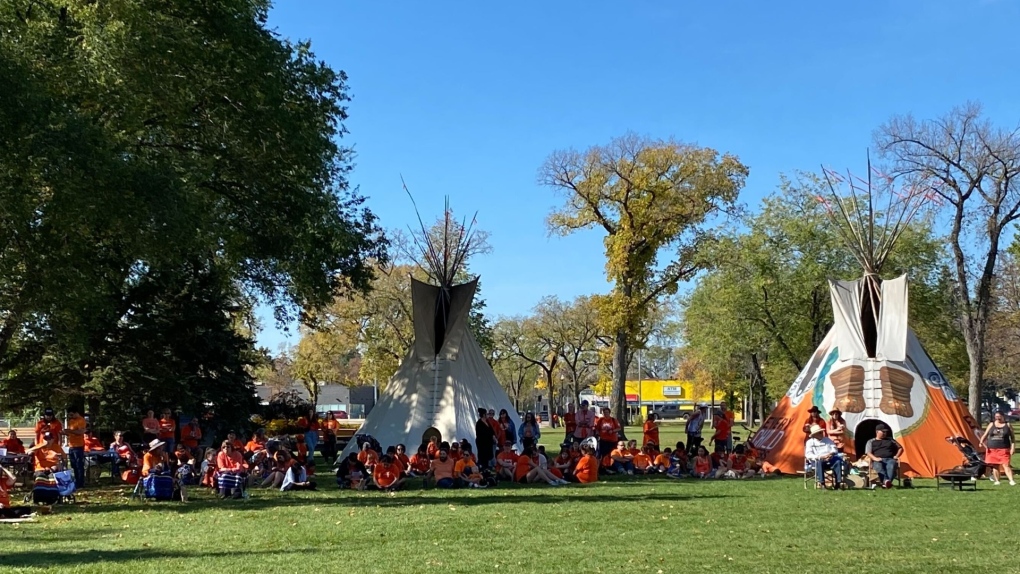 The day included
drumming, singing, round dancing, and smudging, among other Indigenous
ceremonies. (Source: Zach Kitchen, CTV News)
The Day of Reflection, Sacred Fire and Gathering took place at St. John's Park Saturday afternoon, jointly organized by the Anish Corporation, Manito Ahbee Festival, and 60s Scoop Legacy of Canada.
The day included drumming, singing, round dancing, and smudging, among other Indigenous ceremonies.
"We wanted to provide a space where people could come and learn a little bit about Indigenous culture, but also be mindful that today is kind of a mixed-emotion day for Indigenous people who have been affected by Residential Schools and the Sixties Scoop and day schools," said Katherine Strongwind director of the 60s Scoop Legacy of Canada.
Beginning in the late 1950s through the 1980s, the Canadian government enacted a series of policies allowing Indigenous children to be "scooped" from their families and then adopted into white homes.
Strongwind said Canada's Indigenous peoples have been through a lot of tragedy. "It's important to remember that we're still here, our culture is still alive," she said.
Orange-clad families gathered at the park to enjoy free entertainment and food, and to learn about Indigenous culture through tipi teachings.
Members of the White Horse Ranch in South Dakota brought "Sunka Wakan," or sacred horses to the event.
"They're often the lead for our walks and our events, and so it was really important to have them here so that we could honour the horses today," Strongwind said.
More information about the Sixties Scoop can be found online(opens in a new tab).
As a child, Adam North Peigan was taken from his family and placed in a non-Indigenous household. In recognition of the National Day for Truth and Reconciliation, North Peigan joined Edmonton AM to share his family’s story, and how he fought for an official apology — and won.
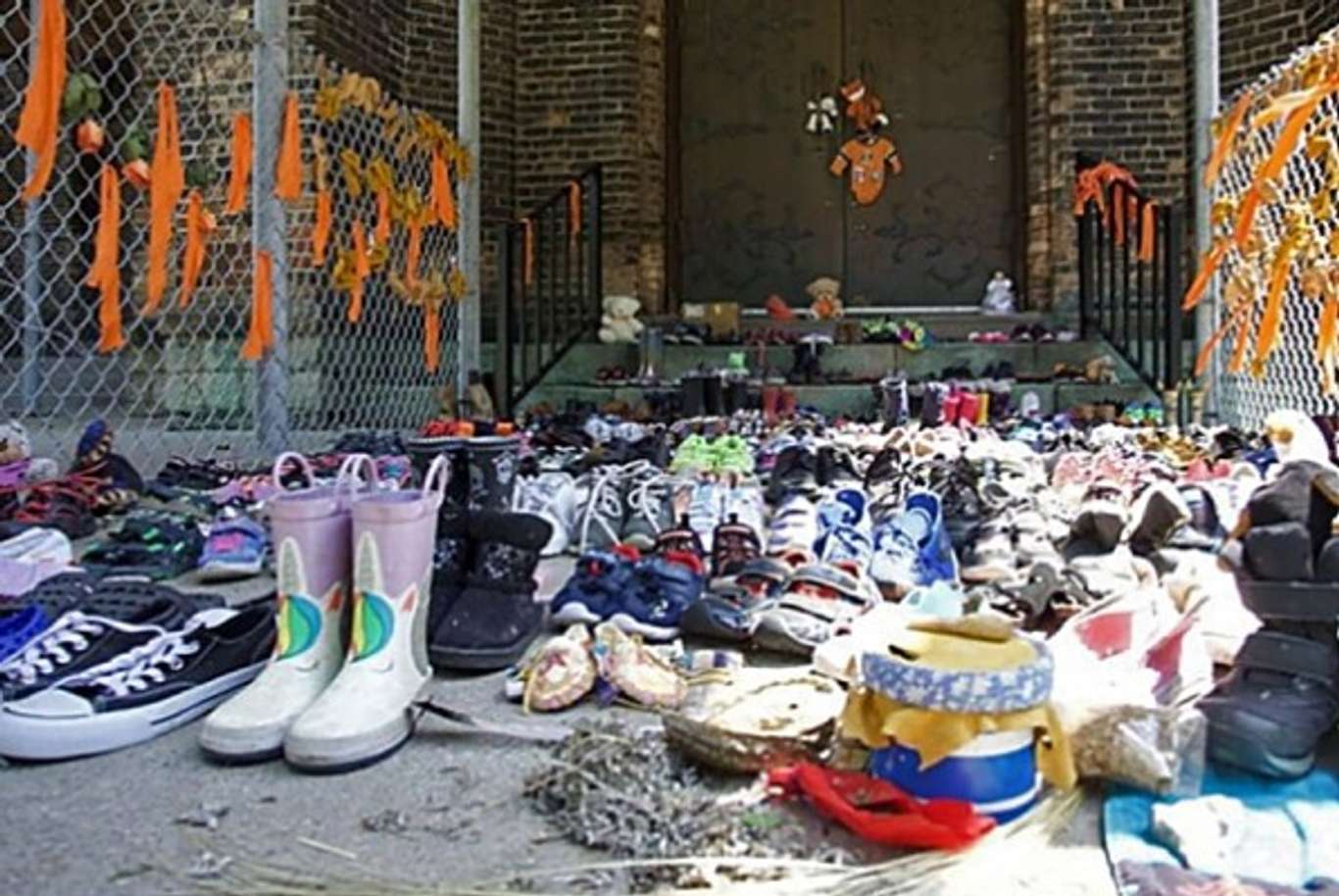 |
| Shoes left at Assumption Church on July 9, 2021 (Photo courtesy of the University of Windsor) |
Orange Shirt Day honours the story of Phyllis (Jack) Webstad, a residential school survivor, who wore a bright orange shirt on her first day of school. The shirt was a gift from her grandmother. It was taken from the six-year-old but became a symbol of remembrance for all Indigenous children who were forced to attend the schools where Indigenous language and culture were repressed, and many suffered abuse.
The National Day for Truth and Reconciliation is a call to action for all levels of government, institutions and Canadians to consider how the Indigenous were and continue to be treated in Canada. It came out of the Truth and Reconciliation Commission, which chronicled the experiences of residential school survivors.

This story is published as part of the Global Indigenous Affairs Desk, an Indigenous-led collaboration between Grist, High Country News, ICT, Mongabay, and Native News Online.
NEW YORK — Seven generations of Métis, Dene and Cree children were taken from their communities and placed into a Catholic-run, government-funded residential school in Île-à-la-Crosse, Saskatchewan that is located in northern Canada. However, the survivors were left out of the country's reckoning with residential schools known globally as the Truth and Reconciliation Commission of Canada.
Métis elder, Antoinette LaFleur, 80, is haunted by the 10 years she spent at Île-à-la-Crosse. She was taken to the school at five-years-old and left as a teenager. During those years, LaFleaur didn’t leave the residential school to visit home. As her siblings started getting sent to the residential school she didn’t even recognize them.
“I never used to go home. Ten years I was in there, 10 years,” LaFleur said during a side event at the United Nations headquarters in April.
LaFleur is part of a class action lawsuit against Canada and
Saskatchewan. During the Truth and Reconciliation Commission’s
investigations, the criteria for which institutions qualified was
narrow, leaving out schools like Île-à-la-Crosse, said vice-president of
Métis Nation Saskatchewan, Michelle LeClair, that represents some
80,000. This is because the school was supposedly run by Saskatchewan,
not the federal government. Although Saskatewan officials deny the school was owned or funded by the provincial government.
KEEP READING: https://ictnews.org/news/left-out-of-truth-and-reconciliation

September 11, 2023
September 30 is the National Day for Truth and Reconciliation in Canada. It is a time to recognize and commemorate the intergenerational harm that residential schools caused to Indigenous families and communities, and to honour those who have been affected by this injustice.
We urge our members, staff and allies to take this opportunity to learn about, and reflect on, our past and how we can meaningfully participate in reconciliation in Canada.
The Truth and Reconciliation Commission ran from 2008 to 2015, providing those directly or indirectly affected by the legacy of the Indian Residential Schools policy with an opportunity to share their stories and experiences. The Commission released its final report detailing 94 calls to action. The National Day for Truth and Reconciliation responds to Call to Action 80 from the Truth and Reconciliation Commission of Canada: Calls to Action, which reads:
80. We call upon the federal government, in collaboration with Aboriginal peoples, to establish, as a statutory holiday, a National Day for Truth and Reconciliation to honour Survivors, their families, and communities, and ensure that public commemoration of the history and legacy of residential schools remains a vital component of the reconciliation process.
The National Centre for Truth and Reconciliation (NCTR) has become the permanent archive for the statements, documents and other materials the Commission gathered, and its library and collections are the foundation for ongoing learning and research.
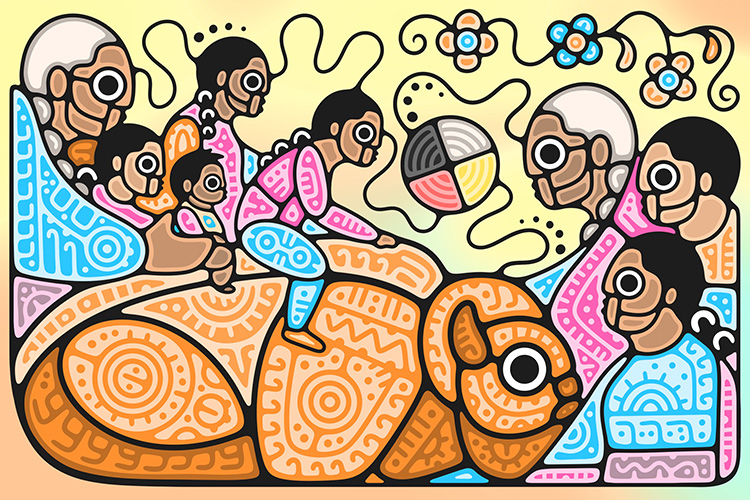 Our 2023 National Day for Truth and Reconciliation artwork was created by Anishinaabe Onyota’a:ka artist, Tsista Kennedy (https://hotdogwaterart.com/.)
When I first read the theme of "healing and care", as well as the theme of "remembering the children" being worked into this art, the image of this first draft immediately came to mind.
The bison is a common image I use in my artwork, and I often use it to portray healing, resiliency, and strength, and wellness. When the buffalo were brought to near extinction, we as Indigenous people struggled due to our diverse relationships with these animals, and the nourishment, shelter, and tools they provided us. Since colonization began, both the bison and we as Indigenous people have maintained our strength and resiliency, and now we both are growing in numbers once again. Because of this, I wanted the bison to be a place for the past generations, the children and elders, to rest upon.
The elder and children on the bison fit the theme of "remembering the children", but also represent the children and elders of the present day who will pass on and receive the traditional knowledge our ancestors succeeded in passing down to us. The individuals on the far right looking at these children and the elder represent those that support the children and the elders in any way they can, ensuring that they are doing their part in the passing down of our culture, wellbeing, and way of life. This is all connected by a medicine wheel, and some floral patterns in the top right corner, which to me represents new life, and continuity.
Tsista Kennedy, Anishinaabe Onyota’a:ka artist
Orange Shirt Day is a legacy of the St. Joseph Mission (SJM) Residential School (1891-1981) Commemoration Project and Reunion events that took place in Williams Lake, BC, Canada, in May 2013. The events were designed to commemorate the residential school experience, to witness and honour the healing journey of the survivors and their families, and to commit to the ongoing process of reconciliation.
Each year on September 30, people across Canada wear orange shirts to raise awareness of, and start a conversation around, the history and legacies of the residential school system in Canada. Watch the video at right to learn more about how Orange Shirt Day came to be and to listen to Phyllis Webstad's story.

MONTPELIER, Vt. (WCAX) - Vermont’s Truth and Reconciliation Commission held its first public meeting Tuesday evening.
The state-funded commission was created in March to document how state laws and policies have discriminated against marginalized communities.
The goal is to seek ways to repair harm caused by the state.
A little over 25 members of the public attended the virtual meeting.
Commissioners introduced their new staff, and set out the goals for the meeting.
“We can all think of a different world where everybody is included, everybody feels safe and can be there best selves,” Melody Machin, a Truth and Reconciliation Commissioner said. ”And in order to do that, they have to address what’s come before that hasn’t been very conducive to that environment.”
Tuesday evening marked the first of its monthly meetings generating ideas about reconciliation.
 Stock photo
NEWS RELEASE
UNITED WAY SIMCOE-MUSKOKA
**********************
United Way Simcoe Muskoka will be screening the award-winning film Birth of a Family at the Midland Cultural Centre on September 26, 2023, as part of the 2023 Real2Reel Film Festival. The local charity is partnering with the Barrie Area Native Advisory Circle and Mamaway Wiidokdaadwin to host the evening in recognition of Truth and Reconciliation Week.
“They say that there can be no reconciliation without truth,” said Brian Shelley, United Way Chief Executive and Philanthropy Officer. “It is important to create space for those with lived experiences to share their stories so that we can begin to move forward with reconciliation in a good way.”
In this deeply moving feature-length documentary, three sisters and a brother meet for the first time. Removed from their young Dene mother during the infamous Sixties Scoop, they were separated as infants and adopted into families across North America. Betty Ann, Esther, Rosalie, and Ben were only four of the 20,000+ Indigenous Canadian children taken from their families between 1955 and 1985, to be either adopted into white families or live in foster care. As the four siblings piece together their shared history, their connection deepens, and their family begins to take shape.
Following the film, Barrie Area Native Advisory Circle’s Heather McIntyre will moderate a panel discussion to further explore the impact of the Sixties Scoop.
United Way Simcoe Muskoka’s Real2Reel Film Festival is sponsored by the RBC Foundation and aims to reduce stigma and raise awareness of complex community issues. Net proceeds raised through this event will support the United Way’s funding of the Wiijinokiiwag project delivered in partnership between CMHA and the Barrie Area Native Advisory Circle.
When: September 26, 2023 – 6:30 to 9:30 p.m.
Where: The Midland Cultural Centre, 333 King St, Midland, ONTARIO L4R 3M7
Who: This event is open to the public. Tickets are $7.53
More Information: https://uwsimcoemuskoka.ca/
This film contains material of a sensitive nature, including the
Sixties Scoop, that may be triggering for some individuals. Please take
part as you feel comfortable.
The full recording can be found here.
In 2021, Secretary of the Interior Deb Haaland announced the
Federal Indian Boarding School Initiative. This initiative, which
includes gathering records from the boarding school era, and compiling
an official list of boarding school sites, makes visible on a national
scale the intergenerational impact federal Indian board schools have had
on tribal communities. Currently, there are five schools in the state
of Michigan that were identified from the federal investigation process
(Holy Childhood Boarding School, Baraga Chippewa Boarding and Day School
(Holy Name), Mount Pleasant Indian Industrial Boarding School, Mackinac
Mission School, and Catholic Otchippewa Boarding School). This is not
an extensive list of all the other entities, schools, and programs that
operated in Michigan through the Indian Civilization Act of 1819.
The Native Justice Coalition’s Truth and Reconciliation
Commission (TRC) was launched in July 2022. It seeks to expand its reach
to strengthen relationships between Indigenous and non-Indigenous
people in an effort to seek the truth behind the Indian boarding school
policies and corresponding actions taken by the government and church.
Through this work, the NJC provides safe, supportive, and culturally
competent spaces that offer opportunities for healing and uniting our
Native communities on this journey. Our goals are to create an
Indigenous-led process that is grounded in mutual respect, culturally
sensitive, and focused on meeting clearly defined, jointly agreed upon
metrics. Our key four priorities are truth and reconciliation, healing
our people and our communities, strengthening ICWA and ensuring a
cultural identity for our children, and building a strong ecosystem
through investment in the Native Justice Coalition.
Without support from community partners such as the Indigenous
Law & Policy Center, Native American Institute, and American Indian
and Indigenous Studies at Michigan State University, this work would not
be possible. This one-day symposium honors that work on a local scale,
providing Michigan State University, and the greater Lansing community
an opportunity to learn about the intergenerational trauma caused by
federal Indian boarding school policies. Attendees will hear first-hand
accounts from boarding school survivors and others who can provide the
legal, social, and historical context of the Indian boarding schools. By
joining together in community to share stories and voices, the
symposium provides a space for knowledge and healing.
Ed. Note: Maine has its own TRC - more states to follow, we hope. Trace

A state-funded effort has begun to document how Vermont state laws and policies have discriminated against marginalized communities,
including people with disabilities, Black people, Indigenous people,
other people of color and people of French Canadian heritage.
It came out of legislation passed last year that created a Truth and Reconciliation Commission to seek ways to repair harm caused by the state of Vermont.
In
a press conference, a selection panel announced the
commissioners who will lead the effort over the next three years as
full-time state employees:
The
new commissioners stressed their roles include making policy
recommendations, as well as hearing experiences of communities who
suffered injustices.
“We know this is not about what has just
happened in the past,” Schultz said. “This is about how that past
continues and is perpetuated in our present, and how we’ll learn from
it, and eradicate it in our future.”
They’ll have an annual budget of almost $750,000, and will hire an executive director and other researchers.
“First,
we're tasked with starting an office — there’s nothing like this that’s
been done before,” Schultz said. “We are starting from scratch.”
"It's a huge task," Melody Walker Mackin said.
A commission with more limited scope was created in Maine
to document the state's child welfare practice with Wabanaki people,
and Burlington City Council created a Reparations Task Force in 2020,
but the new commissioners said they're not familiar with any mandate
that's so broad in scope.
"While it may look overwhelming, it's
essential that all voices by heard," Standen said. "The resources that
are provided by the state at this point seem to be ample and welcomed."
“Recognizing racism in itself will neither be spontaneous nor easy.
We are committed to working with Indigenous healers, scholars, elders
and knowledge bearers, as well as the legal and ethical requirements to
provide respect, dignity and equitable health care for Indigenous Will
ask and intend to guide you along.”
Four months after the apology, Indigenous leaders and politicians
signed a declaration calling for an end to anti-Indigenous racism in
northern Manitoba’s health care system.
The College of Practitioners Regulating Manitoba begins work in 2021
to address the call to action from the Truth and Reconciliation
Commission. The apology is one action the college is taking as a result
of those discussions, the Assembly of Manitoba Chiefs said in a
statement released late Tuesday.
**
“The pow wow is a living cultural
expression of song, dance, and art which brings people together, and
through the drum, reminds us of our connection to Mother Earth. […] pow
wows are a time to put differences aside and to celebrate traditions,
mostly it is the time to celebrate life. A pow wow strengthens an entire
race of people. To be Anishinabe is to be proud, to know who you are,
and where you came from.” – Harold Flett
**
Only 13 T&R Calls to Action achieved over seven years: report - rabble.ca
2023 marks the eighth year since the Truth and Reconciliation Commission released a list of 94 Calls to Action.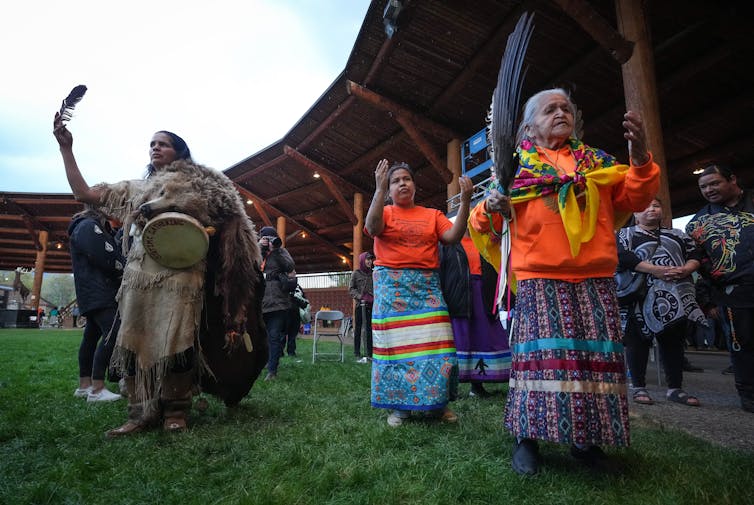

Eleven years. That’s how long it took the federal government to
agree with 325 First Nations over the collective loss of language and
culture suffered by Day Scholars in the Residential School system in Canada that existed between the mid 1800s until 1996.
Day scholars attended a Residential School during the day but didn’t sleep there overnight.
While Day Scholars settled an individual compensation package for just $10,000 each earlier in 2022,
this new agreement is specifically aimed at rectifying the systematic
and forced removal of language and culture through these institutions.
In 2012, members of the Tk'emlúps te Secwépemc and shíshálh Nation led by Shane Gottfriedson and Garry Feschuk launched a national class-action lawsuit for Day Scholars who were left out of the original Indian Residential School (IRS) Settlement Agreement (2006).
I do call them BONE COLLECTORS and LOOTERS... Trace

A major new report released on Tuesday, September 27 by the Canadian Museums Association (CMA) calls for greater support and funding for Indigenous organizations and museums as they pursue Indigenous “self-determination” at all levels of governance.
The CMA estimates that 6.7 million Indigenous objects and human remains continue to be held in Canadian museums, with approximately 94% of them held in eight institutions. The report finds that few museums have formal repatriation policies and that even fewer of them are publicly accessible. Currently, only one province, Alberta, has repatriation legislation. The report also finds that although many museums showcase Indigenous-related programming and say they value Indigenous engagement, Indigenous curators and staff members are underrepresented, suggesting that Indigenous professionals are often slotted into advisory roles.
“We were already aware of the colonial legacy of museums,” Rebecca Mackenzie, co-author of the report, said in an interview with Hyperallergic. “This presented an opportunity to really determine to what level Indigenous communities have been allowed to have self-determination in [museum] spaces.”

Research for the report has been ongoing for over three years and has involved almost a dozen engagement sessions and interviews with Indigenous heritage professionals and community leaders, a survey of over 300 museums, and a key performance indicator study of 84 Canadian institutions.
The report, entitled “Moved to Action: Activating UNDRIP in Canadian Museums,” was commissioned as part of the nation’s response to Call to Action 67, one of 94 calls to action issued in 2015 by the country’s Truth and Reconciliation Commission (TRC). The TRC was established to reckon with Canada’s history of Indian residential schools, which forcibly separated Indigenous children from their communities for purposes of assimilation.
In 2015, the TRC’s report indicated that approximately 150,000 children were removed to residential schools and concluded that the educational system constituted cultural genocide. Since the conclusion of the TRC’s work, researchers have discovered thousands of unmarked graves at residential school sites.
Call to Action 67 petitioned the federal government to supply the CMA with funding “to undertake, from collaboration with Aboriginal peoples, a national review of museum policies and best practices” to assess compliance with the United Nations Declaration on the Rights of Indigenous Peoples. Adopted by the General Assembly in 2007, the declaration was only formally adopted by Canada in 2021, and emphasizes Indigenous rights to self-determination and to the maintenance of their cultural practices. One article specifically delineates that nations must provide redress for cultural and spiritual property taken without consent.

Of the report’s 10 recommendations, one urges the federal government to pass legislation mandating and funding repatriation efforts. Unlike the United States, Mackenzie explains, Canada does not have comparable legislation that requires federally funded institutions to return Native cultural items to Indigenous tribes and organizations. The report also recommends certain best practices for museums, such as hiring Indigenous professionals into permanent positions and consulting Indigenous rights holders to determine how to care for repatriated objects.
“Reconciliation is a gift for museums,” the report stresses. “Together, we have an opportunity to be moved to enact and support Indigenous self-determination.”
“Indigenous communities have a story to say over what happened, how these objects are cared for, where they are, and how they’re presented,” Mackenzie says. “It’s going to take a cross-sector approach: governments, provinces, heritage organizations, coming together. The premise of this entire report is that implementing and supporting Indigenous self-determination is everybody’s job.”

A major new report
released on Tuesday, September 27 by the Canadian Museums Association
(CMA) calls for greater support and funding for Indigenous organizations
and museums as they pursue Indigenous “self-determination” at all
levels of governance.
The CMA estimates that 6.7 million Indigenous objects and human remains
continue to be held in Canadian museums, with approximately 94% of them
held in eight institutions. The report finds that few museums have
formal repatriation policies and that even fewer of them are publicly
accessible. Currently, only one province, Alberta, has repatriation
legislation. The report also finds that although many museums showcase
Indigenous-related programming and say they value Indigenous engagement,
Indigenous curators and staff members are underrepresented, suggesting
that Indigenous professionals are often slotted into advisory roles.
The report, entitled “Moved to Action: Activating UNDRIP in Canadian
Museums,” was commissioned as part of the nation’s response to Call to
Action 67, one of 94 calls to action issued in 2015
by the country’s Truth and Reconciliation Commission (TRC). The TRC was
established to reckon with Canada’s history of Indian residential
schools, which forcibly separated Indigenous children from their
communities for purposes of assimilation.

‘Bones of Crows’ is an emotional account of the intergenerational trauma caused by the Canadian residential school system.
The Canadian history taught in school is a whitewashed version of the truth, omitting much of the country’s sordid relations with its Indigenous populations, which have continued to have negative effects to this day. The last few years have brought appalling revelations that had been covered up and ignored for so long. After years of silence and denial, the government formed The Truth and Reconciliation Commission, providing an avenue for those directly and indirectly affected by the legacy of the Indian Residential Schools system to share their stories and experiences. Bones of Crows is a fictional account of one woman’s life before, during and after being forcibly placed in the system.
Born in the 1920s to a large and happy family, Aline Spears (Grace Dove) and her three siblings were taken from their parents under threat of prison and sent to residential schools. There, they were subjected to horrific physical, emotional and sexual abuse at the hands of the priests and nuns who oversaw their education. As a teen, Aline enlists in the military, where she meets her husband, Adam (Phillip Lewitski), and is eventually recruited for a special operation that uses Cree to transmit secret messages during World War II. After the war, they return to Canada to raise their children. But she is haunted by the years of cruelty she endured, only finally able to confront her abusers in her ‘80s.
There are news stories, a day of reflection and professional sensitivity training, but they don’t capture the impact and scars of this institution of abuse as well as a film is able. The narrative does an exceptional job interweaving so many experiences, traumas and repercussions into a single movie. It highlights the anguish of families forcibly separated, in many cases permanently; the degradation spewed by the clergy who view their charges as less than human; the punishment for any miniscule attempt to maintain the culture and language the schools were meant to eradicate; the widespread abuse and intentional neglect as superiors boast about keeping the children in a state of malnutrition during their own feasts; the countless deaths due to disease and mistreatment; the sexual assaults that steal their innocence and fill their nightmares; the substance abuse to hide from the pain of their memories; the suicides when the hurt becomes too much; and so much more. It also touches upon the numerous unsolved deaths and disappearances of Indigenous women and girls in Canada.
Nevertheless, it’s also a story of joy, strength and triumph, both fleeting and lifelong. As a child, Aline enjoyed sing-alongs and family meals. She and Adam shared a lot of love, which produced equally loved children who grow up to have successful careers and their own children. Aline engages her love of music by playing the piano and passes the skill on to her granddaughter. One must savour the good through the bad and the movie strives to capture both, revelling in the joys and not cowering from the sorrows. This is the story of one family, but it represents the tale of thousands of Indigenous people across the country, giving voice and audience to their lived experiences.
Bones of Crows had its world premiere in the Discovery programme at the Toronto International Film Festival.
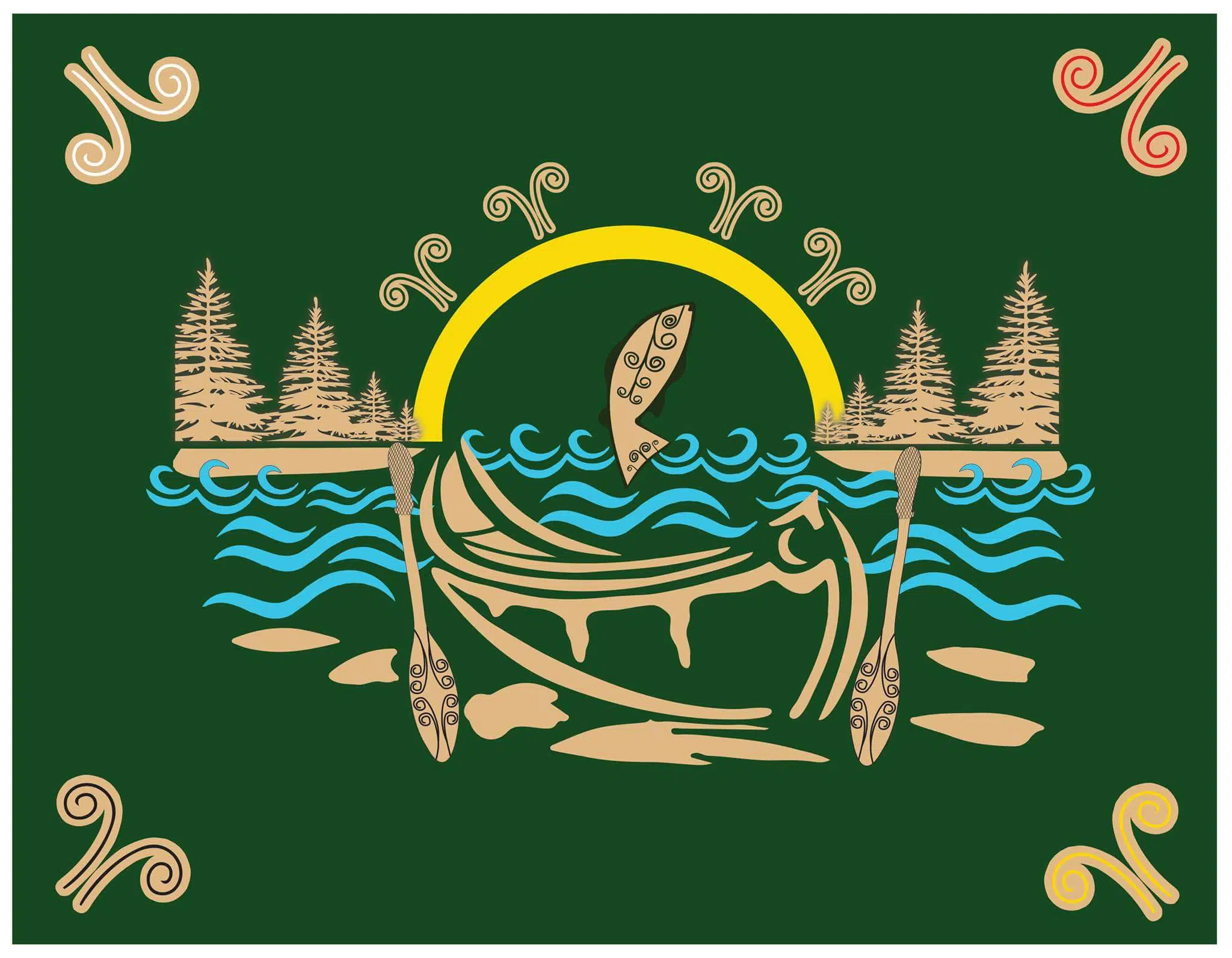
Wolastoqewiyik Neqotkuk (Tobique First Nation) made history on June 8 after becoming the first Wolastoqey nation in the country to ratify its own Child and Family Well-Being Act.
Similar to the federal government’s C-92, also known as the Act respecting First Nations, Inuit and Métis children, youth and families, it empowers Indigenous communities to take jurisdiction over child and family services.
Neqotkuk First Nation Chief Ross Perley said this is a historic step towards self-determination, adding that it will ensure kids and their families can stay healthy, achieve their dreams and celebrate their culture while living at home.
“We have talked for a long time about making our laws and taking control over child welfare for our community, our families,” said Perley in a news release.
“The Neqotkuk Child and Family Well-Being Act makes this goal a reality.”
The Wolastoqey nation noted this was a recommendation by the Truth and Reconciliation Commission to help address the ongoing legacy of Residential Schools and Indian Day Schools.
The new Neqotkuk Child and Family Well-Being Act introduces the following changes:
Neqotkuk First Nation has operated a child welfare agency, the Tobique Child and Family Services Agency Inc., since 1985, delivering services designed by federal and provincial governments.
The act will also allow the agency to design child welfare services.
“The New Brunswick Social Development department has been a solid and reliable partner and we look forward to working productively with them to implement this law and establish its support through provincial institutions,” said Perley.
May 11, 2022 REUTERS

Researchers examined government records and spoke to Native Americans to prepare the report. The results detail a history dating to at least 1801, when the first such schools opened, and one in which education was used as a weapon.
Native American affairs, including education, were a War Department responsibility until 1849 and the military remained involved even after civilians took over, the report noted.
The schools were described as resembling military academies in their regimentation and strictness and emphasizing vocational skills. Police were called on to force families to send their children to the schools. Food was denied to families as another way to force them to surrender their children.
"These conditions included militarized and identity alteration methodologies - on kids!" said Bryan Newland, the assistant secretary for Indian Affairs at the Interior Department, who heads the investigation.
Conditions at former Indian boarding schools gained global attention last year when tribal leaders in Canada announced the discovery of the unmarked graves of 215 children at the site of the former Kamloops residential school for indigenous children, as such institutions are known in Canada.
Unlike the United States, Canada carried out a full investigation into its schools via a Truth and Reconciliation Commission.
The U.S. government has never acknowledged how many children attended such schools, how many children died or went missing from them or even how many schools existed.
The report released on Wednesday included recommendations for funding programs to preserve the Native American languages the schools tried to stamp out, and establishing a federal memorial.
**
Report: Christians May Have Helped Run Half of Native American Boarding Schools
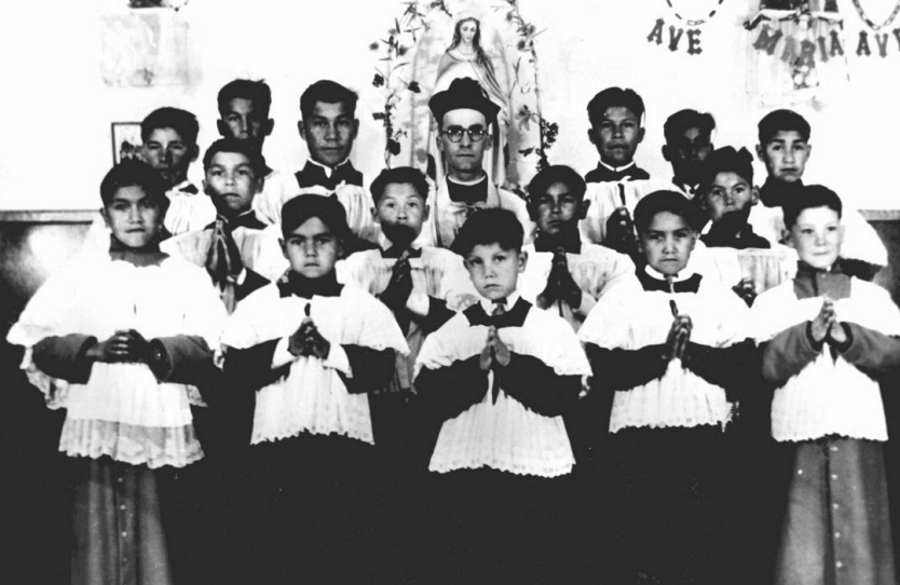 Students at St. Anne’s Indian Residential School in Fort Albany First Nation. Photo courtesy of Algoma University.
If you are a residential school survivor, you are able to contact the 24-hour National Crisis Line at 1-866-925-4419 for support. Indigenous people can also access the Hope for Wellness Help Line at 1-855-242-3310 or online chat at www.hopeforwellness.ca.
The provincial governent is committing nearly $500,000 to support community members in the Nishnawbe Aski Nation area with the region’s search of one of the most notorious Indian Residential School locations in Canada.
Ontario and Ottawa have committed $475,000 over two years to support survivors affected by the six former Indian Residential Schools in the NAN territory, including those of St. Anne’s Indian Residential School in Fort Albany First Nation.
Records from the federal government show students at St. Anne’s were subjected to a homemade electric chair, with survivors describing physical, mental and sexual abuse. Legal battles over compensation for survivors continue to this day.
“This funding will help us develop healing initiatives to support our families and communities through community-driven initiatives as they search for their loved ones,” said NAN’s Deputy Grand Chief, Anna Betty Achneepineskum.
Achneepineskum adds the strategy will be developed with survivors and will include recommendations from the Truth and Reconciliation Commission’s 94 Calls to Action of 2015. Funding will also support communications and technical supports, as well as public education and awareness initiatives.
St. Anne’s Indian Residential School was run by the Oblates of Mary Immaculate Catholic Church and the Grey Nuns of the Cross in Fort Albany First Nation between 1906 and 1976, with support from the federal government.
Records show that the school was originally located at the Fort Albany Mission on Albany Island in Treaty #9, before relocating to the banks of the Albany River in 1932. The school burned down in 1939 and was later rebuilt.
First Nations youth from Fort Albany, Attawapiskat, Weenusk, Constance Lake, Moose Fort and Fort Severn all attended the school.


