BACK UP BLOG (no longer updating)

This blog was a backup for American Indian Adoptees blog
USE THE SEARCH BAR or SEARCH TOPICS at bottom of this blog

If you need support

Support Info: If you are a Survivor and need emotional support, a national crisis line is available 24 hours a day, seven days a week: Residential School Survivor Support Line: 1-866-925-4419. Additional Health Support Information: Emotional, cultural, and professional support services are also available to Survivors and their families through the Indian Residential Schools Resolution Health Support Program. Services can be accessed on an individual, family, or group basis.” These & regional support phone numbers are found at https://nctr.ca/contact/survivors/ . MY EMAIL: tracelara@pm.me

Search This Blog

Showing posts with label Slavery. Show all posts

Tuesday, January 14, 2025

FIGHTING FIRES: PRISON INMATES: It’s time to abolish the 13th Amendment ‘slavery clause’

 Inmates Can Make Up Nearly A Third Of Those Fighting California Fires

Due to “Slavery Clause,” 30% of LA Fires are Being Fought by Inmates
Doug Melville, Forbes, January 9, 2025

Inmate firefighters with Delta Conservation Camp construct a hand line during the Point Fire in ... [+]

 San Francisco Chronicle via Getty Images


As the shock of the Los Angeles fires and their effect on so many communities, businesses and families is still being digested, lots of attention is being turned to those who are on the front lines fighting the flames.

Many people might not be aware that one particular group has long been depended on to battle wildfires: inmates.

While the 13th Amendment ended slavery in the United States, a loophole allows people convicted of crimes to be forced to work for public or private enterprises. In this case, those tasked with firefighting volunteer for those positions and must meet certain criteria. They are not assigned without their consent.

Their pay scale was doubled in 2023, and depending on the skill level and the task assigned, they either receive $0.16 to $0.74 an hour or a maximum day rate of $5.80 to $10.24.

Most of their lunches consist of a simple sandwich—two pieces of white bread with a few slices of bologna—plus an apple. Their daily food budget of approximately $4 per day is hardly enough to sustain them for their high volume of manual labor.

Incarcerated firefighters have some of the highest injury rates among all prison workers and are four times more likely to sustain injuries compared to other firefighters. Also, they work some of the longest hours and have some of the hardest tasks to execute. They don’t shoot water hoses; they use powered chainsaws and manual hand tools, such as axes, with the goal of starving the fire of fuel to continue to burn.

What is an inmate firefighter?

In some form, inmate firefighters have been used in California since the end of World War II. The state has leaned on inmates to provide additional fire-fighting staff in “hand crews” to help contain the blazes. These teams also respond to other disasters like floods.

The California Department of Corrections and Rehabilitation (CDCR) has a Conservation Camp Program that employs incarcerated people as firefighters, who respond to emergencies at the local, state, and federal level. The program started in 1915, and the modern protocol of training the inmates at camps began in 1946. Today, there are 44 conservation camps, also known as fire camps, operated by the CDCR in partnership with the California Department of Forestry and Fire Protection (CAL FIRE) and the Los Angeles County Fire Department.

In 2010, nearly 4,000 inmates lived in California’s fire camps. That number has declined due to the prison population shrinking, sentencing reform and less inmate interest in this volunteer assignment. CDCR has tried to expand eligibility to higher-risk inmates, but the program still represents up to 30% of the wildfire workforce.

For perspective, in 2023 to 2024, the Los Angeles Fire Department has 3,902 employees (3,246 uniformed firefighters and 353 professional support) and is the third busiest in the United States.

It’s time to abolish the 13th Amendment ‘slavery clause’

The 13th Amendment reads:

“Neither slavery nor involuntary servitude, except as a punishment for crime whereof the party shall have been duly convicted, shall exist within the United States, or any place subject to their jurisdiction.”

Passed by Congress on January 31, 1865, and ratified on December 6, 1865, this legislation led to a new form of slavery developed in the 20th century, formally known as convict-leasing. Convict-leasing was a labor solution in which private individuals and businesses leased out prisoners for forced labor.

This practice is still very big business today. It is estimated that $11 billion in prison labor is used annually, from making hand sanitizer and digging mass graves during COVID-19 to cleaning up hazardous materials. The Associated Press recently uncovered a hidden workforce, apparently linking retail brands to forced prison labor. And in instead of pay—which for some is pennies per hour—the prisoners’ wages are often garnished to pay for things like their own room and board and court fees to appeal their cases.

During the most recent U.S. election, California voters rejected Proposition 6, a ballot measure that would have banned forced labor in state prisons. Only a handful of states have abolished forced prison labor: Colorado, Vermont, Nebraska, Utah, Alabama, Oregon and Tennessee.

Will Americans ever change their stance on forced prison labor?

After watching what these men and women battling the most devastating wildfires in Los Angeles history, I know I have.

 

SOURCE: https://www.forbes.com/sites/dougmelville/2025/01/09/inmates-makes-up-nearly-a-third-of-those-fighting-la-fires/


Tuesday, December 6, 2022

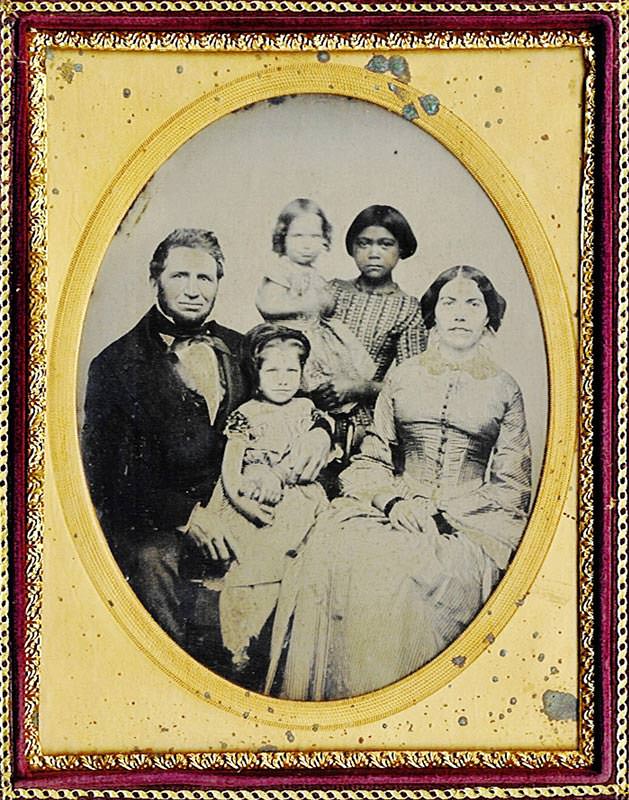
HISTORY: How the "free" state of California enslaved Native children

Photo of Kate Camden, a Native girl who at age 10 was forced into
servitude for a white family living in Shasta County. Photo is one of
few records that exist showing Native children entrapped by California's
apprentice and guardianship laws // Credit: Camden Family Portrait,
circa 1857-1859 courtesy of Whiskeytown National Recreation Area, WHIS
9066

 Kate Camden family portrait


New
Episode of ACLU Gold Chains Podcast Examines Indigenous Child Slavery
in 19th century California, Connects to Upcoming U.S. Supreme Court
Case Brackeen v. Haaland


How the "free" state of California enslaved Native children


Media Contact: press@aclunc.org, (415) 621-2493


SAN
FRANCISCO, CA – California came into the Union as a free state in 1850
with a constitution that banned slavery. So how did white settlers in
the mid-19th century get away with enslaving Indigenous
children, some of them as young as 2 years old? And why does this little
known, terrible chapter of California history matter today?


Today, the ACLU of Northern California released the third episode of Gold Chains, our podcast about California’s hidden history of slavery. “Indigenous Injustice” examines a 19th
century state law called the Act for the Government and Protection of
Indians that effectively legalized Indigenous child slavery and
encouraged kidnappers to snatch Native children from their tribal
communities.


“The
horror of what happened in California, the genocidal violence against
Native people, and especially the enactment of that violence against
children, is unfathomable,” said historian Stacey Smith, who appears as a
guest on the show.


“Indigenous
Injustice” isn’t just ancient history. Over time, the practice of
forcibly separating Native children from their tribal communities has
taken on many forms. There were the so- called Indian Boarding Schools. A
variety of other government-sanctioned adoption schemes have funneled
Indigenous children into Non-Native, mostly white households.


Currently,
there’s a landmark case scheduled to be heard by the U.S. Supreme Court
on Nov. 9 – Brackeen v. Haaland – that deals with the very same issue
of the forced removal of Native children from their families, tribes and
tribal culture. It threatens to dismantle the
Indian Child Welfare Act (ICWA), which was passed to prevent Native children from being removed from their communities.


The American Civil Liberties Union, along with 12 ACLU affiliates ( including the ACLU of Northern California) have filed an amicus brief with the U.S. Supreme Court, urging the court to uphold the constitutionality of the Indian Child Welfare Act.


“Indigenous Injustice” is a timely story that connects the dots between Indigenous child slavery in California to the present.


Link to Episode Website


November 1, 2022

Episode 3:
Indigenous Injustice


California joined the Union as a so-called free state in 1850.
So how did white settlers get away with enslaving Native children until
they were young adults?


We explore a little-known California state law called the Act
for the Government and Protection of Indians that unleashed genocidal
violence against Indigenous children. And we connect the dots between
that terrible past and a landmark upcoming U.S. Supreme Court case.


Episode Credits:


Produced by the ACLU of Northern California


Host and writer Tammerlin Drummond


Senior Producer and Editor Joanne Jennings


Mix and Original Score Renzo Gorrio


Executive Producer Candice Francis


We’d like to thank our wonderful guides Stacey L Smith, William Bauer and Tedde Simon.


Our associate producers are Lisa P. White and Carmen King.


A special thanks also to our voice actors Pauline Schindler, William Freeman, and Avi Frey.


Elize Manoukian provided fact-checking and production assistance.


Field recording was done by Julie Conquest, Ron George and Eric Gleske.


We’d also like to thank the following members of our Gold
Chains team: Brady Hirsch, Gigi Harney and Eliza Wee. Thank you also to
Abdi Soltani, executive director of the ACLU of Northern California.


A special thanks to World Affairs, Oregon State University and
the University of Nevada, Las Vegas for providing us with recording
studios.


Archival sound was provided courtesy of Periscope Films and Prelinger Archives.


Episode Guests:


William Bauer
is a professor of history at the University of Nevada, Las Vegas and a
citizen of the Round Valley Reservation. He is the author of California Through Native Eyes: Reclaiming History and We Were All Like Migrant Workers Here: Work, Community and Memory on California’s Round Valley Reservation.


Stacey Smith is an associate history professor at Oregon State University. She is the author of Freedom's Frontier: California and the Struggle over Unfree Labor, Emancipation and Reconstruction.


Tedde Simon is the Indigenous justice advocate at the ACLU of Northern California and a citizen of the Navajo Nation.


Additional Resources:


Gold Chains: The Hidden History of Slavery in California, ACLU of Northern California


Among the Diggers of 30 Years Ago, Helen M. Carpenter


Early California Laws and Polices Related to California Indians Kimberly Johnston-Dodds, California State Library


Federal Indian Boarding School Investigative Report U.S. Department of Indian Affairs


This Land, host Rebecca Nagle


At Liberty, host Kendall Ciesemier


Monday, August 16, 2021

Shawnee Indian Mission

The Shawnee Indian Mission, from 1839 to 1862, was a manual training
school for children from the Shawnee, Delaware, and other American
Indian tribes, and is now a state historic site. Its founder was Thomas
Johnson, the namesake of Johnson County, who held at least seven
enslaved individuals at the mission in the 1850s. (Max McCoy/Kansas
Reflector)

 The hidden history of Kansas is the story of enslaved people. Let’s say their names.

Max McCoy, August 15, 2021, Kansas Reflector


Shawnee Indian Mission is a bit of the 1850s frontier in the midst of
one of the richest suburban neighborhoods in the country. Just a block
away is the buzz of traffic on Shawnee Mission Parkway, and the homes in
the area cost more than most of us can afford. But for $5, Wednesday
through Saturday, you can visit the historic site with its three
original brick buildings and its 12 pastoral acres and imagine what life
might have been like for the missionaries, the Shawnee and Delaware
children who boarded at the school, and travelers on the Santa Fe
Trail, which ran just a few hundred yards north.


What you can’t do, unless you already know about them, is imagine what
life must have been like for the enslaved persons who helped build the
mission and were bound to Thomas Johnson, the Methodist preacher and
pro-slavery advocate who founded the school.


These enslaved persons aren’t mentioned in the 2015 video shown
to visitors. Only one of the interpretive displays mentions them. By one
account, it says, Johnson “owned at least six slaves at the
mission,” with perhaps another 10 who were children of the enslaved.
The display includes a reproduction of an 1856 bill of sale, from David
Burge to Johnson, at Westport, Missouri, of an enslaved girl named
Martha, of about 15 years, “sound in body and mind and a slave for
life.”

...


In addition to 2020’s summer of George Floyd, there have been discoveries this year at boarding schools in the United States and Canada of hundreds of unmarked graves
of First Peoples children. The Shawnee Indian Mission is attempting to
address the latter, at the urging of tribal leaders, with a ground-penetrating radar
survey of the mission’s cemetery. The cemetery is separated by a few
blocks from the historic site and is locally known as Johnson Cemetery,
because that’s where Johnson and some of his family are buried.


continue

CLICK OLDER POSTS (above) to see more news

CLICK OLDER POSTS  (above) to see more news

MEGWETCH THANK YOU

HUGE Thank you for visiting this blog and sharing this with your kin. It's appreciated. Contact Trace anytime! Use the form below.

BOOKSHOP

Please use BOOKSHOP to buy our titles. We will not be posting links to Amazon.

Popular Posts

To Veronica Brown

Veronica, we adult adoptees are thinking of you today and every day. We will be here when you need us. Your journey in the adopted life has begun, nothing can revoke that now, the damage cannot be undone. Be courageous, you have what no adoptee before you has had; a strong group of adult adoptees who know your story, who are behind you and will always be so.

OUR HISTORY

OUR HISTORY
BOOK 5: Lost Children of the Indian Adoption Projects