BACK UP BLOG (no longer updating)

This blog was a backup for American Indian Adoptees blog
USE THE SEARCH BAR or SEARCH TOPICS at bottom of this blog

If you need support

Support Info: If you are a Survivor and need emotional support, a national crisis line is available 24 hours a day, seven days a week: Residential School Survivor Support Line: 1-866-925-4419. Additional Health Support Information: Emotional, cultural, and professional support services are also available to Survivors and their families through the Indian Residential Schools Resolution Health Support Program. Services can be accessed on an individual, family, or group basis.” These & regional support phone numbers are found at https://nctr.ca/contact/survivors/ . MY EMAIL: tracelara@pm.me

Search This Blog

Showing posts with label ground-penetrating radar. Show all posts

Wednesday, January 25, 2023

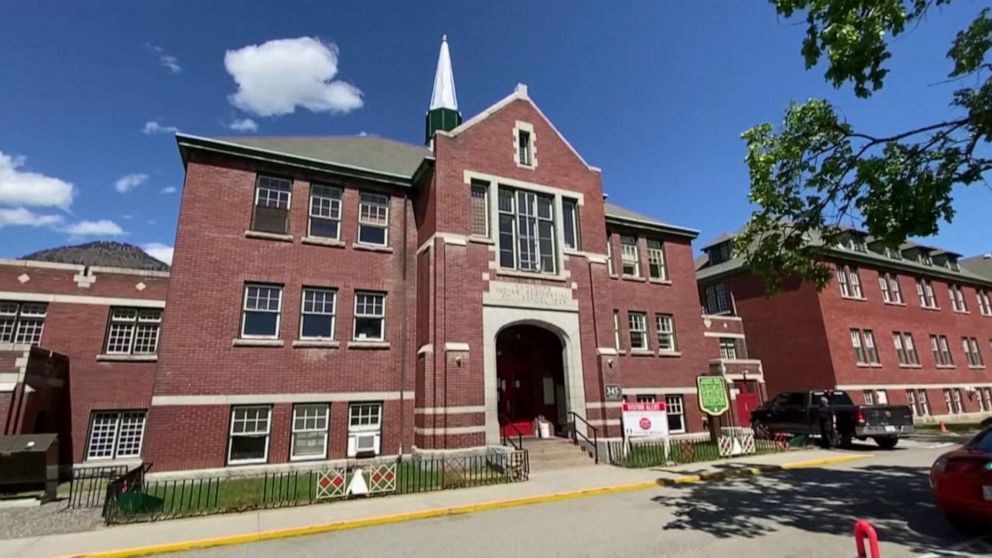
Report: Evidence of genocide found under CA residential school


National Native News January 25, 2023

Indigenous investigators in Alberta say they’ve found evidence of genocide at the site of a former Indian residential school.

As Dan Karpenchuk
reports, they’ve released a preliminary document into missing children
and unmarked graves at the former Blue Quills Residential School.

The
Aciniwyn Opaspiw Society says its investigators have uncovered physical
and documented evidence – and their report includes allegations that a
so-called disciplinarian who worked at the school from 1935 to 1942 was
seen killing Indigenous children.

The society said information came from intergenerational survivors whose parents witnessed the homicides.

The accused died in 1968.

Leah
Redcrow of the society also says many children died after they were
forced to drink unpasteurized milk contaminated with bovine
tuberculosis.

Redcrow says it was deliberate because school administrators were not dying and they didn’t eat the same food as the children.

Redcrow says ground penetrating radar was used on the site last autumn.

“When
it was accidentally excavated, the excavator found a bunch of little
skeletons piled on top of each other, and actually the GPR also
confirmed that it’s only (eight inches) below the surface of the ground.
We don’t know exactly how many children are in the mass grave yet, but
we do plan to excavate the mass grave as our investigation progresses."

Redcrow
says work is still underway to determine how many children disappeared.
She says her group is actively investigating the deaths of at least 200
residential school children who never returned home.

Over the
past year, hundreds of unmarked graves have been discovered at former
residential school sites in British Columbia and Saskatchewan, the
government-funded, church run schools.

The schools were operated across Canada from the late 1800’s to the late 1900’s.

About 150,000 Native children were taken from their families and forced to attend the schools.

Thousands were abused. Many died.

Thursday, August 12, 2021

How Much Does Ground Penetrating Radar Cost?


Written by:  Howmuchisit.org Staff
Last Updated:  August 9, 2018

Ground penetrating radar, also known as GPR or impulse radar, is an electromagnetic technology operating on the physics of the earth to capture images of the subsurface using pulses from the radar.

This technology is diverse and can work on pavement, rocks, ice and even freshwater.  This technology was first used in the early 1970s when several different teams of scientists began to develop radar for viewing into the earth.

This radar was first developed for military applications such as locating tunnels under the DMZ between North and South Korea.

Most of the time, these machines are purchased by companies rather than by individuals.

How much does ground penetrating radar cost?

Traditionally, a GPR system can cost anywhere from $15,000 to $90,000 brand new.   A simple system will tend to be less than $10,000, while those that are over $35,000 will require an experienced user.

For instance, a forum member on this TreasureNet.com forum thread claimed that they saw a GPR sell for $3,600 on eBay.  Another forum member on this same thread claimed that you should be prepared to spend at least $30,000 on a brand new device.

AccurateLocators.com, for instance, sells a unique GPR and the software for about $15,000; however, the antenna system will have to be purchased separately.  The average antenna, depending upon the frequency, can cost $2,500 to as much as $6,500.

US Radar, Inc., according to their official website, starts pricing around $14,000, depending on the specific model.  The costs include the cart, tablet, battery and the software to do basic utility locating.

On eBay, we were able to find slightly used radar equipment for $8,000 to $12,500. Accessories, such as additional antennas or a survey wheel that can control the readings, can cost $600 or more.


researchgate.net

Sunday, June 6, 2021

TRC requested $1.5M to find graves at residential schools. The feds denied the money in 2009

 continuing news...

Canadian Prime Minister Justin Trudeau says it’s not an isolated incident that over 200 children were found buried at a former Indigenous residential school

READ: Canada: Bodies at Indigenous school not isolated incident


In 2009, the TRC asked the federal government to help fund investigating the location of gravesites where residential students are believed to be buried. The request was denied.

Read more: Work underway for forensics experts to identify and repatriate B.C. school remains

...She said she had visited schoolyard cemeteries across Canada in an attempt to find where missing children were buried. But the process of finding the unmarked graves was slow because the “TRC suffers from a chronic lack of funding.”

“That second step of doing the ground-penetrating radar is not something that we’re funded to do,” she told the media outlet. “There are approximately 140 schools on the list now. … There will be probably as many cemeteries as there are schools and in five years we just don’t have the time to do an in-depth investigation of each one of them.”

Cindy Blackstock, executive director of the First Nations Child & Family Caring Society, told Global News that the underfunding of Indigenous projects, like the missing Children Project, is repeated in history.

“They’re making a conscious choice that these kids are not worth the money,” she said. “Like these inequalities, like water, etc., like they were always complaining, ‘Oh, well, we don’t have the money,’ therefore, the default is, ‘We’re going to racially discriminate against children as fiscal policy.'”

Under the TRC, there are six proposals for the Missing Children Project.

Click to play video: 'Mary Ellen Turpel-Lafond on B.C.’s residential schools'
Mary Ellen Turpel-Lafond on B.C.’s residential schools – May 29, 2021
 Among them is a call for former residential school students to establish an online registry of residential school cemeteries, including, plot maps showing the location of deceased children.

According to the Crown-Indigenous Relations and Northern Affairs Canada website, the 2019 federal budget announced $33.8 million over three years to develop and maintain the National Residential School Student Death Register and help maintain an online registry of residential school cemeteries.

Morton argues more needs to be done to help Indigenous communities find the unmarked graves, as there may be many more sites across Canada.

The same survey techniques used in Kamloops — such as the use of ground-penetrating radar to detect bodies — are needed, she said, as well as funds to access archival research, like residential schools survivor stories and archives from the churches or provinces.

“The research components have a cost associated, but the actual physical work of searching the grounds itself would also have a cost component,” she said.

READ: TRC requested $1.5M to find graves at residential schools. The feds denied the money in 2009 | Globalnews.ca


CLICK OLDER POSTS (above) to see more news

CLICK OLDER POSTS  (above) to see more news

MEGWETCH THANK YOU

HUGE Thank you for visiting this blog and sharing this with your kin. It's appreciated. Contact Trace anytime! Use the form below.

BOOKSHOP

Please use BOOKSHOP to buy our titles. We will not be posting links to Amazon.

Popular Posts

To Veronica Brown

Veronica, we adult adoptees are thinking of you today and every day. We will be here when you need us. Your journey in the adopted life has begun, nothing can revoke that now, the damage cannot be undone. Be courageous, you have what no adoptee before you has had; a strong group of adult adoptees who know your story, who are behind you and will always be so.

OUR HISTORY

OUR HISTORY
BOOK 5: Lost Children of the Indian Adoption Projects