This blog was a backup for American Indian Adopteesblog
USE THE SEARCH BAR or SEARCH TOPICS at bottom of this blog
If you need support
Support Info: If you are a Survivor and need emotional support, a national crisis line is available 24 hours a day, seven days a week: Residential School Survivor Support Line: 1-866-925-4419. Additional Health Support Information: Emotional, cultural, and professional support services are also available to Survivors and their families through the Indian Residential Schools Resolution Health Support Program. Services can be accessed on an individual, family, or group basis.” These & regional support phone numbers are found at https://nctr.ca/contact/survivors/ .
MY EMAIL: tracelara@pm.me
More than 2,800 Minnesota adoptees
have already requested copies of their original birth records. Very few
are finding contact preferences from their birth parents.
MINNETONKA, Minn. — From the moment a law change
gave Minnesota adoptees the right to access their original birth
records, Lisa Belknap knew she'd be applying the first chance she got.
She just never imagined it would arrive in her mailbox on her birthday.
"I'm shaking," said Belknap, who invited KARE11 to be there as she
opened her birth record. "I thought... just how remarkable that is, to
get your birth certificate on your birthday, for the first time. The
real one."
Like many Minnesotans who were involved in closed adoptions, Belknap
spent most of her life with very little information about her birth
parents. Limited information about their medical history, along with a
few baby photos from her six weeks in foster care, were her only clues
to her past.
But while she always wondered where she came from, she wants to make
it clear that she never wondered who her family is. She was quickly
adopted by loving parents, and an older brother.
"Do they feel uncomfortable about the fact that I might find my birth
family? Absolutely not. No," Belknap said. "I think the main thing my
parents have always been concerned about is what I might find."
Birth Parent Contact Preference
Because any Minnesota adoptee who is 18 or older can now request
their birth record and attempt to find their birth parents, the state
spent a year trying to publicize the changes and give birth parents a
chance to offer their contact preferences.
"We asked them to fill out a Birth Parent Contact Preference form,"
said State Registrar, Molly Mulcahy Crawford. "There's a space where
they can share anything they want. Maybe their address, maybe how to get
ahold of me if they want contact, maybe to explain why I don't want
contact."
Despite those efforts, and a potential pool of 175,000 Minnesota
adoptions, fewer than .5% of birth parents have returned that form in
the last year.
Mulcahy Crawford: "In total, we've received 377 birth parent contact preference forms."
Erdahl: "Do you know how many said? Yes, I can be contacted versus I prefer not to?"
Mulcahy Crawford: "It's about 50/50, but regardless of that
preference, if an adopted person makes a request under the new law,
they're going to get a copy."
Erdahl: "In other words, noboby can stop them from still contacting them."
Mulcahy Crawford: "Right."
Please Respect My Request
Despite the minuscule odds of encountering one of those forms, Belknap found one tucked behind her birth certificate.
"She marked that she prefer not to be contacted at this time," she
said, with tears in her eyes. "And she wrote, 'Just please respect my
request of no contact.'"
As a mother herself, it's a request she can't fathom.
"One of the probably most profound moments of my life was when my
daughter was born and I just remember looking at her and that was the
first person in my entire life that I had a biological connection with,"
Belknap said. "It's disappointing to know that there's that much
forethought into not wanting to know me."
Searching for Clues
Knowing her birth mother's preference didn't stop Belknap from trying to find her online.
"It's not her choice anymore," she said. "She made her choice for me
when I was a baby and I didn't have a say in that. As an adult now it's,
it's my decision on how I wanna handle this."
Within just a few minutes of searching Facebook, Belknap and her
husband were very confident that they had found her birth mother.
"She seems to be a really proud grandma," Balknap said, looking
through several photos publicly available on Facebook. "I can relate
because my mom is really proud of my kids too."
That realization is a major reason why her search stopped there.
"I don't think I would be true to myself if I disrespected her
wishes," Belknap said. "As much as I want to, my parents didn't raise me
to be that way."
Still a Gift
Despite her disappointment in her birth mother's reply, Belknap says she's still grateful for her records.
"Any information to connect me to my past is a gift," she said. "What
I would want birth parents to know is - at least for me as an adoptee
and other adoptees that I've spoken to - is we're not trying to get
something from someone. I think most people just want to know their
origin story."
For more information on the state law change, and how to request birth records, click here.
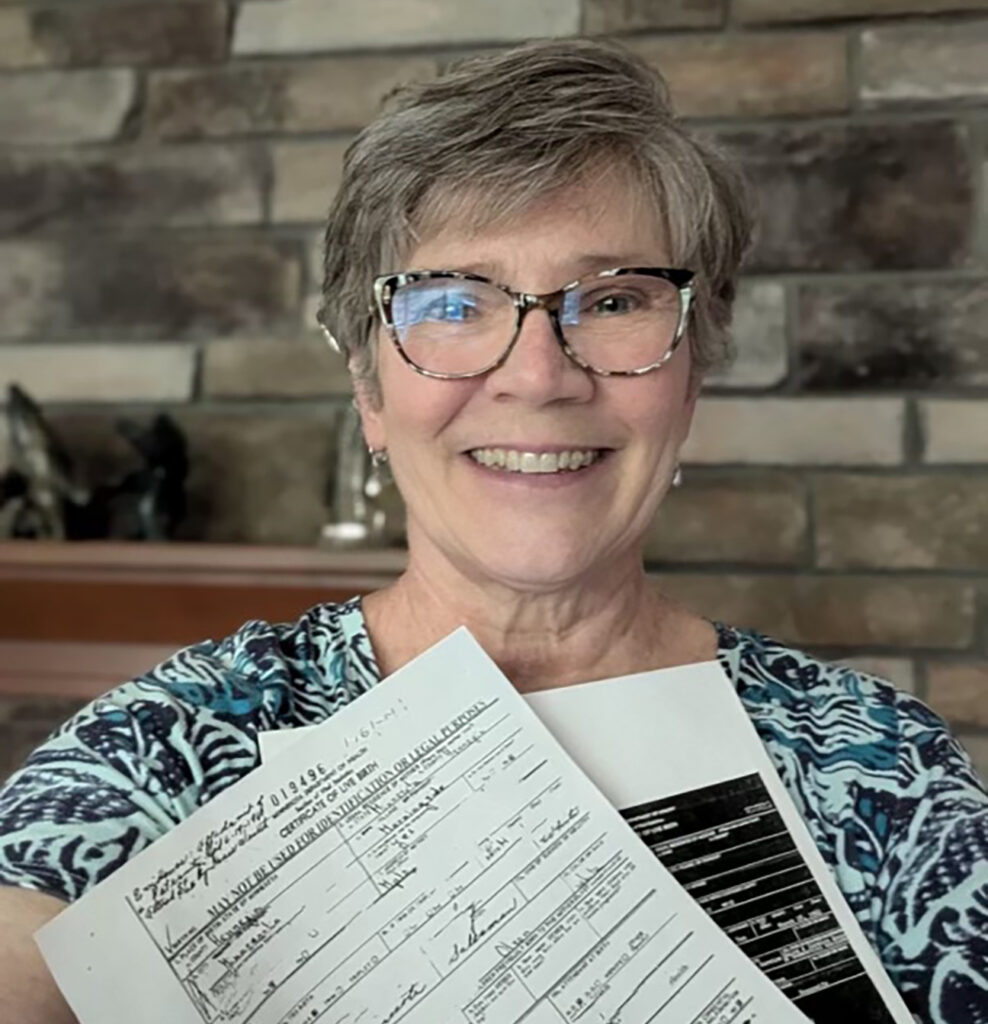
Sheri
Sheeks quickly obtained her original birth certificate under
Minnesota’s new law. (Note: some personal information on the document
has been digitally redacted.) Provided photo.
For decades, U.S. adoptions were steeped in
secrecy — private arrangements struck between parents and caseworkers.
Pre-adoption birth certificates sealed in government archives often left
the origin stories of adoptees undisclosed and inaccessible.
Finding long-lost relatives through DNA testing and social media have
upended that legacy. But confidentiality laws across the country have
not kept pace.
This summer, following decades of advocacy, Minnesota joined a
growing number of states lifting all restrictions. Since enactment of a
new law July 1, thousands of adoptees born in the state have received
vital records that contain the once-concealed details of their birth. As
of August 30, Minnesota’s Office of Vital Records had processed all
2,349 requests it had received, according to a spokesperson.
Sheri Sheeks, a 63-year-old retiree in the Minneapolis area, was one
of the first Minnesotans to seek her original birth certificate after
the law took effect just over two months ago.
She said she had always puzzled over the “very bizarre” gaps in the
birth certificate she’s had since childhood. No name of the hospital
where she was born, no time of birth.
Five years ago she learned why: a genetic test turned up a
half-sister from the second marriage of a birth father she had never
known. Sheeks had been adopted, and her birth certificate was an
“amended” version of the original. The parents who raised her never
shared that vital information before they died.
Sheeks said she had great adoptive parents, but often wondered
whether they were told to keep the adoption secret, perhaps to protect
her from being teased by other kids. Yet she remained acutely aware of a
“key missing piece” in her life: the name of her biological mother.
“I’d look in the mirror and say ‘Who the heck are you’?” she said.
So she faxed a request to the Minnesota Department of Health on the
morning of July 1, the same day the new law went into effect. She was
thrilled to see her birth certificate in the mail two days later.
Her birth mother would be 95 today, and Sheeks is hoping to confirm whether or not she isalive.
In the meantime, she said she has a new sense of closure — simply
seeing her mother’s name and address on a formal document.
“Now,” Sheeks added, “when I look in the mirror, I feel more grounded
in who I am. I don’t have these loose threads hanging out.”
The Minnesota reform represents the latest win for a loosely knit national movement.
The number of states granting adoptees unrestricted access to original
birth certificates has nearly doubled since 2019, from eight to 15. It’s
a quiet but momentous change for millions of American families with
some connection to an adoption, including some 172,000 adoptees born in
Minnesota alone, according to an estimate by the state Department of
Health. Previously, the documents were only made available with a court
order or affidavits of permission from biological parents, who could be
unreachable or deceased.
Private adoption agencies have also remained reluctant to release their internal case files to adoptees, but some agencies have begun to reconsider longstanding practices.
Under the recently enacted bill authored by Sen. Erin Maye Quade and
Rep. Steve Elkins, people over age 18 and who were adopted in Minnesota
can access an original, pre-adoption birth certificate that typically
includes biological parents’ names, birth location and time — with
little hassle. Requests to the state are handled after applicants fill
out a simple notarized form and pay a $40 fee. Wait times may be between a few days and a few weeks.
One leading national advocate for adoptees marveled at the progress.
“It’s been crazy,” said Greg Luce, the Minneapolis-based founder of
the Adoption Rights Law Center. “Minnesota is my state. I live and vote
in this state and advocate in it — to say that it can be done, that you
can undo an incredibly complex law like Minnesota’s, it’s incredibly
fulfilling to see that.”
For decades, some Catholic groups, adoptive parents and adoption agencies
opposed granting adoptees unfettered access to their vital records,
raising concerns about the privacy of birth mothers or pain and
confusion for adoptees. In a 2017 Minnesota Star-Tribune article, a
state lawmaker pointed to opposition from the anti-abortion group Citizens Concerned for Life.
“I
saw some students who just wanted to know: ‘Where did I come from?’
That’s a universal question we all have. There’s grief at the bottom of
this.”
— Penelope Needham, adoptee, advocate and teacher
Despite passage of Minnesota’s new law, two prominent and
long-practicing Minnesota charitable nonprofits that work together on
adoptions — Lutheran Social Service of Minnesota (LSS) and Children’s
Home Society of Minnesota — listongoing concerns.
“Overall, Children’s Home and LSS support adult adoptees gaining access to their original birth record,” the groups’ website states.
But they also warn the new law “may be difficult for some birth parents
who believed their identity would remain confidential.”
Adoptees cite a range of reasons for seeking their original birth
certificates. Like Sheeks, some want answers to gnawing questions, their
parents’ names and medical history, the ability to complete a family
tree, or to learn more about the circumstances of their birth. Others
hope to reunite, or to meet extended family members.
Others are driven less by an interest in personal details or a
hoped-for reunion than by their belief that they have a right to these
records like any other American citizen — that these personal records
belong to them, and that accessing them is a matter of equal rights.
Penelope
Needham, speaking in support of Minnesota’s new law at a hearing last
year. Screen capture from Minnesota Senate Media Services.
Penelope Needham spent three decades helping lead the Minnesota
Coalition for Adoption Reform — a group that includes adoptees, birth
parents, adoptive parents, and adoption professionals — and pressing
lawmakers to change state policy that dates back to 1939.
“We shouldn’t be discriminated against because we were adopted as
children,” said Needham, a former school teacher, 75. “It should be ours
upon request.”
Needham, who was adopted as an infant, said having her own children
as well as her elementary, middle and high school students motivated her
to trek repeatedly to St. Paul to testify before lawmakers about the
need for reform. She and other advocates have long sought to overturn
legislation that previously only provided the “amended’’ birth
certificates to adoptees, with no details about their births such as
birth weight, location, time, parents’ addresses and occupations.
After a costly and lengthy process with her adoption agency, she had
reunited with some family members decades ago and gained her mother’s
consent for the state to release her own birth certificate. She knew the
importance of family origin, and as a result, she later organized
adoptee support groups for her students. Each school year, whenever she
stood before a class of new students, she said she could sometimes guess
who had been adopted.
“When you’re adopted, you can be really good at adapting to other
things, too. There’s a flexibility you can learn,” she added. “But I saw
some students who just wanted to know: ‘Where did I come from?’ That’s a
universal question we all have. There’s grief at the bottom of this.”
In recent years, both Republican and Democratic-controlled
legislatures nationwide have approved birth certificate bills that
eliminate all restrictions on adoptees’ access. Advocates in Minnesota
say even though they have also had bipartisan support, Democratic
control of both statehouses and the governors’ office since 2022 eased
passage of its law.
Needham and Luce said passage of a similar hard-fought reform law
in New York in 2019 also helped. Since taking effect four years ago,
nearly 37,000 people who had been adopted in the state have received
original birth certificates, according to data provided to The Imprint
by the vital records agencies for New York State and New York City.
Since then, in addition to New York and Minnesota, Connecticut,
Louisiana, Massachusetts, Vermont, and South Dakota have made similar
reforms, often with strong bipartisan support.
“Now when I look in the mirror, I feel more grounded in who I am. I don’t have these loose threads hanging out.”
— Adoptee Sheri Sheeks
Republican Rep. Marty Overweg, an adoptive father in the South Dakota
Legislature, testified at a 2023 hearing in support of a bill signed by
the Republican Gov. Kristi Noem a month later.
“When my son went to get his, he ran into more roadblocks than you
can even imagine,” Overweg said. “And then, throwing $2,000 fees at them
just to find out where they came from — who they originally were —
that’s not fair.”
Overweg testified that said fears about the emotional fragility of
adoptees uncovering painful family history tend to be overblown.
“Most of the time when they go back and look, it’s a good thing,” he said. “It’s not a scary thing.”
Advocates for adoptees and birth parents have argued that the availability of DNA testing, onlinegenealogical
archives and public social media accounts have rendered any assurances
of birth mothers’ secrecy all but obsolete. In her examination of dozens
of adoption case files from the mid-20th century, the legal scholar
Elizabeth Samuels found little evidence that mothers who placed children for adoption were even given explicit offers of lifelong secrecy.
Professional services are also widely available to assist with
nationwide searches. In the 1980s, Needham paid hundreds of dollars for
the agency’s staff to help find her birth mother — a process that
required intensive questioning and a letter expressing her intentions.
The contact information later trickled out “in little pieces,” she said.
“They wouldn’t allow contact — only through the social worker. And
then it was only by mail, and then it was a phone call,” she said. “But
nobody gave identifying information. It was very controlled. I think
they wanted to evaluate if you were ‘competent’ for a reunion.”
Only after the eventual reunion did Needham obtain her mother’s sign-off for her birth certificate.
She said she will never forget finally meeting her biological sisters
when she was 39. They had similar musical skills. They were teachers,
just like her. And when the siblings sat down together, there were other
traits they shared. They took off their shoes and socks and compared
toes, happily noting remarkable similarities.
MINNESOTA! Birth records open to adult adoptees July 1
REGIONAL- Starting July 1, Minnesota-born adoptees, 18 years
and older, will have new access to their original birth records, a move
that promises to unlock deeply held questions about their biological
heritage. This access is part of a law passed last year which no longer
allows birth parents to conceal their identities from adult adoptees. After
an adoption in Minnesota, birth records are changed to show the new
name of the adopted person and the adoptive parents, and the original
birth records and all related correspondence are sealed, making the
records confidential and only accessible under certain provisions laid
out in state law. Access to the records has prioritized the specified
intentions of the birth parents to restrict or share the information. But
now the original birth record will be available not only to adult
adoptees, but also to an adoptee’s legal representative or relatives if
the adoptee is deceased.
Noncertified copies of original birth records may also be released to:
👉A birth parent named on the original record.
👉A
representative of a federally recognized American Indian tribe for the
sole purpose of determining an adopted person’s eligibility for tribal
enrollment or membership.
👉A person with a certified copy of a court order directing the release of the original birth record to them.
The
law also introduces a contact preference form for birth parents,
allowing them to indicate their openness to being contacted. This form,
which includes space for a brief message, will accompany the released
birth record, though the decision to initiate contact rests solely with
the adoptee. Birth parents retain the right to alter their contact
preferences at any time.
Gregory Luce, a Minneapolis attorney and adoptee, framed the matter as one of human rights. “I
think people are finally recognizing the human right to know who you
are and where you came from,” he said. “And making adoption secret in
this way is just an anachronism. It’s a human rights issue. It’s found
its day, it’s found its advocates, and it is currently now a real
movement.”
Part of the change is being driven by DNA and the
increasing knowledge base about the role of genetics in influencing
people’s physical, behavioral, and psychological traits, including
genetically-linked health conditions. A heightened societal interest in
genealogy has also informed the debate over open records, particularly
with the proliferation of large voluntarily DNA databases maintained by
companies like Ancestry that will find genetic matches with others in
the database. Also important in the shifting norm has been the
increasingly common practice of open adoption, where the birth parents’
identities are acknowledged from the very outset of the adoption process
and open communication and relationships are established between them
and the adoptive parents and the adoptee.
By Trace Hentz (who still doesn't have a simple piece of paper called her original birth certificate but will apply in 2024 in Minnesota) What is #ASimplePieceOfPaper? Your Original Birth Certificate - the real one with real names and dates.
I have been researching adoption for 20+ years as a journalist and
started my own search for my identity at age 22 - a very long time ago
(as an adoptee).
Can anyone tell me why it has taken years and years for any progress on
open adoption files and letting an adoptee have their original birth
certificate and the name of their parent(s)??
It's a simple piece of paper.
We have to start somewhere. Read this:
Bill of Adoptee Rights gains support locally and across the state
By ELI ANDERSON | TIMES STAFF WRITER | APRIL 15, 2015
HAMMOND — Bridget J. Gordinier had almost given up hope of ever speaking to her daughter, 35 years after she was born.
“I lost all hope. I knew I would never see her again,” Ms. Gordinier said.
In
March 1978, Ms. Gordinier made one of the most difficult decisions she
would ever make: to place her daughter up for adoption.
“I
was 17 at the time, and just was not able to raise a child on my own,”
she said. “I let her go, knowing that she would get a better life than
what I could give her.”
“It was a different era back then,” Ms. Gordinier said. “People didn’t talk a lot about it — it was kind of hush-hush.”
There were also very few options for parents who chose to place a child up for adoption in the ’70s, she said.
“I
knew that I was signing every right away,” Ms. Gordinier said. “I would
never get to know anything about her — where she went or who had her.
My only option would be, on her 18th birthday, I would be able to
register with New York state.”
So,
18 years later, Ms. Gordinier did exactly that. She made her
information public, hoping that her daughter, now legally an adult would
be looking for her.
However, the prospect that she would ever be reunited with her daughter was dashed by restrictions in New York’s legal system.
Even
if her daughter was registered and looking for her, Ms. Gordinier said,
her daughter would get only “non-identifying information,” and that
would be after she went to court to get it.
Under
New York state law, original birth records have been restricted to
adoptees since 1935. When adoptions are completed, the state issues an
amended or adoptive birth certificate.
Adoptees
who need their original birth record to find information about their
genealogy or family medical history, or — in Bridget’s daughter’s case —
to contact a birth parent, are unable to access it, regardless of their
age.
REUNION
Fast-forward
another 18 years, to October 2013. Ms. Gordinier stood in the parking
lot of a Pizza Hut in Canton, hugging her daughter, Cherilyn M. Bush,
who was now almost 36.
“I didn’t
think I would ever be able to do that,” she said. “I just thought that I
didn’t want to let go — never wanted to let go again.”
It
was their first moment together in more than three decades. Ms.
Gordinier had found her daughter through a “search angel,” a woman from
New York City who specialized in helping to reunite adoptees with their
birth parents.
“I gave her the little
bit of information that I did have, and then a week later, my phone
rang and it was my angel,” Ms. Gordinier said. “She said, ‘Your daughter
is in Brasher Falls.’”
For the 35 years they spent apart, Ms. Gordinier and her daughter never lived more than a two-hour drive away from each other.
“She grew up in Massena, and I was always either in Brier Hill or Hammond,” she said.
In fact, Ms. Bush and her biological brother, who is a couple of years younger, both attended SUNY Canton.
“They
can tell each other parties that they were at on the same night,” Ms.
Gordinier said. “He was really good friends with one of her best friends
in college.”
‘PAYING IT FORWARD’
Nonetheless,
it took mother and daughter 18 years to find each other. Ms. Gordinier
said that is why she is fighting for New York to pass a piece of
legislation called the Bill of Adoptee Rights.
“My
daughter started searching at 18,” she said. “I was registered when she
turned 18. We could have been together at her age of 18 instead of 18
years later, when she was a month away from turning 36. I don’t want
anyone else to have that time stolen from them.”
Ms. Gordinier is
active in New York Adoption Equality, an organization working to reform
state adoption laws. She will join thousands of other New Yorkers on
Thursday when she takes part in a campaign called “A Simple Piece of
Paper.”
The campaign’s name
reflects just what its supporters seek to gain: a simple piece of paper,
or in this case, an adoptee’s original birth certificate. Participants
will post photos of themselves displaying the hashtag
#ASimplePieceOfPaper to social media.
“It’s
about being treated with equal dignity by the state,” said C. Catherine
Henderson Swett, the organization’s downstate coordinator. “All
adoptees are denied their original birth certificate in New York state.
We are fighting to restore access to the people whose names are on
them.”
The
bill would allow adoptees to access their original birth certificate
upon turning 18. Ms. Swett said it is a basic civil right, and she is
confident the bill will be signed into law in the next couple of years.
“There is overwhelming support,” she said. “We just need a few more Assembly members to confirm that they support the bill.”
State
Sen. Patricia A. Ritchie, R-Heuvelton, is one of the bill’s cosponsors.
She was unable to be reached for comment despite several attempts this,
and last, week.
Ms.
Gordinier said fighting for this bill is her way of “paying it
forward.” She said she believes adoptees should have the right to access
their birth information upon turning 18.
“It’s
a struggle to get passports, go into the service, or get a job in some
fields because they don’t have their original birth certificates,” she
said.
Ms. Gordinier said denying adoptees this information can also be dangerous for health-related reasons.
“There
are people out there that are carrying around hereditary,
life-threatening diseases that have no idea,” she said. “They could be
taking preventive measures, but they just don’t know.”
Ms.
Gordinier and her daughter see each other regularly now. Ms. Bush has
three children of her own; she lives in Central Square.
“Things are really great,” Ms. Gordinier said. “I was just at her house the other day.”
She and her daughter have occasional setbacks, but Ms. Gordinier said that is to be expected.
“We’re very lucky,” she said. “We are building a beautiful relationship.”
Ms.
Gordinier said she is traveling to Albany on April 21 2015 to gather with
other members of the New York Adoption Equality organization as they
continue lobbying for the bill’s passage.
Hear ye! hear ye! The law of the land has changed. Fourteen states have now affirmed or restored an adult adoptee's right to request and obtain a copy of their own original birth certificates. And at least one more next year. pic.twitter.com/jAC0xxtwLz
“‘We had no idea how far this would go, and nobody ever expected boxes,’ said [Marley] Greiner, who tracks with Luce the 19 states currently authorizing the use of the boxes.”https://t.co/VXoCLZQIiS
SF1279/SF2995/HF1778.[ENACTED!]Unrestricted equal rights bill that dismantles Minnesota’s forty-five year history of inequality. These bills are unrestricted equal rights bill that are generally identical to bills filed in the prior two legislative sessions. Sen. Erin Maye Quade, a DFL (Democratic) legislator, is the chief author of the Senate bill, and Rep. Steve Elkins is the chief author of the House bill. The bills constitute a necessary simplification of the law by eliminating Minnesota’s incomprehensibly complicated and discriminatory intermediary system, the first such system in the United States and one that has been in place since 1977. Minnesota Coalition for Adoption Reform and Minnesota-based Adoptee Rights Law Center are working collaboratively on the bill. The House bill has been assigned to the Health Finance and Policy Committee. The Senate bill was reported out of the Judiciary and Public Safety Committee and heard in the Health and Human Services Committee. It is now part of the Senate HHS omnibus appropriations bill (SF2995), which passed the full Senate on April 18. After negotiations, the adoptee birth record provisions in the Senate version of SF2995 were included and approved as part of the the overall HHS omnibus bill. The legislature passed the omnibus bill on May 22, the last day of the regular session, and Governor Tim Walz signed the bill into law on May 24. Minnesota will now become the 15th state in the country to restore equal rights to all adopted people born in the state. The law is fully effective on July 1, 2024.
Oregon
SB573 [ENACTED!] Allows a biological parent who was omitted or listed incorrectly to be added to an original (pre-adoptive) birth certificate. This bill has been in the Oregon legislature for about three sessions now, doggedly pursued by an adult adoptee who wants the correct factual information listed on her own original birth certificate. The bill, carried by Senator Sara Gelser Blouin, would allow addition or correction of a birthparent on the OBC if approved through an administrative determination of paternity or parentage. DNA evidence is required, along with a $100 filing fee. The first hearing on the bill was January 23, 2023, before the Senate Committee on Human Services, chaired by Senator Gelser Blouin. The bill was then delayed for consideration to work out issues arising out of the process to approve corrections to the birth record. It was reported out favorably on March 6 after the bill was simplified to avoid a court process. It passed the Senate on March 13, on a 28-1 vote and is now in the House, where it was heard on April 24 in the Early Childhood and Human Services Committee and subsequently recommended for passage by the House. The House passed the bill on May 23, 2023, and Governor Tina Kotek signed it into law on June 6, 2023. It is effective on January 1, 2024.
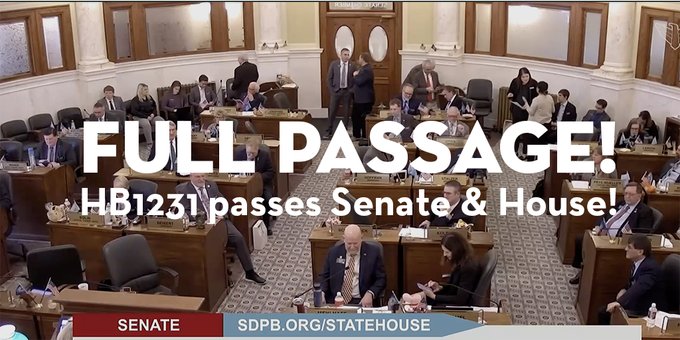
One Good. We mentioned South Dakota’s equal rights bill last week. We have some additional fantastic news. HB1231 yesterday passed the Senate, and it will be transmitted to Governor Kristi Noem soon, who is widely expected to sign it into law. Once enacted, it goes into effect on July 1, 2023, restoring the right of all South Dakota-born adult adopted people to apply for and obtain their own original birth certificates. That is, apply, pay a few bucks, get it.
Two Good. Georgia’s SB64 got over its first legislative hurdle yesterday, receiving a unanimous DO Pass recommendation from the Senate Children and Families Committee. It heads to a vote now by the full Senate, which has to occur no later than March 6. Sign up with the Georgia Alliance for Adoptee Rights if you want to stay informed or get involved.
Two Bad. The bad news comes from two bills pending in West Virginia and Mississippi, though the bills are still far from being enacted. As we produce this newsletter the West Virginia bill has been passed by the Senate and is headed for the House. It has a whole host of problems, including educational requirements, redactions, and your mom’s permission to get your OBC.
Mississippi’s bill is a bit more complicated because, while at one point it was a bad bill, it is now a completely different and unrelated bill, thanks to a maneuver called a “strike all.” It may be dead because of the strike all, but then again the Mississippi legislature has not yet uttered the magic words to truly signify the end of a bill: dead, dead, dead.
Mapping the Life Course of Adoption Project Launch and Survey. Adoption professionals all agree that adoption is life long -- and no one knows this better than adoptees. And yet, our collective knowledge about the life course of adoption does not exist. This is what the MAP project is seeking to change.
By a vote of 35-0 on the consent calender, the South Dakota Senate passed HB1231 today. It now goes to the Governor. Congrats and thanks to Rep. Mellissa Heermann!
Today we remember the Wounded Knee Occupation began on February 27, 1973, when approximately 200 Oglala Lakota and followers of the American Indian Movement seized and occupied the town of Wounded Knee, South Dakota, on the Pine Ridge Indian Reservation. Feb 27, 1973-May 8, 1973 pic.twitter.com/0kxwrgKDNx
Virginia’s equal right bill seemed well on the road to House passage and then—poof—it went down, the victim of tight legislative deadlines and a last minute “re-referral” to where it started: in committee. Advocates are working to determine what happened (aides who worked closely on the bill don’t yet seem to know) and how it can be addressed next session. Plans are already underway for 2024—as are plans next year for next-door neighbor Maryland.
New Bills. Minnesota now has an active equal rights bill in the Senate, with a companion bill likely introduced toward the end of the week. It is probably the best opportunity to pass an equal rights bill in Minnesota in at least two decades, led primarily by the Minnesota Coalition for Adoption Reform.
AB13 in Wisconsin has been filed. It is the companion bill to SB15, which was introduced last week and assigned to a relatively friendly committee.
Adoptees United is a national nonprofit organization with an unwavering commitment to equality for all adopted people. More information, including our board, position statements, and programming are on our website at adopteesunited.org.
Those four words pop into my mind every November, like an annual calendar reminder set to go off with a cartoon “boing.”
November is National Adoption Month, and as an adopted person you might think we’re all a bundle of anticipatory excitement, planning the kegger and booking the cover band.”
For example, I’ve been on a 30-year mission to obtain every page of my medical, adoption, foster care and genealogical records.
I’ve had some success at this mostly because I haven’t stopped asking after being told no.
Poof! Starting today, all Massachusetts-born adopted people have a right to obtain their own preadoption birth records, no donut holes, no muss. Here's how it works and how to apply. https://t.co/bRpSTfta6I
Australia: "While we have recently marked the tenth anniversary of the NSW Apology for Forced Adoption Practices, adoptees are still calling for easier steps to have our fathers recognised, to help us connect with our culture, identity and families." https://t.co/ugOxliixSc
Beginning November 3, 2022, Massachusetts will restore the unrestricted right of all adult adopted people to request and obtain their own original birth certificates.
Prior to November 3, 2022, adult adopted people born between July 17, 1974, and January 1, 2008, will be unable to obtain their own OBCs, except by court order (what’s been known as the Massachusetts “donut hole”). The new law eliminates the donut hole.
* (g) If a person shall have been adopted by judicial decree, the clerk of the town where such person was born or the state registrar shall receive the certificate of such adoption issued under the authority of section 6A of chapter 210 or a certified copy of the decree for such adoption, whether issued by a probate court for the commonwealth or by the appropriate court of any other state or country. Except as hereinafter provided, said clerk or state registrar, after receiving such certificate of adoption or any such certified copy, shall forthwith correct the record of birth of the person so adopted. If such certificate or certified copy does not contain the facts relative to the adopting parents hereinafter required for correcting such record, the clerk or state registrar shall not correct such record until he has received an affidavit, signed and sworn to by the adopting parents, or by the person adopted, furnishing such facts. If a person who was in the custody of the department of children and families is adopted and the adopting parents surrender the person back to the department, that person shall have the right to change the birth certificate back to that person’s biological name.
T he Métis National Council and the Government of Canada will be working collaboratively, Nation-to-Nation, to develop a process to engag...
To Veronica Brown
Veronica, we adult adoptees are thinking of you today and every day. We will be here when you need us. Your journey in the adopted life has begun, nothing can revoke that now, the damage cannot be undone. Be courageous, you have what no adoptee before you has had; a strong group of adult adoptees who know your story, who are behind you and will always be so.
OUR HISTORY
BOOK 5: Lost Children of the Indian Adoption Projects