BACK UP BLOG (no longer updating)

This blog was a backup for American Indian Adoptees blog
USE THE SEARCH BAR or SEARCH TOPICS at bottom of this blog

If you need support

Support Info: If you are a Survivor and need emotional support, a national crisis line is available 24 hours a day, seven days a week: Residential School Survivor Support Line: 1-866-925-4419. Additional Health Support Information: Emotional, cultural, and professional support services are also available to Survivors and their families through the Indian Residential Schools Resolution Health Support Program. Services can be accessed on an individual, family, or group basis.” These & regional support phone numbers are found at https://nctr.ca/contact/survivors/ . MY EMAIL: tracelara@pm.me

Search This Blog

Showing posts with label extreme poverty. Show all posts

Tuesday, October 5, 2021

Family Surveillance by Algorithm

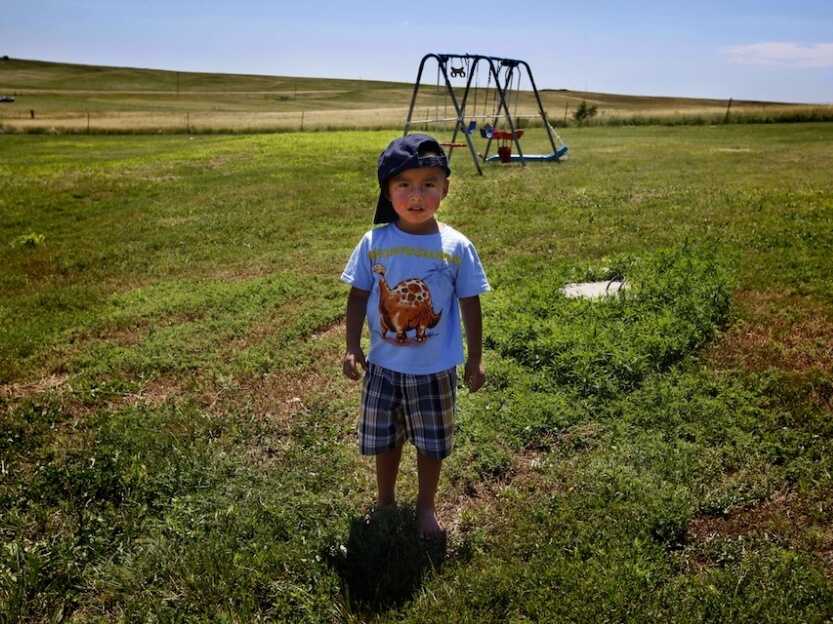
Janice Howe's grandchild Derrin Yellow Robe, 3, stands in his great-grandparents' back yard on the Crow Creek Reservation in South Dakota. Along with his twin sister and two older sisters, he was taken off the reservation by South Dakota's Department of Social Services in July of 2009. READ


It took over a year and a half for Erin Yellow Robe, a member of the Crow Creek Sioux Tribe, to be reunited with her children. Based on an unsubstantiated rumor that Erin was misusing prescription pills, authorities took custody of her children and placed them with white foster parents — despite the federal Indian Child Welfare Act’s requirements and the willingness of relatives and tribal members to care for the children.

For white families, these scenarios typically do not lead to child welfare involvement. For Black and Indigenous families, they often lead to years — potentially a lifetime — of ensnarement in the child welfare system or, as some are now more appropriately calling it, the family regulation system.

Child Welfare as Disparate Policing

Our country’s latest reckoning with structural racism has involved critical reflection on the role of the criminal justice system, education policy, and housing practices in perpetuating racial inequity. The family regulation system needs to be added to this list, along with the algorithms working behind the scenes. That’s why the ACLU has conducted a nationwide survey to learn more about these tools.

Women and children who are Indigenous, Black, or experiencing poverty are disproportionately placed under child welfare’s scrutiny. Once there, Indigenous and Black families fare worse than their white counterparts at nearly every critical step. These disparities are partly the legacy of past social practices and government policies that sought to tear apart Indigenous and Black families. But the disparities are also the result of the continued policing of women in recent years through child welfare practices, public benefits laws, the failed war on drugs, and other criminal justice policies that punish women who fail to conform to particular conceptions of “fit mothers.”


Turning to Predictive Analytics for Solutions

Many child welfare agencies have begun turning to risk assessment tools for reasons ranging from wanting the ability to predict which children are at higher risk for maltreatment to improving agency operations. Allegheny County, Pennsylvania has been using the Allegheny Family Screening Tool (AFST) since 2016. The AFST generates a risk score for complaints received through the county’s child maltreatment hotline by looking at whether certain characteristics of the agency’s past cases are also present in the complaint allegations. Key among these characteristics are family member demographics and prior involvement with the county’s child welfare, jail, juvenile probation, and behavioral health systems. Intake staff then use this risk score as an aide in deciding whether or not to follow up on a complaint with a home study or a formal investigation, or to dismiss it outright.

Like their criminal justice analogues, however, child welfare risk assessment tools do not predict the future. For instance, a recidivism risk assessment tool measures the odds that a person will be arrested in the future, not the odds that they will actually commit a crime. Just as being under arrest doesn’t necessarily mean you did something illegal, a child’s removal from the home, often the target of a prediction model, doesn’t necessarily mean a child was in fact maltreated.

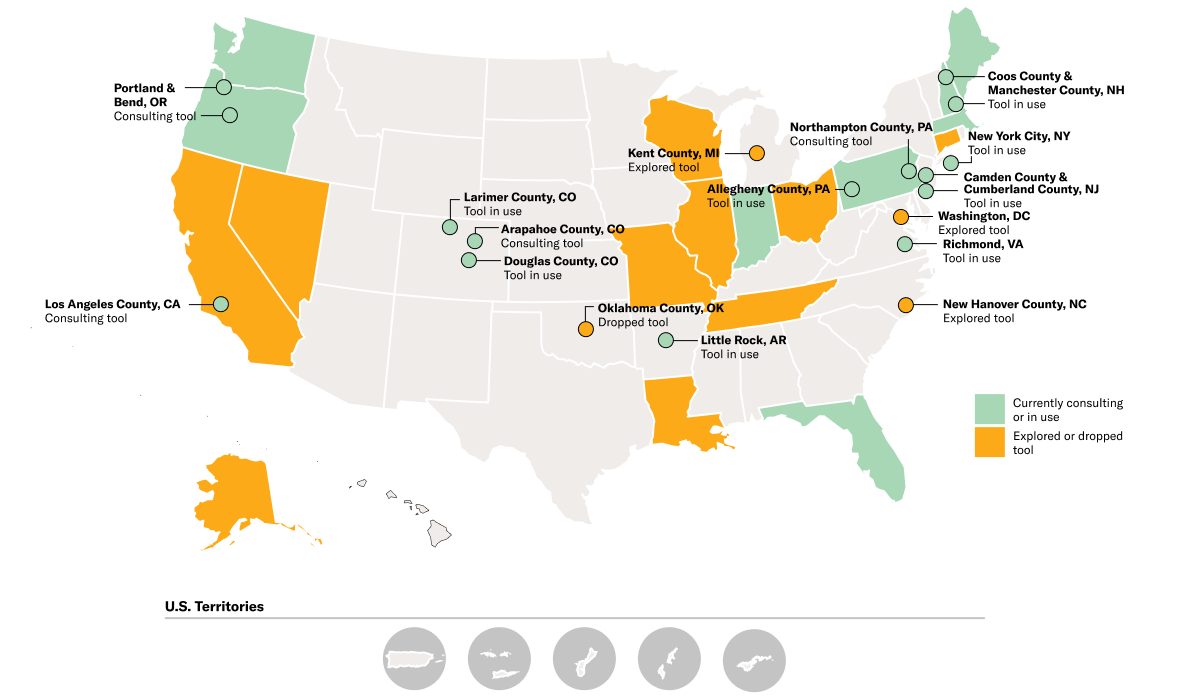
We examined how many jurisdictions across the 50 states, D.C., and U.S. territories are using one category of predictive analytics tools: models that systematically use data collected by jurisdictions’ public agencies to attempt to predict the likelihood that a child in a given situation or location will be maltreated. Here’s what we found:

  • Local or state child welfare agencies in at least 26 states plus D.C. have considered using such predictive tools. Of these, jurisdictions in at least 11 states are currently using them.
  • Large jurisdictions like New York City, Oregon, and Allegheny County have been using predictive analytics for several years now.
  • Some tools currently in use, such as the AFST, are used when deciding whether to refer a complaint for further agency action, while others are used to flag open cases for closer review because the tool deems them to be higher-risk scenarios.

The Flaws of Predictive Analytics

Despite the growing popularity of these tools, few families or advocates have heard about them, much less provided meaningful input into their development and use. Yet countless policy choices and value judgments are made in the course of creating and using the tool, any or all of which can impact whether the tool promotes “fairness” or reduces racial disproportionality in agency action.

Moreover, like the tools we have seen in the criminal legal system, any tool built from a jurisdiction’s historical data runs the risk of continuing and increasing existing bias. Historically over-regulated and over-separated communities may get caught in a feedback loop that quickly magnifies the biases in these systems. Who decides what “high risk” means? When a caseworker sees a “high” risk score for a Black person, do they respond in the same way as they would for a white person?

Ultimately, we must ask whether these tools are the best way to spend hundreds of thousands, if not millions of dollars, when such funds are urgently needed to help families avoid the crises that lead to abuse and neglect allegations.

What the ACLU is Doing

It’s critical that we interrogate these tools before they become entrenched, as they have in the criminal justice system. Information about the data used to create a predictive algorithm, the policy choices embedded in the tool, and the tool’s impact both system-wide and in individual cases are some of the things that should be disclosed to the public before a tool is adopted and throughout its use. In addition to such transparency, jurisdictions need to make available opportunities to question and contest a tool’s implementation or application in a specific instance if our policymakers and elected officials are to be held accountable for the rules and penalties enforced through such tools.

In this vein, the ACLU has requested data from Allegheny County and other jurisdictions to independently evaluate the design and impact of their predictive analytics tools and any measures they may be taking to address fairness, due process, and civil liberty concerns.

It’s time that all of us ask our local policymakers to end the unnecessary and harmful policing of families through the family regulation system.

Read the full white paper:

https://www.aclu.org/fact-sheet/family-surveillance-algorithm

We need you with us to keep fighting
News Provided By


Wednesday, March 13, 2019

High levels of perceived Poverty justifies removal of American Indian children (again?) #PovertyPorn

ARCHIVE PHOTO

How does measuring poverty and welfare affect American Indian children? (aka #povertyporn)


For one group of children in particular, American Indians and Alaska Natives, exceedingly high poverty rates have had profound impacts on community wellbeing and long-term cohesiveness. Given the best available data, from the U.S. Census data, child poverty rates among American Indians and Alaska Natives have consistently exceeded 40% for almost the past 30 years.*

However, a recent National Academics of Sciences (NAS) report affirms what many in these communities have long known—that the data on poverty are sparse and not as reliable for this group as it is for other groups or communities in the U.S.:

“Small sample sizes in population surveys have made it particularly difficult to reliably measure poverty rates among American Indian and Alaska Native children. Moreover, we know little about the effectiveness of a number of important programs and policies – whether provided by the tribes, by the states, or by the federal government – that affect this population.”

As a result, it is quite difficult to accurately track the impact that various programs have had on child poverty over time or how applicable standard assessments of what poverty looks like actually are to American Indian communities.
Are conditions as bad as indicated by the official poverty rates shown above? (see website)

Historically, high levels of perceived poverty have been used to justify the removal of American Indian children from their households by state foster care systems. As recently as the 1970s, state welfare agents were removing almost one third of all American Indian children from their households and placing them in state foster or adoptive care systems. (Mannes, 1995)

One of the aims of the Indian Child Welfare Act (ICWA) of 1978 was to stop the removal of American Indian children from their households due to poverty. A number of studies had confirmed that social workers were removing American Indian children from households not due to maltreatment or being orphaned but simply due to the perceived poverty status of the household (see MacEachron, Ann E., and Nora Gustavsson, 2005). The ICWA legislation was intended to improve tribal control over the determination and placement of American Indian children within the foster care system.

Congress reaffirmed tribal government authority and oversight of the placement of its own citizens – its children. Tribal courts were delegated the authority and jurisdiction over the placement of its own citizens (and those eligible for tribal citizenship enrollment) in foster or adoptive homes.


For instance, Chris Newell (Passamaquoddy; Director of Education; Akomawt Educational Initiative) describes a fundamental misunderstanding of the concept of family and neglect in his Passamaquoddy community in Maine:

“In Maine, parents would often leave their children with their grandparents or other extended family members when they would leave for seasonal work elsewhere. To the state, however, this constitutes neglect and could qualify a child for removal. In reality, our children’s needs were commonly met by extended family and community beyond the nuclear family.”

Mr. Newell served as a senior advisor on a recent documentary film called “Dawnland,” which exposes the impact of such practices on American Indian children and their parents decades later in the state of Maine. The film depicts the long-term trauma and damage that resulted from the removal of children from their families; it also shows the damage to the children caused by their removal from their kinship network and cultural connections.
Individuals with little exposure to or experience with American Indian communities would have little to no knowledge of these forms of social safety nets.
Assessing economic conditions may also be quite difficult for individuals who are unfamiliar with American Indian communities and practices. There are important culturally-specific safety nets that exist in many American Indian communities; most of which would be unknown to outsiders. Individuals with little exposure to or experience with American Indian communities would have little to no knowledge of these forms of social safety nets.

The recent NAS report indicates that even standard measures of poverty are difficult to measure for the American Indian population. However, neither the Official Poverty Measure (OPM) nor the Supplemental Poverty Measure (SPM), which includes taxes and federal government in-kind transfers, account for community or kinship in-kind transfers or from tribal governments. In certain American Indian communities, for instance, hunting, trapping, fishing and other subsistence activities are important parts of the economic and social interactions of community members. These activities do not show up directly as cash income nor are they identified as federal government in-kind transfers. As a result, the OPM and SPM measures may not accurately depict the general welfare of American Indian families or children. In fact, they may understate the resources in some families and whole communities.

While this does not dismiss the fact that child poverty is probably still too high in many American Indian reservations, it does indicate that there may be other activities or practices that exist in non-market (even non-governmental) forms to assist families. Subsistence activities and the sharing of resources is difficult to document with administrative records or tax returns; nevertheless, these safety nets have played an important role in these communities for hundreds if not thousands of years. Individuals with little exposure to or experience with American Indian communities would have little to no knowledge of these forms of social safety nets.

Challenges to ICWA often focus on an erroneous assumption that these policies are race-based.
However, providing tribal government jurisdiction and authority over its own citizens’ welfare is based on American Indian tribal sovereignty- not race. Tribal citizenship enrollment and eligibility is based on tribal government rules which are often specific to a particular tribe and may require showing direct lineal descent from certain enrolled ancestors; there may be other additional conditions for tribal citizenship such as a minimum blood quantum, residency requirement or demonstrated relationship with the community. In the current court case, Brackeen v. Zinke, where oral arguments are scheduled to begin in the Fifth Circuit court this week, the same arguments have been made. ICWA has played an important role in stopping the seizure of American Indian children from their communities. Misunderstanding of how American Indian communities care for their own children and the inability to assess non-monetary well-being of American Indian communities should not play a role in the removal of children from their homes. ICWA plays a critical role in safeguarding these children and maintaining the local and tribal authority for placing American Indian children in foster or adoptive care. Let’s not go backwards.

Sources:
“7 Other Policy and Program Approaches to Child Poverty Reduction.” National Academies of Sciences, Engineering, and Medicine. 2019. A Roadmap to Reducing Child Poverty. Washington, DC: The National Academies Press. Page XXX. doi: 10.17226/25246
Mannes, M. (1995). Factors and events leading to the passage of the Indian Child Welfare Act. Child Welfare, 74(1), 264–282.
National Academies of Sciences, Engineering, and Medicine. 2019. A Roadmap to Reducing Child Poverty. Washington, DC: The National Academies Press. “7 Other Policy and Program Approaches to Child Poverty Reduction.” Page 203. doi: 10.17226/25246.
MacEachron, A. E., Gustavsson, N. S., Cross, S., & Lewis, A. (1996). The effectiveness of the Indian Child Welfare Act of 1978. The Social Service Review, 70(3), 451–463.

Author

Randall Akee

David M. Rubenstein Fellow - Economic Studies, Center on Children and Families, Future of the Middle Class Initiative


*
Editor Note: The government takes the land AND causes the poverty, then they want more LAND and take the children to achieve this goal. The genocide cycle never ends...  That is the sport of colonization and empire. Trace

Thursday, December 17, 2015

First Nations Child Poverty, TRC

[PDF] FIRST NATIONS CHILD POVERTY

M Brittain, C Blackstock - 2015
... Non-Aboriginal peoples refers to persons who do not self-identify as Métis, Inuit or First Nations.
Reserve(s) refers to lands reserved for Indians pursuant to the Indian Act. ... An Indian advisory committee to non-Indians who are making the real decisions is not good enough. ...

First Five Recommendations of Canada’s TRC Report Involve Child Welfare


CBC story here.

Recommendations/Calls to Action here.
Child welfare
1. We call upon the federal, provincial, territorial, and Aboriginal governments to commit to reducing the number of Aboriginal children in care by:
i. Monitoring and assessing neglect investigations.
ii. Providing adequate resources to enable Aboriginal communities and child-welfare organizations to keep Aboriginal families together where it is safe to do so, and to keep children in culturally appropriate environments, regardless of where they reside.
iii. Ensuring that social workers and others who conduct child-welfare investigations are properly educated and trained about the history and impacts of residential schools.
iv. Ensuring that social workers and others who conduct child-welfare investigations are properly educated and trained about the potential for Aboriginal communities and families to provide more appropriate solutions to family healing.
v. Requiring that all child-welfare decision makers consider the impact of the residential school experience on children and their caregivers.
2. We call upon the federal government, in collaboration with the provinces and territories, to prepare and publish annual reports on the number of Aboriginal children (First Nations, Inuit, and Métis) who are in care, compared with non-Aboriginal children, as well as the reasons for apprehension, the total spending on preventive and care services by child-welfare agencies, and the effectiveness of various interventions.
3. We call upon all levels of government to fully implement Jordan’s Principle.
4. We call upon the federal government to enact Aboriginal child-welfare legislation that establishes national standards for Aboriginal child apprehension and custody cases and includes principles that:
i. Affirm the right of Aboriginal governments to establish and maintain their own child-welfare agencies.
ii. Require all child-welfare agencies and courts to take the residential school legacy into account in their decision making.
iii. Establish, as an important priority, a requirement that placements of Aboriginal children into temporary and permanent care be culturally appropriate.
5. We call upon the federal, provincial, territorial, and Aboriginal governments to develop culturally appropriate parenting programs for Aboriginal families.
 

Monday, December 23, 2013

Early infant mortality in Canada called 2nd worst in developed world


by aboriginalpress


"At
the root of it is a distribution problem," Smylie said in a telephone
interview. "We're an affluent country, but at a systems level we're
still not distributing all of our health and social resources equally to
all groups."  Smylie said the social imbalance that sees aboriginals
struggling with higher than average levels of poverty is compounded by
the country's geography. Canada's vast size ensures that people living
in remote northern communities often have to travel dozens, even
hundreds, of kilometres to receive proper maternity care, Smylie
said. Such factors drive up infant mortality within the first year and by
extension those infants who do not survive their first 24 hours on
earth, she said.


Early infant mortality in Canada called 2nd worst in developed world


by aboriginalpress

"At the root of it is a distribution problem," Smylie said in a telephone interview. "We're an affluent country, but at a systems level we're still not distributing all of our health and social resources equally to all groups."  Smylie said the social imbalance that sees aboriginals struggling with higher than average levels of poverty is compounded by the country's geography. Canada's vast size ensures that people living in remote northern communities often have to travel dozens, even hundreds, of kilometres to receive proper maternity care, Smylie said. Such factors drive up infant mortality within the first year and by extension those infants who do not survive their first 24 hours on earth, she said.

Friday, June 21, 2013

First Nations Poverty epidemic

Aboriginal peoples are a growing percentage of Canada's population, but the poverty rate for children is being called 'staggering.' (Darryl Dyck/Canadian Press)

New Report, Half of First Nations Children Live in Poverty

by Victoria Sweet
Half of status First Nations children in Canada live in poverty, a troubling figure that jumps to nearly two-thirds in Saskatchewan and Manitoba, says a newly released report.
"The poverty rate is staggering. A 50 per-cent poverty rate is unlike any other poverty rate for any other disadvantaged group in the country, by a long shot the worst," said David Macdonald, a senior economist at the Canadian Centre for Policy Alternatives and co-author of the report.
The study released late Tuesday by the Canadian Centre for Policy Alternatives and Save the Children Canada found that the poverty rate of status First Nations children living on reserves was triple that of non-indigenous children.
Article here.
Poverty rates among status First Nations children are consistently higher across the country.
Co-author Daniel Wilson cautions that for many of them, "the depth of the poverty … is actually greater than the numbers themselves tell you."
"Imagine any typical First Nations child living on a reserve," said Wilson, a former diplomat and policy consultant on indigenous issues. "They're waking up in an overcrowded home that may have asbestos, probably has mould, is likely in need of major repair, that does not have drinking water and they have no school to go to."

About 426,000 indigenous children live in Canada, with most residing in Saskatchewan, Manitoba, Alberta, B.C. and Ontario. The indigenous population is one of the fastest growing in Canada. 


Monday, September 5, 2011

First Nation in danger of losing a generation (Ontario)

archival photo

By Linda Nguyen, Postmedia News (September 3, 2011)

The federal and provincial governments need to urgently improve basic living conditions for an impoverished, remote northern Ontario First Nations community if it wants to put an end to a "extraordinary rate" of teen suicides there, according to a yearlong review by the provincial coroner's office.
The 215-page report released Friday by the Ontario Office of the Chief Coroner identified a number of factors that it says contributed to the 16 child and youth suicides that have occurred on the Pikangikum First Nation reserve over a two-year old period.
The review found that the fly-in community of 2,400 in northwestern Ontario lacks basic infrastructure, such as easy access to clean drinking water, a sewage system, a school, recreational facilities, and health services, including substance abuse programs.
This has led to a sense of hopelessness among the younger generation in the community, concluded the report, which outlined more than 100 recommendations.
"What we require right now is action," says Assembly of First Nations Chief Shawn Atleo.
Atleo says the problems plaguing Pikangikum are not unique. Many Aboriginal communities feel like they are being "left behind" by the government.
"Canada stands for human rights around the world but the backdrop here is a deep and growing gap between First Nations and the rest of Canada," he said.
During 2006-08, 16 children and youth from 10 to 19 years old committed suicide. The majority of the deaths were hangings.
In the last two months alone, five young people have committed suicide. The latest death was of a 26-yearold on Aug. 29.
The Pikangikum First Nation has a suicide rate of 470 deaths per 100,000 people, which is 36 times the national average and one of the highest in the world, according to a 2004 article in the Canadian Journal of Native Studies.
One of the major recommendations calls on the federal government to fulfil a promise to rebuild a school in Pikangikum after the old one burnt down four years ago. Since then, classes have been held in 17 portables.
A building, says the report, would give students a sense of permanence in their community. Currently only 520 students are enrolled this year, with an estimated 300500 school-age children not attending classes at all.
Improving education prospects also would entice students to finish high school and pursue post-secondary education. None of the nine students who graduated from his school in 2009 went on to college or university.
None of those who died sought medical help in the month before their suicides. Almost all had a history of mental-health problems.
One of the most "troubling findings" was the rampant substance abuse among children in the community. The latest statistics show that 27 per cent of girls in Grades 3 and 4 self-reported sniffing gasoline to get intoxicated.
© Copyright (c) The Regina Leader-Post
Source: http://www.leaderpost.com/news/First+Nation+danger+losing+generation/5349336/story.html


Read more: http://www.leaderpost.com/news/First+Nation+danger+losing+generation/5349336/story.html#ixzz1X5C31NTP

First Nation in danger of losing a generation (Ontario)


archival photo


By Linda Nguyen, Postmedia News (September 3, 2011)


The federal and provincial governments need to urgently improve basic living conditions for an impoverished, remote northern Ontario First Nations community if it wants to put an end to a "extraordinary rate" of teen suicides there, according to a yearlong review by the provincial coroner's office.

The 215-page report released Friday by the Ontario Office of the Chief Coroner identified a number of factors that it says contributed to the 16 child and youth suicides that have occurred on the Pikangikum First Nation reserve over a two-year old period.

The review found that the fly-in community of 2,400 in northwestern Ontario lacks basic infrastructure, such as easy access to clean drinking water, a sewage system, a school, recreational facilities, and health services, including substance abuse programs.

This has led to a sense of hopelessness among the younger generation in the community, concluded the report, which outlined more than 100 recommendations.

"What we require right now is action," says Assembly of First Nations Chief Shawn Atleo.

Atleo says the problems plaguing Pikangikum are not unique. Many Aboriginal communities feel like they are being "left behind" by the government.

"Canada stands for human rights around the world but the backdrop here is a deep and growing gap between First Nations and the rest of Canada," he said.

During 2006-08, 16 children and youth from 10 to 19 years old committed suicide. The majority of the deaths were hangings.

In the last two months alone, five young people have committed suicide. The latest death was of a 26-yearold on Aug. 29.

The Pikangikum First Nation has a suicide rate of 470 deaths per 100,000 people, which is 36 times the national average and one of the highest in the world, according to a 2004 article in the Canadian Journal of Native Studies.

One of the major recommendations calls on the federal government to fulfil a promise to rebuild a school in Pikangikum after the old one burnt down four years ago. Since then, classes have been held in 17 portables.

A building, says the report, would give students a sense of permanence in their community. Currently only 520 students are enrolled this year, with an estimated 300500 school-age children not attending classes at all.

Improving education prospects also would entice students to finish high school and pursue post-secondary education. None of the nine students who graduated from his school in 2009 went on to college or university.

None of those who died sought medical help in the month before their suicides. Almost all had a history of mental-health problems.

One of the most "troubling findings" was the rampant substance abuse among children in the community. The latest statistics show that 27 per cent of girls in Grades 3 and 4 self-reported sniffing gasoline to get intoxicated.

© Copyright (c) The Regina Leader-Post

Source: http://www.leaderpost.com/news/First+Nation+danger+losing+generation/5349336/story.html


Read more: http://www.leaderpost.com/news/First+Nation+danger+losing+generation/5349336/story.html#ixzz1X5C31NTP

First Nation in danger of losing a generation (Ontario)

archival photo

By Linda Nguyen, Postmedia News (September 3, 2011)

The federal and provincial governments need to urgently improve basic living conditions for an impoverished, remote northern Ontario First Nations community if it wants to put an end to a "extraordinary rate" of teen suicides there, according to a yearlong review by the provincial coroner's office.
The 215-page report released Friday by the Ontario Office of the Chief Coroner identified a number of factors that it says contributed to the 16 child and youth suicides that have occurred on the Pikangikum First Nation reserve over a two-year old period.
The review found that the fly-in community of 2,400 in northwestern Ontario lacks basic infrastructure, such as easy access to clean drinking water, a sewage system, a school, recreational facilities, and health services, including substance abuse programs.
This has led to a sense of hopelessness among the younger generation in the community, concluded the report, which outlined more than 100 recommendations.
"What we require right now is action," says Assembly of First Nations Chief Shawn Atleo.
Atleo says the problems plaguing Pikangikum are not unique. Many Aboriginal communities feel like they are being "left behind" by the government.
"Canada stands for human rights around the world but the backdrop here is a deep and growing gap between First Nations and the rest of Canada," he said.
During 2006-08, 16 children and youth from 10 to 19 years old committed suicide. The majority of the deaths were hangings.
In the last two months alone, five young people have committed suicide. The latest death was of a 26-yearold on Aug. 29.
The Pikangikum First Nation has a suicide rate of 470 deaths per 100,000 people, which is 36 times the national average and one of the highest in the world, according to a 2004 article in the Canadian Journal of Native Studies.
One of the major recommendations calls on the federal government to fulfil a promise to rebuild a school in Pikangikum after the old one burnt down four years ago. Since then, classes have been held in 17 portables.
A building, says the report, would give students a sense of permanence in their community. Currently only 520 students are enrolled this year, with an estimated 300500 school-age children not attending classes at all.
Improving education prospects also would entice students to finish high school and pursue post-secondary education. None of the nine students who graduated from his school in 2009 went on to college or university.
None of those who died sought medical help in the month before their suicides. Almost all had a history of mental-health problems.
One of the most "troubling findings" was the rampant substance abuse among children in the community. The latest statistics show that 27 per cent of girls in Grades 3 and 4 self-reported sniffing gasoline to get intoxicated.
© Copyright (c) The Regina Leader-Post
Source: http://www.leaderpost.com/news/First+Nation+danger+losing+generation/5349336/story.html


Read more: http://www.leaderpost.com/news/First+Nation+danger+losing+generation/5349336/story.html#ixzz1X5C31NTP

CLICK OLDER POSTS (above) to see more news

CLICK OLDER POSTS  (above) to see more news

MEGWETCH THANK YOU

HUGE Thank you for visiting this blog and sharing this with your kin. It's appreciated. Contact Trace anytime! Use the form below.

BOOKSHOP

Please use BOOKSHOP to buy our titles. We will not be posting links to Amazon.

Popular Posts

To Veronica Brown

Veronica, we adult adoptees are thinking of you today and every day. We will be here when you need us. Your journey in the adopted life has begun, nothing can revoke that now, the damage cannot be undone. Be courageous, you have what no adoptee before you has had; a strong group of adult adoptees who know your story, who are behind you and will always be so.

OUR HISTORY

OUR HISTORY
BOOK 5: Lost Children of the Indian Adoption Projects