BACK UP BLOG (no longer updating)

This blog was a backup for American Indian Adoptees blog
USE THE SEARCH BAR or SEARCH TOPICS at bottom of this blog

If you need support

Support Info: If you are a Survivor and need emotional support, a national crisis line is available 24 hours a day, seven days a week: Residential School Survivor Support Line: 1-866-925-4419. Additional Health Support Information: Emotional, cultural, and professional support services are also available to Survivors and their families through the Indian Residential Schools Resolution Health Support Program. Services can be accessed on an individual, family, or group basis.” These & regional support phone numbers are found at https://nctr.ca/contact/survivors/ . MY EMAIL: tracelara@pm.me

Search This Blog

Monday, January 9, 2023

Scooped not shattered: I am a Sixties Scoop survivor


Mike (O'dah ziibing/Heart of the river) Ashkewe
Opinion

I
want you to consider building a better future for the next seven
generations, writes Mike "O'dah ziibing (Heart of the river) Ashkewe

By Mike "O'dah ziibing / Heart of the river) Ashkewe
Guelph Mercury |  January 3, 2023

O'dah
ziibing indizhinikaaz. I am Heart of the river. I am also a Sixties
Scoop survivor, and I am a product of Canada’s violence and colonization
against its Indigenous population.

I
was raised as someone who only knew being Indigenous as a hustle, and
it was something not to be proud of, but rather hidden and shameful. I
was stripped of my culture, my language and the very core of my Ojibwe
identity. I would not begin to explore who I was until I started to
attend college in 2006. Even then I would face racism and I was
relatively alone there. I started to talk with people who looked like
me, had the same experiences as me from rural Ontario, but also I would
be exposed to new things. I was exposed to compassion, understanding,
and empathy. I was welcomed as an Indigenous student and I could be
proud of where I came from.

It
would take the lawsuit against Canada regarding the Sixties Scoop for
me to really begin to explore my roots, discover who I was, and what my
blood was calling to. My biological mother, Kim gave me up when she was a
teenager and as a result, we didn’t have a traditional relationship and
she never told me about where I really came from. She told me about the
lawsuit and what it meant. She told me that I was illegally adopted by
the people I thought were my parents, and she told me that a lot of my
childhood was a lie that was wrapped in an alleged compassion.

I
would meet a group known as the 60s Scoop Legacy of Canada and that
would prove to be an amazingly transformative experience. I would learn
about the true horror of the scoop but most importantly, I would learn
that I was not alone, and that my story was not unique. I had brothers
and sisters who were united in a painful experience that was considered
completely legal and only spoken about in hushed tones, hidden in plain
sight.

This
is where I would begin my journey in earnest and I would talk to
elders, advocates, politicians and others in asking hard questions but
chiefly among them,

“Why?”

A
lawsuit would be filed against Canada and it would be settled and it
was determined that our stolen childhoods, cultures and languages were
worth a paltry $25,000.  Our very identity was determined to be worth
less than the poverty level for a single family of two.  This hardly
seems fair but then again, when has Canada ever been fair to the
country’s original inhabitants?

I
decided that my trauma could be something I could harness and use to
fight back for a better tomorrow for my people. We have a belief in our
culture that speaks of seven generations and that our actions will echo
forward seven generations. There is an opportunity to rebuild, grow and
change the future of our shattered cultures and fractured relationships.
I look back at all the wrongs that have been done, and I have promised
that I would not willingly allow that to happen to another person again
regardless of what colour their skin was.

My
Indigenous spirit name translates to “Heart of the river” in Ojibwe.  My
name means that I build community and like the river, I can connect all
things and be the flow of life itself. Water connects all living things
and is the essence of life, it is necessary to all things and it is
necessary to build successful communities.

We
can’t change the past but we can change what happens in the future and
we can promise that we won’t willingly visit those wounds upon future
generations.

O'dah
ziibing indizhinikaaz. I am Heart of the river. I am a Sixties Scoop
survivor and I want you to consider building a better future for the
next seven generations.

Mike "O'dah ziibing / Heart of the river) Ashkewe
is from Neyaashiinigmiing, Ontario. Mike is a disability and Indigenous
activist in the city of Guelph. Mike has had a career in the media
since 2007 in a variety of different roles such as commentator, reporter
and podcaster.


He also wrote:

WHAT IS THE 60s SCOOP: https://www.parrysound.com/news-story/10806584-what-is-the-sixties-scoop-the-story-of-indigenous-children-taken-from-their-families-across-canada/

Sunday, January 8, 2023

What's ahead in 2023

Betting, adoption lawsuits pose greatest threat to tribes in decades, experts say

A lawsuit in Washington state and another case before the U.S. Supreme
Court are part of a coordinated campaign that experts say is pushing
once-fringe legal theories to the nation’s highest court and represents
the most serious challenge to tribal sovereignty in over 50 years.

“It could have really big impacts on basically every law Congress has
passed that has to do with tribes and tribal citizens,” said Rebecca
Nagle, a journalist, citizen of the Cherokee Nation and host of the “This Land”
podcast, which explored the Brackeen case in detail. “It’s really the
legal foundation for the rights of Indigenous nations in this country.”

The highest courts in Canada and the United States are expected
to decide child welfare cases this year that could have far-reaching
implications for Indigenous rights on both sides of the border.
 In Brackeen v. Haaland, the U.S. Supreme Court will decide the future of the Indian Child Welfare Act. And in Attorney General of Québec, et al. v. Attorney General of Canada, et al.,
the Supreme Court of Canada will rule on the constitutionality of the
federal government's Indigenous child welfare legislation, Bill C-92.
Although the constitutions and arguments before the top courts in both
countries are different, legal experts say the two parallel cases could
affect who has the legal right to decide what's best for Indigenous
children throughout the continent. Read more here.


KEY CASES SHARE ATTORNEY

Maverick Gaming and Chad and Jennifer Brackeen are also backed by the same legal team.

The
Brackeens are challenging ICWA, a 1978 law that requires caseworkers to
give preference to Indigenous families in foster and adoption
placements of children who are members of a federally recognized tribe.

The law was aimed at correcting centuries of injustice.

Between
1819 and 1969, the federal government took many thousands of Indigenous
kids from their homes and forced them to attend brutal schools that
employed “systematic militarized and identity-alteration methodologies,”
according to a report released by the U.S. Department of the Interior in May.

After
the federal government ended mandatory attendance at American Indian
boarding schools, officials continued to remove overwhelming numbers of
Indigenous kids from their families and place them in foster or adoptive
care outside their communities.

When Congress passed ICWA in 1978, studies showed
that state child welfare agencies and private adoption companies were
taking between 25% and 35% of Native kids from their families. And 85%
of those children were placed with non-Indigenous families.

Native
families are still four times as likely as white families to have kids
removed from their homes, according to the National Indian Child Welfare
Association.

READ MORE 

👉MORE👇

Native American News: 2022 in Review  


Martha
Aupaluktuq-Hickes, left with green hat, and her mother Nancy Aupaluktuq,
right, listen to Pope Francis during his visit to Iqaluit on July 29.
Seven of Nancy’s eight children, including Martha, are survivors of
Canada’s residential school system (Photo by Corey Larocque)


60s Scoop survivor reconnects with birth mom, discovers her culture, decades after separation

It took many years for the pair to develop a mother-daughter relationship

A small child smiles, dressed in a hat and coat outside in the snow.
Tauni
Sheldon, pictured when she was about three years old. Sheldon has
worked to reconnect and rebuild the relationship with her birth mom
after she was taken away as part of the Sixties Scoop three hours after
birth. (Submitted by Pam Sheldon)

WARNING: This story contains distressing details

Tauni Sheldon remembers the first time she saw her biological mom.

Sheldon was 23 years old. 

It was 1993 and she was in the Winnipeg airport, having just flown in with her adoptive parents, Jim and Pam Sheldon. 

Her birth mom was waiting at the bottom of the escalator. 

"She
had flowers and she looked up at me … and she just said, 'Wow, you're
very tall,'" said Sheldon with a chuckle, adding that her mother is
legally blind, but can see shapes and features.

Sheldon says she towered over her mother's petite frame as the two cried and tried to process what was happening. 

"I
was afraid and I was happy and excited, but I was also scared and
angry, and I think it was a whole mix of 'Holy cow, like, this is real
now,' and I think it was the same for her," said Sheldon.

CBC is not identifying Sheldon's birth mother after being unable to speak with her directly.

In 1970, Sheldon's birth mom was flown from Inukjuak, Que., to Thunder Bay, Ont., to give birth. 

Sheldon was taken from her just hours after birth, and for more than two decades, her mom had no idea where she was.

Sheldon
was adopted by a white family in southern Ontario. She was part of the
Sixties Scoop — a period when Indigenous children were forcibly removed
from their birth families, those families often having no idea where
their children had gone. 

As one of the estimated 20,000 survivors
across Canada, Sheldon has since worked to build a relationship with
her biological mother and move past the anger and trauma that tainted
their relationship for decades.

Advertised for adoption in Toronto newspaper 

In 1970, Sheldon's photo was posted in a column in a Toronto newspaper, the Toronto Telegram.

The
advertisement included a description — and used an offensive and
outdated term to describe Inuit, highlighting the racist attitudes
surrounding the Sixties Scoop.

Sheldon compares it to a car ad. 

Composite image: black and white baby photo on the left, yellowed newspaper clipping on right.
Tauni
Sheldon is pictured here as a baby and to the right is the newspaper
clipping from the Toronto Telegram that advertised her for interested
parents as an 'Eskimo Baby.' (Submitted by Tauni Sheldon)

"Little
Miss Eskimo
can't crawl yet but she moves around anyway, pulling with
her arms and pushing with her sturdy legs. She's big for her age and has
lovely almond-shaped eyes and round cheeks," read the column.

Ten months later, Sheldon was adopted.

Although
she describes her adoptive family as "very loving," Sheldon says she
grew up feeling as though she didn't truly belong in the southern
Ontario town of Milton where they lived.


'I didn't want to be who I was'

Two children sit in a playroom.
Tauni
Sheldon pictured with her baby brother, Duff Sheldon. Tauni says he
tried to defend her against some of the bullies as a child. (Submitted by Pam Sheldon)

Sheldon
was nine when she first saw the column offering her up for adoption.
She remembers thinking she "didn't want to be Eskimo."

"I
experienced a lot of racism.… I didn't want to be who I was," said
Sheldon. She would get beaten up by bullies, her little brother trying
to protect her.

"I know my [adoptive] parents love me and they
always have and we're very close but just not having any visual
identification with other family or Inuit community, I just didn't know
what to do with any of that and I was angry."

That was no secret to Pam Sheldon, Tauni's adoptive mother.

"I knew she was extremely unhappy," she said. 

"She
was kind of introspective. She wasn't a bubbly [or] overly talkative
person. I used to say, 'Still waters run deep.' And so a lot of the
things that happened to her … she didn't share with me."

As Tauni
got older, she did share some of the racism she experienced. One story
from high school stuck out for her adoptive mother. 

"One time in
the schoolyard, a bunch of the boys held her down and painted her legs
with Wite-Out … yelling at her that she had to be white. Holy mackerel, I
was just mortified," said Pam. 

A woman smiles as she holds a baby.
Pam
Sheldon and Tauni Sheldon. Pam says it was only years afterward that
she started hearing about some of the challenges Tauni faced in her
childhood and adulthood. (Submitted by Pam Sheldon)

Adoption challenges 

The
struggles Sixties Scoop survivors face as adoptees into white families
are unique, says Raven Sinclair, a research consultant and
retired professor of social work at the University of Regina who is
Cree, Assiniboine, Saulteaux and Métis. 

"[Historically] the
mythology of adoption was done for the purpose of inheritance," said
Sinclair, who was adopted by a white family when she was four.

"When
children are adopted it's as if [they are] born to that family and so
that works just fine if the children are the same ethnicity as the
parents.… It doesn't work so well when it's children of colour." 

Sinclair
recalls being bullied for being a "brown kid in a white world," and
struggling to connect with her biological family — hoping for a "loving
and nurturing sort of fantasy" that didn't develop right away. 

'I didn't know where to start with her'

After Sheldon's reunion with her mom, she says the mother-daughter bond was harder to build than she could have imagined. 

"I was just terrified to even ask questions. I didn't know where to start with her," said Sheldon.

"We wanted instant mother-daughter [relationship], but it didn't happen."

Although
the pair stayed in touch, there was a symbolic wall between them, says
Sheldon. A big part of that had to do with how her mother began to
relive having Sheldon taken away. 

"At that time, there was a lot of anger and a lot of rage.… We left it alone for a lot of years," said Sheldon. 

She initially felt that she didn't deserve to learn traditional culture or language because she didn't grow up in Nunavik. 

"I
feel like I [still] don't deserve these things unfortunately," she
said. "So as an adult, I'm trying to put that aside and remind myself I
am who I am."

A woman stands next to a young man, who is wearing traditional Inuit clothing.
Tauni Sheldon and her son, Aalpi Inuluk. She says he claimed his Inuit name after his biological grandfather, Inuluk Tukkiapik. (Submitted by Tauni Sheldon)

Opening 'our eyes to each other'

Things changed for the better between the pair in 2003, at Sheldon's wedding. 

She recalls her mom making a moving toast. 

"She
stood up and told the story of how I was taken away from her.… That
just opened our eyes to each other a little more," said Sheldon.
"Finally, there was a time where it changed. We could start talking
about it."

In the following years, they became closer as Sheldon welcomed her son, Aalpi, her birth mother's only grandchild. 

Things also started to change following her birth mom's cancer diagnosis in April 2021. 

Sheldon became her medical escort, travelling with her from her home in Ospringe, Ont., to Montreal for treatment. 

During those trips, there was time for her mother to reflect on her life and her family.

A mother holds a baby on her shoulders.
Tauni
Sheldon, pictured with her son, Aalpi Inuluk. In 2007 she had her birth
mom travel to Ontario to meet him, her only grandchild. (Submitted by Pam Sheldon)

"She
talked about my father a little bit more to me … and I know my parents
did love one another because that's always been a mystery to me," said
Sheldon, adding that her father was also legally blind and met her mom
at a Canadian National Institute for the Blind home in Toronto. Sheldon
reconnected with her birth father as an adult, before he died in 2007. 

One of Sheldon's most precious memories is her 50th birthday in 2019. It was the first she spent with her birth mother.

Her mom sang "Happy Birthday" in Inuktitut as they both sobbed.

"And
she said, 'I'm so happy that we're celebrating your birthday
together,'" recalled Sheldon. "'This is the first time since you were
taken from me.'"

Support is available for anyone affected by their experience as part of the Sixties Scoop or residential schools.

A
national Indian Residential School Crisis Line has been set up to
provide support for former students and those affected. People can
access emotional and crisis referral services by calling the 24-hour
national crisis line: 1-866-925-4419.

Mental health
counselling and crisis support is also available 24 hours a day, seven
days a week through the Hope for Wellness hotline at 1-855-242-3310 or
by online chat at 
www.hopeforwellness.ca.


Saturday, December 31, 2022

The ‘60s Scoop stole so much from my family. Here’s how I’m reclaiming what’s lost.


HIDE CAMP: Unlike
past generations, I was raised not to feel ashamed of being
Anishinaabe. Now, I’m learning what my mother and grandmother couldn’t.

I asked my dad to skin me a deer.

For
as long as I can remember, my father, uncles and grandfather — who
immigrated to Canada from Italy 55 years ago — have spent weeks away
hunting moose, deer, turkey, rabbits, and if you consider fishing
hunting, they do that, too.

I’ve
thought about joining them on hunts for years — heading to Bass Pro to
deck myself out in hunting gear, sitting with them in tree stands in the
bush and scoping out a deer or moose to bring back to my grandfather’s
house to process after a week or so of outdoor living in their trailer.
Usually, the hides would be chopped into bits and discarded in the compost while they masterfully sliced the meat into different cuts.

But
as someone who is not keen on sharing close quarters with men in the
trailer, and whose understanding of Italian is dismal, I’m starting
another tradition this year: I asked them to save me the skins to
transform into usable leather — something long practised by generations
of my mother’s side of the family who are Anishinaabe.

I gave them specific
instructions to remove as much of the flesh as they could, and to save
me the brain and legs — the brain to soften the hide, the legs to make
tools with if my experience permits.

In
May, I spent a week at Niizh Manidook Hide Camp — a Two Spirit
hide-tanning camp in aptly-named ‘Bucktown,’ or Delaware Nation at
Moraviantown in southwestern Ontario. The goal was to learn and reclaim traditional hide-tanning techniques lost in my family through the ‘60s Scoop and residential schools.

I
grew up and continue to live two hours from my community of Chippewas
of the Thames First Nation, and as the first generation in my immediate
family not to be raised to feel ashamed of being Anishinaabe, the
importance of reclaiming these practices is not lost on me.


Kierstin Williams, left, and Star reporter Alessia Passafiume during their weeklong stay at Niizh Manidook Hide Camp.

I
wouldn’t have known about the camp had it not been for my friend
Kierstin Williams, an Anishinaabekwe herself from Garden River First
Nation and Batchewana First Nation, up north in Sault Ste. Marie —
“Moose Country,” as a mug in her apartment refers to it.

“Want
to go to a camp to tan hides?” she asked me earlier this spring. “I’m
in,” I replied, still unsure of what a hide camp actually entailed, but I
was excited to learn once we got there.

I
packed camping gear, drawing inspiration from my dad’s pre-hunt shops,
picking up a fisherman’s hat from Canadian Tire just in case. And while I
didn’t make that trip to Bass Pro, I did make one to Walmart’s men’s
section to stockpile T-shirts I wouldn’t mind ruining.

As
I prepared for the trip, I was filled with self-doubt. I feared I
wouldn’t belong amongst the group and questioned why the hosts, Beze Gray
and Hunter Cassag, both experienced hide-tanners, artists and advocates
— with Gray being one of a group suing the provincial government over
climate change — approved my application.

“Surely they didn’t mean to accept me,” I thought.

Really, it was a projection of me not always accepting myself.

KEEP READING


Friday, December 30, 2022

#60sScoop Oakville artist reclaiming lost Indigenous cultural identity


Kathy Yanchus | Oakville Beaver December 16, 2022

The sense of cultural identity lost to Marvin Terry as a child of the ’60s
Scoop is emerging now through his art, helping him on his path to
self-discovery.

“Art has become my medicine, my healing,” said Oakville’s Terry, one of nine
Indigenous artists whose work was selected by the City of Burlington to
be permanently displayed in Spencer Smith Park.

“I am a Sixties Scoop survivor who has lost their culture, language and now (I’m) in the midst of reclaiming that part that was taken from me as a child, along with my siblings. My birth parents were both in a bad way and we were just another challenge to them.”

An Ojibwe man from Treaty 2 Territory in Manitoba who spent his youth in
foster homes until he was adopted at the age of 14, Terry has always
“been drawn to art.” Many might recognize his name from editorial
cartoons in major Canadian newspapers, including the Toronto Star. His
artistic leanings go back even further though, from drawings his nurses
asked him to sign as a young hospital patient to illustrating school
projects for friends.

Mixed with his editorial cartoons were sports-themed comics and pet portraits for family and friends.

Art has always been a way to express his creative side, but never a career,
said Terry, who is a mechanical salesperson by profession. It has only
been recently that he’s had “a yearning for my own Indigenous art.”

In March of this year, he created his first Indigenous piece titled “Chinook Salmon.”

“I posted it on my Instagram and Facebook page and all of a sudden I had people asking to purchase a signed copy.”

As a knowledge-carrier, his sister Viola helps him with questions pertaining to the images he creates.

“One can't just throw something down on paper, add pretty colours and hope
that people will like and will want to buy it. Each piece I create, I
need to be completely immersed in the real meaning behind it. I am an
Ojibwe person by birth but I know very little about the Ojibwe culture
or history because I grew up in foster homes and group homes run by
non-Indigenous people for the most part.”

His hope is that his art sparks conversations about Indigenous issues both past and present.

Terry is researching his Ojibwe culture, which he said will be reflected in future pieces.

“I am looking forward to seeing what becomes of all this. It's a continued journey of discovery.” (source)

Thursday, December 29, 2022

Utah, Mississippi, Michigan, Minnesota #ICWA headlines


Utah lieutenant governor joins other state leaders in support of Indian Child Welfare Act


Lt. Gov. Deidre Henderson points to one of 5,703
state flag designs posted in the Utah office in Millcreek, Utah, 2022 | Photo by Carter Williams, KSL.com, St. George News


SALT LAKE CITY — Lt. Gov. Deidre Henderson has
joined a number of Utah leaders voicing support for the Indian Child
Welfare Act and enacting legal protections for Native American adoptions
at the state level.


Henderson recently tweeted her support for the act. The law, often referred to as ICWA, was passed in 1978 to safeguard against extensive forced separation of Native children from their families and communities. It is currently being challenged in the Supreme Court.


“A tribe is a political and governmental classification, not a racial one,” Henderson tweeted.
“Utah supports the Indian Child Welfare Act (ICWA) and will seek to
codify it to protect the eight federally recognized Native American
tribes in our state.”


Codifying ICWA in Utah law has widespread support,
including from Utah’s eight federally recognized tribes, the Indian Law
Section of the Utah State Bar and the Utah Native American Legislative
Liaison Committee, which voted unanimously in
November to introduce an ICWA bill in the 2023 legislative session.
Utah Attorney General Sean Reyes was also a part of a bipartisan
coalition that submitted an amicus brief in support of ICWA, arguing
that the law fosters good relationships between states and tribal
governments.


Read the full story here: KSL News.


Written by SYDNEE GONZALEZ, KSL.com.**

👉Choctaws fight to preserve authority over Native American adoptions


U.S. Supreme Court's pending decision on a Native American adoption law will impact Mississippi Choctaws. Credit: Courtesy of the Mississippi Band of Choctaw Indians


A challenge to a decades-old federal law has the potential to impact tribes around the country,
including those in Mississippi. 


The Indian Child Welfare Act governs child custody of Native
children. If a child is removed from their parents, the act sets
preferences to place the child with another family member, another
member of the tribe or a different tribe. 


The case Brackeen v. Halaand before the Supreme Court
challenges these preferences.  Three pairs of non-Native foster parents
and three states are suing the federal government and five tribes,
arguing the act discriminates against non-Native people based on race. 


Tribes including the Mississippi Band of Choctaw Indians are watching the case and see more at stake than adoption. 


“As the only federally recognized tribe in the State of Mississippi,
our 11,000 plus members are descendants of those members who chose to
remain here in Mississippi to preserve our cultural heritage on our
ancestral homelands,” the tribe said in a statement. “Today, just as in
the past, the preservation and security of our tribe, and our tribal
children and families are of utmost importance.”

KEEP READING 

👉And now, kudos

Allie Greenleaf Maldonado, a citizen of the Little Traverse Bay Bands of Odawa Indians, will be the first Native person to serve on the Michigan Court of Appeals. The historic appointment was announced by Gov. Gretchen Whitmer, a Democrat, on Dec. 6.

“I
am humbled and honored to be trusted by Gov. Whitmer for this
appointment to the Michigan Court of Appeals,” Maldonado said in a news
release.

I’m going to cheat here a little by using the news release, but please read carefully.

Maldonado currently serves as Chief Judge of the Little Traverse Bay Bands of Odawa Indians Trial Court. She also has worked for a number of other tribal courts in Michigan.

Nationally, Maldonado is recognized as an expert on the Indian Child Welfare Act. Since February 2020, she has helped address ICWA and other tribal law issues as part of the Michigan Committee on Juvenile Justice.

“I look forward to taking all of my professional experience and diligently applying it to the work ahead of me,” Maldonado said.

“This
is a moment of importance not just for me, but for all of Indian
Country as the Governor’s wisdom in this appointment sends a message
about the critical importance of the work of tribal courts,” Maldonado
added. “I am grateful to the Governor and her team, and I look forward
to giving all of Michigan my best.”

I think of
greatest importance is Maldonado’s work on the Indian Child Welfare Act.
The act was designed to try and keep native children in welfare cases
with their family, extended family or a tribal nation. The
constitutionality of the law is currently before the U.S. Supreme Court.

As a tribal member she brings a Native sensibility to the state appeals court.

Congratulations, your honor. (source)

👇

Sierra Charwood, 19, said the
possibility of overturning the act is especially scary since her
great-grandmother was forced to go to one of the boarding schools the
federal government used to forcibly removed American Indian children
from their homes in order to assimilate them into white culture.  Because of that, Charwood lost the chance to learn more about her
language and culture because it was not passed down, she said.


"It directly affected me that way — I don't have access to my language, my history, my roots," she said.


Charwood and other American Indian students fear that if the act were overturned, it could bring back boarding schools.


"Doing
this would be taking multiple steps back, and with placing Native
children in homes that aren't equipped for them and cannot better them,"
she said. "If this happens again, we're going to see a big hit to our
community."


If ICWA is overturned, it could have ramifications affecting generations of Native children, Littlest Feather said.


READ


Wyoming: Indigenous women discuss growing up with non-Native guardians


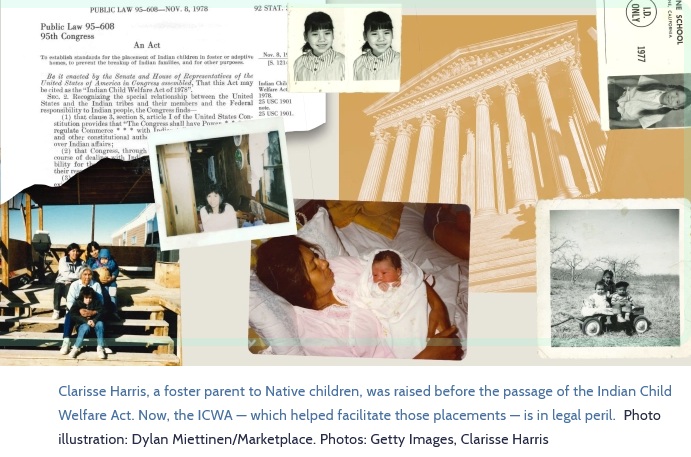
Clarisse and Pat Harris are in their mid-70s. They live in a white house
on a hill in Ethete, Wyoming, with the seven children they’re raising.  In the yard, there’s a chicken coop, a sweat lodge and a view of two
snow-capped mountain ranges: the Wind River to the west and the Owl
Creek to the north. STORY


Federal protections for Native children in jeopardy


WYOMING:  The Riverton Peace Mission’s online discussion about the Indian Child Welfare Act highlighted the experiences of two local Indigenous women who
were fostered or adopted by non-Native families before the federal law
was put into place.

Since 1978, ICWA has given Tribal nations “sole authority (to)
determine what happens with children who belong to their Tribe,” RPM
co-chair Chesie Lee explained at the beginning of the Thursday event.

But before the law was enacted, “large numbers of Native children
were being separated from their parents (and) placed outside of their
families and communities – even when fit and willing relatives were
available,” according to the National Indian Child Welfare Association.


“Congressional testimony documented the devastating impact this was
having upon Native children, families, and tribes,” the association
says. “The intent of Congress under ICWA was to ‘protect the best
interests of Indian children and to promote the stability and security
of Indian tribes and families.'”

Identity


Both of the women who shared their stories Thursday said growing up in non-Native homes impacted their sense of identity.

“We didn’t know who we were,” said Clarisse Harris, a Northern Paiute from the Big Pine Reservation in California who has lived in Ethete for decades.

Harris and her younger siblings were sent to live with white
foster parents when she was 10 years old, and she said their guardians
did a good job making the children feel like “part of (the) family.”


“We did everything like everybody else,” Harris said, recalling 4H
activities, long bus rides to school, family celebrations and trips
throughout the region. “But that was not who we were. … We were Native
Americans. And we should have been told that.”

The foster parents “didn’t try to change us,” Harris noted, and
“we weren’t abused or anything,” so “compared to some people (we) had it
pretty good.”

The “only thing” missing, she said, was “access” to information about their Tribe.


“No one in the home or in the community that we lived in ever talked
about it,” she said. “We (didn’t have) anyone to say, you know, this is
what you do, this is what your Tribe does, or anything like that.”

‘Two worlds’


When she turned 18, Harris returned to live with her biological
family, and over time she learned more about her Tribal community.

Now, she says she is able to “walk in two worlds.”


“I know both sides,” she said. “And I choose the Native side. I can make that choice. (And) that’s the way I raise my kids.”

Harris’ biological children are enrolled members of the Northern
Arapaho Tribe, and before they became teenagers, the family decided they
should move to the Wind River Reservation so they could be closer to
the community there.

“(My kids) learned how to be Arapahos, and the language and the
ways,” Harris said. “That was important. … It’s important that our
people know where we’re from (and) who we are.”

She makes sure the same community connection is available for all
of the Arapaho children she has fostered “on and off” for the past 40
years.

“The children that I have in my homes, they all know they’re
enrolled Arapahos,” she said. “(They) know that they’re Native
Americans.”

Those messages are re-emphasized in the local schools, which are
“a lot” different now than they were when she first moved to Fremont
County, Harris added.

“Everything is slowly changing to reflect Native American
culture,” she said, referencing lessons on Indigenous languages, dress,
dances and songs. “Forty years ago, they didn’t have that. (But) it’s
the core of the schools now.”

‘A Lamanite’


Carol Harper of Riverton said she was “impressed” with Harris’
ability to “walk (in) two worlds” – a skill Harper has begun to develop
later in life.

“I’m on my own journey now … to understand my Native roots and my
heritage,” Harper said. “After all these years I’m really trying to
define myself.”

Harper was born in Fremont County to a Native American and
Hispanic woman who gave her up for adoption to a white family in
Riverton when Harper was still an infant.

Her adopted parents allowed her to visit with her birth mother
and other Native relatives on the reservation when she was a baby,
Harper said, but when she got older, they decided it would be “too
confusing” for her to maintain those relationships.

They did not take the same steps to shield her from the confusion
she experienced as a Native American member of the Church of Jesus
Christ of Latter-Day Saints, where she said she was “programmed to
believe” that she was a Lamanite – a class of people defined in the Book
of Mormon as “dark, filthy and loathsome.”

“That was very, very confusing for me,” Harper said.

She also had to contend with the fact that some of her adopted
relatives were “very racist against Natives” and other minority groups –
opinions that were handed down to her adopted mother “by default.”

“My mom had a hard time with me,” Harper said, describing
multiple instances when her adopted mother physically and emotionally
abused her in the home. “She would say she was going to beat the Indian
out of me one way or another. (So) I just relented, and I conformed.”

Harper went to college at Brigham Young University, and she got
married in the Salt Lake Temple to an LDS man who also was physically
abusive.

She later divorced her husband and then left the LDS church.

Around that same time, Harper also received a call from her
adopted mother, who “tearfully apologized for the abuse that she
perpetrated throughout my childhood.”

“And I forgave her,” Harper said. “But I obviously haven’t forgotten about it.”

She explained that her childhood experiences, both at home and at
church, had “devastating” and lasting impacts on her sense of self.

“That religion stole my identity,” Harper said. “I feel like I’m a baby again, trying to get my identity back with my Tribe.”

She’s also interested in learning more about her ancestors of
Hispanic and Welsch descent, Harper said, prompting Harris to point out
that every child in the foster or adoption system should have access to
information about their biological background, no matter where they’re
from.

“(They) have the right to know that,” Harris said, urging the
guardians of Native children, in particular, to “take it upon”
themselves to “provide that baby with what it needs to be a Native
American,” regardless of the outcome of the ICWA case next year.

To learn more about ICWA, click here.

Harvard’s Peabody Museum Keeping Native Remains Is Just One Attack on the Rights of Indigenous Children


Harvard’s
influence on this tragic story cannot be understated.  It stands as a
symbol of the early stages of colonialism in America and has not fully
reckoned with this past.  In October, Native alumni of Harvard Law School
called for the immediate return of more than previously announced 6,500
Native remains in a letter
to the president of the University, stating that the institution should
“dedicate the resources and place the priority on returning them to the
appropriate places and relatives. Not sometime, not soon, but now.”

As
with Harvard Medical School and Indigenous health, we believe Harvard
Law does not provide its law students an adequate education on Indian
law, even though the Supreme Court has decided an average of 2.6 federal Indian law cases per term since 1959.  Three such Indian law cases are currently underway for the
2022-2023 term.  The future of our Native Nations lies largely in the
hands of  legal scholars who can graduate from top law schools like
Harvard without ever having to take an Indian law course or even hearing
the words “tribal sovereignty.” 

We
do appreciate the Peabody's recent transparency, and celebrate the
announcement of Harvard University’s new president, but we hope to move
beyond apologies and toward action that addresses the erasure of Native
Americans and Alaska Natives at the University, and the burdens they
carry as a consequence. Whether it's the Peabody having Native
children’s hair or Harvard-trained Supreme Court justices deciding on
the Indian Child Welfare Act, the fate of future generations of our
tribal Nations — our Native children — remains bound up in Harvard's
history of colonialism and the legacies it leaves behind, legacies
Native students here feel every day.

KEEP READING 

Wednesday, December 28, 2022

Advocate asks AFN chiefs to ensure $40B settlement deal leaves no child behind

OTTAWA — A First Nations child welfare
advocate on Wednesday implored chiefs to ensure "no child is left
behind" in a landmark $40-billion settlement agreement with the federal
government.


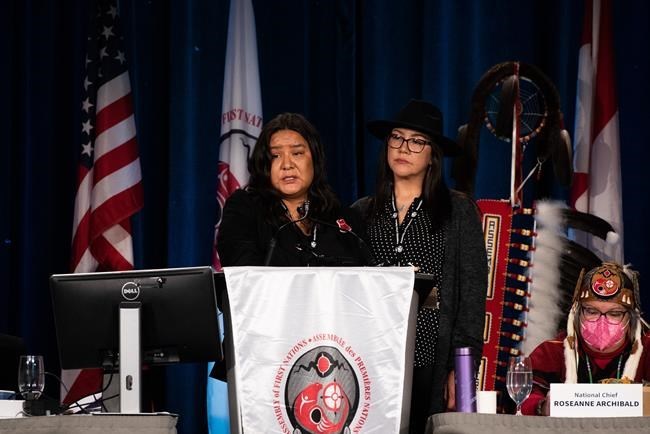
20221207171244-639117adf758715d065bd867jpeg
Karen
Osachoff, left, speaks as Melissa Walterson stands beside her during
the Assembly of First Nations special chiefs assembly in Ottawa on
Wednesday, Dec. 7, 2022.  Chiefs at the assembly heard from the two women
about the harms caused by the child-welfare system and are expected to
vote on how the AFN should move forward with a landmark settlement. [THE
CANADIAN PRESS/Spencer Colby]


OTTAWA — A First Nations child welfare advocate on Wednesday
implored chiefs to ensure "no child is left behind" in a landmark
$40-billion settlement agreement with the federal government.


Cindy Blackstock delivered the message to an Assembly of First
Nations gathering in Ottawa, after being invited to take the stage by
Cindy Woodhouse, regional chief in Manitoba who helped negotiate the
agreement, which had been thrown into question since being rejected by
the Canadian Human Rights Tribunal. 


The AFN, representing more than 600 First Nations across the country,
had asked the tribunal to approve the settlement deal, which would see
the government spend $20 billion to compensate families and children for
systemic discrimination in the Indigenous child welfare system.It would
also spend another $20 billion on making long-term reforms. 


Blackstock, the executive director of the First Nations Caring
Society who first lodged the complaint at the heart of the issue, raised
concerns that the agreement wouldn't provide $40,000 in compensation to
all eligible claimants, which is the amount the tribunal ruled they
should get. 


"We can make sure that in our First Nations canoe of justice, no
child has to see their money go away and no child is left behind in
justice," she said Wednesday. 


"We are capable of that."


Following the tribunal's decision in October, the federal government filed for a judicial review of some parts of its decision. 


Endorsing the settlement agreement loomed as one of the biggest items
on the assembly's agenda, with chiefs being asked to vote on what the
organization should do next. 


The chiefs had been preparing to vote on conflicting resolutions,
with one asking them to support the final settlement agreement, while
another sought to see the organization not appeal the tribunal decision
and renegotiate the deal. 


But on Wednesday, further talks between both sides took place,
assisted by former senator and judge Murray Sinclair, who helped the
AFN, federal government and lawyers for two related class-action
lawsuits reach the $40-billion agreement in the first place, which was
formally announced in January. 


Chiefs ultimately voted late Wednesday against re-entering
negotiations but to instead support compensation for victims outlined in
the agreement and "those already legally entitled to the $40,000 plus
interest under the Canadian Human Rights Tribunal compensation orders."


It also included a provision that AFN leaders must regularly return
to chiefs to provide it with progress updates and "seek direction" from
chiefs on implementing the final agreement. 


Many chiefs thanked Blackstock, who was greeted with applause after
further agreement was met and said she was honoured to see people come
together for children harmed by Ottawa's discrimination. 


"We have had too many apologies, we've had too many compensation
deals, we've had too many kids hurt. And this has got to be it," she
said. 


She added more discussion on the long-term reform part of the deal would be presented to chiefs on Thursday.


Earlier in the day, the assembly heard from sisters Melissa Walterson
and Karen Osachoff, plaintiffs on the case, about the impact the foster
care system had on their lives. 


Osachoff said she had been in the child welfare system since she was born and didn't have a chance to grow up with her sister. 


"Had it not been for the '60s Scoop and the child welfare (system), her and I would have grown up together."


She said she understands why the tribunal characterizes those like
her as "victims," but told chiefs to instead think of them as survivors.


"I am not a victim and our claimants are not victims."


This report by The Canadian Press was first published Dec. 7, 2022.


Counterspin: Jen Deerinwater on Indian Child Welfare Act


CounterSpin
: Those listeners who have heard about Haaland v. Brackeen
will know that that Supreme Court case is about considering the Indian
Child Welfare Act—which is aimed at keeping Native communities
together—to be “race-based,” and therefore unfair and unconstitutional.  Opposing the actual mission of those who want to eliminate the Indian
Child Welfare Act is just…reality: the reality that made the Act
necessary in the first place, and the reality that will likely ensue if
it is repealed. 


According to the National Indian Child Welfare Association, ICWA “lessens the trauma of removal by promoting placement with family and community.” Positive and continuing connections to one’s family, community and culture are key factors in ensuring health and well-being.

ICWA is widely supported by Native and non-Native stakeholders: 497 federally recognized tribes and 62 Native organizations, 23 states and D.C., 87 congresspeople, 27 child welfare and adoption organizations, and many others signed on to 21 briefs submitted to the Court in favor of ICWA.

We’ll learn more from Jen Deerinwater, who writes for Truthout, among other outlets, and is founding executive director of Crushing Colonialism.

READ

LISTEN

Surprise? Late Discovery Adoptee "Cultural Infant"


‘It’s great to embrace
who I am.’ Rob Michno, 50, is only now discovering his Native American
roots after being adopted and raised by a family of German and Polish
descent.

 Frank Vaisvilas, Green Bay Press-Gazette
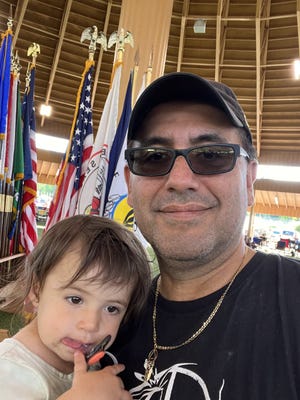
Rob Michno, aka Mark Johnson, with his daughter.

OSHKOSH
- Throughout much his life, Rob Michno went along with whatever people
assumed he was, whether that was Mexican, Italian or Jewish.

“I went out of my way to deny I was Native American,” he said.

It
wasn’t until a few years ago that Michno, 50, of Oshkosh, really
started delving into his heritage and found it has been an enlightening,
life-changing experience.

“It’s been so empowering,” he said. “The puzzle pieces are coming together. … Now, it’s great to embrace who I am.”

Michno was adopted by a family of German and Polish descent from Merrill in 1973.

“Somehow, I knew I was Native American, but it was not discussed when I was growing up,” he said.

Michno’s adopted parents wanted to appear they were a biological family.

“My
mom dyed her hair black and would tan to try to look like me,” he said.
“According to who I call my brother, he said our parents had about
seven miscarriages, so protecting our family of four seemed to be of
utmost importance. I understand that … and they did the best they could,
so there’s no negativity.”

Michno still had
emotional issues from not knowing his heritage and felt a degree of
being different, abandoned and rejected while growing up.

“Growing
up in a very German-rooted town, I felt so different and was afraid to
explore myself, of course, my coping mechanism of avoidance was my best
tool I could counter some of those taunts on the playgrounds,” he said.

Those feelings helped fuel his alcoholism for 22 years, Michno said, until he sought help. 

Michno
is now 10 years sober, and after remarrying in 2017, he found an
interest in discovering his heritage, especially so his 3-year-old
daughter, Audrey, can know more about where her people came from.

After becoming sober, he accepted he is Native American, but hadn’t known to which tribe he belonged.

During a fellowship sobriety meeting, Michno was asked which tribe he was from and struggled with an answer.

“I
answered because I was born in Rhinelander and that Rhinelander is in
Oneida County, I think I’m Oneida,” he said. “That’s how oblivious I
was.”

Michno eventually reached out to the Wisconsin Department of Children and Families
and connected with an adoption coordinator in Madison who told him his
birth mother was half Ho-Chunk and half Forest County Potawatomi.

He
later learned he had been enrolled in the Forest County Potawatomi
Tribe in 1978 by another biological family member under his birth name
of Mark Edward Johnson.

“What was odd with that
first reading of the adoption paperwork is that I could read a few
pages at a time and had to process this all,” Michno said. “It was the
story of Mark Edward Johnson and it was odd reading Mark’s story and
having it sink in that Mark was me.”

He also later learned his birth mother, Pauline Johnson, died in 1989 and is still uncertain who his birth father is.

Michno
has been meeting his birth cousins from the Johnson family for the
first time in the past few years, mostly virtually during the pandemic,
and is eager to start meeting more family members in person.

He’s been attending pow-wows and other community events with his family, trying to learn more about his heritage.

“I’m a cultural infant,” Michno said.

One of his cousins is Manny Johnson, who serves as the tribal treasurer for the Forest County Potawatomi.

“Growing
up, I knew my aunt had a child, but we didn’t know if it was male or
female,” Johnson said. “It was a closed adoption. We didn’t talk about
it back then.”

He said his father had tried to
find his biological nephew, Mark Johnson, not knowing his adopted name
was Rob Michno, in the hopes of connecting as a family. But he was
unsuccessful.

“I’m saddened we missed a lot of
years together,” Johnson said of Michno. “We couldn’t believe we found
each other. It was almost something out of a movie.”

He
said he speaks with Michno on a monthly basis, but still has yet to
have a proper long meeting going through photo albums, because of the
ongoing pandemic.

“He has some of the same mannerisms as his mom, such as in the way he laughs,” Johnson said of Michno.

Michno was adopted before the passage of the Indian Child Welfare Act of 1978, which gives preference to tribal families in adopting Native children.

Johnson
wonders how Michno’s life would have been different had he been adopted
by another Potawatomi family, or even his own family.

For
his part, Michno said his adopted parents loved him as best they could
and hasn’t formed an opinion on a new U.S. Supreme Court case that
challenges the validity of the Indian Child Welfare Act.

A
white couple from Texas is challenging the act after it nearly thwarted
their adoption of a Navajo child, claiming the act is discriminatory
based on race.

Tribal attorneys, including
those representing the Oneida Nation of Wisconsin, said the law is not
based on race, but on tribal sovereignty, and that tribes are sovereign
nations that should look after their own citizens.

A decision on the case is not expected until early to mid 2023.

More:Art
Shegonee grew up in foster care before the Indian Child Welfare Act. He
learned years later a girl who visited as a child was his Indigenous
sister.

More:‘It’s
about who we are, my heritage, my culture’: Indigenous tribes in
Wisconsin grapple with blood quantum dilemma amid declining enrollment


CLICK OLDER POSTS (above) to see more news

CLICK OLDER POSTS  (above) to see more news

MEGWETCH THANK YOU

HUGE Thank you for visiting this blog and sharing this with your kin. It's appreciated. Contact Trace anytime! Use the form below.

BOOKSHOP

Please use BOOKSHOP to buy our titles. We will not be posting links to Amazon.

Popular Posts

To Veronica Brown

Veronica, we adult adoptees are thinking of you today and every day. We will be here when you need us. Your journey in the adopted life has begun, nothing can revoke that now, the damage cannot be undone. Be courageous, you have what no adoptee before you has had; a strong group of adult adoptees who know your story, who are behind you and will always be so.

OUR HISTORY

OUR HISTORY
BOOK 5: Lost Children of the Indian Adoption Projects