At the Adoption Initiative Conference in 2022, this discussion came full circle. Daniel was a panel speaker for a discussion on Adoptees as Immigrants [link ➤]
BLOG POST: PLEASE READ THIS
At the Adoption Initiative Conference in 2022, this discussion came full circle. Daniel was a panel speaker for a discussion on Adoptees as Immigrants [link ➤]
BLOG POST: PLEASE READ THIS
“This really is a time of action,” says Indigenous organizer Morning Star Gali.
By Kelly Hayes, Truthout | April 28, 2022
LINK: https://truthout.org/audio/indigenous-abolitionists-are-organizing-for-healing-and-survival/
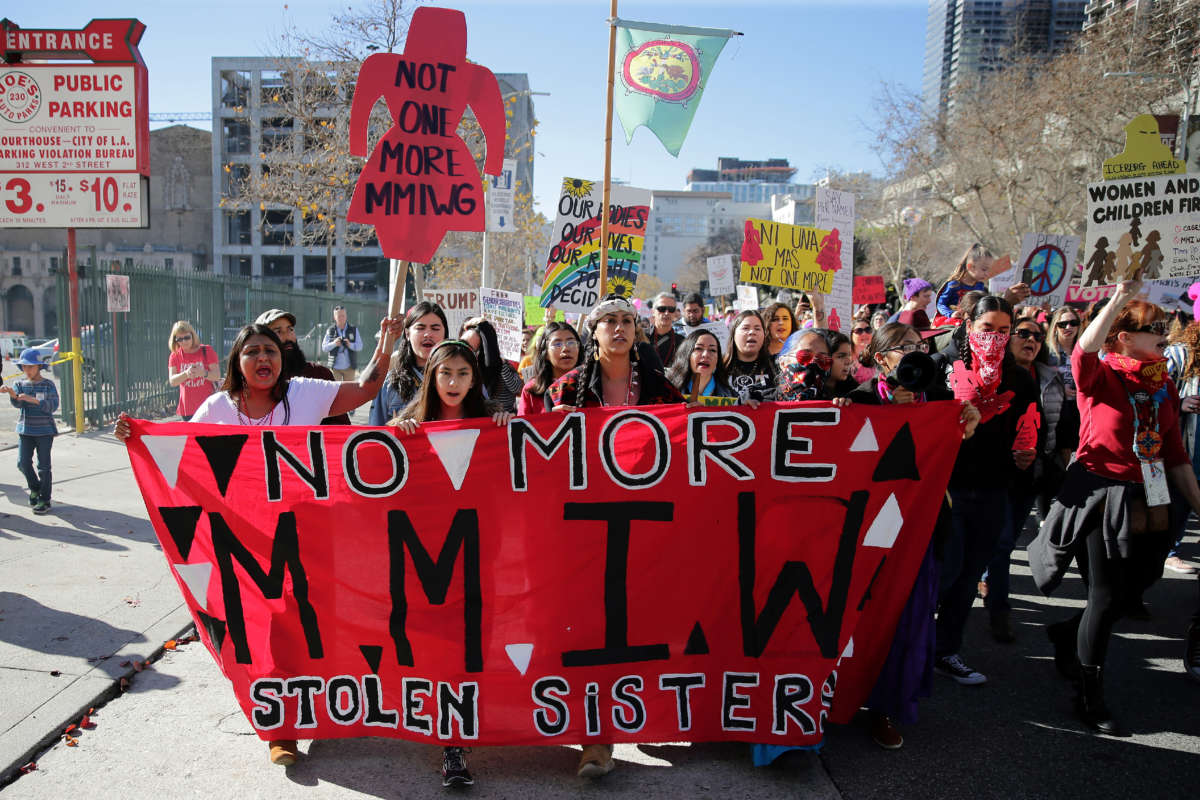 | |
| Activists march for missing and murdered Indigenous women at the Women's March California 2019 on January 19, 2019, in Los Angeles, California. |
From Simply Smiles: Receiving Tribal Council Approval: The vote was unanimous to adopt a formal resolution of support that authorized the creation of the Simply Smiles Children's Village.

Pictured above: Simply Smiles Village Director Marcella Gilbert and Simply Smiles President and Founder Bryan Nurnberger, formerly of Naugatuck, seen here with activist and Village advisor Madonna Thunder Hawk, member of the Waśagiya Najin Standing Strong Grandmothers' Group of Native elders, after securing a formal resolution of tribal support, including from Tribal Chairman Harold C. Frazier.
.png)
As Simply Smiles nears completion of our Children's Village of foster homes on the Cheyenne River Sioux Tribe in South Dakota, this features the challenges encountered and milestones reached in creating this first-of-its-kind endeavor for Native American children.
The Tribal Council of the Cheyenne River Sioux Tribe voted unanimously to adopt a formal resolution of support that authorized the creation of the Simply Smiles Children's Village.
The trust and partnerships Simply Smiles built over our first decade working on the Reservation made this vital step possible. Our pro-bono Native attorneys at Kilpatrick & Townsend drafted the detailed resolution and the Waśagiya Najin Standing Strong Grandmothers' Group of Native elders, led by the legendary activist Madonna Thunder Hawk, guided the resolution of support through the tribal government to unanimous approval and adoption.
This agreement allowed us to begin building and developing the Simply Smiles Children's Village and solidified our shared commitment to provide a child placement option that fulfills the spirit of the Indian Child Welfare Act by ensuring that Native children who have been removed from their homes can remain with kin and community.
Simply Smiles Village Director Marcella Gilbert and Simply Smiles President and Founder Bryan Nurnberger seen here with activist and Village advisor Madonna Thunder Hawk, member of the Waśagiya Najin Standing Strong Grandmothers' Group of Native elders, after securing a formal resolution of tribal support, including from Tribal Chairman Harold C. Frazier.
Stay tuned for the next email in the Creating the Reservation Village series: Becoming A Licensed Foster Care Agency & Professionalizing Foster Care
‘Growing up I kind of thought, why am I this lone person…”
Leah Ballantyne was just 11 days old when she was adopted out to a Scottish family in Winnipeg – by the time she was 13, she was already searching for her birth parents.
Riding the bus to school through Winnipeg’s downtown core, she would see Indigenous people and wondered if they were relatives.
“Growing up, I kind of thought, why am I this lone person and adopted into a family? Why didn’t my family want me and what were the circumstances? And as I learned that the ‘60s Scoop was actually a part of a process that started with reservations, and the Indian Act, and residential schools, and day schools,” she says on the latest episode of Face to Face.
“Then I realized that I was part of something that was a separation that was going on through government policy.”
The push to finally find out where she came from came after an event in Vancouver.
She says she was inspired by speeches by former Assembly of First Nations national chief Ovide Mercredi and Mohawk Council of Kahnawake grand chief Joe Tokwiro Norton
After, she went digging into her past.
Ballantyne’s birth mother had registered her for a status number at birth so she knew she was from Mathias Colomb Cree Nation. She wrote the chief at the time, the late Pascal Bighetty, asking for help.
Not long after, Ballantyne received a call from Bighetty, who, as it would turn out, was her uncle, telling her he knew who she was and to come home.
Ballantyne says the rally and reunification with her community, a “light went on” and she decided she would push for positive changes in law and policy by becoming a lawyer.
To this day, Ballantyne remains the only member of Mathias Colomb Cree Nation to become a lawyer. She is currently working with her nation on child welfare laws and bringing children home, whether they were part of the 60s Scoop, aged out of the care, or still in care.
Ballantyne is vocal about representation and believes those who falsely claim Indigenous identity, should face criminal charges.
“There is a couple of sections in the Criminal Code of Canada for identity and identity fraud and so Indigenous identity fraud is very much a charge that could be laid by any institution that has addressed this kind of issue and people that are claiming false Indigenous identity,” she says.
“And there is no statute of limitation on this type of identity fraud within the Criminal Code.”


More than 200 boxes of records are currently under separate court and internal federal reviews to determine their connection to residential schools after they were found in storage facilities within the last year, CBC News has learned.
The records were discovered in Yellowknife and Vancouver storage lockers, according to information provided to CBC News by a Crown-Indigenous Relations (CIRNA) official.
As a court-appointed firm and federal officials sift through the records, CIRNA Minister Marc Miller said searches continue within his and other departments to find any documents related to the residential school era.
"The state they were found in is entirely unacceptable," Miller said in an interview with CBC News.
"It is part of this process that I continue as the minister … That work isn't complete and is still ongoing — knowing any piece of information related to that time period can help in closure and getting an understanding of the truth."
The first batch of documents, 125 bankers boxes, was found in June 2021 by the owner of a storage facility in Yellowknife who was clearing out a unit once owned by a now-defunct survivor healing group called the Healing Drum.
The owner contacted the territory's information commissioner, which then alerted the regional CIRNA office, said Andrew Fox, the Information and Privacy Commissioner for the Northwest Territories.
Readers are advised this story mentions the physical and sexual abuse of Indigenous children in institutions. There are no graphic accounts included, but the subject matter may be triggering for some people.
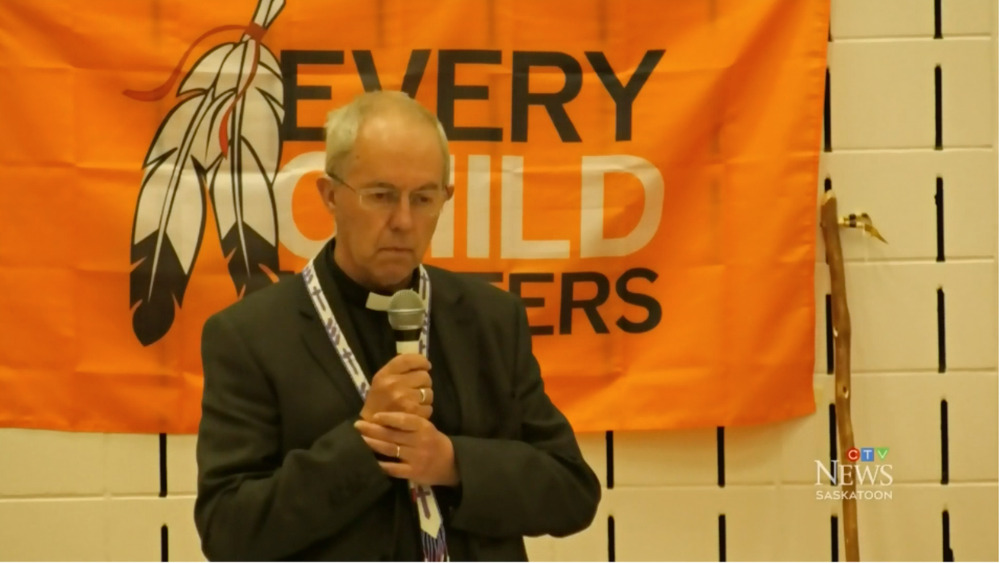
Archbishop of Canterbury Justin Welby delivered an unequivocal apology to children, grandchildren and survivors of Canadian residential schools over the weekend, describing their experiences as “a bit of hell” that was “built by the Church and in the name of the Church.”
The Anglican Church leader met with dignitaries from Indigenous governments from James Smith Cree Nation and the Federation of Sovereign Indigenous Nations, which represents 74 First Nations in Saskatchewan. There, he heard the stories of school survivors about how the residential school system ripped families apart, raised self-doubt and self-confidence issues and left them with traumas as a result of sexual and physical abuse.
“It is the rawest, wickedest, most terrible thing, to molest a child while you read them the Bible,” a sombre Welby told the group after hearing the harrowing accounts.
| |
 |
| Two Worlds is for sale at Walmart.com |
Sarah Deer, Elise Higgins, and Thomas White have published “Editorializing ICWA: 40 Years of Colonial Commentary” in UCLA’s Indigenous Peoples’ Journal of Law, Culture & Resistance.
An excerpt:
Despite studies concluding ICWA has been a successful law to curb the crisis of child removal in Indian country when implemented correctly, a significant number of attorneys, think tanks, and politicians argue that ICWA actually harms Native children and should be repealed. Others argue that ICWA has served its purpose and is no longer necessary. This article considers how newspaper editorials perpetuate misinformation about ICWA, its history and its purpose. Moreover, we explore how anti-ICWA authors employ “words of colonialism”—in particular, the use of derogatory words and phrases to portray Native people as bad parents and Tribal Nations as dysfunctional. Providing inaccurate and racist characterizations of ICWA is one of the primary tactics used by editorials to delegitimize ICWA. Emotionally triggering and wholly inaccurate language is often employed as a sensationalist method to grab the reader’s attention by presenting the law in terms of clear-cut morality.
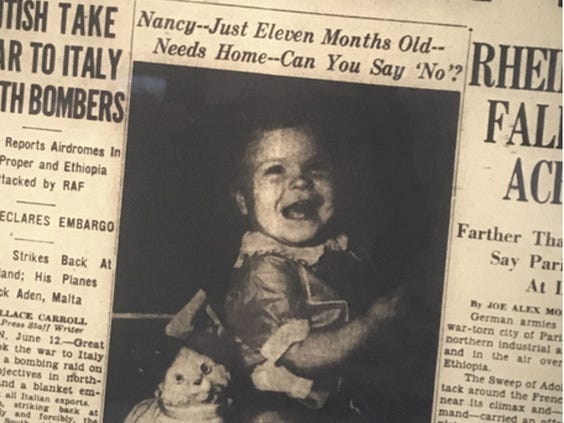 |
| Can You Say No? Tann advertised. Digital Archive of the Memphis Public Libraries |
5,000 children?

It is hard to believe that in Memphis, Tennessee, from 1924–1950, children were being stolen from low-income families and adopted out to wealthy ones for a price. But it did happen.
Robert Taylor, a lawyer who investigated the Tennessee Children’s Home Society scandal for Gov. Gordon Browning, said in his 1992 “60 Minutes” interview.”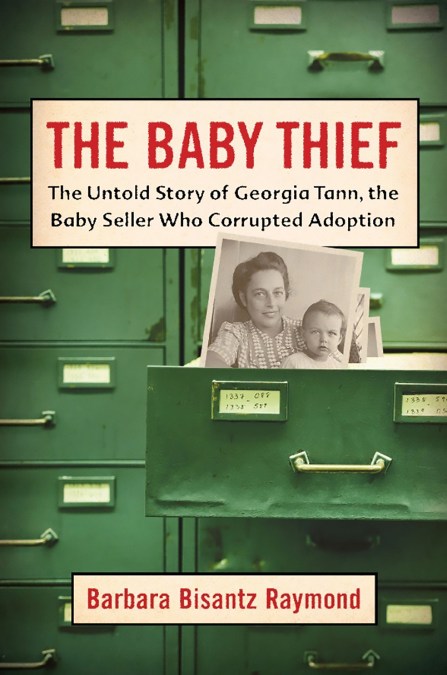
Following the Indigenous delegation's visit to the Vatican earlier this month, renewed questions are emerging around justice: is the Canadian residential school system a case for the International Criminal Court? Selen Kazan considers the question: https://t.co/mosSBbx83F pic.twitter.com/gQsdMcasrf
— Yellowhead Institute (@Yellowhead_) April 20, 2022
The Indian Residential School Crisis Line is available 24-hours a day for anyone experiencing pain or distress as a result of their #ResidentialInstitution experience. pic.twitter.com/gF8wCyF6zf
— AFN (@AFN_Updates) April 20, 2022

WARNING: This story contains distressing details.
Leaders
of George Gordon First Nation in Saskatchewan announced Wednesday that
14 potential unmarked burial sites had been found close to the site of
the former Gordon's Indian Residential School.
George
Gordon First Nation's chief and council and the band's residential
school cemetery committee announced the results of a geophysical
investigation Wednesday afternoon.
Chief Byron Bitternose
addressed the media, announcing the discovery of the 14 possible burial
sites. He also said the search is not complete.
"In upcoming
months this area will be a priority, an area for continued searching,"
Bitternose said. "It is my hope that one day we will be able to tell our
children the whole story of what their great-grandparents,
grandparents, parents and siblings endured."
A total of four areas within the First Nation have been searched, he said. One high-probability site was detected.
While
the ground-penetrating radar (GPR) data cannot discern if the sites are
graves of children, George Gordon First Nation member Sarah Longman
says there is a high probability.
Church says Rev. Mark MacDonald's actions amount to a 'betrayal of trust'
 |
| Rev. Mark MacDonald had served as the church's national Indigenous Anglican bishop since 2007. (Anglican Church of Canada) |
Rev. Mark MacDonald, the Anglican Church of Canada's first national Indigenous archbishop, has resigned over what the church is calling "acknowledged" sexual misconduct.
"This is devastating news. The sense of betrayal is deep and profound when leaders fail to live up to the standards we expect and the boundaries we set," wrote Rev. Linda Nicholls, the church's archbishop and primate, in an open letter published on Wednesday.
Nicholls cites a complainant against MacDonald in the letter but no further details about the allegations have been provided by the church.
"First and most importantly, our prayers must be for the complainant whose life has been affected by Mark's actions. The betrayal of trust by someone in such a prominent role of leadership will require a long road of healing and our constant prayers," the letter continues.
A spokesperson for the church declined an interview request from CBC News and said it would not provide any further comment about MacDonald's resignation.
MacDonald, 68, was named the church's first national Indigenous Anglican bishop in 2007, a post which makes him pastoral leader to approximately 225 Indigenous churches, most of them on reserves.
He was elevated to archbishop in 2019.
A biography on the church's website said he served as a minister in Mississauga, Ont., Duluth, Minn., Tomah, Wis., Mauston, Wis., Portland, Ore., and the southeast regional mission of the Diocese of Navajoland during his career.
MacDonald is a graduate of Wycliffe College, a Christian evangelical seminary at the University of Toronto.
A 2013 article posted by the Anglican Journal, the national newspaper of the Anglican Church of Canada, described MacDonald as a "non-status Indian" with Indigenous ancestry through both his mother and father. The article also says he "grew up among the [Ojibwe] people."
The Anglican Church has named Bishop Sidney Black to serve as its interim national Indigenous bishop.

- Abraham Moses Nakogee
- Alexandra Chookomoolin
- Anna Aitel
- Antoine Wisk
- Charles Hunter (Fort Albany)
- Emile Anishinape
- Emilien Aitel
- Gabriel Carpenter
- Imelda Edwards
- Jennie Kostachin
- John Kioki
- Joseph Metat
- Josephine Chookomoolin
- Madeline Sutherland
- Margaret Sutherland
- Matheiu Kamascatishishit
- Michael Sutherland
- Michel Matinas
- Raphael Katakwapit
- Raphael Tomykatie
- Sabeth Sutherland
- Sabeth Wabano
- Simeon Ashnipinishkam
- Therese Okitigo
Additional photos of the school throughout its history can be found through Algoma University HERE.
In 1992, Former Chief of Fort Albany First Nation, Edmund Metatawabin, presented evidence to Ontario’s provincial police about abuse at the former school, prompting a six-year investigation.
The OPP’s work led to seven former St. Anne’s teachers and administrators being arrested in 1998, with 156 survivors receiving some form of compensation by 2004 – two years before the historic Indian Residential Schools Settlement of 2006.
Documents from the investigation were released in 2014 after an Ontario Superior Court judge ordered the federal government to disclose them to survivors and the Truth and Reconciliation Commission.
But by that time, the federal government had already redacted over 12,000 documents from the record – which denied many survivors any amount of compensation.
Still, the documents that were released by Ottawa revealed the use of a homemade electric chair being used between the 1950s and 1960s, with a variety of reports of disturbing physical and sexual abuse such as beatings, rancid food, disappearances and much more.
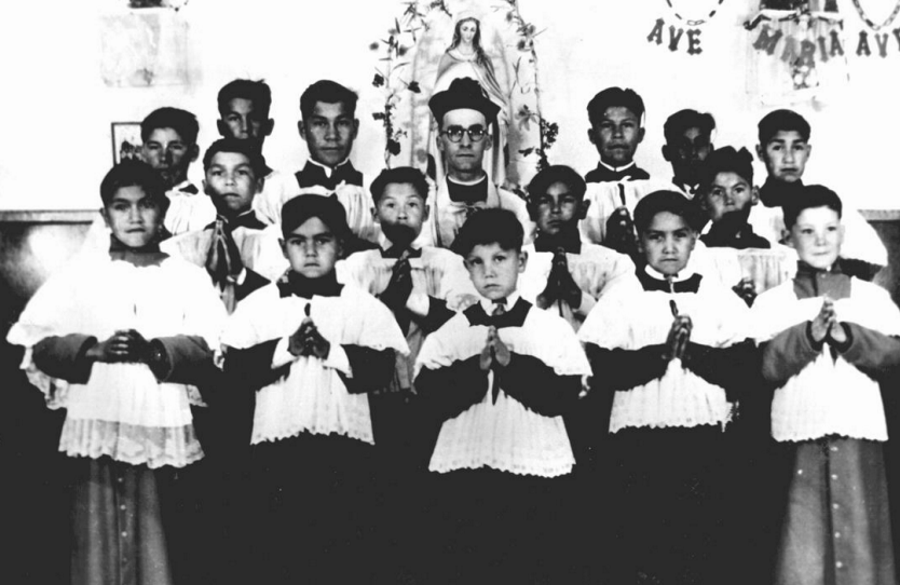 Students at St. Anne’s Indian Residential School in Fort Albany First Nation. Photo courtesy of Algoma University.
 If you are a residential school survivor, you are able to contact the 24-hour National Crisis Line at 1-866-925-4419 for support. Indigenous people can also access the Hope for Wellness Help Line at 1-855-242-3310 or online chat at www.hopeforwellness.ca.
The provincial governent is committing nearly $500,000 to support community members in the Nishnawbe Aski Nation area with the region’s search of one of the most notorious Indian Residential School locations in Canada.
Ontario and Ottawa have committed $475,000 over two years to support survivors affected by the six former Indian Residential Schools in the NAN territory, including those of St. Anne’s Indian Residential School in Fort Albany First Nation.
Records from the federal government show students at St. Anne’s were subjected to a homemade electric chair, with survivors describing physical, mental and sexual abuse. Legal battles over compensation for survivors continue to this day.
“This funding will help us develop healing initiatives to support our families and communities through community-driven initiatives as they search for their loved ones,” said NAN’s Deputy Grand Chief, Anna Betty Achneepineskum.
Achneepineskum adds the strategy will be developed with survivors and will include recommendations from the Truth and Reconciliation Commission’s 94 Calls to Action of 2015. Funding will also support communications and technical supports, as well as public education and awareness initiatives.
St. Anne’s Indian Residential School was run by the Oblates of Mary Immaculate Catholic Church and the Grey Nuns of the Cross in Fort Albany First Nation between 1906 and 1976, with support from the federal government.
Records show that the school was originally located at the Fort Albany Mission on Albany Island in Treaty #9, before relocating to the banks of the Albany River in 1932. The school burned down in 1939 and was later rebuilt.
First Nations youth from Fort Albany, Attawapiskat, Weenusk, Constance Lake, Moose Fort and Fort Severn all attended the school.
‘I haven’t heard a word:’ ‘60s Scoop survivor says healing foundation is no help at all
Some survivors of the ‘60s Scoop say they’re frustrated by the lack of response they’re getting from the organization set up to help them heal.
“I’ve been waiting to hear from the Sixties Scoop (Healing Foundation) to tell me what they have planned,” says survivor Darlene Gilbert of Annapolis Valley First Nation in Nova Scotia.
“I’ve heard nothing.”
The Sixties Scoop Healing Foundation was created with $50 million from the $875-million national class-action settlement that compensated Inuit and First Nations survivors for the loss of their cultural identities.
As children, they were taken from their homes between the 1950s and 1990s to be placed with non-Indigenous foster and adoptive families across Canada and around the world. Métis and non-status Indigenous peoples were excluded from the settlement agreement.
According to the Class Action Scoop Settlement Agreement website, 20,167 people have been approved to receive $25,000 in compensation including Gilbert.
The foundation says on its website its mission is to “accompany Survivors and their descendants along their healing journey by supporting cultural reclamation and reunification, holistic wellness services, advocacy, commemoration, and education initiatives.”

Gilbert, who was removed from her family when she was 10 years old, was placed in a number of temporary spaces and group homes in Nova Scotia.
She says she contacted the foundation using the phone number listed on its website to access therapy to deal with the traumatic effects of losing her culture and language.
“There’s supposed to be healing money,” she said in an interview. “We need therapy, our families need therapy, our children, our grandchildren may.
“I haven’t heard a word, not a word; so that was just like I felt brushed under the carpet like we all do.”
Katherine Legrange, a ‘60s Scoop survivor and director of the national non-profit support group 60s Scoop Legacy of Canada, feels the foundation isn’t working so far.
“I’d say that the communication with survivors has been really poor to date, it’s really unclear about how the healing foundation intends to directly help survivors,” she says from Winnipeg.
“I feel like they are really struggling to connect with survivors and share what their plans are; even if there are no plans, share that.”
Legrange has called for a national inquiry to examine the ‘60s Scoop and “make that connection with residential schools, with MMIWG (missing and murdered Indigenous women and girls), with the justice system, because we know that lots of us ended up in these kinds of unfortunate situations.”
The National Centre for Truth and Reconciliation, a research and archive centre established after the Indian Residential Schools Settlement Agreement, “is in full support of the 60’s Scoop Legacy of Canada and their call for the federal government to commission a national inquiry into Indigenous child removal.
“The Residential School system came first, followed by the Scoop,” the centre says.
“Finding this truth means hearing from those affected directly – nationally and internationally – to hear from all the children, the families and the individuals that ran those systems to fully understand the colonial historical record of the Scoop and what really happened.”
APTN News tried reaching the foundation using the phone number and email on its website and didn’t receive a response.
APTN also requested an interview with the foundation’s inaugural CEO, Dr. Jacqueline Maurice of Saskatchewan.
Maurice, a Métis-Indigenous Scoop survivor with a Ph.D. in social work and a medical degree, was appointed in September 2021.
Her vision for the foundation, described in a statement following her appointment, includes the concept of one survivor helping another survivor on the path to healing.
“In this new role, [Maurice] will be responsible for the development and implementation of programs and services to support survivors and will play an integral part in the development of grants, services and supports to survivors,” the statement added.
A few months later, the foundation distributed its first round of grants – valued at just over $1 million – to eight community groups.
“This year’s pilot program begins the foundation’s legacy of investment into healing and serving Sixties Scoop survivors across the nation,” Maurice said at the time.
“The initial grant process will inform the design of future funding streams that will deliver valuable services to those who need them most.”
But Gilbert is still in the dark about what’s available to her and whether it’s in Nova Scotia.
She feels a national inquiry would help.
“We should be able to tell the government how they tried to colonize us, break us, take our language, keep us away from our communities,” she says.
“This is important for this generation – the ‘60s Scoop – to be able to say, ‘Hey, we need this healing in order to break what has come behind us and [so] it doesn’t come [back] in the future.”
With files from Kathleen Martens

Sexual violence is a far too common thing throughout Native communities. According to the National Resource Center on Domestic Violence, Native Americans are 2.5 times more likely to experience sexual violence in their lifetime. As we know, this may be even higher due to the lack of reporting common in Native communities. Sexual violence is any type of sexual activity done without consent. We often don't know when someone is struggling with something. Sexual violence is no exception.
If you believe someone you know and love has experienced sexual violence, here are some warning signs:
Pulling out of their favorite activities or hobbies
Your relative may be showing little or no interest in their favorite activities.
Small signs of loss of trust
Your relative might stop trusting you or your family members with small or large things.
Isolation
You may notice that your loved one is absent or turning down more invitations. They may have secluded themselves in their homes or workplaces or finding reasons to spend more time alone or with very few people.
Signs of depression or energy fatigue
Your relative may be starting to show signs of depression. This can include changes in appetite and weight, conversations that include hopelessness or lack of outlook on life, and either uncontrollable emotions or numbing of emotions.
Loss of interest in conversations or seeming spaced out
Your relative might be experiencing zone out or feelings of disconnection while in the middle of a conversation. This could look like slow responses to questions, looks of lost in thoughts or slower speech when talking.
Seeming to be uncomfortable when talking about sex or topics related to sex
This can be a little hard to detect if you don't already know how comfortable someone is with talking about the topic of sex. But if you see a dramatic change in the comfortability of one's expression and opinions of sex this could be a sign of sexual violence.
If your partner has a change in interest in sex or being touched
If you are concerned that your partner may have experienced sexual violence, one warning sign may be that they no longer show interest in sex and pull away when you try to approach or touch them. The main component here is that they seem to have lost trust or interest in sexual touch, but not necessarily in your relationship.
While not every sexual assault or rape leaves physical injuries, here are a few to look out for:
● Bruising
● Vaginal or anal bleeding
● Broken or dislocated bones
● Difficulty walking
It can be difficult to talk with someone who has experienced something as traumatic as sexual violence. But as a relative, your support can mean a lot to a victim-survivor. StrongHearts Native Helpline is here to chat about ways that you can support a relative experiencing the effects of sexual violence.
Call or text 1-844-7NATIVE or chat here on strongheartshelpline.org, advocates are available 24/7 for free, safe and confidential support. If you would like more information about how you can help someone in an unhealthy or abusive relationship visit our Help a Friend or Relative page.
Your body. Your sovereignty. Your decision.
Pope Francis is expected to visit at least three cities during a late July trip to Canada, CBC News has learned.
Sources
involved in the planning of the trip say the Pope will likely make
stops in Edmonton, Quebec City and Iqaluit during what is scheduled to
be about a four-day trip to the country. CBC News is not identifying the
confidential sources because they were not authorized to speak
publicly.
The
pontiff initially announced plans for the visit during his Vatican
meetings on April 1 with Indigenous delegates from Canada, where he
offered an initial apology for the actions of individual Roman Catholic Church members in Canada's residential schools.
 |
| Assembly of First Nations Regional Chief Gerald Antoine, centre left, Inuit Tapiriit Kanatami president Natan Obed and Métis National Council president Cassidy Caron walk in St. Peter's Square after a final audience with Pope Francis on April 1. (Yara Nardi/Reuters) |
 |
| Cristi Heath is an advocate for Native American Children, having worked for the Department of Human Services for over 17 years. |
Cristi Heath, Yukon, Oklahoma, has been selected by the National
Indian Child Welfare Association as a 2022 Champion for Native Children.
A member of the Choctaw Nation, Heath has worked for the Department
of Human Services (DHS) for over 17 years and has spent most of her
career with DHS in Oklahoma county.
She received her associate degree from Rose State College with honors
and was a part of the Sociological Honor Society. She received her
bachelor’s degree from the Univ. of Central Okla. (UCO) in Edmond,
Okla., graduating magna cum laude.
Heath said, "When I started with the Department of Human Services, I
did investigations (Child Protective Services) for four and a half
years. Then I was part of the pilot program that they started in
Oklahoma County called Kinship Foster Care. I worked doing that for a
year and then supervised Kinship Foster Care in Oklahoma County from
2006-2009."
She went on to reading home studies for people who wanted to be foster parents.
"I did what they called Family Centered Services for five years,
supervised that for five years. And then I came to STPU (Specialized
Placement and Partnership Unit) and have been doing that for the last
two years," said Heath.
On a day-to-day basis, Heath oversees the DHS youth in shelters
across the state of Oklahoma. She supervises four liaisons who are each
assigned a region of Oklahoma with 21 shelters that have placement of
DHS youth. The liaisons check the shelters, assess safety, and see how
the kids are doing.
An Indigenous chef who creates edible art is expanding her business in Sudbury.
Tammy Maki started Raven Rising Chocolate shop e-Commerce in October
020 and is now opening a storefront. Maki used some of the money she
received from the '60s scoop settlement to start up the business.
"It kinda' didn't feel like very good money, so I actually wanted to
take that money and apply it to something positive," she said.
"So I did take a portion of it strayed Raven Rising and quite frankly it was the best decision I have made."
Maki's chocolate shop will be located in the old Capitol Theatre on Cedar Street downtown.
"I fell in love when I walked in here and I remember it because I am 57
so I remember when it was the Capitol Theatre," she said.
"And when I allowed in and saw the ceilings, what I do is create art … edible art and this place makes me want to create it."
Maki said Raven Rising will be an Indigenous forward shop.
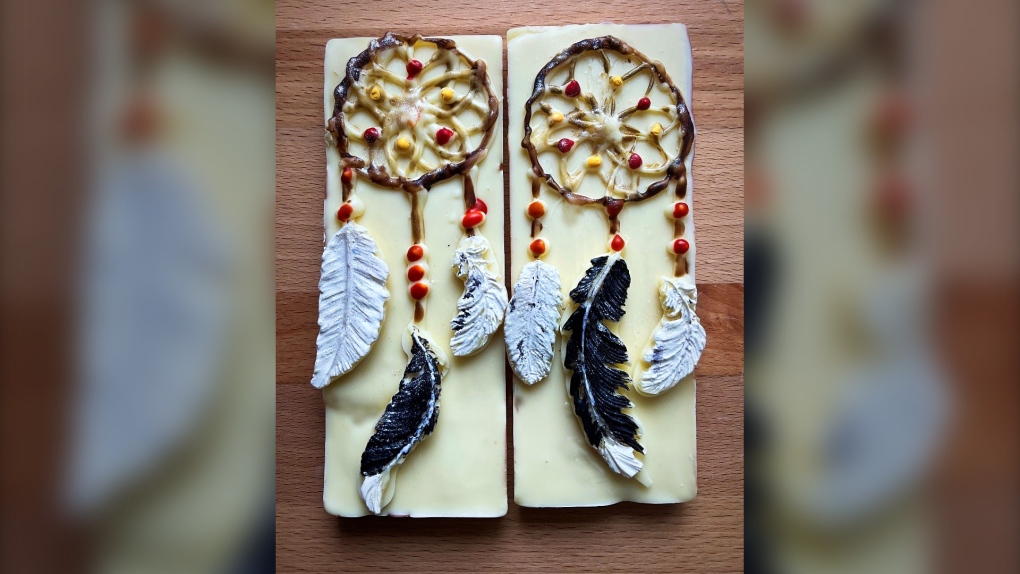 |
| edible art |
Along with opening the retail space, Maki is helping Indigenous
students pursue the art. She's offering a 1,500 Raven Rising Pastry Art
Scholarship at George Brown College.
“I feel shame and pain. I ask forgiveness of God,” Pope Francis said on Friday as he apologized for the “deplorable” abuses of Canada’s First Nations children.
Between the 1880s and the 1990s, the government ran a system of compulsory boarding schools which a National Truth and Reconciliation Commission (TRC) recently dubbed ‘cultural genocide’,” The New York Times reported. The Catholic church operated about 70 percent of those schools, where about 150,000 children were placed and “where abuse, both physical and sexual, was widespread, along with neglect and disease,” The Times said. A former judge, Murray Sinclair, who headed the commission, estimated that at least 6,000 children went missing.
The TRC, established as part of a government apology and settlement over the schools, concluded that at least 4,100 students died from mistreatment, neglect, disease or accident. The Tk’emlups te Secwepemc First Nation in British Columbia, using ground penetrating radar, discovered the remains of 215 of them buried near the Kamloops Indian Residential School which opened in 1890 and closed in the late 1970s, The Times reported. “It’s a harsh reality and it’s our truth, it’s our history,” Chief Rosanne Casimir told a news conference.
Children were also placed with non-Native families, a policy which Ontario Superior Court Justice Edward Belobaba denounced as he ruled in a class action lawsuit, The Guardian reported. “There is … no dispute that great harm was done,” Belobaba wrote. “The ‘scooped’ children lost contact with their families. They lost their aboriginal language, culture and identity. Neither the children nor their foster or adoptive parents were given information about the children’s aboriginal heritage or about the various educational and other benefits that they were entitled to receive. The removed children vanished ‘scarcely without a trace’.”
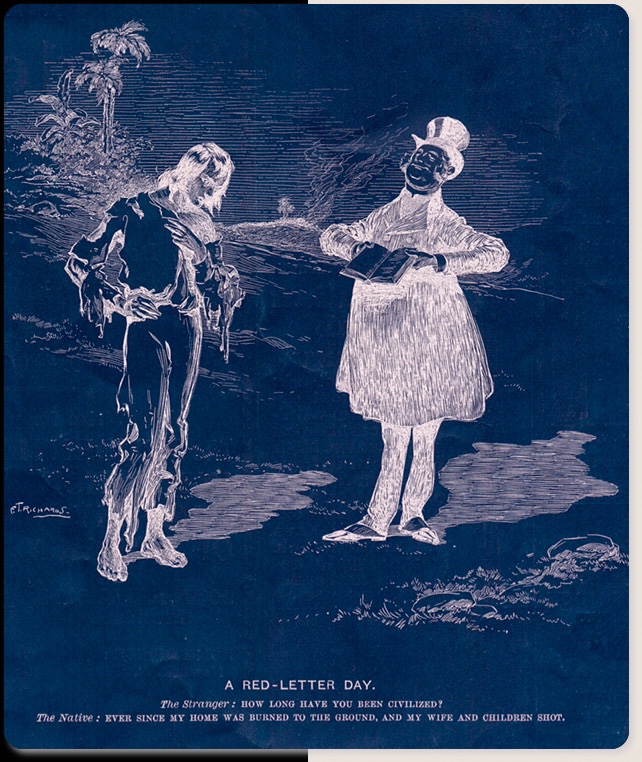
In Australia, Kevin Rudd, as prime minister, apologized in 2008 for this "great stain on our nation’s soul." He was referring to more than 100,000 Aboriginal and Torres Strait Islander children being placed in institutions or foster homes or adopted by nonIndigenous families between 1900 and 1970.
New Zealand tried to “civilize” Māori children, starting in 1840. “Boarding schools initially taught in the Māori language but soon qualified for subsidies only if lessons were in English. By 1960, only 26 percent of children could still speak their native language,” the Toronto Globe and Mail reported.
Denmark’s Prime Minister Mette Frederiksen apologized for the treatment of 22 Inuit children from Greenland, then a Danish colony, more than 70 years ago, Agence France Press reported. Frederiksen told the six survivors at a ceremony in the Danish capital Copenhagen, “What you were subjected to was terrible. It was inhumane. It was unfair. And it was heartless.”
Norway, Sweden and Finland are supporting initiatives to protect the culture of the Sami people living in Sápmi — formerly Lapland — following efforts to force them to culturally assimilate, The Guardian reported.
In the United States, the Trump administration’s seizing of 2,300 refugee children from their parents recalled a history of African and Indigenous family separation. The Washington Post recalled this tweet from the African American Research Collaborative: “Official US policy. Until 1865, rip African American children from their parents. From 1870s to 1970s, rip Native American children from their parents. Now, rip children of immigrants and refugees from their parents.” The Post drew attention to “The Weeping Time” exhibit at the Smithsonian’s National Museum of African American History and Culture documenting the story of children sold away from their enslaved families.
The government sent thousands of Indigenous children to government or government-funded, church-run “Indian schools” between the 1800s and the 1970s. Richard Pratt, who founded the first one, the Carlisle Indian School in Pennsylvania on Nov. 1, 1879, described his philosophy as: “All the Indian there is in the race should be dead. Kill the Indian in him and save the man.”
“While the government believed a white youth’s ‘moral character and habits are already formed and welldefined, when he leaves for school, a Indigenous youth was thought to be ‘born a savage and raised in an atmosphere of superstition and ignorance’,” The Equal Justice Initiative reported. “The government believed that ‘if [an Indigenous child] is to rise from his low estate the germs of a nobler existence must be implanted in him and cultivated.’”
As the boarding schools began closing, the government launched the Indian Adoption Project to promote European American adoption of Indigenous children, Vox reported. “The data showed that 25 to 35 percent of Native children around the country were being taken from their homes, and that 85 to 95 percent of those kids ended up in non-Native homes or institutions,” Vox stated.
Elizabeth Williams, who had been sold twice since she last saw her children, placed an ad in the Christian Recorder newspaper in Philadelphia in 1866 to try to locate them, The Post said. And Sandy White Hawk, a Sicangu Lakota adoptee from the Rosebud Reservation in South Dakota, founded the First Nations Repatriation Institute to help adoptees reunite with their tribes and families.
WGBH noted in a 2015 documentary that Maine had set up its own TRC – an approach which South Africa started in 1995 to try to forge unity after apartheid ended. The commission heard Indigenous testimony such as this: “All we did was beg for our foster mothers to hug us and say they loved us. My baby sister and I sat in a tub of bleach one time trying to convince each other that we’re getting white.”
The struggle continues with a federal lawsuit challenging as racially discriminatory the 1978 Indian Child Welfare Act (ICWA), which deals with child separation, filed by a European American couple in Texas, joined by their state, Indiana and Louisiana. The National Indian Child Welfare Association says the law addresses a crisis affecting Indigenous children, families and tribes. Invalidating the ICWA, its supporters say, would have far-reaching consequences for Indigenous peoples, including the issue of tribal sovereignty.
Pratt’s racism and White Hawk’s lament notwithstanding, it is hard to miss the defiance in the song “Drums” written by Peter LaFarge which Johhny Cash sang 58 years ago:
“And when they think that they’d changed me
Cut my hair to meet their needs
Will they think I’m white or Indian
Quarter blood or just half breed
Let me tell you Mr. teacher
When you say you’ll make me right
In five hundred years of fighting
Not one Indian turned white.”

Survivors told payments would be as high as $50,000. (video here)
Mental health counselling and crisis support is available 24 hours a day, 7 days a week through Hope for Wellness Help Line at 1-855-242-3310 or the online chat at www.hopeforwellness.ca
The total federal settlement payment for individual ‘60s Scoop survivors is now set at $25,000, the claims administrator announced this week.
“I understand everyone won’t be happy,” said Doug Lennox of Klein Lawyers, lead spokesperson for the class-action agreement approved in November 2018.
“But now we know how much money we still need to pay and what everybody’s owed.”
The ‘60s Scoop was a wave of adoptions from the 1950s to the ‘90s that swept First Nations, Inuit and Métis children out of their homes and into non-Indigenous foster and adoptive placements across Canada and around the world.
Survivors sued the federal and Ontario governments, settling for $875-million to compensate for the loss of their cultural identities. Inuit and First Nations people not registered under the Indian Act (non-status) were left out of the deal.
Interim compensation
Already 12,500 survivors received an interim compensation payment of $21,000 during the coronavirus pandemic. They are awaiting their second and final payment of $4,000.
Then, there are those whose claims were approved during the pandemic and are waiting for their total payment of $25,000.
“I know it’s enormously frustrating,” Lennox added.
“People want to know why does everything take so long? We have a legal system that is hundreds of years old. It moves at its own pace.”
He said Collectiva would be ready to implement the decision almost immediately, adding its call centre is now open extended hours.
“They have the funds, they’re ready to go.”
Probably Ruby is her debut novel and her American debut
For readers of Tommy Orange’s There There and Terese Marie Mailhot’s Heart Berries, Probably Ruby is an audacious, brave and beautiful book about an adopted woman’s search for her Indigenous identity.
Relinquished as an infant, Ruby is placed in a foster home and finally adopted by Alice and Mel, a less-than-desirable couple who can’t afford to complain too loudly about Ruby’s Indigenous roots. But when her new parents’ marriage falls apart, Ruby finds herself vulnerable and in compromising situations that lead her to search, in the unlikeliest of places, for her Indigenous identity.
Unabashedly self-destructing on alcohol, drugs and bad relationships, Ruby grapples with the meaning of the legacy left to her. In a series of expanding narratives, Ruby and the people connected to her tell their stories and help flesh out Ruby’s history. Seeking understanding of how we come to know who we are, Probably Ruby explores how we find and invent ourselves in ways as peculiar and varied as the experiences of Indigenous adoptees themselves. Ruby’s voice, her devastating honesty and tremendous laugh, will not soon be forgotten.
Probably Ruby is a perfectly crafted novel, with effortless, nearly imperceptible shifts in time and perspective, exquisitely chosen detail, natural dialogue and emotional control that results in breathtaking levels of tension and points of revelation.
LISA BIRD-WILSON is a Saskatchewan Métis and nêhiyaw writer. Her fiction book, Just Pretending (Coteau Books, 2013), won four Saskatchewan Book Awards, including 2014 Book of the Year, was shortlisted for the Danuta Gleed Award, and was the 2019 One Book, One Province selection. Her debut poetry collection, The Red Files (Nightwood Editions, 2016), is inspired by family and archival sources, and reflects on the legacy of the residential school system and the fragmentation of families and histories. She is the chair of the Saskatchewan Ânskohk Writers Circle Inc. (SAWCI)—the group that hosts the Ânskohk Indigenous Literature Festival and the CEO of the Gabriel Dumont Institute of Native Studies and Applied Research Inc. in Saskatoon.

 Another First Nation in Canada is preparing to search for unmarked graves at a former residential school.
As Dan Karpenchuk reports, this time it will be in northern Manitoba.
The Pimicikamak Cree Nations has announced plans to search the site of the former St. Joseph’s Residential School. It was operated near Cross Lake by the Roman Catholic Church in northern Manitoba, between 1912 and 1969. The chief of the Pimicikamak Nations is David Monia. He says the reserve has identified the names of 85 children who died at the school. However, he adds that surviving records are incomplete.
“Many of them are listed as boy, as girl, 40% of them have first names only. Where did these kids come from?”
Investigators say they will use ground penetrating radar to search the site, which is now a neighborhood with homes.
“You know they don’t describe it as a school. More like assimilation camps, torture camps, or death camps and really that’s an international crime.”
No start date for the search has yet been determined. It was just over a week ago that the Pope apologized at the Vatican to a Canadian Indigenous delegation, for the role of the Catholic Church in the abuses at Canada’s residential schools. Thousands of Native children were abused at the schools, many died.

I was baptized into the Church as a child at the Akwesasne Mohawk
Territory. I was taken against my will to the Mohawk Institute in
Brantford, Ontarior, 600 kilometers (373 miles) from my home and, along
with the two dozen other Akwesasronon (people from Akwesasne) endured
sexual, mental and physical abuse while being denied adequate food and
health care, our bodies marked by open sores and rotting teeth leaving
permanent scars.
After the American Indian Sovereignty Project was established last summer, its leaders knew that they would be busy with scholarly engagements in contemporary issues in federal Indian law. But the group, a collaboration between Yale and New York University (NYU), had little idea how quickly they would become immersed in a series of immediate court challenges at the highest level.
In February, the project had one of its most visible moments to date when U.S. Supreme Court Associate Justice Stephen Breyer cited during oral arguments an amicus brief filed by the project’s team in the case Denezpi v. United States.
A joint initiative of Yale’s Faculty of Arts and Sciences (FAS) and the NYU School of Law, the Sovereignty Project brings together scholars, law students, graduate students, and a select number of undergraduates to study, research, and engage American Indian law and policy. The brief cited by Breyer is the second of three the project’s team has written for the high court, and the justice’s reference was an important recognition: It highlighted the impact their work can have in helping to elucidate federal Indian law and policy and in advocating more broadly for Native American tribal sovereignty, according to Ned Blackhawk (Te-Moak Tribe of Western Shoshone Indians of Nevada), the Howard R. Lamar Professor of History and of American Studies at Yale.
He and Maggie Blackhawk (Fond du Lac Band of Lake Superior Ojibwe), professor of law at New York University, co-founded the Sovereignty Project partly with the mission of providing support to Native tribes in legal cases involving Indian Country. The project, he said, also aims “to build an intellectual research community oriented around questions of American Indian legal concern as well as educational awareness about pressing contemporary tribal issues.”
In the six months since the Sovereignty Project was established, it has already been “flooded” with requests from the Tribal Supreme Court Project for assistance on federal court cases, according to Maggie Blackhawk.