This blog was a backup for American Indian Adopteesblog
USE THE SEARCH BAR or SEARCH TOPICS at bottom of this blog
If you need support
Support Info: If you are a Survivor and need emotional support, a national crisis line is available 24 hours a day, seven days a week: Residential School Survivor Support Line: 1-866-925-4419. Additional Health Support Information: Emotional, cultural, and professional support services are also available to Survivors and their families through the Indian Residential Schools Resolution Health Support Program. Services can be accessed on an individual, family, or group basis.” These & regional support phone numbers are found at https://nctr.ca/contact/survivors/ .
MY EMAIL: tracelara@pm.me
Missing and Murdered: proactive tribal and state initiatives
The Yurok Tribe hired its own investigator to pursue unsolved cases of their citizens who are missing or murdered. Arizona is among the states establishing an MMIP task force that the new governor says will “ensure that not one more Indigenous man, woman, or child is a target of violence, abuse, or exploitation.” The actions are part of the attempts to address the slow momentum to investigate and solve cases with Native victims. Today on Native America Calling, we speak with Jessica Carter (Yurok), Yurok Tribal Court Director; Daisy Bluestar (Southern Ute), member of the MMIR Taskforce in Colorado; Skye Alloway (Forest County Potawatomi tribal member), co-chair of Wisconsin’s Missing and Murdered Indigenous Women Task Force; and Annie Forsman-Adams (Suquamish), program director for the Washington State Native American Coalition Against Domestic Violence and Sexual Assault (Women Spirit Coalition).
A very very good story. It reminds me of the SOS Villages a friend in Austria told me about many years ago, and how it WORKS! Trace
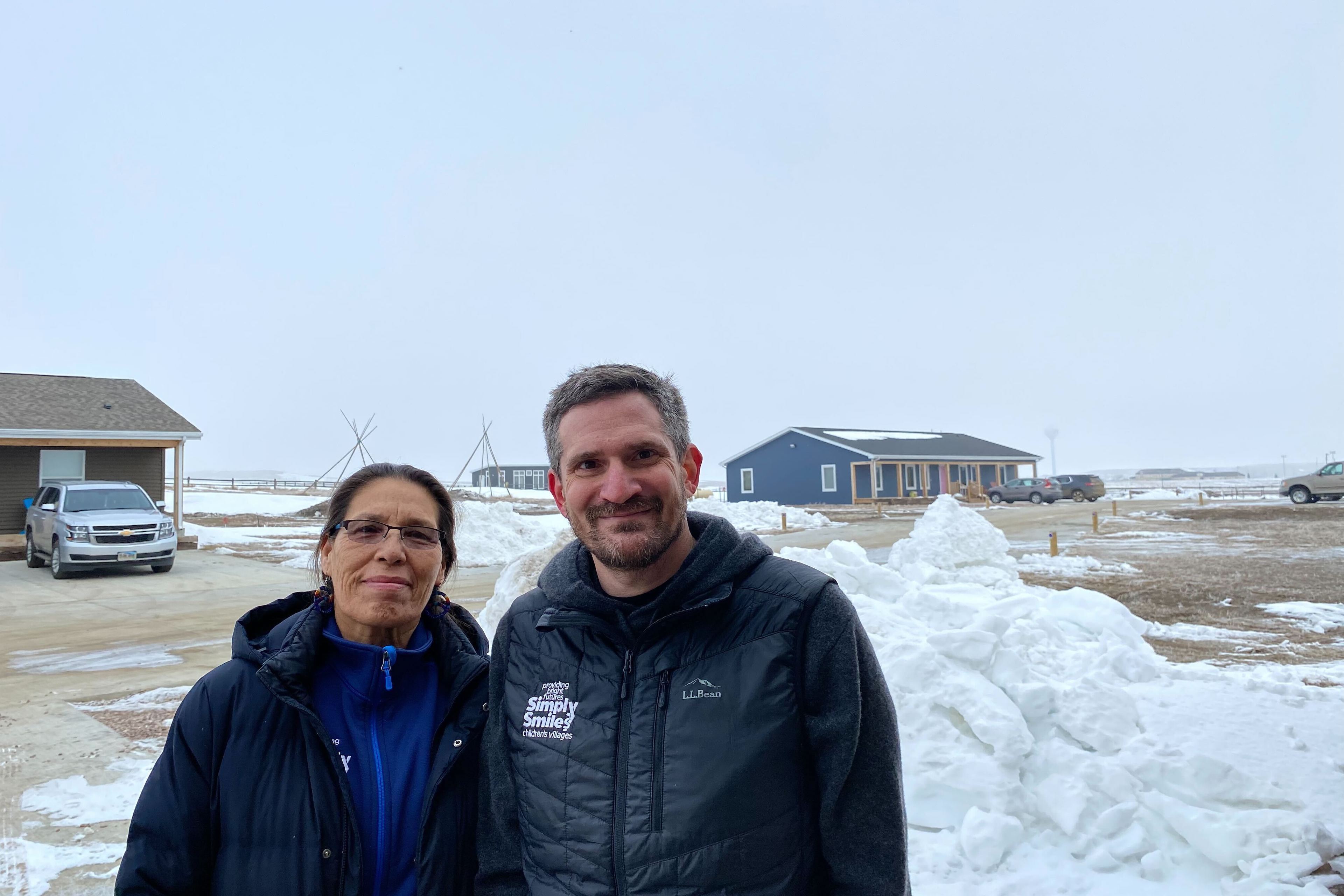
Marcella Gilbert organizes Lakota cultural activities and provides respite care for parents at the Children’s Village operated by Simply Smiles in La Plant, South Dakota. Bryan Nurnberger, president and founder of the nonprofit, serves as interim director of the foster care village. (Arielle Zionts / KHN)
It Takes a Village: Foster Program Is a New Model of Care for Indigenous Children
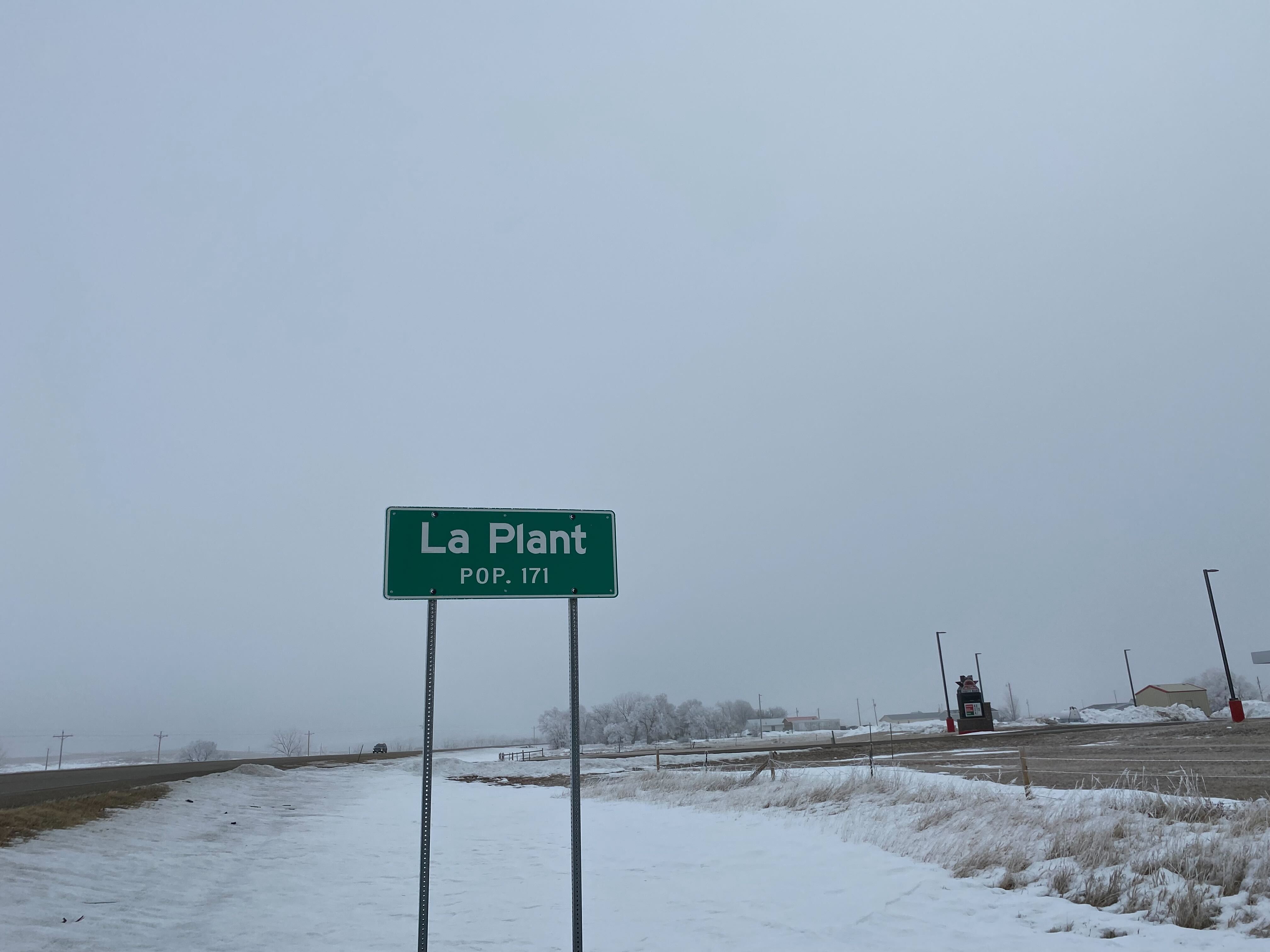
LA PLANT, S.D. — Past a gravel road lined with old white wooden buildings is a new, 8-acre village dotted with colorful houses, tepees, and a sweat lodge.
The Simply Smiles Children’s Village, in this small town on the Cheyenne River Reservation, is home to a program aimed at improving outcomes and reducing trauma for Indigenous foster children.
All foster programs seek to safely reunite children with their families. The Children’s Village goes further.
“We want to make Lakota citizens of the world,” said Colt Combellick, who oversees mental health programs at the village. “If we can help them relearn their culture and their heritage and connect them to the resources that they need to thrive moving forward, we’re going to try to make that happen.”
The program is an example of the growing nationwide effort to improve services for Indigenous children, after generations were routinely traumatized by being separated from their families and cultures. While the Indian boarding school era is over, and improvements have been made to child welfare systems, Indigenous families remain overrepresented in the foster care system.
“We actually have research that shows that kids who have stronger cultural identity have better child well-being outcomes” such as succeeding in school and avoiding drugs, said Angelique Day, an associate professor at the University of Washington and an expert on Indigenous child welfare.
Day, who is not affiliated with Simply Smiles, said she’s excited by any innovative program aimed at improving child welfare in tribal communities if it provides adequate training so foster parents can support the children and avoid turnover. She said it’s also important for organizations to arrange for independent evaluation of kids’ progress after leaving foster programs.
It’s too early to say whether Simply Smiles will succeed in its goals, but the Children’s Village has the support of the leaders of the Cheyenne River Sioux Tribe and has attracted interest and visits from officials representing Indigenous nations across the country.
It was a Cheyenne River Sioux tribal member who suggested the nonprofit set up a foster village on the reservation after learning about a similar program the nonprofit runs in Mexico. The tribal council voted to support the idea, and Simply Smiles has advisers including child welfare experts, elders, and other leaders of the Cheyenne River Sioux and other tribes.
The Children’s Village operated by the nonprofit Simple Smiles is in tiny La Plant, South Dakota, on the Cheyenne River Reservation. (Arielle Zionts / KHN)
Simply Smiles’ model combines living in a house in a family setting with the resources of more institutional settings, said Bryan Nurnberger, president and founder of the Connecticut-based nonprofit.
The Children’s Village in La Plant has one foster parent caring for three teenagers. It’s hiring other parents to fill its three homes, which, together, can house up to six parents and 18 children.
The family has access to a counseling and family visiting center, as well as a large blue barn that stores a bus, maintenance equipment, and new clothing for the children to “shop” through.
MarShondria Adams, 39, grew up with stepsiblings who were placed in multiple foster homes. Last year, she moved 300 miles from Sioux Falls, South Dakota’s largest city, to La Plant, population 167, to become a foster parent at the Children’s Village.
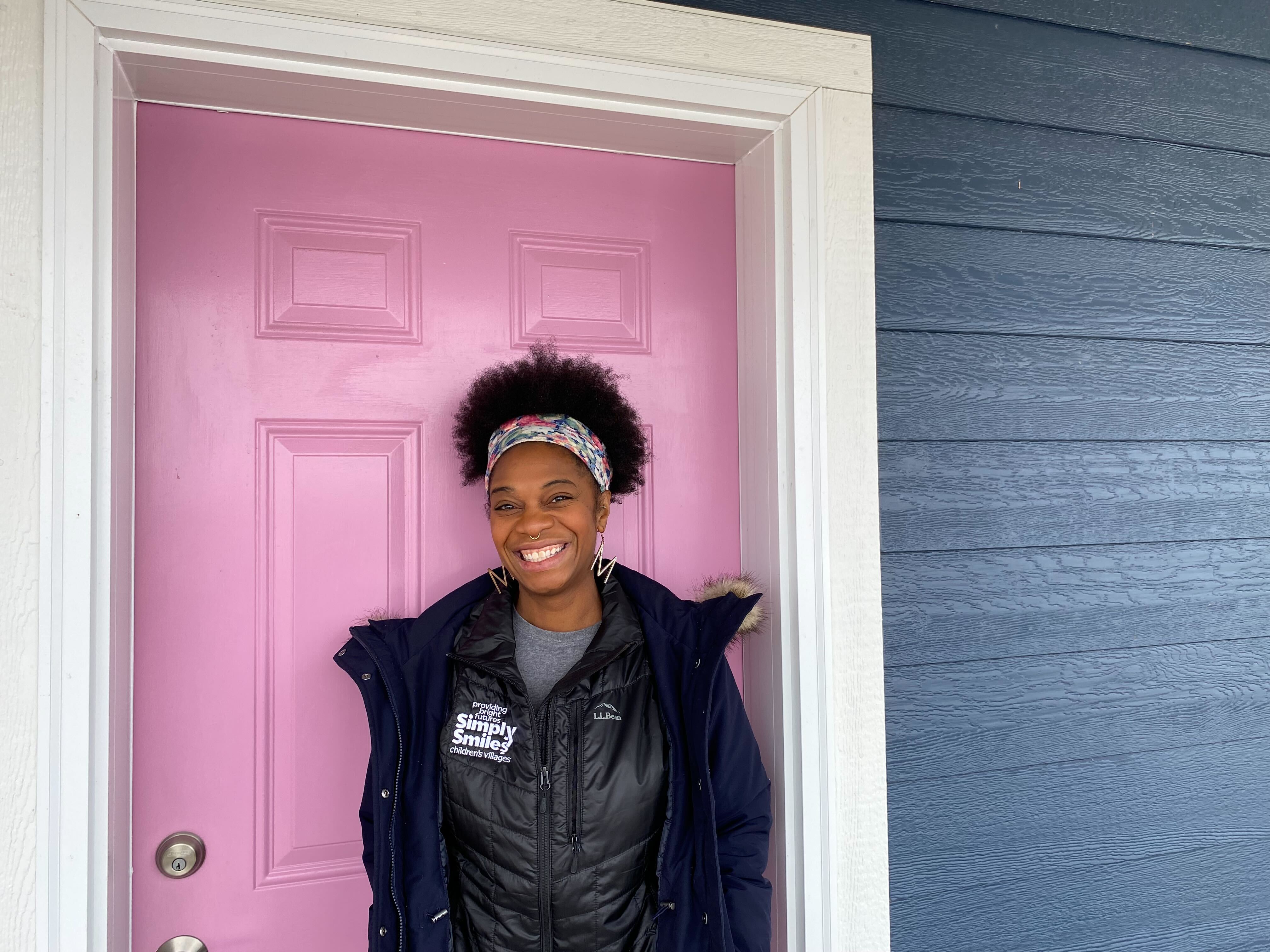
On a recent cold and foggy morning, Adams’ three foster teens made smoothies for breakfast inside their navy-blue house with a bubble-gum-pink front door at the Children’s Village. Adams drove them to school and then returned home, where she did laundry and filled out paperwork for the state’s child welfare department. Her after-school plan was to cook dinner as the kids tackled a YouTube exercise class.
Being a traditional foster parent in Sioux Falls would “be a day-and-night difference,” Adams said. She wouldn’t have on-site resources and staff members to assist her and the children with tasks ranging from repairing flat tires to finding a specialist who conducts learning disability assessments.
“I have all these people that are around me to support me and help me,” Adams said. Traditional foster parents probably spend more time than she does playing phone tag with case managers and searching for other resources, she said.
The program’s foster parents receive 70 more hours of training than required by the state, including education about Lakota culture. It also offers telehealth therapy, evaluations, and medication management to the foster parents, children, and birth parents. Combellick said the mental health services use trauma-informed and culturally relevant evidence-based methods.
The nonprofit funds these services through donations, grants, and the state, which also refers potential foster children to Simply Smiles.
Combellick, a member of the Cheyenne River Sioux Tribe, is another Simply Smiles staffer with a personal story about family separations.
His father was 6 years old when his mother went missing and was found dead on the reservation. Combellick’s dad and his siblings were sent 80 miles away to an Indian boarding school, where they stayed about a year before being reunited with their family.
Combellick said his father developed post-traumatic stress disorder from boarding school, where he faced corporal punishment and was not allowed to speak the Lakota language.
“That’s what spurred my passion. I just wanted to learn about my family history and how to break those cycles of oppression,” he said.
Combellick became a social worker and hoped someday to find a way to directly support his tribe.
“I came by Simply Smiles, and — boom! — it’s like 300 yards from where my ancestors grew up,” he said.
One of the children’s rooms inside a home at the Simply Smiles Children’s Village in La Plant, South Dakota. (Arielle Zionts / KHN)
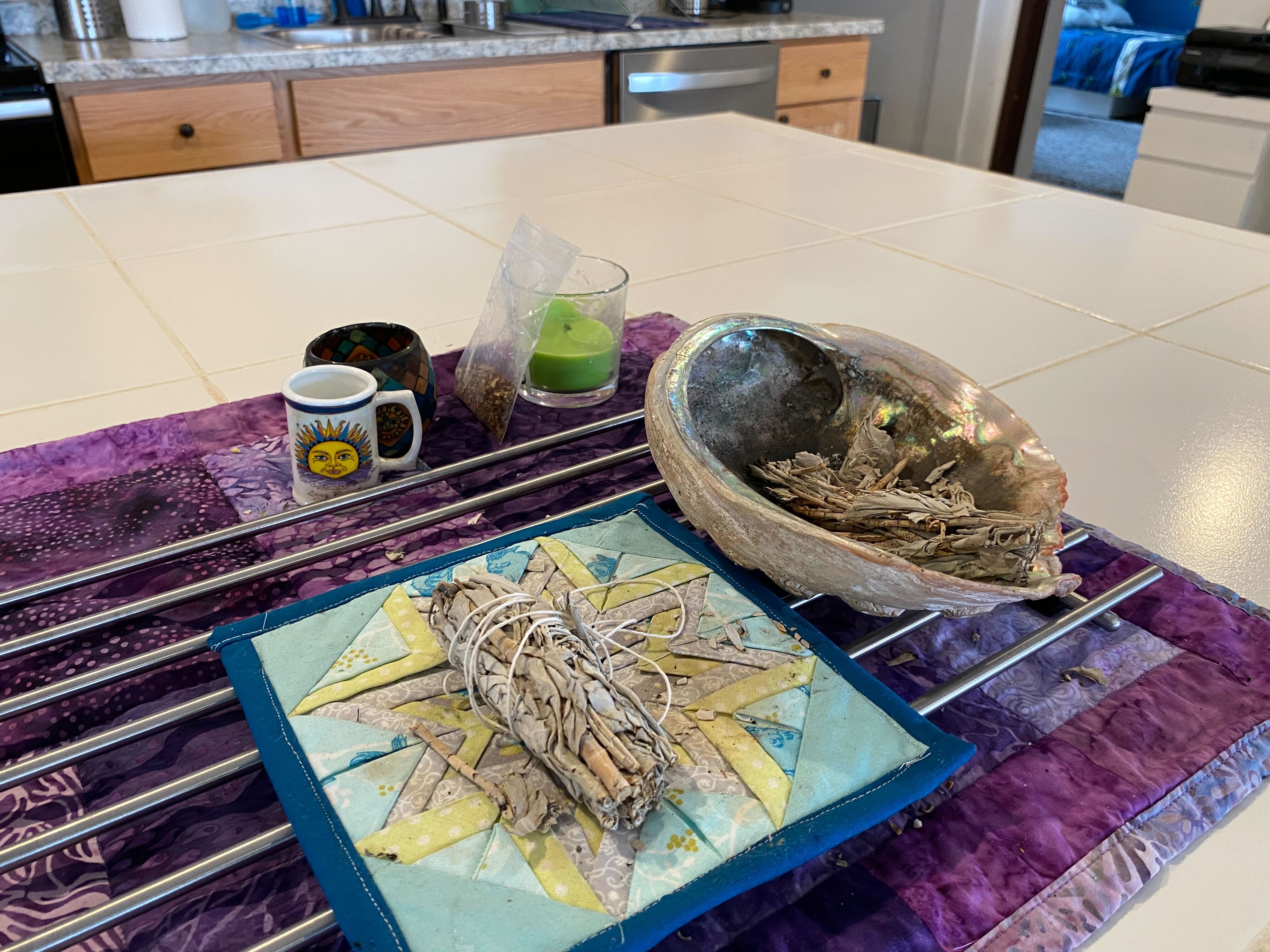
Bundles of dried sage sit on the kitchen counter inside a home at the Simply Smiles Children’s Village on the Cheyenne River Reservation in South Dakota. Lakota people use sage for purification rituals, medicine, and other purposes. (Arielle Zionts / KHN)
Experts say the law has reduced disparities since the 1970s, but by 2003 child protection agencies were still more likely to investigate and substantiate allegations against Native American families than other groups, and more likely to remove their children than those of any other group, according to data analyzed by the Annie E. Casey Foundation.
And as recently as 2020, Native American children were nearly three times as likely to be in foster care as other children, according to a Casey Foundation analysis. More than half of these foster children were placed with non-relatives or non-Indigenous caregivers.
MarShondria Adams moved 300 miles to foster three teens in this house at the Simply Smiles Children’s Village in La Plant, South Dakota. (Arielle Zionts / KHN)
South Dakota lawmakers recently rejected legislation that would have codifiedparts of the Indian Child Welfare Act into state law. But they may create a task force to study how the state can improve Indigenous child welfare.
Eleven percent of the state’s licensed foster homes are Native American, according to state data. Child welfare expert Day, a descendant of the Ho-Chunk Nation, said some Native Americans aren’t able or approved to accept foster children because they have low incomes or live in crowded or subpar housing.
“It’s not like tribal families don’t want to step up and do this work. It’s that we have barriers, systemic barriers, that are embedded within the system that discriminate against families who want to do this work,” she said.
Even with the pay and on-site support, Simply Smiles has found it challenging to recruit and retain caregivers. The first foster family arrived in fall 2020, but the parent burned out amid covid pandemic closures on the reservation. Another parent, from a large city outside South Dakota, left after finding life in such a remote area too difficult.
Marcella Gilbert, a member of the Cheyenne River Sioux Tribe, coordinates cultural programming such as trips to powwows and outings to hunt elk and bison. She also cares for the children when their foster parent needs a break.
“We’re asking people to do the hardest job in the world, which is being a parent to children coming into our homes with loss and trauma,” she said.
From family stories handed down, and from whatever research she’s been able to uncover, Kayl Commanda knows her great-grandmother’s 49 years were shockingly sad.
Beatrice Commanda — Kayl’s mother’s grandmother — was a victim of the infamous “’60s Scoop.” The term refers to the mass removal of Canadian Indigenous children from their families into the child welfare system, in most cases without the consent of their families or bands.
Beatrice lost her children, scuttled away to residential schools and foster families near the Nipissing First Nation, where she would eventually die at the age of 49. Family members marked her grave with a simple wood cross, vowing to at least keep her legacy alive.
But Kayl, a student at Trent University in Peterborough, says the sadness didn’t end there. The property where Beatrice was buried flooded one year and the wooden cross, as well as her burial location, was lost.
“My grandmother remembered attending the funeral,” says Kayl, who also uses the name Opichi — the Anishinaabe word for robin.
“The issue that happened was that the Nipissing cemetery was flooded … obviously, it wasn't exactly a wealthy community at the time, so all of the gravestones were just OK.” But the flood took many away.
Kayl says the family had great difficulty in finding exactly where Beatrice was buried, but eventually her remains were located. They were able to put a bouquet of flowers on the site.
“But now we're trying to give her a proper headstone because she was an amazing woman, from what we hear,” she says. “She had a major injustice done to her, having all of her children taken away.”
It’s an expensive undertaking, but it’s one the family is determined to accomplish. Kayl says they started by selling family belongings, reaching out to relatives to see if they could spare some items. Kayl has also started a GoFundMe page, generating close to $3,000 so far.
Editor’s note: This short piece accompanied “Forever Home” in the March+April 2023 print edition of Mother Jones.
This spring, the US Supreme Court will hear a case
that could decide the future of the Indian Child Welfare Act, the 1978
landmark law that strengthened tribes’ rights to keep Native children
out of the foster care system. At the center of the current case are the
Brackeens, a white Texas couple hoping to adopt a 4-year-old girl from a
Navajo family. Devout Christians, the Brackeens have said that they
felt called by God to adopt, telling the New York Times in 2019 that they considered adoption a way to “rectify our blessings.”
Christian groups have jumped
to the Brackeens’ defense, arguing that ICWA discriminates against
Native children by prioritizing potential caretakers’ Native heritage
over their overall ability to provide for a child. Yet critics see that
argument as merely the latest chapter in Christians’ long history of
removing Native children from their communities to win more converts—a
kind of a modern spin on the famous words of Richard H. Pratt, the
Christian founder of the first residential school for Native children in
the United States. “All the Indian there is in the race should be
dead,” he wrote in 1892. “Kill the Indian in him, and save the man.”
Christian Alliance for Indian Child Welfare
Founded in 2004, this group advocates on behalf of non-Indian
families who are trying to adopt children of Native descent. The group’s
founder is Elizabeth Morris, author of a 2006 book called Dying in Indian Country,
which she describes as “the true story of a father who realized
reservation life and welfare policies were destroying his family.” In an
amicus brief
filed in 2021, an anti-ICWA group called the Christian Alliance for
Indian Child Welfare wrote, “For nearly fifty years, ICWA has imposed
race-based classifications on Indian children and their families—a clear
violation of Equal Protection—and has caused horrendous individual
suffering as a result.” CAICW’s public Facebook page, with 2,700
followers, regularly shares stories about what they see as the
depravities of Native culture; a recent post
cast doubt on recent finding of remains of Native children on the
grounds of Canadian boarding schools despite abundant evidence that they
are legitimate.
Nightlight Christian Adoptions
Since 1959,
this evangelical adoption agency has advocated for adoption as an
alternative to abortion and a boon to Christianity. Nightlight waded
into an ICWA battle in 2013, when the agency facilitated the adoption of
a Cherokee girl into a White Christian family. After a highly publicized custody battle between the adoptive parents and tribal leaders ensued, with evangelical activists staging rallies and circulating petitions to “Save Baby Veronica” from being removed from her Christian adoptive family. The Supreme Court ultimately ruled in the adoptive parents’ favor. In a current brochure
about its faith-based mission, Nightlight states, “Adoption is one of
the most effective ways to make disciples of all nations.”
Allie Beth Stuckey and Naomi Schaefer Riley
Stuckey, a Christian influencer with 441,000 followers on Instagram, devoted a recent episode
of her podcast, “Relatable,” to the Indian Child Welfare Act. Her guest
was Naomi Schaefer Riley, a fellow of the libertarian think tank
American Enterprise Institute and author of the and the 2016 book The New Trail of Tears: How Washington Is Destroying American Indians.
On Stuckey’s podcast, Riley argued that the US government’s history of
abuse and exploitation of Native people is no longer relevant. “I don’t
really believe in historical trauma,” she said. Instead, she blamed
Natives’ poverty and suffering on modern moral failings. “Maybe it’s the
substance abuse,” she said. “Maybe it’s the high crime rates. Maybe it
has nothing to do with the fact that your grandfather was forced to go
to a boarding school by the American government.” She claims that what
“left-wing activists” really hope to achieve is “an Indian Child Welfare
Act for Black children.”
That wasn’t Riley’s first appearance on Stuckey’s podcast; in an episode from last year called “CPS Has A Deadly Wokeness Problem” Riley discussed her most recent book, No Way to Treat a Child: How the Foster Care System, Family Courts, and Racial Activists Are Wrecking Young Lives,
published in 2021. Riley held forth about her belief that law-and-order
conservatives should think of child protective services as a branch of
law enforcement. She told Stuckey, “We don’t think it’s a good idea as
conservatives to abolish the police because we understand…the important
role the police play in protecting our most vulnerable citizens, and we
need to understand the important role that CPS plays in protecting
children.” Stuckey urges her listeners to reject the notion that race
and culture should play a role in custody decisions. “The world doesn’t
care about children,” she says. Her listeners can help, she says, by
“carrying on the legacy of Christianity.”
"Native foster care is a very emotional subject. ... The fact is that Native children need Native families and thriving Native communities."
Opinion by Winona LaDuke
March 15, 2023
Minnesota is poised to be the first state to protect the rights of tribal nations and Native children. That’s the right thing to do and it has broad bipartisan support, thanks to the leadership of Minnesota’s Native legislators.
At stake is The Minnesota Indian Family Preservation Act, which intends to shore up the ability of Native families to keep Native children, instead of seeing them turned over to non-Native homes for long-term foster care or adoption. That’s how a people can continue, given that history has not been good to Native children.
The bill is also moving forward now because the U.S. Supreme Court may strike down the protections afforded to Native children through the Indian Child Welfare Act (ICWA). Minnesota is stepping up to keep protection for Native children intact. But we must also tackle the bigger question of what sends Native kids to foster care, and how we restore healthy Native communities and protect the ecosystems which support a way of life.
Native foster care is a very emotional subject. Losing children to another culture is damaging. Lost to the next generation is the ability to transfer lessons, cultural values, teachings and even places — where to harvest wild rice or pick berries, for instance. Those are essential parts of being Anishinaabe. We want to keep the children, and we want to keep the ecosystems, the wild rice, the fish and good life for them.
The United Nations defines one component of genocide as removal of children from the community. But historically both the Canadian and U.S. governments have forcibly removed thousands of Native children from their homes. The federal Indian Child Welfare Act was intended to protect Native children, but last fall the Supreme Court took up challenges to the ICWA in the case of Haaland v. Brackeen.
This is primarily a Texas case, where the child was eventually kept by the non-Native couple who now wants the child’s sibling. But there’s also a Minnesota connection. A Minnesota couple, Danielle and Jason Clifford, argued in court that they could better provide for the child, but the White Earth Nation and the grandmother fought back and the grandmother won custody because of ICWA.
The fact is that most things have been stolen from our people. Land is the most obvious proof of that. But Christian churches similarly outlawed our religions and took children to residential schools where they were often heavily abused. Many Native people then and now lose their lives to the American system whether in courts, jails or extreme poverty. Children are the future, and that’s why Native families and our communities are fighting to keep minimal protections in Minnesota.
As state Sen. Mary Kunesh, DFL-New Brighton, explained recently, “At one time in Minnesota, the state took Indian children from their families to be placed into foster care or for permanent adoption at five times the rate they did non-Indian children. Some Indian children spent years trying to recover their Indian identities and reconnect with their tribal communities. Many others never made it home to see their families or communities again.”
That’s why Kunesh and Reps. Heather Keeler, Alicia Kozolwski, Jamie Finn and other Native legislators led this work. They were joined by many other state representatives who said this was the right thing to do. These representatives are working to protect Minnesota Native families, making Minnesota the first state in the country to shore up the foundations of the Indian Child Welfare Act.
Nearly every tribe in the nation and in Minnesota, including the White Earth Band of Ojibwe, delivered “friend of the court” briefs to the Supreme Court: “The challenges to ICWA in this litigation seek to diminish ICWA’s protections and undermine the unique trust responsibilities the United States owes to Indian children and Indian Tribes,” says a brief filed by 180 Indian tribes and 35 tribal organizations.
Now, I’m going to ask the uncomfortable question: How do we improve the quality of life in our own tribal communities, so that there is no need for foster care or adoption? Health and housing situations in our community remain dire. The water in villages such as Pine Point and Rice Lake is really a serious problem. Years have gone by without upgrades. Pipes are laid only for Canadian corporations but not for Native people.
When do we secure adequate funding for housing, heat and basic necessities for our communities, so that our children are less at risk? Food security is likewise an ongoing problem for Native families and is further compromised by criminalizing Native harvests, or destruction of Native foods. Wild rice and maple stands are laid to waste by a flick of a pen at the Minnesota Department of Natural Resources, while destabilizing and clear cutting our world continues.
The fact is that Native children need Native families and thriving Native communities. Let’s be courageous Minnesota and make sure Native kids are in our communities, and that our communities are able to thrive, and our Akiing — the land to which we belong — remains intact.
And thank you to the Minnesota legislators for doing the right thing.
Winona LaDuke is executive director, Honor the Earth, and an Ojibwe writer and economist on Minnesota’s White Earth Reservation. She is also owner of Winona's Hemp and a regular contributor to Forum News Service.
Episode 2: John Derek Mills is a ‘60s Scoop survivor from Waterhen Lake First Nation with a long juvenile record and a lifetime of crime that culminated in a botched armed robbery in 1996. Originally sentenced to seven years in prison, Mills is still behind bars nearly three decades later. In this episode, reporter Rob Smith talks to Mills to uncover why he has fallen through every crack in the justice system.
The Spanish Indian Residential School for Boys was managed by the Jesuits, while the girls school was managed by a Roman Catholic teaching order, the Daughters of the Heart of Mary. (Shingwauk Residential Schools Centre, Algoma University)
Over a third of the Jesuits who are "credibly accused" of sexually abusing minors worked in First Nations or at the Spanish Indian Residential School in Spanish, Ont.
The religious order released a list of names, along with the places they were assigned to work, on Monday as part of an attempt to be more transparent and accountable.
Crown-Indigenous Relations Minister Marc Miller said the revelations bring about mixed feelings.
"Largely, the Jesuit fathers identified there have passed, I think robs people of an opportunity to get accountability," he said.
"I do understand that just seeing people's names on this list can be quite triggering for a number of people but I think at the end of the day that in the spirit of better late than never, it is nice to see the Jesuits taking some accountability and transparency in this."
He said from a government perspective, there is a continued need to support communities with wellbeing, language, and culture as they grapple with the "pattern of predation on Indigenous communities."
"We know that a lot of the harm that has occurred has harmed communities as a whole," said Miller.
"We are not dealing with acts of individuals in isolated circumstances. I think that is an important truth that we have to keep at the top of our mind because it goes to the institutional nature of this for which there needs to continue to be accountability."
EDITOR NOTE: Open our records and give us our papers, including our adoption file and original birth certificate! Then we won't be accused of fraud or an undetermined identity... Trace
OPINION:
Fraudulent claims of Indigenous identity are risking community for the rest of us
"By the late 1950s, more Indigenous kids in the south were finally living at home. This concerned the mostly white folks who were social workers, and they ‘scooped’ kids, or stole kids out of Indigenous communities because the houses didn’t have perfect picket fences, the stay-at-home moms and working dads, or the kitchens with chrome-plated tables. Blatant racism in social work called Indigenous parents ‘bad’ and their kids were adopted or sold to white families—good families. Hopefully those kids would lose that pesky Indigenous identity. The ’60s Scoop kids were separated from families, and adopted out across Canada, the United States, and around the world. It’s estimated that 22,500 First Nations, Inuit, and Métis children were removed from the homes in the ’60 Scoop. Any connection to culture and belonging was severed completely."
Action 71 calls upon chief coroners and provincial vital statistics agencies to make their records on the deaths of Indigenous children in care of residential school authorities available to the National Centre for Truth and Reconciliation.
As the organization entrusted to receive, hold and archive the commission’s records, the National Centre for Truth and Reconciliation will add the newly acquired documents to the permanent record of what happened in the residential school system.
The agreement will have a positive impact on survivors and their families who are searching for more information as a means to heal, Debbie Huntinghawk told the Sun on Monday morning.
“That’s a beautiful game changer for a lot of people,” she said.
Did you know you can use ICWA to open your adoption?
How hard is it to open your adoption?
How hard is it to find help, or know how to start?
MY Answers:
👉In the book CALLED HOME: The Roadmap (Book 2) - we devote an entire chapter on how to use ICWA to open your adoption records to contact the tribe, and how to use DNA results. You will need legal help. Don't let that stop you.
***Some of us are told that records burned - that is usually a lie. The Catholic Charities and others will claim your parent is dead - that often turns out to be a lie. In some families, as many as 10 children were sold and trafficked into adoption, especially if you were a Native mother. Read the book series Lost Children of the Indian Adoption Projects for examples.
Under 1917, an "Indian individual who has reached the age eighteen and who was the subject of an adoptive placement" may apply to the court that rendered the final decree, while 1951(b) allows the "adopted child over the age of eighteen, the adoptive or foster parents of an Indian child, or an Indian tribe" to request the adoption information.
If you are an adoptee, call the BIA today... then call again and again - flood their phones and request help! Talk about ICWA. They kept many many records on adoptees. They can tell you your tribe. DO NOT GIVE UP...
What role does the Secretary of the Interior have regarding an Indian adoptees access to his or her adoption records?
Supposedly, under 1951(a) the Secretary of the Interior serves as a central registry for adoption records of Indian children since November 8, 1978. However, the registry in most cases is extremely limited and often times is unhelpful. Although, state courts entering adoption decrees involving Indian children are required to provide to the Secretary of the Interior the Indian child's adoption records, it is routinely overlooked. In any event the registry, in accordance with 1951, should include information that shows:
(1) The name and tribal affiliation of the child;
(2) The names and addresses of the biological parents;
(3) The names and addresses of the adoptive parents; and
(4) The identity of any agency having files or information relating to such adoptive placement.
Should the registry contain pertinent records and upon a request by an adult Indian adoptee, adoptive parent(s) or Indian tribe, the Secretary is required to disclose the information necessary to establish tribal membership. 25 U.S.C. 1951(b). If the biological parent(s) indicate by affidavit to remain anonymous, the Secretary shall insure that the confidentiality of such information is maintained and such information is not subject to the Freedom of Information Act, 5 U.S.C. 522 (2000). 25 U.S.C. 1951(a). To accommodate the confidentiality request, the Secretary can then certify the child's parentage or other information necessary to satisfy a tribe's enrollment requirements and establish the Indian adoptee's membership in that tribe. 25 U.S.C. 1951(b).
ALSO: Make your voice heard! Be proud to protect ICWA for future generations!
To request a meeting with the Director, Bureau of Indian Affairs, please use the Meeting Request Form
**
The Bureau of Indian Affairs will issue a Certificate degree of Indian Blood (CDIB) that shows your blood quantum and tribal affiliation. You will want to contact the BIA agency that provides services to the tribe you’re claiming heritage from in order to obtain the CDIB card, that information can be found in the Tribal Leaders Directory.
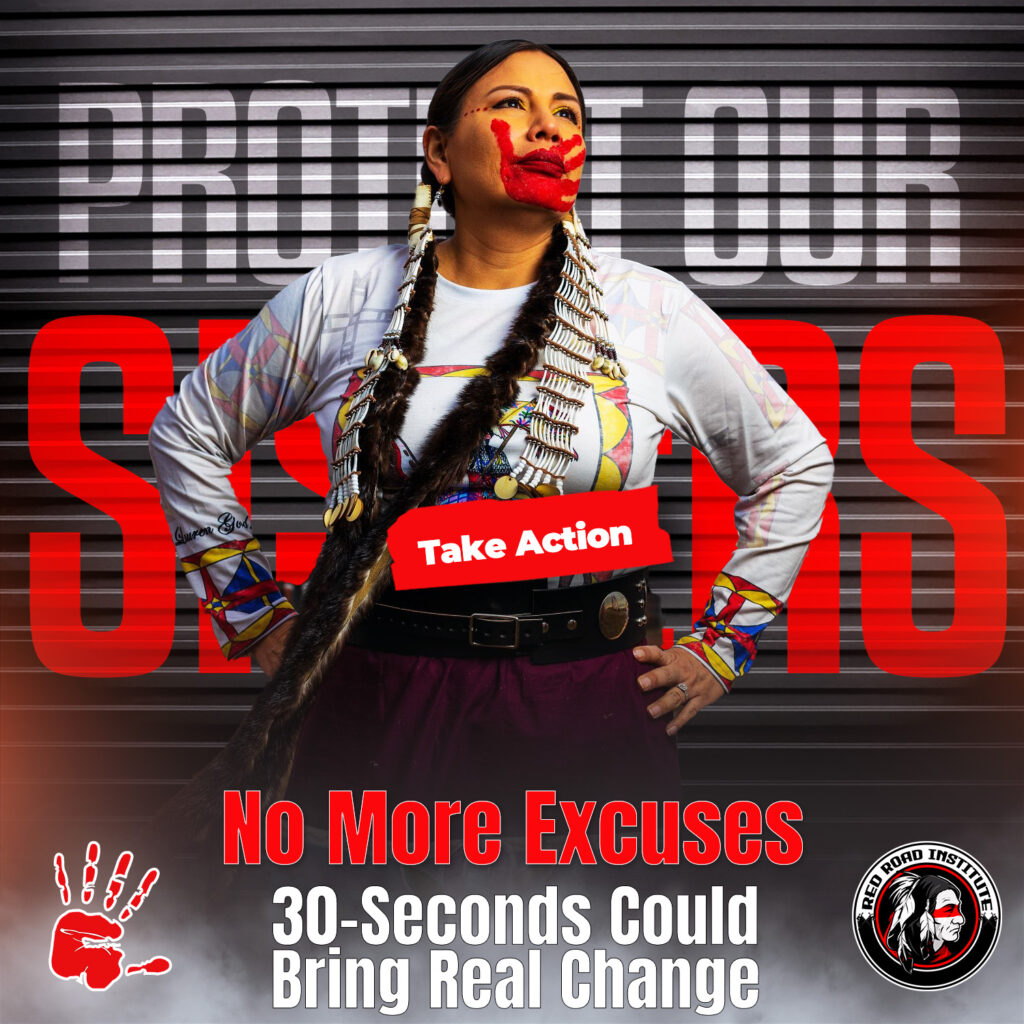
Red Road Institute is proud to announce two new initiatives protecting our people and saving lives. We do need your help to see these through.
As you might know, tribes are rarely able to prosecute non-tribal citizens for crimes they commit on our reservations. As a result, our reservations are breeding grounds for wicked people to rape, murder, and assault our people.
Because the local police are rarely allowed to prosecute crimes outside their jurisdiction, the FBI is the only department able to investigate crimes committed by non-Natives on tribal land.
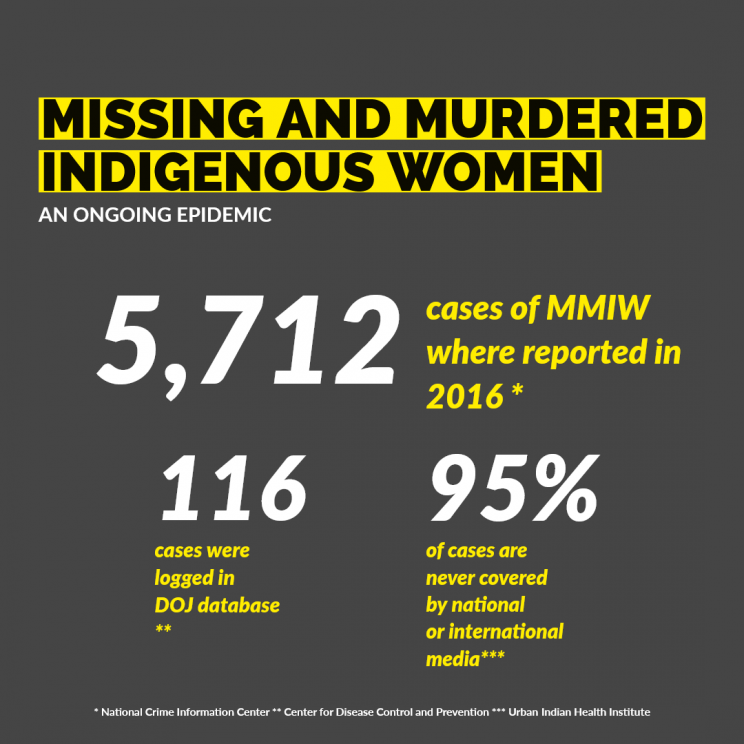
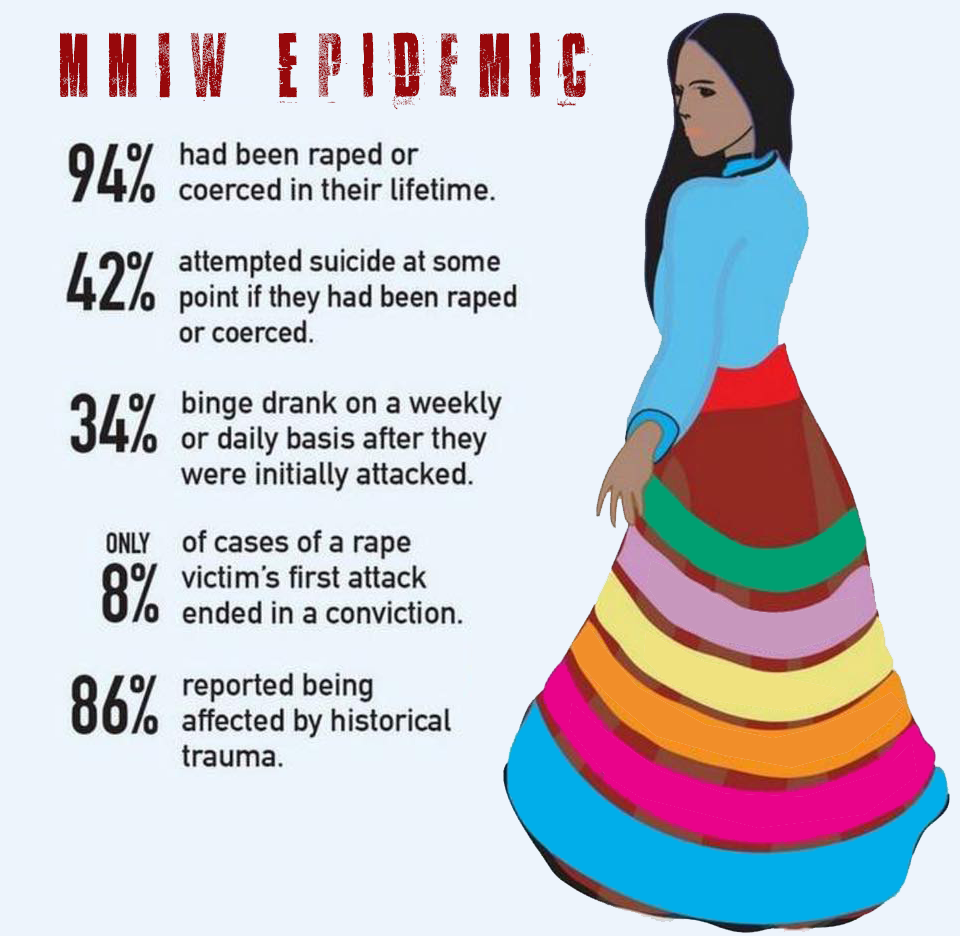
In 2016, the last year these stats were kept, there were 5,712 known cases of missing or murdered indigenous women. However, only 116 were logged into the DOJ database. For over 90% of the crimes, a real investigation never happens.
So we're putting together these programs to help our people because the government will not.
Red Road Alert: On July 1st, we will roll out the Red Road Alert in South and North Dakota. This system will allow tribal police departments and police in cities surrounding reservations to send a text alert to people who have subscribed to our service when one of our relatives is missing.
This is similar to an Amber Alert and will help our people be on the lookout for our relatives and share information.
We plan to expand this to other states as funds and grants become available. However, we need $19k more to ensure this is financed for an entire year.
Red Road TV is the premier TV station for all of your Native American and First Nations content. We are the largest indigenous TV station in the world. We’re all Indigenous, All the Time!
MMIW: Unsolved Cases: Have you heard about Red Road TV? This is our 100% free indigenous programming available on Roku and other smart TVs. Since we don’t charge for our programming, we must raise money for anything we produce.
We’re currently working on the first five episodes of a show that will highlight unsolved MMIW cases. We’re hiring private investigators to go where the federal government will not.
On April 15th, we will release a new website that will allow us to share information and hopefully bring some of our stolen sisters home. Our budget is tight, and we are short $11k for advertising and equipment if you want to donate money or equipment.
We want you to know that 100% of all Red Road Institute’s donations return to our communities. Not one person on our staff receives compensation.
T he Métis National Council and the Government of Canada will be working collaboratively, Nation-to-Nation, to develop a process to engag...
To Veronica Brown
Veronica, we adult adoptees are thinking of you today and every day. We will be here when you need us. Your journey in the adopted life has begun, nothing can revoke that now, the damage cannot be undone. Be courageous, you have what no adoptee before you has had; a strong group of adult adoptees who know your story, who are behind you and will always be so.
OUR HISTORY
BOOK 5: Lost Children of the Indian Adoption Projects



:format(webp)/https://www.thepeterboroughexaminer.com/content/dam/localcommunities/peterborough_this_week/news/2023/02/10/after-gravesite-was-flooded-out-trent-student-wanted-to-do-right-for-60s-scoop-great-grandma/10850266_commanda.JPG)