BACK UP BLOG (no longer updating)

This blog was a backup for American Indian Adoptees blog
USE THE SEARCH BAR or SEARCH TOPICS at bottom of this blog

If you need support

Support Info: If you are a Survivor and need emotional support, a national crisis line is available 24 hours a day, seven days a week: Residential School Survivor Support Line: 1-866-925-4419. Additional Health Support Information: Emotional, cultural, and professional support services are also available to Survivors and their families through the Indian Residential Schools Resolution Health Support Program. Services can be accessed on an individual, family, or group basis.” These & regional support phone numbers are found at https://nctr.ca/contact/survivors/ . MY EMAIL: tracelara@pm.me

Search This Blog

Wednesday, October 12, 2022

NEW! TODAY! One Small Sacrifice is republished: Four Traumas #ICWA


Back in stores soon, ebook is on Amazon Kindle

By Trace Hentz, Blog Editor
After requests and many kind words, the second edition of ONE SMALL SACRIFICE is back on Amazon HERE and it will start showing up in bookstores again, or you can request your local bookstore order it for you.
I never wanted to write about me, but my story helped others and it might help you open your adoption, and process what happened to you.
 
 
๐Ÿ‘‡๐Ÿ‘‡๐Ÿ‘‡This is a reblog from 2012:


The Special Place of Children in Aboriginal
Cultures


Children hold a special
place in Aboriginal cultures. According to tradition, they are gifts from the
spirit world and have to be treated very gently lest they become disillusioned
with this world and return to a more congenial place. They must be protected
from harm because there are spirits that would wish to entice them back to that
other realm. They bring a purity of vision to the world that can teach their
elders. They carry within them the gifts that manifest themselves as they
become teachers, mothers, hunters, councillors, artisans and visionaries. They
renew the strength of the family, clan and village and make the elders young
again with their joyful presence. Failure to care for these gifts bestowed on
the family, and to protect children from the betrayal of others, is perhaps the
greatest shame that can befall an Aboriginal family.  It is a shame that
countless Aboriginal families have experienced some of this repeatedly over
generations.


 By Trace Hentz (formerly DeMeyer)


I saw a photo today (see below) This book cover reminded me of this excerpt and chapter in my memoir.


via


Four Traumas (published in 2012) (10 years later, republished in 2022)


            Now
that we have the internet and many ways to find information, I read that adoptees
are more traumatized than a prisoner of war. That’s right. It’s called post-traumatic
stress disorder. A prisoner of war may escape or be released, but an adoptee may
suffer their entire life.


I
believe there are four distinct traumas in being an adoptee. They are: 1) in
utero, when you feel what is happening to you or sense what is coming; 2) when
you are delivered, abandoned, and handed to strangers; 3) later when you are
told you are adopted and realize fully what it means; and 4) when you realize
you are different, from a different culture or country, and you can’t contact
your people, or know them, or have the information you need to find them.


 It took me years to get this. There
are more traumas, too – like when I’d fill out forms at the doctor’s office. I
had no medical history. I had no idea if I was sitting next to someone who
could be my biological brother, sister, mother or father. It was terrifying to
think I could marry my own relative! I could carry a gene or trait that I pass
down to my children – and I wouldn’t know until it’s too late. If my birthparents
were alcoholics, then I really shouldn’t drink. I could be pre-disposed to
diabetes or heart disease or cancer or depression and not even know. My list went
on and on.


In 2006, I
found out my birthmother had diabetes, which came as another shock.


I realize a
powerful link exists between what I’m feeling, and what happens in my body. Years
ago I’d use emotional binging, working more than one job, creating drama, just to
numb my emotional pain. By 18 I was a total workaholic!  I blamed myself and
hated myself for everything.  What grief, too young to
understand. My birthmother’s rejection destroyed my ability to trust anyone.


There
may be some adoptees who do not wish to heal this and go on as they are,
holding on to these sad feelings and self-pity, rather than do the mental work
to heal. Recognizing a pattern of belief is tough, partly because you gain
sympathy by stealing (or sucking) energy from others when you act sick. That is
no way to live. You need to be your own person, self-energizing, and not steal
energy from anyone.


            Adoptees
are meant to survive this, no matter who we are or how we were traumatized. It’s
a test.


            Can
we heal our own minds? Yes.


            Can
we love two families? Yes.


            Can
we take our recovery and story back to our families? Definitely.


Some
adoptees believe that when we meet mother or father, all pain and agony will
disappear. That sadly is just hope. That is not the way it works. A reunion is
just one step on the journey and it helps, but there are many many more steps
just as difficult. It’s truly a test.       


Regardless
of ancestry, creed or complexion, adoptees can heal this. The only one who can
fix it is you.


 I’m uneasy
around new people, reserved and shy at times. I’ve lived through many
disappointments. It’s very upsetting to find out about orphan trauma now, years
later, knowing no one bothered to tell me or help me while I was experiencing
it. 


After
multiple traumas, which I’ll describe, I came to terms with it… eventually.


Tuesday, October 11, 2022

How To Heal? Domestic Violence Awareness Month


During
Domestic Violence Awareness Month, StrongHearts Native Helpline is
dedicated to eradicating domestic and sexual violence by utilizing a
core message of healing

How do YOU heal?

From StrongHearts Native Helpline

It’s
easy to tell someone that it’s time to heal. What isn’t so easy is
understanding that not everyone heals in the same way or at the same
pace. StrongHearts Native Helpline understands that when it comes to
healing there is no such thing as one size fits all. That is why it is
so important to call attention to healing and to ask yourselves and
relatives: How do you heal?

“As
traditional people, it is customary to put our loved ones before
ourselves. We do this because we love them and want to take care of
them. But, when it comes to Native people loving and caring for
themselves, it can feel like we are betraying our humble values,” said
StrongHearts Chief Executive Officer Lori Jump. “When it comes to
healing, we must make a fundamental decision to take care of ourselves
and to teach our children that whatever it takes, it’s okay to love
ourselves enough to heal from the trauma of domestic and sexual
violence.” 

Make
a commitment to yourself to identify what you can do to feel better,
look better and live better. Please take time to review and enjoy the
following tips on self-care and self-love.

What Is Self-Love? 

Self-love
means accepting yourself as you are in this very moment for everything
that you are. It means putting your physical, emotional and mental
well-being first. It means that you recognize that through self-care you
can accomplish your goals and live your best life. It means taking care
of your own needs and not sacrificing your well-being for others.
Self-love and care means not settling for less than you deserve.

Culturally significant ways to practice self-care and self-love can include the following activities:

●      Traditions:
Continuing or renewing traditions can promote healing especially when
practicing the methods taught to us by our ancestors. It is through our
connection to the past that we can find healing; and it is our link to
the future that we can guide our children on their own healing
journeys.   

●      Ceremony:
There are a number of cleansing ceremonies that can induce healing such
as participating in a sweat lodge where extreme heat helps our spirit
to sweat the tears of trauma as we reflect on our own needs as well as
those of our people.

●      Family, Friends and Community:
Recognize that as relatives, we are all connected and share a trauma
bond born of historical and intergenerational trauma. As such, we must
acknowledge that part of our history to begin the healing journey for
ourselves and our people.

●      Bonding with Mother Nature:
Take a deep breath of fresh air. Walk in green grass with bare feet. A
physical connection to Mother Earth can lead to healing especially when
on ancestral lands.

●     Vacations:
A vacation can be as simple as vacating oneself from a bad conversation
or situation, but it can also include longer planned excursions such
as: taking a walk, visiting childhood playgrounds, or exploring distant
lands. Vacations can restore, refresh or reset a peaceful mindset and
spirit.
 

For starters, you can practice self-love by:

●      Trusting yourself. Everyone makes mistakes and learns from them. Trust your instincts. You know more than anyone what is best for you. 

●      Talking to and about yourself with love. Honor
yourself with praise and love for your personal and professional
achievements. Greet your daily activities with a determination to love
yourself. You are worthy. 

●      Giving yourself a break from self-judgment. Indigenous
people were harshly judged by people who didn’t understand our ways. We
lived in harmony with nature — that is something so special that it
shouldn’t be hard to see the good in our people. So go easy on yourself.
You deserve it. 

●      Forgiving yourself when you make a mistake. Survivors
of domestic and sexual violence are often blamed for their abuse.
Victim blaming relieves the perpetrator of any wrongdoing. Victims who
feel shame should feel strength and resilience in their ability to
survive. When you do make a mistake, understand that making mistakes is a
learning experience and that self-love and care includes forgiving
yourself.

●      Being nice to yourself. Understand
that violence against Indigenous peoples began with colonization and
healing from that trauma can begin with being nice to yourself. After
all, you deserve to be happy. 

●      Setting healthy boundaries. Set
healthy boundaries in all your relationships. You can start by telling
people when they’ve made you feel uncomfortable. Healthy boundaries may
also include ending an unhealthy relationship and doing so may also help
you to develop healthy relationships.
 

Practice Self-Care 

Self-care
involves making healthy choices such as eating nutritious foods and
exercising. When you feel healthy, you are more likely to hold yourself
in high esteem. Self-care is especially important when setting a good
example for the next generation to witness and emulate. 

Go back to the basics:

●      Listen
to your body. If you are feeling tired — take a nap. If you are hungry —
eat nutritious food. If you are weak — get up and exercise.

●      Take breaks from work and move or stretch. Take a sandwich to work and walk off the calories during your breaks.

●      Put
the phone down. Instead, visit someone you’ve been missing or connect
with yourself by meditating or doing something creative.

●      Eat
healthily but allow yourself to indulge in your favorite foods. For
example, dark chocolate is high in antioxidants, which in moderation can
actually be good for you.

Self-love and care can include:

●      Mindfulness. Know what you think, feel and want.

●      Stay focused on your needs and give yourself what you would freely give to others.  

●      Practice
good self-care by eating healthily, exercising and getting enough sleep
which can lead to developing healthy social interactions and intimacy.

●      Give
yourself enough time and space to develop healthy habits. Do things,
not to “get them done” or because you “have to,” but because you “want
to” develop healthy habits.

Be kind, patient, gentle and compassionate to yourself. Take care of you the way you would take care of a loved one.  

●      Manage stress and go for regular medical check-ups.

●      Practice good hygiene because it is good for social, medical, and psychological reasons and reduces the risk of illness.

●      Do something you enjoy every day. Dance, watch a favorite TV show or work in the garden.  

●      Find ways to relax. Meditate, do yoga, get a massage, take a bath or walk in the woods. 

●      Build
a sense of belonging by making and maintaining new friendships.
Consider joining a health or social club. Sign up for art and/or
recreation classes where you can interact with and enjoy meeting new
people.
 

At
StrongHearts Native Helpline, we understand that during Domestic
Violence Awareness Month we must be mindful of self-care and self-love
in our quest to heal. That is why it is so important for you to ask
yourself, “How do you heal?” and let the journey begin.

About StrongHearts Native Helpline

StrongHearts
Native Helpline is a 24/7 culturally-appropriate domestic, dating and
sexual violence helpline for Native Americans and Alaska Natives,
available by calling or texting 1-844-762-8483 or clicking on the chat
icon at strongheartshelpline.org.
Advocates offer peer support, crisis intervention, safety planning and
referrals to Native-centered services. StrongHearts Native Helpline is a
proud partner of the National Domestic Violence Hotline and the
National Indigenous Women’s Resource Center.

Source 

  1. Self-Love and What It Means. Jeffrey Borenstein, M.D. February 2020. https://bit.ly/3CkW3iV
  2. Taking Good Care of Yourself. Mental Health America. https://bit.ly/3LUXuHN (Accessed Sept. 29, 2022)

ICWA - WHY it matters (NPR)


Cleveland NPR Spot on ICWA with Rebecca Nagle and Fletcher


Listen Here. (REALLY GOOD!)


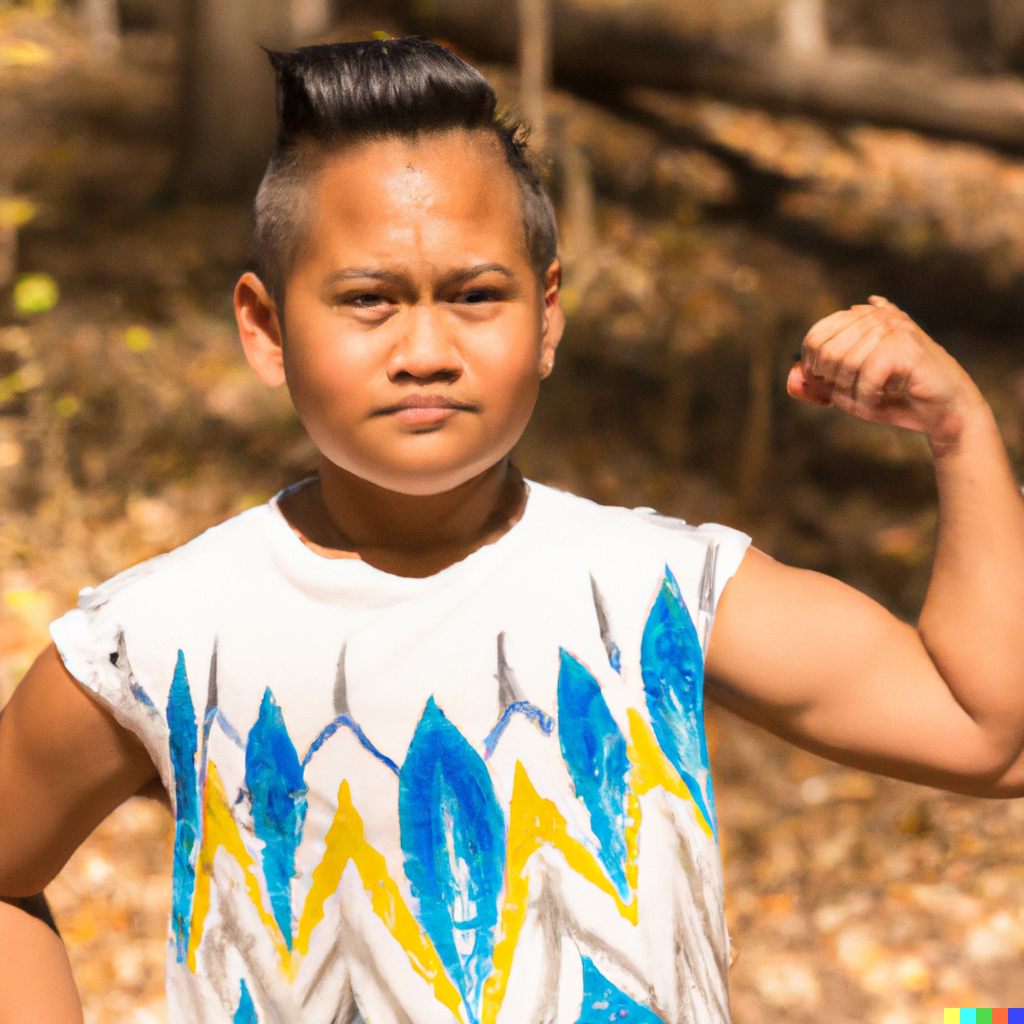
More DALL-E crazy.

Q&A | Daughter of A Lost Bird | 2021 iN Festival | 2022 FESTIVAL


Film Festival 


Together 

Vision Maker Media, Lincoln, NE/USA 

October 10 - November 13, 2022 

https://visionmakermedia.org/festival2022

(hybrid, online) 

Vision Maker Media announces its ninth biennial Vision Maker Film Festival, October 10 to November 13, 2022, in Lincoln, NE and free streaming online.

“Together” encompasses a collection, group, and union in or one place.

Vision Maker Media is celebrating “Together” by gathering American Indian and Alaska Native films for an assembly of in-person and online streaming for the collective. Vision Maker Media chose to recognize “Together” with a graphic of worldwide Indigenous language interpretations of the word “together” to recognize UNESCO and Mexico’s Decade of Indigenous Languages (2022-2023) declaration that calls for “indigenous peoples’ rights to freedom of expression, to an education in their mother tongue and to participation in public life using their languages, as prerequisites for the survival of indigenous languages many of which are currently on the verge of extinction.” 

Contact Email: Visionmaker@unl.edu

Monday, October 10, 2022

Horrible, True Facts about #Columbus and #ColumbusDay


This video is about the Horrible and Terribly True Facts about Christopher #Columbus & #ColumbusDay - The history of Columbus involves, Slavery, Sexual Slavery, Murder, Rape, Torture and horrible persecution of Native people that Columbus described as peaceful and generous. 

Please read my original article here - https://goo.gl/gbVgC9 

Here is my entire list of resources - https://goo.gl/pKAZi7 

Follow Human Rights Award-Winning Author, ICT Associate Editor and Public Speaker Vincent Schilling (Akwesasne Mohawk) on Twitter: http://www.twitter.com/VinceSchilling

Sunday, October 9, 2022

Lakota Human Remains Stolen from US Army Massacre Hoarded by Private Museum in Massachusetts


 UPDATE

I'm happy to report a successful outcome in the fight to correct this
shameful chapter in US history. Mia Feroleto invited LAURA BRUNO to attend (via
Zoom) "a joint announcement from the board of directors of the Barre
Museum Association and the Oglala Sioux Tribe to learn about current
plans for disposition of the sacred objects held at the Woods Memorial
Library for more than 100 years.

"A
press conference is scheduled for Monday, October 10th at 2:00 p.m.
Eastern Time
, 12 Noon Mountain Time when the repatriation of the
artifacts and remains taken from the Wounded Knee Massacre will be
shared with the media. This press conference will be conducted in person
at the Woods Memorial Library in Barre, Massachusetts, located at 19
Pleasant Street and live via Zoom."


Saturday, October 8, 2022

Historian Roxanne Dunbar-Ortiz: Indigenous Peoples’ Day Shared with Columbus Day (2021)...


2022, just 14 states

Confused?
 

Indigenous Peoples Day


Wednesday, October 5, 2022

The History & Future of The Indian Child Welfare Act (Session 1)

Penn Law/Field Center Session on the Origins and History of the Indian Child Welfare Act (VIDEO)๐Ÿ‘‡


Briefing Completed in Haaland v. Brackeen [ICWA]


With the reply briefs filed yesterday, all of the briefing
is completed in the Supreme Court case Haaland v. Brackeen. Oral
argument will be at the Court on November 9th. There will be a decision
before the end of June, 2023, though there's no good way to determine
when that will arrive other than that.


Tuesday, October 4, 2022

Digging up Human Remains in Michigan


The End of a Michigan Law Allowing Scientists to Dig Up “Aboriginal Inhabitants”

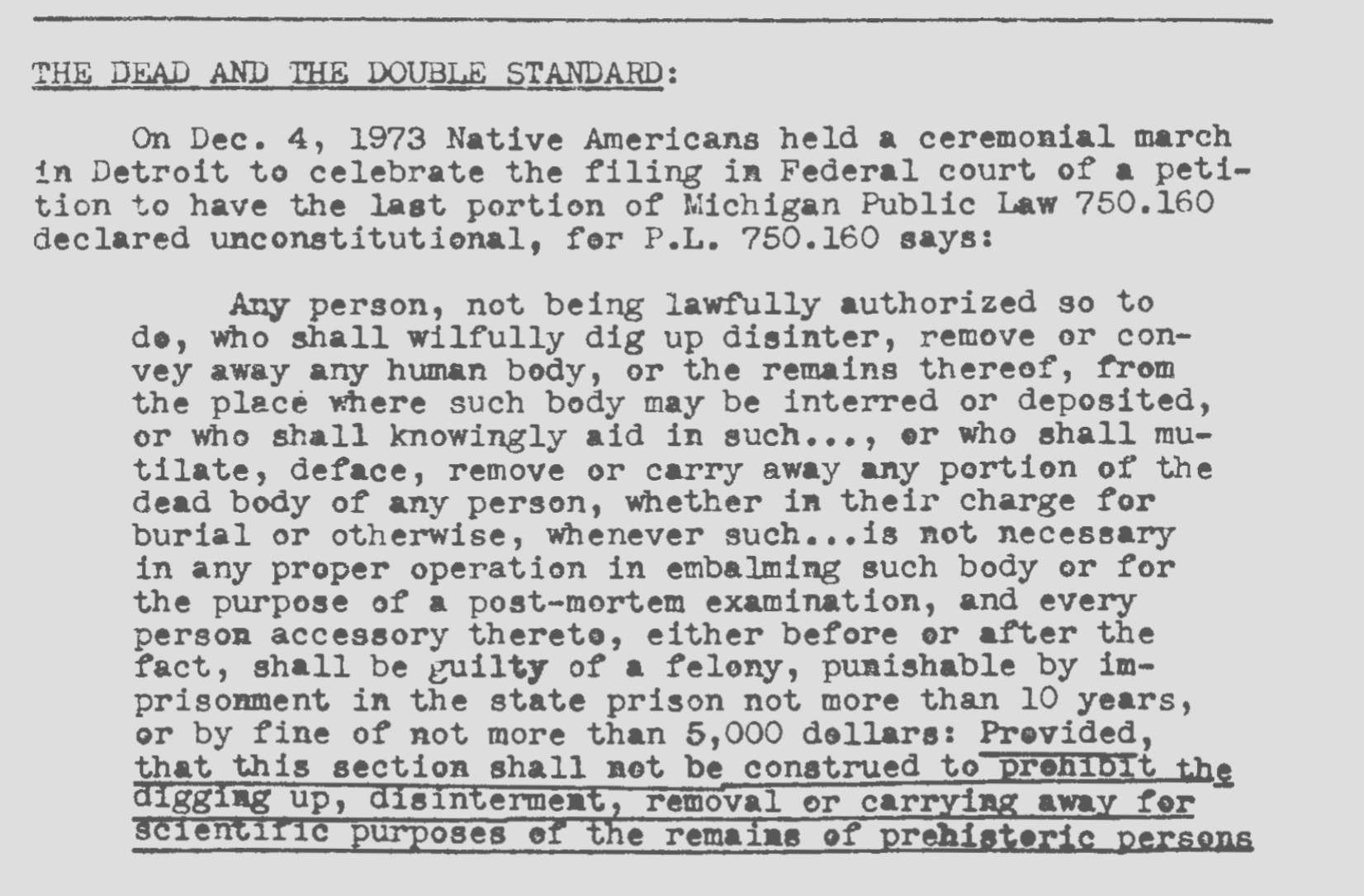
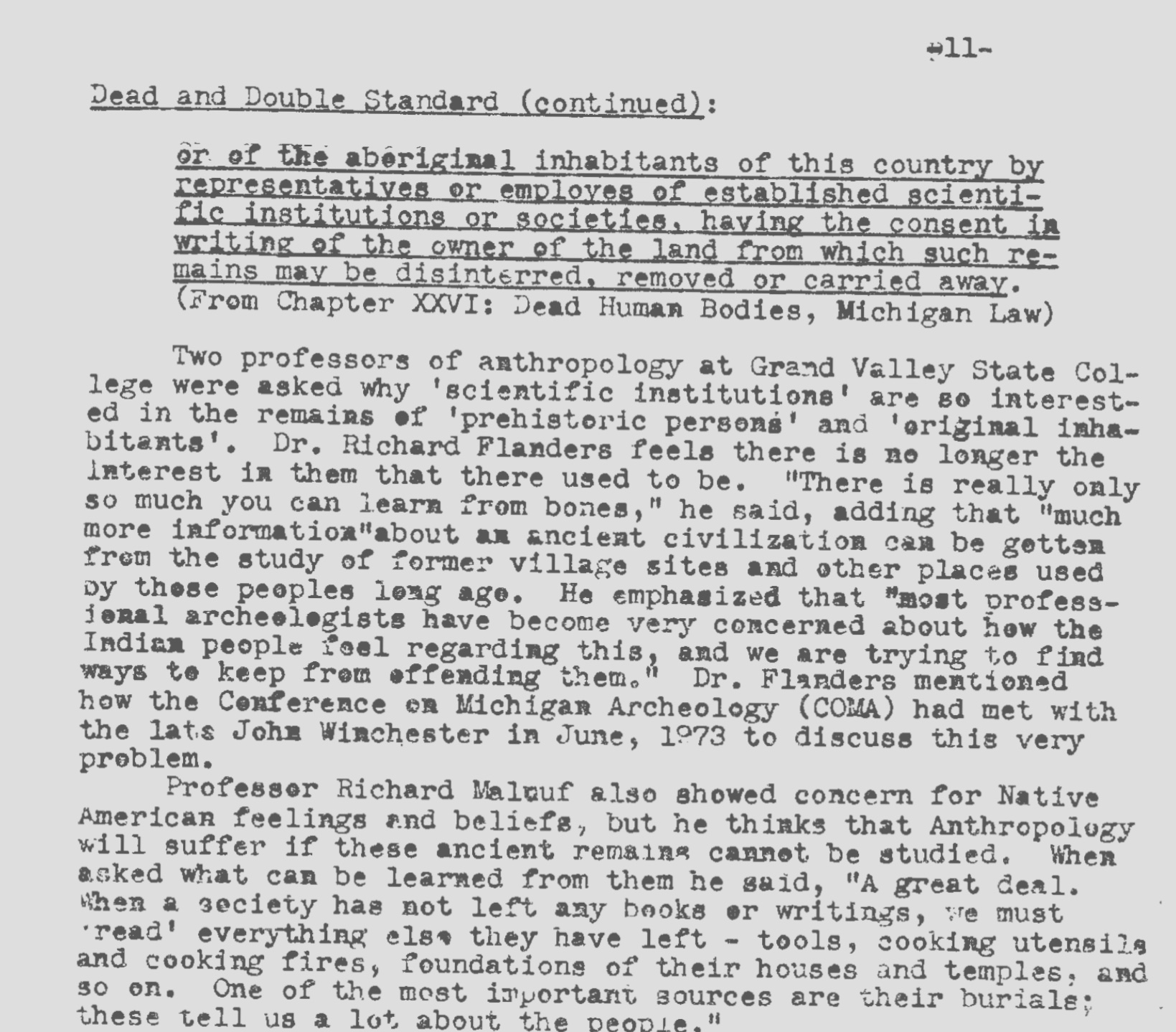
Came across this short note in Indian Talk, a 1973 newsletter by and about Michigan Indians and a precursor to the original Turtle Talk, referencing a federal lawsuit filed to have Michigan public law 750.160 declared unconstitutional. That law prohibited Dr. Frankenstein and others from digging up graves, but granted an exception to Indiana Jones in case he found some Indian bones:

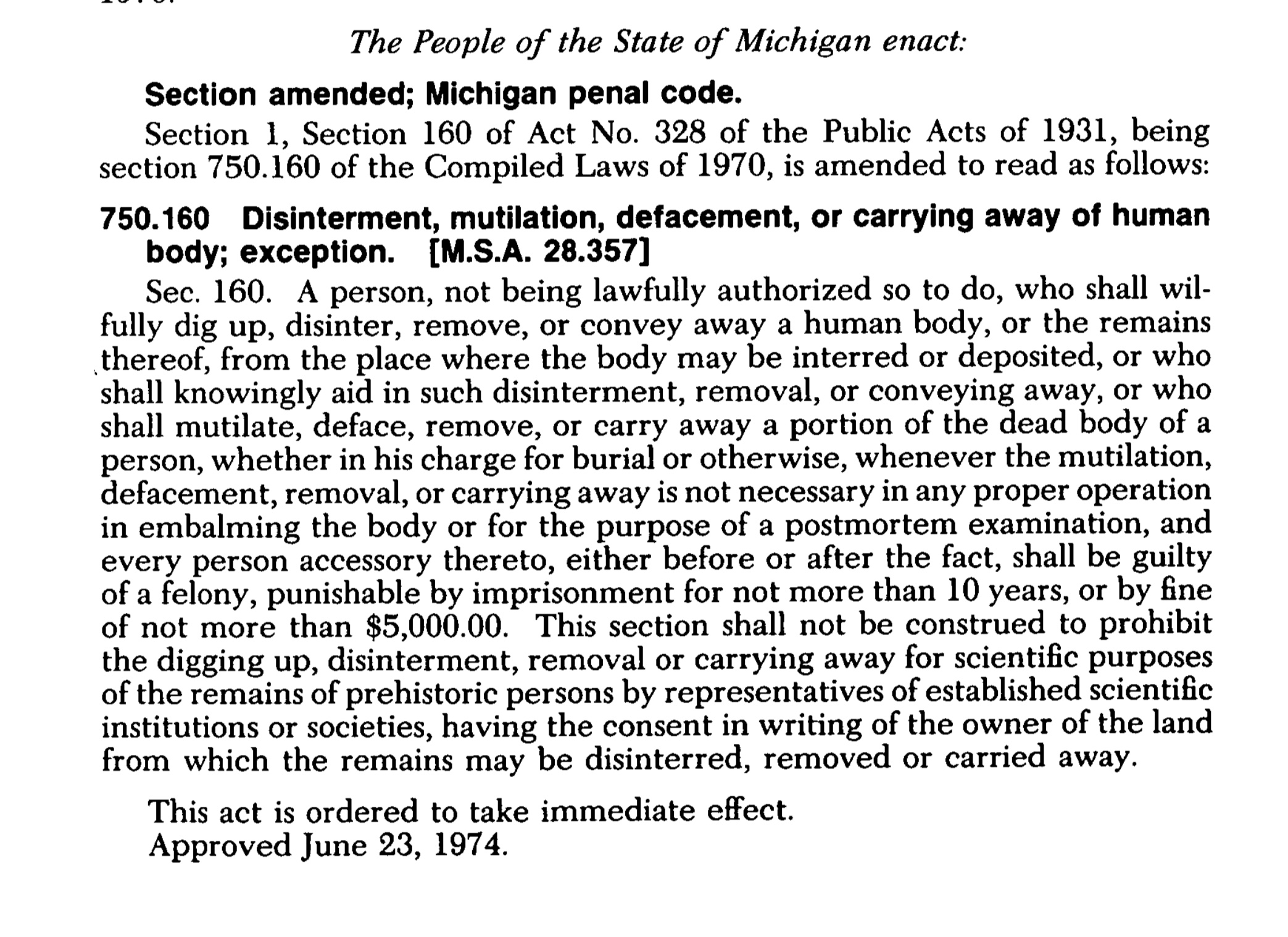
Shay Elbaum at the Michigan law library found a 1974 law repealing the part about “aboriginal inhabitants.”

Can’t find a record of the lawsuit, however. It probably went away when the state legislature repealed the exception.

Monday, October 3, 2022

I call them BONE COLLECTORS and LOOTERS

 I do call them BONE COLLECTORS and LOOTERS... Trace

Canadian Museums Association Urges Repatriation of Indigenous Objects, BONES

The report estimates that 6.7 million Indigenous objects and human remains continue to be held in Canadian institutions, most of which do not have formal repatriation policies.
A display in the First Peoples Hall of the Canadian Museum of History in 2018 (via Wikimedia Commons)

A major new report released on Tuesday, September 27 by the Canadian Museums Association (CMA) calls for greater support and funding for Indigenous organizations and museums as they pursue Indigenous “self-determination” at all levels of governance. 

The CMA estimates that 6.7 million Indigenous objects and human remains continue to be held in Canadian museums, with approximately 94% of them held in eight institutions. The report finds that few museums have formal repatriation policies and that even fewer of them are publicly accessible. Currently, only one province, Alberta, has repatriation legislation. The report also finds that although many museums showcase Indigenous-related programming and say they value Indigenous engagement, Indigenous curators and staff members are underrepresented, suggesting that Indigenous professionals are often slotted into advisory roles.

“We were already aware of the colonial legacy of museums,” Rebecca Mackenzie, co-author of the report, said in an interview with Hyperallergic. “This presented an opportunity to really determine to what level Indigenous communities have been allowed to have self-determination in [museum] spaces.”

A new report released by the Canadian Museums Association offers a set of standards and recommendations for museums to enact Indigenous self-determination.

Research for the report has been ongoing for over three years and has involved almost a dozen engagement sessions and interviews with Indigenous heritage professionals and community leaders, a survey of over 300 museums, and a key performance indicator study of 84 Canadian institutions.

The report, entitled “Moved to Action: Activating UNDRIP in Canadian Museums,” was commissioned as part of the nation’s response to Call to Action 67, one of 94 calls to action issued in 2015 by the country’s Truth and Reconciliation Commission (TRC). The TRC was established to reckon with Canada’s history of Indian residential schools, which forcibly separated Indigenous children from their communities for purposes of assimilation.

In 2015, the TRC’s report indicated that approximately 150,000 children were removed to residential schools and concluded that the educational system constituted cultural genocide. Since the conclusion of the TRC’s work, researchers have discovered thousands of unmarked graves at residential school sites. 

Call to Action 67 petitioned the federal government to supply the CMA with funding “to undertake, from collaboration with Aboriginal peoples, a national review of museum policies and best practices” to assess compliance with the United Nations Declaration on the Rights of Indigenous Peoples. Adopted by the General Assembly in 2007, the declaration was only formally adopted by Canada in 2021, and emphasizes Indigenous rights to self-determination and to the maintenance of their cultural practices. One article specifically delineates that nations must provide redress for cultural and spiritual property taken without consent.

“Reconciliation is a gift for museums,” the CMA report concludes.

Of the report’s 10 recommendations, one urges the federal government to pass legislation mandating and funding repatriation efforts. Unlike the United States, Mackenzie explains, Canada does not have comparable legislation that requires federally funded institutions to return Native cultural items to Indigenous tribes and organizations. The report also recommends certain best practices for museums, such as hiring Indigenous professionals into permanent positions and consulting Indigenous rights holders to determine how to care for repatriated objects. 

“Reconciliation is a gift for museums,” the report stresses. “Together, we have an opportunity to be moved to enact and support Indigenous self-determination.”

“Indigenous communities have a story to say over what happened, how these objects are cared for, where they are, and how they’re presented,” Mackenzie says. “It’s going to take a cross-sector approach: governments, provinces, heritage organizations, coming together. The premise of this entire report is that implementing and supporting Indigenous self-determination is everybody’s job.”

BONE COLLECTORS: 6.7 million Indigenous objects and human remains held in Canada museums #TRC


Canadian Museums Association Urges Repatriation of Indigenous Objects


The report estimates that 6.7 million Indigenous objects and human
remains continue to be held in Canadian institutions, most of which do
not have formal repatriation policies.


A display in the First Peoples Hall of the Canadian Museum of History in 2018 (via Wikimedia Commons)


A major new report
released on Tuesday, September 27 by the Canadian Museums Association
(CMA) calls for greater support and funding for Indigenous organizations
and museums as they pursue Indigenous “self-determination” at all
levels of governance. 

The CMA estimates that 6.7 million Indigenous objects and human remains
continue to be held in Canadian museums, with approximately 94% of them
held in eight institutions. The report finds that few museums have
formal repatriation policies and that even fewer of them are publicly
accessible. Currently, only one province, Alberta, has repatriation
legislation. The report also finds that although many museums showcase
Indigenous-related programming and say they value Indigenous engagement,
Indigenous curators and staff members are underrepresented, suggesting
that Indigenous professionals are often slotted into advisory roles.

KEEP READING

The report, entitled “Moved to Action: Activating UNDRIP in Canadian
Museums,” was commissioned as part of the nation’s response to Call to
Action 67, one of 94 calls to action issued in 2015
by the country’s Truth and Reconciliation Commission (TRC). The TRC was
established to reckon with Canada’s history of Indian residential
schools, which forcibly separated Indigenous children from their
communities for purposes of assimilation.

Sunday, October 2, 2022

U.S. Supreme Court to hear oral arguments Nov. 9, 2022 on an Indian Child Welfare Act case, Brackeen v. Haaland

 #WHYICWAMATTERS

Tribes wait for Supreme Court decision in ICWA case

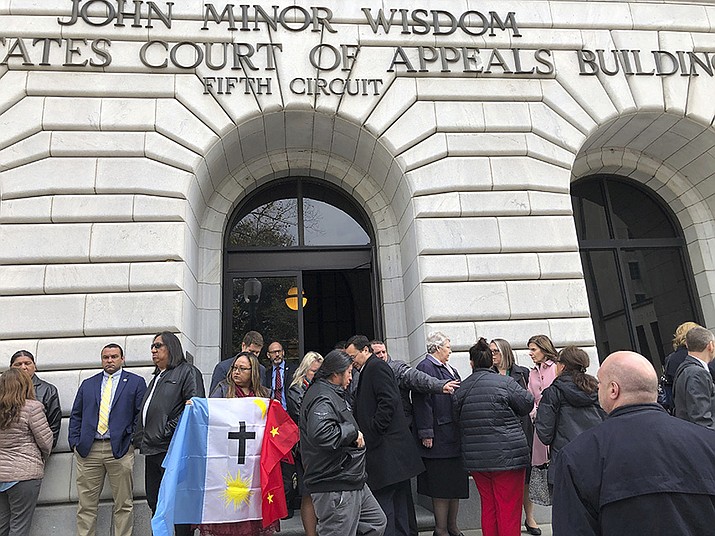
Rosa Soto Alvarez, of Tucson,, holds a flag of the Pascua Yaqui Tribe as she and other Native Americans stand outside the federal appeals court in New Orleans Jan. 22, 2020. Parts of a federal law giving Native American families preference in the adoption of Native American children were effectively struck down April 6, 2021 by a sharply divided federal appeals court, a defeat for Tribal leaders who said the 1978 law was important to protecting their families and culture. (AP Photo/Kevin McGill)

Rosa Soto Alvarez, of Tucson,, holds a flag of the Pascua Yaqui Tribe as she and other Native Americans stand outside the federal appeals court in New Orleans Jan. 22, 2020. Parts of a federal law giving Native American families preference in the adoption of Native American children were effectively struck down April 6, 2021 by a sharply divided federal appeals court, a defeat for Tribal leaders who said the 1978 law was important to protecting their families and culture. (AP Photo/Kevin McGill)

FLAGSTAFF, Ariz. — When the U.S. Supreme Court hears oral arguments Nov. 9, 2022 on an Indian Child Welfare Act case, Brackeen versus Haaland, its decision will decide the constitutionality of the act, which has been in place since 1978.

In February 2022, the U.S. Supreme Court announced it would hear a challenge to ICWA.

Texas, Indiana, Louisiana and other plaintiffs argued that ICWA is unconstitutional saying the act violates provisions of the Fifth Amendment that deal with equal protection and the Tenth Amendment’s prohibitions on issuing direct orders to states. The act says that Tribes are given the authority to decide adoption placement of Native children and states must comply.

While the appeals court ruled in April 2021 that Congress had authority to enact the law and that ICWA did not violate equal protections because it is not a race-based calculation, the Court of Appeals for the Fifth Circuit ruled that provisions of the act violate the 10th amendment because it “imposes” duties on the states, according to Scotusblog, a blog devoted to covering the U.S. Supreme Court comprehensively.

The U.S. government originally enacted ICWA in 1978 because of the large number of Native American children public and private agencies removed from their homes.

The act was designed to preserve Native American culture and heritage by giving Native American children and tribes a say in what happens to those children by establishing minimum standards for the removal of Native American children from their families. The act established a preference that Native children who are removed from their homes be placed with extended family members or in Native foster homes.

“Some who fiercely assert the evils of ICWA contend that all children should be treated equally and, therefore, ICWA should be dismantled,” said Terry Cross, former executive director of the National Indian Child Welfare Association (NICWA), in 2013. “This argument sounds reasonable to those unfamiliar with the long history that led to ICWA’s passage. At that time 20-30 percent of all American Indian children were removed from their homes…80 percent were placed, often permanently, in white homes.”

On Aug. 19, the National Council of Urban Indian Health, and five urban Indian organizations signed on to the National Indigenous Women’s Resource Center’s amicus brief to the Supreme Court in support of the constitutionality of the act, according to Indian Country Today.

An amicus brief, commonly known as ‘friend of the court’ is filed on behalf of an entity who is not one of the main parties in a case.

In the lower court, 486 Tribal Nations, 59 Native organizations, 31 child welfare organizations, 26 states and Washington D.C. and 77 members of Congress offered support for ICWA.

“These supporters recognize that ICWA is firmly in the best interests of Native children,” said a NICWA press release. “In keeping them connected to their extended family and cultural identity, the positive outcomes are far-reaching and include higher self-esteem and academic achievement. Further, they recognize that collaboration between sovereign Tribal nations and state child welfare systems is effective and just governance.”

University of Kansas professor Sarah Deer, filed an amicus brief with the court, with attorneys Mary Kathryn Nagle and Shoney Blake on behalf of two women who were adopted by white families, pre-ICWA, and struggled throughout their lives to reconnect with their tribal nations.

Deer works at the University of Kansas in the Department of Women, Gender and Sexuality Studies and the Public Affairs and Administration. She is also a MacArthur fellow and an inductee into the National Women’s Hall of Fame and is credited for her role in the 2013 reauthorization of the Violence Against Women Act.

Deer said Brackeen is the first Supreme Court case to address ICWA since Adoptive Couple v. Baby Girl in 2013.

In that case, a Cherokee father was ultimately ordered by the Supreme Court to turn over his biological daughter to a couple who sought to adopt her after the court decided that ICWA played no role in the case.

“There is more at stake in this case, however, because one of the questions to be resolved is whether ICWA is constitutional at all,” Deer said. “In other words, the Supreme Court could overturn ICWA.”

While people assume the purpose of ICWA is to take Native children away from white foster or adoptive parents, Deer said that typically happens only if ICWA is not followed from the beginning and/or is deliberately ignored.

“Native children in state court deserve to have their Nation involved in any long-term decisions about custody arrangements,” she said. “And ICWA is considered ‘gold-standard’ by numerous child advocacy groups, who appreciate the value of connecting Native children with their heritage and citizenship.”

Deer said the current numbers and make-up of the court make her worry what the outcome of the ruling may be.

“I’m trying to stay optimistic, but this particular court seems somewhat hostile to tribal nations,” Deer said. “In addition, Justice Roberts and Justice Coney Barrett are adoptive parents [of non-Native children]. As such, they may bristle at any argument that questions the value of adopting children outside the tribal nation. [Justice] Clarence Thomas also has a history of suggesting — in dissents — that all Indian law is potentially unconstitutional.”

Oral arguments are to take place Nov. 9. The Supreme Court will issue a decision by June 30, 2023.

Indian Country Today contributed to this report

SOURCE

Saturday, October 1, 2022

October: Domestic Violence Awareness Month


StrongHearts Native Helpline Statement 2022 Domestic Violence Awareness Month

(EAGAN, Minn., September 26, 2022) — During Domestic Violence Awareness Month in October, StrongHearts Native Helpline once again is raising awareness about domestic violence and supporting and honoring survivors and victims. As in past years, StrongHearts asks that domestic violence advocates, tribal leaders, reservation and urban Indigenous community members, service providers and Indigenous organizations come together to support and strengthen the movement to prevent and end domestic violence once and for all.

According to the National Institute of Justice, domestic violence disproportionately impacts Native Americans and Alaska Natives, with more than 1.5 million Native women and 1.4 million Native men experiencing violence during their lifetime, often by non-Native perpetrators.  Domestic violence has many faces: physical, sexual, emotional, cultural, financial and digital.  Domestic violence doesn’t discriminate; and anyone can experience domestic violence, including children, women, men, elders and LGBTQ2S+ individuals.  There is also a strong connection between domestic violence and thousands of Missing and Murdered Relatives.

Native nations in the Lower 48 and Alaska Native Villages continually go underfunded for life-saving  domestic violence services.  Now in its fifth year of operation, StrongHearts has received more than 25,000 calls from relatives requesting critically needed support to deal with intimate partner violence.

During Domestic Violence Awareness Month, StrongHearts Native Helpline is dedicated to eradicating domestic and sexual violence by utilizing a core message of healing. “As traditional people, it is customary to put our loved ones before ourselves; we do this because we love them and want to take care of them,” says StrongHearts Chief Executive Officer Lori Jump (Sault Ste. Marie Tribe of Chippewa Indians). “When it comes to healing, we must make the fundamental decision to take care of ourselves and to teach our children that whatever it takes, it’s okay to love ourselves enough to heal from the trauma of domestic and sexual violence.”

“With tenacity, StrongHearts Native Helpline will continue our mission to restore power to our relatives impacted by domestic violence by providing a system of safety, sovereignty, support and healing,” says Jump. “During October and, indeed, throughout the year, we envision the restoration of our traditional lifeways where everyone is safe, domestic violence is eradicated, and sacredness is restored.”

About StrongHearts Native Helpline

StrongHearts Native Helpline is a 24/7 culturally-appropriate domestic, dating and sexual violence helpline for Native Americans and Alaska Natives, available by calling or texting 1-844-762-8483 or clicking on the chat icon at strongheartshelpline.org. Advocates offer peer support, crisis intervention, safety planning and referrals to Native-centered services. StrongHearts Native Helpline is a proud partner of the National Domestic Violence Hotline and the National Indigenous Women’s Resource Center.

CLICK OLDER POSTS (above) to see more news

CLICK OLDER POSTS  (above) to see more news

MEGWETCH THANK YOU

HUGE Thank you for visiting this blog and sharing this with your kin. It's appreciated. Contact Trace anytime! Use the form below.

BOOKSHOP

Please use BOOKSHOP to buy our titles. We will not be posting links to Amazon.

Popular Posts

To Veronica Brown

Veronica, we adult adoptees are thinking of you today and every day. We will be here when you need us. Your journey in the adopted life has begun, nothing can revoke that now, the damage cannot be undone. Be courageous, you have what no adoptee before you has had; a strong group of adult adoptees who know your story, who are behind you and will always be so.

OUR HISTORY

OUR HISTORY
BOOK 5: Lost Children of the Indian Adoption Projects