This blog was a backup for American Indian Adopteesblog
USE THE SEARCH BAR or SEARCH TOPICS at bottom of this blog
If you need support
Support Info: If you are a Survivor and need emotional support, a national crisis line is available 24 hours a day, seven days a week: Residential School Survivor Support Line: 1-866-925-4419. Additional Health Support Information: Emotional, cultural, and professional support services are also available to Survivors and their families through the Indian Residential Schools Resolution Health Support Program. Services can be accessed on an individual, family, or group basis.” These & regional support phone numbers are found at https://nctr.ca/contact/survivors/ .
MY EMAIL: tracelara@pm.me
WHAT STATES have open access to adoption records and your OBC (original birth certificate) - 9 states currently allow for unrestricted access to OBC :: read here
Access to Original Birth Certificates
IOWA Adoptees may now receive a noncertified copy of the certificate of birth prior to adoption
HF855 was signed into law on May 19, 2021. This new legislation allows an adult adoptee to apply for a noncertified copy of the original certificate of birth prior to adoption immediately. If the adult adoptee is deceased, an entitled family may apply for the record.
Beginning January 1, 2022, any adult adoptee 18 years old or older may apply for a noncertified copy of the original certificate of birth prior to adoption. If the adult adoptee is deceased, an entitled family may apply for the record.
Proper application, proof of identity and entitlement must exist before a noncertified copy of the original certificate of birth may be issued to any party.
Contact preference forms and medical history forms may be on file for the biological parent(s) named on the record. If the contact preference forms and medical history forms are on file, the forms will be released with the noncertified original certificate of birth.
Biological parents may state their preference to release their identity and option for contact, or for their identity to be redacted from the original certificate of birth prior to adoption.
An original noncertified certificate of birth prior to adoption may be released regardless of any contact preference forms being filed when proper application has been made and proof of entitlement exists.
EXPECTED PROCESSING TIME TO COMPLETE COPY REQUESTS SUBMITTED IS 6 TO 8 WEEKS
The new law allows an adult adoptee to request and receive a noncertified copy of their original certificate of birth that was created prior to their adoption. Biological parent information is listed on this document.
The new law allows biological parents to file contact preference and medical history forms with the Bureau of Health Statistics. These forms shall be released to the adult adoptee or entitled person upon proper application.
Who else can request a noncertified copy of the original certificate of birth for an adoptee?
An entitled person may request and receive a noncertified copy of the original certificate of birth prior to adoption if the adoptee is deceased.
Who is an entitled person?
An entitled person is the spouse of the adopted person who is deceased, or an adult related to the adopted person who is deceased within the second degree of consanguinity. The second degree of consanguinity is applied to individuals after adoption.
Who is within the second degree of consanguinity?
The following individuals are within the second degree of consanguinity of the adult adoptee: children, parents, grandchildren, siblings and grandparents.
Can an original noncertified copy of a birth certificate prior to adoption be released if no contact preference form has been filed?
Yes.
If I am a biological parent listed on an original certificate of birth prior to adoption, when can I filed a contact preference form and medical history form?
The Bureau will accept contact preference forms and medical history forms immediately. If the contact preference form and medical history form is submitted to the Bureau of Health Statistics after the release dates noted above, adult adoptees or entitled persons may have requested the original certificate of birth prior to adoption. Contact preference forms and medical history forms are provided with the noncertified original certificate of birth once filed.
Applications for a noncertified copy of the original certificate of birth prior to adoption, contact preference and medical history forms will only be accepted via mail or in-person at the Bureau of Health Statistics. These forms will not be filed at any other issuing office.
Mail contact preference and medical history forms to:
Iowa Department of Public Health Bureau of Health Statistics Lucas State Office Building 1st Floor, 321 E. 12th Street Des Moines, Iowa 50319-0075
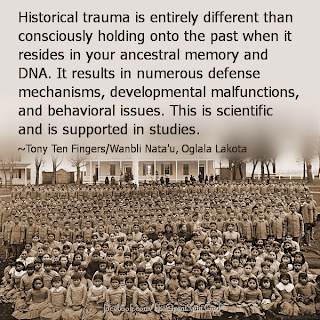
The upcoming Why Repatriation is Important livestream event will focus on repatriation of the children who died at Indian boarding schools as well as the healing that needs to take place in tribal communities to overcome the intergenerational trauma associated with Indian boarding school experiences.
Across the United States, many former Indian boarding schools have cemeteries on their grounds, including the former Carlisle Industrial Boarding School in Pennsylvania. The graves of deceased Indian children buried at Carlisle fall under the control of the U.S. Army, which has taken the position that the graves of Indian children buried there are not subject to the Native American Graves Protection and Repatriation Act (NAGPRA). Many Indian law experts disagree with the U.S. Army’s stance.
The 1st time I spoke out on any Native issue was the #BabyVeronica case involving a Cherokee child, trafficked across state lines in a for-profit adoption. Media coverage of her Cherokee dad, of her tribe, of her right to both was *atrocious*. Ignorance, racism, clear bias. https://t.co/VZml4eftwo
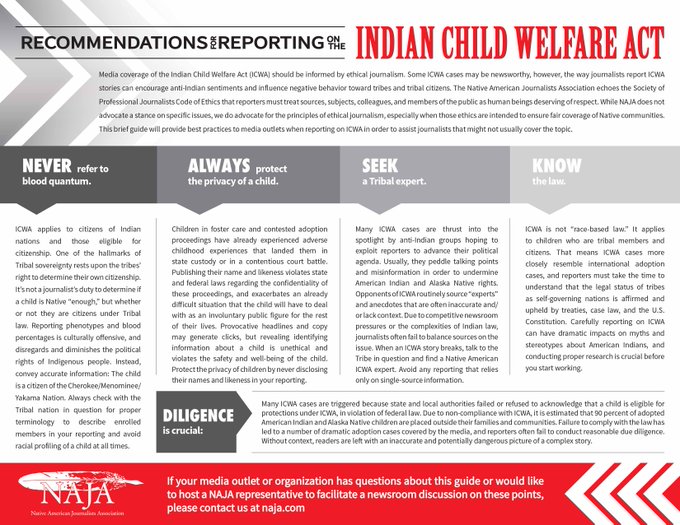
⚖️#SCOTUS agreed to hear 4 consolidated cases that test #ICWA provisions. Here is @najournalists ICWA reporting guide. ‘Cases may be newsworthy, however, the way journos report can encourage anti-Indigenous sentiments & negative behavior toward tribes.’ - https://t.co/GZUXugx6vMpic.twitter.com/tHwnA2JvSC
— Native American Journalists Association (@najournalists) February 28, 2022
@DrPhil hosted a show painting #ICWA, the law enacted to slow the decades-long theft of Native kids, & Veronica’s tribe badly. @NPR was just as biased. Journalistic integrity & the powerful money interests backing ICWA attacks, nowhere in sight.
This blog posted many times about BABY V and the propaganda and misinformation and outright lies about the Baby Veronica case and how (adoption) trafficking in children (like her case) was rampant among affluent whites. Dr. Phil "Hollywoodized" Adoption Propaganda is what I called it. TL Hentz, Blog Editor
Kapawe'no First Nation said Tuesday that ground-penetrating radar and a specialized drone were used to find evidence of 169 potential graves at the former Grouard Mission site. This file photograph shows Bishop Émile Grouard with school children, circa 1924. (Submitted by the Catholic Archdiocese of Grouard-McLennan)The residential school, also known as St. Bernard Mission School, was opened by the Roman Catholic Church in 1894 and ran until 1961.
A northern Alberta First Nation says 169 potential graves have been found using ground-penetrating radar at the site of a former residential school. https://t.co/I1H2S0JHsy
The U.S. Supreme Court agreed to hear Texas v. Haaland, a case seeking to overturn the Indian Child Welfare Act.
The high court said Monday morning it would take the case reviewing the 1978 federal law. Many call the Indian Child Welfare Act a gold standard for child welfare policy.
A federal appeals court in April upheld the law and Congress' authority to enact it. But the judges also found some of the law's provisions unconstitutional, including preferences for placing Native American children with Native adoptive families and in Native foster homes.
“The far-reaching consequences of this case will be felt for generations,” stated the National Indian Child Welfare Association in a statement. “In a coordinated, well-financed, direct attack, Texas and other opponents aim to simultaneously exploit Native children and undermine tribal rights.”
ICWA has long been championed by tribal leaders to preserve Native families and cultures involving Native children, and it places reporting and other requirements on states.
Native Women in Film & Television in All Media – Film Festival. The first and largest representation of Native and Indigenous Women Filmmakers. NWIFTV is a program of Red Nation Celebration Institute. NWIFTV serves under its fiscal partner Red Nation Celebration Institute The Creative Enterprise by Natives delivering to all people the stories that shape our world. RNCI the pioneer longest standing Native Women-Led Indigenous Media, Arts & Cultural nonprofit in the City of Los Angeles, Empowering Native and Indigenous Storytellers.
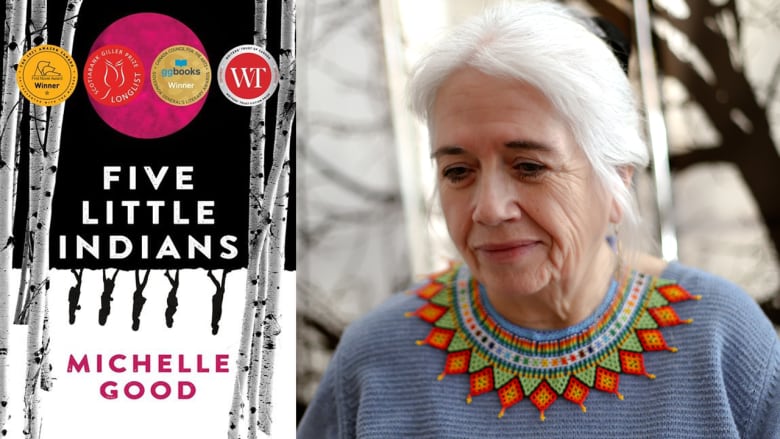
Christian Allaire is defending Five Little Indians by Michelle Good on Canada Reads 2022
CBC Radio ·
Five Little Indians is a novel by Michelle Good. (HarperCollins, Silken Sellinger Photography)
WARNING: This story contains distressing details.
Michelle Good is a writer, retired lawyer and a member of Red Pheasant Cree Nation in Saskatchewan. Her poems, short stories and essays have been published in magazines and anthologies across Canada.
Good's debut novel Five Little Indians is a bestselling book thatchronicles the quest of five residential school survivors — Kenny, Lucy, Clara, Howie and Maisie — to come to terms with their past and find a way forward. Released after years of detention, the five teens find their way to the seedy and foreign world of Downtown Eastside Vancouver, where they cling together, striving to find a place of safety and belonging in a world that doesn't want them.
The news has had an emotional effect on Good, who is currently based in southern British Columbia. She spoke with Shelagh Rogers about why she wrote Five Little Indians — and why the legacy of Canada's residential school system stays with her.
Calls to action
"That first weekend after the Kamloops announcement was really rough. I told a friend of mine that I felt catatonic after that announcement. It's not because we didn't know. We did know. People have been talking about this for years and years. But there's never been any support to resolve this, to do what the band has done themselves.
"But the thing that really, really bothers me — and it actually infuriates me and I try to stay away from being infuriated — is in 2015, when the Truth and Reconciliation report was issued, there are six calls to action, 71 through 76, that are up here under the heading of 'missing children and burial information.'
"Murray Sinclair and the other commissioners basically gave the federal government a roadmap for how to address this issue through those calls to action. They developed a budget to go with it. And the federal government said no.
I would bet you my bottom dollar, you're going to find one of these grave sites virtually at every residential school.
"So when I hear the prime minister speaking about how 'all children matter' and flying the flags at half mast, it's a lovely symbolic gesture. But it does nothing. What they need to be doing is providing the resources, the expertise and the support.
"They need to protect these lands. I would bet you my bottom dollar, you're going to find these grave sites at virtually every residential school."
The half-life of trauma
"There was a reason that I chose to pick up the story upon the release of the characters, whether it's escape or when they age out or whatever. Through all of the work that's been done in the form of memoir, in the form of the Truth and Reconciliation report, I think that there is some understanding of the nature of the abuse that children suffered.
"What was missing was how that trauma has a half-life that continues for generation upon generation upon generation. When people ask that question, 'Why can't they just get over it?' I've started to transpose that into another question, which is, 'What is it that they're asking us to forget and get over?'
We simply cannot forget 120 years of colonial brutality.
"It was 120 years of taking every school-aged child from our community — from their parents, grandparents, aunts, uncles, siblings. Are they asking us to forget that? And how could we?
'It's had such an impact on the integrity of our cultural cohesion, which was the intent. So, no, we simply cannot forget 120 years of colonial brutality."
"I went to the MFA program at UBC to write this book — but I had no idea what I was doing or what it was going to look like. It started with Kenny; it started with me writing about those first pages with that character.
One of the impacts of this kind of abuse...is a real struggle to maintain meaningful relationships in your life.
"I immediately realized that I needed more characters because to be able to express the scope, the range of injury that was suffered by kids, I needed more than one person. There were so many forms of abuse: abuse that was specific to young girls, and abuse that was specific to young boys.
"One of the impacts is a real struggle to maintain meaningful relationships in your life. So that was another thing that I wanted to demonstrate through the relationships between the characters. But the other thing is that when you have five characters, you have a community. And that's what these kids were to each other.
"They created a community for each other."
This week the Governor General's award for literary fiction was given to Michelle Good for her debut novel about residential school survivors. Breakaway guest host Peter Tardif talks with her about the book and the recent discovery in Kamloops, B.C. 9:30
What stays with me
"The characters from the novel have been in my life for many years. They came to feel like my kids, as though they were my children. I still find myself reaching for them in my mind.
"Many, many survivors have reached out to me and given me some very strong and supportive feedback. They've told me that they could see themselves in these stories and that they were grateful to have these stories out in the world — for the same purpose that I have in putting them out in the world.
The characters from the novel have been in my life for many years...I still find myself reaching for them in my mind.
"That, more than anything, is really, really satisfying."
Support is available to anyone affected by their experience at residential schools and to those who are triggered by the latest reports.
A national Indian Residential School Crisis Line has been set up to provide support to former students and those affected. People can access emotional and crisis referral services by calling the 24-hour national crisis line: 1-866-925-4419.
T he Métis National Council and the Government of Canada will be working collaboratively, Nation-to-Nation, to develop a process to engag...
To Veronica Brown
Veronica, we adult adoptees are thinking of you today and every day. We will be here when you need us. Your journey in the adopted life has begun, nothing can revoke that now, the damage cannot be undone. Be courageous, you have what no adoptee before you has had; a strong group of adult adoptees who know your story, who are behind you and will always be so.
OUR HISTORY
BOOK 5: Lost Children of the Indian Adoption Projects