(reblog) Listen to the comments he makes about adoption and blood quantum- it is vital we understand.
It is now National Adoption Awareness Month (#NAAM2023) - we will be posting more on the topic of adoption all month.
(reblog) Listen to the comments he makes about adoption and blood quantum- it is vital we understand.
It is now National Adoption Awareness Month (#NAAM2023) - we will be posting more on the topic of adoption all month.

As you are probably aware, November is Native American Heritage Month here in the United States. A time we often use to connect and celebrate our various cultures and appreciate that we are still here. We have many native people here in Oregon who are from tribes both local, and far away – federally recognized or not. With Oregon’s history it can be especially important to reflect on how we came to be here, how we can interact with the systems in place, and how we can bring our vibrancy and cultures to the forefront of healing and moving forward together.
With those things in mind, you are invited to our 4th annual “Thanks-taking” talk, this year with a side of ICWA (Indian Child Welfare Act) basics. We’re celebrating as a community the Indian Child Welfare Act (ICWA) being upheld by the supreme court, and we know some people may have questions. All members are welcome, you don’t have to be indigenous to participate. It will be happening during our usual Indigenous People’s Caucus meeting time (on the third Tuesday of the month) 11/21/23, at 6pm on Zoom. Feel free to invite others and register here.
I also encourage you to look into the history of Native American Heritage Month, think about your “Landcestors” – the people who historically lived where you live now, and best of all, look at some really good art. Here’s a great place to start, at least for the art portion.

From: Jean Jones, Any pronouns accepted and respected, Co-Chair of the SEIU 503 Indigenous Peoples Caucus

.jpg)
By Trace L Hentz (blog editor and adoptee)
Adoptee Clarissa Pinkola Estés, a psychologist who wrote Warming the Stone Child, said that those who have been “abandoned” and face it and work through it can become the strongest people on the face of the earth.
A few days ago I wrote a brand new blog post about an adoptee I am trying to help. She was born in Utah and now lives in another country.
Strange issues with google blogger are happening more often now. (It might be bugs, a.i. or just bots.)
Two hours I was writing this blog post then it vanished when I went to hit “publish.” Gone, Poof.
That leads me to this: we may lose this blog. It’s entirely possible. Strange bad things are happening on the internet. There are days we have no ethernet or internet connection at all. I live in western Massachusetts.
I do have a back-up blog: https://americanindianadoptees.blogspot.com/ that I updated in June 2023 with all the posts on this blog/website. I don’t want us to lose everything.
For safety I am
going to make a third blog. Here is that link. [https://iapbabies.blogspot.com]
What writing did I lose? I wrote about “what do we need as adoptees.”
For example, this adoptee was told her adoption was private, but in order to create a birth certificate, they’d need a lawyer and a judge. So there had to be a hearing in Utah.
She was born in 1981 but her birth certificate is dated 2006. That’s strange: 25 years later?
There is nothing on it: which hospital, time of birth, her weight, etc., stuff that you normally see on a birth certificate. She may not be born in Utah.
It’s essentially blank with her adoptive parents listed as her birth parents.
The information she needs is not there.
I made a few suggestions:
Register with the Utah DHHS adoption registry. Of course there is a fee.
I also suggested she get a DNA test. At least she’d find a relative.
But that is the problem too. Native people are not keen on doing a DNA test and having their blood in a database.
DNA testing is helping and has helped many adoptees get past the barbaric system called “adoption” and sealed adoption files.
Or in her case, a private adoption that may have been done illegally. We don’t know. Her adoptive mother has passed and her adoptive parents divorced when she was two years old. Did they buy her? Where is her birthmother? What tribe is she from?
There are eight federally recognized tribes in Utah.
November is Adoption Month or Adoption Awareness Month. Same thing. Same propaganda.
More tomorrow. Part 2
November is Adoption (beware) Awareness Month

|
|
October 26th, 2023
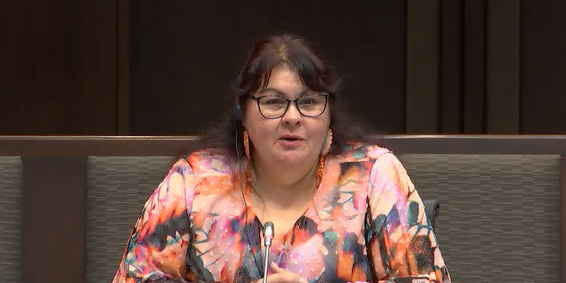
Saskatchewan Treaty Commissioner Mary Musqua-Culbertson didn’t mince words when she spoke to members of the Senate Committee on Indigenous Peoples Oct. 25 about the difficulty in accessing Catholic Church records for Indigenous residential schools.
Not only has her office come up against barriers in trying to acquire student records for four of the former Indian residential schools in the Prince Albert diocese, but staff had to sign a non-disclosure agreement (NDA) for 21 years in order to access the diocese records they were told were housed at St. Paul University in Ottawa. However, she says, Prince Albert diocese records were never found there.
“Who specifically asks for a 21-year NDA? Who within their organization needs to die within that 21 years that is being protected?” asked Musqua-Culbertson, a lawyer who added that 21 years is not a usual timeframe.
“There is still people who are responsible for sexual abuse and deaths that are still alive that are still out there and they’re walking about within our institutions and in churches and in religious organizations. I do believe that religious organizations are there to protect religious organizations and the people within them,” she said.
Musqua-Culbertson drew the connection between persons of interest (POI) who were named by survivors during the Independent Assessment Process (IAP). The IAP was used as part of the Indian Residential Schools Settlement Agreement (IRSSA), signed in 2006. Through the IAP, survivors had to recount how they were sexually or physically abused in order to receive compensation beyond what the base common experience payment was.
Musqua-Culbertson served as legal counsel during the IAP.
“So you have these vast lists of POIs. Where is that database? Could that be a database? Because POIs are still protected…Those are people who were named as abusers,” she said.
She also pointed out that the IAP records will be destroyed unless survivors state otherwise.
Musqua-Culbertson recounted numerous incidents where the diocese gave her staff difficulties as they tried to access residential school records, including promising to release records and then reneging on those promises.
“When we come back up against this (many) barriers when it comes to the graves of missing children, it’s very disheartening,” she said.
The Office of the Treaty Commissioner of Saskatchewan officially built its library and archives in 2020, although documents began to be collected in 1989. In the past few years, the office has started to collect documents and church records relating to the four Indian residential schools of Delmas (west of Thunderchild First Nation), St. Anthony’s (Onion Lake Cree Nation), Beauval (English River La Plonge Reserve) and St. Michael’s (Beardy’s and Okemasis and One Arrow First Nations).
Raymond Frogner, head archivist for the National Centre for Truth and Reconciliation (NCTR), also recounted the frustrations involved with working with the Catholic Church. Centre researchers are combing through the oblate records housed at Société historique de Saint-Boniface (Manitoba) and Deschâtelets-NDC Archives (Quebec).
“We….are currently funding researchers to go into their archive, go through their records and tell them what records they have that they’ve been holding for decades. Tell them which ones are actually relevant to residential schools…They’re also asking us to pay for the digitization of those records because they aren’t digitized,” said Frogner.
“We all know the Catholic Church did not pay the compensation that they originally were assigned to pay up for the IRSSA.”
Four churches were signatories to the settlement agreement. While the Anglican, United, and Presbyterian churches have paid their agreed-upon negotiated amounts, the Catholic Church has fallen well short.
Frogner said that the archive at the NCTR held approximately four million records largely focused on the daily administration and operation of the schools.
“There is not a single one of the 141 schools that were part of IRSS agreement …that has a complete set of admission records, discharge records or quarterly returns. This is because, partly, the quality of record keeping was abysmal, to put it lightly,” he said.
Frogner recommended moving away from the legal perspective set out for the records to start to search the more expansive Indian residential school experience.
He suggested documentation be collected from five different fields.
Education would document curriculum, development and staffing at the schools, along with a focus on evangelical curriculum development and projects undertaken by the protestant and Catholic missionaries.
He pointed to health care records, much of which fell under provincial jurisdiction. Disease and pandemics forced children from the schools to hospitals where many died.
He noted that records are being held up in the court system because of ongoing or pending legal action. While court proceedings prevented the release of the records, Frogner said, a file list could be requested and then the records acquired when they were no longer restricted by the court.
A list could also be made of where records are being held in semi-active disposition awaiting processing within government offices or Library and Archives Canada, which would eventually be acquired by the National Truth and Reconciliation Centre.
Frogner’s proposed wider expanse could get limited support from the new Residential School Documents Advisory Committee headed by former Cowessess First Nation chief Cadmus Delorme. The committee has been mandated to work with federal government departments and agencies to scope out their documents in order to identify which are to be transitioned to the NCTR.
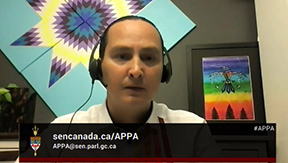
Delorme told the Senate Committee there are “grey areas” when it comes to which records the committee can transition. Records that deal with the 141 Indian residential schools acknowledged through the IRSSA are the targets. Other documents, like hospital records or records in the justice system, both of which will identify children, are not included in the committee’s “main mandate.”
However, Delorme said, “we can identify on the sideline other things that are going on because there will probably be other mandates similar to what we are doing. So let’s make sure we identify those (other records).”
Healthcare records were part of the work undertaken by Anne Panasuk, who was mandated for two years by the Secretariat for Relations with First Nations and Inuit of Quebec, as special advisor for support for families of missing children.
Panasuk told the committee about Bill 79, the Quebec legislation adopted in 2021 that gave Indigenous families the ability to get information about their children who went missing from health institutions in Quebec in the 1950s to the 1980s. This included children who were sent from residential schools to healthcare facilities.
The bill, said Panasuk, “unlocks medical archives and religious archives and it forces institutions to provide medical files…It bypasses the act of protecting information for the health department. Some religious organizations managed hospitals in the past—the diocese, the parishes, the cemeteries. So all these institutions are now obligated to provide information requested by the family.”
However, she said, as the bill is provincial, families do not have access to the records of children who were transferred to health institutions outside of Quebec.
Panasuk suggested that similar bills be adopted by other provinces and territories.
Musqua-Culbertson also suggested legislation that could be useful in addressing “when there is protectionism and when there is barriers put in place.”
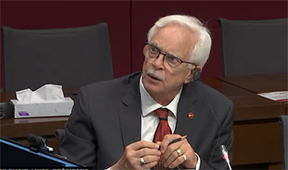
Senator David Arnot, former chief commissioner of the Saskatchewan Human Rights Commission and federal treaty commissioner, referred to what the Senate Committee had heard as a “litany of frustration with the non-compliance truculent stonewalling purposeful barriers” that was being faced by those trying to gather records from the Catholic Church.
What the Senate Committee heard Oct. 25 was in direct contrast with what they were told on Sept. 27 by Father Ken Thorson, provincial superior of the Oblates of Mary Immaculate (OMI) Lacombe Canada.
See our story here: https://windspeaker.com/news/windspeaker-news/senator-digging-delay-res…
Thorson said that since the 215 unmarked graves had been identified at Kamloops Indian Residential School, the Catholic Church’s “commitment has been renewed and strengthened” to work with researchers and survivors.
However, Arnot called what they had heard from Musqua-Culbertson and Frogner of their interactions with the Catholic Church as “incomprehensible conduct.”
Other senators described the testimony as “disturbing”, “appalling”, and “shocking.”
The Senate Committee, chaired by Mi’kmaw Senator Brian Francis from Prince Edward Island, is holding a series of hearings as follow-up to recommendations included in their interim report, Honouring the Children Who Never Came Home: Truth, Education and Reconciliation, released last July.
That report was the result of hearings that took place in March where the Senate Committee heard from representatives from the Office of the Independent Special Interlocutor for Missing Children and Unmarked Graves and Burial Sites associated with Indian Residential Schools, and the NCTR about the difficulty in accessing records that could be used to either identify children who died at Indian residential schools or locate where they were buried.
The Senate Committee has invited specific witnesses to answer questions on why all residential school documents have not been disclosed.
Windspeaker is owned and operated by the Aboriginal Multi-Media Society of Alberta, an independent, not-for-profit communications organization.
Gordon Bluesky was elected chief of the Brokenhead Ojibway Nation in April 2022. On this episode of Face to Face, he shares his journey as a ‘60s Scoop survivor who grew up in the United States before returning and reconnecting with his nation and culture. #aptnnews #aptnfacetoface
Today, October 30, is Adoptee Remembrance Day.
Why an Adoptee Remembrance Day?

From the Adoptee Remembrance Day Facebook page: “We are opening October 30th to be our day of truth, transparency, and remembrance for adoptees all over the world.”
There is a Virtual Candlelight Vigil today via Facebook at 5pm eastern.
Lions Roaring Far From Home: An Anthology by Ethiopian Adoptees is dedicated to Ethiopian adoptees like Hanna Williams who died at the hands of their adoptive parents, as well as to Ethiopian adoptees who died by suicide: they include Amanuel Kildea, Ashkenafi Jitka Lom, Fisseha Samuel, Gabe Proctor, Kaleab Schmidt, Tadesse Söhl, Mekbul Timmer, Seid Visin, and all those who have left us too soon. The book also has an essay by Mike Davis, a deported Ethiopian adoptee,

May they rest in power and in peace. May their memories be eternal; may their memories be a blessing. May their friends and families find peace and healing as well.
Trigger Warning – mention of genital mutilation
Taking away a person’s ability to reproduce without consent, or through coercion, is called forced or coerced sterilization. This process is often done through surgical interventions. According to the International Justice Resource Center (IJRC), forced sterilization in Canada “disproportionately, and possibly exclusively, targets women of ethnic minorities.” A heinous practice that is still not confined to the past—dating back decades and even into 2018—Indigenous women in Canada have been forcibly subjected to this torturous act of gender-based violence and discrimination.
The breadth of the issue remains unknown, as there is a both a lack of publicly available data and a lack of in-depth investigation. Synonymous with the data for the Missing and Murdered Indigenous Women and Girls that have yet to be properly and reliably documented, there is limited data concerning the sterilizations that have been conducted. However, since the 70s, at least 12,000 women have been affected by sterilization.
—
It was the mid-70s when Morningstar Mercredi was impregnated from a rape. She chose to keep the child, as her community condemned abortion, but later she slipped on ice and began spotting. Mercredi went to an emergency room where she was admitted. She was 14 when she woke up from surgery, only to discover her fetus had been removed. An incision spanned across the length of her lower pelvic region. She later learned that the surgery had also removed her left ovary and fallopian tube.
This is just one of many similar stories.
Many Indigenous women were forced into sterilization because they were deemed “unfit” and not in the right circumstance to have a child by the standards of health care professionals. A parallelism to past events, like the Sixties Scoop—the removal of Indigenous children from their birthparents—this pattern of discrimination of ethnic minorities with different styles of living is entrenched in Canada’s history.
Alisa Lombard, a legal and policy matters lawyer from Maurice Law, the first Indigenous-owned and operated firm in Canada, represents many of these women. She stated in The Guardian that “[t]hese are people whose choices were taken away and they are choices based in fundamental human rights. The very intimate and personal decision to have children—or to not have children—belongs to the individual. It’s not something that can be influenced or coerced or forced.”
The IJRC is working with Lombard and other Indigenous rights lawyers who are engaged in litigation and advocacy to end the practice of forced sterilization of Indigenous women in Canada. Since November 2017, IJRC has partnered to secure multiple advocacy opportunities before bodies such as the Inter-American Commission on Human Rights and the United Nations (UN) Committee against Torture.
This advocacy collaboration has resulted in numerous powerful statements from human rights organizations, the Canadian government’s final acknowledgement of its responsibility in the matter, and most significantly, increased public awareness and campaigning.
The issue of forced sterilizations will be raised at the United Nations’ Committee Against Torture. The United Nations (UN) sees this plainly as an act of genocide that should not be labeled as anything less, in accordance with Article II of the UN Genocide Convention, which prohibits “imposing measures intended to prevent birth within [a] group.”
As a non-status Cree Indigenous woman, I view this act of coercive sterilization upon Indigenous woman as a serious violation of human rights that sheds light onto the systemic discrimination and racism that Indigenous people face within the health care system. Issues like these disproportionately impact Indigenous women due to lifestyle differences and perceived inadequacies in rearing children to the post-colonization Canadian standards. These women were not in a position to make any permanent decisions regarding their reproductive organs and abilities, they were betrayed by the Canadian medical system, as these healthcare recommendations came from professionals.
SOURCE: https://themedium.ca/the-forced-sterilization-in-indigenous-women-is-genocide/
**
Truth and reconciliation: Inside 'Canada's' healthcare system - IndigiNews
By Rick Garrick
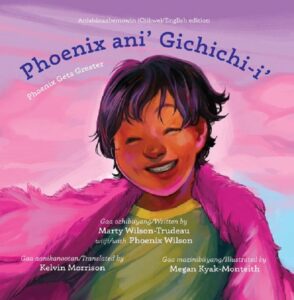
SUDBURY — M’Chigeeng authors Marty Wilson-Trudeau (60s Scoop adoptee) and Phoenix Wilson were recently recognized with the PMC Indigenous Literature Award in the Children’s Category for their Second Story Press children’s book, Phoenix Gets Greater. Joseph Kakwinokanasum, from James Smith Cree Nation, was also recognized with the PMC Indigenous Literature Award in the Young Adult/Adult Category for his Tidewater Press book, My Indian Summer. The two awards were announced by First Nation Communities READ 2023-2024 on Oct. 2.
“It’s absolutely amazing — I’m very honoured and humbled because the other books that were in my category were all fantastic, amazing books written by wonderful authors and illustrators,” says Wilson-Trudeau, a secondary school drama teacher in Sudbury. “Our book is about my youngest son coming out as a two-spirit person and what we did as a family to accept him and make him feel like he could be authentically himself.”
Wilson-Trudeau says it was a great experience working on the book with her son.
“We bonded and we did the exchange of ideas and how to go about writing this and writing that,” Wilson-Trudeau says. “It just kind of strengthened not our mother-son relationship but respecting each other’s ideas, and on that note it strengthened our relationship.”
Wilson-Trudeau says they created the book while Phoenix, who is now pursuing post-secondary studies in Toronto, was in Grade 12.
“It was very quickly written and even more quickly accepted to be made into a book,” Wilson-Trudeau says. “I said to him that I’d really like to write a book because it could help families and other children out there that are two-spirit and he said OK.”
Wilson-Trudeau says she wrote the skeleton of the story and Phoenix added to it that evening.
“The next day, I sent it out to the Second Story Press and she called me within about 20 minutes and said, ‘We’ll take it,’” Wilson-Trudeau says. “It’s a story of bullying and my son growing up always knowing who he was but never coming out and saying it because he was getting bullied, and then him coming out to his brother and myself and us accepting him for who he is. It’s just this beautiful tale of family and acceptance and Phoenix being brave to say who he really was.”
Wilson-Trudeau says she used to write short stories and longer stories and always wanted to be a writer, but she put writing on the back burner to pursue her teaching career.
“The love of writing has always been there, even when I was a young kid,” Wilson-Trudeau says. “There’s a lot of creative aspects [in theatre] but I’m telling somebody else’s story in theatre. This way, when I write a book, I’m telling my own story.”
Wilson-Trudeau says she has had a very positive response from people who have read the book.
“People that I’ve encountered at different writing festivals and my own publisher and the women that work for her [have been] very positive, really wonderful,” Wilson-Trudeau says. “I met this teacher … and when she found out I was the lady who wrote Phoenix Gets Greater, she was like, ‘I read this to my class, it’s amazing.’ So it’s really great to hear the positive effects that this book has had.”
Wilson-Trudeau says working with the editor at Second Story Press was a wonderful learning experience.
“I was very happy with everything,” Wilson-Trudeau says. “As a child, I could have never imagined that I would be here and I would have done this.”
Wilson-Trudeau says she is currently working on a graphic novel based on her experiences as a Sixties Scoop survivor.
“It’s loosely based on my life as a Sixties Scoop survivor and the whole aspect of being lost and not knowing who you are because you’re cut away from your culture,” Wilson-Trudeau says. “[It] will be for older kids so they can really understand how it is to experience loss and loss of culture.”
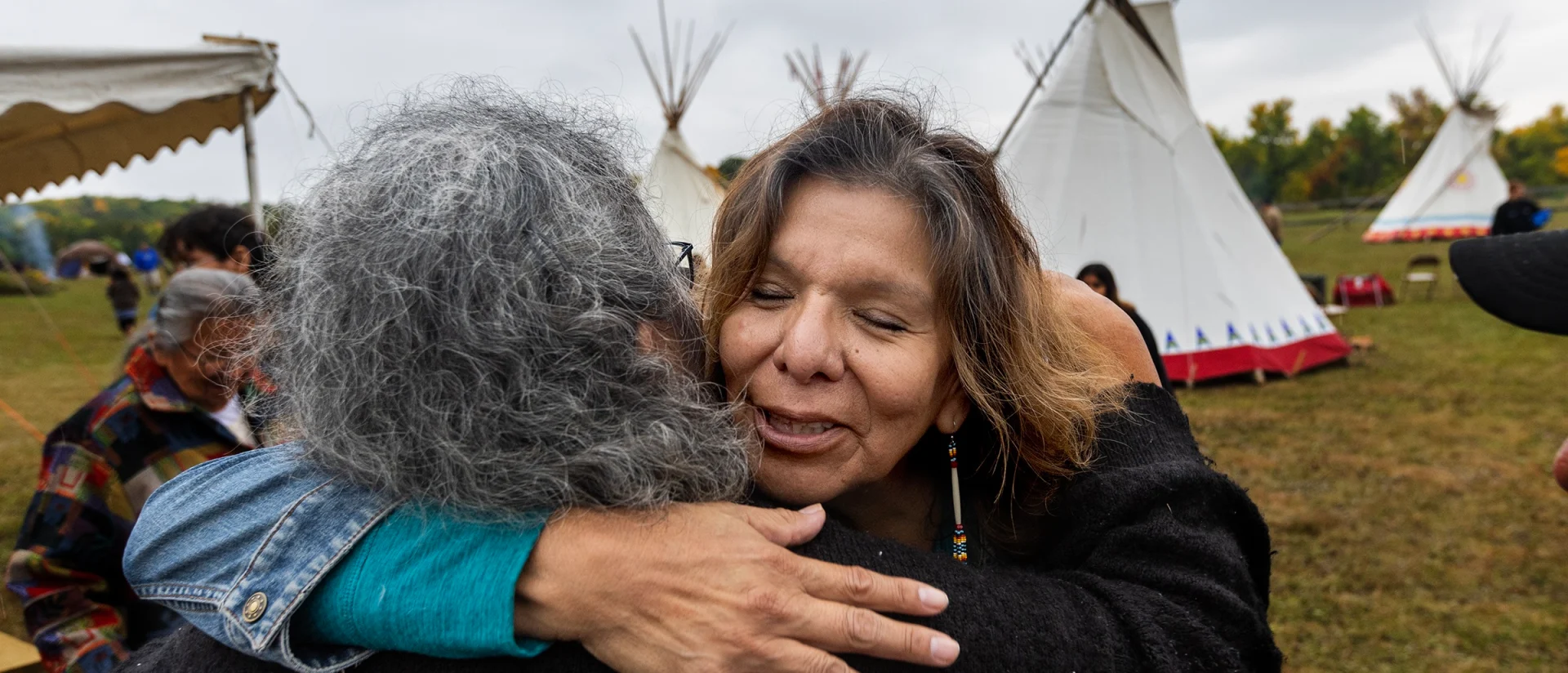
Kelley
Bova, right, receives a hug after speaking to a group of elders at the
Lake Traverse Reservation in South Dakota on Sept. 23, 2023. Bova,
Sisseton Wahpeton Oyate, brought home a pair of moccasins that had been
confiscated from a Native boy at the Carlisle Indian Industrial School
in Pennsylvania more than 100 years ago. They were repatriated to the
tribe along with the remains of two students who died there in the late
1800s. (Photo by Charles Fox for ICT)
Charles Fox
Special to ICT
LAKE TRAVERSE RESERVATION, S.D. — The moccasins sat for decades in the corner of a glass-enclosed bookcase in Pennsylvania, nestled on a shelf with a Davy Crockett trading card and Canadian Mountie knick-knack.
They had long been separated from the unknown Native boy who had worn them into the notorious Carlisle Indian Industrial School more than 100 years ago, where they were taken from him along with his Native connections to family, language and traditions.
By the time they returned quietly home to Sisseton Wahpeton Oyate lands in late September, however, their anonymity had made them universal, a reminder of the forced assimilation that had formed the mission of the Pennsylvania school.
“It's all about those moccasins,” said Tamara St. John, a Sisseton Wahpeton Oyate historian and South Dakota state representative. “They are the symbol of everything that happened there.”
Their journey home – accompanying the remains of two Sisseton and Spirit Lake boys repatriated to their tribes and families – brought not only another step toward reconciliation and healing for those involved but also inner peace and a sense of purpose to others along the way.
The skilled craftsmanship of the moccasins’ quill and beadwork apparently caught the attention of seamstress Susan Zeamer, who worked at the Carlisle school from 1895 to 1908.
At some point, she took them home for herself. Whether she slipped the moccasins into her pockets or was given permission to keep them is lost to history.
The moccasins were then passed down through generations until a great-nephew by marriage, John Baker, 72, now of Buckingham Township, Pennsylvania, became their owner in 2011.
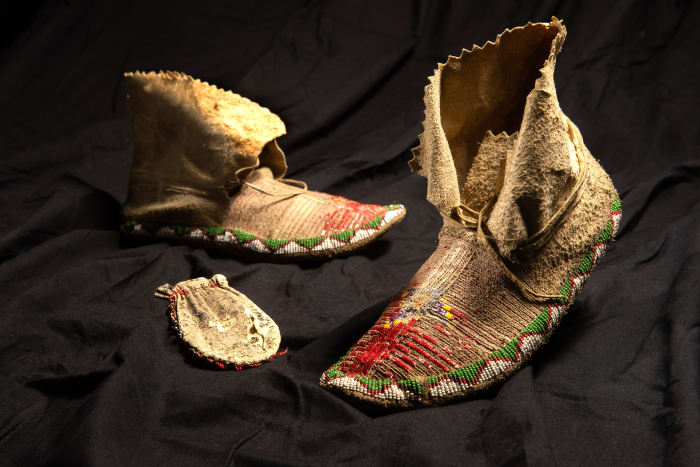 |
| A pair of moccasins and a medicine pouch that were confiscated from a student at the Carlisle Indian Industrial School more than 100 years ago were repatriated to the Sisseton Wahpeton Oyate on Sept. 23, 2023. They had been in the possession of a Pennsylvania family for more than a century before Kelley Bova, a tribal citizen, was asked to return them to the tribe. (Photo by Charles Fox for ICT) |
Baker remembers being fascinated by the moccasins in the bookcase in his parent’s home as a boy in the 1950s, when Westerns were popular on television and movie screens. He visualized a young Indigenous boy wearing them on adventures.
Over the past decade, however, despite the sentimental attachment, Baker became uneasy with possessing them. Like many who grew up in the Carlisle area, Baker’s knowledge of the Carlisle school was limited, but being the owner of the moccasins had enlightened him to the reality of the harsh history of the school and the treatment of Indigenous children. He felt a new responsibility. He understood the moccasins were not his to keep, but his quest to find their home of origin was filled with frustrations.
Museums and tribes did not always reply to his queries, but his research convinced him the moccasins were Plains Indian in style.
He finally reached out to Arla Patch, in Bucks County, Pennsylvania, a founding member of the Coalition of Natives and Allies advocacy, group which has led a fight against Native mascots. He showed her the moccasins on a Zoom call and told her of his desire to see them returned.
"I was getting pretty frustrated,” Baker said. “What’s going to happen to these? … They're more than just an artifact, they're actually part of a lineage that still is alive and well."
Patch introduced him to her close friend, Kelley Bova, a fellow member of the Coalition of Natives and Allies, who is Dakota.
Bova, too, had been removed from her culture and traditions. Born in Sisseton, South Dakota, she was adopted as a 3-month-old infant by a White family and grew up far from her Native relatives.
Independent research with tribal historians and museum experts confirmed the moccasins were Plains Indian in style, though a specific tribe could not be pinpointed. Officials with the Blackfeet, Dakota, and Rosebud Sioux tribes all felt they were characteristic of their style.
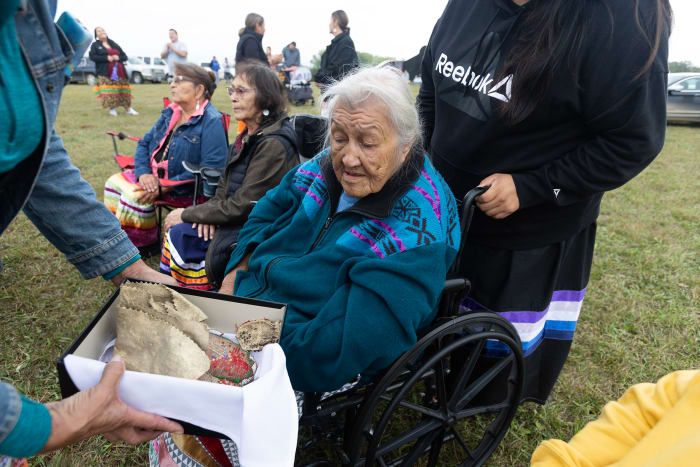
Kelley Bova (not shown) shows the moccasins to Helena Little Ghost at the Lake Traverse Reservation in South Dakota on Sept. 23, 2023. The moccasins were confiscated from a student at the Carlisle Indian Industrial School more than 100 years ago. They remained in the possession of a Pennsylvania family for more than a century before being repatriated back to the Sisseton Wahpeton Oyate. (Photo by Charles Fox for ICT)
Bova believed her own tribe, the Sisseton Wahpeton Oyate, should take the moccasins, and tribal officials agreed. Bova was tapped as the proper person to deliver them to their symbolic home.
“I find it mystical that Kelley and my path would cross, and that John's and my path would cross,” Patch recalled. “It's just so amazing. You couldn't write a script like this.”
Baker presented the moccasins to Bova in November 2022, at Peace Valley Park in Bucks County. He said he felt both a void and a peace to no longer have them in his home in the antique bookcase that he inherited along with the moccasins.
“It was really strange to not have the moccasins in the bookcase anymore,” he said recently. “They've been there my whole life. I kind of lost this imaginary friend. But I can't tell you how much peace that brought me. There was a real sense of well-being about it. Something definitely was settled.”
While Baker felt the absence, Bova quickly formed a close bond with the worn, leather shoes. They had been on similar journeys, more than a half-century apart, and Bova felt it was time to take them home.
“I would actually talk to them, tell them that they were safe now,” Bova said, as she waited to take the moccasins to Sisseton. “I have prayed with them, and I treat them like a child. I take care of them and plan to be able to bring them home.”
Finding your way home is something Bova knows about.
Her journey began as Rose Anne Owen, a Dakota infant taken from her family at birth and moved to Rosebud to await adoption. At age 3 months, she was placed into the hands of Salvatore and André Petrilli, a suburban Philadelphia dentist and his wife. The Glenside couple, of Italian and Irish descent, had struggled to have their own biological children and had arranged for the adoption through Catholic Charities.
Rose made her 1,900-mile journey to Glenside, Pennsylvania, and was renamed Kelley Elizabeth Petrilli. A new birth certificate was created to reflect that she was the child of two Caucasian parents. Her American Indian heritage was wiped away on paper. A Montgomery County Orphans Court clerk, ironically with the last name of Custer, gave the final stamp of approval to the adoption.
She had become a child of the Native adoption era, a decades-long forced assimilation of Native children established under the Indian Adoption Project, which started in 1958 and evolved to include 50 private and public placement agencies across the United States and Canada.
By then, boarding schools had proven to be expensive and unsuccessful. Adoption was the new attempt at assimilation, but the expenses would be the responsibility of the adopting parents and not that of the government. Raised in a White home, without the communal support of other students, adoption was viewed as a more successful tool for assimilation.
In the next 20 years, until the Indian Child Welfare Act ended the adoption project, almost 13,000 Native children were adopted. Native children are still four times more likely to be removed from their families and placed in foster care than non-Native children.
Unlike many other adoptees, Bova did not suffer a childhood of abuse. The Petrillis provided a loving, middle-class home and private schools, while never hiding her Native heritage.
Eventually, they would have five biological children on their own, but Bova always knew she was different, a Native island in an ocean of White suburbia.
“You’re an Indian, you’re an Indian,” one of her cousins would taunt.
“No, I’m not,” she would scream back, a denial that still embarrasses her and causes her pain today.
“When I was younger, I wanted to be White; I still feel guilty about that,” Bova told The Philadelphia Inquirer in 2021. “I just wanted to fit in and be like my sisters. … I did not like being tall and brown and different.”
For Bova, that feeling of isolation led to what she calls her “dark years” after high school.
“Deep down, when you are adopted, you have a wound inside yourself,” she said. “If your parents gave you up, how lovable can you be?”
Sandy White Hawk, a Sicangu Lakota from Rosebud, knows the feeling. She was adopted at 18 months, and grew up to found the First Nations Repatriations Institute. She currently works at the Indian Child Welfare Act Law Center in Minneapolis.
“Even in loving families, Native adoptees live without a sense of who they are,” White Hawk told the Inquirer. “Love doesn’t provide identity.”
Bova, now 60, did not find her way back to her biological mother, Lillian Owen, and siblings, or her Dakota tribe, the Sisseton Wahpeton Oyate, until she was 50. Like students who attended Native boarding schools, she found herself split between two worlds and not fitting completely in either.
“When any child was taken, they were also not able to continue their journey of being Native American. We were robbed of our identity,” said Bova, who is now an enrolled member of the tribe. “I think that's the hardest part for me to sometimes wrap around, that you're robbed of that. And people don't understand that, but I'm … grateful that I found my family and I try to learn as much as I can.”
Patch said the journey continues.
“Kelley does not have her Whiteness, and she does not have her Nativeness,” Patch said of her friend. “The healing power of Kelley’s story is that she is now getting to be Dakota. She’s getting to connect with that Dakota heritage.”
On Memorial Day weekend in 2021, Kelley made her first visit to the former grounds of the Carlisle Indian Industrial School, drawn by a group of Native women and others from the Circle Legacy group who clean and decorate the graves each year.
She stood in the Indian Cemetery on a raw, rainy day with the white gravestones laid out in front of her in perfect rows, like desks in a classroom.
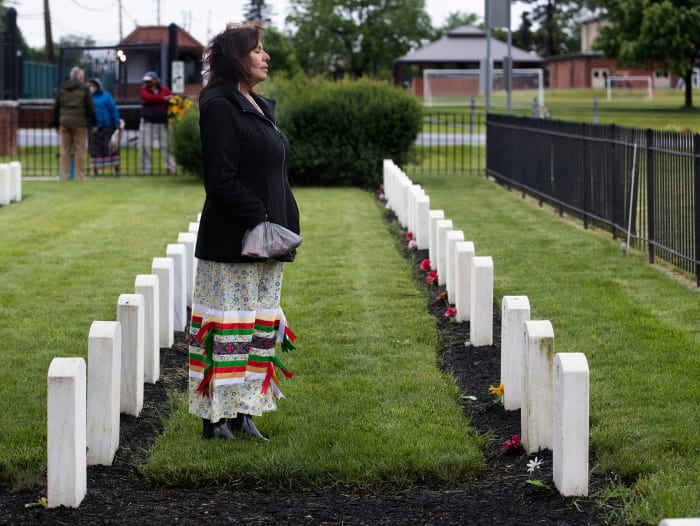 |
| Kelley Bova, of Pennsylvania, pays her first visit to the Indian Cemetery on May 29, 2021, at the site where the Carlisle Indian Industrial School operated from 1879-1918. Bova was taken from her family as an infant and adopted out at three months old to a White Pennsylvania family. She later reconnected with her birth family and is now a member of the Sisseton Wahpeton Oyate. (Photo by Charles Fox, courtesy of The Philadelphia Inquirer) |
They marked the remains of the students who had died while attending the school but had not been returned home to their families. Most were victims of diseases such as tuberculosis.
Her eyes became transfixed on one particular grave. The gravestone simply read “Rose, Sioux.” It was the name she had been given by her biological parents.
“Just seeing that grave with her name, my name on it,” Kelley later said, “it just made me cry.”
It was the grave of Rose Long Face, also known as Little Hawk, Rosebud Sioux, who was among the initial group of 84 students to arrive at the school on Oct. 6, 1879. She died 18 months later on April 29, 1881.
Their journeys had been separated by 84 years but were nonetheless similar. Both had made the journey from Rosebud to a Pennsylvania town, to have their Native identities removed and be renamed in the process. Both had been separated from their families and the land that should have been their home by a government assimilation program.
Bova moved a few rows over and found the graves of two other Dakota students, Amos LaFromboise and Edward Upright. She knelt, placing tobacco bundles on their graves, speaking softly to let them know they were not forgotten and one day they would be home again.
Rose Long Face made it home first, however. In the summer of 2021, she was among nine Rosebud students repatriated from the cemetery to their homeland in South Dakota. She had been away 140 years.
Amos and Edward began their journeys home in September 2023, when they were disinterred from the Carlisle cemetery in a private ceremony that included tribal members, ancestors and others.
Their homecoming provided a chance to return the moccasins, as well, to Sisseton.
Amos and Edward were among six Sisseton Wahpeton Oyate/Spirit Lake students, four boys and two girls, who arrived at the Carlisle school on Nov. 6, 1879, along with seven students from other tribes. They arrived exactly one month after the first group of students had walked through the gates.
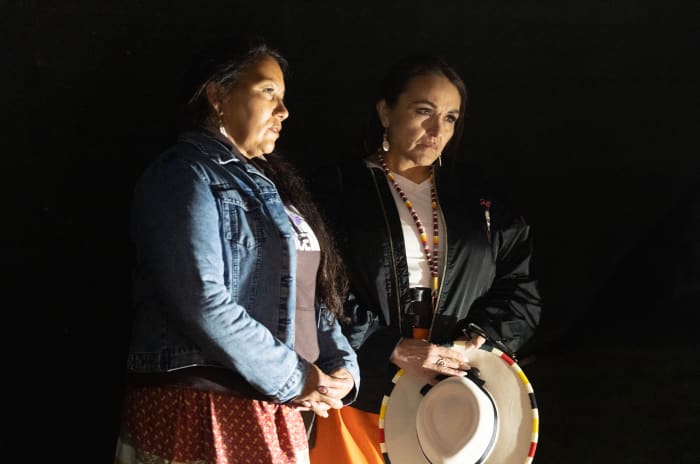 |
| Chairperson Lonna Street, left, Spirit Lake Tribe, and Tamara St. John, Sisseton Wahpeton Oyate historian and a South Dakota state representative, stand in the Indian Cemetery at the former site of the Carlisle Indian Industrial School late in the evening of Sept. 17, 2023. Work in the cemetery disinterring the graves of Amos LaFromboise and Edward Upright had gone on for approximately 11 hours on a rainy day. (Photo by Charles Fox for ICT) |
In 20 days, Amos was dead — the first student to die at the school. There is no record of the case of death, though a newspaper report at the time suggested he was sick when he arrived at the school.
Edward, son of Chief Waanatan II, was 12 when he arrived at the school, a year younger than Amos. He died on May 5, 1881, of pneumonia as he was recovering from measles.
Amos and Edward were among four students disinterred from Carlisle in September as part of the U.S. Army’s disinterment project at the Carlisle Barracks. The others, Beau Neal, Northern Arapaho, and Launey Shorty, Blackfeet, were also returned to their tribes and families.
Amos and Edward were taken by a caravan of nine passenger vans and vehicles that left Carlisle on the afternoon of Sept. 19 for the 22-hour drive to Sisseton.
Along the way, the caravan stopped in Ohio to pick up two more remains being returned by Oberlin College. Two additional remains, believed to be about 500 years old, were already waiting for burial in South Dakota after being returned by a North Dakota coroner’s office.
Amos and Edward arrived on Sept. 20 at the site of the former Sisseton Agency, where they had last said goodbye to their parents. This time, however, they were greeted by about 100 people gathered in celebration.
They were then taken to the Sisseton Wahpeton Oyate repatriation grounds to complete the traditional four days of mourning before a private ceremony and burial at the repatriation cemetery. The other four remains were also buried at the repatriation cemetery.
Bova made the same journey with the moccasins tucked inside a shoebox, boarding the caravan at Carlisle for the trip to Sisseton.
For her, the trip was an opportunity to take part in an historic moment for the Sisseton Wahpeton Oyate and Spirit Lake people, but also an opportunity to continue her healing process. She had visited Sisseton more than 10 times in the past 10 years for Sundances, powwows, and family events.
“It's like there's this vessel and this wound and every time [I go to Sisseton] it gets filled a little more, then a little more and a little more,” Bova said afterward. “That's why it helped doing this. Because that was able to fill [the void] even more. Fill that wound up and heal it.”
During the final three days of mourning at Sisseton, with ceremonies at sunrise and sunset, gatherings with food, and conversations with elders, Bova experienced events she had missed for 50 years. This was especially true of her time spent with the Buffalo Heart women.
“Those Buffalo Heart women allowed me to help with the remains,” she said. “That was such a gift to me.”
On Saturday, Sept. 23, the day of burial for Amos and Edward, about 100 people of all ages stood on the hillside overlooking the open graves.
The remains were taken down from a wooden scaffold and eventually bundled in buffalo robes along with a star quilt, moccasins, and other traditional items brought by relatives. They were then placed in their graves with the love and respect that should have been afforded them as the sons of chiefs.
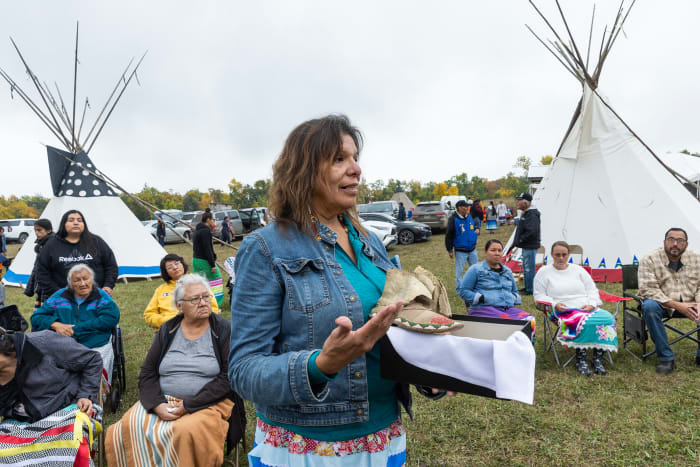 |
| Kelley Bova, Sisseton Wahpeton Oyate, speaks to a gathering at the Lake Traverse Reservation in South Dakota on Sept. 23, 2023, after bringing home a pair of moccasins confiscated from an unknown Native boy at the Carlisle Indian Industrial School more than 100 years ago. They had been in the possession of Pennsylvania family for more than a century. (Photo by Charles Fox for ICT) |
“Whenever I am in the teepees, by the fire, and hearing the men drumming and singing, it takes me back to another time,” Bova said. “It’s something that makes me feel so special. …That’s my DNA; that’s my heritage. Not knowing it for 50 years and finally seeing things like that, it has a healing power inside of me that helps a lot. Seeing all of this, I come to the realization that these are my people. This is who I am… The biggest thing I have learned is to let go of how I was raised as opposed to who I really am.”
Then it was Bova’s turn to address the group. She spoke to a gathered group of elders at the front of the crowd where they could see the moccasins she held in her hands.
She told the story of the moccasins and their pathway to her, and then presented them to tribal chairpersons J. Garret Renville of the Sisseton Wahpeton Oyate and Lonna Street of Spirit Lake, as well as historian St. John.
“It's a privilege to be able to do this,” she told ICT. “And it's a very spiritual thing. Because I feel like it's my journey home, and now I can help these moccasins go home. I know they're just a thing. But to me, there are symbols of every child that was taken, whether it was through adoption or through the residential schools. I think it's just so important that these go home.”
Upon hearing the news of the moccasins' return to the Dakota people, Baker responded from his Pennsylvania home that he felt “ relief, peace, and closure” and “a sense of gratification that comes with complete accomplishment.” The endeavor had taken over a century but was finally achieved.
St. John has big plans for the moccasins.
“I could build a museum around the moccasins to forever tell the stories of so many — past, present, and future,” she said. “I want them to be representative of our children and their journey home. I want them to represent how the federal assimilation tactics of places like Carlisle did not win.”
The moccasins can tell that story, she said.
“Our boys will be here and laid to rest on the homelands and protected ever on, but those moccasins will sit in their place in our collections with their story,” St. John said.
“To ‘keep one’s moccasins’ is said to mean that a Native person did not give up their traditional way,” she said. “Our children came home with moccasins.”