This blog was a backup for American Indian Adopteesblog
USE THE SEARCH BAR or SEARCH TOPICS at bottom of this blog
If you need support
Support Info: If you are a Survivor and need emotional support, a national crisis line is available 24 hours a day, seven days a week: Residential School Survivor Support Line: 1-866-925-4419. Additional Health Support Information: Emotional, cultural, and professional support services are also available to Survivors and their families through the Indian Residential Schools Resolution Health Support Program. Services can be accessed on an individual, family, or group basis.” These & regional support phone numbers are found at https://nctr.ca/contact/survivors/ .
MY EMAIL: tracelara@pm.me
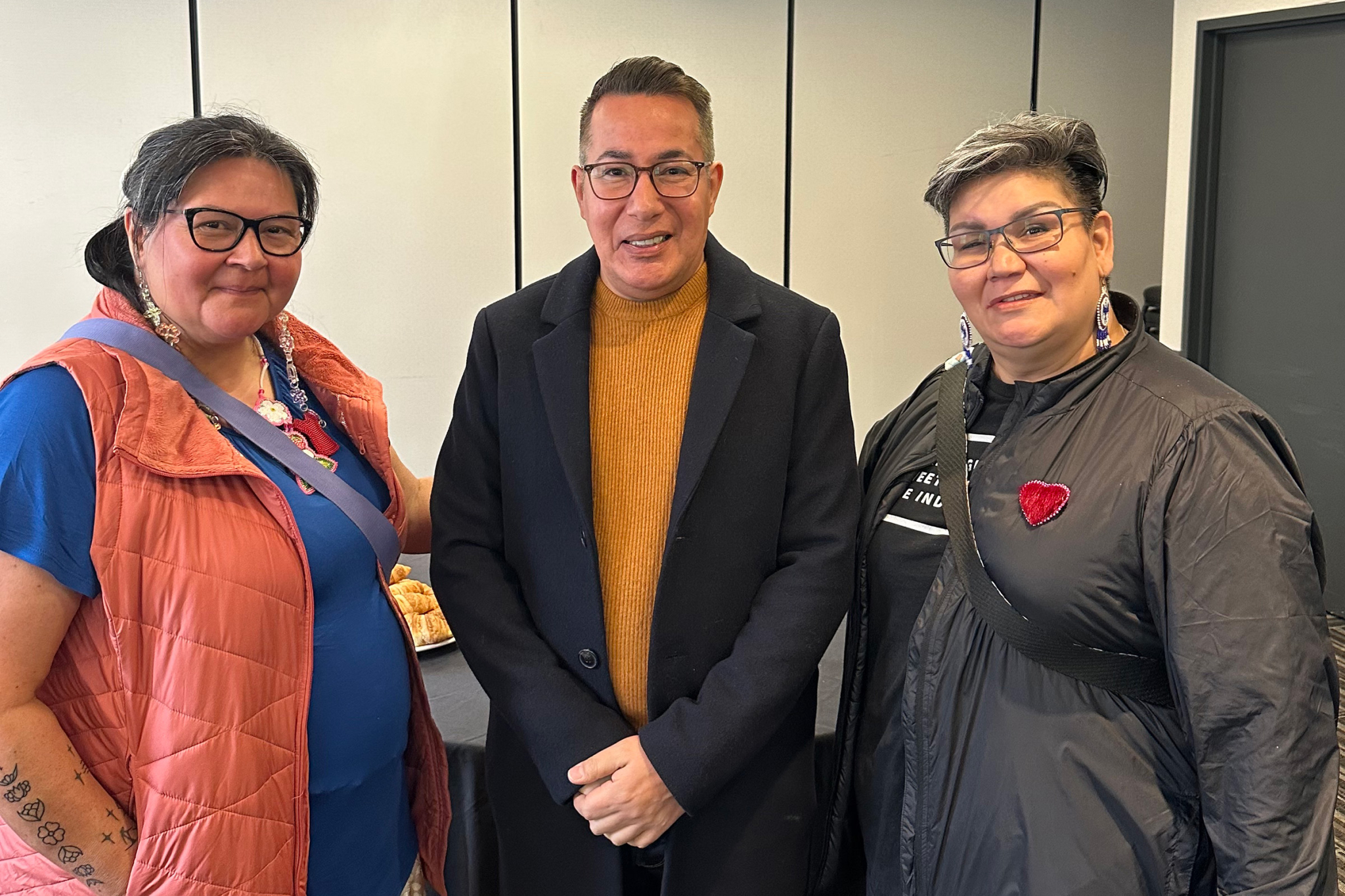
Using DNA tests, Dean Lerat has created a massive family tree for the Treaty 4 territory in Saskatchewan...
By day, Dean Lerat is an RCMP staff sergeant in Fort Qu'Appelle, Sask. But in his free time, the member of Cowessess First Nation is a DNA detective.
Lerat, who is Saulteaux, is using DNA testing and archival records to help Indigenous people learn about their biological families and fill in gaps in their family histories. With that data, he's creating genetic maps and extensive family trees of the Treaty 4 area in Saskatchewan.
"The Sixties Scoop adoptees [and] descendants of residential school survivors, I think I've helped over 15 of them now find their way back," he told Unreserved host Rosanna Deerchild.
Lerat said people he doesn't know contact him through social media channels, asking him to help them find where they come from.
"I'll spend a couple hours in the morning, Saturday morning, having a cup of coffee … trying to figure out who their aunts and uncles are. And then I'll send them back a tree if I can. Whether it's partial, whether it's full," he said.
"I'm curious. I like to solve mysteries."
Creating a 'genetic road map'
Along with DNA testing, Lerat also uses obituaries, band lists, censuses and old documents from the Northwest Mounted Police (the precursor to the RCMP) to inform his work. He also uses online databases offered by companies such as Ancestry, 23 and Me, My Heritage and Family Tree DNA.
All of this work helps Lerat piece together what he calls a "genetic road map."
In a major win in the fight to #ProtectICWA, Wyoming becomes the 11th state to codify the Indian Child Welfare Act. Utah and Montana are considering similar legislation, which is vital for Native children, Native families and Tribal sovereignty. https://t.co/oa8f63d8nA
After decades of failing to comply with federal law, the single-largest holder of Native American human remains is taking steps to complete the repatriation of more than 14,000 Native American ancestors, reports @YahooNews. https://t.co/xQSwcB6Z3O
With limited records, the abuse, neglect and cultural oppression of #IndianBoardingSchools has been largely erased by the US government. Now, a group is finally compiling a first-of-its-kind list of Catholic-run boarding schools. https://t.co/yY3VmQuQLX
$23-billion settlement for First Nations children announced by AFN and Caring Society
The new deal secured $3 billion more than what was proposed by the federal government in 2021 for First Nations children discriminated by the child welfare system.
The Assembly of First Nations and the First Nations Child and Family Caring Society (FNCFS) said they have announced a revised final settlement agreement in a landmark child-welfare case.
The new proposal increases the federal government’s settlement spend to $23 billion — up from $20 billion — to compensate First Nations children and families who have experienced discrimination in the child welfare system.
“This compensation recognizes the serious harms First Nations, children, youth, and families suffered including unnecessary family separations and the denial of life saving and life wellness services,” said Cindy Blackstock, the executive director of FNCFS, in a release Monday.
The AFN, which represents more than 600 First Nations across Canada, has been working to negotiate a deal after the Canadian Human Rights Tribunal in 2016 found that Canada discriminated against First Nations children by paying less for child welfare services on-reserve compared to those offered off-reserve.
Vermont’s Truth and Reconciliation Commission has officially started its work with the announcement of its first three staff: Mia Schultz, Melody Walker Mackin and Patrick Standen.
A state-funded effort has begun to document how Vermont state laws and policies have discriminated against marginalized communities, including people with disabilities, Black people, Indigenous people, other people of color and people of French Canadian heritage.
The new commissioners stressed their roles include making policy recommendations, as well as hearing experiences of communities who suffered injustices.
“We know this is not about what has just happened in the past,” Schultz said. “This is about how that past continues and is perpetuated in our present, and how we’ll learn from it, and eradicate it in our future.”
They’ll have an annual budget of almost $750,000, and will hire an executive director and other researchers.
“First, we're tasked with starting an office — there’s nothing like this that’s been done before,” Schultz said. “We are starting from scratch.”
"It's a huge task," Melody Walker Mackin said.
A commission with more limited scope was created in Maine to document the state's child welfare practice with Wabanaki people, and Burlington City Council created a Reparations Task Force in 2020, but the new commissioners said they're not familiar with any mandate that's so broad in scope.
"While it may look overwhelming, it's essential that all voices by heard," Standen said. "The resources that are provided by the state at this point seem to be ample and welcomed."
But at the age of 28, sitting in a university classroom, Colleen Cardinal learned her experience was shared by many. It even had a name — the ’60s Scoop. From about 1951 until 1984, Canadian child welfare authorities took more than 20,000 First Nations, Métis and Inuit children from their homes and placed them with white families.
“I wanted to find all these adoptees, I wanted to know where they are, I wanted to hear what they went through,” Cardinal said. But then, Cardinal said, that information wasn’t available.
Cardinal first decided to create a map after visiting a conference for grassroots human rights organizations in 2014. There, Cardinal said she came across a world map drawn on a large, white bedsheet on which visitors could map their stories out with colourful yarn.
In 2019, Cardinal launched the online mapping tool. Now, it includes the stories of more than 100 survivors who were displaced from across Canada to places as far as the U.K. and Botswana. The map illustrates where people were born and where they were moved. It logs birthdates, when people moved and if survivors met their biological families, the date that happened. Each entry includes space for people to share words and videos telling their own stories and contact information for survivors to connect with others.
Genetic Detective, a genetic genealogy service near Ottawa, has offered to subsidize DNA test kits for some survivors, create a database of survivors' genetic information and connect survivors to their biological families.
A small group of survivors gathered in Ottawa last week. They filmed themselves telling their stories in their own words, to create videos that will be posted on the map’s website. By sharing their stories, Cardinal said she hopes to normalize their experiences and create a community for survivors.
“I know as an adoptee how lonely it is and how isolating it can be. I needed (to find others). So if I needed it, others need it,” Cardinal said. “And if we want it done our way, we need to do it ourselves — by survivors, for survivors.”
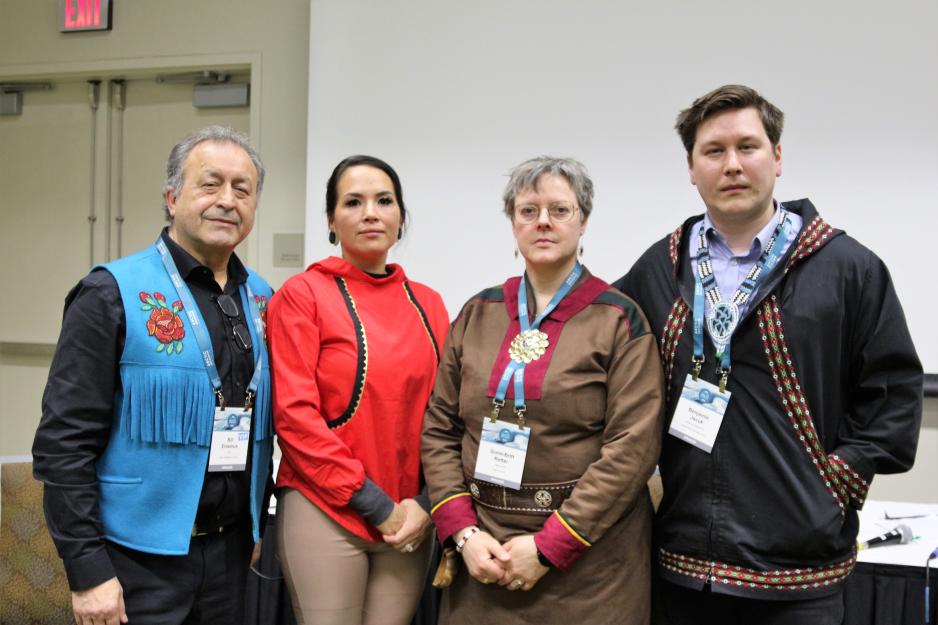
"They always go for our babies." -Emily Edenshaw, President & CEO at Alaska Native Heritage Center
Chief Bill Erasmus, Emily Edenshaw, at the Alaska Native Heritage Center, Gunn-Britt Retter at the Saami Council and Benjamin Jacuk at the Alaska Native Heritage Center. (Photo: Trine Jonassen)
Anchorage Alaska (High North News):
He admitted that this was genocide. -Chief Bill Erasmus
Most Arctic nations have been affected by assimilating and oppressive boarding school policies. Now indigenous community leaders are looking for healing as they brace for the dark truth of a government-led genocide.
Ground zero
The boarding school practice started in Alaska in 1879, 12 years after the USA purchased the Arctic state from Russia without consulting the indigenous population.
Maybe that is also where the healing has to start.
"Alaska may be ground zero for all of this. But ground zero can also be the place of healing for indigenous peoples from all over the world," Jacuk concludes.
In 2015 the Truth and Reconciliation Commission of Canada concluded what happened was "cultural genocide". It identified more than 3,000 children who died from disease due to overcrowding, malnutrition, and poor sanitation or died after being abused or trying to run away.
Most schools had their own cemeteries, and sometimes when children died, their parents were never informed.
Daniel Frost is Métis and Cree. Born in northern Saskatchewan, he was adopted by British parents in 1968 at just two years old. (Francis Ferland/CBC)
Thinking about meeting his sister Patsy for the first time seven years ago is still tough for Sixties Scoop survivor Daniel Frost.
"All I could do was look at her hands," he recalled, still overwhelmed with emotion as he remembered how much those hands looked like his.
"I couldn't look at her eyes."
Frost is Métis and Cree, one of about 22,000 Indigenous kids who were torn from their homes and placed in foster care or adopted into non-Indigenous families between 1951 and 1991, a system known today as the Sixties Scoop.
He came to Ottawa this week to share his story with the interactive mapping project, In Our Own Words.
The In Our Own Words map tracks where Indigenous kids were taken after being torn from their families. (Francis Ferland/CBC)
Born in Île-à-la-Crosse in northern Saskatchewan, two-year-old Frost was adopted by British parents in 1968, taken to White Rock, B.C., and then finally to Brighton, England. He now lives in Spain.
He spoke with CBC News at downtown Ottawa's Novotel Hotel, where Sixties Scoop survivors gathered this week from far-flung places all over the world to share stories and connect.
Frost explained how a federally funded Saskatchewan-based organization, Adopt Indian Métis (AIM) scooped seven youngsters from his 13-sibling family. The organization is known for placing ads in newspapers and aggressive public relations campaigns.
Frost began learning his history by reading legal documents, including the court files that tell how his mother ran out of the courtroom when she learned her children were being taken.
"What they were saying in the 1960s and '70s was, 'We're not going to help you. We're just going to take your children,'" Frost said.
"I don't know if I'll heal from it, but I think being able to work my way through it is something which is necessary."
He visited Île-à-la-Crosse in 2016 and met his family, which he said changed him from a scared outsider to a man deeply proud of his Indigenous identity, and this trip to Ottawa includes a hop across the river to Gatineau, Que., to pick up a copy of his first Indian status card.
"The greater the consensus that the Doctrine of Discovery is fundamentally racist and immoral, the harder it is for Canadian courts to continue to decide cases based on this fundamental doctrine," said Pearl, who is from One Arrow First Nation, in an interview with Day 6.
(left) Tamara Baldhead Pearl, an assistant professor of law at the University of Alberta, is cautiously optimistic after the Vatican's repudiation of The Doctrine of Discovery. (University of Alberta)
Pearl, who's also an assistant law professor at the University of Alberta, says she hopes there will be increased pressure to "try to rethink how Canadian law can be brought into conformity with the contemporary understanding of Indigenous rights and equality among peoples."
The Doctrine of Discovery is a set of colonial-era theories, backed by 15th-century papal bulls, which was used to legitimize the seizure of Indigenous lands by colonial powers. Legal decisions in both the U.S. and Canada invoked the doctrine in some form.
The Vatican says in its statement the doctrine was not a Catholic teaching and had been manipulated for political purposes by colonial powers.
"The Church's magisterium upholds the respect due to every human being," the statement reaffirmed.
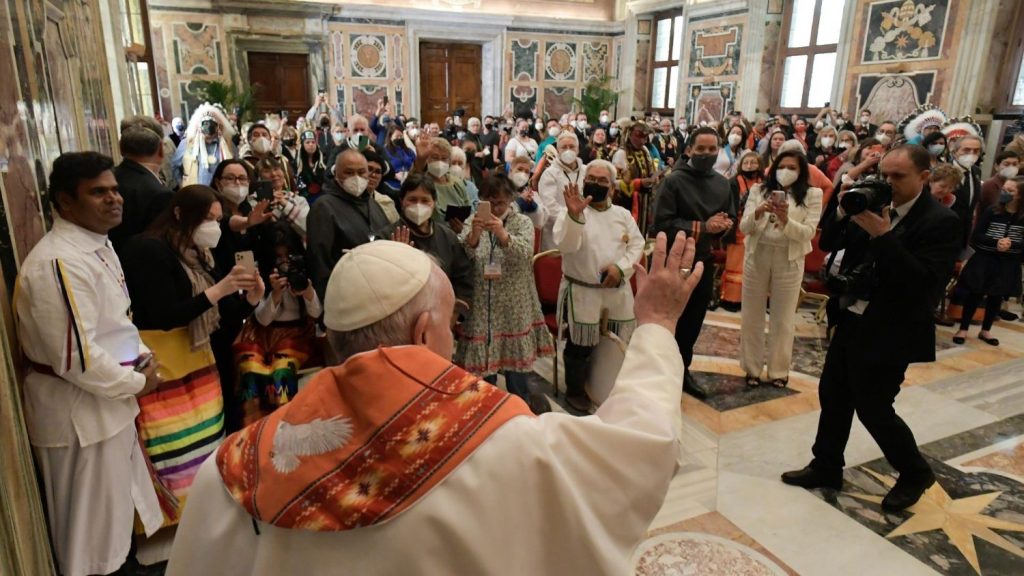
There have been calls to repudiate the doctrine for decades, but they gained more visibility in Canada during Pope Francis' visit last summer. Two women held a banner reading "Rescind the Doctrine" at the altar of the National Shrine of Sainte-Anne-de-Beaupré on July 29, 2022. They were escorted from the basilica without incident, but draped the banner outside as part of a protest.
Sarain Fox, right, and Chelsea Brunelle of the Batchewana First Nation demonstrate outside the mass presided over by Pope Francis at the National Shrine of Saint Anne de Beaupre, Thursday, July 28, 2022, in Saint Anne de Beaupre, Quebec. (John Locher/The Associated Press)
During the visit, Pope Francis apologized to Indigenous people for the residential school system that forcibly removed Indigenous children from their homes. However, he was criticized by some for not taking the opportunity to repudiate the doctrine.
If the Brackeen v. Halland case currently challenging the Indian Child Welfare Act (ICWA) of 1978 before the U.S. Supreme Court is successful, Native children are more likely to be placed with non-Native foster parents, and from there, face a surge in psychiatric labeling and drugging.
Tribes across the U.S. are outraged by the attempt to dismantle ICWA, and a “think tank” was recently formed in California to respond to what seems a foundational threat to community sovereignty, beginning with who controls Native child welfare decisions. It’s the latest in a battle as old as the United States: White Christian evangelicals fighting for the right to take Native children away from family, tribe, and culture, and re-educate them, no matter the harms—and its outcome will determine whether more Native youth are exposed to psychiatric drugs.
Chad Brackeen and his wife, Jennifer, lead plaintiffs, are White, and according to a 2019 interview with The New York Times, also dedicated members of the fundamentalist Church of Christ, which they attend twice a week, and through which they first became inspired to adopt. They began as foster parents before successfully adopting a young Dine (Navajo) boy, and then mounting efforts to adopt his sister. They contend they are being racially discriminated against by ICWA’s mandates favoring a great aunt of both of these children, who has stepped forward from their tribal community seeking to adopt the sister.
...
But what about the contention that ICWA’s dismantling will also create a surge in Native foster youth being psychiatrically labeled and drugged? It’s frankly impossible to find adequate information bearing on this topic because the U.S. Indian Health Service (IHS), primary purveyor of behavioral health services in Indian Country, has never been accountable to publicly report prescription rates and the types of psychiatric drugs it dispenses.
Yet as I detail in my new book, Coyote’s Swing, IHS has for decades been very involved in psychiatric labeling and drugging. In 2013, for example, the agency attributed 850,000 of its outpatient visits and 5,000 of its inpatient stays to a “mental disorder.” And 10 percent of the services IHS provided that same year to children and young adults aged 5 to 24 years had “mental disorder” listed as the “primary reason.”
...
The history of EuroAmerican culture in North America is rife with the theft of Native children and their childhoods and is both the root cause and effect behind today’s Native foster care system.
According to a recent joint report by Pro Publica and NBC News, 3.5 million homes are searched annually by state child welfare agencies investigating child maltreatment. Most searches happen without a warrant because caregivers may not know their rights or are intimidated by aggressive caseworkers pounding on their doors. Once inside, these workers may push their way into a caregiver’s kitchen, go through the refrigerator, sift through trash, and inspect bedrooms and bathrooms while trying to observe children present in the home. Only five percent of such coercive searches result in actual findings of child maltreatment.
Using a traditional Yakama tale as a motif, Coyote’s Swing combines the author’s firsthand experiences as a consulting psychologist with rare history and sociocultural critique, revealing how the U.S. mental health system reframes Native American reactions to oppression and marginalization into “mental disorders” and “mental illness,” and how the Indian Health Service’s contemporary practices echo historical injustices.
“In the IHS, dissension is often suppressed as blasphemy and whistleblowers are rarely tolerated. Walker is to be commended for his thorough research and timely recommendations for reform of the agency’s delivery of mental health services in Indian County…I join him in praying that this period of tribal history comes to an end.”—Toobshudud Jack Fiander (Yakama), attorney
Alaska Native Heritage Center says its study of church records that go back to the 1800s is not research for research’s sake, reports Rhonda McBride from our flagship station KNBA.
Researcher Benjamin Jacuk-Dolchok (Kenaitze) says he hopes to reconstruct the story of how early churches used schools to separate Alaska Native peoples from their land, their culture, and their spirituality.
He says the impacts are still felt today.
“You can’t understand what you need healing from, unless you pull back the band aid and understand the wound.”
Jacuk-Dolchok says most Alaskans don’t realize how closely churches coordinated their efforts.
“While these might be different denominations, the ideology was mostly the same. And that was forced assimilation.”
Jacuk-Dolchok says some of the research looks at the role of boarding schools — and how Americanization and Christianity intersected to break the close connections Alaska Natives had with their land.
He says the forced use of English took away the “heart language” of the people, which sped up the process.
“The major takeaway from what we’re doing is understanding the truth to bring healing, so that younger generations can thrive.”
Jacuk-Dolchok has studied Native boarding schools for more than a decade and credits his grandfather, who attended boarding school, for inspiring his work.
The Princeton Seminary graduate says his theology studies has helped him with his research and given him access to important documents.
Jacuk-Dolchok will share some of his research at the Alaska Native Heritage Center in Anchorage on Friday.
The Vatican’s recent repudiation of the Doctrine of Discovery has been described as a “major step” by some Indigenous leaders, but for others, the Holy See has a long way to go before it can heal the centuries of pain caused by the doctrine’s colonization and control. Today on Native America Calling, we speak with Steve Newcomb (Shawnee and Lenape), author of Pagans in the Promised Land: Decoding the Doctrine of Christian Discovery and cofounder and director of the Indigenous Law Institute, and Bruce McIvor (Métis), lawyer and partner at First Peoples Law.
We are thrilled to have Sandy White Hawk in conversation with Gabrielle Glaser next week, each discussing their work, Sandy’s new memoir (a must read), and the impact and future of the Indian Child Welfare Act. Plus, Sandy and Gabrielle will discuss their recent work together on a documentary project about the history and legacy of the federal Indian residential school system in the United States.
Don't miss a great virtual event that will discuss timely and incredibly important issues around adoption, adoptee rights, and the profound impact of forced removal of Native American children from their parents and communities.
I hope to see you there. Be good, and keep up the hard work.
Greg
Yes, the event will be recorded and available later to those who register. :)
We meet the author behind the book aiming to support young women called 'Sisterhood.' A short film explores the legacy of the Rapid City boarding schools. The Vatican has repudiated the Doctrine of Discovery. We discuss its influence on tribal sovereignty ... The Vatican officially repudiated the Doctrine of Discovery on Thursday morning. This comes after Indigenous peoples across the world demanded this action. The Doctrine of Discovery originated in the late 1400s, as justification by the Catholic Church to seize lands that were not inhabited by Christians. continue reading
The Pope seems to not know about the Doctrine, according to a twitter Native.
The Vatican has formally repudiated the “Doctrine of Discovery,” which justified colonization and the taking of Indigenous lands.
Two Vatican departments issued a joint statement Thursday saying it’s not part of teachings of the Catholic Church.
Indigenous people have long called for the church to rescind the legal concept.
Joint Statement of the Dicasteries for Culture and Education and for Promoting Integral Human Development on the “Doctrine of Discovery”, 30.03.2023
1. In fidelity to the mandate received from Christ, the Catholic Church strives to promote universal fraternity and respect for the dignity of every human being.
2. For this reason, in the course of history the Popes have condemned acts of violence, oppression, social injustice and slavery, including those committed against indigenous peoples. There have also been numerous examples of bishops, priests, women and men religious and lay faithful who gave their lives in defense of the dignity of those peoples.
3. At the same time, respect for the facts of history demands an acknowledgement of the human weakness and failings of Christ’s disciples in every generation. Many Christianshave committed evil acts against indigenous peoples for which recent Popes have asked forgiveness on numerous occasions.
4. In our own day, a renewed dialogue with indigenous peoples, especially with those who profess the Catholic Faith, has helped the Church to understand better their values and cultures. With their help, the Church has acquired a greater awareness of their sufferings, past and present, due to the expropriation of their lands, which they consider a sacred gift from God and their ancestors, as well as the policies of forced assimilation, promoted by the governmental authorities of the time, intended to eliminate their indigenous cultures. As Pope Francis has emphasized, their sufferings constitute a powerful summons to abandon the colonizing mentality and to walk with them side by side, in mutual respect and dialogue, recognizing the rights and cultural values of all individuals and peoples. In this regard, the Church is committed to accompany indigenous peoples and to foster efforts aimed at promoting reconciliation and healing.
5. It is in this context of listening to indigenous peoples that the Church has heard the importance of addressing the concept referred to as the “doctrine of discovery.” The legal concept of “discovery” was debated by colonial powers from the sixteenth century onward and found particular expression in the nineteenth century jurisprudence of courts in several countries, according to which the discovery of lands by settlers granted an exclusive right to extinguish, either by purchase or conquest, the title to or possession of those lands by indigenous peoples. Certain scholars have argued that the basis of the aforementioned “doctrine” is to be found in several papal documents, such as the Bulls Dum Diversas (1452), Romanus Pontifex (1455) and Inter Caetera (1493).
6. The “doctrine of discovery” is not part of the teaching of the Catholic Church. Historical research clearly demonstrates that the papal documents in question, written in a specific historical period and linked to political questions, have never been considered expressions of the Catholic faith. At the same time, the Church acknowledges that these papal bulls did not adequately reflectthe equal dignity and rights of indigenous peoples. The Church is also aware that the contents of these documents were manipulated for political purposes by competing colonial powers in order to justify immoral acts against indigenous peoples that were carried out, at times, without opposition from ecclesiastical authorities. It is only just to recognize these errors, acknowledge the terrible effects of the assimilation policies and the pain experienced by indigenous peoples, and ask for pardon. Furthermore, Pope Francis has urged: “Never again can the Christian community allow itself to be infected by the idea that one culture is superior to others, or that it is legitimate to employ ways of coercing others.”
7. In no uncertain terms, the Church’s magisterium upholds the respect due to every human being. The Catholic Church therefore repudiates those concepts that fail to recognize the inherent human rights of indigenous peoples, including what has become known as the legal and political “doctrine of discovery”.
8. Numerous and repeated statements by the Church and the Popes uphold the rights of indigenous peoples. For example, in the 1537 Bull Sublimis Deus, Pope Paul III wrote,“We define and declare [ ... ] that [, .. ] the said Indians and all other people who may later be discovered by Christians, are by no means to be deprived of their liberty or the possession of their property, even though they be outside the Christian faith; and that they may and should, freely and legitimately, enjoy their liberty and possession of their property; nor should they be in any way enslaved; should the contrary happen, it shall be null and have no effect”.
9. More recently, the Church’s solidarity with indigenous peoples has given rise to the Holy See’s strong support for the principles contained in the United Nations Declaration on the Rights of Indigenous Peoples. The implementation of those principles would improve the living conditions and help protect the rights of indigenous peoples as well as facilitate their development in a way that respects their identity, language and culture.
“The ‘enrollment’ process was started by the Feds so they could use ‘blood quantum’ to finish the Genocide of Native Americans. Now we are finishing the job ourselves by continuing to use it as a ‘membership’ requirement. Membership: like the Elks Club or Lions Club or the Moose Lodge. Sad.”
—Harold Monteau, former chair of National Indian Gaming Commission and a citizen of the Chippewa Cree Tribe, today on social media
Missing and Murdered: proactive tribal and state initiatives
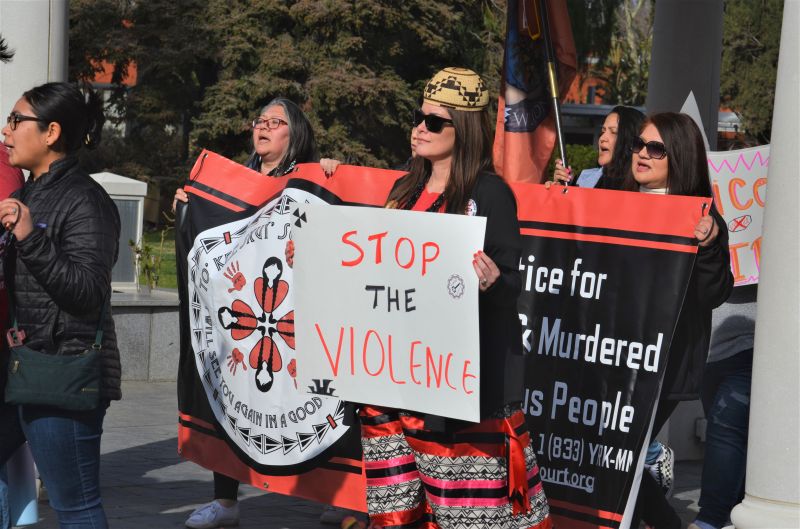
The Yurok Tribe hired its own investigator to pursue unsolved cases of their citizens who are missing or murdered. Arizona is among the states establishing an MMIP task force that the new governor says will “ensure that not one more Indigenous man, woman, or child is a target of violence, abuse, or exploitation.” The actions are part of the attempts to address the slow momentum to investigate and solve cases with Native victims. Today on Native America Calling, we speak with Jessica Carter (Yurok), Yurok Tribal Court Director; Daisy Bluestar (Southern Ute), member of the MMIR Taskforce in Colorado; Skye Alloway (Forest County Potawatomi tribal member), co-chair of Wisconsin’s Missing and Murdered Indigenous Women Task Force; and Annie Forsman-Adams (Suquamish), program director for the Washington State Native American Coalition Against Domestic Violence and Sexual Assault (Women Spirit Coalition).
A very very good story. It reminds me of the SOS Villages a friend in Austria told me about many years ago, and how it WORKS! Trace
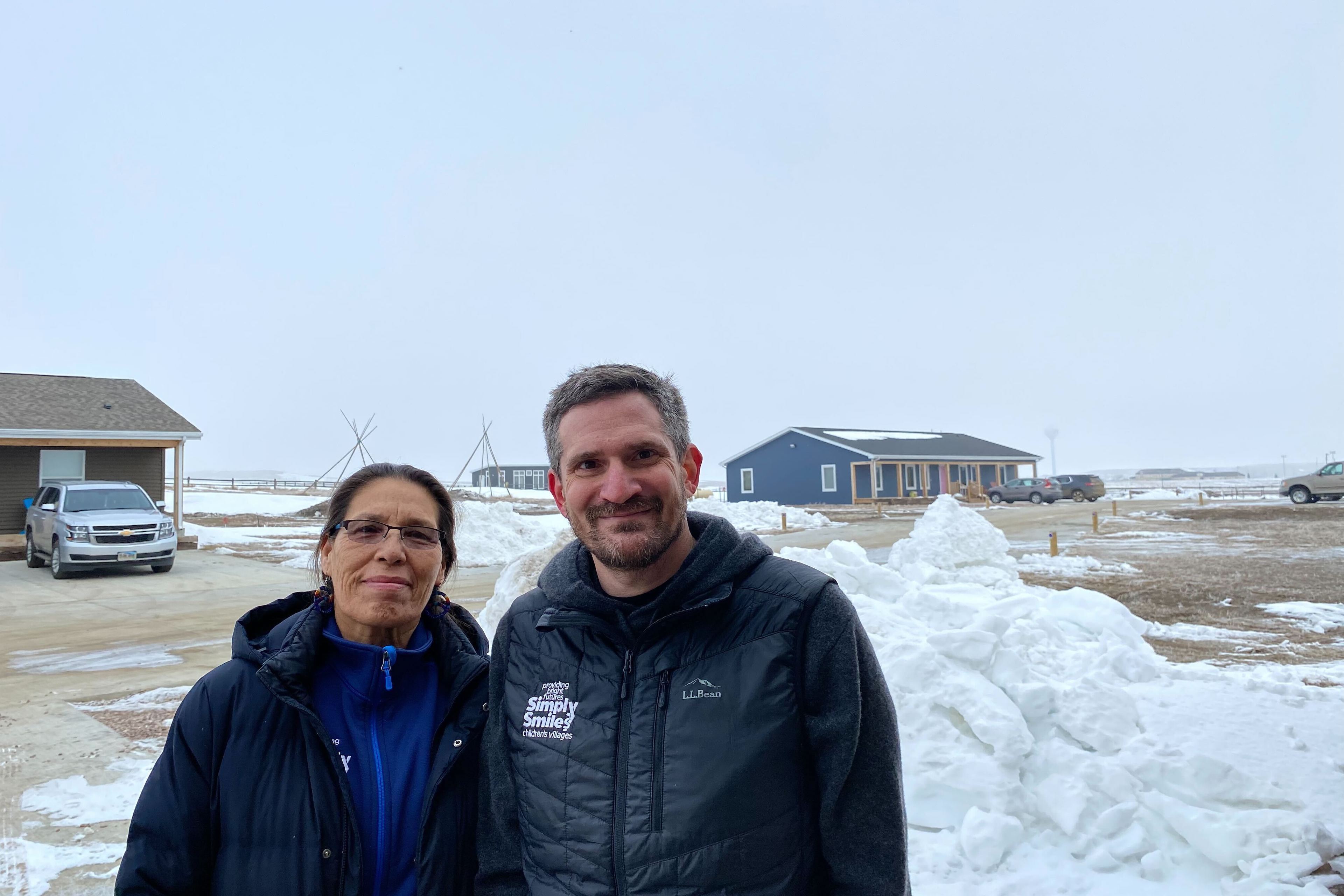
Marcella Gilbert organizes Lakota cultural activities and provides respite care for parents at the Children’s Village operated by Simply Smiles in La Plant, South Dakota. Bryan Nurnberger, president and founder of the nonprofit, serves as interim director of the foster care village. (Arielle Zionts / KHN)
It Takes a Village: Foster Program Is a New Model of Care for Indigenous Children
LA PLANT, S.D. — Past a gravel road lined with old white wooden buildings is a new, 8-acre village dotted with colorful houses, tepees, and a sweat lodge.
The Simply Smiles Children’s Village, in this small town on the Cheyenne River Reservation, is home to a program aimed at improving outcomes and reducing trauma for Indigenous foster children.
All foster programs seek to safely reunite children with their families. The Children’s Village goes further.
“We want to make Lakota citizens of the world,” said Colt Combellick, who oversees mental health programs at the village. “If we can help them relearn their culture and their heritage and connect them to the resources that they need to thrive moving forward, we’re going to try to make that happen.”
The program is an example of the growing nationwide effort to improve services for Indigenous children, after generations were routinely traumatized by being separated from their families and cultures. While the Indian boarding school era is over, and improvements have been made to child welfare systems, Indigenous families remain overrepresented in the foster care system.
“We actually have research that shows that kids who have stronger cultural identity have better child well-being outcomes” such as succeeding in school and avoiding drugs, said Angelique Day, an associate professor at the University of Washington and an expert on Indigenous child welfare.
Day, who is not affiliated with Simply Smiles, said she’s excited by any innovative program aimed at improving child welfare in tribal communities if it provides adequate training so foster parents can support the children and avoid turnover. She said it’s also important for organizations to arrange for independent evaluation of kids’ progress after leaving foster programs.
It’s too early to say whether Simply Smiles will succeed in its goals, but the Children’s Village has the support of the leaders of the Cheyenne River Sioux Tribe and has attracted interest and visits from officials representing Indigenous nations across the country.
It was a Cheyenne River Sioux tribal member who suggested the nonprofit set up a foster village on the reservation after learning about a similar program the nonprofit runs in Mexico. The tribal council voted to support the idea, and Simply Smiles has advisers including child welfare experts, elders, and other leaders of the Cheyenne River Sioux and other tribes.
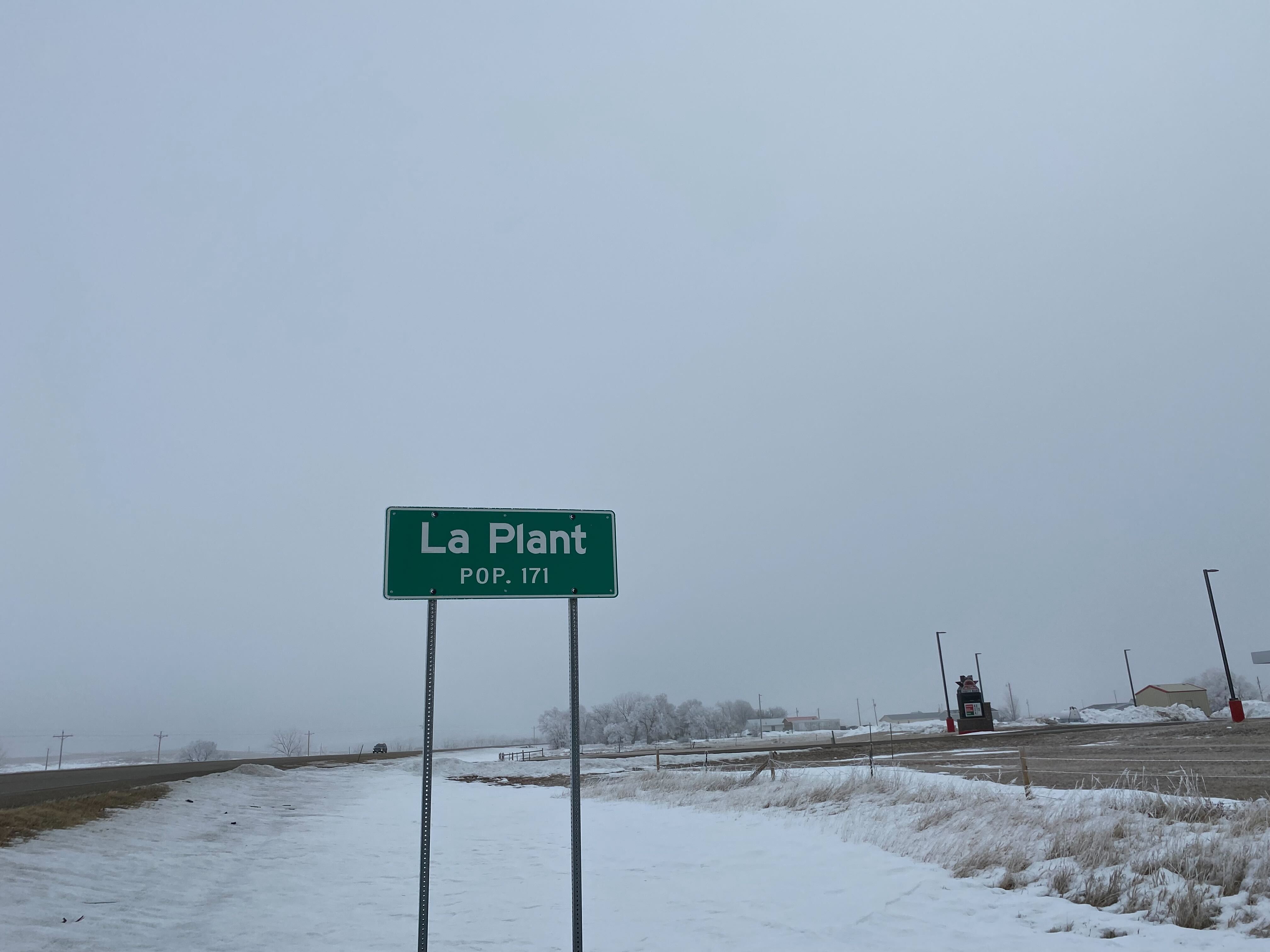
The Children’s Village operated by the nonprofit Simple Smiles is in tiny La Plant, South Dakota, on the Cheyenne River Reservation. (Arielle Zionts / KHN)
Simply Smiles’ model combines living in a house in a family setting with the resources of more institutional settings, said Bryan Nurnberger, president and founder of the Connecticut-based nonprofit.
The Children’s Village in La Plant has one foster parent caring for three teenagers. It’s hiring other parents to fill its three homes, which, together, can house up to six parents and 18 children.
The family has access to a counseling and family visiting center, as well as a large blue barn that stores a bus, maintenance equipment, and new clothing for the children to “shop” through.
MarShondria Adams, 39, grew up with stepsiblings who were placed in multiple foster homes. Last year, she moved 300 miles from Sioux Falls, South Dakota’s largest city, to La Plant, population 167, to become a foster parent at the Children’s Village.
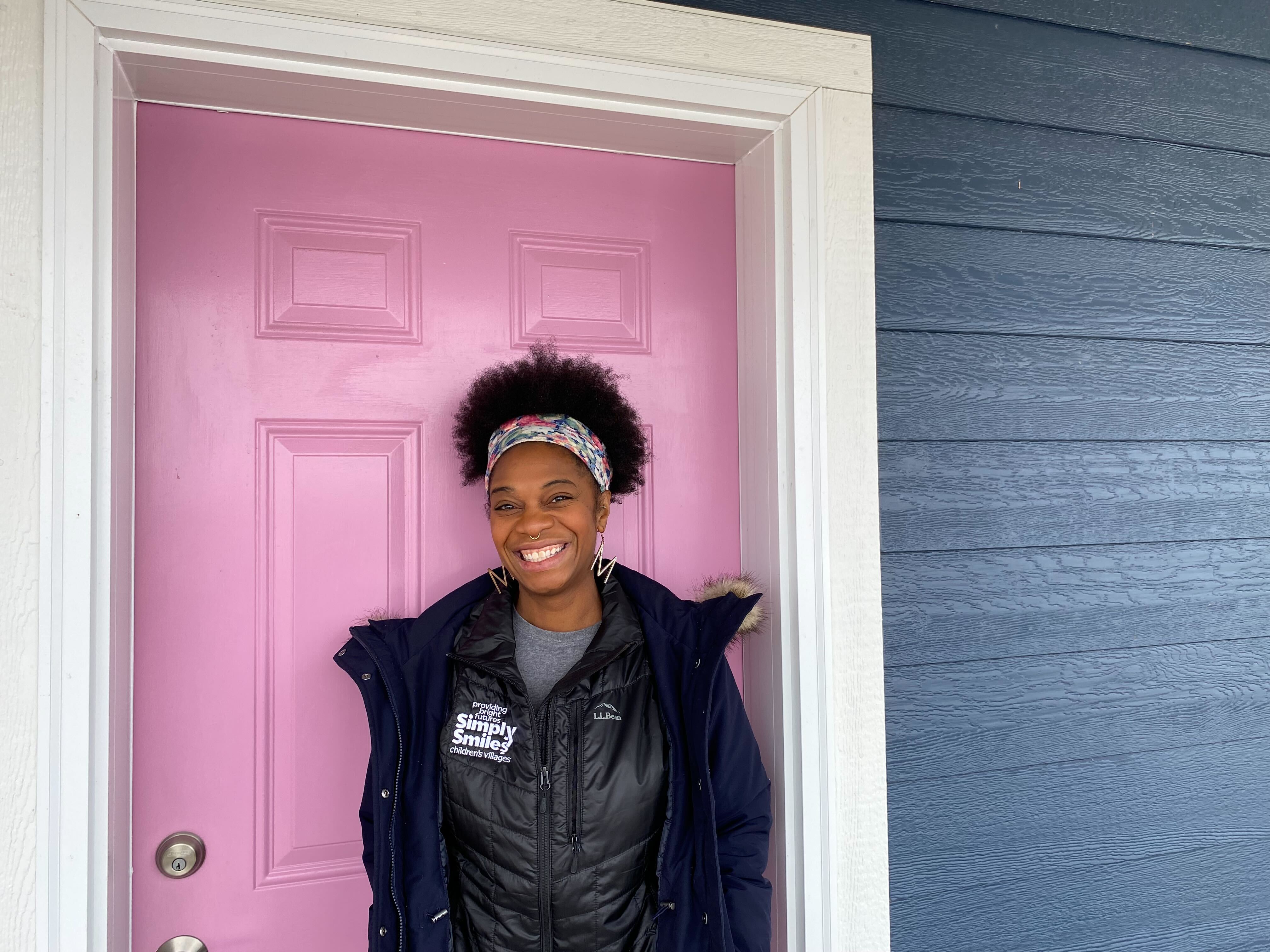
On a recent cold and foggy morning, Adams’ three foster teens made smoothies for breakfast inside their navy-blue house with a bubble-gum-pink front door at the Children’s Village. Adams drove them to school and then returned home, where she did laundry and filled out paperwork for the state’s child welfare department. Her after-school plan was to cook dinner as the kids tackled a YouTube exercise class.
Being a traditional foster parent in Sioux Falls would “be a day-and-night difference,” Adams said. She wouldn’t have on-site resources and staff members to assist her and the children with tasks ranging from repairing flat tires to finding a specialist who conducts learning disability assessments.
“I have all these people that are around me to support me and help me,” Adams said. Traditional foster parents probably spend more time than she does playing phone tag with case managers and searching for other resources, she said.
The program’s foster parents receive 70 more hours of training than required by the state, including education about Lakota culture. It also offers telehealth therapy, evaluations, and medication management to the foster parents, children, and birth parents. Combellick said the mental health services use trauma-informed and culturally relevant evidence-based methods.
The nonprofit funds these services through donations, grants, and the state, which also refers potential foster children to Simply Smiles.
Combellick, a member of the Cheyenne River Sioux Tribe, is another Simply Smiles staffer with a personal story about family separations.
His father was 6 years old when his mother went missing and was found dead on the reservation. Combellick’s dad and his siblings were sent 80 miles away to an Indian boarding school, where they stayed about a year before being reunited with their family.
Combellick said his father developed post-traumatic stress disorder from boarding school, where he faced corporal punishment and was not allowed to speak the Lakota language.
“That’s what spurred my passion. I just wanted to learn about my family history and how to break those cycles of oppression,” he said.
Combellick became a social worker and hoped someday to find a way to directly support his tribe.
“I came by Simply Smiles, and — boom! — it’s like 300 yards from where my ancestors grew up,” he said.
One of the children’s rooms inside a home at the Simply Smiles Children’s Village in La Plant, South Dakota. (Arielle Zionts / KHN)
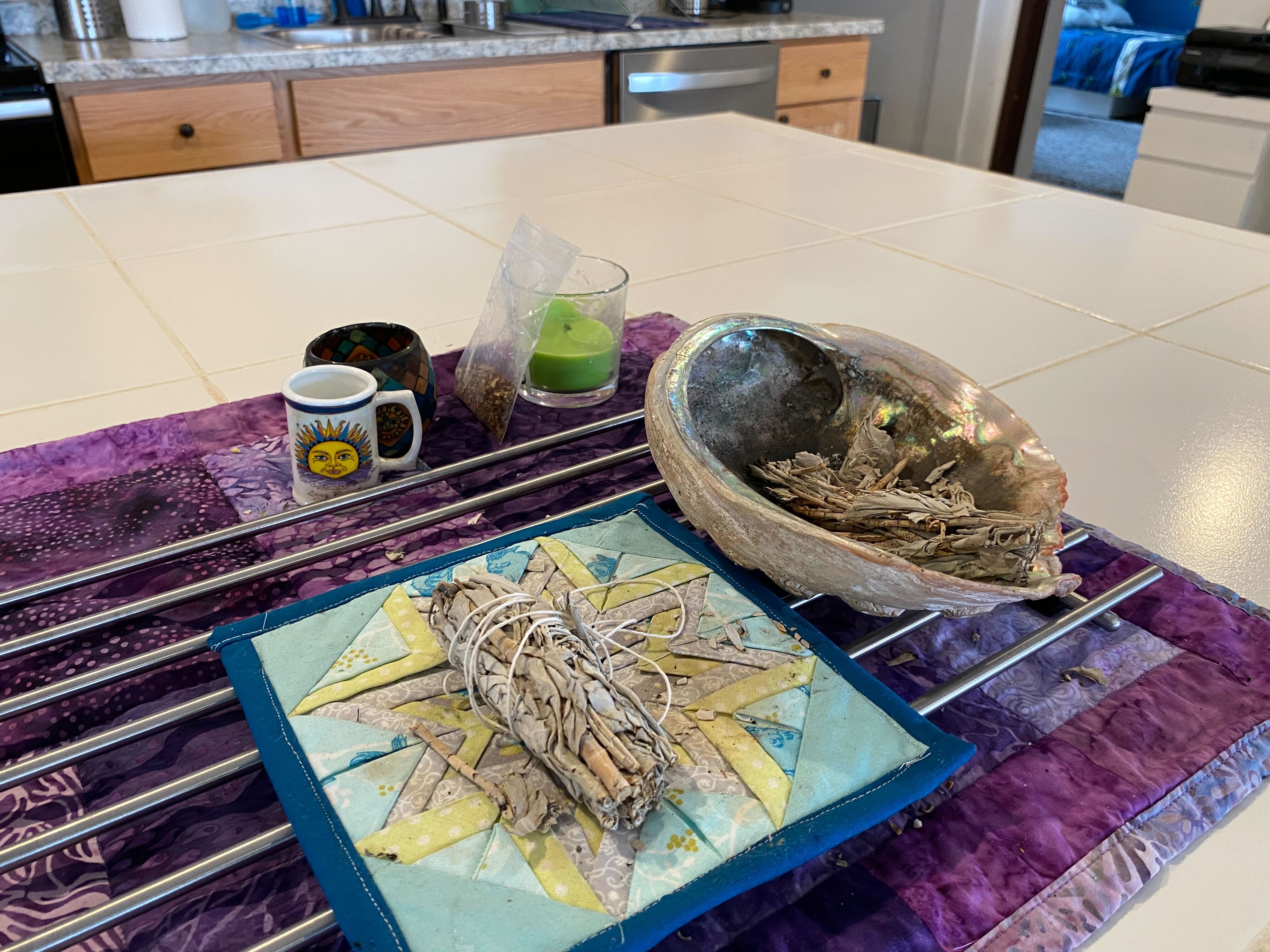
Bundles of dried sage sit on the kitchen counter inside a home at the Simply Smiles Children’s Village on the Cheyenne River Reservation in South Dakota. Lakota people use sage for purification rituals, medicine, and other purposes. (Arielle Zionts / KHN)
Experts say the law has reduced disparities since the 1970s, but by 2003 child protection agencies were still more likely to investigate and substantiate allegations against Native American families than other groups, and more likely to remove their children than those of any other group, according to data analyzed by the Annie E. Casey Foundation.
And as recently as 2020, Native American children were nearly three times as likely to be in foster care as other children, according to a Casey Foundation analysis. More than half of these foster children were placed with non-relatives or non-Indigenous caregivers.
MarShondria Adams moved 300 miles to foster three teens in this house at the Simply Smiles Children’s Village in La Plant, South Dakota. (Arielle Zionts / KHN)
South Dakota lawmakers recently rejected legislation that would have codifiedparts of the Indian Child Welfare Act into state law. But they may create a task force to study how the state can improve Indigenous child welfare.
Eleven percent of the state’s licensed foster homes are Native American, according to state data. Child welfare expert Day, a descendant of the Ho-Chunk Nation, said some Native Americans aren’t able or approved to accept foster children because they have low incomes or live in crowded or subpar housing.
“It’s not like tribal families don’t want to step up and do this work. It’s that we have barriers, systemic barriers, that are embedded within the system that discriminate against families who want to do this work,” she said.
Even with the pay and on-site support, Simply Smiles has found it challenging to recruit and retain caregivers. The first foster family arrived in fall 2020, but the parent burned out amid covid pandemic closures on the reservation. Another parent, from a large city outside South Dakota, left after finding life in such a remote area too difficult.
Marcella Gilbert, a member of the Cheyenne River Sioux Tribe, coordinates cultural programming such as trips to powwows and outings to hunt elk and bison. She also cares for the children when their foster parent needs a break.
“We’re asking people to do the hardest job in the world, which is being a parent to children coming into our homes with loss and trauma,” she said.
T he Métis National Council and the Government of Canada will be working collaboratively, Nation-to-Nation, to develop a process to engag...
To Veronica Brown
Veronica, we adult adoptees are thinking of you today and every day. We will be here when you need us. Your journey in the adopted life has begun, nothing can revoke that now, the damage cannot be undone. Be courageous, you have what no adoptee before you has had; a strong group of adult adoptees who know your story, who are behind you and will always be so.
OUR HISTORY
BOOK 5: Lost Children of the Indian Adoption Projects



:format(webp)/https://www.therecord.com/content/dam/thestar/news/canada/2023/04/03/23-billion-settlement-for-first-nations-children-announced-by-afn-and-caring-society/first_nations_children.jpg)




.jpg)