BACK UP BLOG (no longer updating)

This blog was a backup for American Indian Adoptees blog
USE THE SEARCH BAR or SEARCH TOPICS at bottom of this blog

If you need support

Support Info: If you are a Survivor and need emotional support, a national crisis line is available 24 hours a day, seven days a week: Residential School Survivor Support Line: 1-866-925-4419. Additional Health Support Information: Emotional, cultural, and professional support services are also available to Survivors and their families through the Indian Residential Schools Resolution Health Support Program. Services can be accessed on an individual, family, or group basis.” These & regional support phone numbers are found at https://nctr.ca/contact/survivors/ . MY EMAIL: tracelara@pm.me

Search This Blog

Thursday, December 8, 2022

NEW BOOK: "A Child of the Indian Race"


"A Child of the Indian Race" 
"A Child of the Indian Race": A Story of Return


Sandy White Hawk


Foreword Gene Thin Elk


Introduction by Terry Cross


Minnesota Historical Society Press (December 1, 2022)


Description


An adoptee reconnects with the
Lakota family and culture she was born into— and nurtures a new
tradition that helps others to do the same.


In the 1950s, when Sandy White Hawk was a
toddler, she was taken from her Lakota family on the Rosebud Indian
Reservation in South Dakota. Her adoption papers identify her as “a
child of the Indian race,” and her adoptive mother never let her forget
it, telling her she was unwanted and shaming her for being “Indian.”
White Hawk medicated her traumas with drugs and alcohol. At age
twenty-eight, she gained sobriety and reconnected with her birth
relatives. As she learned what it means to be Lakota, she also learned
that thousands of Native adoptees shared her experience—left to navigate
racial and cultural complexities as children, with no way to understand
what was happening to them.


Mentored by a respected elder, White Hawk
began to work with relatives who also had been separated by adoption and
foster care, taken away from their families and communities. Fighting
through her feelings of inadequacy, she accepted that she could use her
voice to advocate. Ultimately, White Hawk founded the First Nations
Repatriation Institute, an organization that addresses the post-adoption
issues of Native American individuals, families, and communities.


White Hawk lectures and presents widely on
the issues around adoption. She exposes the myth that adoption is a path
to protecting "unwanted children" from "unfit mothers," offering a
child a "better chance at life." Rather, adoption, particularly
transracial adoption, is layered in complexities. “A Child of the Indian
Race” is Sandy White Hawk's story, and it is the story of her life
work: helping other adoptees and tribal communities to reconcile the
enormous harms caused by widespread removals.


Advance Praise


“Of all human rights assaults on Native peoples in the United States, the stealing
of Native children is perhaps the most heartbreaking. Adopted by a white couple,
Sandy White Hawk grew up without cultural defenses against the onslaught of racism 
and
erasure she experienced. Her eloquent, riveting book takes the reader
on her journey back home and toward her life’s work: helping Native
families to reconnect and, together, face down generations of trauma.”
Suzan Shown Harjo (Cheyenne and Hodulgee Muscogee), writer, curator,
policy advocate, and recipient of a 2014 Presidential Medal of Freedom


"In this profoundly moving
memoir, Sandy White Hawk, Sicangu Lakota, speaks eloquently of her life
as a young child adopted by a white family. It is an intensely personal
story of resilience and perseverance in spite of trauma, racism, and
painful truths. At the core of her healing is her tribe’s Welcome Home
song and ceremony for adoptees. To all Native adoptees, this book is a
must read. Welcome home."

Denise Lajimodiere (Turtle Mountain Band of Chippewa), author of Stringing Rosaries: The History, the Unforgivable, and the Healing of Northern Plains American Indian Boarding School Survivors

"Worthy
of a novel—but true. A young child is transported to a strange place
where she is challenged to overcome events no child should have to face.
She lives in a world that doesn’t recognize or accept her, all the
while being told that this is in her own best interest. This is a story
about the triumph of the human spirit that finds love, acceptance, and
purpose in restoring hope to others who were also lost.

William A. Thorne, Jr. (Pomo and Coast Miwok), retired tribal and state court judge

"Since
the 1870s, first through boarding schools and then through forced
adoptions, federal bureaucrats have permanently removed Native children
from their families. Their goal was the erasure of Native people; the
result was trauma and severely damaged families. Sandy White Hawk, who
lived this adoption experience, has become a strong advocate for Native
people and Native families. In this compelling and immensely readable
story, her compassion and dignity shine through."
Anita Fineday (White Earth Tribal Nation), managing director, Indian Child Welfare Program, Casey Family Programs


“Sandy White Hawk is ‘a child of the Indian
race.’ This is her powerful memoir of coming home to the Rosebud Sioux
Reservation in South Dakota as an ‘Indian adoptee.’  It is a story of
much suffering and great courage, and it highlights the indelible
importance of song, ceremony, culture, and landscape in the arduous
journey towards truth, reconciliation, and healing.  It is also a
journey greatly facilitated by the vision and hard work of many Native
mentors, families, and communities. Read this book. It will change
you.” 
Frank Pommersheim, professor of law and associate justice, Rosebud Sioux Tribe Supreme Court


Author Information


Sandy White Hawk is a Sicangu Lakota adoptee from the Rosebud
Reservation, South Dakota. She is the founder and director of First
Nations Repatriation Institute, which offers resources for First Nations
people impacted by foster care or adoption to return home, reconnect,
and reclaim their identity. White Hawk is Director of Healing
Programs at the National Native American Boarding School Healing
Coalition and was elder-in-residence at the Indian Child Welfare Law
Office in Minneapolis. She is the subject of several documentaries,
including Blood Memory: A Story of Removal and Return.


Gene Thin Elk (Great Sicangu Nation) is an internationally known consultant in the area of Indigenous healing methods.


Terry Cross (Seneca
Nation) is the founding executive director of the National Indian Child
Welfare Association. He is the author of the Heritage and Helping and
Positive Indian Parenting curriculum, as well as Cross-Cultural Skills
in Indian Child Welfare.

$ 18.95 Minnesota Historical Society

One Choinumni man's adoption horror story


Emerson Gorman (R), who is a Navajo elder, poses at his property with his (L-R) daughter Naiyahnikai, wife Beverly and grandchild Nizhoni near the Navajo Nation town of Steamboat in Arizona on May 23, 2020. - Emerson Gorman knows what it's like to face the destruction of his culture: when he was five-years-old he was among thousands of Navajo children taken from their families and sent to Christian schools that tried to erase their belief systems.


Emerson
Gorman (right) was one of the thousands of Navajo children taken from
their families and sent to Christian schools to erase their beliefs. His
daughter Naiyahnikai, wife Beverly, and grandchild Nizhoni are pictured
(left to right) on his Arizona property May 23, 2020.


“But honoring tribal sovereignty isn’t about discrimination or
race. That’s a fundamental misunderstanding of Indigenous rights,” Ciesemier said in an episode meant to draw attention to what’s at stake for Native children.


Jaimie Nelson, a Choinumni Yokuts man from Fresno, California, was
once one of those children. He detailed on the podcast abuse he
encountered at the hands of a white family who adopted him. For Nelson,
legal experts, and activists, the Supreme Court challenge is an
outgrowth of an intentional and systematic effort to whitewash Native
Americans.


"I am not a victim of some odd set of circumstances where I lost my
sister and my brother," Nelson said. "It was an intentional act built
around ‘Kill the Indian, Save the Man.’"


Nelson referenced words
uttered in 1892 by racist American Army Capt. Richard Henry Pratt.
He tried, along with the federal government, to strip Native Americans
of their beliefs, cultural histories, and traditions. And though Pratt
made the speech 130 years ago, the sentiment he championed is far from
extinguished.


Nelson said eliminating the very constitutional right that attempts
to protect Native children from such cultural atrocities is “a genocidal act.” And he would know exactly what that feels like, because it was attempted on him. 


Nelson told the ACLU of his adoption:


There’s a lot of muddy water in there. I know that it happened
at a very young age in the late seventies. My biological parents, they
were, my mom was either addicted to drugs, my dad was a pretty bad dude.
But it didn’t mean that they had to take us away from our native
family. Our native family wanted to keep us, but the courts indicated,
essentially that there’s nothing you can do about it. They specifically
told my grandmother that there’s nothing that you can do about it. And
from what I understand, from what I was told, it destroyed her that she
was not able to keep us in the home. I don’t have very many memories of
my of my time in the foster care system or any of the sort of lead up to
the adoption. What I do have, I have physical reminders of my
introduction into the system. I have a tracheotomy scar on my neck and
on my sides from apparently when I was abused
, like immediately after
being taken from my Native family.


Nelson said when he learned of the case that will be before the
Supreme Court, he knew he had to do something "because there cannot be
another Jamie."


"There cannot be another child that is taken away because of some
archaic, just genocidal, bigoted ideas," he said. "It’s unbelievable.
It’s unconscionable to me that we still have to go through these
hurdles, but we do."


Dr. Twyla Baker, president of the Nueta Hidatsa Sahnish College,
tweeted about the case five days before Native American Heritage Month
began today. "The thing I can’t get off my mind—it’s about to be Native
American Heritage Month, as SCOTUS is about to hear a case that has the
potential to knock down the Indian Child Welfare Act," Baker said in the
tweet. "This kind of existential dichotomy pops up way too often for
Native people here."


She later added:


“My bad, actually this didn’t ‘pop up’—it was a situation
crafted, intentionally, over years with much larger implications and
intentions to follow. Superficial acknowledgments of our humanity as
other structures work to dismantle our Native Nationhood is really
pretty standard.”


Stephanie Amiotte, a member of the Oglala Lakota Tribe and legal
director for the ACLU of South Dakota, North Dakota, and Wyoming, said
when the Indian Child Welfare Act was proposed, 25 to 35% of American
Indian children were being raised in adoptive or foster homes or other
institutions.  About 90% of Indigenous children were being raised by
people who were not Indigenous, Amiotte said.


She explained that, historically, the federal government’s position
and policy has been “to remove Indian children from their families in an
attempt to assimilate” them “to white dominant culture.”


“It is something that actually threatens the very existence of future
tribes and Indigenous peoples as a population,” Amiotte said.

Wednesday, December 7, 2022

SIXTIES SCOOP: Raised Jewish, Adoptee Sharing Story

Former Winnipegger of Métis ancestry, raised Jewish sharing her experience


Growing up as an adopted child in a Jewish family in Winnipeg, Lisa Wilder knew she was different. She just didn’t know why.

She found out when she was in her mid-20s.


She was of Métis ancestry.


SUPPLIED by Lisa Wilder


“I felt misaligned as a child,” said Wilder, 53, who was part of the ’60s Scoop.


It wasn’t the fault of her family or the Winnipeg Jewish community, she said.


“I had a good upbringing, and my adoption was presented in a positive
manner by my parents,” she said. “I just felt something was off.”


Later in life, as Wilder learned more about her adoption, she
discovered her mother was 17 when she was born. Shortly after, her
mother was told Lisa would soon die. Hospital officials convinced her to
sign papers to pay for the burial.


But the baby was not dying. Instead, she was put into a foster home
where she was adopted by her new parents — who didn’t know she had been
“scooped.”


Today Wilder, a mother of three who now lives in Calgary, is on a
quest to learn more about her Indigenous roots and combine them with her
Jewish life.


There are similarities between the two, she said, adding both groups “suffered a genocide.”


She also noted that Indigenous people, like Jews in Nazi Germany,
were prevented from performing their ceremonies or celebrating their
spirituality. They were also confined to reservations, like Jews were,
for a time, confined to ghettos.


As she learns more about the Indigenous side of her heritage, she is
looking for ways to amalgamate the two. At the same time, although she
is of Métis ancestry, Wilder is careful not to call herself Indigenous.


“I’m not trying to pass myself off that way,” she said. “I have not
led an Indigenous life. I grew up Jewish. Métis is my ancestry. I’m
reaching out to Indigenous people for guidance. I want to learn more.”


Wilder spoke about her experience at a presentation called
Uncovering my Métis Roots: A Jewish Woman’s Journey.


“I’m a bit terrified to share my story in the community I grew up
in,” said Wilder, noting her adoptive parents, who were supportive of
her search for her biological family, will be there.


Her hope in sharing her experience is to promote understanding between Indigenous and non-Indigenous Canadians.


“I hope I can move the needle of awareness a little bit, to make this
a more peaceful and understanding world,” she said. “I’m no expert. I’m
just a person with a story who wants a better world.”


To register for the event, which is presented by the Jewish Federation of Winnipeg — Women’s Philanthropy, call 204-477-7426 or visit their website.


REUNION: ‘Where do I belong?’

Another White Earth Adoptee... are you one?  Were you raised in a Jewish family? Please leave a comment on our website.  Let's share your stories... Trace

Native roots, hard realities surface in woman’s search for her past

two women stand shoulder to shoulder
Anita Fineday (left) and Peggy Mandel, on the day they first met.
Courtesy Peggy Mandel- Fineday learned that family members at White Earth tried to adopt Peggy

Feeling
trepidation and hope, Peggy Mandel dropped a letter in the mail to a
woman she’d never met but who held the key to a secret piece of her
past.

Adopted and raised in a loving middle-class Jewish family,
Mandel didn’t know her own origin story. As a kid, she could remember
people asking, “Are you sure you're Jewish? You're too tall to be
Jewish.”

She wasn’t sure either but needed to find out.

After
decades of searching, she’d come across a name — someone who might be a
blood relative, someone who would lead her to a wrenching history of
Native people in Minnesota she wasn’t supposed to find.

Mandel had
been so scared she couldn’t write the letter. Her husband Joel wrote
it. For weeks, there was silence. Then came a voicemail that changed
lives across two families and three generations.

“I am pleasantly surprised. I'm shocked,” said the voice. “And I would like to connect with you.”

...

Mandel, who moved to the Twin Cities at age 11, started looking for
her birth mother in the 1990s. However Kentucky adoption records were
closed and no information was available.

About eight years ago she sought help from a staff member at the Children’s Home Society, a St. Paul adoption agency.

In
early 2014, an agency staff member called. “She said, ‘We found her.
She is alive and well. But we can't tell you where she lives. And she
doesn't want anybody to know. She doesn't want to meet you,’” recalled
Mandel.

READ

Tuesday, December 6, 2022

MMIWG: Bodies in Landfill


Police believe remains of three women in Winnipeg landfill, but do not plan to search

Winnipeg’s
police chief said Friday the remains of three victims of an alleged
serial killer are believed to be at a city landfill, but no search is
planned.

Too
much time has passed and there is no known starting point at the large
site, where bulldozers are constantly moving things around, Danny Smyth
said, adding that he understands that families are frustrated.

“I would want the remains of my loved ones as well.”

Smyth’s comments, after a police board meeting, came as Jeremy Skibicki, 35, appeared briefly in court.

Skibicki
was taken into custody and charged on May 18 with first-degree murder
in the death of Rebecca Contois, 24. Her partial remains were found in a
garbage bin near an apartment building. Police later found the rest of
her remains in the Brady Road landfill in the city’s south end.

On
Thursday, Skibicki was charged with first-degree murder in the deaths
of Morgan Harris, 39, Marcedes Myran, 26, and an unidentified woman.
Their bodies have not been found.

Contois
lived in Winnipeg and was a member of the O-Chi-Chak-Ko-Sipi First
Nation, also known as Crane River. Harris and Myran also lived in
Winnipeg and were both members of Long Plain First Nation. Police say
the three were killed in May.

The unidentified woman is also believed to be Indigenous. Police believe she was killed in March.

“We caught a break with Rebecca Contois in the timing of that particular search,” Smyth said.

“We
were able to take some action to isolate a very specific area of the
landfill within hours of discovering her other remains at the scene of
the crime. We don’t have that luxury with these other victims.”

Skibicki,
his head shaved and sporting a long beard, kept his gaze forward as he
walked by family members of some of the women and their supporters in
the courtroom. He said “correct” when a judge said his name and asked
him to confirm his identity.

Skibicki did not enter a plea, but his lawyer said he maintains his innocence and a trial is likely some time away.

“We
just received 10 terabytes today of disclosure and that’s probably not
all there is to it,” Leonard Tailleur told reporters outside the
courthouse.


Court documents show
Skibicki has been accused of violence against women in the past. One
woman applied for and obtained a protection order against him in 2019.
The woman alleged in the documents that Skibicki stalked her and
repeatedly sexually assaulted her while she was sleeping.

Another
woman applied for a protection order against Skibicki in 2015. The
documents say she alleged he repeatedly assaulted her while they lived
together and that he held a knife against her stomach while she was
pregnant. Her application for a protection order was dismissed.

The
court documents also say Skibicki has several Facebook pages. One page
with a profile photo matching Skibicki contains antisemitic and white
supremacist posts. A post from last January linked to a video questions
the discovery of unmarked graves at former residential schools.

The
Crown said it plans to proceed by direct indictment with a murder
trial, which means there will be no preliminary hearing to first
consider whether there is enough evidence. Skibicki remains in custody.

Members of the Contois family said they are deep in sorrow.

“The
last couple of months have been incredibly exhausting. We have
experienced paralyzing grief,” the family said in a written statement.

“We also continue to think of the other families. Our deepest condolences to them.”

— With files from Kelly Geraldine Malone in Saskatoon

This report by The Canadian Press was first published Dec. 2, 2022.


 Indigenous transracial adoptee shares her personal struggle amid US Supreme Court case

NEWS VIDEO


If the Indian Child Welfare Act is overturned, it would make it easier for non-indigenous families to adopt indigenous children.


FORT COLLINS, Colo. — When Susan Devan Harness, an indigenous
transracial adoptee, was removed from her home as a child, she was
placed with a white family, and the resulting experience was a lifetime
of otherness.


“You cannot take a child from a colonized race and place them in the
midst of the colonizers and think everything’s going to go great,” said
Harness, a Fort Collins author who said she is Salish Kootenai, of
Western Montana.


The U.S. Supreme Court is considering a challenge to the Indian Child Welfare Act, also known as ICWA,
enacted in 1978 to put in place adoption protections for Native
American and Alaska Native children. If those protections are
overturned, it would make it easier for non-native families to adopt a
native child.


Before ICWA, indigenous children were removed from their homes at
high rates. Studies showed 25% to 35% of indigenous children were being
removed from their homes. Of that group, 85% were placed outside of
their family and reservation community.


As someone who was removed from her home, Harness said she struggled
to connect with American Indian peers in school and she also faced
incredible difficulties trying to reconnect with her tribe.


There are complications to living in between those two worlds. The
first, Harness said, is the historic violence and conflict that
indigenous communities have faced at the hands of white communities.


“They’ve declared wars on us," she said. "Over a thousand wars,
they’ve declared on us, the U.S. Army. They’ve objectified us and moved
us when they didn’t want us. They’ve educated us in schools whose motto
was ‘kill the Indian, save the man.’ ”


To understand who she was, she went to school to study anthropology.
Eventually, she found others like her. They didn’t fit into white
mainstream culture but didn’t necessarily have a place amongst American
Indian peers, either.


“You can't be funny enough. You can't be scholarly enough. You can't
be talented enough,” Harness said. “You're always going to be this
person, this American Indian, living in white America.”


Harness wrote a book about her experience, aptly titled “Bitterroot,” named after a medicinal plant that grows near her tribe.


“It has the ability where if it goes through a lot of drought, it
doesn’t bloom, but the first time it gets rain, it blooms in amazing
ways,” she said.


Her book brought in rain. Harness reconnected with her tribe and even
has an honor song. Now Harness knows her biological family, intimately,
but that did not happen without a lifetime of emotional struggle.


“I don’t want to see other kids come out the same way I did, the same
way a lot of people in my generation did, trying to figure out what
happened to us when we’re in our 40s and 50s,” she said.


The U.S. Supreme Court has taken up challenges to ICWA three times —
in 1989, 2013 and 2022. The current case is the most significant because
it raises questions of equal protection under the Constitution.


The justices heard three hours of arguments Nov. 9. The high court
wasn’t expected to rule in the case until next summer. Lower courts
split on the case.


As the Supreme Court challenge goes on, Harness has a message: Anyone
involved in a transracial adoption has an immediate responsibility to
help the child find their place of belonging.


“They better be able to take that kid to the reservation every single
year,” she said. “They better make friends with people in the tribe to
ensure that child is given a proper education of who they are and where
they came from.”

HER FANTASTIC WEBSITE: HERE 

Interview – The Archibald Project – American Indian Transracial Adoption


MORE ADOPTEE STORIES


HISTORY: How the "free" state of California enslaved Native children

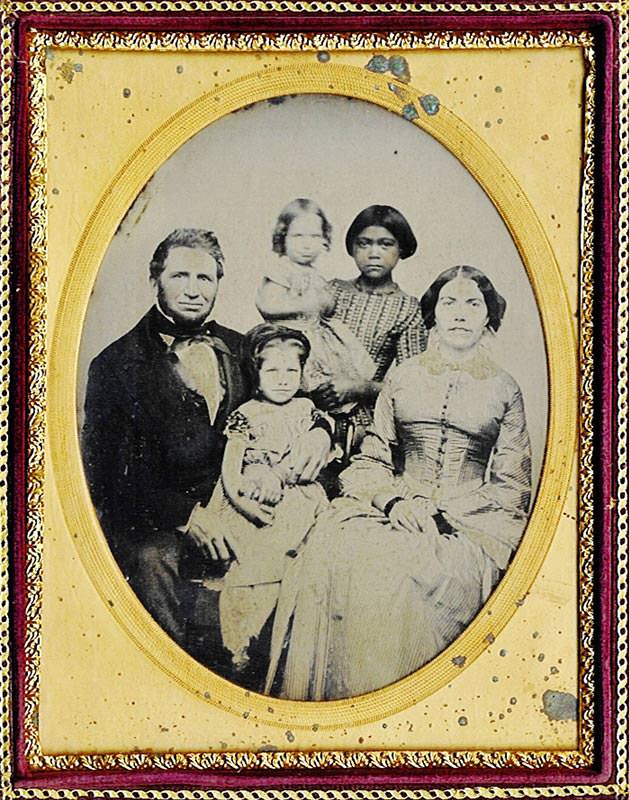
Photo of Kate Camden, a Native girl who at age 10 was forced into
servitude for a white family living in Shasta County. Photo is one of
few records that exist showing Native children entrapped by California's
apprentice and guardianship laws // Credit: Camden Family Portrait,
circa 1857-1859 courtesy of Whiskeytown National Recreation Area, WHIS
9066

 Kate Camden family portrait


New
Episode of ACLU Gold Chains Podcast Examines Indigenous Child Slavery
in 19th century California, Connects to Upcoming U.S. Supreme Court
Case Brackeen v. Haaland


How the "free" state of California enslaved Native children


Media Contact: press@aclunc.org, (415) 621-2493


SAN
FRANCISCO, CA – California came into the Union as a free state in 1850
with a constitution that banned slavery. So how did white settlers in
the mid-19th century get away with enslaving Indigenous
children, some of them as young as 2 years old? And why does this little
known, terrible chapter of California history matter today?


Today, the ACLU of Northern California released the third episode of Gold Chains, our podcast about California’s hidden history of slavery. “Indigenous Injustice” examines a 19th
century state law called the Act for the Government and Protection of
Indians that effectively legalized Indigenous child slavery and
encouraged kidnappers to snatch Native children from their tribal
communities.


“The
horror of what happened in California, the genocidal violence against
Native people, and especially the enactment of that violence against
children, is unfathomable,” said historian Stacey Smith, who appears as a
guest on the show.


“Indigenous
Injustice” isn’t just ancient history. Over time, the practice of
forcibly separating Native children from their tribal communities has
taken on many forms. There were the so- called Indian Boarding Schools. A
variety of other government-sanctioned adoption schemes have funneled
Indigenous children into Non-Native, mostly white households.


Currently,
there’s a landmark case scheduled to be heard by the U.S. Supreme Court
on Nov. 9 – Brackeen v. Haaland – that deals with the very same issue
of the forced removal of Native children from their families, tribes and
tribal culture. It threatens to dismantle the
Indian Child Welfare Act (ICWA), which was passed to prevent Native children from being removed from their communities.


The American Civil Liberties Union, along with 12 ACLU affiliates ( including the ACLU of Northern California) have filed an amicus brief with the U.S. Supreme Court, urging the court to uphold the constitutionality of the Indian Child Welfare Act.


“Indigenous Injustice” is a timely story that connects the dots between Indigenous child slavery in California to the present.


Link to Episode Website


November 1, 2022

Episode 3:
Indigenous Injustice


California joined the Union as a so-called free state in 1850.
So how did white settlers get away with enslaving Native children until
they were young adults?


We explore a little-known California state law called the Act
for the Government and Protection of Indians that unleashed genocidal
violence against Indigenous children. And we connect the dots between
that terrible past and a landmark upcoming U.S. Supreme Court case.


Episode Credits:


Produced by the ACLU of Northern California


Host and writer Tammerlin Drummond


Senior Producer and Editor Joanne Jennings


Mix and Original Score Renzo Gorrio


Executive Producer Candice Francis


We’d like to thank our wonderful guides Stacey L Smith, William Bauer and Tedde Simon.


Our associate producers are Lisa P. White and Carmen King.


A special thanks also to our voice actors Pauline Schindler, William Freeman, and Avi Frey.


Elize Manoukian provided fact-checking and production assistance.


Field recording was done by Julie Conquest, Ron George and Eric Gleske.


We’d also like to thank the following members of our Gold
Chains team: Brady Hirsch, Gigi Harney and Eliza Wee. Thank you also to
Abdi Soltani, executive director of the ACLU of Northern California.


A special thanks to World Affairs, Oregon State University and
the University of Nevada, Las Vegas for providing us with recording
studios.


Archival sound was provided courtesy of Periscope Films and Prelinger Archives.


Episode Guests:


William Bauer
is a professor of history at the University of Nevada, Las Vegas and a
citizen of the Round Valley Reservation. He is the author of California Through Native Eyes: Reclaiming History and We Were All Like Migrant Workers Here: Work, Community and Memory on California’s Round Valley Reservation.


Stacey Smith is an associate history professor at Oregon State University. She is the author of Freedom's Frontier: California and the Struggle over Unfree Labor, Emancipation and Reconstruction.


Tedde Simon is the Indigenous justice advocate at the ACLU of Northern California and a citizen of the Navajo Nation.


Additional Resources:


Gold Chains: The Hidden History of Slavery in California, ACLU of Northern California


Among the Diggers of 30 Years Ago, Helen M. Carpenter


Early California Laws and Polices Related to California Indians Kimberly Johnston-Dodds, California State Library


Federal Indian Boarding School Investigative Report U.S. Department of Indian Affairs


This Land, host Rebecca Nagle


At Liberty, host Kendall Ciesemier


Sunday, December 4, 2022

Search 101: A Primer (and More)

FREE

ADOPTEES UNITED
are launching a series of programs on searching, with the first one
this month focusing on search angels, birth searches, and the difference
between domestic and intercountry adoptees in finding their origins.
Join us for Search 101: A Primer and More, on Tuesday, December 13, 2022, at 3pm Pacific/5pm Central/6pm Eastern (USA and Canada).


Search 101: A Primer and More, sponsored by Adoptees United

We will be with Lynelle Long of Intercountry Adoptee Voices (ICAV)
and Annette O’Connell of Adoptees United as they introduce the basics
of searching, not only for US-born adoptees but also for intercountry
adoptees. We’ll discuss as many questions that we can fit in, plus take
on a few we have teed up already. Register today for this AU-produced event.


We’ll discuss many questions:


  • What should I know about the process even if I wanted to search?
  • What are the differences between a domestic (US-based) search and one involving a specific country and intercountry adoption?
  • What’s a Search Angel and how do I find one? What do they charge, or aren’t they supposed to be free?
  • What is an intercountry adoptee birth search and what does it involve? Are there resources to help?
  • What can DNA do for me and what are the limitations of it, especially across the globe?
  • How do I handle cultural and language differences?
  • What are the ethics of searching and what should I be careful about?
  • Who makes contact with a possible birth relative and how should that be handled?


Registration/Info
Global times are December 14, 2022, at 12:00am (Amsterdam); 4:30am (Mumbai) and 10:00am (Sydney). This event will be recorded, though we would still love to see you there. -Gregory Luce

Saturday, December 3, 2022

Seeking justice for missing children and unmarked graves uncovers ‘larger’ concerns


Kimberly
Murray says an impending bill making Indigenous policing an essential
service could make the process of searching burial sites much safer for
Indigenous communities.

In June, Murray was appointed the country’s independent special interlocutor for missing children, unmarked graves and burial sites.

For
two years, Murray is taking on the heavy task of liaising with
Indigenous communities to examine how Ottawa, provinces and territories
protect and investigate these sites, with the aim of improving Canadian
laws and making recommendations for a new federal legal framework.

Nearly five months into the job in October, Murray says some of those challenges are more sprawling than she first believed.

“The records are proving (to be) a larger concern than originally I thought,” she told the Star.

While
obtaining and accessing residential school records held by churches and
the federal government have long been considered a barrier to achieving
reconciliation, Murray said the issue extends far beyond those
entities.

She’s encountered cases of
children sent to the schools, apprehended by municipal police for
running away, entered into the court system and sent to reformatories,
before being shuttled back to the institutions they first fled.

“This
systemic interconnection of all these organizations and entities and
institutions is much larger than I thought,” said Murray, of attempts to
lay out a clear paper trail in each of those cases.

The
role of special interlocutor was first announced last summer, after
ground searches confirmed the existence of hundreds of unmarked graves
at the sites of several former residential schools. At the time, the
federal government earmarked $83 million
, on top of other investments,
to research and locate burial sites, and to commemorate children who
died at the institutions.

Since then,
Indigenous communities have grappled with how to go about conducting
searches of their own.  As of September, 88 communities have received
federal funding to begin that work, Murray said.

The
former executive director of the Truth and Reconciliation Commission
said the ongoing battle to access records — including those from local
police services, hospitals and universities — is mirrored in the
challenges accessing potential burial sites.

She
referenced the recent example involving Sioux Valley Dakota Nation in
southwestern Manitoba, whose radar survey at a campground in Brandon was
stalled after the site’s owner blocked access to the area.

“There’s
also issues with other sites that aren’t necessarily where the
residential school was located, but was associated with a residential
school, or we know that Indigenous children got sent to these places,”
Murray said.

“Our legislation and our legal framework doesn’t adequately address those concerns.”

These
are issues Murray raised at a meeting with federal, provincial and
territorial ministers of justice two weeks ago, where she was able to
discuss her mandate with government officials for the first time.

Murray
said she hopes to conduct similar meetings with Indigenous relations
ministers across the country as part of a wider effort to improve
co-ordination between hundreds of Indigenous communities.

One
of the topics raised in her discussion with justice ministers was
enshrining Indigenous policing as an essential service — a topic Ottawa
is hoping to address in the form of new legislation this year.

At
present, Indigenous police services are funded through the First
Nations and Inuit Policing Program, which was established in 1991. While
costs are split between provinces, territories, and the federal
government, police services are still regularly underfunded.

Ottawa
had initially hoped to table legislation on the matter as early as this
fall, a deadline that has now been pushed back to this winter. The
legislation is expected to help reform the way Indigenous police
services are funded, which would provide communities with full-time,
culturally-sensitive services.

Murray
said having a safe policing alternative is critical for communities
wrestling with how to bring law enforcement into their searches.

Such
police services could fundamentally change the way investigations are
conducted, Murray said, including allowing families and survivors to
actively take part in the process.

“I
am always offended when I hear a Crown attorney or a police officer
say, ‘Well, we have to protect the integrity of the investigation. To
me, that’s very demeaning and disrespectful to the families and their
communities because nobody wants to interfere with the integrity of the
police investigation,” Murray said.

“That to me is a buzzword, a white people buzzword, for ‘Get out of our way.’”

Having legislation in place as quickly as possible would eradicate some of that mistrust, Murray said.

“(Indigenous
police) weren’t the ones taking the kids when they ran away and
bringing them back. They weren’t the ones that did the failed
investigation when survivors were coming forward about sexual abuse,”
Murray said. “If we have First Nations police services, trained,
properly resourced, with the ability to do this investigation, that
could be the solution.”

Friday, December 2, 2022

#MMIWG UPDATE: Alleged Serial Killer in Custody


Alleged serial killer in custody and charged in killings of 4 Indigenous women in Canada, police say


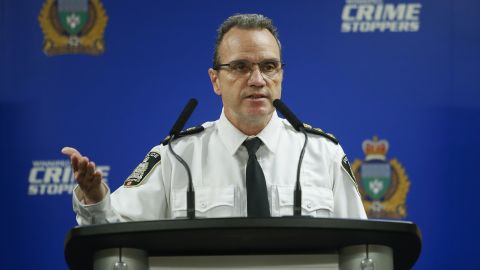
Winnipeg Police Chief Danny Smyth provides an update Thursday to the homicide investigation.


CNN
 — 


Authorities in Winnipeg, Manitoba, believe the murders of four
Indigenous women came at the hands of an alleged serial killer now in
custody in Canada.


Jeremy Anthony Michael Skibicki, 35, of Winnipeg, has been charged
with four counts of first-degree murder for the deaths of the women, a
news release from the Winnipeg Police Service states. It is not clear if he has an attorney.


The investigation dates to May 16, when Winnipeg police shared
information on the murder of 24-year-old Rebecca Contois, of the Crane
River First Nation, after her partial remains were discovered.


Skibicki was arrested May 18 by the agency’s Homicide Unit and charged with first-degree murder, the release says.


During the investigation, detectives established three more
victims murdered between March and May – before Contois’ death.


Morgan Beatrice Harris, 39, is believed to have been killed on or
around May 1, and Marcedes Myran, 26, is believed to have been killed on
or around May 4. Both women were members of the Long Plain First
Nation, according to the release.


A fourth victim also is confirmed but not yet identified. She is
believed to be an Indigenous female killed on or around March 15, police
said.


And the investigation is not over, Winnipeg Police Inspector Shawn Pike said Thursday during a news conference.


Bodies of those three new victims haven’t been recovered, said
Winnipeg Police Chief Danny Smyth, noting police have enough evidence to
charge Skibicki in their killings.


“Our officers will continue to search for information with the
goal of identifying this fourth unknown victim,” Pike said, adding DNA
has helped in their probe without saying how.


Meantime, Winnipeg must better address the safety concerns of the
community, Mayor Scott Gillingham said at Thursday’s news conference.


“As a city, we must all grieve their loss and recognize that we
have much more work to do to protect the lives of Indigenous women and
girls,” Gillingham said.


Skibicki is being held at the Milner Ridge Correctional Centre in Manitoba. 

In his Facebook bio, Skibicki described himself as an "official
member of 'Holy Europe,'" which is a small faction of a broader
far-right movement, an anti-facism expert told CBC last June.

mugshot of bearded man
Jeremy
Skibicki is now facing four first-degree murder charges in connection
with the deaths of four women, including Rebecca Contois, Morgan
Beatrice Harris and Marcedes Myran. (Jeremy Skibicki/Facebook)


Support is available for anyone affected by details of this case.
If you require support, you can contact Ka Ni Kanichihk's Medicine Bear
Counselling, Support and Elder Services at 204-594-6500, ext. 102 or
104, (within Winnipeg) or 1-888-953-5264 (outside Winnipeg).

Support is also available via Manitoba Keewatinowi Okimakanak's Missing and Murdered Indigenous Women and Girls Liaison unit at 1-800-442-0488 or 204-677-1648.


CLICK OLDER POSTS (above) to see more news

CLICK OLDER POSTS  (above) to see more news

MEGWETCH THANK YOU

HUGE Thank you for visiting this blog and sharing this with your kin. It's appreciated. Contact Trace anytime! Use the form below.

BOOKSHOP

Please use BOOKSHOP to buy our titles. We will not be posting links to Amazon.

Popular Posts

To Veronica Brown

Veronica, we adult adoptees are thinking of you today and every day. We will be here when you need us. Your journey in the adopted life has begun, nothing can revoke that now, the damage cannot be undone. Be courageous, you have what no adoptee before you has had; a strong group of adult adoptees who know your story, who are behind you and will always be so.

OUR HISTORY

OUR HISTORY
BOOK 5: Lost Children of the Indian Adoption Projects