BACK UP BLOG (no longer updating)

This blog was a backup for American Indian Adoptees blog
USE THE SEARCH BAR or SEARCH TOPICS at bottom of this blog

If you need support

Support Info: If you are a Survivor and need emotional support, a national crisis line is available 24 hours a day, seven days a week: Residential School Survivor Support Line: 1-866-925-4419. Additional Health Support Information: Emotional, cultural, and professional support services are also available to Survivors and their families through the Indian Residential Schools Resolution Health Support Program. Services can be accessed on an individual, family, or group basis.” These & regional support phone numbers are found at https://nctr.ca/contact/survivors/ . MY EMAIL: tracelara@pm.me

Search This Blog

Wednesday, March 16, 2022

LOST BIRD Cynthia Jeannette Mountain : her son Kyrie Irving is Little Mountain

(updated from 2018)
Kyrie and Asia Irving (Standing Rock)


Kyrie [Irving] stunned members of the tribe in 2016 when he said in an interview with ESPN that his mother Elizabeth was a member.  That sent the elders scrambling to identify a lineage, and they found his grandparents and great-grandparents from the White Mountain family in the Standing Rock reservation in South Dakota.
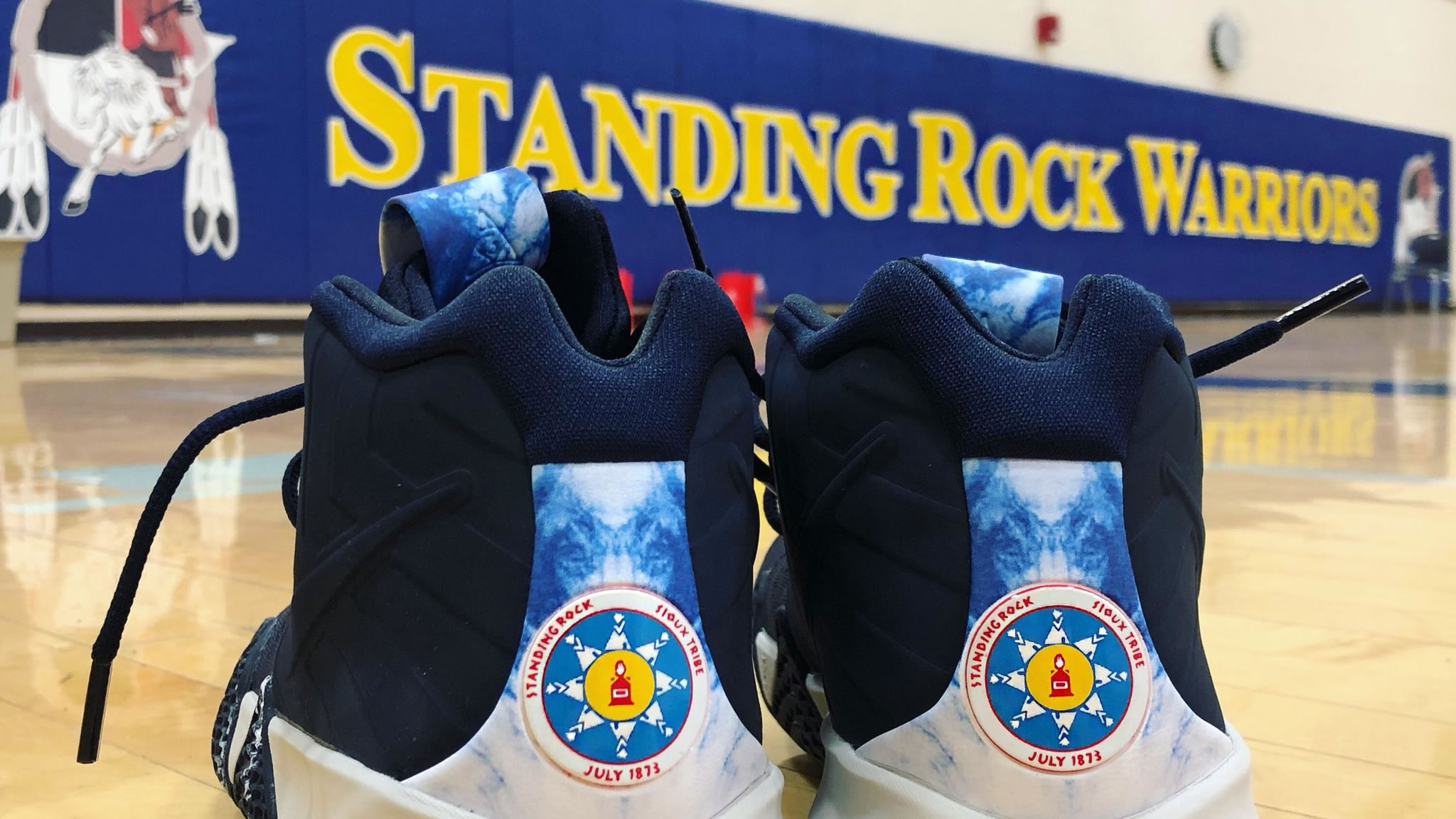
Irving supported the tribe’s fight against the Dakota Access Pipeline in 2016 and has had the tribe’s logo tattooed on the back of his neck. Earlier in 2018, he released a version of his Nike signature shoe that featured the logo as well. In 2017, Irving made a six-figure donation to the tribe.
The tribe and Irving have been working since April to put together a time for him to come and take part in a naming ceremony, which is sacred in Native American culture.

In Lakota, Irving’s name, ‘Little Mountain’ is ‘Hela’ (roughly: HEY-law), and his sister, Asia’s, name, ‘Buffalo Woman’, is ‘Tatanka Winyan’ (roughly: ta-TONG-ka WIN-yan). ‘Winyan’, ‘woman’, is perhaps most familiar to the rest of us in the derived form used to refer to one’s oldest daughter: ‘Winona’.  ESPN
Kyrie had apparently known of his tribal heritage for a while before acknowledging it publicly during the Dakota Access Pipeline protests in 2016. His mother was adopted out of the tribe as a child, a practice that was common at the time, but which was sharply curtailed by the Indian Child Welfare Act in 1978.

On his mother’s side, Kyrie and his sister are members of White Mountain family which is itself a part of the Hunkpapa band of the Lakota Sioux; Sitting Bull is probably the best known member of the band.

The tribe occupies some of the worst land in the Dakotas. The Sioux were, according to the 1868 Laramie Treaty, granted all of Dakota Territory west of the Missouri River, including the Black Hills. When George A. Custer’s expedition confirmed that there was gold in the Hills, the Army first put up a half-hearted effort to keep trespassers out of the Hills, before taking possession of them and protecting prospectors and others from the Lakota who objected to their presence.

Although the US had de facto, if not de jure, possession of the Black Hills, they were content to leave the rest of the Lakota reservation alone. However, passage of the Dawes act–which most famously opened up Oklahoma for homesteaders–led to a similar gutting of reservation lands in South Dakota.
What was left for Natives was the most unproductive land available. Such members of the tribes as had an inclination to learn how to farm and raise stock were forced to do so on the most marginal of land which was marginal for those purposes to begin with. The South Dakota Badlands, for example, occupy about a third of the land allocated to the bands of the Pine Ridge reservation.

At present, only about one out of a thousand U.S. citizens identify as Native American and their suffering is more or less invisible to the rest of the country. Life expectancy for those born onto the Pine Ridge reservation is less than 67 years. Unemployment is reportedly 60% on the Standing Rock, where 40% of the population is below the poverty line.

The pipeline protests of 2016 are perhaps illustrative of the occasional interest shown in Native issues. For a short period, any number of people embraced some Native phrases, and camped out along the Missouri River professing solidarity. When the protests ended, they left behind a gigantic mess and more or less forgot about the tribe, having done absolutely nothing to improve the plight of the people they were ostensibly there to support.

This is not a post about political parties, about who’s right and who’s wrong. This isn’t about blaming people of one particular set of political beliefs for a course of neglect and mistreatment that has gone on for over 200 years and for which people of all political stripes bear a measure of responsibility. This post is about the manifest suffering of ethnic groups that were more or less wiped out by the United States over the course of a century. It’s about the horrific world of Indian Health Services, the mismanagement of trust funds, and broken treaties.

What you choose to do with this information is up to you, but you need to know what life is like on these reservations.

source 

Kyrie and his mom Elizabeth. Elizabeth died from sepsis at a young age of 29. She was survived by her husband Drederick and their two kids – a son Kyrie and his sister Asia.

In spite of her early death, Elizabeth did a lot. She was a woman of an interesting and troubled fate.

She was born as Cynthia Jeannette Mountain. Her biological mother gave her for adoption. Thus, Kyrie’s mother got new parents and a new name – Elizabeth Ann Larson. She grew up in the family of a pastor and Lutheran minister George Larson and his wife Norma. She moved a lot in her childhood and teen years because of her father’s job.

After graduation from school she entered Boston University, where played for the local volleyball team. She was a brilliant student with open modern views and dreamed to become the first female president. After graduation she earned her living as a pianist, and was really talented in it. She could play by ear any melody.

Elizabeth tied a knot with Drederick Irving in 1990. They lived together during 6 years and gave a birth to a daughter and a son. She died six years later from skin disease. Source

StrongHearts Native Helpline Observes Five-Year Anniversary with more than 20,000 Calls


(EAGAN, Minn., March 2021)
 – This month StrongHearts Native Helpline observes five years of successful operation. More than 20,000 calls have been received since the organization’s launch in 2017.

Significant organization milestones over the past five years include: 

●      An increase in operating hours to 24/7/365

●      Launch of a new website

●      Addition of sexual violence advocacy, chat and text advocacy

●      Opening of a branch office in Sault Ste. Marie, Michigan (in addition to the national headquarters in Eagan, Minnesota)

●      Launch of the Michigan Enhancement Project to expand that state’s existing domestic and sexual violence advocacy services to support tribal programs and their contacts (a partnership with the Division of Victim Services at Michigan’s Department of Health and Human Services, which also provided the funding)

●      In October 2021, StrongHearts became an independent, national Native non-profit 501(c)3 organization with its own board of directors

“In 2021, StrongHearts Native Helpline continued its commitment to provide culturally-appropriate advocacy despite the continuing Covid-19 pandemic — it is through the resilience of our ancestors and our own experience with hardships that we were able to stay the course,” said Lori Jump (Sault Ste. Marie Tribe of Chippewa Indians) director, StrongHearts Native Helpline. “With tenacity, we will continue our mission to restore power to Native Americans and Alaska Natives impacted by domestic, dating and sexual violence by providing a system of safety, sovereignty and support in 2022 and beyond.”

StrongHearts Native Helpline History

In 2012, the National Indigenous Women’s Resource Center (NIWRC) and the National Domestic Violence Hotline (The Hotline) prioritized the need for a domestic violence hotline to support tribal communities across the United States. Together with input from tribal leaders, a Native women’s council, domestic violence experts, and the Family Violence Prevention and Services Program, NIWRC and The Hotline developed a plan to establish StrongHearts Native Helpline, a Native-centered hotline staffed by advocates with a strong understanding of Native cultures, as well as issues of tribal sovereignty and law. StrongHearts began its services in March 2017 in Austin, Texas — home to the National Domestic Violence Hotline, which provided initial infrastructure and technology support. On October 1, 2021, StrongHearts Native Helpline became a national, Native non-profit 501(c)3 organization with its own board of directors. StrongHearts is a proud partner of the NIWRC and The Hotline. StrongHearts Native Helpline is funded by the Administration on Children, Youth and Families, Family and Youth Services Bureau, U.S. Department of Health and Human Services; the Office for Victims of Crime: Michigan Department of Health and Human Services.

About StrongHearts Native Helpline

StrongHearts Native Helpline is a 24/7/365 culturally-appropriate domestic, dating and sexual violence helpline for Native Americans, available by calling or texting 1-844-762-8483 or by clicking on the chat icon at strongheartshelpline.org. 

Tuesday, March 15, 2022

Swimming Upstream: Indigenous Environmental Justice for Our Waterways

A Film Collaboration for Indigenous Environmental Justice 

In February 2022, Denise and Paul Pouliot, the head speakers of the Cowasuck Band of Pennacook-Abenaki people, collaborated with filmmaker Catherine Stewart to create Swimming Upstream: Indigenous Environmental Justice for Our Waterways. The short film was supported by the Episcopal Church of New Hampshire, and featured historic and scientific information relating to the Great Bay Estuary, located on the seacoast of New Hampshire. The film premiered on Monday, February 28th at an online screening. 

 The film invites the audience to join Indigenous Peoples of the region as they introduce us to the River Herring, a once abundant species which is now under threat. The film focuses on the importance of the removal of dams as a significant step in ensuring Indigenous environmental justice. Specifically, it explores the history of the Mill Pond Dam in Durham, NH. The film was completed just before a successful vote on March 8th 2022, in which 74% of voters chose to uphold a previous decision by the Durham Town Council to remove the dam. 

Please enjoy the short film, Swimming Upstream: Indigenous Environmental Justice for Our Waterways here.

Monday, March 7, 2022

Indigenous Filmmakers: Ryan RedCorn (Reservation Dogs) | Adam Piron to lead Sundance Institute's Indigenous Program

If you got a chance to watch the Reign of Terror episode on the CNN series, “This is Life with Lisa Ling,” he was one of the producers. If you’ve ever heard of a little hit show called “Reservation Dogs” on HULU, he’s one of the writers for its highly anticipated second season.

 Indigenous Filmmakers: Q&A with Ryan RedCorn https://t.co/e1UnoVSNSn via @osagenews


Adam Piron (Kiowa and Mohawk Tribes ) to lead Sundance Institute’s Indigenous Program
(LOS ANGELES, March 3, 2022) — Sundance Institute today announced that Adam Piron, a longtime staff member of the Institute’s Indigenous Program, has been named the Director of the Indigenous Program. In this new role, Adam will lead Sundance’s  engagement and investment in global Indigenous storytellers and will take over the Director position that Bird Runningwater left several months ago.

The Institute’s commitment to supporting Indigenous artists is woven throughout its history; amplifying President and Founder Robert Redford’s original vision, the Institute has remained committed to supporting the voices of Indigenous artists. The Indigenous Program has built and sustained an Indigenous film circle, which now spans over four generations. The cycle of work begins by scouting for and identifying Indigenous artists, providing a year-round support system at Sundance Institute to get their work made and shown, and then bringing the filmmakers and their work back to Native lands. The Native Lab has been a vital part of supporting Indigenous filmmakers since 2004; and the Merata Mita and Full Circle Fellowships offer further support to emerging Indigenous voices.

“It’s been a privilege to collaborate with colleagues in devising ways to support Indigenous storytellers at every stage in their career,” said Piron. “I look forward to leading this work with heart, vision and experience.” 

“Adam’s unflagging commitment to Indigenous artists and his vision of how best to bring their stories to life, has long been a source of inspiration for the Institute,” said Michelle Satter, Founding Senior Director of the Institute’s Artist Programs.

Piron belongs to the Kiowa and Mohawk Tribes and was raised in Phoenix, Arizona. In addition to the Director, Indigenous Program role, he also serves as a short film programmer for the Sundance Film Festival. Prior, he was the Indigenous Program’s Interim Director, Associate Director, and Program Manager. He is a co-founder of COUSIN, a film collective dedicated to supporting Indigenous artists experimenting with and pushing the boundaries of the moving image. He was previously the film curator at the Los Angeles County Museum of Art (LACMA). He received his BA in Film Production from the University of Southern California's School of Cinematic Arts.

He currently serves on the Editorial Advisory Board of Seen, a journal produced by BlackStar examining the visual culture of communities of color, featuring interviews, reviews and essays about Black, Brown and Indigenous visual culture. He concurrently serves on the Board of Trustees and Programming Committee of the Robert Flaherty Film Seminar as well as on the Indigenous Advisory Board for TIFF. He has also been on advisory panels for Canyon Cinema, the Herb Alpert Award in the Arts, The Jerome Foundation, The Princess Grace Awards and the Rolex Mentor and Protégé Arts Initiative.

Sundance Institute

As a champion and curator of independent stories for the stage and screen, the Sundance Institute provides and preserves the space for artists in film, theater, film composing, and digital media to create and thrive.

Founded in 1981 by Robert Redford, the Institute's signature Labs, granting, and mentorship programs, dedicated to developing new work, take place throughout the year in the U.S. and internationally. Sundance Co//ab, a digital community platform, brings artists together to learn from each other and Sundance Advisors and connect in a creative space, developing and sharing works in progress. The Sundance Film Festival and other public programs connect audiences and artists to ignite new ideas, discover original voices, and build a community dedicated to independent storytelling. Sundance Institute has supported such projects as Clemency, Never Rarely Sometimes Always, Zola, On the Record, Boys State, The Farewell, Honeyland, One Child Nation, The Souvenir, The Infiltrators, Sorry to Bother You, Won't You Be My Neighbor?, Hereditary, Call Me By Your Name, Get Out, The Big Sick, Mudbound, Fruitvale Station, City So Real, Top of the Lake, Between the World & Me, Wild Goose Dreams and Fun Home. Join Sundance Institute on Facebook, Instagram, Twitter and YouTube.


Medicine for the Resistance podcast


TRANSCRIPT


An Afromystic and Anishinaabekwe talk about everything

Top of Form

Bottom of Form

Top of Form

Bottom of Form

Bottom of Form

The Land is My Ancestor Listen now (66 min) | with genomic researcher Dr. Keolu Fox

patty krawec

 Feb 1


CLICK OLDER POSTS (above) to see more news

CLICK OLDER POSTS  (above) to see more news

MEGWETCH THANK YOU

HUGE Thank you for visiting this blog and sharing this with your kin. It's appreciated. Contact Trace anytime! Use the form below.

BOOKSHOP

Please use BOOKSHOP to buy our titles. We will not be posting links to Amazon.

Popular Posts

To Veronica Brown

Veronica, we adult adoptees are thinking of you today and every day. We will be here when you need us. Your journey in the adopted life has begun, nothing can revoke that now, the damage cannot be undone. Be courageous, you have what no adoptee before you has had; a strong group of adult adoptees who know your story, who are behind you and will always be so.

OUR HISTORY

OUR HISTORY
BOOK 5: Lost Children of the Indian Adoption Projects