BACK UP BLOG (no longer updating)

This blog was a backup for American Indian Adoptees blog
USE THE SEARCH BAR or SEARCH TOPICS at bottom of this blog

If you need support

Support Info: If you are a Survivor and need emotional support, a national crisis line is available 24 hours a day, seven days a week: Residential School Survivor Support Line: 1-866-925-4419. Additional Health Support Information: Emotional, cultural, and professional support services are also available to Survivors and their families through the Indian Residential Schools Resolution Health Support Program. Services can be accessed on an individual, family, or group basis.” These & regional support phone numbers are found at https://nctr.ca/contact/survivors/ . MY EMAIL: tracelara@pm.me

Search This Blog

Wednesday, September 22, 2021

Canada knowingly underfunding services for 165,000 First Nations kids and their families for decades


Where They Stand: The Parties on Indigenous Child Welfare

It’s been five years since a tribunal ruled that Canada discriminates against First Nations kids. Advocates still await change.
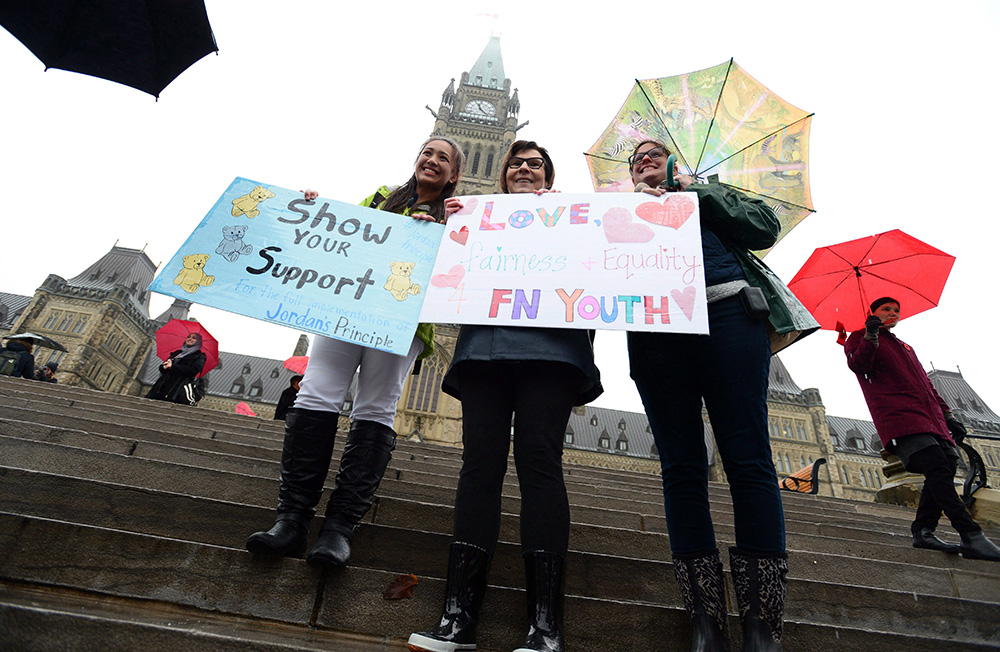

Katie Hyslop 16 Sep 2021 | TheTyee.ca

Cindy Blackstock doesn’t know why Liberal Leader Justin Trudeau lied about taking First Nations kids to court during the leaders’ debate last week. But Blackstock, the executive director of the First Nations Child and Family Caring Society, is “really sad” he did.

Especially when there is over 14 years of evidence — including court transcripts, news articles and 20 non-compliance orders from the Canadian Human Rights Tribunal — to the contrary.

“They have every legal right to litigate against our kids. I think it’s morally wrong — and it’s bad for the country — but they’ve chosen to do it,” said Blackstock of the government’s Federal Court case arguing against a tribunal ruling that First Nations children and families impacted by the child welfare system should be compensated.

“What they don’t have a right to do is then lie about it to protect themselves from accountability for their own behaviour.”

Blackstock would know: along with the Assembly of First Nations, her organization took the federal government to the Canadian Human Rights Tribunal in 2008 over its systemic underfunding of child welfre on reserves.

In 2016, the tribunal issued its ruling: the federal government had been knowingly underfunding services for 165,000 First Nations kids and their families for decades. The tribunal ordered the government to stop its discriminatory practices.

More than 50 per cent of children in government care in this country are Indigenous, despite representing fewer than 10 per cent of all children. The majority are First Nations children taken into care for “neglect,” which child welfare researchers say is another word for poverty.

In 2019, the tribunal declared the government must pay $40,000 — the maximum the tribunal can award — to every First Nations child removed from their family since 2006. Their guardians before the children were taken into care are entitled to $20,000.

The tribunal also awarded $40,000 to every First Nations child denied federal medical coverage between 2007 and 2017, citing Jordan’s Principle, a 2007 policy that governments should pay the medical bills of any First Nations child, on or off-reserve.

But two weeks before the 2019 election, government lawyers requested a judicial review of the compensation orders.

Hearings were held in Federal Court in June, less than a month after the Tk’emlúps te Secwe̓pemc Nation announced the rediscovery of 215 bodies on the grounds of the former Kamloops Indian Residential School.

The Federal Court’s ruling is expected at any time.

The government also took issue with the tribunal’s 2020 declaration that all children with Indian Act status; eligibility for status; or parents or guardians who have status, live on-reserve and whose First Nation acknowledges their membership — are covered by Jordan’s Principle.

The federal government argued before the court that only children with status under the Indian Act — a racist Canadian law that determines First Nations’ band membership — should be covered.

The Liberals have tried to respond to Canada’s child welfare crisis. In 2018 they released a six-point plan to reform child welfare, including implementing the tribunal’s ruling and working with Indigenous leaders to re-establish jurisdiction over child welfare.

In January 2020, the federal Act Respecting First Nations, Inuit and Métis Children, Youth and Families became law, starting the process to return jurisdiction to Indigenous communities. But it did not come with funding, and a year and a half later the federal government has yet to release a funding plan.

In B.C., a working group on child welfare and family services was established by the provincial and federal governments, the BC Assembly of First Nations, the Union of BC Indian Chiefs and the First Nations Summit.

Assembly Regional Chief Terry Teegee said that three of the 198 First Nations in the province are close to reclaiming their inherent jurisdiction over child welfare, though a federal funding commitment is needed.

“It’s always a work in progress, and I certainly know that a lot of these changes weren’t going to happen overnight,” Teegee said, adding the assembly is also waiting on provincial child-welfare jurisdiction legislation.

“We can’t let up. We need to continue on to allow our First Nations to take their rightful place in asserting their jurisdiction and their ability to express their sovereignty and self-determination in terms of children.”

The Splatsin of the Secwe̓pemc Nation is one of the three nations. It was close to signing a child welfare co-ordination agreement with the federal government before it was scrapped due to the election.

But despite how close they were, Splatsin Kukpi7 (Chief) Wayne Christian said the process has been frustrating, in part because the federal government has approached transferring child welfare jurisdiction like it is creating a new federal program.

“It’s beyond belief that you have a whole number of bureaucrats staffing up to offer this program,” he said.

No matter which party forms government, Christian said, the main stumbling block to re-establishing jurisdiction are the bureaucrats who have worked in the departments dedicated to Indigenous affairs for decades.

“They have a certain culture of how to operate with ‘the Indian problem’ and they’re still acting like Indian agents, except there’s a multitude of them now,” he said.

“It’s the bureaucracy that makes things happen, and they’re very slow to react to what we actually need to happen. They deny, delay and distract, that’s what they do.”

READ MORE

Morongo, 3 other tribes ask U.S. Supreme Court to uphold Indian Child Welfare Act

updated podcast: https://crooked.com/podcast-series/this-land/

 NEWS

'There’s a lot at stake here, and it’s important that the general public understands that (ICWA) stands as a beacon in child welfare practices'

The Morongo Band of Mission Indians and four other tribes from across the nation have joined the federal government in petitioning the U.S. Supreme Court to uphold a law that gives adoption preference for American Indian children in state foster care to American Indian families.

In a petition filed Sept. 3, the tribes are essentially requesting that the high court leave intact the Indian Child Welfare Act, a law enacted in 1978 amid a trend that saw an “alarmingly high percentage” of American Indian children separated from their families by nontribal public and private agencies.

U.S. Secretary of the Interior Deb Haaland, who is of American Indian descent, also has petitioned the Supreme Court to uphold the law, while the state of Texas, on behalf of Chad and Jennifer Brackeen, have petitioned the high court to repeal the law, claiming it is unconstitutional.

On April 21, the Fifth Circuit released its more than 300-page opinion — a mixed bag that largely upheld the law, but in which some judges agreed that certain provisions of ICWA were unconstitutional and others were constitutional, leaving the outcome less than clear.

Now, both the plaintiffs and the defendants have petitioned the nation’s highest court to review the case.

A Supreme Court response to the tribes’ petition and the petition filed by the plaintiffs is due on Oct. 8, according to the docket.

Ken Ramirez, chairman of the San Manuel Band of Mission Indians in San Bernardino, said in a statement Friday that, for more than 40 years, the Indian Child Welfare Act has helped reverse the tide of one of the most enduring historical attacks on Native American people: the forcible removal of American Indian children from their homes, tribal cultures, and tribal communities.

“We are hopeful that the United States Supreme Court will review this case and affirm the constitutionality of the Indian Child Welfare Act,” Ramirez said. “Those who seek to remove Native children from their homes and tribal communities should not be emboldened to return to the harmful and tragic practices of the past.”

 KEEP READING


Goldwater and other rich interests have their guns pointed at us... we will fight them with laws and ceremony... Blog Editor TL Hentz


Wawa to mark the National Day for Truth and Reconciliation #OrangeShirtDay

from unlearn.com

Wawa, Ontario | September 30th – Orange Shirt Day has been recognized by the Federal Government as the National Day for Truth and Reconciliation, a new statutory holiday. The Truth and Reconciliation Call to Action #80 states that the federal government will work with Indigenous people to establish a statutory day to “honour Survivors, their families, and communities, and ensure that public commemoration of the history and legacy of residential schools remains a vital component of the reconciliation process”. There are 94 Calls to Action.

In Wawa, the Town Hall and all municipal facilities will be closed and staff is encouraged to continue to expand their education as part of their individual reconciliation efforts.

Municipal Council notes that anyone who is interested in developing a better understanding can visit the Truth and Reconciliation Commission of Canada’s website, or use the Libby App to access digital books by Indigenous authors, such as “21 Things You May Not Know About the Indian Act” by Robert P.C. Joseph.

Other books that residents may find educating are:

  • Clearing the Plains – James Daschuk
  • The Inconvenient Indian – Thomas King
  • Seven Fallen Feathers: Racism, Death, and Hard Truths in a Northern City – Tanya Talaga

Residents may wish to visit these two websites:

  • Orange Shirt Day (www.orangeshirtday.org). Orange Shirt Day originates from the story of Phyllis Webstad from the Stswecem’c Xgat’tem First Nation. In 1973, on her first day at St. Joseph’s Residential School in Williams Lake, BC, Phyllis’s shiny new orange shirt was stripped from her, never to be seen again. 40 years later, on September 30th, 2013, Phyllis spoke publicly for the first time about her experience, and thus began the Orange Shirt Day movement.
  • National Centre for Truth and Reconciliation (https://nctr.ca). From September 27th to October 1st the NCTR will provide historical workshops, exclusive video content, and activities for students — all supported by artistic and cultural performances by First Nations, Métis, and Inuit artists.

A new broadcast special, National Day for Truth and Reconciliation, in partnership with APTN, CBC/Radio-Canada, Insight Productions and Canadian Heritage. In recognition of the new federal statutory holiday, also known as Orange Shirt Day, this unique one-hour, commercial-free primetime special honours the stories and perspectives of Indigenous Peoples affected by the tragedies of the residential school system in Canada, with musical tributes and ceremonies in Indigenous communities across the land. National Day for Truth and Reconciliation will broadcast and stream live Thursday, September 30 at 8 p.m. ET on APTN, CBC, CBC Gem, ICI TÉLÉ and ICI TOU.TV.

Additionally, the Wawa Goose Monument will be illuminated in orange on September 30th, to honour survivors of residential schools, along with their families and communities.

“Council has prioritized relationship building with our Indigenous neighbours,” said Mayor Rody. “We will continue to work with local Indigenous leaders to best determine how we can support their efforts and find opportunities to learn and highlight the First Nation roots of the community. Thank you to municipal staff for having the orange lights illuminating the Wawa Goose in honour and recognition of the residential school survivors and their families on September 30th. This is only a small part of recognition, and we have much more work to do.”

In June, the federal government passed legislation recognizing Sept. 30 as a federal holiday, a paid day off for federal workers and employees in federally regulated workplaces. On Sept. 9, the Ontario government confirmed that the day will not be a holiday for the province.

SOURCE

Bay Mills president's Indian Affairs appointment will transform relationships #ProtectICWA

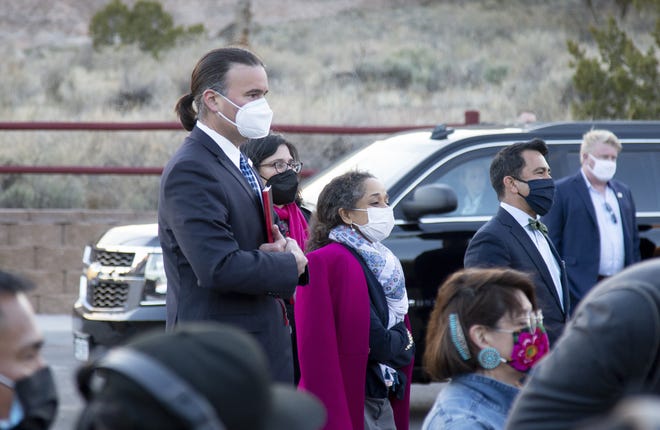
 | Opinion by Kirsten Matoy CarlsonPrincipal Deputy Assistant Secretary of Indian Affairs, Bryan Newland, visits the Navajo Nation in Window Rock, Ariz., with first lady Jill Biden on April 22, 2021.

It was a historic ceremony: U.S. Secretary of the Interior Deb Haaland, the first tribal citizen to hold the position, swearing in Bryan Newland, a citizen of the Bay Mills Indian Community, as Assistant Secretary of Indian Affairs.

For the first time in American history, tribal citizens lead the U.S. in its government-to-government relationship with American Indian and Alaska Native Nations. 

As assistant secretary, Newland becomes the highest-ranking official in the Bureau of Indian Affairs. One of the oldest federal agencies, the Bureau of Indian Affairs exists to enhance the quality of life, promote economic opportunity, and carry out the federal responsibility to protect and improve the trust assets of American Indians, tribal governments and Alaska Natives. 

Newland’s experiences as an attorney for tribal governments, a policy advisor in the Obama Administration, the Chief Judge of the Bay Mills Indian Community, and the President of the Bay Mills Indian Community make him especially qualified to lead the Bureau of Indian Affairs. The Bay Mills Indian Community is located near the Upper Peninsula's Whitefish Bay, on the shores of Lake Superior. 

Newland is uniquely positioned to advance the Biden Administration’s priorities of upholding the United States’ trust responsibility to tribal nations, strengthening the nation-to-nation relationship between the United States and Indian tribes, and working to empower tribal nations to govern their own communities and make their own decisions.

In leading the BIA, Newland will draw on many of his own experiences as a tribal leader to improve the relationship between tribal governments and the United States. 

Having just finished serving his community as tribal president, Newland knows firsthand the struggles faced by tribal governments in developing sustainable economies, protecting their territories, and serving their communities. He showed tremendous leadership during the pandemic, urging the BIA to provide adequate testing in Indian country and ensuring that tribal governments received funding allocated to them under the CARES Act. 

His advocacy for federal government accountability to Indian country demonstrates his deep understanding of the trust relationship between the United States government and Indian tribes. This understanding will serve him well as he takes on a key role in implementing the trust relationship and assisting tribal governments as they recover from a pandemic, which has disproportionately affected their communities.

Newland’s vision for helping tribal governments stems from his knowledge that tribal communities are best served when they are empowered to craft their own solutions to problems. Like President Biden and Secretary Haaland, he is dedicated to advancing the federal government’s commitment to ensuring tribal consultation on and input into federal policymaking. As a former Tribal President, he brings key insights into what works for tribal leaders in this process as he seeks to improve it.

Newland shares many of the values of other tribal leaders and will prioritize them as Assistant Secretary of Indian Affairs. Raised in his traditional Anishinaabek homeland along the shores of Lake Superior, he values the restoring and strengthening of tribal homelands so that every Native person has a place to call home. He understands that tribal homelands must be economically viable and has emphasized the need to restore tribal wealth to tribal communities so that they will thrive for generations yet to come. As tribal president, he sought to protect his own tribal homeland by vocally opposing Enbridge’s Line 5.

In addition to his on the ground experiences in Indian country, Newland understands the challenges facing the BIA, which has not always served Indian country well. 

He acknowledges that the agency has contributed to the state of affairs in Indian country and sees undoing colonization as intergenerational work. He has emphasized the importance of children to Native communities and acknowledged the incredible harm done to tribal families, cultures, and communities when their children are removed. 

As assistant secretary, he will support enforcement of the Indian Child Welfare Act, which prevents the unnecessary removal of Indian children from their tribal communities.

Newland’s appointment, alongside Haaland's historic appointment, will usher in a transformative new era in federal Indian affairs. As head of the BIA during an administration devoted to tribal sovereignty and racial equity, Newland can start to undo the colonization that has pervaded federal Indian law and policy from within.

Kirsten Matoy Carlson is a professor of law and adjunct associate professor of political science at the Wayne State University Law School, and is a leading authority on federal Indian law and legislation.

SOURCE

Monday, September 20, 2021

TODAY: Native America Calling

Monday, September 20, 2021 – ICWA: Federal protections for children under constant legal pressure

Host: Rebecca Nagle

The Indian Child Welfare Act has been upheld in dozens of court decisions as a vital federal protection for Native adoptees and foster children. That string of wins ended when a Texas district court judge ruled the more than 40-year-old law unconstitutional. A subsequent federal appeals court agreed that at least parts of ICWA are unconstitutional.  Long considered by legal experts as the gold standard of adoption law, ICWA faces its most significant legal challenge. We’ll examine how we got here and who is behind the legal efforts to dismantle ICWA.

Guests:

Matthew Fletcher (Grand Traverse Band of Ottawa and Chippewa Indians) - law professor at Michigan State University’s college of law and author of the “Turtle Talk” blog

Sandy Whitehawk (Sicangu Lakota) – Elder in Residence at the ICWA Law Center

Shana King (citizen of the Mandan, Hidatsa and Arikara Nation) – parent advocate at the ICWA Law Center

CLICK TO LISTEN

Break 1 music: Tapwe Oma (song) Fawn Wood (artist) Iskwewak (album)

Break 2 music: Dat One (song) The Delbert Anderson Trio (artist) MANITOU (album)


Wednesday, September 8, 2021

‘This Land’ podcast unravels complexity of child welfare in Indian Country in its second season

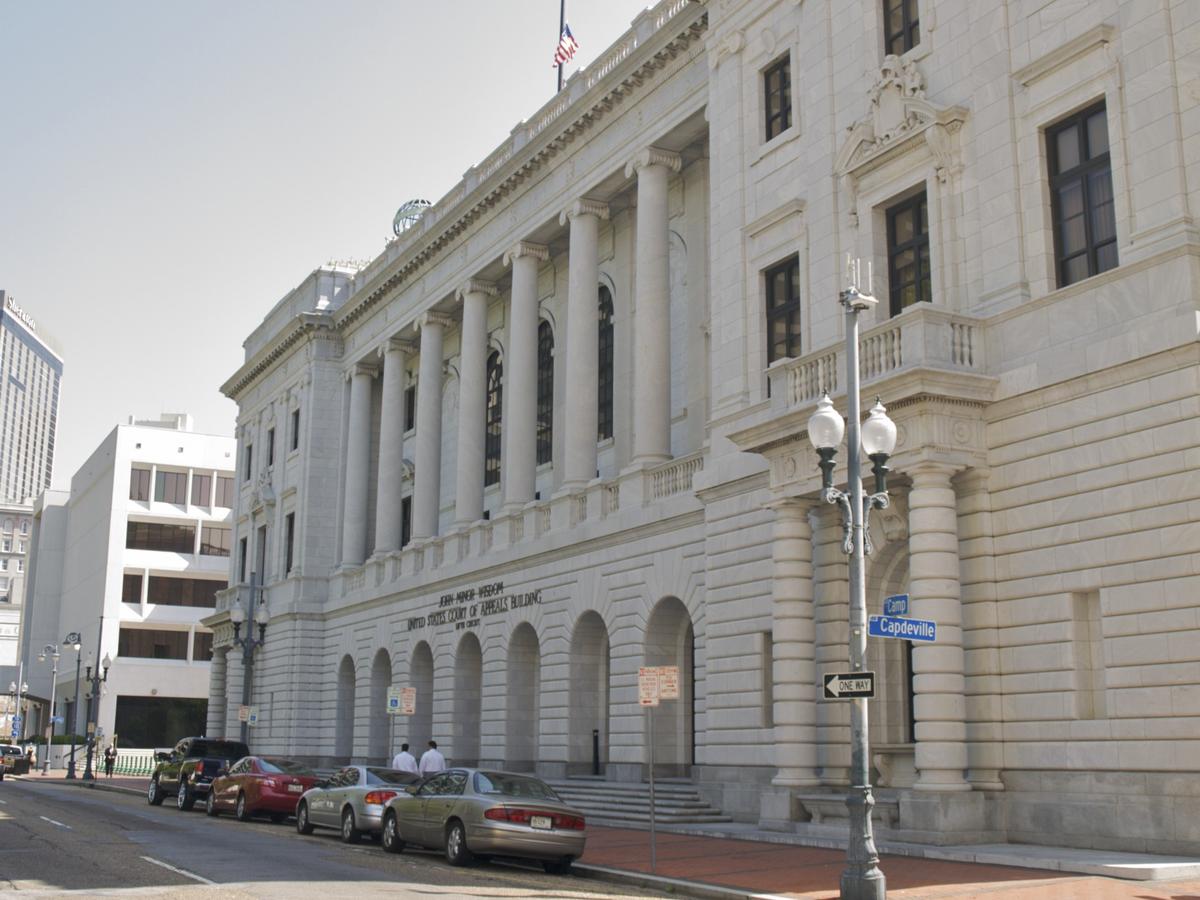
Sixteen judges on the United States Fifth Circuit Court of Appeals delivered a split decision in a lawsuit challenging the constitutionality of the Indian Child Welfare Act of 1978. The lawsuit charges that the law is racially based and unconstitutional because it is biased against non-Native families seeking to adopt. The 8-8 split decision largely means that portions of the ruling would apply only to cases in the Fifth Circuit district, which includes Texas, Mississippi and Louisiana, and would not directly affect ICWA cases in Alaska. (Creative Commons photo by David Schexnaydre/via Flickr)
• KNBA NEWS

The award-winning podcast “This Land” returns for a second season. This one examines the legal attacks on a 40-plus-year old federal law meant to protect Native children in the U.S. 

The first season of “This Land” examined two legal cases that became incredibly important to criminal jurisdiction and recognizing Tribal land. Cherokee journalist Rebecca Nagle is the host.  LINK

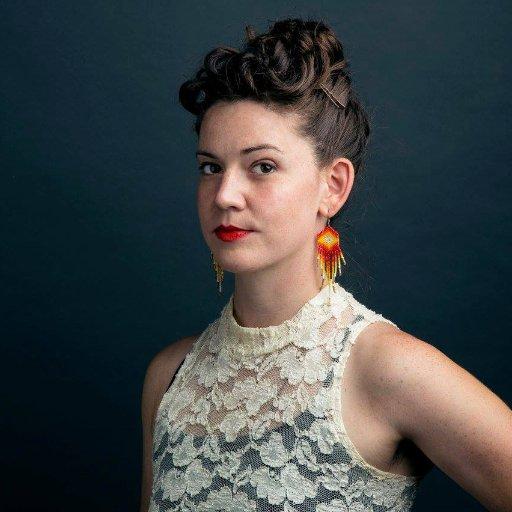
Rebecca Nagle (courtesy photo)

“The podcast is about cases that are important to federal Indian law and Indigenous sovereignty that I felt like needed to be covered more.” 

Two cases pitted state jurisdiction over Tribal jurisdiction in Oklahoma, where the Creek people were forced to relocate from the Southeast during the Trails of Tears in the 1800s. They signed another treaty with the federal government in 1856.  

Oklahoma never really recognized the Mvskoke (Muscogee) Nation reservation. 

“Oklahoma's main argument was, ‘we haven't recognized these reservations in over a century. And so you can't possibly ask us to recognize them.’ Now, there was no real legal argument behind that. It was just this kind of thing of, well, eastern Oklahoma can't possibly be a reservation.”

Eventually, those cases went to the U.S. Supreme Court, and the decisions re-affirmed the Mvskoke still had a reservation in eastern Oklahoma -- and in turn, jurisdiction over its lands and Tribal sovereignty. It also reaffirmed the Tribal land of four other Tribes in the area: The Cherokee, the Choctaw, the Chickasaw and the Seminoles.

But it’s still a huge legal mess. Oklahoma continues to challenge the Supreme Court decision. 

Nagle pivoted from that story to another legal battle that’s been brewing over the Indian Child Welfare Act, or ICWA. That’s a federal law passed in 1978 intended to prevent the removal of Native children from their families and communities.

Before ICWA, the federal government was adopting Native children out of their communities to white families. 

“The federal government under the BIA (Bureau of Indian Affairs) had this program called the Indian Adoption Project, where it was literally trying to take Native kids and put them up for adoption, for them to be adopted by white families,” Nagle said. “There was just deep racial bias within (the) child welfare system. So social workers were seeing Native kids being raised by an aunt or being raised by a grandma. But because they weren't being raised by the biological parent, that was child abandonment.” 

The Association on American Indian Affairs published a report that said between 1941 and 1967 as many as one-third of Native children were separated from their families. 

“And so it was a crisis -- about a third of Native kids were gone,” Nagle said. “You talk to Elders and people from that time and they'll talk about how there were communities, Native communities, where there just weren't kids.” 

The Indian Child Welfare Act was passed in 1978. 

“It was really created under this time where white homes were seen as being inherently better than Native homes. And it's this remedial measure to stop that racism in the system.”

ICWA requires that when child welfare workers consider the adoption of Native children -- they must first consider the family, the Tribe or Tribes, or at the very least another Native home. 

The law applies to Native children who are enrolled members of their Tribe or Tribes -- or are eligible for enrollment.

A years-long challenge to ICWA began brewing when a Texas couple, the Brackeens, fostering a Native toddler, were told they couldn’t adopt the child. 

“The child welfare department there in Texas and also the child welfare departments of Cherokee Nation, Navajo Nation, were looking for a permanent home for the child,” Nagle said. “Navajo Nation found a Navajo home, and because of ICWA, that's where the child was going to go. But then the Brackeens sued. And the way that they tell it is that ICWA was threatening to tear their family apart and that they were told they couldn't raise this child because he was Native and they were not. And so it was unfair to them and it was also unfair to the child, and that's unconstitutional.”

The Brackeens took their case to state court and then to federal court, until a split en banc decision in the 5th Circuit Court of Appeals -- ruled that in this case ICWA was constitutional in parts, but it wasn’t in others. 

But that decision really only affects court cases in the 5th Circuit -- which covers the federal judicial district in Louisiana, Mississippi and Texas.

“I think that the actual story of the custody cases show why there's still a deep bias in the system against our families -- against Native families and especially Native families who are struggling with poverty or homelessness or other issues,” Nagle said. “The system really doesn't view those families, at least in these cases, as favorably as white families and as families that have more money.” 

Nagle says podcast producers interviewed one grandmother, who helped raise a grandchild before she went into foster care.

The grandmother fought for three years to be considered as a placement for the grandchild -- and then she had to fight the non-Native foster family before she was finally able to adopt the grandchild.

"She had spent six years total fighting first the system and then this foster family to be able to adopt her grandchild," Nagle said. "If that bias hadn't been in the system, she wouldn't have had to go through all that, but also her grandchild wouldn't have had to go through all of that. 

Nagle said a lot of work went into producing this second season of the podcast. 

“I would say making podcasts is hard and I like to think that I'm learning and getting better at it,” Nagle said. “This season it was a story that we really had to uncover. And so we had to do a ton of legwork, one to just get our hands on the details of these custody cases and then two to really find out like what is going on behind this attack on ICWA.” 

Nagle says that the team sent 60 Freedom of Information Act requests during the reporting process.  But it has made a difference in the reporting and thoroughness -- in comparison with some mainstream media outlets like The New York Times, The Atlantic or NPR.

“I can look at those articles, especially the Atlantic article, and find factual inaccuracies and also just sort of and we also found factual inaccuracies within federal court documents and things that have been filed, a story that's been told to federal court,” Nagle said. “And so it became really, really, really important for us to get to the truth and to get to a well documented truth. And that that was a lot of legwork.”

Nagle says within the ICWA cases are broader implications -- like Tribal sovereignty and the rights of Tribes. 

“We need to think about the safety and well-being of our children. We also need to think about the legal status of Tribes that this case is attacking the heart of it,” Nagle said. “If you are worried about that, if you care about Indigenous rights in this country, this is a case to be paying attention to.”

Episodes of “This Land” season 2 drop every Monday through October 4. 


Tuesday, September 7, 2021

Province acknowledges Day for Truth and Reconciliation (September 30) #OrangeShirtDay


The province (Manitoba) has decided to acknowledge and observe the National Day for Truth and Reconciliation (NDTR) on Sept. 30.

Observance of the holiday, which will see Manitoba public schools closed and non-essential public servants off work, will advance reconciliation, and allow residents time to reflect on the residential school experiences of First Nations, Métis and Inuit, Alan Lagimodiere, Indigenous Reconciliation and Northern Relations Minister announced Friday.

“We all have a role to play in reconciliation,” he said in a statement. “We can all listen, learn, and support the healing needed to address the intergenerational trauma caused by the residential school system. Reflecting on our tragic history by recognizing the National Day for Truth and Reconciliation provides an opportunity for Manitobans to learn about the ongoing legacy of residential schools.”

The NDTR was instituted as a federal statutory holiday in June by the federal government in recognition of Indigenous families and communities harmed by Canada’s residential schools, which existed up to 1996.

“Thanks to the hard work of survivors, who pushed for the recognition of the National Day for Truth and Reconciliation as a provincial holiday, Manitobans can have the chance to learn, grow, and move toward reconciliation,” provincial NDP leader Wab Kinew said in a statement on Friday. “In 2017, I introduced a bill to recognize this day in Manitoba, which was one step, and our NDP team has been honoured to work alongside survivors and communities who pushed the PCs to take this latest step.”

Katherine Legrange, director of 60s Scoop Legacy of Canada, said the provincial recognition is a good first step. She said real reconciliation can only come with the truth.

“We encourage all Manitobans to take this day to learn the truth behind the terrible IRS (Indian Residential Schools), Day Schools, and Sixties Scoop policies of the federal and provincial governments that continue to affect our families today,” she said in a statement. “We encourage the minister to engage with survivors with lived experience in amending Wab Kinew’s 2017 Bill for Orange Shirt Day to acknowledge this day as a general holiday in Manitoba, and support our healing, going forward.”

Grand Chief Arlen Dumas of the Assembly of Manitoba Chiefs said on Friday his organization appreciates the province’s decision.

“There are some provinces that will not be observing the national holiday,” he said. “We all look forward to September 30 and paying our respect to the former IRS students and helping this government to move forward on the path to reconciliation with First Nations in Manitoba.”

Sept. 30 will also see flags on all provincial government buildings lowered to half-mast in observance of National Day for Truth and Reconciliation.

Nova Scotia also said Friday that it will recognize the day. British Columbia and the Northwest Territories have already indicated they will observe the day.

Utah reconciling history with Indian Residential Schools


A single building stands on the grounds that once contained an Indigenous boarding school, Aug. 26, 2021, in Panguitch, Utah. There are six known boarding schools within Utah, with the largest one located near Brigham City. The school in Panguitch primarily housed Utah Paiutes and Kaibab Paiutes Native Americans and this school operated from 1904 to 1909. (Chris Caldwell/The Spectrum via AP)

(excerpt)

The Indian Student Placement Program was sponsored by The Church of Jesus Christ of Latter-day Saints and was run from 1947 to 2000. This program started in 1947 but didn’t get sponsored by the church until 1954, according to the church. The program had missionaries approach Native American families and offer to have their children move in with an LDS foster family during the school year and return for the summer.

A 1976 document from the church identifies the objective of the Indian Student Placement Program as “to provide Lamanite children with educational, spiritual, social, and cultural opportunities that would contribute to their leadership development.”

Lamanite is a term from the Book of Mormon which refers to a group of people that settled in the Americas from Israel but turned their back on the Gospel and were cursed with dark skin. The church believed it had a mandate to help the Lamanites and convert them.

The president of the LDS Church at the time that document was released was Spencer W. Kimball, a staunch advocate for LDS outreach to Native Americans who described this program as an “inspiration from the Lord.”

In total, the Indian Student Placement Program placed 50,000 Native American children in homes that were in good standing within the LDS church, as reported by the Atlantic. These kids had to be baptized before entering the program with some instances of the children having wet hair from their baptism when they were introduced to their host family.

In 2018, the LDS church settled a lawsuit with members of the Navajo Nation that alleged they were sexually abused while in this program. The terms of the settlement were confidential and included no admission of wrongdoing by the church.

This was just one of many Native American assimilation efforts that were taken in the 20th century. In total there were over 489 residential schools in the U.S. and Canada, with the last residential school on the continent being shut down in 1996, according to the Union of Ontario Indians.

Assimilation programs in the 20th century didn’t just target Native American children. Another main policy was called “termination” which was a policy meant to terminate federal recognition and supervision of Native American Tribes and take more of their land.

The U.S. enacted termination policies in 1953, removing Indigenous people from their land. The land was sold and the people were relocated into urban areas and were promised good jobs. However, when Native Americans were relocated to cities the work was often less than rewarding, many felt out of place, and the housing offered was often sub-par.

Termination policy was led by Utah Sen. Arthur Watkins, who sold this policy was a way to stop Native Americans from being “wards of the government.” In a 1957 article written by Watkins, he argued that termination policies should be enacted by the government “as rapidly as possible.”

In total, termination policies enacted across the country took somewhere between 1.3 million to 2.5 million acres of land from Native Americans and more than 12,000 people lost tribal affiliation.

This termination policy worked poorly, with around 50% of relocated Native Americans deciding to return to reservations. These policies were phased out during the ’60s and during the Civil Rights Movement. In 1968, President Lyndon B. Johnson signed the Indian Civil Rights Act which called for the end of termination and instead allows tribes to self-determine their futures.

KEEP READING

Native American Pastor Seeks White House Apology for Historic Abuses

Cecily Hilleary |  September 06, 2021 VOICE OF AMERICA

Indian Boarding School
FILE - Children pose in an unidentified Indian boarding school in Minnesota, ca. 1900.

WASHINGTON - Almost every important piece of U.S. legislation contains at least one completely unrelated provision, embedded either as a favor to lawmakers or because it couldn’t pass as a standalone law. 

As it was with the 2010 defense appropriations act, H.R. 3326 (now, Public Law 111-118), which contained America’s first apology to Native Americans for historic policies of assimilation and forced removal. 

The bill, which passed in the Senate on December 19, 2009, and was signed by then-President Barack Obama the same day, recognizes the legal and political relationship between the U.S. and tribes, acknowledges “years of official depredations, ill-conceived policies, and the breaking of covenants,” and apologizes for violence, maltreatment and neglect.

US apology to Native Americans
A U.S. apology for historic wrongs against Native Americans was embedded deep within a defense spending bill passed December 19, 2009.

“The apology covered pretty much what it needed to cover,” said Dr. Negiel Bigpond, a fourth-generation Christian pastor and member of the Euchee (Yuchi) tribe, which was forced into absorption by the Muscogee (Creek) Nation in the late 19th century. For years, he worked with then-Senator Sam Brownback of Kansas to get a joint resolution of apology through Congress. 

KEEP READING (with videos)


**

Related Stories

USA
Hundreds of Native American children succumbed to disease, neglect in boarding school era.
USA
"When I did have children, I didn't know how to raise them."

 
For more than a century, from the late 1870s to the early 1970s, the U.S. government forcibly took thousands of Native American children from reservations and sent them to federal or religious boarding schools. At that time, supporters of the policy said these institutions would help Indians assimilate into mainstream American society, while later critics charged that the schools tried to eradicate the Indian culture by suppressing traditional languages and customs.


Thursday, September 2, 2021

Former residential school child-care workers say they wish the school had never existed...

Nancy Dyson and Dan Rubenstein worked at St. Michael's Indian Residential School on Vancouver Island in 1970 as child-care workers. They say after speaking out about neglect and abuse at the school to federal authorities they were fired the next day.

Wednesday, September 1, 2021

#MMIWG: Dateline


As we have posted on MISSING AND MURDERED INDIGENOUS WOMEN and GIRLS on this blog here, here, please watch this episode of DATELINE:   HERE

In August 2016, Carla Yellow Bird disappeared. She suddenly stopped texting and calling, and that didn’t sit right with her mother, Loretta, and sister, Kerry.

So they reported Carla missing to the Mandan Police Department in North Dakota.

Carla’s roommate said that she may have gone to a town called Saint Michaels on the Spirit Lake Reservation in North Dakota, the day she stopped communicating.

Spirit Lake is a reservation that spans 400 square miles, and it’s located about three hours northeast of Mandan, where Carla lived.

Lissa Yellow Bird has dedicated herself to searching for missing and murdered Native American women. This time, she would be helping to find out what happened to her own niece.

And the information provided by Carla’s roommate, gave her somewhere to start…

Lissa and many others believe that, too often, the cases of Indigenous women are ignored. Lynnette Grey Bull, activist and founder of Not Our Native Daughters, agrees. Lynnette describes her organization and why the MMIW movement hits close to home. READ MORE

 You can watch on Peacock TV as well.

The podcast version of the full episode is also available.

 AND use the search bar for more on this topic: #MMIWG and MISSING AND MURDERED


My earlier research:

Minnesota is one of only seven states to have established a task force to study the prevalence of violence against Indigenous women and girls.

“Bring Her Home: Stolen Daughters of Turtle Island” opened earlier this year at All My Relations Gallery in Minneapolis, and is now on display at the Fargo Public Library.

GREAT LISTEN: Missing, but not forgotten: Fargo library art exhibit tells story of missing indigenous women | MPR News

Walkthrough of the MMIW art exhibit “Bring Her Home: Stolen Daughters of Turtle Island” from Unicorn Riot on Vimeo.

Read More: unicornriot.ninja/2019/a-walk-through-of-bring-her-home-stolen-daughters-of-turtle-island/

MMIWG on my other blog

Over 1.5 million Native women have experienced violence, including sexual violence, in their lifetime according to the National Institute of Justice. Native women experience violence of twice the rate of women in the U.S. and on some reservations, the murder rate of Native women is 10 times the national average. In 2016, 5,712 cases of missing Native women nationwide were reported to the National Crime Information Center. Only 116 of them were logged in the U.S. Department of Justice’s missing persons database, according to the Urban Indian Health Institute.

READ: The Crisis Of Murdered And Missing Indigenous Women And Why Tribes Need The Power To Address It – The Appeal


Sixties Scoop survivor finds sister, only to lose her again

Nakuset wrote her story in the anthology STOLEN GENERATIONS

Podcasts: Crooked, This Land

LISTEN

The Lawsuit About the Indian Child Welfare Act That Isn’t About the Children

In This Episode

Fellow Crookedian Rebecca Nagle joins to talk about Season Two of “This Land.” From the “boarding schools” of the 19th century to the good intentions of the Indian Child Welfare Act — and the big money campaign to repeal it.

podcast link


excerpt:

Ana Marie Cox: What you’re telling me, Rebecca, is that there’s money to be made.

 Rebecca Nagle: There’s a lot of money to be made. There’s a lot of money to be made.

 Ana Marie Cox: [laughs] There’s surprisingly, there’s deep pockets because there’s deep, you know, dough on the other side. But I just wanna repeat back to you what I think you said just because it’s fascinating. And I think I want to make it really clear. There is some talk, there is some reason that is somewhat about this case is about kids. OK, fine. But if you dig deep, what you are seeing is an attempt to establish precedent, to undo almost everything that exists to protect tribal sovereignty.

 Rebecca Nagle: If the Supreme Court took this case in the broadest way possible and decided it based on the broadest way possible, it would absolutely set that precedent. And it’s interesting because you already see some people making that argument in other areas. So people are already, people have tried and are already making this like kind of like equal protection, race-based argument in other areas of federal Indian law. And some people are even doing it based on this case. And so I don’t think we have to, like, take a wild stretch of the imagination to see the broader implications of it. And then what I want to add is that I actually, I actually do think, and this was something that I was surprised by, that some people are fighting ICWA for ideological reasons. And that ideology is that our country should not have laws that are race conscious, should not have laws that are remedies to structural racism. And the thinking behind that is that the way to solve racism is to stop talking about race and to pretend like it doesn’t exist. And so when you look at the people who are attacking ICWA, a lot of them have also fought things like affirmative action. You know, it’s some of the same players that were behind the Abigail Fisher case and now the Harvard case. You know, we talked about the Voting Rights Act, it’s some of those people. And I think there is this really deep ideological divide, which I think in some ways is kind of intellectually dishonest because we can see all the ways that systemic racism in the child welfare system exists, but any effort to remedy that is what is unfair. [laughs] I think one of the things that’s very telling about this lawsuit is that they’re trying to get rid of something and not trying to build something different. I think if you’re concerned about children in foster care, there is a lot of reason to be concerned about the well-being of children in foster care in the country right now. You know, and there’s also a lot of reasons to see, you know, there’s a lot of evidence that ICWA actually does a lot of good. And so, yeah, I think if their end-goal was really helping Native children, they would be trying to build something, not trying to destroy something.

 Ana Marie Cox: So when I look at this case and your podcast and what I’ve learned, the case is itself about both children and the ability of non-Native people to adopt Native children in a echo of the boarding school, you know, system a little bit, that echoes—not the same! But it’s Echo. And it’s about who controls the resources in Native land, Native sovereignty. You know, you can’t oppress a people, just, you know, but, just in culture or just in economics, it’s both. It’s always both. You’re always, your oppressing in both these both these lanes. And it made me start to think about reparations. Which we talk a lot about in terms of slavery. But I really hear so much less discussion when it comes to Indigenous people. I mean, hardly any. I think I’ve talked to one person about it. But this case raises it for me, because it’s talking about the most precious resources you have in a community, which is the children, and who were taken.

 Rebecca Nagle: Yeah. And I think, you know, when I interviewed Native leaders, one thing, one thing that more than one Native leader said to me was, you know, if we can’t protect our children, then what can we protect? You know, if we can’t, if we can’t keep our children, then then what else do we have? Yeah, and I think when it comes to what justice looks like for Indigenous nations, you know, the slogan or the hashtag or what will you, but the thing that people are talking about a lot right now is Land Back. And I think that looks like a lot of different things. And so, you know, Under Secretary Deb Haaland, she’s trying to make the tribes putting land back in trust easier. There’s been some proposals that national parks or national forests should be returned to the stewardship of Indigenous nations. And I think it’s also restoring sovereignty over the land that we have that is recognized and really creating a legal reality where tribes, the inherent rights of our tribes to govern our land, to govern our citizens, is recognized. And right now, what we have in the United States, thanks in large part to the Supreme Court, some things that Congress has done, but mostly the Supreme Court, is that that’s piecemeal. And so when you look at civil jurisdiction, criminal jurisdiction, the right of law, the right of tribes to do everything from taxation, to arrest somebody, from speeding, for speeding it, it’s very complicated. And I think what we need is a full restoration of tribal sovereignty and tribal jurisdiction on tribal land and also restoring land to tribes. And my last thought, not to be too meta, but I think, you know, as our country faces a growing ecological and climate crisis, you know, I think that restoration of tribal sovereignty is going to be critical for all of us, and is what is best for all of us. You know, there’s the statistic that Indigenous people globally control about like 5% of the land in the globe, but protect 80% of biodiversity. And so, you know, Indigenous peoples, we really have the knowledge of that stewardship that is so desperately needed right now.


new episode

THIS LAND:

LISTEN


Nebraska Indian Child Welfare Coalition awarded prize

 WATCH

Native foster care nonprofit earns prize for child advocacy work

OMAHA, Neb. (KMTV) — A grassroots nonprofit advocating for Native youth in the child welfare system was recently granted a highly competitive prize to further their efforts.

In 1978 the Indian Child Welfare Act set federal regulations to prioritize the specific needs of native children and their communities, regulations that the Nebraska Indian Child Welfare Coalition aims to protect and upkeep here in Nebraska.

“The reality is that historical trauma continues to impact our families every single day," said Misty Frazier, executive director of the coalition. "With the child welfare system, and other systems, and other issues that Native families face, we are treating the symptoms of historical trauma.”

According to the Nebraska Foster Care Review Office's latest quarterly report Native children only make up 1.1% of the population, but make-up nearly 3.9% of foster children placed out of home or trial placement. They also make up nearly 5.9% of probation-supervised youth.

Native girls make up 10% of the children sent to a youth rehab and treatment center, the most restrictive type of placement and often the last option. Native boys make up 2.4% of that population.

The coalition aims to keep native children in the foster care system connected to their culture and community. They work with families to learn their rights, train care workers, and advocate for the children in and leaving the system.

One of their latest achievements was working to extend resources to native youths aging out of the system.

“For most of the tribes their age of majority is 18, and Bridge to Independence doesn’t start until they are 19, and so there was a one-year age gap," Frazier explained.

For their efforts, the coalition was recently awarded the Springboard Prize for Child Welfare. Only four applicants out of over 300 were granted the $200,000 prize.

The coalition plans to use the funds to continue their efforts for foster youth aging out of the system.

‘The child-welfare system is residential schools part two,’ says lawyer

This
article contains content about residential “schools” that may be
triggering. IndigiNews is committed to trauma-informed ethical
reporting, which involves taking time and care, self-location,
transparency and creating safety plans for those who come forward with
stories to share.

Roslyn Chambers
says she first began drawing connections between residential “schools”
and Canada’s child-welfare system during law school.

It
was the early 2010’s, and she was studying law at Dalhousie University
in Halifax. After learning that her peers didn’t know about Canada’s
residential “school” system or the Sixties Scoop — something Chambers
believes everyone should know about — she started a discussion group.

They
welcomed guest speakers to join them, and Chambers says their teachings
helped her to understand that “the child-welfare system is residential
schools part two.”

“The same
principles that put residential schools in place are almost identical to
what’s happening within the child-welfare system today,” she tells
IndigiNews.

“It’s another thing that we’re going to get an apology for in twenty years.”

Chambers
is a Black and Métis lawyer and the co-founder of Chambers Caldwell Law
LLP. She spoke with IndigiNews about why it’s important to fight for
Indigenous kids and families involved in the child-welfare system, and
what lawyers can do differently.

Anna McKenzie: What is your area of expertise or focus as a lawyer, and how long have you been practicing?

Rosyln
Chambers
: I practice family law and child protection. I’ve been
practicing for five years, which seems like a very short time. I was a
mature law student with a lot of life experience. I think that’s part of
why my practice is very strong and growing.

AM:
How many parents [roughly] have you represented in cases against the
Ministry of Children and Family Development (MCFD) or a Delegated
Aboriginal Agency (DAA)?

RC: Hundreds. Somewhere between 200 and 250, and that’s in five years. That doesn’t include the people that call for advice.

AM: Why is it important for you to fight for Indigenous kids and their families who are involved with MCFD?

RC:
It’s important to me because of the families that are broken and
they’re getting broken apart by the Director [of MCFD], by the
government, and their colonial views. I don’t know how else to describe
it. Colonial arrogance, white privilege … The Director steps in and
decides where that child goes, when in fact, the family and the
community probably could have dealt with that situation better and with
less disruption to the child.

It’s
important to me because I’ve got a few new tools right now with the new
Act [respecting First Nations, Inuit and Métis children, youth and
families]. I’m quoting it all of the time, and the judges are listening.
The legislation has to change now that we have this new Act. The
provinces need to step up.

I’m
doing this work because I don’t want to see yet another government
apology in twenty years. I want to make sure that every family, whether
it’s a mom or dad or a grandmother, gets to have their voice heard
against the Director. There are so many sad stories where the parents
don’t get a lawyer, don’t know what to do, and end up losing their kids.
It’s disgraceful, and so my work is basically trying to reunite the
family. The Director has to understand that and they have to be more
flexible and understanding instead of destroying families. Not all
families are perfect.AM: What do you think needs to be changed about the
way the legal system approaches Indigenous child welfare cases?

RC:
The very first thing is, they have to listen to the parents. I think
the judges need to listen to the parents a lot more. Also, the Director
needs to be checked. That’s the key.

There’s
been a number of refreshing changes recently, because we’re in an
environment now where judges have a better understanding. Recently, a
judge said that the Director shouldn’t go unchecked and that the court
should be [more] engaged … and this was based on me trying to get an
Indigenous child out of a non-Indigenous foster home. It’s important to
me because these families are broken, and they are getting broken apart
by the government.

I also think the
Director shouldn’t be able to just remove kids and then deal with it
later. [Social workers] should be calling and looking for a family
member and involving the child’s nation where possible. Instead, parents
may not be able to see their child for weeks.

There’s
also a lack of adequate access. The Director seems to think that two
hours, two or three times a week, is adequate to see your child.

There’s
also a lot of people that rely on kids being in care. If you look it
up, you’ll see how much money is spent on legal fees going to trial.
There’s a financial infrastructure that relies on a certain amount of
kids being in care. That money should be put into preventative measures
like keeping kids at home, supporting parents with child care and
respite care, services for mom and dad … that is money better spent that
is going to make a change. ​​Or even just give [the money] to
communities. Give it to First Nations.

There
are some amazing social workers out there that really work to try and
get the kids home, but they are the exception, sadly.

AM:
What do you want other lawyers to know or do differently when they are
representing indigenous families involved in the system?

RC:
I want them to be empathetic. I want them to fight hard to be the
advocate. You are the voice of your client. I want them to understand
all of the services that may be available to Indigenous clients, like
legal aid or supports in finding housing so parents can work towards
getting their kids back. Those resources give us [lawyers] extra hours
for Indigenous client support.

Be more imaginative and try to support the person as a whole. Also, make sure you know the kid’s name.

AM: Would you say law students are encouraged to pursue child protection law in school?

RC:
No, I don’t think they are. It’s not sexy, it’s not fancy. It’s
possibly not even lucrative. But it is a very valuable thing. I think
there has to be a larger emphasis on it in family law, and I think it
should also be a course on its own. A child protection [course] will
help people understand the historical disadvantage of a group of
peoples, and it’s sad to say that out loud but the child-protection
system is the new residential school.

AM: Is there anything else you’d like to share?

RC: There’s another thing that perpetuates the historical disadvantage, and that’s “the watchlist.”

It’s easy to get into the child-protection system. It is very difficult to get out.

It’s
also, you know, a stereotype. It’s like we don’t expect you to do well
if you came out of the system, which is kind of ironic.

Also,
kids are still being removed at birth. It was supposed to have stopped,
but it still happens. One of my proudest moments was supporting a mom
whose new baby was removed. She was still in the hospital and then she
came home without the baby, but the baby came home that afternoon
because I went to court right away and I said this is completely
ridiculous. When you take a child away at birth, you know you are
changing this child’s destiny and ability to bond.

Instead of coming and taking kids, provide [families] with [the] supports and services in advance.

A
National Indian Residential School Crisis Line has been set up to
provide support for former students and those affected. Access emotional
and crisis referral services by calling the 24-hour national crisis
line: 1-866 925-4419.Within B.C., the KUU-US Crisis Line Society aims to
provide a “non-judgmental approach to listening and problem-solving.”
The crisis line is open 24 hours a day, seven days a week. Call
1-800-588-8717 or go to kuu-uscrisisline.com. KUU-US means “people” in
Nuu-chah-nulth.

Thursday, August 26, 2021

Canada pledges millions to search for residential school graves

By Al Jazeera Staff | 10 Aug 2021 

Warning: The story below contains details of residential schools that may be upsetting. Canada’s Indian Residential School Survivors and Family Crisis Line is available 24 hours a day at 1-866-925-4419.

 
Canada has promised tens of millions of dollars to help Indigenous communities in their search for unmarked graves linked to the government’s decades-long residential school system, which a commission of inquiry said in 2015 amounted to “cultural genocide”.

Hundreds of unmarked graves have been discovered since late May on the grounds of residential schools across Canada.

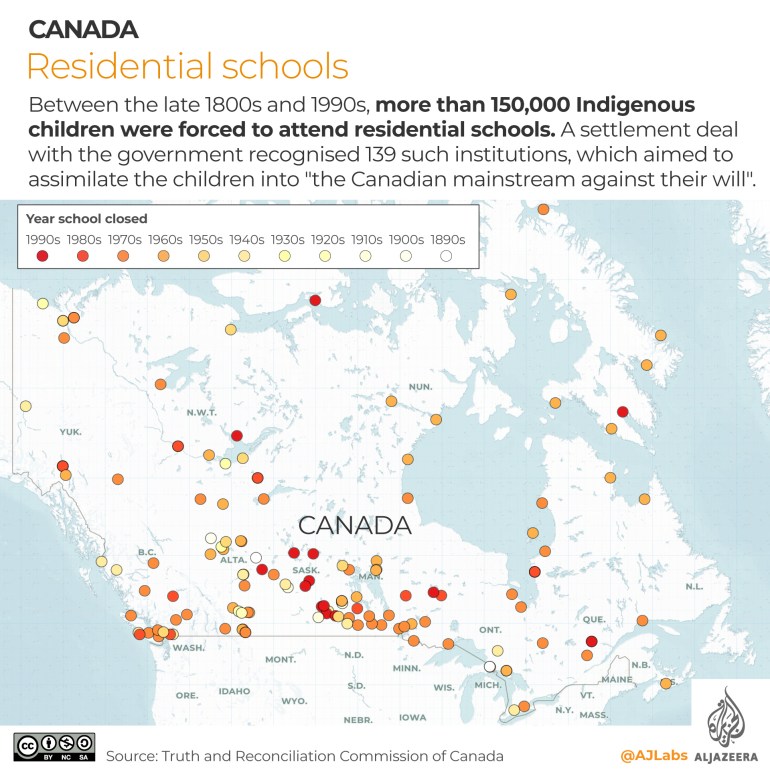
Between the late 1800s and 1990s, more than 150,000 First Nation, Inuit and Metis children were forced to attend the institutions, which aimed to forcibly assimilate them and destroy their cultures. Thousands of children are believed to have died there.

In a news conference in August, Crown-Indigenous Relations Minister Carolyn Bennett said the government would provide an additional $66.2m ($83 million Canadian dollars) to help communities search for unmarked graves.

“As a country, we know the truth. Once you know the truth, you cannot unknow it. First Nations, Inuit and Metis communities have lived with the trauma caused by residential schools for generations,” Bennett said. “So today, we are announcing an additional $83 million in funding … to support more Indigenous communities in this extremely difficult and necessary work.”

The announcement comes as Canadian Prime Minister Justin Trudeau is widely expected to trigger a snap election in the coming months amid countrywide calls for his government to do more to address the intergenerational trauma caused by residential schools.

Since hundreds of graves were first discovered at the Kamloops Indian Residential School in the western province of British Columbia in late May, Indigenous community leaders and residential school survivors and their families have been plunged into renewed trauma.

They have demanded Ottawa support Indigenous-led efforts to find more unmarked graves and pressure the Catholic Church – which ran most of the institutions – to release its records, apologise and pay reparations.


A child holds a flag that reads 'Every Child Matters' during a march in British Columbia after the discovery of hundreds of unmarked graves of Indigenous children at residential schools across Canada [File: Kevin Light/Reuters]
Source: Al Jazeera
 

CLICK OLDER POSTS (above) to see more news

CLICK OLDER POSTS  (above) to see more news

MEGWETCH THANK YOU

HUGE Thank you for visiting this blog and sharing this with your kin. It's appreciated. Contact Trace anytime! Use the form below.

BOOKSHOP

Please use BOOKSHOP to buy our titles. We will not be posting links to Amazon.

Popular Posts

To Veronica Brown

Veronica, we adult adoptees are thinking of you today and every day. We will be here when you need us. Your journey in the adopted life has begun, nothing can revoke that now, the damage cannot be undone. Be courageous, you have what no adoptee before you has had; a strong group of adult adoptees who know your story, who are behind you and will always be so.

OUR HISTORY

OUR HISTORY
BOOK 5: Lost Children of the Indian Adoption Projects