This blog was a backup for American Indian Adopteesblog
USE THE SEARCH BAR or SEARCH TOPICS at bottom of this blog
If you need support
Support Info: If you are a Survivor and need emotional support, a national crisis line is available 24 hours a day, seven days a week: Residential School Survivor Support Line: 1-866-925-4419. Additional Health Support Information: Emotional, cultural, and professional support services are also available to Survivors and their families through the Indian Residential Schools Resolution Health Support Program. Services can be accessed on an individual, family, or group basis.” These & regional support phone numbers are found at https://nctr.ca/contact/survivors/ .
MY EMAIL: tracelara@pm.me
CHICAGO — In a resolution with multiple requests, the American Bar Association House of Delegates, a 597-member policy body, is calling on Congress to conduct oversight hearings on Indian boarding schools. The resolution was adopted by the ABA Monday evening.
Looks like lawyers will get in on the action here in the US... Blog Editor
Canadian Bishops convey commitment to healing and reconciliation
The Permanent Council of the Canadian Conference of Catholic Bishops (CCCB) released a statement on Friday noting its support to Bishops of Saskatchewan who are have issued an “Appeal for Support of Healing and Reconciliation” in favor of the Indigenous Peoples of Canada. The project aims to generate fundraising to promote healing and reconciliation. It also foresees cemeteries on the sites of former residential schools, as well as educational and cultural support. The goal of the campaign, according to the Bishops of Saskatchewan, is to "support Indian Residential School survivors and their communities, and to engage more deeply in our own ongoing commitment and response to the Truth and Reconciliation process." - Source: Canadian Bishops convey commitment to healing and reconciliation - Vatican News
The world's richest church needs to ask others to pay for their actions? Blog Editor
Not just in Canada, American has a bad history problem, too...
Against Residential School Denialism
Residential school denialism is not the outright denial of the Indian Residential School system’s existence, but rather the rejection or misrepresentation of basic facts about residential schooling to undermine truth and reconciliation efforts.
Residential school denialists employ an array of rhetorical arguments. The end game of denialism is to obscure truth about Canada’s residential school system in ways that ultimately protect the status quo as well as guilty parties.
For years, alumni from the Chilocco Indian Agricultural School in Oklahoma have been searching for information about the students who died at their old boarding school, one of hundreds once set up by the U.S. government to assimilate young Native Americans.
Sifting through archived records, the volunteer group has compiled 67 names, but with little funding for more research, they have no way of knowing how many of the children are buried in Chilocco’s cemetery, which bears only a single marked grave.
Theirs is one of numerous efforts by tribal historians and researchers over the past several years to uncover evidence of Native Americans who died at the boarding schools. Until now, these grass roots investigations have been stymied by limited resources and logistical hurdles.
Now, those leading the projects are hoping a new federal investigation can shed light on a mystery that has haunted Indian Country for generations. In June, Interior Department Secretary Deb Haaland launched a review of Native American boarding schools, hoping to figure out how many students died at the institutions—whether from disease, accidents or mistreatment—and where they are buried. The move was spurred by the recent discovery of mass graves of indigenous children at boarding schools in Canada.
“The government abandoned this sacred site when they closed Chilocco in 1980,” said Jim Baker, the alumni group’s president. If the Interior Department provides resources, he added, “then we can do a comprehensive ground-penetrating radar survey.”
Ground penetrating radar, also known as GPR or impulse radar,
is an electromagnetic technology operating on the physics of the earth
to capture images of the subsurface using pulses from the radar.
This
technology is diverse and can work on pavement, rocks, ice and even
freshwater. This technology was first used in the early 1970s when
several different teams of scientists began to develop radar for viewing
into the earth.
This radar was first developed for military applications such as locating tunnels under the DMZ between North and South Korea.
Most of the time, these machines are purchased by companies rather than by individuals.
How much does ground penetrating radar cost?
Traditionally,
a GPR system can cost anywhere from $15,000 to $90,000 brand new. A
simple system will tend to be less than $10,000, while those that are
over $35,000 will require an experienced user.
For instance, a forum member on this TreasureNet.com forum thread
claimed that they saw a GPR sell for $3,600 on eBay. Another forum
member on this same thread claimed that you should be prepared to spend
at least $30,000 on a brand new device.
AccurateLocators.com, for
instance, sells a unique GPR and the software for about $15,000;
however, the antenna system will have to be purchased separately. The
average antenna, depending upon the frequency, can cost $2,500 to as
much as $6,500.
US Radar, Inc., according to their official website, starts pricing around $14,000, depending on the specific model. The costs include the cart, tablet, battery and the software to do basic utility locating.
Ground penetrating radar, also known as GPR or impulse radar, is an electromagnetic technology operating on the physics of the earth to capture images of the subsurface using pulses from the radar.
This technology is diverse and can work on pavement, rocks, ice and even freshwater. This technology was first used in the early 1970s when several different teams of scientists began to develop radar for viewing into the earth.
This radar was first developed for military applications such as locating tunnels under the DMZ between North and South Korea.
Most of the time, these machines are purchased by companies rather than by individuals.
How much does ground penetrating radar cost?
Traditionally, a GPR system can cost anywhere from $15,000 to $90,000 brand new. A simple system will tend to be less than $10,000, while those that are over $35,000 will require an experienced user.
For instance, a forum member on this TreasureNet.com forum thread claimed that they saw a GPR sell for $3,600 on eBay. Another forum member on this same thread claimed that you should be prepared to spend at least $30,000 on a brand new device.
AccurateLocators.com, for instance, sells a unique GPR and the software for about $15,000; however, the antenna system will have to be purchased separately. The average antenna, depending upon the frequency, can cost $2,500 to as much as $6,500.
US Radar, Inc., according to their official website, starts pricing around $14,000, depending on the specific model. The costs include the cart, tablet, battery and the software to do basic utility locating.
There are many myths around intimate partner violence, particularly around victims who identify as men. Myths about violence are harmful. Myths keep people silent, add to shame and guilt, make people doubt the violence and can even perpetuate violence. The truth is anyone can be a victim of intimate partner violence.
FALSE: Abuse only happens to men who are in same-sex relationships.
TRUE: Abuse can happen to anyone. Abuse happens when one person uses a pattern of violent and coercive tactics to gain and keep power and control over another partner. Sexual orientation does not dictate abuse. Men can be abused by a person of any gender.
Twenty-six percent of gay men, 37 percent of bisexual men and 29 percent of heterosexual men have experienced physical violence, experienced rape and/or stalking by an intimate partner in their lifetime (Ncadv.Org, 2021).
FALSE: Men will always be mistaken as the abuser if they report the violence and they won’t be welcome at domestic violence shelters or programs.
TRUE: While women are more likely to be the victims of abuse than men, that is not always the case. When there is abuse in relationships between men and women, it is untrue that men are always the abusers.
It is well documented that there is a need for more Native-specific shelters throughout the country. However, many shelters house anyone who is a victim of violence, including men. Some shelters may provide accommodations for men outside of their traditional shelter, such as at an extended stay hotel. StrongHearts advocates can help male victim-survivors find a shelter that is safe for them and their dependent children.
FALSE: Men should just tough it out.
TRUE: This myth is particularly insidious as it denies the violence and abuse, minimizes the real effects of violence and perpetuates harmful ideas about rigid gender roles.
Tribal gender roles were once as diverse as the tribes and cultures themselves. During colonization, Native peoples’ understanding of their place within their tribal community was disrupted and destroyed. Traditional gender roles were lost, harming future generations.Predominant American culture teaches boys a harmful definition of masculinity. They are often taught to suppress their emotions and that controlling others is strength. This toxic messaging harms men who are experiencing intimate partner violence, as it discourages them from seeking the support they need and further makes them feel inadequate because of the abuse.
The impacts and experiences of violence are very real. In addition to physical harm, victims may experience depression, anxiety, disconnection from friends, family and themselves and post-traumatic stress disorder (PTSD) as a result of abuse. These impacts and experiences cannot just be toughed out.
FALSE: Native men are "wife-beaters.”
TRUE: Native women experience a disproportionately high rate of violence; however, studies show most violence against Native women (and men) is not caused by Native men. Of all Native women who have experienced violence, 97% had an interracial perpetrator, meaning the violence was done by someone who is not Native. (National Institute of Justice, 2021).
Stereotypes like this are unfounded and racist. They harm Native women as much as Native men as it distracts from the reality of their situation and does nothing to address the root causes of violence against Native peoples.
FALSE: Men can't be abused. They are bigger, stronger, tougher.
TRUE: Untrue.
Men are abused. No matter someone’s size or strength they can experience abuse. Intimate partner violence can take many forms and men can experience physical abuse, emotional abuse, sexual abuse, financial abuse, digital abuse, and cultural abuse. Most people experience many if not all of the above forms of abuse.
●One in seven men report having experienced severe physical violence from an intimate partner in their lifetime (Cdc.Gov 2021).
●38 million men have experienced psychological aggression by an intimate partner in their lifetime (Cdc.Gov 2021).
●One in 10 men have experienced rape, physical violence and/or stalking by an intimate partner (Cdc.Gov 2021).
Emotional abuse is the most common form of abuse reported to StrongHearts Native Helpline. Emotional abuse is intentional tactics that cause someone psychological, mental, or spiritual harm, especially as a means of control over that person. Emotional abuse against men can include:
●Questioning where they’ve been and questioning where they’ve been and with whom.
●Calling them names, belittling them.
●Enforcing unhealthy gender roles and expectations: saying they aren’t man enough, shaming them if they are not the main financial contributor to the household, pressuring them into sexual activity to prove their manhood, etc.
●Constantly accusing them of cheating.
●Limiting their time with friends and relatives.
StrongHearts Native Helpline is here for all Native Americans and Alaska Natives, whatever their gender or sexual identity. If you think you are being abused, StrongHearts can help. StrongHearts advocates take a Native-centered, empowerment-based approach to every contact. Services are anonymous and confidential. Call or text 1-844-7NATIVE (762-8483) or visit strongheartshelpline.org for one-on-one chat advocacy 24/7.
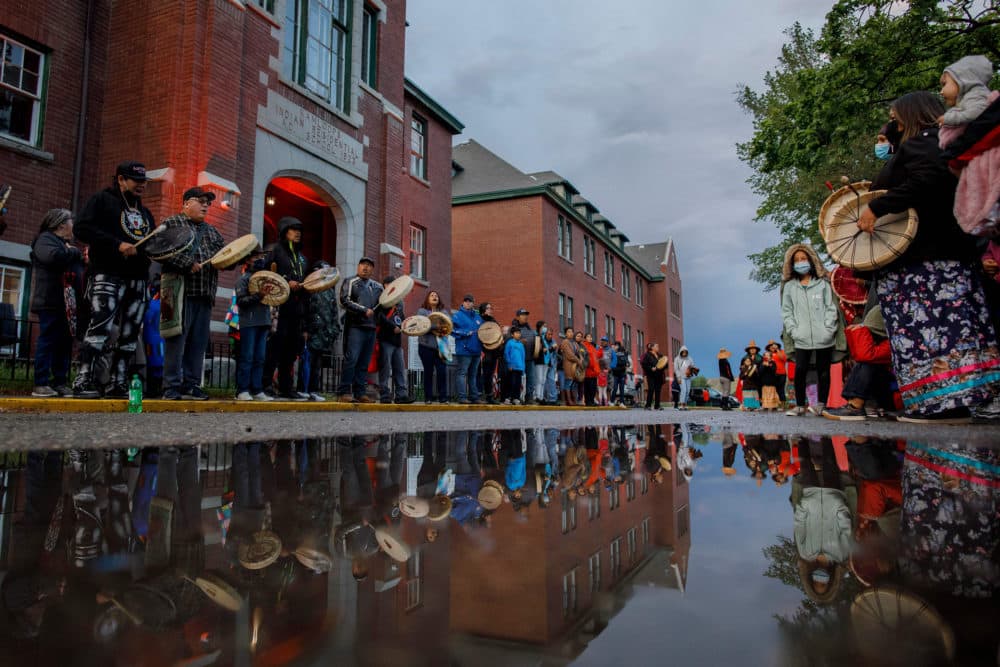
The discovery of three mass burial sites at former residential schools has left the Canadian public reeling. The grim—but sadly unsurprising—news has resulted in calls for action, with a number of Indigenous groups calling for accountability in the form of criminal justice.
Cowessess Chief Cadmus Delorme has described the unmarked gravesites at the former Marieval Indian Residential School as a “crime scene”, while Federation of Sovereign Indigenous Nations Chief Bobby Cameron described the situation as a “crime against humanity”. The Native Women’s Association of Canada is demanding charges as an essential step toward reconciliation.
Their position is that the criminal charges are not only appropriate, but necessary. It is a concrete, unambiguous position. Seeing it through, though, will be anything but.
The first hurdle on the road to criminal prosecution will be building a case.
(left) Vancouver lawyer Sarah Leamon writes a regular column on Straight.com
The discovery of these mass gravesites is not enough on its own. Even when combined with first-hand accounts of the abuse that happened at residential schools, more evidence will likely be required to proceed with a criminal prosecution.
Canadian police have exclusive jurisdiction to investigate crimes and to recommend criminal charges to the government as a result of their findings. In this case, the RCMP would need to begin an investigation of the burial sites. This would be an intense exercise that would likely not just involve physically pulling these sites apart, but also examining documents and interviewing witnesses in order to determine what actually happened.
The passage of time, combined with the general unreliability and/or unavailability of supporting records and documents, could make securing the evidence required tenuous at best.
If enough evidence is uncovered, the next stage would be to lay charges. However, there will likely be a number of practical complexities associated with doing so.
For example, naming parties to the proceeding could present a significant challenge.
Given the age of these gravesites, it is logical to conclude that many of the individuals responsible are deceased. Living parties to the crime may be difficult to locate. Bringing them within the jurisdiction of our courts could be a near-impossible task.
Given these realities, some have suggested that the entities responsible for the schools—not the individuals who carried out the abuse—should be charged. After all, we know that these so-called schools were run by the Catholic Church and funded by the federal government.
While an incorporated body is a legal person, capable of being criminal charged, this approach is still potentially fraught with difficulty.
Consider that criminal charges in this country are almost always laid by the Crown. Government-employed lawyers prosecute crimes as agents of the Crown.
If charges were to be laid by the Crown against the federal government, an unprecedented legal quagmire would arise. The government would be prosecuting itself.
Although private prosecutions are technically possible, which would help sidestep this impractical and improbable situation, the circumstances under which they occur is narrow and complicated. Navigating such a prosecution would be exceedingly circuitous, why may explain—at least in part—why they are so exceedingly rare.
Then arises the question with respect to the appropriate legislation. It seems that acts of this nature would be more appropriately prosecuted under the Crimes Against Humanity and War Crimes Act than the more commonly used Criminal Code.
This piece of legislation is just 20 years old—a relative baby compared to the Criminal Code—and with very few charges having ever proceeded under it, it is largely unchartered legal territory.
Moreover, proceedings under this act must only proceed with written personal consent from the attorney general. Obtaining such consent could be a laborious effort.
Finally, like in all criminal proceedings, the standard for a successful prosecution is high. In order to secure a conviction, Crown must prove their case beyond any reasonable doubt. This is the highest legal standard of proof available. It is one that presents challenges to Crown, sometimes even in seemingly straightforward cases.
Underpinning all of these complexities is the government’s extremely poor record when it comes to the treatment of Indigenous people.
Many have pointed out the RCMP’s complicity in the operation of residential schools. Bearing this context in mind, there is a looming concern that any police investigation or government action in relation to this tragedy would be disingenuous at best and dishonest at worst.
Given the seemingly enormous odds against a domestic prosecution, the International Criminal Court may be a more pragmatic forum for such a proceeding.
There is no indication that this matter has been referred to this court as of yet.
Sarah Leamon is a criminal defence lawyer. She holds a master of arts in women’s studies from UBC. Follow her on Twitter @SarahLeamonLaw and find her website here. The Georgia Straight publishes opinions like this from the community to encourage constructive debate on important issues.
John Jones was just 7 years old when he was forced to attend the Alberni Residential School in Canada. Stories from survivors of Canada’s residential schools.
Residential schools were a key tool in America’s long history of Native genocide
Why we need to grapple with these past atrocities.
The recent discovery of unmarked mass graves of 1,300 Indigenous children buried in five former residential schools has forced Canada to come to grips with a legacy of cultural and physical genocide against Native people.
In the 19th and 20th centuries, 150,000 children were separated from their families, language and culture and placed in 150 government-funded residential schools. There, children were subjected to torture, trauma and death to “kill the Indian in the child.” Thousands of children died — 4,100 according to Canada’s Truth and Reconciliation Commission on the residential schools, although the actual number may have been as high as 15,000. And we can only imagine the trauma these children experienced, including those who were forced to bury their classmates and build their coffins.
The disturbing news from Canada was a reminder that the United States maintained its own system of 367 Indian boarding schools from 1860 until 1978. The two countries’ systems were intertwined, with the United States providing a model that Canada would adopt and emulate.
Responding to events in Canada, U.S. Interior Secretary Deb Haaland — the first Native American to hold a Cabinet position and a granddaughter of people forced into these boarding schools — announced an investigation of residential schools. She noted that most Americans would be alarmed to learn that “the United States also has a history of taking Native children from their families in an effort to eradicate our culture and erase us as a people.” But, she emphasized, “it is a history that we must learn from if our country is to heal from this tragic era.”
She is right. Just as America is being forced to address its legacy of enslavement, segregation and systemic racism, the nation must confront the genocide of Indigenous people — who are rendered all butinvisible in society — and the role of settler colonialism in building the country. Native American genocide, like slavery, constitutes America’s original sin.
From the earliest colonial days, violently clearing the land of Indigenous people — like slavery — was critical to the formation of the country. And, as with slavery, Christianity played an instrumental rolein advancing violence against Indigenous communities.Three papal edicts — known together as the Doctrine of Discovery — provided a religious justification for colonial conquest and exploitation of non-Christian people and paved the way for the West African slave trade, slavery and Indigenous genocide.
These beliefs permeated the Declaration of Independence, which referred to the original inhabitants of this land as “merciless Indian savages.” And with U.S. expansion came Native American dispossession, death, forced relocation and containment in reservations. In fact, it was public policy. In 1819, Congress enacted the Civilization Fund Act, which authorized the president “in every case where he shall judge improvement in the habits and condition of such Indians practicable” to “employ capable persons of good moral character” to introduce tribes to the “arts of civilization.” In 1824, the Bureau of Indian Affairs was established to administer the fund, which paid Christian missionaries to “civilize” the Indians.
The creation of residential schools were part of the broader settler colonial project to exterminate Native American culture and separate them from the land through war and violence. The first government-run boarding school for Native American children was the Carlisle School, which opened in Pennsylvania in 1879 for the purpose of “civilizing” by forcibly assimilating the children into White society. Founded by a Civil War veteran, Gen. William Henry Platt, who was in charge of Native American prisonersof war, its mission was clear. “A great general has said that the only good Indian is a dead one, and that high sanction of his destruction has been an enormous factor in promoting Indian massacres,” Platt said. “In a sense, I agree with the sentiment, but only in this: that all the Indian there is in the race should be dead. Kill the Indian in him, and save the man.”
Of the 10,000 children who attended the Carlisle School until it closed in 1918, more than 180 diedamid abuse, malnourishment and disease related to substandard living conditions. After 100 years, the bodies of 10 of these children were returned to their families in June 2021.
Nevertheless, Carlisle came to serve as a model for other residential schools. Employing Platt’s assimilationist and genocidal philosophy of eliminating Native American culture, these schools adhered to policies forcing children to speak, dress and behave according to White American values, focusing on individualism and materialism, private rather than communal property and the monogamous nuclear family structure. Boys received industrial training, while girls learned home life skills in regimented environments, suffering under living conditions the Native American Rights Fund described as “somewhere between dungeons and death camps” in a 2019 report.
Between one-third and 40 percent of the Indian boarding schools in the United States were operated by Christian denominations. Churches believed that “civilizing” and converting Indigenous people to Christianity was their only hope of salvation from a “dying” culture. Missionaries regarded Indigenous spirituality as witchcraft and Christianity as the only acceptable moral law for a civilized society.
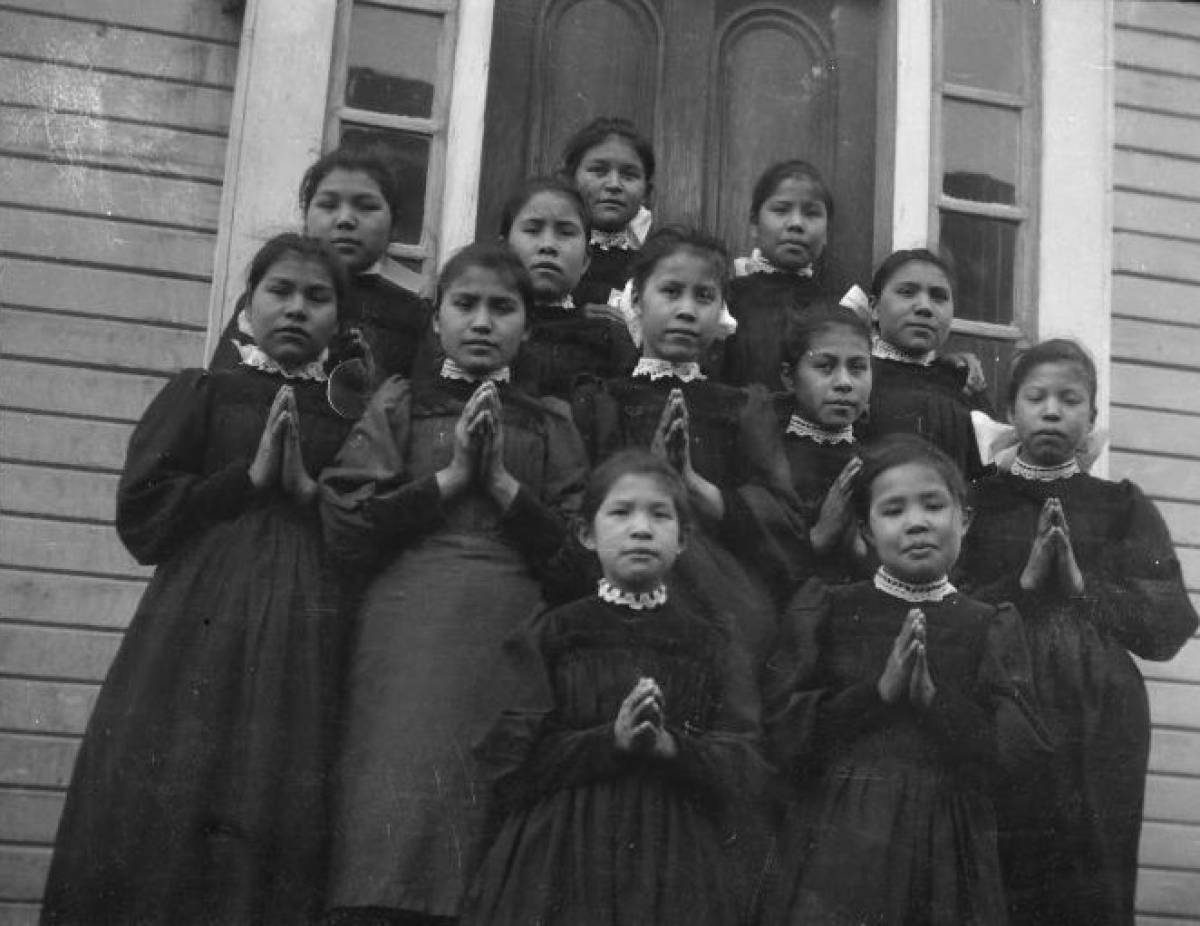
But, in fact, the boarding school system is now recognized as a form of genocide designed to forcibly remove children from their homes and separate them from their families, culture, clothing and language. Their hair was cut in a humiliating manner. Sadistic missionaries punished them for speaking their native tongue by washing out their mouths with soap, lye and chlorine. They were neglected, denied food, beaten and raped, sometimes leading to death —all for the sake of destroying Indigenous culture.
And their influence spread across the northern border. Nicholas Flood Davin, the architect of the Canadian residential school program, visited Indigenous boarding schools in the United States in 1879 and was impressed with what he saw, particularly with the Carlisle School and its solution to the “Indian problem” through an “aggressive civilization” policy that deconstructed Indigenous children.
“The experience of the United States is the same as our own as far as the adult Indian is concerned. Little can be done with him,” Davin wrote in his 1879 report to the Canadian government. “He can be taught to do a little at farming, and at [live]stock-raising, and to dress in a more civilized manner, but that is all. The child, again, who goes to a day school learns little, and what little he learns is soon forgotten, while his tastes are fashioned at home, and his inherited aversion [avoidance] to toil [work] is in no way combated [stopped].” In Canada, residential schooling was made compulsory for all First Nations children in 1920.
Most of the schools ceased operations by the mid-1970s, with the last one closing in the late 1990s. With the Indian Residential Schools Settlement Agreement in 2007, Canada paid reparations to the survivors of residential schools and issued an apology.
Lawyers in Canada have requested the International Criminal Court investigate the Canadian government and the Vatican for alleged crimes against humanity. While the Canadian government identified 5,300abusers, none have been charged under a federal law addressing war crimes and crimes against humanity. A few priests have faced sexual assault charges but not homicide. Out of more than 38,000 reports of abuse at the residential schools, there were fewer than 50 convictions.
The mass graves in Canada are a wake-up call for the United States to seize the opportunity and get on the right side of human rights. As a country with a long, unresolved and traumatic history of genocide and mass graves, of family separation and the erasure of children, America must heal itself by accounting for its past.
As a Diné child, I relished the time spent traveling to lectures that my dad delivered to museums and universities about his work as a photographer. The old Kodak projector slides dropped into focus with the rhythm of his lessons: Navajo people are the land, Navajo culture is Navajo survival. Native culture is Native survival.
His talks would share what it meant to be Navajo. As he shared about his work he would illustrate the legacy of Federal Indian Policy and its treatment of Native people. I still couldn’t imagine at that age what the U.S. government boarding schools had done to attack the very essence of my identity and pride in my culture I held so dear. Each time he delivered a talk, he asked a simple question that rings in my head to this day: “how many schools do you know that have graveyards next to them?”
That question rings in my head again today, and the past several weeks as multiple First Nations and Indigenous communities have uncovered mass graveyards of people— many of them children— at the sites of former residential schools in Canada.
Here at the U.S. Department of Arts and Culture, we’ve long stated the importance of providing a land acknowledgement before events, gatherings and meetings. Whether in-person or online, the purpose of a land acknowledgement is meant to restore and name the ancestral and continuing bond between Indigenous peoples and the land, air, minerals, water, vision that we’ve stewarded since time immemorial. We see this as a small first step toward being in right relationship, toward true Native sovereignty. Today, we ask you to join us in recommitting to acknowledging not only the proper stewards of our land, but the specific violence that keeps that space in settler occupation. We ask you to commit to naming and contextualizing the violence that undergirds the places we call home.
For most Americans, the idea of a boarding school might invoke images of affluent college prep schools, or repositories for disobedient students. For Indigenous people in the US and Canada, the term brings forth terror. Indigenous boarding schools were a tactical experiment, supported by the US War Department and the Department of Interior. After hundreds of years of attempted ethnic genocide, Indigenous people maintained their hard-fought connection to land and culture. The U.S. government made the strategic decision to wage a new kind of war. Alongside the implementation of the Dawes Act of 1887, the Carlisle Indian Industrial School was a targeted effort to obliterate the ties children had between their culture and land before they were fully developed.
The continuing slogan of the first boarding school, Carlisle Indian School was “kill the Indian, save the man.” A phrase illustrative of the genocidal agenda at the center of these institutions. The school opened in 1879 and swiftly became a “success” by white supremacist standards as the children were taught Euro-centric education and were severely punished for practicing any part of their culture, language or Indigenous way of knowings.
According to the National Boarding School Healing Coalition, “between 1869 and the 1960s, it’s likely that hundreds of thousands of Native American children were removed from their homes and families and placed in boarding schools operated by the federal government and the churches. Though we don’t know how many children were taken in total, by 1900 there were 20,000 children in Indian boarding schools, and by 1925 that number had more than tripled.”
In Canada, from the 1800s to 1996 over 150,000 children were removed from their families and communities. Regardless of which side of the colonial border, Indigenous children were sent away from everything they knew and forced to assimilate into the settler culture. For countless Indigenous children, this meant pervasive abuse, psychological torment, cultural erasure and, as the recent headlines illustrate, murder.
In times like these I think of my dad, the photographer, how do you photograph the invisible? How do you document the erased? The Indian Boarding School Project created ghost generations. I have never wanted to become accepting of this horrific legacy in the U.S. education system. Children “graduated” from these hellish places to find a country that regarded them as subhuman, no matter how hard they’d had the culture beaten out of them. Many tried to return home and found they could no longer communicate with their own families, or practice their most sacred rites. Many lay in graveyards next to these schools, waiting to be found. We see now that the ghosts of this trauma want to be seen.
So how can we begin to be in right relationship? Here are some first steps:
Push for action to fund the U.S. efforts to investigate what happened to the thousands of children who didn’t return home: a call that Secretary of the Interior Deb Haaland declared. Contact your representatives and let them know you support this call to action.
Incorporate and specifically name the violence of boarding schools into the land acknowledgements you are already giving. Be explicit about the history necessary for truth-telling. (Check out the USDAC Native Land page if you don’t know how to get started)
Research the location of boarding schools near you. Since Carlisle proved to be “successful,” the U.S. and Canadian governments funded the opening of these schools across both countries, many times partnering with churches like the Catholic Church to operate these schools. For these reasons there are hundreds of schools that were opened across the U.S. and Canada.
You can access the curriculumof the National Indian Boarding School Healing Coalition to learn more about the history of the boarding school here.
You can teach the children in your life about the boarding school experience. There is a very poignant, child-appropriate episode of Molly of Denali here from PBS. You can read and access questions to help have a generative conversation with the children in your life here.
You can participate in Orange Shirt Day, a legacy project meant to build awareness of the residential school project and its harmful events.
Indigenous Nations and communities have long carried the living history and trauma of the boarding school era. It is time for allies to help in fighting for justice and truth. Without truth we will never reach the hope of reconciliation.
Yours in solidarity,
Jaclyn Roessel, Director of Decolonized Futures & Radical Dreams
Melissa Parkyn, a worker with the Saskatoon Indian and Metis Friendship Centre, said residential school survivors 'feel like they know they're not respected and listened to.' (Jason Warick/CBC)
WARNING: This story contains distressing details.
The revelation that the Roman Catholic Church spent millions of dollars earmarked for residential school survivors on lawyers and unapproved loans has drawn harsh condemnation from the federal minister of Crown-Indigenous Relations.
"I don't think there's any excuse for this. I have heard from Catholics coast to coast to coast that they want their church to do better," said Minister Carolyn Bennett in a statement in July.
As part of the landmark 2005 Indian Residential Schools Settlement Agreement, the Roman Catholic Church agreed to make a $29-million payment to programs directly benefitting survivors.
Instead, documents obtained by CBC News show the church spent at least some of the money on other expenses.
That includes $2.7 million on lawyers, $1.8 million on unapproved loans and $2.3 million on administration, while $8.4 million was credited as money paid for previous lawsuits.
Those who work with residential school survivors say the Catholic Church should be ashamed of its actions.
Documents show the Catholic Church spent money meant for residential school survivors on other expenses. (CBC)
They say the money could've done a lot to assist those who still suffer from a federally operated system that the Truth and Reconciliation Commission described as a structured plan to "regulate Aboriginal life."
"I feel like they're not being responsible for these survivors. These survivors feel like they know they're not respected and listened to," said Melissa Parkyn, a support worker with the Saskatoon Indian and Métis Friendship Centre.
'We hope there is some type of investigation'
The Anglican, United and Presbyterian churches — all of which were part of the 2005 settlement — paid the full amounts agreed to years ago.
The Canadian Conference of Catholic Bishops declined a request for an interview. They noted the organization was not a party to the settlement. Individual dioceses and orders created a corporation to oversee the deal.
In an email, an official says they are committed to engaging and listening.
Chief Bobby Cameron of the Federation of Sovereign Indigenous Nations said he feels angry and disappointed with the Catholic Church.
Cameron says the money needs to be paid immediately and called on the federal government to intercede.
"Obviously, we hope there is some type of investigation, and right away. Do it now. Don't wait six months to find every excuse in the book to delay or prolong an investigation," he told CBC News in a video call on Tuesday.
In her statement, Bennett did not commit to an investigation.
Instead, she said those who were part of the Indian Residential Schools Settlement Agreement had a "moral responsibility" to support healing and closure and fulfill their commitments.
"Canadians are expecting us all to meaningfully engage in reconciliation, recognize the ongoing intergenerational trauma and support healing for survivors, families and communities," Bennett said.
$25M fundraising came up short
The Catholic Church never had to justify its use of the money, despite a 2015 legal challenge by the federal government.
On the eve of the 2015 hearing on the matter, Saskatchewan Court of Queen's Bench Justice Neil Gabrielson approved the church's buyout proposal, and the case was closed.
The $29 million cash payment was in addition to a failed $25 million fundraising campaign that was meant to benefit survivors.
As reported by CBC News, that fundraising campaign only brought in $3.9 million. Instead, the church was allowed to meet its financial obligation with "in-kind services."
As part of the 2015 lawsuit, a Catholic Church accountant testified that $25 million worth of services were provided "even though he has not audited these records and accounts, has no basis on which to value these service
, and relies only on minutes of meetings" supplied by Catholic officials.
Catholic bishops in Saskatchewan, Calgary and Toronto announced earlier this month that they would restart efforts to fulfill the $25-million fundraising pledge.
In her statement to CBC News, Bennett said she was encouraged by that decision.
Cameron had a simple message to the Catholic Church.
T he Métis National Council and the Government of Canada will be working collaboratively, Nation-to-Nation, to develop a process to engag...
To Veronica Brown
Veronica, we adult adoptees are thinking of you today and every day. We will be here when you need us. Your journey in the adopted life has begun, nothing can revoke that now, the damage cannot be undone. Be courageous, you have what no adoptee before you has had; a strong group of adult adoptees who know your story, who are behind you and will always be so.
OUR HISTORY
BOOK 5: Lost Children of the Indian Adoption Projects

 wsj.com