This blog was a backup for American Indian Adopteesblog
USE THE SEARCH BAR or SEARCH TOPICS at bottom of this blog
If you need support
Support Info: If you are a Survivor and need emotional support, a national crisis line is available 24 hours a day, seven days a week: Residential School Survivor Support Line: 1-866-925-4419. Additional Health Support Information: Emotional, cultural, and professional support services are also available to Survivors and their families through the Indian Residential Schools Resolution Health Support Program. Services can be accessed on an individual, family, or group basis.” These & regional support phone numbers are found at https://nctr.ca/contact/survivors/ .
MY EMAIL: tracelara@pm.me
"All records stemming from the redress process of the Indian residential school legacy should be public record and not subject to more legal wrangling," said Garnet Angeconeb, who attended Pelican Lake Indian Residential School, near Sioux Lookout and received the Order of Canada, in an email. "We often hear that the Indian residential schools legacy is our 'collective' or 'shared' history as a country. Why then is that one side is driving this contemporary history through the use of law? It looks like, smells like, feels like modern-day colonialism at its best."
Today the Supreme Court will hear Adoptive Couple v. Baby Girl, a case about a South Carolina Indian girl who the South Carolina Supreme Court ruled that the child must be returned to her Indian father. The child's mother ignored the Indian Child Welfare Act (ICWA) of 1978, a federal law designed to protect Indian families from "abusive child welfare practices that resulted in the separation of large numbers of Indian children from their families and tribes through adoption or foster case placement" and, as a result, both the tribe and the father were denied their rights under ICWA. As the Supreme Court hears this case, the coverage has been largely one-sided. I thought it was important for people to hear my story, and how being separated from my family and tribe has affected me.
My name is Jacqueline Davis. I am one of six siblings affected by a decision made by the state of South Carolina. I am a member of the Cheyenne River Sioux Tribe in South Dakota and my grandfather is Chief Dave Bald Eagle. My father, who is African-American, met my mom and married her while he was stationed in the Air Force. They eventually moved off the reservation to South Carolina. Their lives changed one day when my mother applied for WIC and the nurse realized that she spanked her children as a form of discipline. Their children were taken and placed in foster care. We were split in pairs. The charges were piled on, and our parents lost custody. The Bald Eagle family offered to take us on the reservation and for reasons I still don't know they were told our case had nothing to do with ICWA. I can remember my parents coming to visit us for years.
Native communities in the U.S. have suffered disproportionately from COVID-19, with higher rates of infection and death. The Navajo Nation has implemented a series of strict lockdown measures in an effort to protect its population, but health care facilities have still been overwhelmed. In fact, tribes across the country see the pandemic as representing an existential threat. Stephanie Sy reports.
Back in New Mexico, there are significant clusters of cases in the state's Pueblos. By one estimate, 11 percent of the Zia Reservation of only 646 members were infected. At that rate, leaders are concerned about the risk of extinction.
For more information on reports, helpful prevention tips, and more resources, please visit the Navajo Department of Health’s COVID-19 website at http://www.ndoh.navajo-nsn.gov/COVID-19. To contact the Navajo Health Command Operations Center, please call (928) 871-7014. For the latest news from the Office of the President and Vice President, please visit http://www.opvp.navajo-nsn.gov/ or find us on Facebook, Twitter, and Instagram
ØAdrian Sutherland, Midnight Shine founder and frontman, wrote Sister Love from a poem written by his sister Iris Sutherland – she shares co-writing credit on the song.
ØAdrian’s Mom played acoustic guitar, keyboard, and sang, instilling in him his love of music, and inspiring him to play.
ØSister Love is Midnight Shine’s 2nd most streamed song on Spotify – second only to Heart of Gold (which now has more than 227,000 YouTube views).
ØSister Love reached #1 on Canada's Indigenous Music Countdown when it was released.
Native America Calling is a national call-in program that invites guests and listeners to join a dialogue about current events, music, arts, entertainment and culture.
The program is hosted by Tara Gatewood (Isleta Pueblo) and airs live each weekday from 1-2 pm Eastern.
There is no one way to address the coronavirus threat. The state of Alaska has relatively few COVID-19 cases. But some vital modes of transportation are already shut down and Native villages are working on keeping potential virus exposures at bay. It's a different story in urban centers that the U.S. Census says is home to nearly seven out of every 10 Native Americans. In Los Angeles, the Native population is large and diverse. Organizations like United American Indian Involvement is helping elders and others coping with a significant and growing health threat. We'll hear the various ways leaders are tackling the coronavirus emergency to suit the needs of their people.
Isolation because of the coronavirus doesn't stop the need to raise awareness of a tragic statistic for Native people. May 5th is the National Day of Awareness for Missing and Murdered Native Women and Girls. Organizers are encouraging virtual walks, candles in windows, and twitter campaigns to keep the light on the disproportionate number of victimized Indigenous women and girls.
The COVID-19 pandemic axed the much-anticipated U.S. theater release of the film, "Blood Quantum." The good news is audiences can now see it online. The film is about a zombie outbreak near a Mi'gmaq reserve in Canada. It's directed by First Nations filmmaker, Jeff Barnaby and has a host of Native stars, including Michael Greyeyes (Cree), Elle-Máijá Tailfeathers (Blackfoot and Sami), Forrest Goodluck (Diné/Mandan/Hidatsa /Tsimshian) and Gary Farmer (Cayuga/Tuscarora/Mohawk).
Expecting mothers face added anxiety because of the coronavirus pandemic. They may be separated from their newborn if they test positive for the virus or are showing symptoms. At the same time, just going to a hospital to give birth increases the chances of getting exposed to coronavirus. We'll get medical advice on what precautions pregnant women can take and hear from those who facing difficult decisions during their pregnancies. Have a question? Send us an email at comments@nativeamericacalling.com.
The global COVID-19 pandemic generates fear and confusion for a lot of people. As always, scam artists are ready with new and creative ways to exploit people's fears and steal their money. The Federal Trade Commission is coming down on marketers who falsely claim to have COVID-19 cures. The agency is also warning about phone calls from criminals pretending to be sick family members needing money. We'll get reminders on how to protect yourself from the latest frauds and scams.
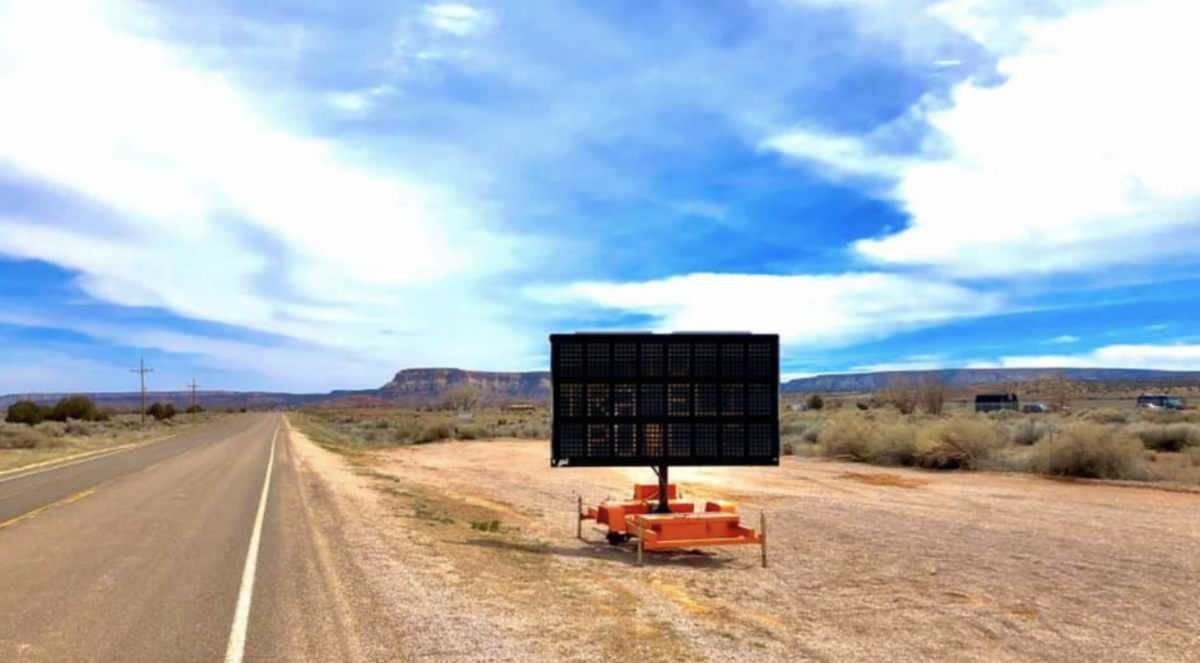
A travel advisory near Zuni Pueblo in New Mexico. The tribe has confirmed a COVID-19 case and is asking community members to limit travel outside the reservation. (Photo-Pueblo of Zuni, Facebook)
Some Pueblos communities confirm first cases of COVID-19 Volunteers deliver traditional herbs to elders in Rapid City Doctor discusses anxiety and stress during the pandemic
The federal government's response to the COVID-19 crisis includes a $2.2 trillion stimulus package. Of that, $10 billion is aimed specifically toward helping tribal health, housing, education, and business recovery, among other things. The crisis is already severely affecting tribes, businesses and individuals. Health and business experts are still not able to predict the full extent of the financial damage. We'll talk with tribal policy and economic experts about what the stimulus package makes available for tribes and how you might see those funds working in your community.
Native child adoptions, court hearings and in-person family visitations are some of the things grinding to a halt because of efforts to slow the spread of coronavirus. Many child welfare advocates are also worried that states may use the current confusion to withhold information important to adequately assessing cases where the Indian Child Welfare Act may apply. We'll check in with the National Indian Child Welfare Association on suggestions they are providing for tribal child welfare agencies, attorneys and individuals about how to navigate the new normal of COVID-19 restrictions.
The Trump Administration took the unprecedented step of disestablishing the Mashpee Wampanoag's more than 300 acre reservation in Massachusetts. Tribal Chairman Cedric Cromwell described the action as "cruel" and "unnecessary." It sent shock waves through Indian Country and unnerved some tribal leaders who fear such a precedent could lead to more trust land reversals in the future. We'll get updates about the issue and get reaction from tribal leaders.
As the country grapples with an unprecedented pandemic threat, there is another health concern on the rise. The Centers for Disease Control and Prevention's most recent report shows rates of sexual transmitted disease (STDs) are at an all-time high. The revelation comes in the Sexually Transmitted Disease Surveillance 2018 report. Native Americans have some of the highest rates for diseases like chlamydia, gonorrhea and syphilis. We'll talk about what can be done to prevent further infections and how that is affected by COVID-19 pandemic.
Many people turn to prayer, traditional practices or messages of encouragement during times of personal or communal crisis. The COVID-19 pandemic limits people's ability to connect in groups to heal. But there are still ways to find fellowship and access spiritual solace. We'll get perspective from three people about what they are leaning on during this crisis. How are you managing? Send us an email to comments@nativeamericacalling.com with how you are getting through this challenging time.
Native America Calling is a national call-in program that invites guests and listeners to join a dialogue about current events, music, arts, entertainment and culture.
The program is hosted by Tara Gatewood (Isleta Pueblo) and airs live each weekday from 1-2 pm Eastern.
House Bill 4148 was passed in the Oregon House of Representatives on Thursday, February 20. The legislation seeks to place Native American and Alaska Native foster children in culturally appropriate care.
WOULD ALIGN OREGON WITH FEDERAL LAW:This bill modifies the current dependency law in order to better fit with the Indian Child Welfare Act and mandates the Oregon Department of Human Services to provide reports every other year on American Indian and Alaska Native children in the welfare system. This new legislation essentially works to protect Native American children in culturally appropriate environments within Oregon’s foster care system. “Culturally appropriate” meaning that the cultural identity of Native American foster children will be protected through carrying on their traditions and connection to their family and tribe whilst they are in the foster care system. The bill is a response to the federal Indian Child Welfare Act, which was created “to protect the best interests of Indian children and to promote the stability and security of Indian tribes and families by the establishment of minimum Federal standards for the removal of Indian children from their families and the placement of such children in foster or adoptive homes which will reflect the unique values of Indian culture.”
4148 is a direct follow up to concerns about over-representation of Native American children in the foster care system, who made up 4.8 percent of Oregon’s system in 2018, though they make up only 1.6 percent of the total population.
The federal court case could have a sweeping impact on Native families and tribal sovereignty. This cultural difference — that a family’s fitness is determined by its wealth, and that those concerns should outweigh a child’s connection to their family and heritage — is essentially why the Indian Child Welfare Act was created in 1978. The law recognizes the history of federal policy aimed at breaking up Native families and mandates that, whenever possible, Native families should remain together.
Sarah Kastelic, the executive director of the National Indian Child Welfare Association, said that ICWA acknowledges important familial and tribal bonds that have long been disregarded, and that Native ways — such as extended families living under the same roof — have often been used to show unfitness in child welfare proceedings. “No matter the picket fences and swimming pools and things, most of the time, kids want to be with their families,” she said.
Tribes say an end to hostilities with the state of Alaska is long overdue.
A bill that would require state acknowledgement of federally-recognized tribes had its second hearing Tuesday and was approved and moved out of the Alaska House Special Committee on Tribal Affairs. At the hearing questions were raised and addressed about the impact of the legislation on state jurisdiction and sovereignty.
Two witnesses gave legislators a look at what could be a national model for a state-tribal partnership, in 2017 the state of Alaska and a dozen tribes signed an Alaska Tribal Child Welfare Compact.
Nicole Borromeo, Athabascan, general counsel for the Alaska Federation of Natives, said a compact is like a modern-day treaty. "[This one] specifically defines the services and supports that are going to be carried out by our tribes and tribal organizations on behalf of the state as well as the funding streams required," she said.
“I want to call the committee’s attention to the fact that this is the first ever compact that has been negotiated at the state level. And that is something for all of us to be proud of,” Borromeo said. “We [Alaskans] tend to be at the top of the list of undesirables and at the bottom of the good list. In this case we are truly breaking ground and we're on the cutting edge of law and policy. It's just something that all Alaskans should know about and be able to celebrate.”
Francine Eddy Jones, director of tribal family and youth services, Central Council of Tlingit and Haida Indian Tribes of Alaska. (Photo courtesy of Central Council of Tlingit and Haida Indian Tribes of Alaska)
Francine Eddy Jones, Tlingit, is director of tribal family and youth services at the Central Council of Tlingit and Haida Indian Tribes of Alaska. 🔻
“The tribal co-signers don't want to take over the state child welfare system the exact same way that the state has done it and continue to provide services the exact same way the state does. The state is more focused on intervention, including removal of children from homes,” said Eddy Jones. “Tribes want to focus more on prevention.”
She said being locally based, tribes are better able to get help and services to children and parents, and to reach out to extended family before it gets to the point of a child being removed from the family. Eddy Jones said, “If we're able to continue on this path with tribes providing services, we expect to see a decrease in the number of children that are in state custody because they are no longer being be removed from their home.”
She said tribes have had more success in matching children going into foster care with relatives and within tribes so they can maintain ties to their families and to their culture.
“I'll give you just one illustration of a particular case where the state was having a hard time identifying who the child's family was and how to match, whereas the tribe got involved and at the end of the day, this particular case file had 70 names on it," Eddy Jones said. "That's just because tribal members feel more comfortable sometimes talking to their own tribe or tribal organization. So that's a very big win here for the state."
Eddy Jones concluded: “Tribes have been exercising tribal sovereignty under the federal Indian child welfare act since its implementation in 1979, when it was a federal law that was passed and tribes embraced that. Tribes had been at the table working with the state not only in this work under the compact but for the past 42 years, working with families, whether that's on the prevention end or in the intervention side of in terms of children coming into foster care system.”
The proposed legislation however would remove barriers for tribes that partner with the state on child welfare issues.
As another example of the way a tribe can take a different approach than the state, a tribal judge and former magistrate from the southeast Alaska village of Kake described the tribal court’s focus on healing and prevention. Michael Jackson said people can avoid a criminal misdemeanor record by participating in Kake’s Peacemaking Circle.
“I would say that our interventions without formal charges brought against people here in our community were a preventative measure… They prevented youth and adults from committing other crimes knowing that people loved them in our community, that they were willing to change, they righted the wrong to the victims,” Michael said. “And our community became stronger because of apologies. And for love, respect and forgiveness and our spiritual part, whether it was through the Western way of religion or our culture, modified bad behavior,” Michael Jackson said. Roberta Moto, Inupiaq, of Deering and Kotzebue in Northwest Alaska, has worked in suicide and substance abuse prevention, and as an administrator in child welfare. She said the state’s taking over services tribes once managed hasn’t worked.
“With the erosion of tribal powers, we have seen a rise in social problems in our villages and I feel very strongly that if tribes resumed their role as tribal courts and mediators in their village, we would see an improvement in the areas of social issues,” Moto said. “Tribes would be empowered to prevent adverse childhood experiences. Childhood trauma is what contributes to higher rates of substance abuse, suicide, and even chronic health problems like heart disease, diabetes and cancer.” She went on to say studies have shown that local self determination helps with school performance, cut juvenile delinquency, and reduce crime.
“If this bill passes, the tribes will have a stable ground to build on and not have to worry if their progress will be set back with each change in administration… I support the recognition of tribes because I want my grandchildren to live in a thriving community where they are safe, their culture's protected, and there is hope for their future. This bill is a historic event for the Alaska Native people,” Moto said.
Dawn Jackson, Tlingit, is executive director of the Organized Village of Kake. She said the tribe has existed since before the state of Alaska and since 1995 has been operating programs in higher education, social services, Indian child welfare, realty, tribal operations, housing and tribal transportation. She said the village has a domestic violence program, and environmental programs as well as the only tribal historic preservation office in the state of Alaska.
“We have built programs without the state's assistance through the years due to the state not recognizing our existence,” said Dawn. The Kake tribe “has been a partner in successful partnerships on regional and national levels. And the missing link in these partnerships is the state of Alaska,” Dawn said. “I urge your legislature, the Senate, the administration, and the courts of Alaska to recognize tribes for Alaska to not just heal, but to grow emotionally and economically in the future.” Nikki Pollock, Yup’ik, is director of senior services for Orutsararmiut Traditional Native Council, the federally recognized tribe for Bethel, a regional hub in western Alaska.
She said, “This lack of recognition of the Alaska Native tribe here in their territorial jurisdiction creates silos. The lack creates barriers. It's been historically, in my opinion, viewed as a pie where if one gets a bigger slice that means someone else gets a smaller piece. But one bigger slice, more rights for tribes, doesn't mean less pie for other people,” Pollock said. “It doesn't take away state’s rights. It supplements. It gives that recognition that tribes are already federally recognized.” Director of Southeast Senior Services Maryann Mills said, “Alaska is the only state in the United States that ever requires waivers of sovereign immunity in order for tribes to access these federal funds.” She said tribes get annual audits, handle budgets responsibly and competently provide services,
“Yet the state requires us to waive our sovereign immunity for federal funds given to them by the federal government to give to us,” Mills said. “This process results in costly pass-through fees, putting roadblocks to the tribal government's ability to perform the functions of providing critical services to its citizens. Alaskan Indigenous people face insurmountable challenges. Many of these challenges come from the many years of hostility from the state of Alaska.”
The bill's sponsor Rep. Kopp noted that half of the nation’s federally recognized tribes are in Alaska so state recognition is especially important.
“Alaska Native people and the tribes in particular never had an open declaration of war or hostilities but yet they were removed from their land and were resettled," he said, "and in return for that they gave up aboriginal land claims.”
Rep. Dave Talerica, a Republican from the Denali Borough in Interior Alaska, said questions remain about the effects of the legislation on state and tribal jurisdiction.
“Obviously the topic of sovereign immunity is on everyone's minds and I think that's something that needs to be addressed is what effect, what does this bill do in regards to sovereign immunity; does it have any effect on that with the state? Perhaps that can be answered as the bill moves along through committee,” said Rep. Sarah Vance, a Republican from Homer. “And, what impact does it have on tribal compacting with the current compacts and in the future? These are just some of the questions that have come up. “
Tribal Affairs Committee Chair Rep. Tiffany Zulkosky, Yup’ik, said “I do want to call out to address the concerns around trust obligations and jurisdictional issues that there is explicit language in the bill that says in section four that nothing in this section creates a concurrent trust relationship between the state and federally recognized tribes.
“That really what it's doing is putting into statute a recognition of federally recognized tribes that are already inherently recognized just through a trust relationship with the federal government regardless of the passage of this legislation,” Zulkusky said.
“Especially as the granddaughter of one of Alaska's Territorial Guard members who put his life and his family's situation on the line to protect this state before statehood, I believe that it is important to acknowledge [tribes]," Zulkusky said. "I think one of the most profound moments of the tribal affairs committee last year was when a representative asked ‘what is an opportunity for mutual respect moving forward?’ And the comment of our invited testifier was, ‘visibility and acknowledgement, just seeing and acknowledging the existence of the people.’”
“To recognize Alaska Native people, by doing that we do not diminish the state's sovereignty. We do not diminish the State‘s work moving forward” Zulkosky called the bill long overdue.
The committed voted unanimously to move HB 221 out of committee. It now goes to the Alaska House Committee on Community and Regional Affairs.
Joaqlin Estus, Tlingit, is a national correspondent based in Anchorage, Alaska. Follow her on Twitter: @estus_m. Email her at: jestus@indiancountrytoday.com.
Wayne (center) with his brother and a-mom Ann Snellgrove
Torn Apart 32 Years Ago By Canadian Policy Toward Aboriginals, A Mother And Son Meet For The First Time.
September 21, 2003| BY MARGO HARAKAS
He called himself Lost Cub, and for years he tried futilely to find his way home.
Then in 2002, feeling that at last he was closing in, Wayne Snellgrove hired a private investigator to follow up on the final four names on his list. He needed a shield, a buffer from the searing pain of renewed rejection. When the Canadian investigator finally telephoned her news, Snellgrove took the phone to the bedroom, closed the door, and, lying down on the bed, braced himself.
"I found your mother," she said. Then it all tumbled out.
Nora Smoke, a Saulteaux Indian living on a reserve in Saskatchewan, told the investigator, she loved Wayne, always had, that it was the happiest day in her life that he had found her. She had never forgotten the child she'd never seen.
"Please tell my son," Smoke pleaded with the investigator, "I've always thought of him."
And the 6-foot-3-inch, 225-pound athlete sobbed, sobbed like a baby, sobbed with 32 years of repressed emotion, sobbed like a kidnapped child returned to his bereft mother.
The search had ended; however, the story of a newborn's disappearance three decades ago was yet to be told.
Snellgrove, like many Canadians, calls it kidnapping. Others call it cultural annihilation or cultural genocide. Officially, it's been dubbed the Sixties Scoop.
Throughout the 60s, 70s and into the mid 80s, thousands of native children were separated from their mothers and adopted out to middle-class, non-native families in the United States, Europe and elsewhere.
"Some communities lost an entire generation," says Darrell Racine, professor of native studies at Brandon University, in Manitoba, Canada.
At best, say the critics, the action of the Children's Aid Societies, authorized at the time to administer Canada's child welfare services, was misguided. At worst, it was racism.
"It goes back to the usual manifest destiny complex white people have over red people and the idea they are more civilized than aboriginal people. They thought they were doing the aboriginals a favor," says Emma LaRocque, professor of native studies at the University of Manitoba.
The problem was those removing the children were usually white and, because of bias or ignorance of aboriginal culture, they were, say critics, unqualified to determine what was in the best interest of the native child.
That the Sixties Scoop followed on the heels of the horrific residential school program was not coincidence. The thinking there, says Racine, "was the only way to civilize the Indians was to get the child away from the parents." So the children were forced into church-run boarding schools to be purged of their language, customs and culture. (Similar boarding schools were operational throughout most of the 20th century in the United States, as well.)
In the 1960s, with the closing of Canada's residential schools, aboriginal children continued to be removed, this time on the grounds of parental ambivalence, poverty, illness, or drug or alcohol addiction.
"Entire reserves would be assessed as dysfunctional and every child in the community would be removed," says Kenn Richard, director of Native Child and Family Services of Toronto.
And then "because of racism," says Richard, who is half native, "few white Canadians were willing to adopt aboriginal children, so placements were made through agencies in the U.S."
'I really don't belong'
Wayne Snellgrove came through an agency in Northampton, Mass. Six months before getting the 2 1/2-year-old Wayne, Richard and Ann Snellgrove, his adoptive parents, had taken home another boy, a white boy. They wanted to find for him a companion.
Despite loving and caring parents, Wayne says, "I've always had this feeling of being lost and misplaced, feeling I don't really belong here. Every time I looked in the mirror, I knew it. I had only to look at my brother to know I was different."
He describes his adoptive family as "wonderful." But his situation was far different from those that have made headlines in Canada and suggest there was little screening of prospective parents. Several stunning cases are recounted by the Native Child and Family Services of Toronto in its report titled "Research Project: Repatriation of Aboriginal Families -- Issues, Models and A Workplan." One Native child, placed with a bachelor in Kansas, was sentenced to 20 years in prison for killing his adoptive father with a baseball bat. The trial revealed that for years the youth had been sexually abused by his adoptive father.
Likewise, a native girl placed with a family who subsequently moved to Holland wound up a drug addict and prostitute after being impregnated twice by her adoptive father. After years of living abroad, she returned to Canada where, with the help of birth siblings, she established a new life.
Please leave a comment! Wayne, an amazing artist and Olympic swimmer, is on Facebook. He lives in Florida. This is his painting of a red hand.
T he Métis National Council and the Government of Canada will be working collaboratively, Nation-to-Nation, to develop a process to engag...
To Veronica Brown
Veronica, we adult adoptees are thinking of you today and every day. We will be here when you need us. Your journey in the adopted life has begun, nothing can revoke that now, the damage cannot be undone. Be courageous, you have what no adoptee before you has had; a strong group of adult adoptees who know your story, who are behind you and will always be so.
OUR HISTORY
BOOK 5: Lost Children of the Indian Adoption Projects