This blog was a backup for American Indian Adopteesblog
USE THE SEARCH BAR or SEARCH TOPICS at bottom of this blog
If you need support
Support Info: If you are a Survivor and need emotional support, a national crisis line is available 24 hours a day, seven days a week: Residential School Survivor Support Line: 1-866-925-4419. Additional Health Support Information: Emotional, cultural, and professional support services are also available to Survivors and their families through the Indian Residential Schools Resolution Health Support Program. Services can be accessed on an individual, family, or group basis.” These & regional support phone numbers are found at https://nctr.ca/contact/survivors/ .
MY EMAIL: tracelara@pm.me
The latest edition of our NARF Legal Review features a story on the current attack on the Indian Child Welfare Act (ICWA). ICWA was enacted in 1978. Congress took this action when they realized that Native American children were being removed from their families and communities at an alarming rate.
By the time that Congress recognized the problem in 1978, more than a quarter of all Native children had been separated from their families. ICWA was created to improve the handling of Indian child welfare cases and their outcomes. The law has been called the gold standard of child welfare practices. But in recent years it has come under attack. Learn more about these attacks, and how NARF is responding, in the latest edition of the NARF Legal Review.
Growing up as a Diné woman, I was taught to carry on my cultural practices of reverence for land and place. I was molded by the beliefs, prayers, and encouragement of my parents and grandmothers, and was raised hearing stories of our creation—stories that relate us to the world around us. In my community, fall brings with it a full of appreciation of the harvest and new practices to welcome the colder months.
While this time is filled with reverence internally, outside of my community the fall season is also full of cringe-worthy debacles. Between the racist costumes that arise around Halloween, the offensive mascots that storm the field, and the continued perpetuation of the false history of Thanksgiving, this season is challenging as a Native person.
Since the 1990s, the federal government has declared November “Native American Heritage Month.”
This year, however, the White House made another tactical effort to malign Native communities and Nations, proclaiming November as “National American History and Founders Month.” The announcement centers colonizers and “founding fathers,” invisibilizing the Indigenous people whose land was taken and the millions of Indigenous lives lost since contact because of genocide.
As Philip Deloria asks in his essay, “The Invention of Thanksgiving,” “how does one take on a myth?” At the USDAC we know that is not as simple as saying Indigenous peoples “are still here.” These times call on all of us to deconstruct the myths and falsehoods related to the “founding” of this country, and to work in active solidarity with Native communities. At the USDAC, we want to offer a few ways we might start:
Start Conversations + Take Action
Begin conversation around your turkey dinner this year. Use the USDAC’s #HonorNativeLand Toolkit to investigate whose land you’re gathering on and offer a land acknowledgment as a way of opening conversation. Discuss with your loved ones the history you learned or didn’t learn about Native peoples. Brainstorm together how can you move beyond acknowledgment and into allyship and action. Is there a commitment you can make together to learning more about the history of the Indigenous communities that have inhabited the land you occupy? Are there Indigenous-led organizations in your community that you can support?
Understand that 100% of the land this country is on is occupied Native land. All. Of. It. In the video “The ‘Indian Problem’” Suzan Harjo shares, “There was no land brought here, the land here was Native Nations’.” She shares the power of myths and falsehoods and how critical they are to the continual dispossession of Native Peoples of their land.
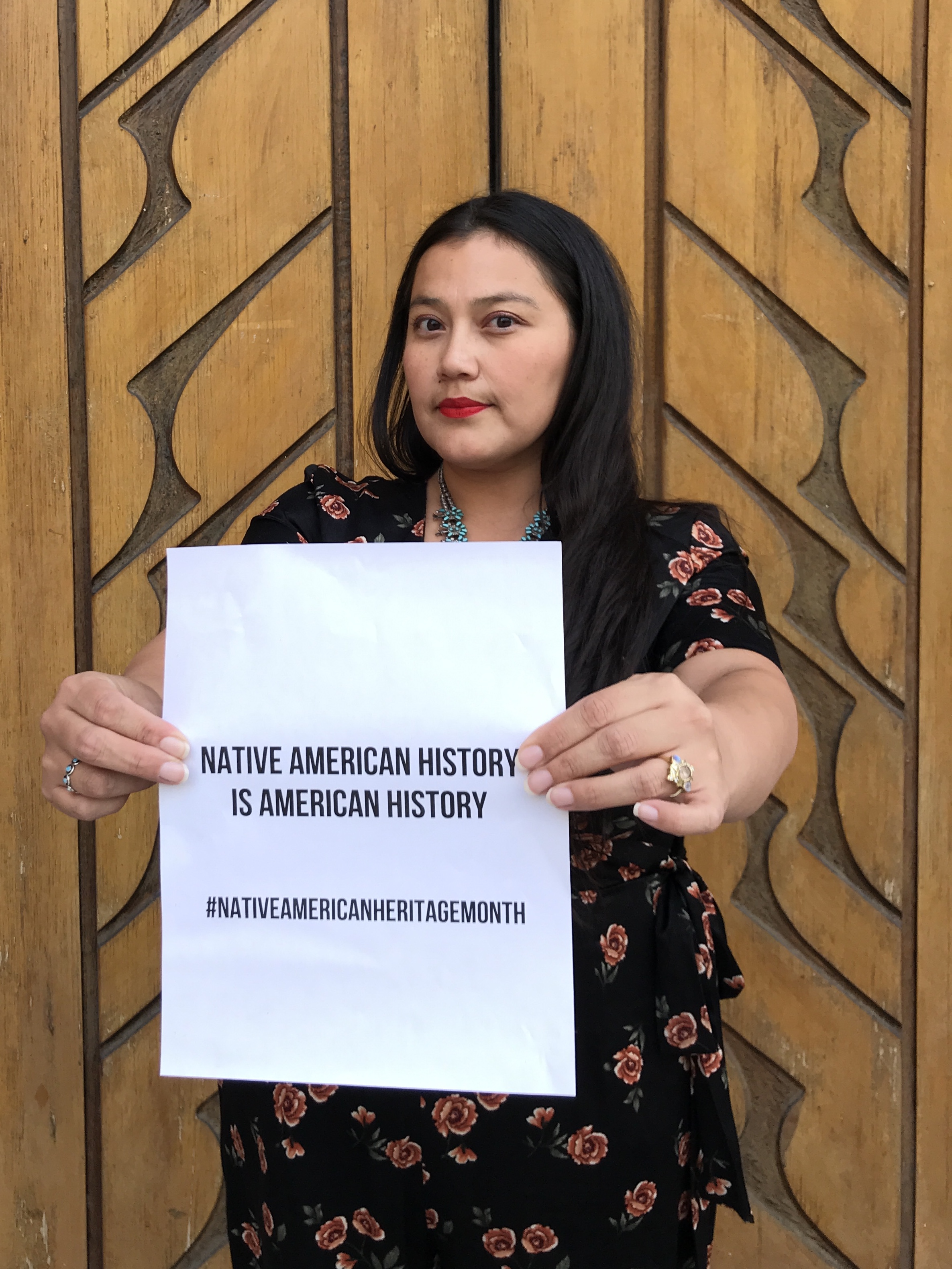
Join the movement to recognize Native American history as American History. This social media campaign is working to visually represent how there would be no American History without the Native American contributions, protection and stewardship of Turtle Island (the above photo of me is part of this campaign).
Indigenous peoples and communities are on the frontlines of the protection of Earth Mother. USDAC, has been working to support Climate Strikes through the USDAC Bureau of Energy, Power, and Art. We feel strongly this intersection is one we will grow in the next year and encourage you to show up for the next Global Strike on Friday, November 29th.
When I dream of future worlds, I see one that includes and centers Indigenous peoples through a true telling of history, where Native sovereignty and culture is protected and Native land recognized and stewarded with respect. When you understand the history of this country and the treatment of my ancestors, you understand how truly radical this dream is.
Ahe'hee, Jaclyn Roessel USDAC Director of Decolonized Futures & Radical Dreams
Finding Fernanda: Two Mothers, One Child, and a Cross-Border Search for Truthby Erin Siegal
The dramatic story of how an American housewife discovered that the Guatemalan child she was about to adopt had been stolen from her birth mother. Over the last decade, nearly 200,000 children have been adopted into the United States, 25,000 of whom came from Guatemala. Finding Fernanda, a dramatic true story paired with investigative reporting, tells the side-by-side tales of an American woman who adopted a two-year-old girl from Guatemala and the birth mother whose two children were stolen from her. Each woman gradually comes to realize her role in what was one of Guatemala’s most profitable black-market industries: the buying and selling of children for international adoption. Finding Fernanda is an overdue, unprecedented look at adoption corruption—and a poignant, riveting human story about the power of hope, faith, and determination. Author: Erin Siegal Publication Year: 2012
The Indian Child Welfare Act of 1978 (ICWA) is a federal law that requires state courts to give tribes notice of child placement proceedings involving Indian children and, under certain circumstances, to transfer jurisdiction to tribal courts and to give placement preference to Indian families. Hostility to the law has engendered strategic lawsuits seeking to strike down both the ICWA statute itself and the Final Rule implementing ICWA, on multiple grounds. A three-judge panel of the Fifth Circuit Court of Appeals had rejected all of the anti-ICWA arguments in a unanimous decision Aug. 9, 2019, Brackeen v. Bernhardt, 937 F.3d 406 (5th Cir. 2019), holding that
the special rules that ICWA applies to Indian children are not race-based distinctions subject to Fourteenth Amendment strict scrutiny but, rather, a political classification based on the unique relationship between the United States and tribes;
the special treatment of Indian children under ICWA “is rationally tied to Congress’s fulfillment of its unique obligation toward Indian nations and its stated purpose of “protect[ing] the best interests of Indian children and ... promot[ing] the stability and security of Indian tribes;”
the requirements that ICWA places on state courts are consistent with the Supremacy Clause and do not implicate the anti-commandeering mandate of the Tenth Amendment;
the requirements that ICWA places on state agencies do not violate the anti-commandeering mandate because they “do not require states to enact any laws or regulations, or to assist in the enforcement of federal statutes regulating private individuals;
ICWA, as an exercise of Congress’ plenary power over Indian affairs under the Commerce Clause, preempts inconsistent state laws;
provisions of ICWA permitting tribes to adopt placement preferences did not run afoul of the non-delegation doctrine since “[t]he Supreme Court has long recognized that Congress may incorporate the laws of another sovereign into federal law without violating the nondelegation doctrine” and the preferences constitute a “‘deliberate continuing adoption by Congress’ of tribal law as binding federal law;”
the Final Rule did not violate the APA because, in promulgating it, “BIA relied on its own expertise in Indian affairs, its experience in administering ICWA and other Indian child-welfare programs, state interpretations and best practices, public hearings, and tribal consultations. … and … BIA’s current interpretation is not ‘arbitrary, capricious, [or] an abuse of discretion’ because it was not sudden and unexplained;” and
the Final Rule’s recommendation that a deviation from prescribed placement preferences be supported by “clear and convincing evidence” was entitled to Chevron deference and did not contradict Congressional intent.
On Nov. 7, however, all of the Fifth Circuit’s judges vacated the Aug. 9, decision and agreed to rehear the case en banc (i.e. with all sixteen active status judges participating). The full Court had taken the extraordinary step of deciding to rehear the case on its own motion before deciding instead to grant the plaintiffs’ motion for rehearing. Oral arguments have been scheduled for the week of Jan. 20, 2020. While a judge will not normally vote to rehear a case that he or she believes the panel has correctly decided, predictions are hazardous because of the wide range of issues that may have motivated different judges to vote in favor of rehearing. There is no doubt, however, that the forty-one-year-old ICWA is in jeopardy.
Please use this blog search bar and look at Goldwater for more information about this attack on ICWA.
A serious injury or shock to the body, as from violence or an accident. An emotional wound or shock that creates substantial, lasting damage to the psychological development of a person, often leading to neurosis. An event or situation that causes great distress and disruption.
By Trace Hentz (adoption survivor)
After many years, in many quiet moments, I recognize that being adopted has affected me very deeply.
In my case, the day my mother left me, how she never came back, my world changed. All I knew as this newborn baby was my own mother was not holding me, nursing me, talking to me. I was devastated by that. Broken. Part of my brain shut down. That pain was too much.
That very early experience needed to be processed as stress and trauma much later as an adult. No one explained this to me, not even a doctor. As an adult I understand that a church/adoption agency places an infant with new parents and society says this is good and permanent. Good? Good for who?
Years pass and I accept this happened to me and my early trauma scars me.
This monumental loss of my mother cracks me open and I am left to survive it, or not. No one explains that I need to grieve this. I figure it out. After years pass, I finally understand. This experience affected me in complex ways. This pain has layers and layers and layers.
But for others to tell me adoption was good for me? What? Or how I need to accept this is "adoption." Accept it? Are they kidding? My scars are invisible but they are there. I know they are there. I call this my Invisible Storm of Trauma!
How Catholic Charities took possession of me, handled me, first placing me in an orphanage then foster home, with no regard for my physical health, or my trauma-ridden emotional body, this speaks to the inhumanity of child trafficking and the traumatic consequences of adoption for the infant. This speaks to the inhumanity of the deadly colonization of Indigenous people whose children were taken from them, calling us stolen generations. This speaks to a society that only sees what it wants to see.
Once adopted, you’re erased, an outsider, a stranger to your own nation, lands and people. I prefer to think of my younger self as brainwashed.
The bonding I had made with those mystery foster parents was also broken. How Catholic Charities and other churches and adoption agencies did this to millions of babies has consequences. This leaves millions of adoptees in the state of trauma, a stranger being raised by strangers, and a stranger to your first family.
Adoption is a cruel and inhumane way to treat an infant. A very sick society would do this. And removing me from my own mother affected me in ways that are now measured and defined as post-traumatic stress disorder, or reactive attachment disorder, or severe narcissistic injury...and this explains how I was unable to bond with my adoptive parents.
"When a mother is forced to choose between the child and the culture, there is something abhorrently cruel and unconsidered about that culture. A culture that requires harm to one's soul in order to follow the cultures prescriptions is a very sick culture indeed. This 'culture' can be the one a woman lives in, but more damning yet, it can be the one she carries around and complies with within her own mind....." -- Women Who Run With The Wolves by Clarissa Pinkola Estes
A law designed to prevent the breakup of Native American families is being challenged in the courts. What could this mean for Native American children and their communities? pic.twitter.com/0qRXOopZgF
Changed my New York page on the website so that people who get there through the Googles understand a new law has now been enacted. Threw in a little quote here too. https://t.co/Zz7ORZBwAA
November 14: Gov. Cuomo signs bill giving adopted people in NY their original birth certificates
My daughter (center) with her daughter, my mother and me. My family.
As on January 2020 individuals born and adopted in New York will be able to have a copy of their original birth certificates with the names of their biological parents, if so listed.
What a simple statement of fact.
How long it has taken to write those words. For me, nearly a half century.
Many of you already know this because it's been all over Facebook and Twitter and even the eleven o'clock news last night. Yesterday evening when I got the news from my husband--Florence called and she told him--when I was out having tea with a friend not related to this issue. At first, sitting on the couch in our living room, I hardly reacted to his words. I had been assured the signature was coming even though the wait was driving us all nuts, and so now, I thought, Oh, thank god, Cuomo's finally signed the bill.
Vandervort, The Indian Child Welfare Act: A Brief Overview to Contextualize Current Controversies
Fletcher & Fort: The Indian Child Welfare Act as the "Gold Standard"
Piper: The Indian Child Welfare Act: In the Best Interest of Children?
Piper: Response to Fletcher and Fort
Fletcher & Fort: Response to Piper
APSAC ADVISOR | Vol 31, Issue 247
Special Section: Contested Issue
The “solutions” provided in the article by Dr. Kathryn Piper, ...while well meaning, demonstrate a fundamental misunderstanding of tribes, the federal government, and the application of the Indian Child Welfare Act (ICWA). There is no data available anywhere that demonstrates Native children are kept in foster care longer than non-Native children because of ICWA, that they are harmed more than other non-Native children in foster care due to the heightened standards for removal or termination, or that applying the placement preferences, with their good cause exception, delays placement for Native children. Instead, the limited data we have on foster care generally shows that placing children in foster care has overwhelmingly negative outcomes, that kinship placements tend to help children, and that keeping children connected to their culture helps with creating resiliency factors they need to overcome early childhood trauma (Gallegos & Fort, 2017-2018; Pecora, 2006). ICWA does not hurt children—it’s the one law out there trying to address the very issues foster care creates.
There is no time machine to transport you back to the moment you were abandoned. You can’t erase how you felt or how it feels now. Or how it controls your life. Or how it breaks your heart into a million pieces. You don’t know how to stop feeling this way. You pray you’ll find your family, some one like you, who gets you, who looks like you. You want to put the pieces of your life back together, but you don’t know how.
These were thoughts I had – as I was processing.
Yes, there are adoptees who also feel this but never get to say it. I see it on their face. I hear their words and their silence.
No matter how much love and care we are given, the truth is – we are (and will always be) someone else’s children. We’re just not able to say it out loud, usually.
No doctor diagnosed me with birth trauma or splitting sickness. Therapists would recommend drugs which would only deaden my senses, missing the whole point. I didn’t want to feel more dead; I was already dead, or at least part of me was. I wanted to feel alive! Instead I just shut down. Power off.
My sickness was a dead zone, a black hole. It was not visible on my skin, nor did it raise its ugly head in one outburst or one tantrum.
I heard a story about another adoptee, a doctor with an Ivy League education, who was unable to meet his birthmother before she died. His wife told me he was never able to get the information he needed to find his birthfather, or know his identity.
Regardless of this man’s expensive education and medical training, the pain wounded him so badly he just couldn’t function, feel love or have a successful relationship. The pain was so deep, he couldn’t see it.
His wife told their therapist about his adoption, how he reacted, and how he seemed cold, heartless. Even marriage counseling didn’t save their marriage. Their therapist thought his adoption trauma was too much for him to handle; trying to work on it might kill what was left of him.
I’m not sure where I got my strength.
(excerpt from One Small Sacrifice, which is out of print)
I've had the honor of adding my voice to the voices of others who are part of the complex structure of adoption. RG Adoption Consulting asked me to be a part of their programming for this month, and asked great questions for adoptees, adoptive parents, birth parents and others involved in this process.
The question I chose to answer was "What was the most challenging for you as an adoptee?" Please click on the link to listen to the interview, labeled "Through the Eyes of an Adoptee".
As an American Indian transracial adooptee, this question allowed for a lot of discussion of history, policy and the clash when American Indian children are placed in non-Native families. If you are interested in sharing this video, please do!
All my best for your interest in this story.
Susan
Today is Part II, with great and honest information for adoptive parents of racial children. Please like and share.
This IS Adoptee Rights: "I look at it as a human rights issue. Why should people who, to no fault of their own, happen to be adopted, have less rights to their existence?" David Weprin said. "It's really a piece of the puzzle people should be entitled to. In this day and age, there is no reason why there should be a restriction to an adoptee having access to their original birth certificate (OBC)." (via facebook)
By Trace L Hentz (repost from 2010)
This article sums it up...
No Wonder Adoption Agencies are Nervous About OBC Access!
I was looking for a quote in my 1989 'mini-book' The Adoption Machine and came across something I had forgotten about. It fortifies what we've known all along about why agencies fight so hard to keep adoptees and birth families from locating one another. The agency is in Michigan - it's the one my daughter was placed through. I'll quote directly from the book:
A birthmother who placed her child through our same "Christian" agency contacted me for search help. She had kept in touch with her social worker throughout the years, even after the woman retired, as a way of somehow staying connected to her child. In recent visits, the former social worker had become quite upset about the birthmother's desire to be reunited with her daughter. "Give it up," she admonished her, suggesting that she was merely having a "bad day." "Cheer up! You have another family now! Besides, I checked the phone book recently, and the family isn't living in the area anymore."
Mother and daughter did meet, however, and upon comparing information provided to each by the agency at time of placement and later with the real story, found:
Claim:Birthmother was told by her social worker at time of relinquishment that her infant was perfectly normal and healthy.
Fact:Records indicated the child was diagnosed in the hospital, right after birth, as having a severe hearing impairment (95% loss), possibly due to exposure of mother, unknowingly, to German measles during pregnancy.
Claim:One year after relinquishment, birthmother was sent a letter by the agency, informing her that her child was "in a happy home" and that the adoption was finalized.
Fact:At the time the social worker wrote that letter, this child was back in foster care after a failed adoption. "The adoptive mother was having a nervous breakdown and couldn't handle a handicapped child." A second placement had been made at thirteen months, and fortunately it was a very good placement.
Claim:The adoptive family no longer lived in the area.
Fact:Adoptive father was deceased, but the mother still lived in the same home as at the time of adoption, and was still listed in phone directory. (Adoptive mother was supportive of her daughter's desire to meet her birth family.)
Claim:The adoptive couple had been told by the agency social worker after placement that the child's birthmother had died subsequent to the birth! (Common practice, we now know, as was telling birthmothers their infants died before or after birth.)
Fact: This agency social worker had spun so many lies that she was in a virtual panic that the two parties might actually meet one day and learn the truth!
++++++++++
We're getting the truth out drop by drop. But we've been doing it for so many decades - when will legislators begin to "get it" and realize how power has been abused by adoption brokers at the expense of children and their mothers?...Trace
“My problem is secrecy. I believe that perpetually secret adoptions assure un-accountability and lack of transparency. And secret adoptions are only the tip of the iceberg. The secrecy permeates the process: secret identities, secret parents, secret records, secret foster care providers, secret social workers, secret judges and lawyers (all their identities are sealed, typically), secret physicians, secret statistics and, in the case of some adoption-oriented organizations, secret budgets and secret boards of directors. In any social practice, when people in positions of power hide behind masks, one can be pretty sure that they have something to hide.”
-Albert S. Wei, Special Advisor to the Bastard Nation Executive Committee
“Storytelling is an important aspect of Ojibwe culture. My ability to tell a good tale can be used as a tool for teaching and connecting. Even though I grew up outside of my Native community and culture, my stories helped me to become a part of the community that I had lost. Adoption is part of the contemporary tales that Native people need to tell…”
- Tamara Buffalo, published author-poet-visual artist
“Everyone has a right to knowledge about their lineage, genealogy and identity. And if they don’t, then it will lead to cases of incest...”
-Lord David Alton quoted after married adoptee twins were granted annulment in Great Britain (January 2008)
“We, as adoptees and birth mother’s, have become so conditioned to keep quiet and take the living in shame as just a part of our life that we don’t unite. As if we are not allowed to unite. The fear and stigma is so incredibly strong, it is all controlling. I truly don’t think adoptees realize this.”
- 73Adoptee Blog: Chynna Girl, November 14, 2008 [www.blogger.com/comment]
🔺I saved these quotes I used in my memoir One Small Sacrifice - they speak volumes and as you can see they are from 2008 and earlier... Trace
in the next few posts you will learn more about complex PTSD like this:
Charlie Hunter was one of the children who never came home.
He died in October, 1974, days shy of his 14th birthday, after he fell through ice while attending St. Anne’s Residential School in Fort Albany, Ont., his sister Joyce Hunter said on Monday after his name appeared on a registry of deceased Indigenous children.
“Those are stories and those are lived experiences,” Ms. Hunter said. “They matter.”
The National Residential School Student Death Register – 2,800 names presented publicly for the first time on a scarlet banner at the Canadian Museum of History in Gatineau – is a permanent reminder of fatalities as a result of the government-funded education program that spanned more than 100 years and forcibly removed more than 150,000 Indigenous children from their families.
The National Residential School Student Death Register was presented publicly at the Canadian Museum of History in Gatineau by the Truth and Reconciliation Commission...
T he Métis National Council and the Government of Canada will be working collaboratively, Nation-to-Nation, to develop a process to engag...
To Veronica Brown
Veronica, we adult adoptees are thinking of you today and every day. We will be here when you need us. Your journey in the adopted life has begun, nothing can revoke that now, the damage cannot be undone. Be courageous, you have what no adoptee before you has had; a strong group of adult adoptees who know your story, who are behind you and will always be so.
OUR HISTORY
BOOK 5: Lost Children of the Indian Adoption Projects






/arc-anglerfish-tgam-prod-tgam.s3.amazonaws.com/public/WEOVSGQAJ5G4BECSCCMS6NR4GY.jpg)


