BACK UP BLOG (no longer updating)

This blog was a backup for American Indian Adoptees blog
USE THE SEARCH BAR or SEARCH TOPICS at bottom of this blog

If you need support

Support Info: If you are a Survivor and need emotional support, a national crisis line is available 24 hours a day, seven days a week: Residential School Survivor Support Line: 1-866-925-4419. Additional Health Support Information: Emotional, cultural, and professional support services are also available to Survivors and their families through the Indian Residential Schools Resolution Health Support Program. Services can be accessed on an individual, family, or group basis.” These & regional support phone numbers are found at https://nctr.ca/contact/survivors/ . MY EMAIL: tracelara@pm.me

Search This Blog

Wednesday, February 6, 2013

NPR: Lack of ICWA Compliance, Genocide

Bryan Brewer, Tribal Council Chairman, Oglala Sioux Tribe (Pine Ridge)
It has to be exposed nationwide what [South Dakota is] doing to our Lakota people. It’s a form of genocide (Chairman Brewer).

NPR: South Dakota Tribal ICW Directors’ Studies on State’s Incredible Lack of Compliance with the Indian Child Welfare Act

Here, via Pechanga.
An excerpt:
South Dakota’s Indian Child Welfare Act (ICWA) directors have issued two reports to Congress: “Reviewing the Facts: An Assessment of the Accuracy of NPR’s ‘Native Foster Care – Lost Children, Shattered Families,’” and “Is South Dakota Over-Prescribing Drugs to Native American Foster Kids?” The first of these reports cites evidence that South Dakota’s Department of Social Services (DSS) is placing 87% of Indian children into non-Indian homes or group care, even while anywhere from 20-43% of licensed Native American foster homes in the state sit empty. This, according to the authors of the report, is in clear violation of the federal ICWA law which requires states to keep Native foster children with their extended families and tribes whenever possible. The study also affirms NPR’s assessment that the state’s ICWA violations are partly motivated by the tens of millions of federal dollars that South Dakota receives for placements of Native children each year.
 
This is HUGE NEWS! Good movement forward! I am so honored to share this with you... Trace

Monday, February 4, 2013

Canada's unstated paternity policy amounts to genocide against Indigenous children


By Dr. Lynn Gehl Gii-Zhigaate-Mnidoo-Kwe, January 29, 2013

Source: http://rabble.ca/news/2013/01/canadas-unstated-paternity-policy-amounts-cultural-genocide-against-indigenous-children


Canada commits genocide of 25,000 Indigenous children through Aboriginal Affairs and Northern Development Canada's (AANDC) unstated paternity practice, yet relies on language -- unstated paternity -- that blames their mothers.

In 1943, Raphael Lemkin first coined the term "genocide" and proceeded to define the term. Interestingly, what many people do not know is that Lemkin defined genocide in cultural terms rather than in terms of killing and mass murder. More specifically, Lemkin defined genocide as having two stages. The first involves the denial of an oppressed group's national pattern; and the second stage involves the imposition of the oppressor's national pattern.

When the International Convention on the Prevention and Punishment of the Crime of Genocide was adopted by the United Nations in December 1948, Lemkin's definition was included within the definition. Article 2 of the Convention codifies five genocidal practices and states that any of these acts committed with intent to destroy, in whole or in part, a national, ethnical, racial or religious group, constitutes genocide. These five practices are: killing members of the group; causing serious bodily or mental harm to members of the group; deliberately inflicting on the group conditions of life calculated to bring about its physical destruction in whole or in part; imposing measures intended to prevent births within the group; and, forcibly transferring children of the group to another group.

That said, when I think about the issue of unknown and unstated paternity and the Indian Act, specifically about AANDC's unstated paternity policy, or internal practice or whatever they want to call it, I realize it is in fact genocide. As many know, Indian status is delineated into two subsections of section 6 of the Indian Act: subsection 6(1) and subsection 6(2). While mothers registered under subsection 6(1) are able to pass on status to their children in their own right, this is not the case with mothers registered under subsection 6(2), also known as a weaker form of status. In the event that a father’s signature is missing or not found on a child’s birth registration form, the Registrar of AANDC assumes a negative presumption of paternity, meaning the Registrar assumes non-Indian paternity. This means that the children born of mothers registered under subsection 6(2) are vulnerable as their children are now considered to be non-status and thus not entitled to their treaty rights such as health care and education rights, First Nation band membership, and First Nation citizenship.

Many know by now that Indigenous women are victims of a higher rate of sexual violence such as incest, rape, gang rape, sexual slavery and prostitution. This situation has been brought on through the oppression of colonization, the denial of our rights as Indigenous people, the denial of our land and resources, the residential and day school systems, and the criminalization of our cultures and Indigenous knowledge systems. In any sexist and racist society young Indigenous women are particularly vulnerable. Research has shown that 45 per cent of the children born to status Indian mothers 15 years of age or younger do not have their father’s signature on their birth registration form.

It is precisely at this moment where Canada's practice falls within the parameters outlined in the International Convention on the Prevention and Punishment of the Crime of Genocide. Specifically, when a father's signature is not placed on a child's birth registration form and the mother is registered under subsection 6(2) of the Indian Act, AANDC's unstated paternity policy transfers [read commits the genocide] these children from their First Nation community into mainstream Canadian society.

It is crucial that I point out that in the process of committing genocide Canada relies on language that blames mothers, as in "unstated paternity." While AANDC's unstated paternity policy targets Indigenous mothers for the lack of the father's signature, there are many instances where a mother, for very legitimate reasons, may refuse to obtain a man's signature, such as in the unfortunate situations of incest and rape. In addition, there are many situations where a father will not sign a birth registration form as they seek to avoid child support payments or because they need to preserve a previous relationship. Clearly, terms such as unreported, unnamed unacknowledged, unestablished, unrecognized, and unknown paternity are better signifiers of women's realities.

AANDC's genocidal policy continues to exist today despite the fact that section 15 of the Charter of Rights and Freedoms was put in place in 1982 and is supposed to protect Indigenous women from sex discrimination. Furthermore, this genocidal policy exists today despite the long-time heroic efforts of Mary Two-Axe Early, Jeannette Corbiere-Lavell, Yvonne Bedard, Sandra Lovelace, and Sharon McIvor. It is clear to me that legislative change, such as the changes to The Indian Act that took place in 1985 and 2011, is not an avenue for Indigenous women. Clearly the government of Canada has merely manipulated moments of legislative change in their favour: genocide.

Through their unstated paternity policy, Canada perpetuates the sexual violence imposed on Indigenous women and commits genocide on their children. Since 1985, when this AANDC policy emerged, I estimate that as many as 25,000 Indigenous children have been affected by this genocidal practice.

In April 2012 Canadians celebrated the 30th anniversary of the Charter of Rights and Freedoms. Do you feel protected? Did you feel fuzzy and warm? I certainly did not and I am sure many Indigenous women and their babies stand with me on this.

Dr. Lynn Gehl is an Algonquin Anishinaabe-kwe from the Ottawa River Valley. She has a section 15 Charter challenge regarding the continued sex discrimination in The Indian Act and she recently published a book titled Anishinaabeg Stories: Featuring Petroglyphs, Petrographs, and Wampum Belts. You can reach her at lynngehl@gmail.comand see more of her work at www.lynngehl.com.


Sunday, February 3, 2013

Q&A with Trace DeMeyer

Joe, Edie and Trace in Wisconsin (Family photo)
Q & A with journalist-adoptee Trace A. DeMeyer, author of the ONE SMALL SACRIFICE, a memoir and TWO WORLDS: Lost Children of the Indian Adoption Projects.
Why did you write your memoir?
Trace A. DeMeyer: I'd never told my story of opening my adoption. A few friends knew details but not all of it. I got the idea for a book when I wrote an article in 2005 about Stolen Generations of North American Indian children placed for adoption with non-Indian parents. That article "Generation after Generation, We are Coming Home" was published in Talking Stick magazine in New York City and then in News from Indian Country in Wisconsin. It took me down a path I never expected.
What do you mean?
TAD: I was not aware of the various medical terms for adoptee issues such as severe narcissist injury or post-traumatic stress disorder. There is new science called birth psychology so I read studies about adoptees in treatment for identity issues, reactive attachment disorder (RAD), depression and suicidal thoughts. Then I found statistics. An adoptee friend in Toronto told me to read Adoption: Unchartered Waters by Dr. David Kirschner, a book about adoptees who are notorious serial killers. Another chilling book I found was "The Baby Thief: The Untold Story of Georgia Tann, the Baby Seller who Corrupted Adoption." I soon realized the adoption industry doesn't disclose any of this to the media or to adoptive parents or to adoptees like me. So I wrote my memoir as an adoptee and wrote about the history and business of adoption as a journalist. I found more adoptees after my article was published, which really added to my understanding of the devastating impact of the Indian Adoption Projects.
How did you handle being an adoptee in a closed adoption?
TAD: I grieved my birthmother but didn't know I was grieving until much later. Being adopted affected my self-esteem but no one had told me. Trauma and grief issues were like tentacles, affecting me even as an adult. I had difficulty feeling good or bad. I was hurt my birthmother abandoned me as a baby, so I didn't bounce back emotionally until I had counseling and after I found my birthfather. My emotional state recovered but it took many years.
How did you recover?
TAD: First, I opened by sealed adoption file at age 22. That healed me more anything, to know my name. Even though I never met my birthmother, I did meet my birthfather when I was 40. Our reunion is in my memoir. Finding out why you are abandoned and put up for adoption, once you know the truth, it works like a miracle. I call it my cure. It felt like a dark cloud lifted and I could feel again. Before I met Earl, my b-dad, I did co-counseling in Seattle where you tell your whole life story - all of it - with complete honesty, no holding back. Then it was like a powder keg exploded. I started to see how being adopted had locked me up in illusions about who my birthparents were, so when I learned the truth about them, my heart did begin to heal. I was no longer a mystery. Even my health improved.
What about the Indian Adoption Projects?
TAD: There is congressional testimony and documented proof of various adoption programs in different states which lead to the passage of the Indian Child Welfare Act of 1978. The idea in America and Canada was to assimilate Indians. If they took us and placed us with non-Indian parents, they assumed we'd forget we're Indians. But we don't forget. I know my ancestors were in my head, talking to me when I was young. Adoptees who are American Indian are called Lost Birds, Split Feathers, Lost Children, and Lost Ones. Of course most of us adapt and bond with our birthparents but as we grow up, our identity and name might still be locked up in a sealed file. Adoptees told me we won't heal until we open our adoption and go full circle, which means we meet our tribal relatives. The adoption projects are acknowledged by the Bureau of Indian Affairs and the Child Welfare League of America, and I include one apology in the book. My book is basically a memoir but it does include history.
How long did it take to write?
TAD: About 5 years. I chose the title "ONE SMALL SACRIFICE: Lost Children of the Indian Adoption Projects." Now Amazon is selling it and bookstores and libraries will be able to order copies. The 2nd edition was released on Kindle on Dec. 21. 2011 - it has more chapters and a new format. I am so pleased with the reviews and have done lots of interviews and hope to do more.
Who should read it?
TAD: Adoptees, definitely, and the families who adopted us. One birthmom is California told me she plans to read it with her son she placed in an open adoption. Those who have read my book do react strongly to the idea the American government condoned and conducted closed adoptions to erase our identity as Indian people. My hope is tribal leaders will read it so they understand Lost Birds are anxious to return to the circle, meet relatives, relearn language and attend ceremonies. In Canada they call their adoptee population "The Baby Scoop Generation" and the 60s Scoop and their reunions are called "repatriation to first nations." There are no programs in America for adoptees to be repatriated or returned to their tribal nations as adults. With sealed adoption records in the majority of states, adoptees struggle to get answers. My book offers suggestions and places to write for help. I offer my help, too.
What's next?
TAD: Some adoptees are in reunion, some are not. Their stories needed to be told. Adoptees found me on Facebook and read my blog.  I collected stories from other Lost Birds/adoptees for the anthology: Two Worlds. I started this in 2008. It's my goal to shine a light on adoption secrecy and end the atrocity of closed adoptions affecting so many American Indians who are now adults. We do need to heal this and go full circle.


To listen to an interview about Trace's work on getting Congressional hearings and opening the Indian Adoption Project files: We the Jury: A Forum without Borders  broadcast on February 2: www.blogtalkradio.com/wethejury .
 

Friday, February 1, 2013

Ottawa ordered to find and release millions of Indian residential school records


By GLORIA GALLOWAY, OTTAWA — The Globe and Mail


The federal government must scour its archives for millions of documents related to the Indian residential schools that operated in Canada for more than century – institutions where physical and sexual abuse was rampant and from which many students never returned.

An Ontario Superior Court judge ruled on Wednesday (Jan. 30) that it is not good enough for Ottawa to provide the Truth and Reconciliation Commission (TRC) with records that can be found in the active files of departments.

Most of the relevant documents were long ago sent to Library and Archives Canada (LAC) for storage, and Mr. Justice Stephen Goudge said the government must now retrieve them so that the commission can fulfill its mandate of compiling a historical record of the residential-schools experience.

Canada’s obligation under a settlement agreement signed in 2006 with the school survivors, the government, the churches that ran the institutions, and others, is straightforward, Judge Goudge wrote.

“It is to provide all relevant documents to the TRC,” which was created as part of the settlement agreement, he wrote. “The obligation is in unqualified language unlimited by where the documents are located within the government of Canada.”

The department of Aboriginal Affairs has turned over a million records and promises hundreds of thousands more. But 23 other departments have refused to do likewise. It is estimated that millions of school-related documents in the archives could occupy 6.5 kilometres of shelf space, and finding them could cost as much $100-million.


The only thing I can add is America needs to do the same - and if it's up to me, we will have the records released in my lifetime for the residential schools here and the genocidal Indian Adoption Projects...Trace


Ottawa ordered to find and release millions of Indian residential school records

By GLORIA GALLOWAY, OTTAWA — The Globe and Mail
The federal government must scour its archives for millions of documents related to the Indian residential schools that operated in Canada for more than century – institutions where physical and sexual abuse was rampant and from which many students never returned.
An Ontario Superior Court judge ruled on Wednesday (Jan. 30) that it is not good enough for Ottawa to provide the Truth and Reconciliation Commission (TRC) with records that can be found in the active files of departments.
Most of the relevant documents were long ago sent to Library and Archives Canada (LAC) for storage, and Mr. Justice Stephen Goudge said the government must now retrieve them so that the commission can fulfill its mandate of compiling a historical record of the residential-schools experience.
Canada’s obligation under a settlement agreement signed in 2006 with the school survivors, the government, the churches that ran the institutions, and others, is straightforward, Judge Goudge wrote.
“It is to provide all relevant documents to the TRC,” which was created as part of the settlement agreement, he wrote. “The obligation is in unqualified language unlimited by where the documents are located within the government of Canada.”
The department of Aboriginal Affairs has turned over a million records and promises hundreds of thousands more. But 23 other departments have refused to do likewise. It is estimated that millions of school-related documents in the archives could occupy 6.5 kilometres of shelf space, and finding them could cost as much $100-million.
 
The only thing I can add is America needs to do the same - and if it's up to me, we will have the records released in my lifetime for the residential schools here and the genocidal Indian Adoption Projects...Trace

Ottawa ordered to find and release millions of Indian residential school records

By GLORIA GALLOWAY, OTTAWA — The Globe and Mail
The federal government must scour its archives for millions of documents related to the Indian residential schools that operated in Canada for more than century – institutions where physical and sexual abuse was rampant and from which many students never returned.
An Ontario Superior Court judge ruled on Wednesday (Jan. 30) that it is not good enough for Ottawa to provide the Truth and Reconciliation Commission (TRC) with records that can be found in the active files of departments.
Most of the relevant documents were long ago sent to Library and Archives Canada (LAC) for storage, and Mr. Justice Stephen Goudge said the government must now retrieve them so that the commission can fulfill its mandate of compiling a historical record of the residential-schools experience.
Canada’s obligation under a settlement agreement signed in 2006 with the school survivors, the government, the churches that ran the institutions, and others, is straightforward, Judge Goudge wrote.
“It is to provide all relevant documents to the TRC,” which was created as part of the settlement agreement, he wrote. “The obligation is in unqualified language unlimited by where the documents are located within the government of Canada.”
The department of Aboriginal Affairs has turned over a million records and promises hundreds of thousands more. But 23 other departments have refused to do likewise. It is estimated that millions of school-related documents in the archives could occupy 6.5 kilometres of shelf space, and finding them could cost as much $100-million.
 
The only thing I can add is America needs to do the same - and if it's up to me, we will have the records released in my lifetime for the residential schools here and the genocidal Indian Adoption Projects...Trace

Ottawa ordered to find and release millions of Indian residential school records

By GLORIA GALLOWAY, OTTAWA — The Globe and Mail
The federal government must scour its archives for millions of documents related to the Indian residential schools that operated in Canada for more than century – institutions where physical and sexual abuse was rampant and from which many students never returned.
An Ontario Superior Court judge ruled on Wednesday (Jan. 30) that it is not good enough for Ottawa to provide the Truth and Reconciliation Commission (TRC) with records that can be found in the active files of departments.
Most of the relevant documents were long ago sent to Library and Archives Canada (LAC) for storage, and Mr. Justice Stephen Goudge said the government must now retrieve them so that the commission can fulfill its mandate of compiling a historical record of the residential-schools experience.
Canada’s obligation under a settlement agreement signed in 2006 with the school survivors, the government, the churches that ran the institutions, and others, is straightforward, Judge Goudge wrote.
“It is to provide all relevant documents to the TRC,” which was created as part of the settlement agreement, he wrote. “The obligation is in unqualified language unlimited by where the documents are located within the government of Canada.”
The department of Aboriginal Affairs has turned over a million records and promises hundreds of thousands more. But 23 other departments have refused to do likewise. It is estimated that millions of school-related documents in the archives could occupy 6.5 kilometres of shelf space, and finding them could cost as much $100-million.
 
The only thing I can add is America needs to do the same - and if it's up to me, we will have the records released in my lifetime for the residential schools here and the genocidal Indian Adoption Projects...Trace

Ottawa ordered to find and release millions of Indian residential school records

By GLORIA GALLOWAY, OTTAWA — The Globe and Mail
The federal government must scour its archives for millions of documents related to the Indian residential schools that operated in Canada for more than century – institutions where physical and sexual abuse was rampant and from which many students never returned.
An Ontario Superior Court judge ruled on Wednesday (Jan. 30) that it is not good enough for Ottawa to provide the Truth and Reconciliation Commission (TRC) with records that can be found in the active files of departments.
Most of the relevant documents were long ago sent to Library and Archives Canada (LAC) for storage, and Mr. Justice Stephen Goudge said the government must now retrieve them so that the commission can fulfill its mandate of compiling a historical record of the residential-schools experience.
Canada’s obligation under a settlement agreement signed in 2006 with the school survivors, the government, the churches that ran the institutions, and others, is straightforward, Judge Goudge wrote.
“It is to provide all relevant documents to the TRC,” which was created as part of the settlement agreement, he wrote. “The obligation is in unqualified language unlimited by where the documents are located within the government of Canada.”
The department of Aboriginal Affairs has turned over a million records and promises hundreds of thousands more. But 23 other departments have refused to do likewise. It is estimated that millions of school-related documents in the archives could occupy 6.5 kilometres of shelf space, and finding them could cost as much $100-million.
 
The only thing I can add is America needs to do the same - and if it's up to me, we will have the records released in my lifetime for the residential schools here and the genocidal Indian Adoption Projects...Trace

Ottawa ordered to find and release millions of Indian residential school records

By GLORIA GALLOWAY, OTTAWA — The Globe and Mail
The federal government must scour its archives for millions of documents related to the Indian residential schools that operated in Canada for more than century – institutions where physical and sexual abuse was rampant and from which many students never returned.
An Ontario Superior Court judge ruled on Wednesday (Jan. 30) that it is not good enough for Ottawa to provide the Truth and Reconciliation Commission (TRC) with records that can be found in the active files of departments.
Most of the relevant documents were long ago sent to Library and Archives Canada (LAC) for storage, and Mr. Justice Stephen Goudge said the government must now retrieve them so that the commission can fulfill its mandate of compiling a historical record of the residential-schools experience.
Canada’s obligation under a settlement agreement signed in 2006 with the school survivors, the government, the churches that ran the institutions, and others, is straightforward, Judge Goudge wrote.
“It is to provide all relevant documents to the TRC,” which was created as part of the settlement agreement, he wrote. “The obligation is in unqualified language unlimited by where the documents are located within the government of Canada.”
The department of Aboriginal Affairs has turned over a million records and promises hundreds of thousands more. But 23 other departments have refused to do likewise. It is estimated that millions of school-related documents in the archives could occupy 6.5 kilometres of shelf space, and finding them could cost as much $100-million.
 
The only thing I can add is America needs to do the same - and if it's up to me, we will have the records released in my lifetime for the residential schools here and the genocidal Indian Adoption Projects...Trace

Utah adoptees need court order to get adoption records

Go here:
http://www.utdcfsad opt.org/search_ reunion.shtml
The Utah Mutual-Consent Voluntary Adoption Registry
http://health. utah.gov/ vitalrecords/ pictures/ forms/adopt. pdf> 

Utah law permits adult adoptees the right to obtain non-identifying,
detailed genetic and social history with regard to their biological family.
Adoptive parents should receive the state forms entitled "Birth Father's
(and/or) Birth Mothers Non-identifying Information for Adoption Registry" at
the time of finalization. Copies of the completed forms may be obtained for
a nominal fee from the Office of Vital Statistics. In 1987 the state of Utah
established a "Mutual Consent Voluntary Adoption Registry." This registry is
administered by the Bureau of Vital Records and Statistics and is available
to adult adoptees (21 years or older who were born in Utah), their
biological brothers and sisters, and their birth parents. If both the adult
adoptee and an adult member of the biological family register, then
identifying information will be released to both parties.
See links below.

A Few Tips:

* Request non-identifying information from the agency that handled the
adoption. Contact the Department of Vital Statistic for the state you were
born in and they should be able to direct you to the agency.
* Review the laws and what is available for the state where you were
adopted.
* Sign up with the state registry. Contact the Department of Vital
Statistics for the state where the adoptee was born and where the adoption
was finalized.
* Sign up with the International Soundex Reunion Registry.
* Speak with your adoptive parents. Many adoptive parents have
additional information that they were waiting for the "right time" to share
with their children.
* Join a support group.

Utah Dept. of Vital Statistics
288 N. 1460 W.
Salt Lake City, Utah
Telephone: (801) 538-3916

Overview of Utah Adoption Information

In Utah, records are sealed and may be opened only by court order upon a showing of good cause. Requests to open sealed adoption records are initiated by formal petition in the court in the county where the adoption took place. Where a petitioner is seeking medical information to aid in the preservation of his or her health, petitioner must contact the bureau of vital statistics and the agency involved in the adoption to request non-identifying information, accompanied by a letter from a physician stating the need, and whether the information requested is necessary for the preservation of the health of petitioner. Where petitioner is seeking something other than medical information from the adoption records, he or she must register with the Voluntary Adoption Registry. Identifying information will be released when a registration is received by a court or licensed child placing agency from an adult adoptee (age 21) and a birth parent. Information will not be released if the adult adoptee has a biological sibling who was raised in the same family and who has not yet reached age 21. Adult biological siblings of adoptees may also register. If a registration has been received from both the adult adoptee and his or her biological sibling, such information may be released.

Utah Code Ann. 78-30-15; 78-30-18.

For registry information, contact:
Adoption Reunion Registry
Department of Health
Vital Statistics
288 N. 1460 W.
Salt Lake City, Utah
Telephone: (801) 538-3916

Only 8 states have opened adoption records. Utah, who has a very high percentage of Native adoptees, needs to open them immediately... Trace

Monday, January 28, 2013

Judges to improve compliance with ICWA


National Council of Juvenile and Family Court Judges Bulletin to Improve Compliance with ICWA


Here


"...The training on the history and spirit of ICWA, including listening to the stories of the adoptees was life changing! It was worth flying across the country just to hear..." 
 – Judge Jeri Beth Cohen, Florida Statewide Model Court


This pdf is very insightful and significant - it's about time every state complies with ICWA! It's long overdue...Trace


Judges to improve compliance with ICWA

National Council of Juvenile and Family Court Judges Bulletin to Improve Compliance with ICWA
 
Here

"...The training on the history and spirit of ICWA, including listening to the stories of the adoptees was life changing! It was worth flying across the country just to hear..." 
 – Judge Jeri Beth Cohen, Florida Statewide Model Court

This pdf is very insightful and significant - it's about time every state complies with ICWA! It's long overdue...Trace

Judges to improve compliance with ICWA

National Council of Juvenile and Family Court Judges Bulletin to Improve Compliance with ICWA
 
Here

"...The training on the history and spirit of ICWA, including listening to the stories of the adoptees was life changing! It was worth flying across the country just to hear..." 
 – Judge Jeri Beth Cohen, Florida Statewide Model Court

This pdf is very insightful and significant - it's about time every state complies with ICWA! It's long overdue...Trace

Judges to improve compliance with ICWA

National Council of Juvenile and Family Court Judges Bulletin to Improve Compliance with ICWA
 
Here

"...The training on the history and spirit of ICWA, including listening to the stories of the adoptees was life changing! It was worth flying across the country just to hear..." 
 – Judge Jeri Beth Cohen, Florida Statewide Model Court

This pdf is very insightful and significant - it's about time every state complies with ICWA! It's long overdue...Trace

Judges to improve compliance with ICWA

National Council of Juvenile and Family Court Judges Bulletin to Improve Compliance with ICWA
 
Here

"...The training on the history and spirit of ICWA, including listening to the stories of the adoptees was life changing! It was worth flying across the country just to hear..." 
 – Judge Jeri Beth Cohen, Florida Statewide Model Court

This pdf is very insightful and significant - it's about time every state complies with ICWA! It's long overdue...Trace

Judges to improve compliance with ICWA

National Council of Juvenile and Family Court Judges Bulletin to Improve Compliance with ICWA
 
Here

"...The training on the history and spirit of ICWA, including listening to the stories of the adoptees was life changing! It was worth flying across the country just to hear..." 
 – Judge Jeri Beth Cohen, Florida Statewide Model Court

This pdf is very insightful and significant - it's about time every state complies with ICWA! It's long overdue...Trace

Thursday, January 24, 2013

Grief Memoir: Mothers at the Catholic Infant Home


Linda Back McKay also went to the same Catholic Infant Home as my mother Helen and Kay.
Over a week ago, I had a conversation with Kay (not her real name) who resided and relinquished her baby at the Catholic Infant Home in Minnesota, about 10 years after my own mother was there. Her story revealed details I had only guessed. I've had conversations with other first mothers, but nothing enlightened me as much as this call with Kay.

Unmarried young women like Kay and my mother Helen were taken to 933 Carroll Street, the address of the Catholic Infant Home (an unwed mother's home that shut its doors in 1969). The girls were dropped off with their suitcase and were expected to leave the same way. 
At check in, each were given fake names. (I call this classic Catholic shaming.)
Each day the girls/women were expected to scrub and clean the home and do chores while they waited out their pregnancies; a few went to work for wealthy Catholic families as day workers and nannies. On a few weekends, Kay was happy to leave there to visit with her family during this difficult time. The women were expected to attend daily mass and "act Catholic," in Kay's words. She admits she cannot even remember details of the rooms since she blocked out those memories.
(Her family expected her to give up the baby, as if this was her only option. Nobody talked about it, not before or after.)
When it was time for Kay to deliver her baby, the infant home called her a cab that delivered her to St. Joseph's, the same hospital where I was born in St. Paul, MN.  At the hospital she begged them to call her mother but they refused. It was a long labor since it was her first delivery and at 19, she was very frightened but noone was interested in helping her or guiding her through the contractions. Eventually they drugged her and when she woke up, they wouldn't tell her the sex of her baby and wouldn't bring the baby to her.  As soon as she could, Kay walked to the nursery and put up a sign with her name so a nurse could point to her child.
She finally saw her beautiful son.
Kay wasn't allowed to hold him.  It was all head games, Kay told me, all to make her feel unworthy of him, and of being a mother. She was told to forget about him, he was gone.
Then a day later, a nurse walks into her room with her newborn and tells her to dress him and get ready to leave. The brief contact she had with her baby was the cab ride back to the Catholic Infant Home.
For years, Kay would not go back to St. Paul. She said it held too many bad memories for her.
She handed over her son and he was whisked away to some deserving family, she was told.  Kay signed the paperwork to relinquish him and signed a payment plan to pay for the hospital bill, which she was expected to pay monthly. (She paid for one year then stopped. It horrified her she was expected to pay when they took her baby.)
Kay never had another child. The trauma of losing him, she believes, hurt her so deeply - she was never able to have another baby.
It took many years but Kay found her son in 1986 when he was 19. (He told her he was raised in an alcoholic home in a wealthy Minneapolis suburb and shown no affection by his adoptive mother.)

I was so sad to hear this story but I thanked Kay for her courage in sharing it with me, and for helping me to understand the pain of the mothers at the Catholic Infant Home.

Next week, Kay and her son plan to have another reunion.


Mothers at the Catholic Infant Home


Linda Back McKay also went to the same Catholic Infant Home as my mother Helen and Kay.
Over a week ago, I had a conversation with Kay (not her real name) who resided and relinquished her baby at the Catholic Infant Home in Minnesota, about 10 years after my own mother was there. Her story revealed details I had only guessed. I've had conversations with other first mothers, but nothing enlightened me as much as this call with Kay.

Unmarried young women like Kay and my mother Helen were taken to 933 Carroll Street, the address of the Catholic Infant Home (an unwed mother's home that shut its doors in 1969). The girls were dropped off with their suitcase and were expected to leave the same way. 
At check in, each were given fake names. (I call this classic Catholic shaming.)
Each day the girls/women were expected to scrub and clean the home and do chores while they waited out their pregnancies; a few went to work for wealthy Catholic families as day workers and nannies. On a few weekends, Kay was happy to leave there to visit with her family during this difficult time. The women were expected to attend daily mass and "act Catholic," in Kay's words. She admits she cannot even remember details of the rooms since she blocked out those memories.
(Her family expected her to give up the baby, as if this was her only option. Nobody talked about it, not before or after.)
When it was time for Kay to deliver her baby, the infant home called her a cab that delivered her to St. Joseph's, the same hospital where I was born in St. Paul, MN.  At the hospital she begged them to call her mother but they refused. It was a long labor since it was her first delivery and at 19, she was very frightened but noone was interested in helping her or guiding her through the contractions. Eventually they drugged her and when she woke up, they wouldn't tell her the sex of her baby and wouldn't bring the baby to her.  As soon as she could, Kay walked to the nursery and put up a sign with her name so a nurse could point to her child.
She finally saw her beautiful son.
Kay wasn't allowed to hold him.  It was all head games, Kay told me, all to make her feel unworthy of him, and of being a mother. She was told to forget about him, he was gone.
Then a day later, a nurse walks into her room with her newborn and tells her to dress him and get ready to leave. The brief contact she had with her baby was the cab ride back to the Catholic Infant Home.
For years, Kay would not go back to St. Paul. She said it held too many bad memories for her.
She handed over her son and he was whisked away to some deserving family, she was told.  Kay signed the paperwork to relinquish him and signed a payment plan to pay for the hospital bill, which she was expected to pay monthly. (She paid for one year then stopped. It horrified her she was expected to pay when they took her baby.)
Kay never had another child. The trauma of losing him, she believes, hurt her so deeply - she was never able to have another baby.
It took many years but Kay found her son in 1986 when he was 19. (He told her he was raised in an alcoholic home in a wealthy Minneapolis suburb and shown no affection by his adoptive mother.)

I was so sad to hear this story but I thanked Kay for her courage in sharing it with me, and for helping me to understand the pain of the mothers at the Catholic Infant Home.

Next week, Kay and her son plan to have another reunion.


Thursday, January 17, 2013

What we’ve known a long time

By Trace A. DeMeyer
First, do no harm. That is the doctor’s creed. Doctors are part of a larger group I call The Adoption Industry. Their group includes clergy, politicians, academics, psychology-types, social workers, lawyers and adoption agencies made up of similar people. Apparently this group lacks historians. If they had historians, they’d know adoption hurts the adoptee. Statistics don’t lie. Adoptees are among the highest population in psychiatric care. If it hurts, it harms.
The mental health of Native babies and children who go through adoption with non-Indian parents has been documented in studies for decades. Suicides, arrests and addictions are common and adoptees have known this a long time. The Indian Child Welfare Act of 1978 was supposed to end the harm to Indian children by placing them with other family members. Sadly, that still isn’t happening.
My friend Stephanie Woodard wrote in Indian Country Today, here(Dec. 1, 2012) about South Dakota’s ICWA violations:
“The ICWA directors found that the latest information shows South Dakota is not only taking a disproportionate number of children into custody, it is also failing to ensure that they stay with their tribes, despite ICWA provisions requiring that tribes have a say in their children’s placement. As of July 2011, they said, Native American foster homes sat empty while nearly 9 out of 10 Indian children in state foster care were in non-Native homes.
“The ICWA directors also noted the state’s tendency to equate “poverty” with “neglect,” which in turn results in more seizures of Native American children: “South Dakota’s rate of identifying ‘neglect’ is 20 percent higher than the national average,” they wrote.
“The group also found disturbing information on the fate of children once they left the (social care) system. Some youngsters are reunited with their families or adopted; or they may turn 18 and “age out.” But from 1999 to 2009, the “other” category—children who died, ran away or were transferred to correctional or mental-health facilities—grew from 6.9 percent to 32.8 percent….”
In two conversations, two different birthmothers in Minnesota confirmed what I was thinking about harm to the adoptee. One mother found her son was harmed emotionally by his adoption and is in treatment for addictions. Then an adoptee friend shared her brother, also an adoptee, is homeless and drug addicted. Her family doesn’t know what to do, other than hope and pray he finally gets mental health counseling for adoption issues and not get prison-time.
This mental health crisis has been building for decades! I sought counseling twice in my life, and even though it wasn’t focused on adoption, it helped me recover my self-esteem. Doing research for my book One Small Sacrifice changed me the most and healed what I call “the wound.”
The truth that adoption harms and hurts Native children is something we’ve known a long time. But this truth never seems to reach our adoptive parents ears. They were not told by Adoption Professionals they’d need to prepare for our adoptee issues and get us help early.  
Propaganda by the Adoption Industry would prefer we don’t speak the truth. Adoptees have known that a long time, too.

Monday, January 14, 2013

Staggering Adoption Industry Profits

From Musings of the Lamb blog:

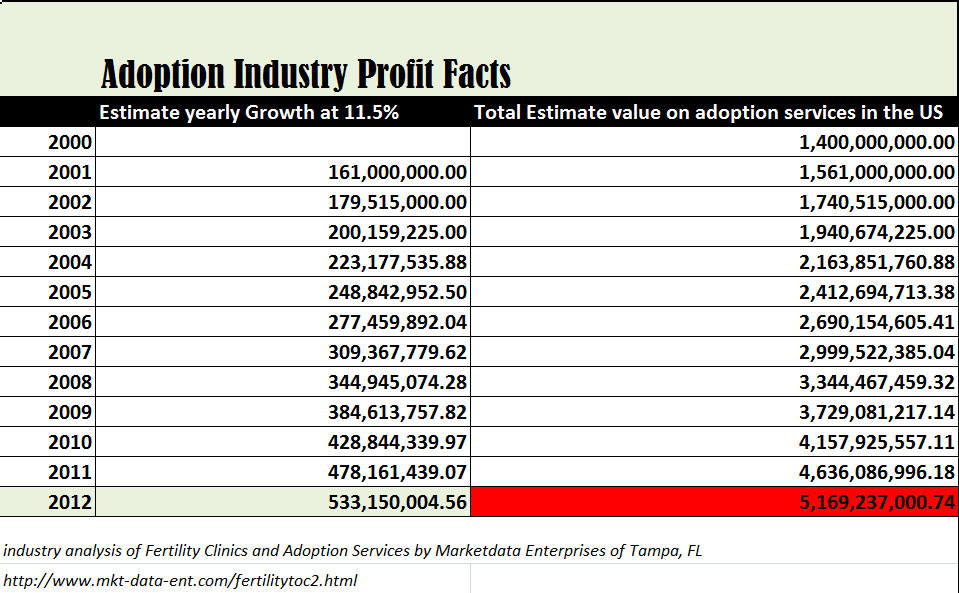
By 2012, Adoption Will be a 5 BILLION Dollar Plus industry

Even the banking and insurance industry has more regulations applied to then than adoption and we know what they do to try and make money at all costs.
An industry analysis of Fertility Clinics and Adoption Services by Market Data Enterprises of Tampa, FL, has placed a $1.4 billion value on adoption services in the US back in’ 99. No other government or private agency has bothered since then. With a projected annual growth rate of 11.5% to 2012, this makes adoption the largest unregulated industry in the US.
Do the math; even if we follow those conservative projections, because the market has exploded since this last study was done making 11.5% is very mild of a percentage, we have a number that is in excess of 5 billion dollars by the end of 2012 with a growth rate of at least a half billion a year and growing.
Adoption is a billion dollar business
Let’s all repeat: NO REGULATIONS PLUS LARGE SUMS OF MONEY EQUALS CLIMATE FOR CORRUPTION. That, folks, is human nature.
http://www.adoptionbirthmothers.com/its-not-about-you-but-it-is-2/#more-3268

Staggering Adoption Industry Profits

From Musings of the Lamb blog:

By 2012, Adoption Will be a 5 BILLION Dollar Plus industry

Even the banking and insurance industry has more regulations applied to then than adoption and we know what they do to try and make money at all costs.
An industry analysis of Fertility Clinics and Adoption Services by Market Data Enterprises of Tampa, FL, has placed a $1.4 billion value on adoption services in the US back in’ 99. No other government or private agency has bothered since then. With a projected annual growth rate of 11.5% to 2012, this makes adoption the largest unregulated industry in the US.
Do the math; even if we follow those conservative projections, because the market has exploded since this last study was done making 11.5% is very mild of a percentage, we have a number that is in excess of 5 billion dollars by the end of 2012 with a growth rate of at least a half billion a year and growing.
Adoption is a billion dollar business
Let’s all repeat: NO REGULATIONS PLUS LARGE SUMS OF MONEY EQUALS CLIMATE FOR CORRUPTION. That, folks, is human nature.
http://www.adoptionbirthmothers.com/its-not-about-you-but-it-is-2/#more-3268

Staggering Adoption Industry Profits

From Musings of the Lamb blog:

By 2012, Adoption Will be a 5 BILLION Dollar Plus industry

Even the banking and insurance industry has more regulations applied to then than adoption and we know what they do to try and make money at all costs.
An industry analysis of Fertility Clinics and Adoption Services by Market Data Enterprises of Tampa, FL, has placed a $1.4 billion value on adoption services in the US back in’ 99. No other government or private agency has bothered since then. With a projected annual growth rate of 11.5% to 2012, this makes adoption the largest unregulated industry in the US.
Do the math; even if we follow those conservative projections, because the market has exploded since this last study was done making 11.5% is very mild of a percentage, we have a number that is in excess of 5 billion dollars by the end of 2012 with a growth rate of at least a half billion a year and growing.
Adoption is a billion dollar business
Let’s all repeat: NO REGULATIONS PLUS LARGE SUMS OF MONEY EQUALS CLIMATE FOR CORRUPTION. That, folks, is human nature.
http://www.adoptionbirthmothers.com/its-not-about-you-but-it-is-2/#more-3268

Staggering Adoption Industry Profits

From Musings of the Lamb blog:

By 2012, Adoption Will be a 5 BILLION Dollar Plus industry

Even the banking and insurance industry has more regulations applied to then than adoption and we know what they do to try and make money at all costs.
An industry analysis of Fertility Clinics and Adoption Services by Market Data Enterprises of Tampa, FL, has placed a $1.4 billion value on adoption services in the US back in’ 99. No other government or private agency has bothered since then. With a projected annual growth rate of 11.5% to 2012, this makes adoption the largest unregulated industry in the US.
Do the math; even if we follow those conservative projections, because the market has exploded since this last study was done making 11.5% is very mild of a percentage, we have a number that is in excess of 5 billion dollars by the end of 2012 with a growth rate of at least a half billion a year and growing.
Adoption is a billion dollar business
Let’s all repeat: NO REGULATIONS PLUS LARGE SUMS OF MONEY EQUALS CLIMATE FOR CORRUPTION. That, folks, is human nature.
http://www.adoptionbirthmothers.com/its-not-about-you-but-it-is-2/#more-3268

CLICK OLDER POSTS (above) to see more news

CLICK OLDER POSTS  (above) to see more news

MEGWETCH THANK YOU

HUGE Thank you for visiting this blog and sharing this with your kin. It's appreciated. Contact Trace anytime! Use the form below.

BOOKSHOP

Please use BOOKSHOP to buy our titles. We will not be posting links to Amazon.

Popular Posts

To Veronica Brown

Veronica, we adult adoptees are thinking of you today and every day. We will be here when you need us. Your journey in the adopted life has begun, nothing can revoke that now, the damage cannot be undone. Be courageous, you have what no adoptee before you has had; a strong group of adult adoptees who know your story, who are behind you and will always be so.

OUR HISTORY

OUR HISTORY
BOOK 5: Lost Children of the Indian Adoption Projects