BACK UP BLOG (no longer updating)

This blog was a backup for American Indian Adoptees blog
USE THE SEARCH BAR or SEARCH TOPICS at bottom of this blog

If you need support

Support Info: If you are a Survivor and need emotional support, a national crisis line is available 24 hours a day, seven days a week: Residential School Survivor Support Line: 1-866-925-4419. Additional Health Support Information: Emotional, cultural, and professional support services are also available to Survivors and their families through the Indian Residential Schools Resolution Health Support Program. Services can be accessed on an individual, family, or group basis.” These & regional support phone numbers are found at https://nctr.ca/contact/survivors/ . MY EMAIL: tracelara@pm.me

Search This Blog

Tuesday, February 4, 2025

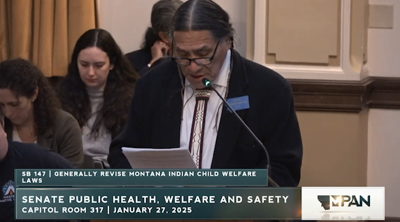
Montana Native American Caucus focuses on cultural preservation, ICWA

Montana Native American Caucus focuses on cultural preservation

The Montana Native American Caucus is focusing on preserving Native culture during the 2025 Legislative Session. Senator Jonathan Windy Boy shares that key priorities include strengthening the Montana Indian Child Welfare Act and enhancing Native language education. These efforts aim to ensure Native children stay connected to their heritage and support cultural preservation in schools.

HELENA, Mont. - The Montana Legislative Session for 2025 is underway, and the Montana Native American Caucus is actively working on their goals for the future. Senator Jonathan Windy Boy, a member of the caucus, shared insights into their priorities.

Windy Boy highlighted three key issues aimed at preserving Native culture for future generations. One of the main bills is to revise and strengthen the Montana Indian Child Welfare Act.  This act ensures that Native children adopted or placed under the care of non-Native parents have the opportunity to stay connected to their tribe's culture.

Another focus is the Indian Education for All program, which requires public school districts to teach both Native and non-Native students the history and culture of Native Americans.  Additionally, the Montana Indian Language Preservation Program supports efforts by Montana tribes partnering with school districts to preserve native languages.

Native American children in Montana are disproportionately represented in the foster care system.  According to the Montana Free Press, Native children in Montana were involved in foster care at an average rate of about 44 per 1,000, compared to about 9 per 1,000 white children.  The revised Montana Indian Child Welfare Act would require guardians to make concerted efforts to immerse children into their tribe's culture.

"A lot of the kids that are in the system, for the most part, this new language is going to afford those kids that are affiliated with the tribes they're connected with the opportunity to go home and participate in the local ceremonies and cultural activities that go on.  That they probably won't have access to," said a spokesperson.

Windy Boy emphasized the importance of teaching Native languages as part of the curriculum, similar to Spanish or French.  However, no such curriculum currently exists, making legislative support crucial.

"Native language teachers have to come up with a curriculum from scratch, because there isn't any curriculum that's developed.  That's why it's important to assist and try to support those class 7 teachers, to try and get a baseline of stuff so they can just kind of take it from there.  Fill in a lot of blanks, and try to get these basic instructional pieces together so they can implement them from there," he said.

Windy Boy noted that the three bills do not have a fiscal note attached, which could impact their budgeting. However, he remains confident that they will pass.

MORE: 

CSKT member and former Chairwoman Shelly Fyant (right) is one of 12 Native Americans in the Montana State Legislature.The Montana State House of Representatives convenes for the first day of the 2025 legislative session, which includes 10 new Native Americans in leadership positions.  

Top of Form

Bottom of Form

Twelve Native American representatives are sworn into the Montana Legislature, including three from Confederated Salish and Kootenai Tribes| Char-Koosta News 

HELENA — Three Confederated Salish and Kootenai Tribal members were sworn in at the 69th Montana Legislature: Shelly Fyant in the House and Shane Morigeau and Jacinda Morigeau in the Senate. Shelly and Jacinda, both Bitterroot Salish women, join retuning senator Shane Morigeau, in bringing unique perspectives to the legislative process.

The 2024 election brought 10 new Native American representatives to Montana’s state House and Senate, including Sen. Jonathan Windy Boy, Sen. Jacinda Morigeau, Rep. Thedis Crowe, Rep. Tyson Running Wolf, Rep. Frank Smith, Rep. Mike Fox, Rep. Jade Sooktis, Rep. Shelly Fyant, Rep. Donavon Hawk, and Rep. Sidney Fitzpatrick. Along with returning senators Susan Webber and Shane Morigeau, the total number of Native American legislators now stands at 12.

Together, they are part of legislative sessions that are foundational to the democratic process, where they help shape laws governing society and ensure equitable distribution of resources and rights.


READ MORE:

Trump’s attempt to end birthright citizenship would overturn more than a century of precedent

Monday, February 3, 2025

New online tool tracks progress on MMIWG calls for justice

The monument to Missing and Murdered Indigenous Women, Girls and 2SLGBTQQIA+ People outside the NWT Legislative Assembly. Emily Blake/CabinRadio

The federal government has launched a new online tool that tracks its progress on the calls for justice from the National Inquiry into Missing and Murdered Indigenous Women and Girls.

A Wednesday press release from Crown-Indigenous Relations and Northern Affairs Canada stated the new reporting tool presents the results of its annual progress reports on the calls for justice “in a more accessible, visual and interactive format.”

The national inquiry released its final report in 2019, which included 231 calls for justice to various levels of government, media, service providers, police, industry and all Canadians.

Of those calls, 215 are directed at the federal government, which has also supported a further five actions.

The federal government released a national action plan to address the calls for justice in 2021.

The online reporting tool states that as of June 2024, the federal government has begun work on 115 of the calls for justice.  A further 105 are “pending action.”

The tool allows users to search progress on the calls for justice by theme and government department.

The federal government said the online tool will be updated with the results of its 2024-25 progress report when it is released on June 3.

The launch of the tool was announced during opening remarks at the third annual national Indigenous, federal, provincial and territorial meeting on Missing and Murdered Indigenous Women, Girls and 2SLGBTQI+ People in Ottawa.

The NWT government has said Lucy Kuptana, the territory’s minister responsible for the status of women, is attending the meeting virtually.

The GNWT released its action plan to address the calls for justice in 2022. The territory is currently working to develop missing persons legislation, which was one of the calls for justice.

Brutal Western makes 'Game of Thrones' look tame


'American Primeval' review:  Brutal Western makes 'Game of Thrones' look tame

Netflix's new historical fiction series "American Primeval" is coming under fire for its depiction of the Church of Jesus Christ of Latter-day Saints and leader Brigham Young.

USA TODAY TV critic Kelly Lawler called the series "savage and primal and bloody and cold and ruthless" as it depicts "all the worst parts of life."

The series premiered in 2025 and stars Taylor Kitsch (Isaac), Elizabeth "Betty" Gilpin (Sara Rowell), Preston Mota (Devin Rowell) and Shawnee Pourier (Two Moons) as they travel west.  But the group is soon caught up in the middle of an undeclared war between Indigenous nations, the U.S. government, pioneers heading west and the newly powerful Mormon church, its Nauvoo militia and Young.

The series depicts the Mountain Meadows massacre during the 1857-58 Utah War. In the massacre, settlers of the LDS Church involved in a territorial militia killed 120 American western emigrants.

The church said the series "inaccurately portrays" the massacre "as reflective of a whole faith group."

"The Church has long acknowledged and condemned this horrific tragedy," the LDS Church said. "It has also taken significant steps to uncover and share the full truth of what happened and promote healing.

"The problem with such deceptive, graphic and sensationalized storytelling is that it not only obscures reality and hinders genuine understanding but can foster animosity, hate and even violence. This is particularly troubling today when peacemakers are needed more than ever," the church continued.


Sacred Mound Returned to Osage Nation

 So much destruction of our history, along with looting and worse... Trace

Annotated image of Sugarloaf Mound from the Heckenberg Family Scrapbook. Photograph by Jennifer Colten. (photo/Courtesy of Joan Heckenberg.)

By Kaili Berg

November 22, 2024

Sugarloaf Mound, the last remaining intact Mississippian mound is one step closer to returning to the Osage Nation.

Once part of “Mound City,” a network of over 100 earthen structures constructed by Native Americans between 800 and 1450 AD, Sugarloaf Mound is the sole surviving structure to a civilization nearly erased by colonization and urban development. 

Bottom of Form

The Mississippian culture, responsible for building Sugarloaf Mound and others, was one of the most advanced pre-Columbian civilizations in North America. At its height, it included Cahokia, a massive urban center just across the Mississippi River in present-day Illinois. 

Cahokia, known for its towering Monk Mound, still the largest structure in the Americas, was home to an estimated 20,000 people during its peak around 1100 AD. 

Sugarloaf and Big Mound were among the most prominent structures in what is now St. Louis. These signal mounds were positioned along the Mississippi River, allowing communication with Cahokia via smoke signals. 

The mounds of St. Louis stood as landmarks when the city was founded in 1764, even drawing visits from European royalty.  However, settlers soon repurposed the structures, demolishing them to make way for roads, railroads, and the 1904 World’s Fair. 

According to AP News, bones from Big Mound were reportedly discarded into the Mississippi River as the structure was dismantled.  By the early 20th century, only Sugarloaf Mound remained. 

In 2009, the Osage Nation purchased a portion of Sugarloaf Mound and began stabilizing the site.  A pivotal moment came recently when 86-year-old Joan Heckenberg, who has lived on the mound for 81 years, agreed to sell her property to the Osage Nation. 

Once Heckenberg moves or passes away, this part of the mound will officially return to the tribe.  However, a house owned by Kappa Psi, a pharmaceutical fraternity, remains on the mound, and the fraternity has yet to commit to selling the property, AP News reported. 

Efforts to rematriate Sugarloaf Mound gained momentum with the 2023 Counterpublic triennial, a public art exhibition that turned the site into a symbol of Indigneous homecoming.  Public programming led by the artist collective New Red Order, curator Risa Puleo, and the Osage Nation brought visibility to the sacred mound and its importance. 

The city of St. Louis has also taken steps to recognize the mounds’ significance. Alderman Cara Spencer announced plans for a resolution in January 2024 to formally acknowledge Osage sovereignty over the site.

Long-term plans include developing a cultural and interpretive center at Sugarloaf Mound, which overlooks the Mississippi River a few miles south of downtown. 

For the Osage Nation, reclaiming Sugarloaf Mound is more than preserving a sacred site, it is a step toward sovereignty and the restoration of their heritage. 

“To be able to at least salvage one mound in St. Louis, on the west side of the Mississippi River — it means a lot to us, to regain our heritage,” Andrea Hunter, director of the Osage Nation Historic Preservation Office, told AP News. 


CLICK OLDER POSTS (above) to see more news

CLICK OLDER POSTS  (above) to see more news

MEGWETCH THANK YOU

HUGE Thank you for visiting this blog and sharing this with your kin. It's appreciated. Contact Trace anytime! Use the form below.

BOOKSHOP

Please use BOOKSHOP to buy our titles. We will not be posting links to Amazon.

Popular Posts

To Veronica Brown

Veronica, we adult adoptees are thinking of you today and every day. We will be here when you need us. Your journey in the adopted life has begun, nothing can revoke that now, the damage cannot be undone. Be courageous, you have what no adoptee before you has had; a strong group of adult adoptees who know your story, who are behind you and will always be so.

OUR HISTORY

OUR HISTORY
BOOK 5: Lost Children of the Indian Adoption Projects