This blog was a backup for American Indian Adopteesblog
USE THE SEARCH BAR or SEARCH TOPICS at bottom of this blog
If you need support
Support Info: If you are a Survivor and need emotional support, a national crisis line is available 24 hours a day, seven days a week: Residential School Survivor Support Line: 1-866-925-4419. Additional Health Support Information: Emotional, cultural, and professional support services are also available to Survivors and their families through the Indian Residential Schools Resolution Health Support Program. Services can be accessed on an individual, family, or group basis.” These & regional support phone numbers are found at https://nctr.ca/contact/survivors/ .
MY EMAIL: tracelara@pm.me
New England Public Media | By Nancy
Eve Cohen November 12, 2024
The Barre, Massachusetts, Museum Association
repatriated two 19th century headdresses to the Oglala
Sioux, a tribe in South Dakota, on
Monday. It was the second repatriation from the museum to the tribe in two years.
One of the bonnets is topped with a
feather, painted red — probably earned by a warrior wounded in battle,
according to Tribal Historic Preservation Officer Justin Pourier, who drove
from South Dakota to pick up the items. He viewed them for the first time this
week.
Pourier pointed out eagle talons and
porcupine quills, along with porcupine, white-tailed deer and horse hair on the
intricately designed warrior's headdress.
The second bonnet, with a train of
about 30 eagle feathers, most likely belonged to a chief, Pourier said. He said
each feather would have been earned by a chief for performing great deeds to
protect family and community.
Pourier said repatriating the
headdresses to the Pine Ridge Reservation will have a positive impact on young
people.
PHOTO: Nancy Eve Cohen/NEPM
Justin Pourier, the Oglala Sioux
tribal historic preservation officer from South Dakota, examines a 19th century
warrior's bonnet at the Barre, Massachusetts, Museum Association on November
11, 2024. The headdress is topped with a feather and painted red, symbolizing
the person who earned it was wounded in battle.
"It's returning the energy and
a prayer back to our kids to ... restore some hope in them. Because the
reservation life it's really ... a hard way of living," he said.
Pourier sang a chief's song and
prayed over the items as they were boxed up at the museum. He said he was very
grateful to the people at the museum.
"It really means a lot, from my
heart to everybody here, for doing what you guys do," Pourier said.
He gave a brief language lesson in
Lakota as he explained he really wanted to show his gratitude.
"'Pilamaya' is 'thank you.'
'Wopila' is a bigger thank-you. If you really want to put an exclamation point
on that, you say, 'Wopila tanka.' That's like a real big thank-you," he
said.
The museum acquired the headdresses
from Frank Root, a traveling showman, in the late 1800s, according to Aaron
Miller, a repatriation expert who has consulted with the museum.
Root also gave the museum items that
are believed to have been stolen off the bodies of Native people killed by the
U.S. Cavalry at Wounded Knee, South Dakota, in 1890. The museum repatriated 130
items from Wounded Knee to the tribe two years ago.
Pourier said when the items from the
massacre were shown during two ceremonies to tribal members in South Dakota, it
helped people.
"Seeing the grandmas and the
kids, the ones that are crying, shows me that the impact is helping them maybe
start to process that historical trauma, that intergenerational trauma, that we
carry," he said.
All of the items from the Barre
Museum are kept at the Oglala Lakota College in Kyle, South Dakota.
Elizabeth Martin, the clerk of the
Barre Museum Association, explained what returning the items this week meant to
her.
"It's a tiny reparation for a
great harm — the great harm that's been done to Indigenous people all around
the world by what we call civilization," she said.
Pourier said he'd like to have a
building on the reservation where young people can come and view the bonnets.
"For our young ones, boys and
girls, that are learning to do beadwork and quillwork, that they can look at
the designs that our tribes had, our families had, our wives had back
then," he said.
After visiting the Barre museum,
Pourier planned to visit Harvard University, where he was consulting about the
return of human remains of Native people and the hair clippings of Native
children who were at boarding schools. He said medicine men from the tribe
would join him.
Pourier said he expected to bring
back from Harvard a hammer and also a human skull, which would be buried.
Treasurer Chief Lynn Malerba signs
her name during a ceremonial signing at the Bureau of Engraving and Printing in
September 2022, when she became the first Native American U.S. Treasurer. Her
signature, which appears as "Lynn Roberge Malerba" in honor of her
maiden name, was added to U.S. currency alongside that of Treasury Secretary
Janet Yellen, shown on right. (Photo: Treasury)
U.S. Treasurer Chief Marilynn
"Lynn" Malerba, the first Native American to hold the position, is
stepping down this week after overseeing significant expansions in tribal
economic development and investment programs during her two-year tenure at the
Department of Treasury.
Malerba made her decision to step
down ahead of the 2024 election, according to sources familiar with the timing.
The lifetime chief of The Mohegan
Tribe in Connecticut, Malerba realized a long-held vision as Treasurer:
creating Treasury's first Office of Tribal and Native Affairs, which she had
advocated for both as a tribal leader and member of the Treasury tribal
advisory committee. Under her leadership, the office helped administer $30
billion in economic recovery funds, including $20 billion for tribes through
the American Rescue Plan — the largest single investment in tribal nations in
U.S. history.
When offered the historic
appointment in 2021, Malerba acknowledged feeling some intimidation, but saw a
greater opportunity. "It was a space that Indigenous people have not been
represented in, and that's really very special to me, to be able to be the
person that would then bring our voice forward in a bigger way," she said
during a press call Wednesday, reflecting on her tenure at Treasury.
As Mohegan's first female chief, Malerba
brought a unique perspective to the role of Treasurer. Prior to her
appointment, she served as a critical care nurse and held various tribal
government positions, including executive director of health and human services
and chair of the Mohegan Tribal Council.
At Treasury, she helped the agency
reach a milestone of more than $500 million in State Small Business Credit Initiative (SSBCI) Capital
Program approvals for tribal nations, including an $83 million allocation for a
consortium of 125 Alaska tribes. These investments are expected to leverage up
to $5 billion in additional financing for Native entrepreneurs and small
businesses.
As I wrote in a recent POST, for a tribe to get federal recognition, you need time, resources, reams of paper and MONEY which most tribes do not have.... The feds made this process VERY HARD...only to delay delay delay... Trace
Mattaponi Indian Tribe Files for Federal Recognition
The Mattaponi Indian Tribe on Thursday formally
submitted a petition for federal acknowledgment as an Indian Tribe with a
government-to-government relationship with the United States. The
petition was delivered to the Office of Federal Acknowledgment within
the Bureau of Indian Affairs by a delegation of tribal citizens and
leaders, including Chief Mark T Falling Star Custalow, who traveled to
Washington, D.C., for the occasion.
“Today we return to Washington, D.C. to continue the pursuit of the
highest possible recognition of our Tribe’s sovereignty” said Chief Mark
T Falling Star Custalow. “Since the 1970’s we have fought for the
federal government to acknowledge our sovereignty, as the State of
Virginia does, to give us access to the rights, freedoms and resources
granted to other federally recognized tribes. Our people have fought
long and hard for this, and we look forward to joining the family of
federally recognized tribes.”
In Virginia, there are seven federally recognized tribes and eleven
state-recognized tribes. The Pamunkey Tribe was the first in the state
to gain federal recognition in 2015, with six other tribes added in
2018. The Mattaponi, one of the original Powhatan tribes, is now the
last of these tribes seeking federal recognition. The Mattaponi’s
petition has gained strong support from other tribes in Virginia, both
state and federally recognized, as well as from the Commonwealth of
Virginia.
Pursuing federal recognition is a rigorous and costly process. In
2021, the Mattaponi Tribe received a grant to aid in gathering data and
preparing the extensive petition, which includes nearly 1,000 pages of
narrative and more than 1,000 supporting documents. Researchers examined
historical records dating back to the founding of Jamestown, and a
dedicated team—including six enrolled tribal members—worked tirelessly
with the Mattaponi Petition Office to make today’s filing possible.
“We could not have gotten this far without the dedicated staff,
tribal members, and consultants who worked long hours on short
deadlines.” “Special thanks also goes to Administration of Native
Americans for their help and support along the way,” the Chief said.
Federal recognition would affirm the Mattaponi’s sovereignty,
empowering the Tribe with self-determination over its lands, resources,
and cultural heritage. This status would also open up new opportunities
for education, healthcare, and housing programs that would strengthen
the Tribe’s economic stability and prosperity. Additionally, federal
recognition would support the Tribe’s efforts to preserve its rich
cultural and historical heritage, enhancing America’s understanding of
Native American history.
The Mattaponi Tribe, a state-recognized Indian tribe with nearly 300
enrolled members across the United States, holds a reservation of over
200 acres along the Mattaponi River in King William County, Virginia. The name “Mattaponi” is derived from the Algonquian language and
translates to “Landing Place” or “River of Highbanks.” The Mattaponi are
one of the core tribes of the Powhatan chiefdom, led historically by
Chief Powhatan, the father of Pocahontas, who ruled most of Tesenacomoca
(now Tidewater Virginia) when European settlers arrived in 1607.
The
Mattaponi signed articles of peace with European colonists in 1646,
later ratified in 1677, and have since maintained their treaty
obligations, presenting an annual tribute to the Governor of Virginia,
thereby sustaining their government-to-government relationship.
Murray
Sinclair made his mark on Canadian society as a judge, activist,
senator, the chief commissioner of the Truth and Reconciliation
Commission and the co-chair of the Aboriginal Justice Inquiry — and now
he writes all about it in his memoir Who We Are. The
book answers the four guiding questions of Sinclair's life — Where do I
come from? Where am I going? Why am I here? Who am I? — through stories
about his remarkable career and trailblazing advocacy for Indigenous
peoples' rights and freedoms.
Murray
Sinclair is a former judge and senator. Anishinaabe and a member of the
Peguis First Nation, Sinclair was the first Indigenous judge appointed
in Manitoba and the second appointed in Canada. He served as Co-Chair of
the Aboriginal Justice Inquiry in Manitoba and as Chief Commissioner of
the Truth and Reconciliation Commission. He has won awards including
the National Aboriginal Achievement Award, the Manitoba Bar
Association's Equality Award and its Distinguished Service Award (2016)
and has received Honorary Doctorates from 14 Canadian universities.
Sara
Sinclair is an oral historian of Cree-Ojibwa and mixed settler descent.
She teaches at Columbia University and is currently co-editing two
anthologies of Indigenous letters.
Niigaan Sinclair is a
writer, editor, activist and the head of the Department of Native
Studies at the University of Manitoba. He is the co-editor of Manitowapow: Aboriginal Writings from the Land of Water and Centering Anishinaabeg Studies: Understanding the World Through Stories. He won the Peace Educator of the Year award in 2019. He is also the author of the book Wînipêk.
LISTEN | Murray Sinclair reads from his memoir on The Current:
Former
judge, senator and chair of the Truth and Reconciliation Commission
Murray Sinclair reads an excerpt from his book Who We Are: Four
Questions For a Life and a Nation. The memoir draws from his personal
experiences to reflect on truth and reconciliation in Canada.
A quote from the book WHAT JUST HAPPENED, which includes my interviews with John Trudell
By Trace Hentz, blog editor
I had emails right after the election (Trump won) and I was asked about how this could impact Indigenous Sovereign Tribal Nations here in the US.
Trump obviously doesn't know our history. There is no sign that he cares, unless it can make him money or gain him prestige and power.
His first term was defined as SURREAL
So, yes, it could impact every one of us in some way - for good or for bad. For one, tribal nations will not have a seat at the table, judging by Trump's last term. (Sadly, the Department of the Interior will no longer have a Native (Secretary Deb Haaland) running it.) Trump will not convene any Tribal Summits, even though we are sovereign and deserve a voice and a seat at the table.
How about his type of corruption? His financial ties and connections to oil and gas industries in exchange for permits to DRILL DRILL DRILL could impact every state, especially Alaska!
“The policies enacted during President Trump’s first term played a
crucial role in this growth and innovation. By reducing regulatory
burdens, his administration allowed energy companies to focus on
production and innovation rather than navigating an endless stream of
rules from Washington bureaucrats. In contrast, the Biden-Harris
administration has been far more aggressive than even the Obama
administration in undermining domestic oil and gas production,” the
alliance said. MORE HERE
BACKWARDS? Yup, in reverse, we will be back to THE GREAT WHITE FATHER making new rules and breaking and bending treaties, again.
Another possibility is Trump would terminate tribes, like what happened over 40+ years ago. I remember when I was editor of the Pequot Times that Trump played a part in the denial of federal recognition for the Eastern Pequot and the Schaghticoke tribes in Connecticut. Both tribes had tried over many years to petition the federal government for recognition, and regain the land they deserved to be declared their reservations. (At one point there were over 200 tribes in that situation, stuck in limbo and petitioning for federal recognition.)
Remember that every treaty ever written was broken.
Termination ended federal recognition of affected tribes and the
federal aid and services that came with that recognition. It also ended
federal trust status for affected reservations and the protections
granted by such status. In many cases, termination meant the transfer of
federal jurisdiction over criminal and civil matters on reservationsto
state authorities as well. (REMEMBER: House Concurrent Resolution 108 called for termination “at the
earliest possible time” of all American Indian tribes in California,
Florida, New York, and Texas, as well as termination for specific tribes
in other states, including “the Flathead Tribe of Montana, the Klamath
Tribe of Oregon, the Menominee Tribe of Wisconsin, the Potowatamie Tribe
of Kansas and Nebraska, and those members of the Chippewa Tribe who are
on the Turtle Mountain Reservation, North Dakota.”)
It was devastating, beyond what anyone could have imagined. (Like the Dawes Act!)
It took the tribes like Grand Ronde in Oregon many years to be recognized again, to be regarded and treated as Sovereign - costing these tribes their time and money and untold tragedy.
You see, it never ends. Domination never ends. Their demand for land and what is on the land, or under the land, never ends.
In 2020 I compiled a non-fiction book WHAT JUST HAPPENED concerning Trump's new presidency, because I had friends who were literally scared to death. The instability of the man, the crime boss Mafia mentality he displayed, the pathological liar who was our new president, this new phenomena was called TRUMP DERANGEMENT SYNDROME, or TDS. People were knocked off balance and literally in fear, scared. For good reason.
I know it's only one branch of government, yes, but in the past, almost all past presidents were a danger to us, and what is coming, has yet to be determined.
As far as future adoptees, ICWA is still our federal law. But sadly, even that could change!
With the election of President Donald Trump to serve
in his second term, the National Indian Child Welfare Association
released the following statement:
As the 2024 election results are nearly complete, we
recognize there is much at stake for our communities. At times, the
campaign rhetoric was divisive and raised important questions about how a
transition in leadership might impact our communities. While leadership
changes can often bring uncertainty and even anxiety, we have prepared
for this and are already planning how we will organize, educate, and
advocate for the needs and rights of Native children and families and
the protection of tribal sovereignty.
NICWA has navigated national leadership changes going
back to the 1980s, and we understand how to strategically and diligently
advocate for the rights and protection of Native children and families
in changing political environments. During some of the most challenging
times, we have found ways to protect and even advance resources and
rights for Native children and families. This included expanding our
network of allies—both Native and non-Native—and finding new ways to
communicate the importance of laws like the Indian Child Welfare Act,
which are crucial to the well-being of our communities.
NICWA values seeking opportunities to work in a
bipartisan manner and designing strategies that ensure support from both
parties. Our strength is the relationships we have within our
communities, leadership, and each other. We will continue our fight for
the protection of Native children and families with you as our most
valuable allies and partners.
**
Hey! We're SMART!
Let's keep watch. Like Trudell told us many times in many ways: we are resilient, sacred and ancient. We are not going anywhere.
Adopted children should be able to meet birth parents, says top judge
Report calls for ‘sea change’ to make face-to-face contact with birth
families the norm to help all involved with issues such as identity
Angela Frazer-Wicks is reunited with her eldest son who was adopted aged five, along with his brother, in 2004
Credit: X.com
Adopted children should have face-to-face contact with their birth parents, a major report has recommended.
The
report, commissioned by Britain’s most senior family court judge, said
the system where face-to-face contact was the exception rather than the
rule was outdated.
Its author, Mrs Justice Judd, said there needed
to be a “sea change” in the approach to enable children under 18 to
regularly see their birth families provided it was safe to do so.
Most adopted children
have little or no contact with their birth parents but, under current
laws, they have a right to see their birth records and reach out to
them. An adoption contact register allows the birth parents to indicate
whether they want to be contacted, if it should be limited or none at
all.
Until the 1970s, mothers would give up their babies for adoption with no expectation of future contact.
The
report said: “The stigma attached to illegitimacy and infertility meant
that the decision not to promote contact was considered to be a
protective factor for the adopter, the adopted child and the birth
family.”
Buffalo have deep cultural significance to members of the Cree Nation. // Matt Hinsta via Flickr
By Bob Covey |November 7, 2024
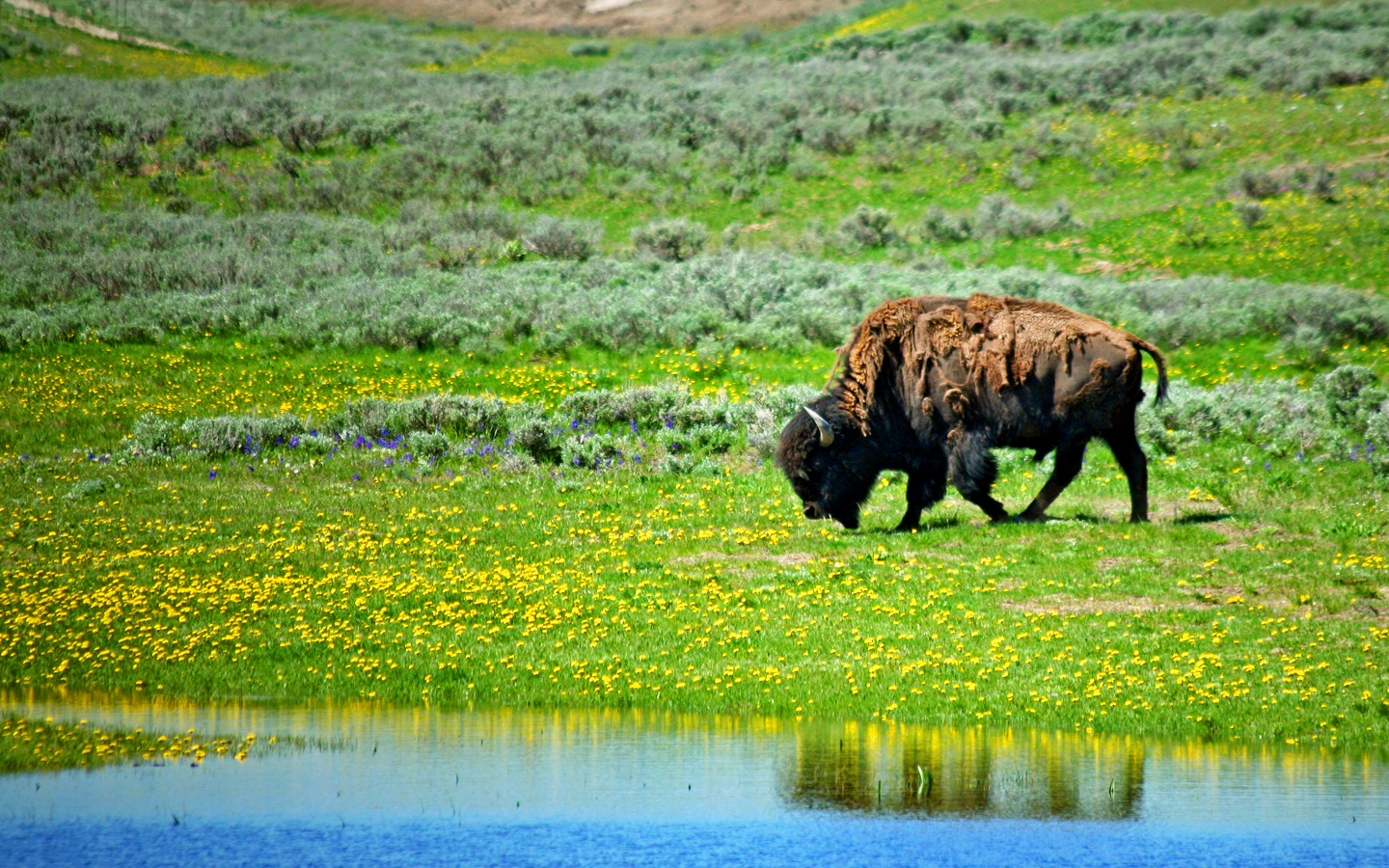
To members of the Cree Nation, the buffalo has deep and significant spiritual meaning.
“At a core level, the Cree people in Alberta were buffalo
people,” says Jasper’s Matricia Bauer. “Buffalo was their food, their
celebrations, their instruments, their tools, their way of life.”
But even though her own life as a knowledge keeper and storyteller is
centred around connections to Cree culture, until she took up residency
at the Banff Centre recently, Bauer hadn’t spent any time considering what the buffalo represents to her.
“The government has done a pretty good job of colonizing us,”
she said when asked to consider that particular crevice between her
ancestors. “And I guess I’ve done a good job of colonizing myself.”
Jasper’s Matricia Bauer (right) with her daughter Mackenzie, performing as Warrior Women in 2016. // M McFarlane
Bauer is a Sixties Scoop
survivor. She was one of thousands of Indigenous children in Canada
removed from their families to be raised by non-Indigenous families. As
an adult, Bauer has reconnected to her heritage, and today as an
Indigenous educator operates Warrior Women, an organization which aims to “Indigenize the world” through workshops, performances and plant walks.
“It was nice to be back in the boots of a student,“ she added.
The conduits which allowed her do that inner reset were twofold:
Firstly, as one of seven other Indigenous artists at the Banff Centre
residency, she was able to tap into a shared community, and exchange
traditional knowledge and skills. And secondly, she tapped into the
power of paskwâwi-mostos: the buffalo.
“I thought [the residency] would be more about traditional
practices and processes, but it was more about the relationship with the
buffalo,” she said.
Despite
its importance to her ancestors, until her residency at the Banff
Centre, the buffalo was not part of Cree educator Matricia Bauer’s
connection to her culture. // Matt Hinsta via Flickr
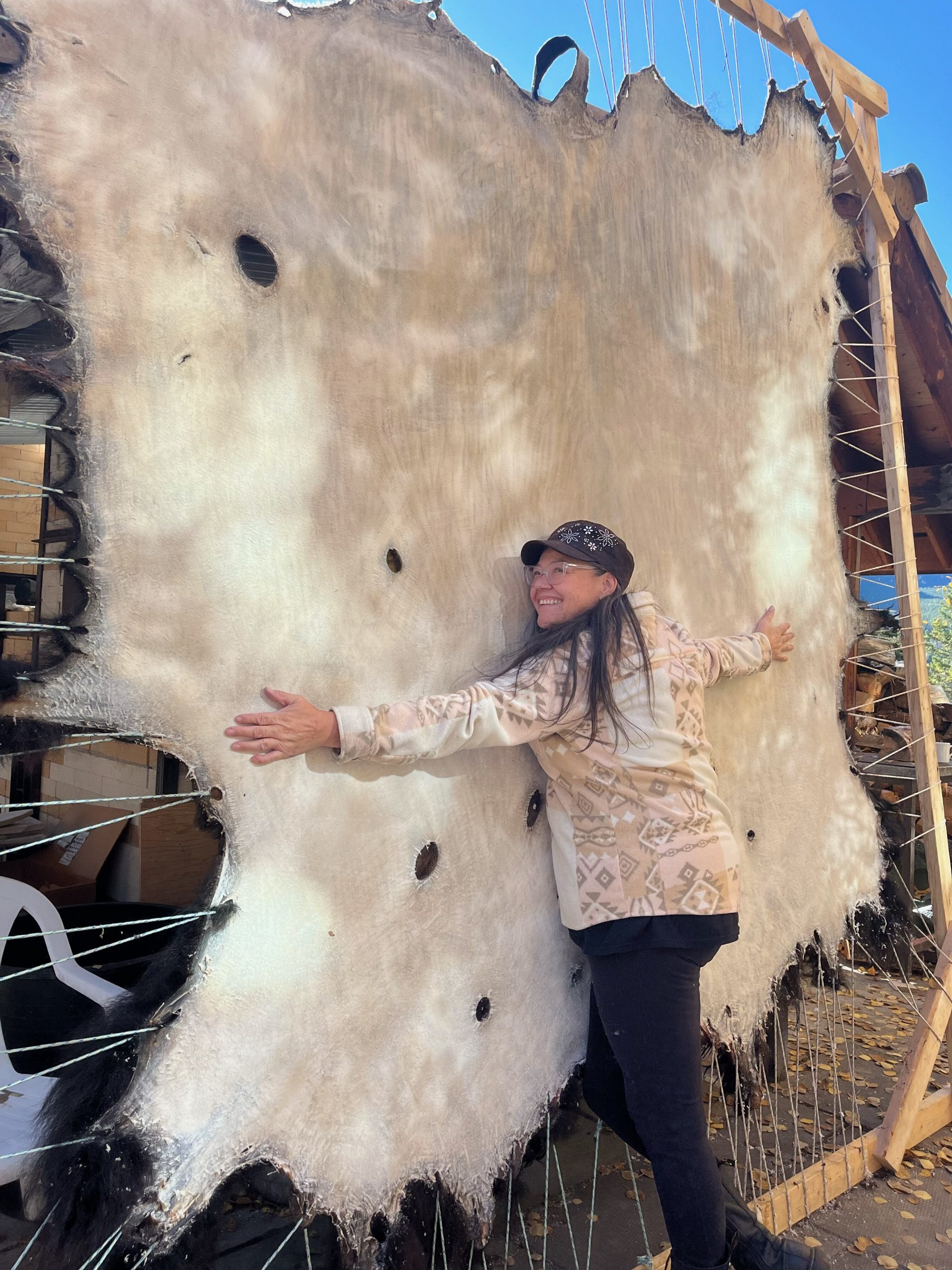
Navigating that relationship was neither easy nor expected. When she
first saw the buffalo hide that she and the group were slated to tan,
Bauer was instantly overwhelmed.
“When they rolled it out I just thought ‘oh no, that’s so big,’” she laughed.
Bauer had experience tanning hides, but she still couldn’t fathom the
amount of physical work which would be required to scrape the buffalo
hide clean of its membranes and hair. For hours each day, Bauer scraped.
By the end of each session, she could barely lift her arms. Her back
ached and her hands were cramped. And the pitiful progress made from her
monumental efforts simply ticked her off.
“I would get mad,” she said. “You would stand there scraping
for four to eight straight hours. It breaks you down mentally,
physically, emotionally.”
Hitting a low point, suddenly, one day, Bauer noticed the Banff
Centre was abuzz with activity. The reason for the heightened energy was
a visit from a group of Indigenous seniors—elders from the Bow Valley
community of Mini Thni were being toured around campus. When they saw
the hide, Bauer said, the elders were immediately drawn to it. By turn,
the aunties and uncles picked up unclaimed scraping tools, helping to
dress the hide. It was a revelatory moment for Bauer.
“I realized it’s not something meant to be done alone,” Bauer said. “It’s meant to be done together, with community.”
The shared experience buoyed Bauer and her fellow artists in
residency. They soon completed the scraping and tanning process, and
from the hide created drums, rattles, parfleches and other tools.
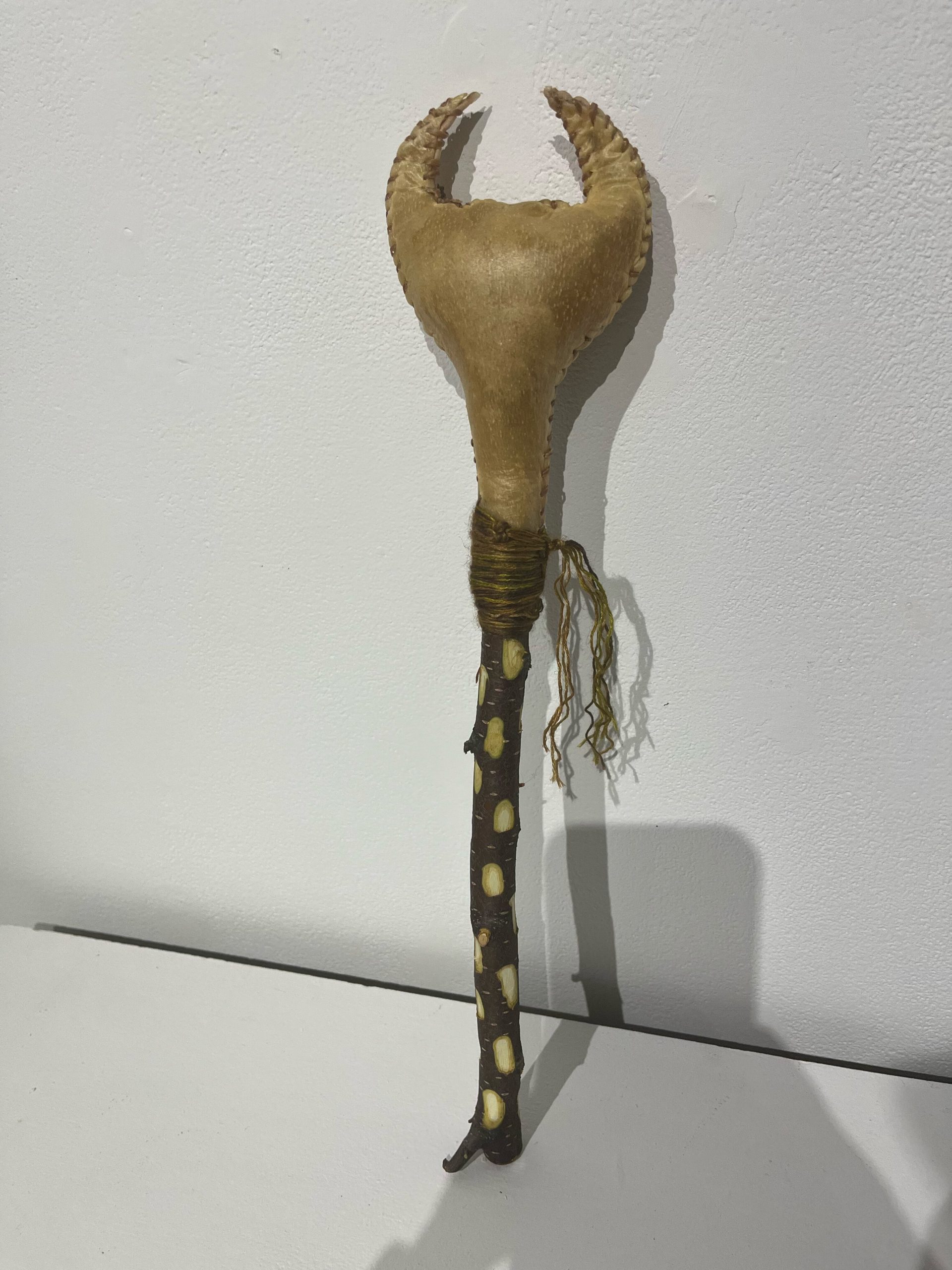
Buffalo hide rattle made by Bauer during her residency at the Banff Centre. // Supplied
A secondary exchange of knowledge came when the artists—whose
collective mosaic included representation from the Māori people, the Ute
from Colorado, the Lakota, and several other First Nations across
Canada—shared their traditional forms.
Bauer demonstrated fish scale jewelry-making and caribou hair
tufting. In exchange, she was taught horse hair wrapping, porcupine
quilling, moose hair embroidery, and making leather from fish skin.
“I learned how to carve tools out of moose bone,” she said. “That blew my mind.”
Ten weeks after wildfire destroyed parts of her community, Bauer’s
mind welcomed the outside stimulation. Because the fire torched any fall
performances and workshops she had booked, a freed-up schedule allowed
her to go into the residency with necessary focus. But like many of her
friends and neighbours, she was also feeling very vulnerable.
“I went into it like a lot of Jasperites after the fire—fractured, confused and beat down,” she said.
The physically-demanding hide tanning process broke her body down
even further, but by the end of the three weeks, she had not only had
stronger arms and shoulders, but a clearer head and a fuller heart.
Perspective
is everything: Bauer with the enormous buffalo hide she and her fellow
artists in residence at the Banff Centre scraped and tanned. // Supplied
The biggest lesson she learned? To be open to the teaching in the first place.
“It reminded me that as much as I share my culture, I still
have a massive amount to learn, and other people have a lot of gifts to
share,” she said.
T he Métis National Council and the Government of Canada will be working collaboratively, Nation-to-Nation, to develop a process to engag...
To Veronica Brown
Veronica, we adult adoptees are thinking of you today and every day. We will be here when you need us. Your journey in the adopted life has begun, nothing can revoke that now, the damage cannot be undone. Be courageous, you have what no adoptee before you has had; a strong group of adult adoptees who know your story, who are behind you and will always be so.
OUR HISTORY
BOOK 5: Lost Children of the Indian Adoption Projects