BACK UP BLOG (no longer updating)

This blog was a backup for American Indian Adoptees blog
USE THE SEARCH BAR or SEARCH TOPICS at bottom of this blog

If you need support

Support Info: If you are a Survivor and need emotional support, a national crisis line is available 24 hours a day, seven days a week: Residential School Survivor Support Line: 1-866-925-4419. Additional Health Support Information: Emotional, cultural, and professional support services are also available to Survivors and their families through the Indian Residential Schools Resolution Health Support Program. Services can be accessed on an individual, family, or group basis.” These & regional support phone numbers are found at https://nctr.ca/contact/survivors/ . MY EMAIL: tracelara@pm.me

Search This Blog

Saturday, November 9, 2024

Artist Jeffrey Gibson: Path of Possibilities: THE SPACE IN WHICH TO PLACE ME


Gibson posing with the pavilion organizers and some of the convening panelists, including novelist Dinaw Mengetsu (far right), artist Sonya Clark (fifth from right), and photographer Jolene Rickard (Tuscarora) (second from right)


A Swell of Native Pride at Jeffrey Gibson’s Venice Symposium

By

11/5/2024  hyperallergic.com /963410/a-swell-of-native-pride-at-jeffrey-gibson-venice-symposium/


VENICE, ITALY — The air was full of energy outside Jeffrey Gibson’s (Mississippi Choctaw/Cherokee) United States Pavilion at the Venice Biennale on October 26, after White People Killed Them finished their performance. Raven Chacon (Diné) played a keyboard synth, pitch shifter, and distortion pedals, as well as vocalized and used a loop cassette player, while John Dieterich played the electric guitar at the base of Gibson’s bright-red sculpture comprising empty plinths and pedestals titled “the space in which to place me,”sharing a name with the exhibition itself. Marshall Trammell played a drumset on top of the interactive sculpture’s front pedestal, performing with such passion that his bass drum kept sliding toward the edge of the pedestal.  Near the end of the performance, Gibson rose from his seat in the audience and retied a cement block placed on the base of the drum to prevent it from crashing down.  Afterward, several Native curators, artists, and scholars confided that they felt their insides vibrate from the sheer volume of the electronic music.

This was the last performance of if I read you/what I wrote bear/in mind I wrote it, a three-day convening hosted by Bard College’s Center for Indigenous Studies to “address the interdisciplinary, transnational nature of Jeffrey Gibson’s work in the US Pavilion.”  Before White People Killed Them took the stage, members of the Colorado Inter-Tribal Dancers and Oklahoma Fancy Dancers welcomed the large crowd gathered around the pavilion and performed to hand drumming and singing by Miwese Greenwood (Otoe-Missouria-Chickasaw-Ponca). At the beginning of the blended performance, dancer Kevin Connywerdy (Kiowa and Comanche) told the audience that Gibson’s presence at the pavilion was not only an honor for the artist himself but for “all of our people.”

Nick Ohitika Najin (Cheyenne River Sioux) from the Colorado Inter-Tribal Dancers joins the performance by White People Killed Them.

As a Diné audience member who spent the previous three days at the convening, I shared Connywerdy’s sentiment of Native pride. It was stunning to witness the various performers making the sculpture their stage, with dancers surrounding it in brightly colored regalia that matched the color of Gibson’s block text across the top of the pavilion that read “THE SPACE IN WHICH TO PLACE ME” and “WE HOLD THESE TRUTHS TO BE SELF EVIDENT.” As Greenwood’s drum echoed, it was not only heard but deeply felt.

This specific feeling of a hand drum’s echo is found across the United States at Native cultural events, powwows, and performances.  And in accordance with the spirit of Native humor at those events, Connywerdy jokingly told the audience to get ready to hear some Grateful Dead when he introduced White People Killed Them. In the middle of the performance, Nick Ohitika Najin (Cheyenne River Sioux) from the Colorado Inter-Tribal Dancers seamed the two separate performances.  The crowd cheered as he rejoined the sculpture-stage and danced around the trio.  The bells on his regalia joined Trammell’s drum beat.   While Chacon’s fingers quickly moved around the keyboard synth, Ohitika Najin waved his feather fan around the keyboard.  This fusion of radically different styles was representative of the convening, which gathered Native and non-Native poets, academics, artists, musicians, curators, teachers, and students.  The convening as a whole felt like an energizing disco, a kaleidoscopic exploration of Native identities in all their rich dualities, contrasts, and dichotomies: familiar and unfamiliar, past and future, joy and sorrow, detailed and monumental.

“I think one of the goals was for people to understand how many different tribal nations there are, how many different cultural contexts there are, and how many different languages there are,” he continued. “My hope is that we’ve been able to push some of those conversations to the next subject or the next place.” 

KEEP READING: hyperallergic.com /963410/a-swell-of-native-pride-at-jeffrey-gibson-venice-symposium/ 


John Dieterich on guitar, Marshall Trammell on drums, and Raven Chacon (Diné) on keyboard synth, pitch shifter, and distortion pedals


Thursday, November 7, 2024

New Law Helps CA Tribes Keep Kids Out of Foster Care | SoCal Matters

Native American children in California’s foster care system are frequently placed in non-relative, non-native homes. Although the U.S. Supreme Court upheld the 1978 Indian Child Welfare Act, ensuring child welfare agencies investigate ancestry, contested cases still emerge.  This story explores the long-standing issues and the ongoing fight to protect Native foster care rights in California. Read the full story.

TRANSCRIPT: https://calmatters.org/justice/2024/10/new-law-california-tribes-foster-care-video/


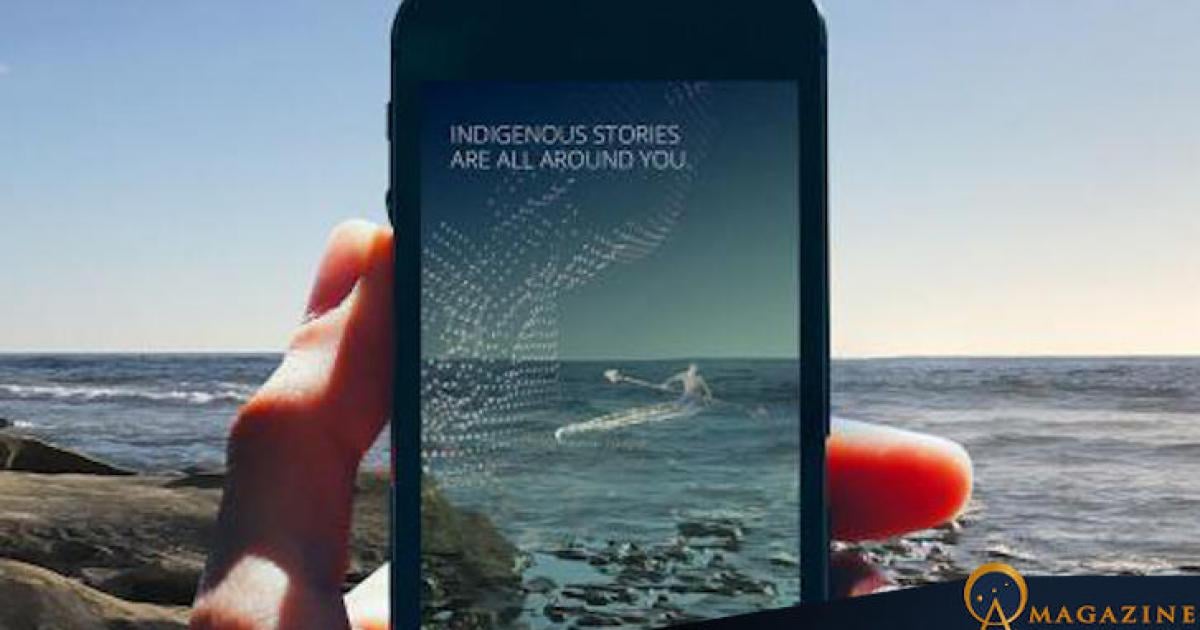
OurWorlds, Immersive Reality, and the Future of Native Histories


 NEW APP IMAGE

In a remarkable fusion of software technologies and human imagination, we are now able to experience disparate worlds simultaneously. Seamlessly intertwined, the past meets the present and cultures collide through immersive and extended reality. The possibilities are endless, as demonstrated by the innovative projects pioneered by OurWorlds.

The result of a chance encounter between designer-developer-filmmaker Catherine Eng and entrepreneur and Pala tribe member Kilma Lattin, this San Diego company is using a blend of mobile-based immersive reality, geolocation, stereoscopic 360º video capture, and storytelling.  Their mission is to connect users with Native American history, language, and culture in a multi-dimensional manner. “By building and deploying extended reality layers on top of the natural world, we enable users to see far beyond the world that exists today,” explained Lattin at TEDxSanDiego in April 2024.

Hologram of a Choctaw soldiers superimposed on the Choctaw Code Talkers Monument in Antlers, Oklahoma.

Hologram of a Choctaw soldiers superimposed on the Choctaw Code Talkers Monument in Antlers, Oklahoma. Courtesy of OurWorlds

Putting aside all the tech talk, this basically means that they are using all these tools to allow users to connect with their surroundings to unearth indigenous histories, culture, and narratives.  The goal is to share and amplify silenced Native histories, fostering culturally significant experiences and understanding, revealing stories typically overlooked by Western academic or scientific practice.

Want to find out more about the OurWorlds app and their many applications for augmented reality? Read the full article ‘OurWorlds, Immersive Reality, and the Future of Native Histories and Knowledge’ available in the July – August 2024 51st Issue New Technology Uncovering the Past. Get it here!

Featured Image: Courtesy of OurWorlds


PST ART: EMBODIED PACIFIC – OLD TOWN

Sa'will Weshow (to weave a basket)

September 27 - December 6, 2024
Kosay Kumeyaay Market

Holographic and augmented reality installations by Kumeyaay artist Gloria Montes Crosthwaite and Our Worlds highlight the botany and design of Kumeyaay basketry with traditional weaving and pottery of Indigenous artists of the region. The works are displayed at Kosay Kumeyaay Market, presented by artist and community leader Ana Gloria Rodriguez, Kosay's director, representative of the Kumeyaay Nation to Mexico, and founder of Tipey Joa Native Warriors. 


Tuesday, November 5, 2024

Indigenous peoples tell Biden: ‘Sorry is not enough’

Editorial By Editor

President Joe Biden did something that no U.S. president has done. He offered a formal apology for the horrific, racist abuse suffered by Native American and Alaska Native children in so-called American Indian boarding schools. Biden apologized on Oct. 25 outside of Phoenix, Arizona, at the Gila River Indian Community, at a meeting which included tribal leaders, survivors and their families.

The timing and place of this apology raises eyebrows since it comes within two weeks of the Nov. 5 presidential election, and Native Americans make up 5% of the overall population of Arizona, which is a “swing state.” 

Beginning in 1819, thousands of Native American and Alaska Native children were kidnapped from their homes and sent away to schools (in reality, concentration camps), where they were denied the right to their cultures, languages, histories and spiritual beliefs. Their long hair was cut, and many of these children were mentally and physically tortured, scarring them for life. 

At least 973 children died in Indian boarding schools operated or supported by the federal government, often from abuse and disease. (The number is likely much higher.) Their labor was superexploited in the schools and by white adults who adopted them or hired them out. Most large American Indian boarding schools closed in the 1980s and 1990s following years of activism, the passage of the Indian Self-Determination and Education Assistance Act of 1975 and the Indian Child Welfare Act of 1978.

Many of these schools were maintained by the Catholic Church, other Christian denominations and the Mormon Church. 

This abominable treatment was an instrumental part of a centuries-long genocidal campaign waged against Indigenous peoples that began when the butcher Christopher Columbus seized Caribbean islands in 1492, claiming them for the Spanish monarchy.

While many who attended the Oct. 25 meeting were heartened to hear Biden’s apology, others said that the apology wasn’t nearly enough to reverse the long-lasting physical and psychological harm done to those forced to attend the schools and to the generations that followed. 

Rosalie Whirlwind Soldier, a 79-year-old member of the Rosebud Sioux Tribe, who suffered severe mistreatment at a school in South Dakota that left her with a lifelong, painful limp, said, “Sorry is not enough. Nothing is enough when you damage a human being. A whole generation of people and our future was destroyed for us.” She and others are asking what comes next after the apology. (Associated Press, Oct. 25) 

Indigenous activists and allies protest in Boston.


United American Indians of New England (UAINE), the main organizer of the annual National Day of Mourning in Plymouth, Massachusetts, stated on its Facebook page in anticipation of the president’s Oct. 25 announcement: “Biden to issue apology, without reparations, for U.S. Indian boarding schools. Nothing pledged to help Native children and families now dealing with intergenerational trauma, disproportionate number of children in care and all the other effects of genocidal U.S. anti-family policies.”

UAINE continued: “No increased support for Indigenous language revitalization. Not to mention the necessity of landback. Nor the fact that this is being done for votes by an administration actively committing genocide. And free Leonard Peltier!”

Any formal apology by a U.S. president to an oppressed people, such as one President Bill Clinton made in 1997 to African Americans regarding slavery and Biden made recently to Indigenous peoples, is certainly a concession.  But these apologies for state-sanctioned atrocities are toothless, because their white supremacist legacies remain intact. 

Workers World is in total solidarity with UAINE and other Indigenous peoples in demanding that reparations be put in place to make any kind of apology real for those who are still fighting for their right to basic human rights, sovereignty and self-determination. 

Otherwise, these apologies amount to nothing but grandstanding.

https://www.workers.org/2024/10/81636/

Adoption Awareness Month

A child who looks a little lonely and sad sits on a couch hugging a stuffed animal and looking off into the distance.
(Photo via fizkes/Shutterstock.com)


OPINION | Why Media Representation Matters for Adoptees

Editor |

by Angela Tucker

Many people can instantly remember a movie they saw as a teenager that became a part of their identity. My husband still talks about The Matrix (1999), and the way it deeply impacted his questions about free will and technology in daily life. Some of my adult friends still dress up like the characters in Clueless (1995) for Halloween; clearly, its exploration of self-perception, fashion, and social status resonated with many people. As a Black adoptee, I remember when I first saw Antwone Fisher (2002) and related to how he grapples with questions about his origins, wondering who he is without knowing where he came from. His search for his biological mother and family symbolizes a desire for self-understanding and a connection to his roots, which was my experience, too. I also saw pieces of that conversation in Losing Isaiah (1995) and Matilda (1996), but they were sensational, rags-to-riches, zero-to-hero stories that fell short of capturing the nuance that most adoptees like me face daily. I ached for shows that reflected the wholeness of the adoptee experience on the silver screen.

The popular representations of adoption do not capture the range and complexity of adoptee experiences with real-life consequences. Adoption comes with trauma; being adopted doubles the odds of having contact with a mental health professional and increases the risk of developing a substance abuse disorder, and adoptees are four times more likely to attempt suicide. Those adopted by parents of a different race, like me, face additional challenges in forming our identity. If we want to provide lasting, happy lives for adoptees, we must transform how we support them throughout every stage of life.

While working as a caseworker at an adoption agency, I didn’t have many pop culture examples to show adoptive parents to provide a blueprint for how to help their adopted child form a healthy identity. The media was full of tidy, feel-good adoption stories that minimized the reality. Every day, I spoke to well-meaning prospective adoptive parents, listening as they struggled to understand practices that could benefit their adoptee, like an open adoption that would allow their child to maintain a relationship with their biological family. These ideas felt foreign and frightening to many, leading to questions like, “Will the child become confused about who their ‘real’ parents are?”

At the same time, I was going through my own search for my biological parents.

I had a positive upbringing in my adoptive family, but I also felt a hole in my heart that was left from growing up not knowing my birth parents. One evening, after listening to my struggles to communicate with the parents I work with, my husband said, “Why don’t we use the home video footage we have of you meeting your birth mom for the first time and turn it into something you can show your clients?” Our reunion had been captured on camera, though at the time it was just for us, just for the memory.

What began as a casual passion project with our home footage quickly evolved. Film had just been a hobby for my husband, but soon, he started renting professional cameras and lights. He conducted interviews with my parents, my siblings, and others involved in my life and my journey. Friends of ours even offered to compose a soundtrack.

The result was Closure (2013), a documentary that transformed from private family footage into a film that found its way to Netflix.  While on the screening tour, I had countless conversations with adoptees who would share their stories with me. Suddenly, they had a real, lived experience that could serve as a blueprint for grappling with the complexities of adoption openly with their parents.  Adoptees who were of a different race than their adoptive parents shared that they didn’t get the racial self-identity support they needed and felt alone. 

At the same time, my parents, who often traveled with me to screenings, were having a different kind of encounter. Adoptive parents would praise them for allowing me to meet my birth mother. They believed that because their child didn’t bring up their adoption, it wasn’t weighing on them.

When my parents and I compared notes after these events, we realized something important. Many adoptees didn’t have safe spaces to share their feelings about being adopted — not because their adoptive parents were unkind or indifferent, but because adoption itself wasn’t a normalized topic in their homes. It simply wasn’t discussed. Adoption became a quiet shadow — present but unspoken. The adoptees I spoke to longed for connection, for answers to questions that had been with them their whole lives, but did not want to fracture their relationship with their parents. They needed more ways to share their experiences without fear and to have pathways to deeper understanding and healing along the journey to find their identity and a sense of belonging.

Even though many adoption agencies understand adoption is a lifelong journey, very few can offer the kind of lifelong support adoptees need.

Action and Evolution 

I knew I had to create a space where adoptees could say the things aloud that otherwise were filed away in the “not now/not safe” folder in their brain. These conversations transformed into mentoring hundreds of adoptees via Zoom. The strength, comfort, and mental well-being that came from these conversations inspired me to found the Adoptee Mentoring Society to reach more adoptees. We provide virtual one-on-one and group mentorship facilitated by trained adoptee mentors. Our model serves as an example of the power of offering post-adoption services by adoptees for adoptees. Adoptees need a community and opportunities for individual growth. Spending time with others who just get it by having mentors or talking to other adoptees whose experiences reflect our lives fosters the sense of well-being that is the foundation for a happy, successful life.

We need to make room for these raw, unfiltered truths in public discourse. Only then can we foster real understanding and change for adoptees. I loved working with the writers of NBC’s show This Is Us to ensure Randall’s character was as true to the transracial adoptee experience as possible. Adoptee and screenwriter ​​Marissa Jo Cerar infuses her experience as an adoptee into nearly everything she touches, including the episode she wrote for The Handmaid’s Tale and her television adaptation of Charmaine Wilkerson’s novel Black Cake.

This National Adoption Month, support the healing work that we’re doing at the Adoptee Mentoring Society by centering adoptees and ensuring our voices are included in mainstream media and public discourse. This will help support the basic needs and joys that lead to a healthy identity formation for adoptees.

SOURCE: https://southseattleemerald.org/voices/2024/11/01/opinion-why-media-representation-matters-for-adoptees 


READ MY EARLIER POST: (2010)

https://blog.americanindianadoptees.com/2010/03/my-adoption-archives-and-144-billion-in.html


WHAT WE HAVE KNOWN A LONG TIME: (2013)

https://blog.americanindianadoptees.com/2013/01/what-weve-known-long-time.html 


2024:

A Proclamation on National Adoption Month - The White House 

CLICK OLDER POSTS (above) to see more news

CLICK OLDER POSTS  (above) to see more news

MEGWETCH THANK YOU

HUGE Thank you for visiting this blog and sharing this with your kin. It's appreciated. Contact Trace anytime! Use the form below.

BOOKSHOP

Please use BOOKSHOP to buy our titles. We will not be posting links to Amazon.

Popular Posts

To Veronica Brown

Veronica, we adult adoptees are thinking of you today and every day. We will be here when you need us. Your journey in the adopted life has begun, nothing can revoke that now, the damage cannot be undone. Be courageous, you have what no adoptee before you has had; a strong group of adult adoptees who know your story, who are behind you and will always be so.

OUR HISTORY

OUR HISTORY
BOOK 5: Lost Children of the Indian Adoption Projects