This blog was a backup for American Indian Adopteesblog
USE THE SEARCH BAR or SEARCH TOPICS at bottom of this blog
If you need support
Support Info: If you are a Survivor and need emotional support, a national crisis line is available 24 hours a day, seven days a week: Residential School Survivor Support Line: 1-866-925-4419. Additional Health Support Information: Emotional, cultural, and professional support services are also available to Survivors and their families through the Indian Residential Schools Resolution Health Support Program. Services can be accessed on an individual, family, or group basis.” These & regional support phone numbers are found at https://nctr.ca/contact/survivors/ .
MY EMAIL: tracelara@pm.me
For the first time, the United States is owning up to its role in the
deplorable treatment of Native American, Alaska Native and Native
Hawaiian children at Indian Boarding Schools over more than a century.
The report from the U.S. Department of Interior
documents the deaths of nearly 1,000 children at boarding schools—many
in collaboration with Catholic and other Christian institutions. The
report includes distressing testimony collected at public meetings
around the country from boarding school survivors and their relatives,
detailing the personal costs of the government’s attempts to eradicate
Native cultures and languages. It recommends the federal government not
only formally apologize, but also establish a path and funding to
account for the wrongs and the continuing harm resulting from it.
GUESTS
Bryan Newland (Bay Mills Indian Community), Assistant Secretary for Indian Affairs in the U.S. Department of the Interior
Children should not be separated from their families due to financial
hardship alone. Several states, like Kentucky, Indiana, South Carolina,
Wisconsin, Pennsylvania, Washington, and Kansas have already clarified
that poverty alone should not cause child removal.
Details:
Allowing child welfare agencies to draw on federal funds to finance
background check operations to facilitate quicker licensing for kin and
others who provide foster care.
Rolling out a new website spotlights states and Tribes that have
adopted new kinship licensing rules, as well as data on their kinship
placement rates.
Publishing a resource guide on federal programs that provide supports to grandparents and kin in their caregiving roles.
Conducting a series of listening sessions to identify federal
flexibilities needed for states and Tribes to adopt kinship licensing
rules and kinship first approaches.
Respecting Tribal sovereignty. The Administration expanded the scope of Public Law 102-477 plans,
which now deliver over $300 million in flexible funding to 298 Indian
Tribes to strengthen the economic stability and mobility of families in
Indian Country – including by braiding child welfare funding with
workforce funding to help preserve families. And just over a year ago,
the President celebrated the Supreme Court’s decision in Haaland v. Brackeen,
which upheld the Indian Child Welfare Act as a necessary safeguard to
ensure that whenever possible, children should be kept with their
extended families or community.
EDITOR NOTE: It blows my mind the system that created poverty (and forced adoptions in Indian Country) is aiming to fix that - what, after 100+ years? Really? THEY CREATED POVERTY! We already had KINSHIP care for kids on the rez... it's called family and relatives!
So Biden-Harris really really need the NATIVE VOTE in 2024, apparently...
The billions of dollars spent to run all these gov't agencies and departments to remove Native kids could have ended poverty a long time ago.
New York City’s American Museum of
Natural History (AMNH) is repatriating the remains of 124 Native individuals
and 90 Native cultural items as it faces increased pressure to return the thousands of human remains
in its holdings. The news follows an updated and stricter set of federal rules under the 1990 Native American Graves Protection and
Repatriation Act (NAGPRA) that went into effect at the beginning of this year.
Last Thursday, July 25, AMNH
President Sean Decatur updated staff on the institution’s repatriation efforts
in a letter first
reported by the New York Times.
According to his announcement, AMNH has conducted “more than 400 consultations,
with approximately 50 different stakeholders, including hosting seven visits of
Indigenous delegations and eight completed repatriations” in 2024.
A Hyperallergicinvestigation
last year found that the museum’s collection of around 12,000 remains from
communities within and outside the United States includes the bodies of Black
New Yorkers acquired from medical schools in the late 1940s. Collected across
150 years of acquisitions, donations, and expeditions, a majority of these
remains originate from Indigenous or colonized communities and lack
identification.
Earlier this year, AMNH joined othermuseumsaroundthecountry in
removing swaths of Indigenous artifacts from public view by closing two galleries
dedicated to Native American history, in order to abide by the updated NAGPRA
regulations.
The newly enacted rules now mandate institutions
to “obtain free, prior and informed consent” from tribal communities “before
allowing any exhibition of, access to, or research on human remains or cultural
items.” Despite these recent regulations, tribal community members have
continued to raise skepticism
over institutional delays in returning the remains of their ancestors, while
issues like contaminated collections
and damage to cultural objects
have also posed complications.
In an email to Hyperallergic,
an AMNH representative noted that the museum’s recent repatriations do not
account for objects that were on display in its since-closed galleries, as
“reviews and consultations for [these items] are ongoing.”
The Federal Register shows that in
April, AMNH identified the remains of three individuals affiliated with the
Santa Ynez Band of Chumash Mission Indians of the Santa Ynez Reservation,
situated in southern California. Their
bodies were taken from San Miguel Island and Santa Rosa Island, located off the
Santa Barbara coast. In the late 19th
century, the museum acquired one set of remains from James Terry, a curator in
its anthropology department, and the two others from Felix von Luschan, an
Austrian-born anthropologist and ethnologist whose private collection of more than 5,000
human skulls was sold to AMNH
after his death. That same month, AMNH identified
the remains of another four individuals and one associated funerary object
affiliated with seven tribal communities in California, including the Santa
Ynez tribe.
Today, many families of individuals
in AMNH’s collections still have not received information about their
ancestors’ whereabouts, according to recent reports.
👉👉WHAT?
While it no longer does so, in the past, the Museum applied potentially hazardous pesticides to items in
the collections. Museum records do not list specific objects treated or which
of several chemicals used were applied to a particular item.(WHAT?) (POISON!) Therefore, those handling this
material should follow the advice of industrial hygienists or medical personnel
with specialized training in occupational health or with potentially hazardous
substances.
The Interior Department has concluded an unprecedented
yearslong review finding nearly 1,000 children died, separated from
their tribes and families, with many buried across hundreds of
institutions created for ‘forced assimilation.’
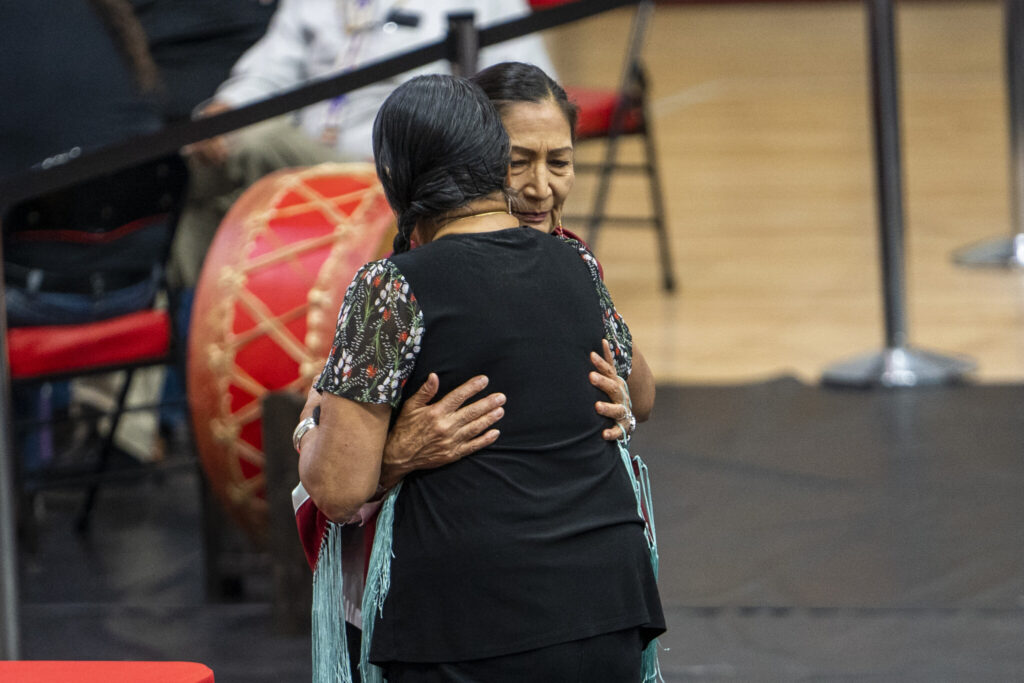
Interior
Secretary Deb Haaland embraced boarding school survivor Delores
Twohatched at the first stop on the “Road to Healing” tour in July 2022,
Photo by Nick Oxford.
The federal government has concluded a
comprehensive inquiry into one of the American continent’s darkest and
most tragic episodes: The more than century-long tactics to forcefully
assimilate Native American children separated from their families and
tribes into hundreds of so-called Indian boarding schools.
In a rare and sweeping admission, the federal agency that oversaw
that network is now calling for a formal national apology to the
descendants of those who died or suffered rampant abuse and trauma in
this system.
The 105-page volume announced Tuesday builds on information the Interior Department uncovered in May 2022
as part of its Federal Indian Boarding School Initiative. It
significantly increased the number of student deaths to nearly 1,000,
and tallied and detailed the federal dollars going into federally-run
and church-operated schools and burial sites. The department also
confirmed the massive public investment and priority the young United
States once placed on this human toll: More than $23 billion from
taxpayers in today’s dollars and more than 150 treaties with tribes
baked the schools into the national infrastructure.
“The most important thing is that our work to tell the truth about
the Federal Indian boarding school system be paired with action,”
Assistant Secretary of the Interior Bryan Newland, a citizen of the Bay
Mills Indian Community, noted in the report. “As we have learned over
the past three years, these institutions are not just part of our past.
Their legacy reaches us today, and is reflected in the wounds people
continue to experience in communities across the United States.”
These volumes — and the Interior Department’s oral history project —
represent the first-ever comprehensive attempt by the federal government
to recognize and document the experiences of survivors as well as
tracking the impact of generations of genocidal policies against
Indigenous children and their families.
In the process of publishing these two volumes in the last two years,
Interior Department staff and contractors painstakingly sifted through
approximately 103 million pages of U.S. government records and met with
Indigenous leaders and government officials to compile the findings.
Interior Secretary Deb Haaland, through her “Road to Healing” tour that
began in Anadarko, Oklahoma,
participated in listening sessions with hundreds of boarding school
survivors at 12 locations across the country. The experiences of some of
those individuals are included in this second volume.
Many of the employees who worked on the project were Indigenous, said
Sec. Haaland, the first Indigenous woman in a U.S. cabinet and a member
of the Laguna Pueblo tribe. It’s a dramatic contrast to the way the
agency operated for nearly two centuries: as an anti-Indigenous driving
force in advancing these policies.
The report notes that “Indian education” was a treaty right, and a
priority in the relations between tribes and the U.S. government — as
evidenced by the 100-plus treaties that “explicitly include Federal
Indian boarding schools or general Indian education provisions.”
“I
think of my mother standing on that sidewalk as we were loaded into the
green bus to be taken to a boarding school. And I can see it – still
have the image of my mom burned in my brain and in my heart where she
was crying. What does a mother think? She was helpless.”
— Road to Healing tour participant from Arizona
“I am immensely proud of the hundreds of Interior employees — many of
them Indigenous — who gave of their time and themselves to ensure that
this investigation was thoroughly completed to provide an accurate and
honest picture,” said Sec. Haaland. “The Road to Healing does not end
with this report — it is just beginning.”
The final report builds on findings in the first report,
released in 2022, adding to the nation’s understanding of the federal
policies of the Indian boarding school system. The initial findings
accounted for 500 child deaths across 19 schools, while the updated list
of boarding schools now includes 417 institutions across 37
then-territories or states.
The children’s death tally has doubled.
Nearly 1,000 children — 973 Alaska Native, Native Hawaiian and Native
American children buried in 74 marked or unmarked gravesites across 65
different school sites — died while attending schools operated by the
federal government.
And the total does not include children who died whose records
weren’t available or who attended “Indian day schools, sanitariums,
asylums, orphanages, stand-alone dormitories, and Indian boarding
schools operated by religious institutions and organizations that
received no U.S. Government support.”
The atrocities occurring within school walls range from abusive to
culturally genocidal, with matrons, priests and other school employees
using various methods to erase the cultures and identities of tribal
children.
In Alaska, children were given a number that was haphazardly written
on everything they owned — that is, all the non-cultural items they were
allowed to keep.
The Anaktuvuk Pass Eskimo from Central Alaska “came in after we did,
they had all their parka, their caribou pads,” an Alaska Native
participant, who spoke to Haaland during her stop in that state, said in
the report. “They came in, they stripped them down, put all their
clothes, the food they bring in, dry caribou, salmon, and stuff like
that, they put it all on the side. I think I probably cried when they
took all their clothes down there and burned them in the furnace, all
the beautiful, beautiful parkas and everything.”
Another Alaska participant described being forced to eat Western
processed foods. “We all got violently ill because our bodies couldn’t
process changing our diet over from our traditional Native foods. And we
had vomiting, we had diarrhea, we had both and we were often punished
for soiling our pants or clothing or bedding and we got beaten for
that.”
Assistant
Secretary for Indian Affairs Bryan Newland listening with Secretary of
The Interior Deb Haaland in 2022 at Riverside Indian School in Oklahoma.
Photo by Nick Oxford.
Other participants from South Dakota and Oklahoma described watching
classmates being sodomized by priests, and throwing “green stuff” all
over them that “stung like hell.” Others from those states called the
torture not just physical, but psychological as well.
“It was warfare against Indian children,” explained a South Dakota
participant. “So the littler children, when they got bigger, they could
beat up little children for crying, and the nuns looked the other way.
That was part of their strategy.”
Other survivors of boarding schools and their descendants outlined
ways the schools negatively impacted their relationships with parents,
children and communities.
“I experience feelings of abandonment because I think of my mother
standing on that sidewalk as we were loaded into the green bus to be
taken to a boarding school,” said a participant from Arizona, according
to the report. “And I can see it — still have the image of my mom burned
in my brain and in my heart where she was crying. What does a mother
think? She was helpless.”
“...we
continue to heal as the full story of that dark chapter is brought to
light. Through truth, reconciliation, and our traditional ways of
knowing, we can take healing even further.”
Cheyenne Brady, Center for Native American Youth
The report outlined eight recommendations to guide the path the
nation should take to heal from this history. They include a formal
acknowledgment and apology from the U.S. government for its role in
implementing these policies and investing in responses to the
present-day impacts of the system.
“I want you to imagine a Native community with no kids left, just the
parents and grandparents,” Brian Schatz, Chair of the Senate Committee
on Indian Affairs, said about boarding schools’ impact at a legislative
hearing last week. “Imagine not just the trauma for that group of
children who were abducted, but what kind of community is left there? As
a parent I would be absolutely catatonic for the rest of my life.”
The report’s recommendations include establishing a national memorial
to commemorate survivors and descendants; repatriating the remains of
children and objects — including the boarding school sites themselves —
to tribes; investing in further research on the economic and health
impacts perpetuated by the schools; documenting survivors’ experiences;
and finally, building relations with countries like Australia, New
Zealand and Canada to see what can be learned from similar but unique
assimilation policies there.
The goal, the report states, will be to exchange “best practices for
healing and redress” between federal and Indigenous governments in the
aftermath of “Indigenous child removal through boarding schools and
predatory foster care and adoption practices.”
“The federal boarding school program created immeasurable trauma for
our people that is an active piece of our everyday lives,” said Cheyenne
Brady of the Sac and Fox Nation, who is the Associate Director of Youth
Programs at the Center for Native American Youth. “The resilience of
our ancestors has been passed down alongside that trauma, and we
continue to heal as the full story of that dark chapter is brought to
light. Through truth, reconciliation, and our traditional ways of
knowing, we can take healing even further.”
Earlier today, Governor Kathy Hochul
convened leaders from the Indigenous Nations across New York State for a
historic summit at the New York State Capitol in Albany.
PHOTOS of the event are available on the Governor's Flickr page.
Today's summit was attended by the
following Indigenous Nations:
Cayuga Nation
Oneida Nation
Onondaga Nation
Tonawanda Band of Seneca
Tuscarora Nation
Saint Regis Mohawk Tribe
Shinnecock Nation
Unkechaug Nation
This summit follows Governor
Hochul's commitment to supporting and strengthening relationships with
Indigenous peoples across the state. As part of this commitment, Governor
Hochul has:
Appointed the First Deputy Secretary for Indigenous
Nations. Elizabeth Rule was appointed
Deputy Secretary for Indigenous Nations. Elizabeth is an enrolled citizen
of the Chickasaw Nation and an Assistant Professor specializing in Native
American Studies at American University. Prior to joining American
University, Elizabeth directed George Washington University's Center for
Indigenous Politics and Policy. She received her bachelor's degree from
Yale University, and her master's degree and Ph.D. from Brown University.
Visited the Onondaga Nation Longhouse. Governor Kathy Hochul made a historic visit to the Onondaga Longhouse – the first visit by a
sitting Governor in more than half a century – for a conversation with
Onondaga Nation leaders, including Tadodaho Sid Hill, representatives of
the Council of Chiefs, and Clan Mothers.
Returned more than 1,000 Acres of Land to the Onondaga
Nation. Governor Kathy Hochul, joined
by United States Department of Interior Secretary Deb Haaland and Onondaga
Nation Tadodaho Sidney Hill, announced a historic agreement as part of the
Onondaga Lake Natural Resource Damage Assessment and Restoration Program
that will return more than 1,000 acres of scenic land
to the Nation. As Natural Resource Trustees
for the settlement with Honeywell International, Inc., the New York State
Department of Environmental Conservation and the Department of the
Interior's Fish and Wildlife Service signed a resolution that directs
Honeywell to transfer the title to more than 1,000 acres of open space in
Central New York's Tully Valley to the Onondaga Nation - one of the
largest returns of land by any state to an Indigenous nation.
Proposed to Strengthen Stability of Indigenous
Families.The 1978 Indian Child Welfare Act (ICWA) is a
federal law created to protect the best interests of Native American
children involved in child custody proceedings. The law emerged as
a response to the disproportionate rates at which both residential
boarding schools and state actors removed Native American children from
their homes, communities, and Indigenous Nations. This year, New York’s
Deputy Secretary for Indigenous Nations and the Office of Children and
Family Services, will advance, in consultation with Nation leadership and
stakeholders, strategies to strengthen the objectives of the Indian Child
Welfare Act, underscoring New York’s commitment to redressing injustices
inflicted upon Indigenous communities.
Ensured Dental Care Access for Indigenous Nations. As part of the FY 2025 Budget, New York State will
include $2.5 million in funding for Indigenous
Nations dental health care,
with the aim of addressing gaps in access. This funding will help ensure
Indigenous Nations dental offices and providers can offer treatment without
referring patients off-site and away from Nation territories. This builds
on Governor Hochul’s commitments to lifting up Indigenous Nations
throughout New York, including directing New York’s Deputy Secretary for
Indigenous Nations and the Office of Children and Family Services to
advance strategies to strengthen the objectives of the Indian Child
Welfare Act and commencing a comprehensive review of artistic
representation of Indigenous peoples at the New York State Capitol.
Responded to Offensive Representations. To ensure that all New Yorkers are welcomed in the
State Capitol, Governor Hochul will commence a comprehensive review of
artistic representation of Indigenous peoples in the Capitol, with invited
participation from representatives from each of the nine Indigenous
Nations. All New Yorkers should feel welcome and respected when visiting
the Capitol, but unfortunately, offensive imagery and distasteful
representations of populations in the art which adorns the Capitol can
alienate visitors. Assessments of offensive artistic representations of
Indigenous peoples are informed by precedent more than eighty years old,
and Indigenous peoples, in particular, are often depicted in artworks in a
manner that reflects harmful racial stereotypes and glorifies violence
against Indigenous peoples. Such depictions do not reflect the values of
New York State.
I’ve been reading blogs by Christian folks who saved an orphan and plan to do it again.Apparently
using the words “Christian” and “Orphan” somehow makes this adoption
business holy. “Doing God’s work,” some potential adoptive parents
(PAPS) are blogging... how they are so compassionate and defend it’s the
Christian thing that they adopted babies - because these babies were orphans and in need and “born in another womb” decreed by God to be adopted by them.
Really. Really?
Orphans in this day and age?
A
few PAPS were upset that no one understands how difficult it is for
them as married couples to cope with infertility... how no one feels sorry
for them. So that makes it perfectly alright for them to go out and buy adopt that baby. (Yup, it’s always a baby they want. They get angry if you argue with them.)
So adopting makes them feel
good. It doesn’t really matter a woman will have to sacrifice her baby
for them. (Some birthmothers may also feel euphoric they gave a couple a
precious baby. Maybe a few did it for cash.) It’s
a mind bender that it doesn’t enter their minds that the baby hurts and
is devastated losing their mother (or father) and this wound lasts a
lifetime…
There
are thousands upon thousands of PAPS who want only a baby and defend
their reasons why. Adoption agencies are more than happy to make their
dreams come true.
I
have a new theory. It’s a crazy world out there. People want to feel
better so they’ll rescue someone, in this case a baby, and this “giving”
back will create euphoria in their brain chemistry. I think the
adoption industry has manipulated and used “adopting babies” as the
wonder drug that clouds the mind from adoption reality. (They also steer
clear of the adoptee perspective or Nancy Verrier’s Primal Wound in their adoption propaganda.)
So these righteous saviors of babies are on a mission to make themselves feel better. Adopting makes them high.
…the surprising conclusion is that giving affects
our brain chemistry. For example, people who give often report feelings
of euphoria, which psychologists have referred to as the "Helper's
High." They believe that charitable activity induces endorphins that
produce a very mild version of the sensations people get from drugs like
morphine and heroin.
Norm
offers a thought experiment: if a pill reproduced exactly the same
brain effects, wouldn't people still give? I agree this suggests there's
more to it.
Adding to that, and reflecting on my own thought
processes related to giving, I think this is a good case illustrating
the interactions between levels of causes in human behavior. Proximately, I often go through with a charitable act despite fretting
that it will be boring, too much trouble, too costly, or otherwise
unpleasant. But upon doing it, or soon afterwards, I feel a sort of
euphoria I would associate with the endorphin effect described in the NY
Sun article.
I will suppose that the euphoria and the
associated brain chemistry register somehow in my mind -- in behaviorist
terms, an association is reinforced between the feeling and the act of
giving -- and this association comes into play the next time a choice
for giving arises. But even if so, the association is barely liminal,
and I don't reflect along the lines of 'I'll
get a nice endorphin rush if I go through with this.' Rather, I think
along the lines of 'good people do things like this, and I want to be a
good person despite the short-term fuss I will have to endure' --
and I think the euphoric brain chemistry is a bonus (and should be seen
as a second-order cause) that keeps acts of giving on the list of
thinkable, possible alternatives. The next time I am faced with a choice
to give or not to, I will have inarticulate impulses pushing for it,
and these impulses will be rooted in brain chemistry.
T he Métis National Council and the Government of Canada will be working collaboratively, Nation-to-Nation, to develop a process to engag...
To Veronica Brown
Veronica, we adult adoptees are thinking of you today and every day. We will be here when you need us. Your journey in the adopted life has begun, nothing can revoke that now, the damage cannot be undone. Be courageous, you have what no adoptee before you has had; a strong group of adult adoptees who know your story, who are behind you and will always be so.
OUR HISTORY
BOOK 5: Lost Children of the Indian Adoption Projects