BACK UP BLOG (no longer updating)

This blog was a backup for American Indian Adoptees blog
USE THE SEARCH BAR or SEARCH TOPICS at bottom of this blog

If you need support

Support Info: If you are a Survivor and need emotional support, a national crisis line is available 24 hours a day, seven days a week: Residential School Survivor Support Line: 1-866-925-4419. Additional Health Support Information: Emotional, cultural, and professional support services are also available to Survivors and their families through the Indian Residential Schools Resolution Health Support Program. Services can be accessed on an individual, family, or group basis.” These & regional support phone numbers are found at https://nctr.ca/contact/survivors/ . MY EMAIL: tracelara@pm.me

Search This Blog

Thursday, July 4, 2024

A new history of the Americas: Indigenous peoples nearly defeated European colonizers

NOTE: For those of you who read ALMOST DEAD INDIANS, you will know I have a chapter on FORT DETROIT which explains taking captives/captivity/adoption, collecting and taking scalps and the conditions for the tribes dealing with the French, British and Spanish invaders and the Long Knives (Virginians, pre-America).

 There is also history about New England, like King Phillips War and the Phips Proclamation.  You really need to understand this real history, our tribal histories.... and I made it easy to read...Trace

THIS IS SO HELPFUL!👇

Finnish historian Pekka Hämäläinen – who hates the film ‘Dances with Wolves’ – wrote a book called ‘Indigenous Continent,’ in which he explains that the tribes of North America had notable military capacity and that their defeat was by no means inevitable...


The defeat of Custer and his Seventh Cavalry at the hands of the Sioux and Cheyennes at Little Bighorn in 1876 was not at all a matter of bad luck on the part of the general and his troops.  Rather, it was the logical and expected result of the Indigenous people being better strategists, more familiar with the terrain and tactically superior to the American soldiers.

By no means was this the only time in which the so-called “redskins” — a derogatory term — proved to be very capable of defeating the whites and imposing their own military dynamics from the beginning of the 16th century until the end of the 19th century.  In a fascinating history of the American Indian Wars — Indigenous Continent: The Epic Contest for North America (2022) — Finnish historian Pekka Hämäläinen calls into question the inevitability of colonial expansionism.  The researcher — who holds a doctorate in History from the University of Helsinki and is considered to be one of the world’s specialists in the conquest of North America — reveals how, on several occasions, the Indigenous people came close to inflicting a definitive defeat on the European colonial powers, as well as the United States.  

In fact, they nearly expelled these settlers from North America entirely.

In the revolutionary account by the 57-year-old Hämäläinen — who is currently the Rhodes Professor of American History at the University of Oxford — the Indigenous tribes of North America cease to be the usual passive victims, subject to an inexorable and irreversible destiny.  Instead, in the book, they become powerful agents who dominated the continent for centuries after the arrival of the colonizers and represented a very serious threat to their plans of conquest.
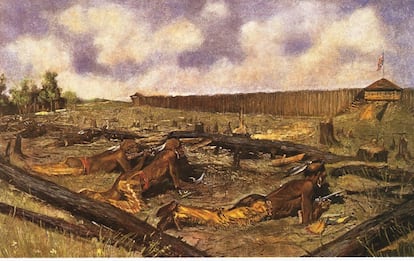
The siege of Fort Detroit during the Pontiac Revolt of 1763, depicted in a painting by Frederic Remington.

The continent, Hämäläinen points out, was in the hands of the Indigenous peoples for much longer than we usually think.  They had political entities with extraordinary warlike capacity, such as the Iroquois League — whose power, he reminds us, lasted from the 16th to the 19th century, “which makes this nation the oldest and gives it a more central historical role than the United States” — or the Comanche and Sioux equestrian empires, which he compares to other powerful tribes of horseback nomads, such as the Mongols.

On a date like 1776 — when the independence of the United States was proclaimed — the scholar tells EL PAÍS that “the Europeans claimed most of the continent… but the natives, as a whole, effectively controlled it.”  The expert affirms that instead of talking about a “colonial America,” we should talk about an “Indigenous America” that became colonial “only slowly and unevenly.”  In fact, it remained “overwhelmingly Indigenous until well into the 19th century.” Countless native nations, he claims, “fought fiercely to keep their territories intact and their cultures unscathed” and “came to thwart the imperialist pretensions of France, Spain, Great Britain, the Netherlands and, later, the United States.”

The scholar’s narrative follows the Indian Wars in a meticulously-documented and very engaging way, contrasting sharply with the somber and traditional structure of classics such as Bury My Heart at Wounded Knee (1970), by Dee Brown.  This book established an idea in the popular consciousness — reinforced by the film Dances with Wolves (1990) — that the fight against the whites was an unavoidable march towards the disaster of Indigenous societies, which were doomed since the first settlers set foot in North America.  However, Hämäläinen shows how, in fact, the colonizers often moved on the margins of powerful Indian tribes and confederations, retreating on many occasions, with their colonial project bordering on disaster.  And the Indigenous people didn’t sit around nursing feelings of melancholy or disaster: rather, they were muscular, full of vitality and equipped with the resources and weapons needed to fight.

Throughout Indigenous Continent, Hämäläinen portrays the native people as “strong, creative and resilient” historical actors.  In the work, he highlights that they were by no means one-dimensional tribes, as they have been shown in a traditional narrative “entrenched in our [Western] culture and our mentality.”
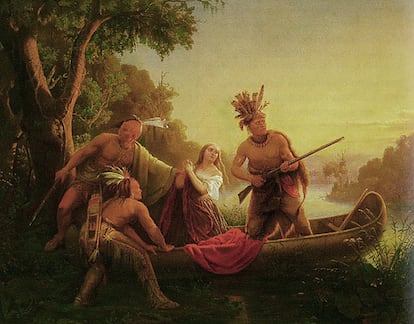
The kidnapping of Jemima Boone by the Shawnee people, depicted in a painting by Karl Ferdinand Wimar.

Along with the word “empires” — which draws so much attention in relation to Indigenous peoples of North America, who are popularly associated more with veritable gangs — the researcher chooses to refer to the native warriors as “soldiers” (which equates them militarily with white combatants) and uses Indigenous terms for the leaders and authorities of tribal nations, instead of the standard use of “chiefs.”  It’s also notable that, in several cases, he uses the names that these nations prefer to use, instead of the more common ones given to them by the whites or their enemies.  For instance, he uses Wyandot people instead of Hurons and Meswaki Nation instead of the Fox tribe.

Finnish historian Pekka Hämäläinen, who specializes in history of the conquest of North America.

In his account of the “overwhelming and persistent Indigenous power in North America” — after some chapters in which he explains the past of the societies that faced European colonization, highlighting their “horizontal and consensual” concept of leadership — Hämäläinen reviews the early conflicts with the Spanish, French and English, while touching on how the pilgrims from the Mayflower were allowed in because they were useful in the Wampanoags’ strategy against their Indigenous enemies.   The historical Uncas and their manipulation of the Connecticut settlers to achieve primacy over the Pequots also appears in the book.  As does the central role of women in the politics of the League of Five Nations — which so surprised the French (other Indigenous women, such as the Cherokees, could even go into battle) — and the “overwhelming military superiority of the Iroquois.”  The Mohawk, Hämäläinen emphasizes, “had gone beyond containing the Europeans… they demanded obedience from them.”
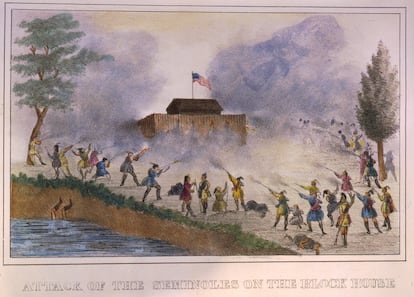
The Seminole people attack a fort, in a vintage illustration.

New England was nearly destroyed in 1675.  And all colonial projects on the continent seemed to falter or expire entirely between that date and 1690, during what Hämäläinen refers to as an Indigenous “backlash.”  King Philip’s War (1675-1676) forced New York to be defended.  The scholar emphasizes that the cruelty that the whites deployed was a sign of weakness: it’s no coincidence that the terror they felt was expressed in a psychosis of demons and witches.  In 1692, Salem was only 50 miles away from the Indigenous border.

In the southwest, the rebellion of the Pueblo Indians broke out in 1680.  Colonialism receded throughout North America at the end of the 17th century.  In 1763 came the Pontiac War. And, in the 18th and 19th centuries, the threat came especially from the Comanche and Lakota equestrian empires, whose Seven Council Fires were the most powerful Indigenous force on the continent, after the weakening of the Iroquois and Cherokee peoples in the Seven Years’ War (1756-1763).

Hämäläinen also points out that the Sioux and their allies defeated the United States in two wars: first in Red Cloud (1866) and then in the campaign that ended at Little Bighorn.  He writes how the Lakota Empire — also known as the Teton Sioux — served as an involuntary protective shield for a multitude of smaller Indigenous nations, keeping the US militias and soldiers at bay for decades.

The chronicle of the powerful Indigenous resistance is lengthy.  It includes Osceola — the leader of the Seminoles of Florida — or Black Hawk, the Sauk leader west of Lake Michigan.  The Kiowa and Apache people are also mentioned.  Indeed, there were fires of resistance everywhere.  The United States was only able to finally extinguish them after “four centuries of Indigenous power” by applying a genocidal policy.  

The Wounded Knee Massacre of 1890, Hämäläinen states, was a sign of settler weakness and fear.  The US was exhausted after more than 1,600 official armed clashes against the natives. “There’s a direct link between Indigenous success and the sense of vulnerability — and the magnitude of revenge — of the Americans.”
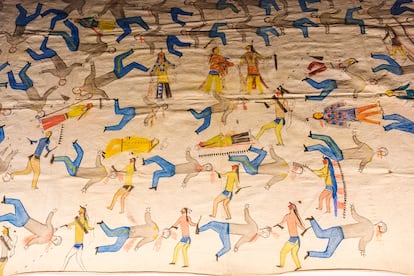
A Sioux depiction of the Battle of Little Bighorn.HECTOR JUAN

Could the history of North America be different from what has been taught?  

“As historians, we can only point out the possible forks in the road… but in 1776, it was certainly possible to imagine a future on the continent in which [Indigenous] peoples controlled it.”

For Hämäläinen, the military technology of the European settlers wasn’t as superior as is believed.  “It was important, without a doubt.  But it must also be taken into account that there wasn’t a single moment in North American history in which that technology wasn’t also available to the [Indigenous people], or even transferred by them to others.  Success in war often lies less in technology per se and more in social, cultural and strategic issues of access to technology and what’s done with it. We’re making a mistake if we conceive the continent’s military history as having been a battle between Europeans with modern military technology against Indigenous peoples without it.  Much more important is the scale at which communities can access and effectively deploy such technology.”
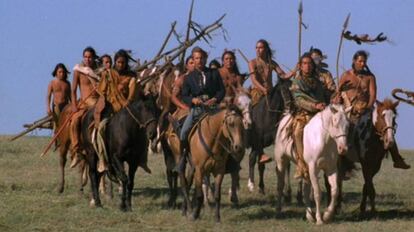
A scene from 'Dancing with Wolves' (1990).

Among the most exciting pages of Indigenous Continent is the chapter on the acquisition and mastery of horses by the Comanche and Sioux nations.  “It was a thrilling turning point and I’ve always enjoyed writing about it.  Fortunately for me, European authors of the era were obsessed with native equestrian peoples and wrote about the subject in great detail.  My ability to describe the phenomenon is largely based on theirs.”

The use of the term “empires” for Indigenous tribes may appear surprising at first glance.  “There have been different kinds of empires throughout history.  The last thing I wanted is to suggest an equivalence between empires such as the Comanche or the Sioux with the current United States.  If there’s a similarity, it’s with other empires of horsemen.   That’s the center of the project we launched at Oxford a few years ago.  One of the books that came out of it was [French historian] Marie Favereau’s seminal The Horde: How the Mongols Changed the World (2021).”

When asked what he thinks about Bury My Heart at Wounded Knee, the Finnish historian notes that it was an “extraordinarily popular book that arrived in the early 1970s at the time of the anti-Vietnam War protests and the civil rights movement, when people were disillusioned with stories of frontier progress and were hungry for new narratives that shed light on the violence and inhumanity of Western expansion.  [But we’re now] in another moment,” he clarifies, “in which historians are [centering Indigenous narratives] in the context of the history of the continent.”

As for movies about Indigenous peoples in North America, Hämäläinen is firm: “I can’t remember any that don’t present problems, but I reserve my particular distaste for Dances with Wolves, which is full of historical errors and has a protagonist — a very intelligent white man — who guides the Native American characters.  Black Robe (released in 1991, based on Brian Moore’s novel about a Jesuit trying to convert the Hurons in Canada) is less known, but better and more historically accurate.”

Translated by Avik Jain Chatlani.

 
READ: Native Americans  https://english.elpais.com/culture/2024-06-30/a-new-history-of-the-americas-indigenous-peoples-nearly-defeated-european-colonizers.html

Nadleh Whut'en unveils Hope and Strength billboard on HIGHWAY OF TEARS | MMIWG inquiry deeming deaths and disappearances a genocide

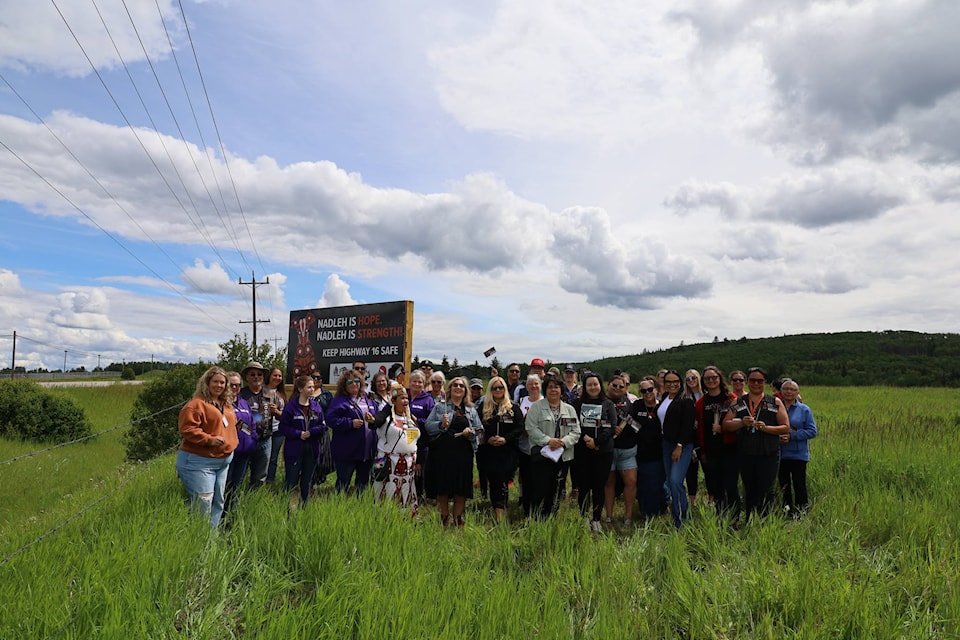
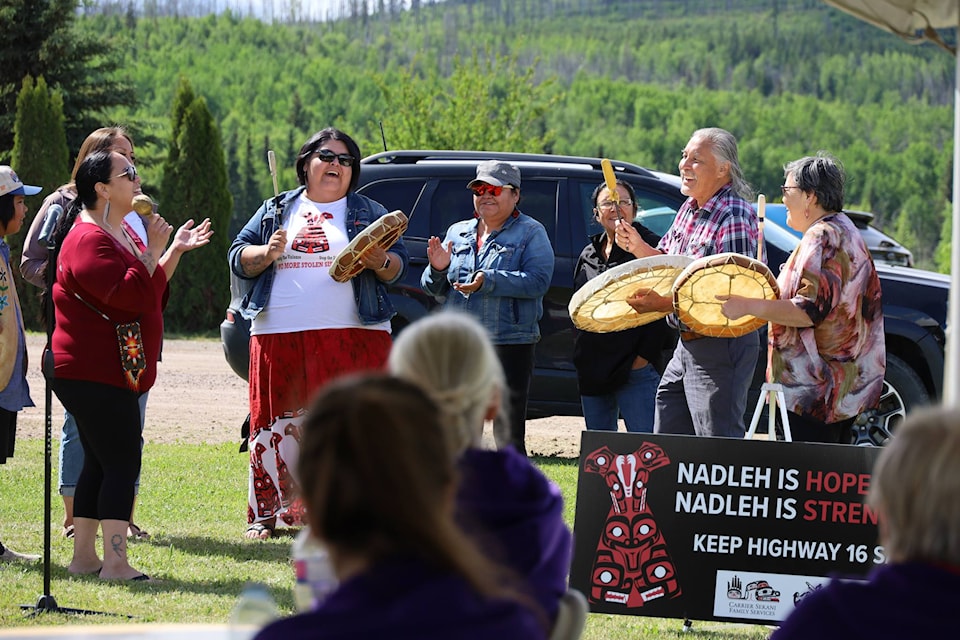
A new billboard, advocating awareness for the the Missing and Murdered Indigenous people was unveiled along Highway 16, near Fraser Lake (June 25).

A new billboard, advocating awareness for the the Missing and Murdered Indigenous people  was unveiled along Highway 16, near Fraser Lake (on June 25). 

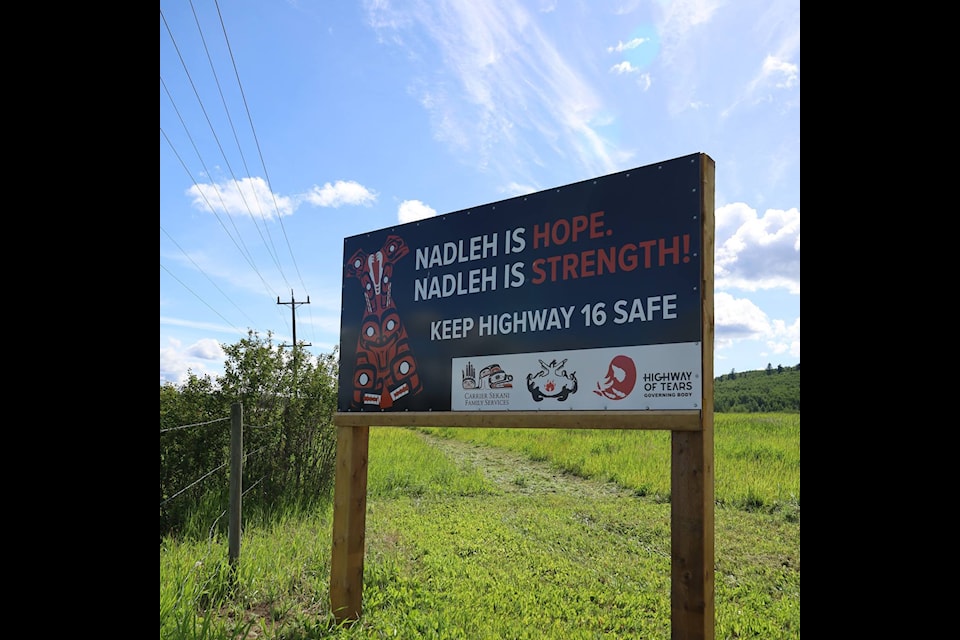
The billboard, unveiled amidst drumming and speeches, features the message of 'Hope and Strength' and is located 5 kilometres east of Fraser Lake at the Tse Yaz Bunk’et Gas Bar & CafĂŠ.

It was erected by Nadleh Whut’en, in partnership with Carrier Sekani Family Services (CSFS). 

Talking about the event, Serina Greene, Family Advocate at Nadleh Whut’en said the moment exemplifies the strength of the Nadleh community.

 “The billboards are important to draw awareness for the Missing and Murdered Indigenous people along Highway 16 and to bring hope and strength to our people,” Greene said. 
“It took a lot of people and partnerships to make this possible, and it warms my heart to see so many come together for justice," she said, adding, "I get goosebumps just thinking about it.” 

Last year, CSFS, in partnership with the Highway of Tears Governing Body, raised their own Hope and Strength billboards along Highway 16.
“Highway 16 has been a place of hurt for many Indigenous families, and we want to honour those families to the best of our abilities” says Julie Daum, CSFS Executive Director of Justice.
“Amidst the heartache of the Highway of Tears, these Hope and Strength billboards are a symbol of our resiliency," she said.

"The strength shown by families who have lost loved ones along Highway 16 is inspirational, and gives us strength in our campaign for justice for Missing and Murdered Indigenous Women, Girls, Men, Boys, and 2SLGBTQQIA individuals who are missing or have been murdered along this highway. All of this work is for them.”

SOURCE: https://www.ominecaexpress.com/local-news/nadleh-whuten-unveils-hope-and-strength-billboard-on-hwy-16-7416660 


👇BACKGROUND

'Bittersweet' reaction to MMIWG inquiry deeming deaths and disappearances a genocide

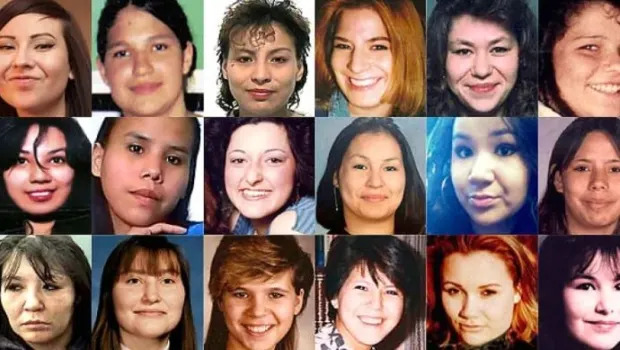
For many British Columbians, a new report deeming the deaths and disappearances of thousands of Indigenous women and girls a "Canadian genocide" could not come soon enough.

The national inquiry into the ongoing tragedy, two-and-a-half years and $92 million in the making, culminated in a final report that was set to be released on Monday. CBC obtained a copy earlier.

"Our families have been fighting for this for so long and it's coming to an end," said Lorelei Williams, who testified at the national inquiry.

"I'm definitely feeling emotional."

CBC News
CBC News

Her cousin Tanya Holyk's DNA was found on the farm of convicted serial killer Robert Pickton. Her aunt, Belinda Williams, went missing from Vancouver's Downtown Eastside more than 40 years ago.

Since 2017, the inquiry has held 24 hearings and events to gather statements from people like Williams across the country. More than 2,380 Canadians attended those events.

"It's been a very, very hard process," Williams told CBC's B.C. Today

"Now, it's coming to an end but our women are still going missing and being murdered at a high rate."

Some estimates have suggested roughly 4,000 Indigenous women have been murdered or have disappeared over the past few decades.

The inquiry report said the true number may be impossible to establish.

Not just numbers

For Mary Teegee, executive director of Child and Family Services for Carrier Sekani, the data doesn't tell the full story.

"The report talks about the atrocities and it talks about genocide, which is very real, but we can't forget that all the statistics is somebody's daughter, somebody's child, somebody's cousin, somebody's friend," she said.

Her cousin Ramona is among those murdered along Highway 16, known as the Highway of Tears.

"It's a vindication and I welcome this report. I'm glad that it has been completed, but definitely there's a lot of bittersweet feelings," Teegee said.

"We could have been doing this decades ago."

Tristan Le Rudulier/CBC

Calls for action

The report runs to over 1,200 pages and includes more than 230 recommendations.

Judy Wilson, Chief of the Neskonlith and Union of BC Indian Chief's Executive Member, said she hopes the report will lead to immediate action.

"It's really timely with this report because we need to get on with the actions," said Wilson, whose sister was murdered.

She wants to see concrete change before the fall election. "We're dealing with it in every day of our lives," she said.

"It's hard to find anyone that is not affected in some way or another — our family is most definitely affected with the murder of my young sister at the age of 21." 

SOURCE: https://ca.style.yahoo.com/news/apos-bittersweet-apos-reaction-mmiwg-021712810.html


MINNESOTA BIRTH RECORDS opened JULY 1

 I filed this week and paid $13 - now I wait...   Trace

More information about the new law, as well as required forms and fees, are available on the Minnesota Department of Health website at www.health.state.mn.us/people/vitalrecords/adoption.html.

You can file online as well... I wrote a check and mailed it. 

Earlier post: https://blog.americanindianadoptees.com/2024/05/reminder-minnesota-adoption-records.html 


House members introduce ICWA enhancement measure

US REP TOM COLE

BY D. SEAN ROWLEY Senior Reporter  Save

WASHINGTON, D.C. – Recently, a bipartisan group of federal lawmakers announced their introduction of legislation intended to add some reinforcement to the Indian Child Welfare Act.

The “Strengthening Tribal Families Act of 2024” would require the Department of Health and Human Services to create a technical assistance plan using six metrics of data to assess the strengths and weaknesses of states’ implementation plans of the Indian Child Welfare Act.

The measure was introduced to the U.S. House of Representatives by Rep. Don Bacon, R-Nebraska, along with Reps. Judy Chu, D-California; Tom Cole, R-Oklahoma; Sharice Davids, D-Kansas; and Dan Kildee, D-Missouri. 

Sen. Tammy Baldwin, D-Wisconsin, will introduce the legislation in the U.S. Senate.

“The Indian Child Welfare Act protects vulnerable Native American children from being taken from their tribal communities and culture during custody or guardianship proceedings,” Cole said. “However, due to such a high rate of Indian children entering into our foster care system, ICWA is not enough. I am proud to have partnered with Congressman Bacon, Congresswoman Chu, Congresswoman Davids, Congressman Schweikert and Congressman Kildee to lead the Strengthening Tribal Families Act of 2024, which will strengthen ICWA protections and ensure Native American children remain in their own communities.”

Congress passed ICWA in 1978 to address the high rate of Native children being removed from their homes and separated from families. The ICWA established federal standards for the removal of Native American children from their homes while prioritizing placement in homes with their Indian culture. ICWA also sets federal requirements for state child abuse and adoption cases for Native children.

In June 2023, the ICWA received a boost when it was ruled constitutional by the U.S. Supreme Court with a 7-2 decision in Halaand v. Brackeen.

“Brackeen was a landmark decision and a major victory for Native tribes, children and the future of our culture and heritage,” Cherokee Nation Principal Chief Chuck Hoskin Jr. said. “But more needs to be done to strengthen the Indian Child Welfare Act and protect the law from future attacks. I applaud Reps. Bacon, Chu, Cole, Davids and Kildee for introducing this important legislation, and Sen. Baldwin for carrying this effort in the Senate. Cherokee Nation supports this bill and will advocate for its passage.”

The implementation of ICWA continues to vary between states and Native tribal interests. Estimates have suggested Native American children are 2.5 times more likely to enter the foster care system than non-Native children. This bill is intended to allow HHS to be able to provide states with evidence-based assistance to improve their plans for implementation of ICWA. 

“The Strengthening Tribal Families Act of 2024 will help states improve their compliance with ICWA, which will help more Indian children remain within their tribal culture,” Bacon said. “With Indian children disproportionately represented in the foster care system, this bill will help us achieve better outcomes for Indian children. Research shows us kinship placement helps children develop a stronger attachment to their extended family and culture.”

Chu cited the “unfinished work” of helping Native children who enter the foster care be placed with homes that have a familiar culture.

“I’m leading the Strengthening Tribal Families Act of 2024 … so we can assist state child welfare agencies in implementing those critical ICWA federal protections for tribal children,” Chu said. “By strengthening the relationships between these agencies and the courts and comprehensively analyzing data supplied to HHS by states at regular intervals, the federal government can secure better outcomes for tribal children everywhere and support Indian Country.”

SOURCE:  https://www.cherokeephoenix.org/news/house-members-introduce-icwa-enhancement-measure/article_148198f4-2f0d-11ef-9a1e-f3dd35426164.html

How to be an Ally? Learn our history!

Photo by Alexey Demidov

Most of the time adoption is viewed as a rescue in a sense. A child in need of a home is given one with a family who will raise that child as their own. That simple story often doesn’t resemble the reality of what adoption can mean for a child or that child’s first mother. That is even more true if a child was a part of a Native American tribe at any time over the history of our country.

The Count 2024

The number of children adopted out of Native American tribes is so unclear that journalist and Native American Adoptee Trace Lara Hentz has embarked on an ambitious plan to get a count of every Native American adoptee she can this year. She tries to explain just how far-flung Native Adoptees can be.

“The United States adoptees, some of them were sent to Canada and some of the Canadian adoptees were sent to the United States, but like the story I published on the American Indian adoptees.com. There was a young woman from Canada who was taken to Scotland. I mean, literally, these adoptees are everywhere. I had a friend who found an adoptee in Iceland, So that’s why this count means so much to me. No one has ever published an actual count, one that we can look at and trust. It’s long overdue.” (1)

The Boarding School Nightmare

How did we get here? The tension between America’s original inhabitants and European settlers has been present since before America as a nation existed. Europeans tried to control or destroy the Native population in a variety of ways over the years. It was in the 1800s that they began to take the tribes’ children As Elizabeth Hidalgo Reece so aptly said in her article in Harper’s Bazaar, “The United States figured out a long time ago that it is impossible for a tribal nation to survive without its next generation.” (2) Native children were placed into boarding schools. The language and culture of their tribes of origin were forbidden. Children were dressed in the costumes of traditional European children and taught a whitewashed curriculum. More than 75% of the Native children who were in school at the turn of the century were in these boarding schools. (3) Life in a Native American boarding school wasn’t just harsh in the sense that the children there were deprived of their Native community. These schools were prone to disease outbreaks. Abuse of all kinds was known to plague these schools. The combination of lack of health care and abuse led to the deaths of hundreds of Native children throughout the existence of these schools. The number of dead in America is still not completely known. (4)

The Indian Adoption Project Deception

Even when the boarding school movement began to wind down in the late 1950s to 1960s that didn’t mean that efforts to separate native children from their families using adoption was over. In this period the Indian Adoption Project began. (5)This was another government policy. Rather than shuffling Native children into boarding schools, this policy sought to get them placed into white families. It is said that social workers sometimes came to native homes and just took children without talking to the adults involved. (5)The criteria for taking children was often questionable, but Native people didn’t have the standing to speak up for themselves or their families. As many as ⅓ of Native children during this time were taken from their homes and placed with non-native families. (6) Before better protections were in place it is said that 75-80% of families living on a reservation had lost at least one child to adoption outside of their tribe. 

A Shred of Hope

In 1978, less than 50 years ago, Congress passed the Indian Child Welfare Act. (7). Finally, potentially for the first time in our Country’s history, the voice of Native people pleading for their right to exist was starting to be heard. Common sense minimum standards were set that needed to be met before Native children could be taken from their homes. If children did need to leave their first families this law required that homes within the tribe be sought first, then if one couldn’t be found it mandated that a home be sought in another tribe before any non-native family is found for the children. (8)

Hope Under Attack

Native tribes can’t rest, though. Even as recently as recently as 2023 the Supreme Court weighed in on a case that may have meant that the ICWA was pronounced unconstitutional. In this case, a white family adopted a Navaho boy. The Navaho tribe stepped up, requesting that the boy be placed with a Navaho family. One of the arguments made in the case was that the white family was being discriminated against based on race. The tribe argued that tribal memberships were a citizenship designation and not a race. In the end, the ICWA was preserved. (9)

Children from Native tribes do sometimes legitimately need to be placed outside of their homes. When they do, compliance with the ICWA isn’t always followed as well as it should be. Part of the reason might be that those involved in the placement might not understand fully what is at stake (10) People, social workers especially, need to comprehend the importance of preserving Native tribes by making sure the children of tribes are immersed as fully as possible in their birth culture.

Trust the Tribes to Look out for Their Children

As much as non-Native families want to help the children of Native tribes, their place may not be to care for Native children themselves. Non-Native placements are looked at as a last resort by the ICWA after extended family, or Native American foster homes, whether those are within the child’s tribe or from another tribe. (11)

If we look back over the history of the Native people in America and the many attempts that this country has made to extinguish them and their culture, it starts to make sense that placing a Native child anywhere they cannot easily access their tribe and culture is much more than an inconvenience. Making sure Native children know their heritage can in some ways mean the life or death of their tribe and the tribe’s unique ways. (12)

When Being an Ally Means Staying on the Outside.

Knowledge of the history of this issue is necessary to be a true ally of Native people today. Making sure a child is in a safe home is necessary, but when we understand how the future of Native tribes rely on the ability to pass their culture and language down to the children of that tribe, that should change how non-Natives support them. We should be striving to support keeping children within their culture rather than separating them. 

Sources

  1. Spiering, Charlyn. “Trace Lara Hentz Talks About the Importance of “The Count 2024” to Native American Adoptees Everywhere.” Adoption Uncovered, 7 Feb. 2024, adoptionuncovered.com/2024/02/07/trace-lara-hentz-talks-about-the-importance-of-the-count-2024-to-native-american-adoptees-everywhere/.
  2. Hidalgo Reese, Elizabeth. “The Long History of Native American Adoptions.” Harper’s Bazaar, Hearst, 30 Nov. 2022, http://www.harpersbazaar.com/culture/features/a42097413/native-americans-scotus-adoption/.
  3. Abrams, Abigail. “The Fight Over Native American Adoptions Is About More Than Just the Children.” Time, 2 July 2019, time.com/longform/native-american-adoptions/ .
  4. Little, Becky. “Government Boarding Schools Once Separated Native American Children From Families.” History.com, 10 July 2023, http://www.history.com/news/government-boarding-schools-separated-native-american-children-families  .
  5. Randhawa, PJ. “‘Indian orphan nobody wanted gets parents’: The dark history of the Indian Adoption Project.” King5.com, 23 June 2023, http://www.king5.com/article/news/community/facing-race/indian-adoption-project-dark-history/281-a21a5d07-b405-4342-a6d7-ba3d0a01921f .
  6. Kaur, Harmeet. “Should Native Americans get preference over White people in adopting Native children? The Supreme Court may decide.” CNN.com, 13 Nov. 2022, http://www.cnn.com/2022/11/13/us/supreme-court-icwa-native-adoptions-cec/index.html .
  7. “ICWA History and Purpose.” dphhs.mt.gov, dphhs.mt.gov/cfsd/icwa/icwahistory#:~:text=The%20Indian%20Child%20Welfare%20Act,placed%20in%20non%2DIndian%20families.
  8. “About ICWA.” NICWA.org, http://www.nicwa.org/about-icwa/ .
  9. “ICWA RULED CONSTITUTIONAL BY U.S. SUPREME COURT.” potawatomi.org, 30 Aug. 2023, http://www.potawatomi.org/blog/2023/08/30/icwa-ruled-constitutional-by-u-s-supreme-court/#:~:text=In%202022%2C%20the%20states%20of,vote%2C%20June%2015%2C%202023. .
  10. Kraker, Dan. “Heart work: Training social workers to keep Native children home.” mprnews.org, 12 June 2023, http://www.mprnews.org/story/2023/06/12/heart-work-training-social-workers-to-keep-native-children-home .
  11. “Topic 16.Placement.” narf.org, narf.org/nill/documents/icwa/faq/placement.html .
  12. “Identity Crisis: Tribal Nonenrollment & Its Consequences for Children.” embracerace.org, http://www.embracerace.org/resources/identity-crisis-tribal-nonenrollment-its-consequences-for-children .

SOURCE: https://adoptionuncovered.com/2024/02/28/native-american-adoptees-can-help-their-tribes-continue-to-exist-but-only-if-they-know-who-they-are/comment-page-1/#respond

Almost Dead Indians (excerpt)


What did tribes make of the INVASION?

“Try as he might to comprehend the life on the far side of the ocean that the white man described, the brown man was unable.  Such a life was beyond belief.  He could not envision one man or a small group of men and women owning all the land, all the animals, all who dwelt upon it, all the produce, man’s labor and his harvest, and men’s lives. But he felt sorry for his friend.” – Basil Johnston, THE MANITOUS (1995), Chapter 11, AUTTISSOOKAUNUK, describing the strangers with light complexions who landed on the brown man’s land and described Europe.  Tribes had no concept for what he described, which was colonization and slavery.

(👆this is my favorite quote)

What has been written about the European’s arrival is for the most part sinister.  In rock art, scrolls and oral history, tribes recorded, understood and remembered the events of early colonial contact by means of symbolic images: Manitous (or spirits), floating islands, flying and underwater ships, giant birds, thunder and lighting, sounds of music in the air, a strange white whale, dreams, premonitions and warnings.  Early tribes viewed Puritan disregard for ritual to mean earthly disaster and punishment.  The tribes believed these aliens were Manitous possessing a powerful spirit.  (This is according to missionaries who knew the tribes here in the northeast.  And of course, this was written from their perspective…) (I use “Indian” in this text, as they did.)

Anishinaabe say:  After the French came the Zhaaganaash (“Off-shore ones”) of Great Britain.  But out of the Zhaaganaash came the Gichi-ookomaan (“Big-Knives”)—the Virginians (i.e. pre-Americans) via WIKI   Wonder if the Anishinaabe have a word for serial killers?

The Indians lack of material wealth and simple lifestyle was viewed as a character flaw; Puritans could not comprehend their apparent lack of interest in wealth.  (The “Indian” had no concept of being owned or owning land.)

**

You and me: we are not supposed to know.    

President Thomas Jefferson


The Papers of Thomas Jefferson, December 29, 1813  

 “This unfortunate race, whom we had been taking so much pains to save and to civilize, have by their unexpected desertion and ferocious barbarities justified extermination and now await our decision on their fate.”  

Jefferson owned many slaves, had offspring with slaves, and had a fancy plantation, of course. (In Virginia)

These are real crimes and real atrocities against Indigenous First Nations People yet no one involved has been charged or put in prison?  Their goal? 

When details of the Indian Adoption Projects were sealed and files were closed after adoptions, a child would not have his/her name or tribal identity anymore, with their birth certificate altered and falsified.  Tribal membership might exist for some adoptees on paper but with secrecy and sealed files, the adult adoptee would never know or be able to find out.  

It appears that was the plan.   


CLICK OLDER POSTS (above) to see more news

CLICK OLDER POSTS  (above) to see more news

MEGWETCH THANK YOU

HUGE Thank you for visiting this blog and sharing this with your kin. It's appreciated. Contact Trace anytime! Use the form below.

BOOKSHOP

Please use BOOKSHOP to buy our titles. We will not be posting links to Amazon.

Popular Posts

To Veronica Brown

Veronica, we adult adoptees are thinking of you today and every day. We will be here when you need us. Your journey in the adopted life has begun, nothing can revoke that now, the damage cannot be undone. Be courageous, you have what no adoptee before you has had; a strong group of adult adoptees who know your story, who are behind you and will always be so.

OUR HISTORY

OUR HISTORY
BOOK 5: Lost Children of the Indian Adoption Projects