BACK UP BLOG (no longer updating)

This blog was a backup for American Indian Adoptees blog
USE THE SEARCH BAR or SEARCH TOPICS at bottom of this blog

If you need support

Support Info: If you are a Survivor and need emotional support, a national crisis line is available 24 hours a day, seven days a week: Residential School Survivor Support Line: 1-866-925-4419. Additional Health Support Information: Emotional, cultural, and professional support services are also available to Survivors and their families through the Indian Residential Schools Resolution Health Support Program. Services can be accessed on an individual, family, or group basis.” These & regional support phone numbers are found at https://nctr.ca/contact/survivors/ . MY EMAIL: tracelara@pm.me

Search This Blog

Monday, January 8, 2024

SOLUTIONS: Lodge Grass Healing Center

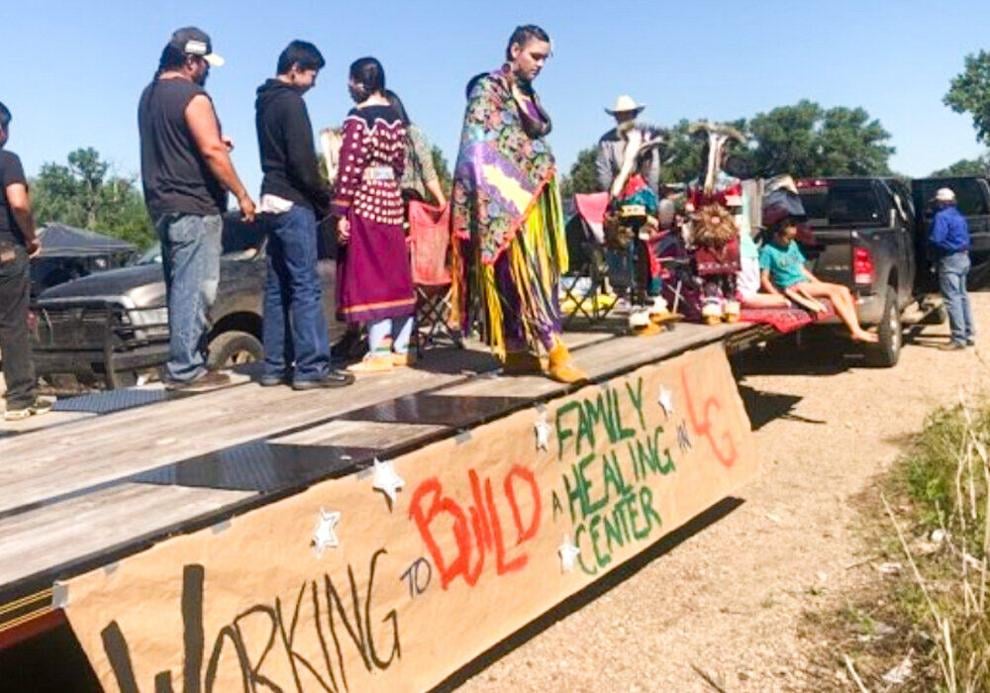
This 2019 photo shows Lodge Grass residents campaigning for the creation of a family healing center.  


Lodge Grass non-profit gets funding for family healing center: read

SEE : Historic photos from Montana's Native American boarding schools. 

A non-profit on the Crow Reservation just got a boon to its efforts to keep families in Lodge Grass intact and in good health. 

    The Mountain Shadow Association, based in Lodge Grass, received a six-figure grant toward the creation of a family healing center with the ambition of preventing trauma or addiction from leading to children being pulled from their homes and potentially off the reservation.

    “What we want is support for the whole family unit,” said Megkian Doyle, executive director for the Mountain Shadow Association. “What we want is for kids and their parents to be engaged in services for emotional and social support.”

    With a population of roughly 450, Lodge Grass is unique in being the only incorporated town on the reservation.  Located about 80 miles southeast of Billings, the Lodge Grass District of the Crow Reservation is home for about 2,000 people.  Over 90% of its population is Native American.

    Doyle, who earned a doctorate in education from Montana State University, came to Lodge Grass to teach at Lodge Grass High School.  She met her husband in town, a Crow man, and the two have since had five children.  After teaching for three years, she said, seeing the conditions in Lodge Grass inspired her to find a position to improve life for its residents.

    She moved to Bozeman with her family, where she and her husband got masters and doctorate degrees.  During that time, Doyle stayed in touch with her former students.  Talks with them evolved into discussions on how best to assist a town in which nearly half of the population lives beneath the poverty line.

    “I asked them, ‘If there’s anything you could do besides pray, what would you do?’” she said.

    In 2017, a coalition of Lodge Grass residents banded together to apply for a grant from the Raising Places Robert Wood Johnson Foundation, which gave them the resources to exhaustively study the factors contributing to the economic and health disparities in town.

    “It meant bringing in everyone, including people who are not normally asked for their opinion, like children,” Doyle said.

    The results were stark.  Nearly 90% of newborns in Lodge Grass are born to single mothers, roughly one in five of whom are teenagers, and about half of all children in Lodge Grass are raised by their grandparents.

    As recently as 2020, according to federal data, about 9% of the children in Montana were Native American. However, they made up 35% of the children in the state’s foster care system.

    Earlier this year, Gov. Greg Gianforte signed into law the Montana Indian Child Welfare Act, which gave Native American families legal preference in foster and adopting Indigenous children in the state.  The Montana legislation was modeled after the federal Indian Child Welfare Act of 1978, which was passed in response to Indigenous children being adopted and fostered outside of their respective tribes only to face physical and emotional abuse.

    Nationwide, Indigenous children are four times more likely to enter the foster care system than white children, according to the National Indian Child Welfare Association. Among the leading causes for Native American kids entering the foster care system in the respective states were allegations of neglect and substance abuse on the part of their parents.

    Separating a child from their family, Doyle said, can have long-term physiological effects, despite a child entering an ideal foster home. Per research published by the National Institute of Health, children separated from their families at an early age experienced higher rates of anxiety and depression and engaged in unhealthy coping behaviors like smoking and alcohol abuse.

    “We can have a great foster care system — we don’t — but even if we did it can still cause damage just by pulling a kid away from their home and their parents,” Doyle said.

    From that Lodge Grass coalition that applied from the Raising Places grant came the Mountain Shadow Association. Coming to the aid of children often means coming to the aid of parents, Doyle said. The non-profit currently assists parents in enrolling in treatment for addiction, but programs that allow them to bring their children along are a 19-hour drive away.

    The solution members of Mountain Shadow reached was the construction of a facility in Lodge Grass where whole families can get treatment without any separation. It’s called Káale’s Village; “káale” is the Crow word for grandmother.

    “We wanted to interrupt family separation on the spot before they would lose their kids,” Doyle said. “But we wanted to do it, obviously, in a safe and healthy way.”

    Mountain Shadow has the land for Káale’s Village, 13 acres in Lodge Grass. Now, thanks to a $750,000 grant from the Arthur M. Blank Family Foundation, the non-profit can start designing it. The center will be a single location for counseling and housing for two families. That space, Doyle said will be for children who need to be removed from their home in Lodge Grass to stay.

    “We want people to become functional in their own ecosystem,” Doyle said.

    Once the architectural designs are completed, Doyle said, the non-profit hopes to see Káale’s Village opened in two years.

Sunday, January 7, 2024

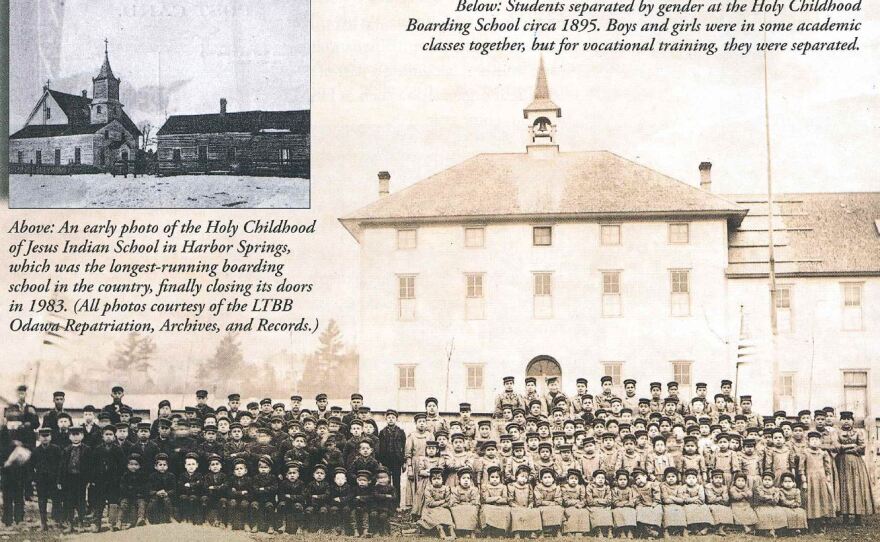
MICHIGAN | A Harbor Springs boarding school worked to erase Odawa culture until the 1980s

LISTEN

Michigan Radio | By Stateside Staff

You have probably heard the phrase “school of choice” used when describing public education options in Michigan, but what about a “school of no choice?” That was the case for many native Michiganders for over a century.

With November being Native American History Month, Stateside welcomed Eric Hemenway, director of archives and records for the Little Traverse Bay Bands of Odawa Indians in and around Harbor Springs, and Sandra Clark, director of the Michigan History Center.

On the creation of Indian boarding schools

During the westward expansion of the United States, in which large populations of American Indians were killed, the government decided to establish a number of Indian boarding schools around the country to force the adoption of American culture.  More importantly, the schools tried to erase the American Indians’ cultures.

“The idea is to found these Indian boarding schools where Indian children will basically not be allowed to be Indian children anymore,” says Clark.

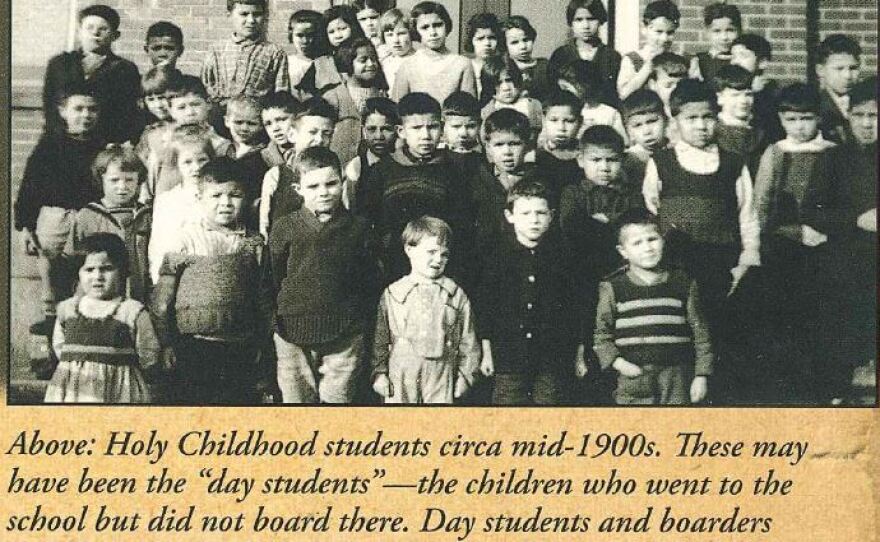
“The boarding schools varied from community to community, but we had one here up in Harbor Springs,” says Hemenway.  The school, Holy Childhood, “started out as a mission school that was in conjunction with the tribe and the local Catholic Church. But as federal policies dictated Indian education into the 1880s, the policy said that Indian language was forbidden, Indian dress was forbidden.”

At the boarding schools, Indians were generally taught to be laborers, not any higher professional aspiration like doctors or lawyers, says Hemenway.  The students were taught to read and write, but the schools also aimed to “uneducate them on being Odawa.”  Students were reprimanded, adds Hemenway, for practicing their culture.

On the schools’ closings

Most of the schools closed in the 1920s, but almost certainly not for moral reasons. The U.S. government didn’t think of the American Indians as much of a threat, and World War I led the U.S. government to reconsider funding the schools because “they were very, very expensive,” says Clark.

“But what makes Holy Childhood an anomaly is that it keeps going for another 60 years,” says Hemenway. “It doesn’t close until 1983 and it’s the last Indian boarding school to do so.”

On impacts on American Indian communities

The large-scale forcing of American Indian children into abusive schools undoubtedly had massive impacts on those communities.

“Loss of language I think is one of the biggest impacts,” says Hemenway. “When these kids were at the school they were forbidden to speak their language, and [there was a] loss of culture, tradition, spiritual beliefs, community ties, family skills.”

Repercussions are still felt today.

Hemenway explains, “We hear devastating stories of kids who survived the school and they grow up to be our elders and, you know, they talk about the situations they went through and how that affected their ability to raise children and develop relationships with other people because of what happened to them at the boarding schools.”


This segment is produced in partnership with the
Michigan History Center.

Saturday, January 6, 2024

In Bear Skin | Wayne William Snellgrove, Saulteaux Tribe


Wayne has been mentioned on this blog before...

READ THIS:

https://blog.nativehope.org/wayne-william-snellgrove

Wayne William Snellgrove, Saulteaux Tribe, Fishing Lake First Nation.  Indigenous Author, Canadian genocide 60s scoop survivor, 2 x USA Swimming National Champion and USA Swimming National Team member 95’. The only full blood Native American to accomplish this fea

A New Book, Daily Medicine, Shares Snellgrove's Wisdom with a Wider Audience

Snellgrove recently released a new book entitled Daily Medicine which has quickly become Amazon’s best selling new release for Native American Religion. You can find a copy of his book here.

When Snellgrove reflects on his journey and on the topics he has written about in Daily Medicine, here's what he had to say:

Overcoming the trauma of being a 60s scoop survivor, I had to build a healthy relationship with Creator and Mother Earth. I asked in prayer for help and guidance. The wisdom that was passed down to me from the Spirit are in these pages. Any success this book has is much more Creator's success than mine.

If you are interested in learning more about the wisdom of Native culture that Snellgrove discovered over the course of his journey to find his identity, check out his book today.

NICE BLOG:

https://blog.nativehope.org/


Friday, January 5, 2024

60s Scoop Class Action Progress Report

add ADOPTION

Ph: 1-844-287-4270    |   sixtiesscoop@collectiva.ca

December 2023: Progress Review 

As 2023 comes to an end, we would like to reiterate our commitment to finalizing the claims administration phase of this class action. Our goal remains that each Eligible Class Member receives their compensation.

With more than 99% of the total number of claims received having been processed under the terms of the settlement, we are actively working to resolve those applications that remain in process. The Claim Statistics Table will continue to be the source for updates in 2024.

We wish everyone peace and comfort in the coming weeks.

On all other days, the call centre will be open, and voice messages can be left when calls are received outside of regular business hours. The phone number is 1-844-287-4270 and our email is  SIXTIESSCOOP@COLLECTIVA.CA.

If at any time you are dealing with trauma or need support, please do not hesitate to contact the Hope for Wellness Helpline for counselling: at 1-855-242-3310 or online at www.hopeforwellness.ca. Counselling is available in English, French, Cree, Ojibway and Inuktitut on request.

If you are in British Columbia, you can contact the First Nations and Aboriginal Helpline offered by the KUU-US Crisis Line Society toll-free at 1-800-588-8717.

***Not every claim will follow a straight path from assessment to approval or denial. Some claims will be assessed and reassessed more than one time, as new information is requested and received. View the claims process

 OFFICIAL DOCUMENTS:

https://sixtiesscoopsettlement.info/official-documents/

VIDEO:

https://sixtiesscoopsettlement.info/sixtiesscoop-english-master-1280x720/  

NOTE:

The CLASS ACTION settlement for which the parties seek judicial approval provides for legal fees in the amount of $75 million. These amounts are over and above the compensation and Foundation amounts the Defendant is obliged to pay pursuant to the agreement.  The potential total value of the settlement is $880 million. 

When Brown v. Canada was commenced in Ontario in 2009, it was true pioneer litigation, the first of its kind anywhere in the country (Canada).  The claims in the action generally related to loss of cultural identity. No court in Canada has ever awarded damages for loss of cultural identity. In consequence, these claims were novel, and therefore there was significant risk with respect to the monetary value that a court may place on such loss.

Ontario Superior Court of Justice:
"Those eligible for compensation included not only Indian adoptees, as Justice Belobaba had ordered based upon the '65 Agreement, but also crown or permanent wards. …. The period of time to be eligible as a class member is double the period in the Brown v. Canada class definition.  It covers all survivors who were placed in non-indigenous homes from 1951 to 1991.  It eliminates the hardship for the class member who has no 'record' (ie. adoption or crown wardship orders) to prove her or his eligibility, shifting that burden to the governments."
This finding applies with full and equal force to this action and the largely untold history of the Sixties Scoop until these cases were brought.

MEMOIR: WHO AM I?

Memoir examines path from illegal adoption to finding herself as a “proud Mohawk woman”

Tuesday, December 19th, 2023 windspeaker
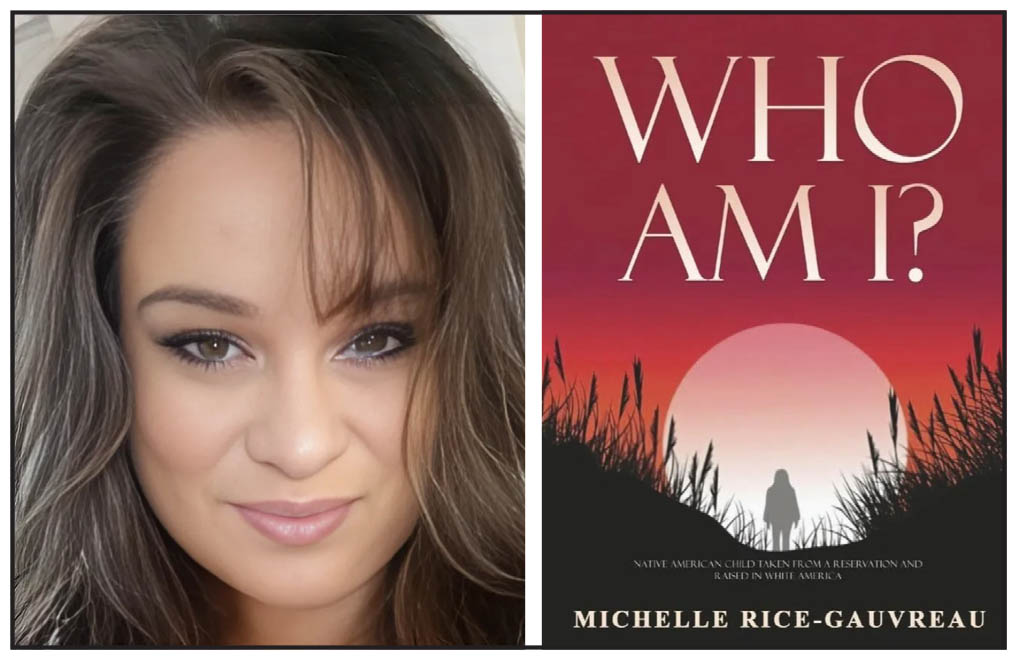
Michelle Rice-Gauvreau with her book Who Am I?

Summary

“I was like, ‘Oh, I have a family. Maybe they'll rescue me.’ Right. Every adoptee might have that fantasy. Little did I know the culture shock I was going to get because I was not raised on the reservation.” —author Michelle Rice-Gauvreau
 
By Shari Narine
Windspeaker.com

Like many adopted children, Michelle Rice-Gauvreau believed that meeting her birthmother and extended family would save her.

Instead, the first time she travelled by bus from Connecticut to Montreal and then by borrowed car to the Kahnawake reserve resulted in culture shock.

“It was tough at 15 (years of age). And I was so headstrong. I was like, ‘Oh, I have a family. Maybe they'll rescue me.’ Right. Every adoptee might have that fantasy. Little did I know the culture shock I was going to get because I was not raised on the reservation. I'm being raised in white society,” said Rice-Gauvreau, 54.

In Who Am I?, a self-published accounting of her life from birth, Rice-Gauvreau traces her time from the hospital room of her delivery and her illegal adoption by Tom Rice, also of the Kahnawake reserve, to growing up in Connecticut where Tom lived.

When Tom dies before Rice-Gauvreau turns three years old, she is raised by Lea, Tom’s widow. Lea suffers from mental illness, which in part presents through hoarding and controlling her adopted daughter. Rice-Gauvreau lives in a filthy, moulding, cluttered house until Lea sends her away, first to live with an aunt and finally into the foster care system.

Rice-Gauvreau dedicates her memoir to Tom.

“I don’t think I would have wanted for anything (had he lived). I was told I was a Daddy’s girl,” she said. “I think everything, all of my needs, would have been met. I don't think he would have let my adoptive mother hurt me the way she did.”

Then again, she admits, that could be another adopted child’s fantasy.

“I'm sure I romanticize it a lot, but I also go by the stories that I was told, too, about him,” said Rice-Gauvreau.

Her memoir is a hard-hitting journey through pain, numbness, anger, and depression to forgiveness and understanding.

Like many Indigenous children in the 1960s, Rice-Gauvreau was given up because of poverty. It’s not an aspect she examines in any depth in her memoir because, she says, “it was a common-sense type of thing” to understand.

And because of that, Rice-Gauvreau says, she never had to forgive birth mother Sharon Armstrong, who she understood had no choice.

Sharon was living with her mother Mary, who was already raising Sharon’s first child, and she could not afford to raise and feed a second child. Rice-Gauvreau’s birth father had taken off.  While in hospital, Sharon’s roommate became aware of the situation and contacted Tom.

Rice-Gauvreau would not learn that she was adopted until Lea’s sister told her at the age of 15. Her birth and baptismal certificates had been forged which presented another issue when Rice-Gauvreau needed to get a U.S. passport in order to travel into Canada.

Rice-Gauvreau did a few successive trips to Kahnawake in her late teens, including spending time with Mary before her grandmother passed away. However, it wasn’t until she met up with foster parents Elaine and Geoff that she started to more fully embrace her First Nation heritage.

The British couple fostered only First Nations children. They co-founded the Connecticut River Powwow Society. It was at these events, Rice-Gauvreau writes, that her mind was “opened…to the spiritual world and the spiritual animals that are always guiding us.”

Rice-Gauvreau is continuing to learn about her Mohawk culture.

While today she is semi-estranged from Sharon and older brother Mike, she is in constant contact with one of her aunts. As for her birth father Eddie, he met her only once when she was a young adult and then cut off contact.

Rice-Gauvreau has no contact with Lea’s family. After Lea passed away, Rice-Gauvreau, with the support of her husband and son, spent five years sorting through Lea’s decrepit house. She sold many of Lea’s collectibles on eBay. The money from that she considers as her inheritance.

It was a hard job, she says, for her physical and emotional health to be in a house that held no good memories.

Rice-Gauvreau is continuing to learn that her feelings and experiences as an adopted child and adult aren’t unique for children or adults in her position.

For about one year now she has belonged to a group for adoptees, from which she gets support and gives support.

“I needed to feel what others were feeling. I needed to know that I was relatable to them,” said Rice-Gauvreau.

After writing her memoir, she says, she needed to connect with other people.

While putting her feelings and thoughts down on paper was cathartic, she says it was difficult.

“I still think about it. I still think about certain circumstances, absolutely. I think that happens with everybody. And I think it will always happen but I don't feel sorry for myself,” she said.

Writing her memoir came about in 2019 when she ended up in the hospital with sepsis and thought she might not make it out. She realized her only son Raymond, now 30, didn’t know her story. She started writing and even after learning she would recover, she kept on writing with the help of a book coach.

“I wanted to get my voice out there,” she said. “It took a long time. I also relived quite a bit. So I'm still kind of healing… but I think I'm doing a good job. That scab is pretty solid.”

And while that scab may be “pretty solid” now, in her memoir Rice-Gauvreau recounts the poignant goal of trying to make Sharon and Lea proud of her. Proud that after such a difficult beginning and upbringing, she survived and worked hard to get a college education. She now works as a legal professional in Connecticut.

Pride for her accomplishments is something Rice-Gauvreau feels only now for herself.

“If you asked me that five years ago, I wouldn't have said yes… because I don't think I knew where I was headed...I still didn't have a direction in my life, and that wasn't until I became sick. And then I realized, ‘Oh, I got direction. And I also have a voice and I need to use it.’.. I started writing and I started feeling my voice coming out. And that's where the pride started coming from,” she said.

It was frightening to put her life out there in a “very raw” way, she says, but her memoir, which came out in August, has received positive attention both in Connecticut and Canada.

At the end of her memoir, Who Am I?, Rice-Gauvreau answers the question, “So many events in my life shaped me into who I am today and that will never change. Growing up between two countries and two cultures, I now tell myself: ‘I am strong, I am thankful, I stand as a proud Mohawk woman. I am Michelle.’”

Who Am I? can be purchased at michellegauvreau.com

Thursday, January 4, 2024

When Police Fail #MMIWG

...this First Nations tracker steps in: ‘I’m searching for our people’

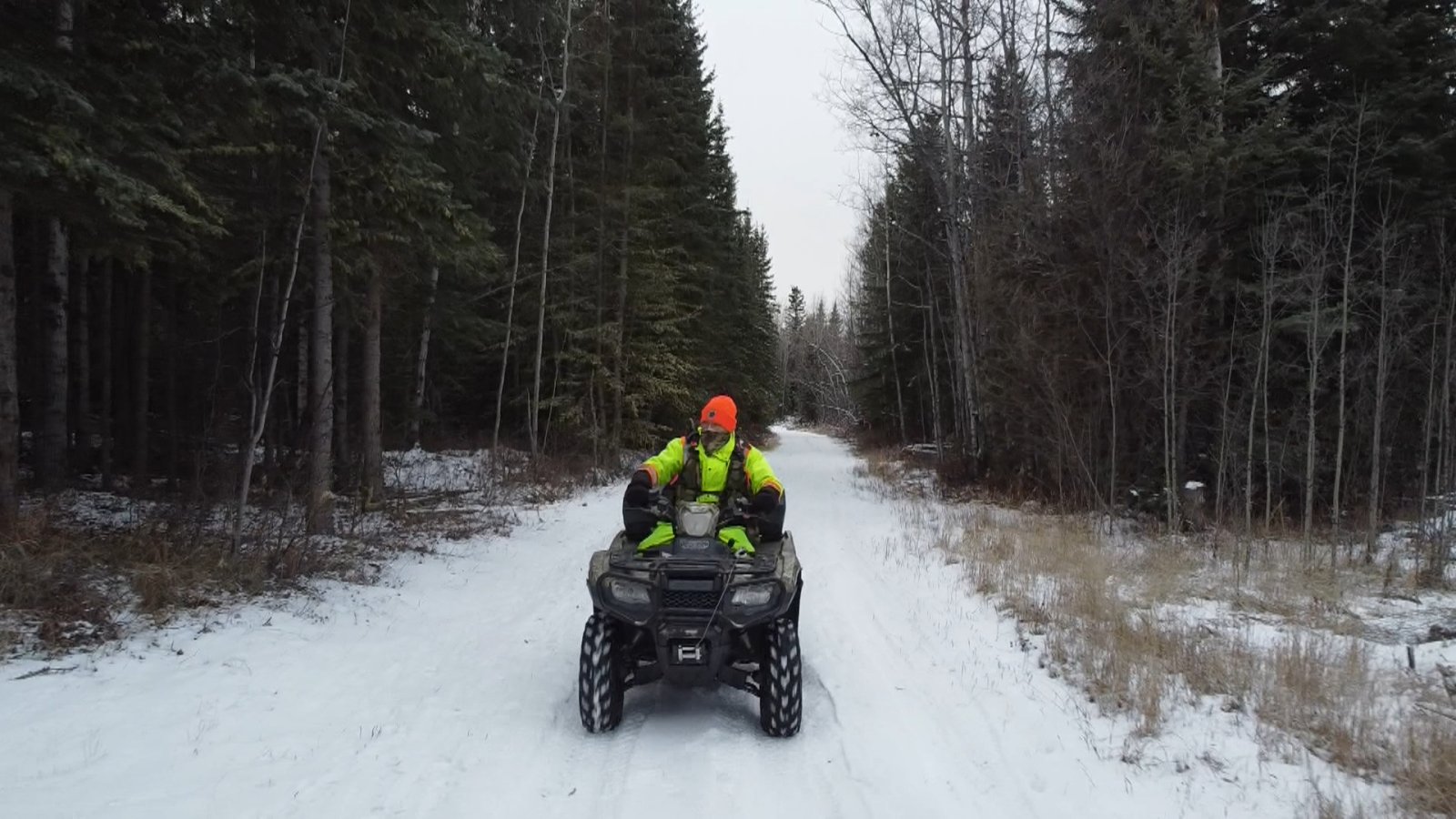
It’s not uncommon for Mukwa Bear to get a ping on his phone, pack up his gear and hit the road with the goal of bringing someone back to their family.

An expert First Nations hunter and tracker with a wealth of experience in search and rescue, Bear has spent the past four years with his phone set to alert him when an Indigenous person goes missing.

He grew up on the trapline immersed in his culture and traditions before being taken into foster care. Many of his early skills were passed on from family with deep roots in Wabaseemoong, an Ojibwe community in Northwestern Ontario also known as Whitedog.

In Canada, research shows that Indigenous women are 400 per cent more likely than non-Indigenous women to go missing. And when they do go missing, the search is often hampered by police apathy.

“The knowledge that (Bear) brings to community is invaluable, he offers a skill set that you can’t really find anywhere,” said Cora McIntosh, general manager for Saik’uz First Nation, where Bear has spent the past month. “The willingness, compassion, kindness and caring he shows to the families is great because he’s doing it from his heart.”

His work is what led police to find missing Saik’uz member Chelsey Heron less than 1 km from where she went missing.

“I just work with the tracks of the animals that tell the stories when having to search for somebody — it’s not just track the person you’re looking for. You’re also tracking where everyone moves.”

Mukwa Bear is hoping to fundraise enough money to 
buy his own ATV to make searches easier. 
He’s currently using one lent to him by Saik’uz First Nation.

 A GoFundMe has been set up to support Bear’s search effort.

KEEP READING: https://globalnews.ca/news/10170503/first-nations-tracker-search-and-rescue-mmiwg-mmip/


Wednesday, January 3, 2024

Klee Benally Walks On | ICWA and Continued Legislation of Indigenous Existence


Diné ‘Land Defender, Warrior,’ Klee Benally Walks On


Diné activist and musician Klee Benally walked on on the morning of December 31, 2023. He was 48 years old. 

Read More


As many celebrate the defense of ICWA, we also must recognize the colonial violence that has demanded and produced it. 

ICWA was passed in 1978 due to the rampant genocidal white christian driven legal practice of taking Indigenous children from their homes and placing them with white christian families.  The law was created to resolve a problem colonialism created.  The settler colonial state didn’t become interested in “keeping Indigenous children with their Tribes” until it was assured that those children would be passively assimilated into its “civilized” order.

Through laws like ICWA, the State continues to legislate and enforce Indigenous existence.

White families stealing Indigenous children should be a non-issue.  That any argument for justification for keeping Indigenous children with their peoples is occurring is part of the larger issue of white supremacy, cis-heteronormativity, and Indigenous genocide. 

Before ICWA was enacted in 1978:

    – 25%–35% of all Native children were being removed from their homes; 

    – of these, 85% were placed outside of their families and communities—even when fit and willing relatives were available. 

    – Today, Native families are 4x more likely to  have their children removed and placed in  foster care than their White counterparts.

    (facts from https://www.nicwa.org/about-icwa) 

Before 1492 Indigenous children weren’t stolen by colonizing predators.

While ICWA is celebrated as an affirmation of Indigenous sovereignty, in actuality it affirms congressional power to regulate commerce (The Commerce Clause) with Indigenous Peoples and plenary power over “Indian affairs.”  A plenary power or plenary authority is a complete and absolute power to take action on a particular issue, with no limitations. 

The legal battle over ICWA erases Indigenous children who are not from federally recognized tribes, border communities, & migrants doesn’t address issues of dis-enrollment.  Particularly as ICWA specifically “sets federal requirements that apply to state child custody proceedings involving an Indian child who is a member of or eligible for membership in a federally recognized tribe.”  ICWA reinforces “Indian” citizenship policies that some Tribal governments have used to exclude mixed race descendants.  Regardless of ICWA, child theft still occurs within the foster care system, where Indigenous youth still are most likely to end up.

The discourse around ICWA is also inherently cis-heteronormative as it doesn’t support queer & two-spirit family formations.  ICWA defines Indian child as “any unmarried person who is under age eighteen and is either (a) a member of an Indian tribe or (b) is eligible for membership in an Indian tribe and is the biological child of a member of an Indian tribe…” 

What justice can we expect from a colonial system that also maintains anti-Indigenous laws sanctioning desecration of sacred lands and attacks bodily autonomy?

Are our cultures and communities so desperate and broken that we celebrate that colonizers can determine if our children belong with us? The apparent “necessity” of ICWA demonstrates the fallacy of colonial laws and the predatory white supremacist violence that constantly looms outside our homes.

That colonial laws are required to stop white people from outright stealing Indigenous babies is the result of a much deeper systemic problem than laws like ICWA can address.

Many of our families & homes are broken due to colonization, more colonial laws won’t fix that.

What are culturally-rooted non-state based solutions to keeping Indigenous children with our families?

www.indigenousaction.org

'It's our job to be mom's voice,' but despite that, number of Indigenous kids in care is climbing

This is part 2 of 3 in a series looking at the Indigenous child welfare system in northern Ontario

Nogdawindamin Family and Community Services CEO talks about two of the children in care who he thinks about the most

Indigenous children's aid CEO Kerry Francis has heard the stories of hundreds of kids, but these two stick with him.

The calls coming from the hospital were sadly very familiar to the staff at the Nogdawindamin neonatal hub in Sault Ste. Marie.

They are commonly known as "birth alerts."

"That mom should not be caring for this baby, it's not safe," recalled outreach worker Carli Ochman.

But when she got to the hospital she found an Indigenous mother who was "tirelessly" by the side of her newborn son, being treated in the neonatal intensive care unit.

"And I'm looking at the paper work that's been provided to me and I'm thinking 'Something is wrong here,'" said Ochman.

"It's our job to be mom's voice when her voice might be breaking."

READ: https://www.cbc.ca/news/canada/sudbury/nogdawindamin-children-in-care-birth-alerts-1.7035977

Tuesday, January 2, 2024

“NOBODY’S CHILDREN" 1946 FILM ABOUT ADOPTION, SOCIAL WORKERS, ORPHANAGES, etc...


@donaldharlan3981 This video makes me sick, then angry. 

@garyflythe1362 Children of average intelligence go to the parents with average intelligence . Only in the richest country in the world - another one of their failed systems 

👇Leave your thoughts. I was sick and angry watching this too - its pure propaganda. How did adoption become a BILLION DOLLAR INDUSTRY? This movie helped....  Trace

Friday, December 29, 2023

Top Stories of 2023: Indigenous Rights Upheld

A selection of The Imprint’s most impactful stories from the past year

Native leaders said the high court’s decision to uphold ICWA “will be felt across generations.” Photo by Rosemary Stephens.

In 2018, the future of the Indian Child Welfare Act was put in jeopardy by a case that would come to be known as Brackeen v. Haaland. A federal district court judge ruled that the 45-year-old law known as ICWA was unconstitutional in its entirety. As the case progressed, many supporters of the law — which is designed to maintain the bonds between Native children and their families and tribes — feared that the U.S. Supreme Court would gut or erase ICWA.

This June, the court did the opposite in a 7-2 ruling that strongly affirmed the Indian Child Welfare Act’s constitutionality.

“The bottom line is that we reject all of petitioners’ challenges to the statute, some on the merits and others for lack of standing,” wrote Justice Amy Coney Barrett.

The Imprint’s five years of coverage on the Brackeen case includes Nancy Marie Spears’ reporting on the arguments considered by the Supreme Court and the prayers and protests outside that day.  And check out The Imprint Weekly Podcast episode from the week after the court’s decision for more insight from several leading experts on ICWA and tribal law.

But Spears’ reporting in 2023 went well beyond the Supreme Court case.  She profiled the Indigenous practices that ICWA is meant to protect, such as the My Two Aunties program developed by a group of tribes in Southern California.  Her recent three-part series, Born of History, explores the ways in which the colonization of the past, and the present constraints of federal funding, make it difficult for many tribes to make full use of ICWA’s protections. 

SOURCE:

https://imprintnews.org/best-of-2023/top-stories-2023-indigenous-rights-upheld/246657

Wednesday, December 27, 2023

FOR IMMEDIATE RELEASE: Adoptee Activist and Author Trace Hentz Announces “THE COUNT 2024,” a New Project to Coincide with the Release of a New History Book “Almost Dead Indians”

LINK TO AMAZON

FOR IMMEDIATE RELEASE

Media Contact Only:

Liz Hill; liz@lizhillpr.com


Adoptee Activist and Author Trace Hentz Announces “THE COUNT 2024,” a New Project to Coincide with the Release of a New History Book “Almost Dead Indians”

GREENFIELD, Mass., Dec. 27, 2023 — Adoptee activist, award-winning journalist and author Trace Hentz, who created the American Indian Adoptees website in 2009, has announced a new project, “THE COUNT 2024.” It will coincide with the release of a new history book, “Almost Dead Indians,” Book 5 in the Lost Children of the Indian Adoption Projects series.

When Hentz moved to Massachusetts in 2004 she began to tirelessly investigate numerous adoption programs, such as the Indian Adoption Projects and ARENA (The Adoption Resource Exchange of America). Both involved moving Native American babies and children across North America into adoptions with non-Native families.

After her 2009 memoir, “One Small Sacrifice” and a second edition, which followed in 2012,  Hentz met more adoptees and asked them to write their personal narratives, which resulted in three anthologies: “Two Worlds: Lost Children” (2012), “Called Home: The RoadMap,” (updated second edition, 2016), and “Stolen Generations: Survivors of the Indian Adoption Projects and 60s Scoop” (2016).  A poetry collection on the same topic, “In The Veins,” the fourth book in the series, was published in 2017.

“In these closed (sealed) adoptions, adoptees are unable to access the vital information they need to find their tribal families and communities,” Hentz said. “This new history book, “Almost Dead Indians,” with a lengthy chapter I wrote, titled “Disappeared,” which is about our history, ties in how these government-funded programs were run by churches and charities and were meant to erase children permanently from tribal rolls, making us dead Indians — almost.”

“Most people have heard how the governments of Canada and the United States ran residential boarding schools like the first U.S. school, which was Carlisle Indian Industrial School in Pennsylvania,” Hentz said. “Today, tribes are finding unmarked graves at these schools. I realized after 20 years that we deserve to see the numbers on these various federal and state-run adoption programs. We need “THE COUNT 2024” of Native American and First Nations adoptees to solidify facts and see actual numbers of adoptees in these government-funded projects that crisscrossed the U.S. and Canada.”

“Neither government has been forthcoming and some academics who looked at available reports claim nearly 13,000 children were adopted in the U.S., some by force and some by gunpoint,” Hentz said. “In Canada, they have already settled a class action lawsuit with adoptees called the Sixties Scoop.”

Hentz recommends the new PBS series “Little Bird” to understand what happened in Canada also happened in the U.S.

“Before first grade, I knew I was adopted, that these people were not my birthparents,” Hentz said. “I wasn’t sure what happened but it took me a lifetime to open my adoption file and finally meet my relatives.” Hentz had a reunion in 1994 with her birthfather Earl Bland in Illinois when she was 38 years old. Since then, she has found her ancestry includes Shawnee and Anishinaabe.

Hentz got the idea of a count when she could not find reliable information. “I set up a new website: https://thecount2024.blogspot.com. Native American and First Nations adoptees simply fill out a comment form and I will send them a survey.” She hopes people will share this link and get the word out. “The COUNT” begins January 1, 2024.

Hentz’s new book, “Almost Dead Indians,” will be available soon at Bookshop and Amazon. Visit: www.blueindianbooks.com or https://blog.americanindianadoptees.com

About Blue Hand Books:

Blue Hand Books, based in Greenfield, Massachusetts, on Pocumtuckland, celebrated its 12th anniversary on November 11, 2023. To date, the collective has published 28 book titles. Founder and award-winning journalist Trace Hentz (formerly DeMeyer) embraced and adopted the idea to decolonize book publishing for other Indigenous writers with a collective that supports each writer, helping them to produce a paperback book, providing proofing and editing and allows them to keep 100% of their book royalties.  Blue Hand Books was created to be community and a collective for Indigenous authors.  For more information, contact: Blue Hand Books, Trace L. Hentz, Publisher, 25 Keegan Lane, Suite 8-C, Greenfield, MA 01301.

# # #

VISIT: https://thecount2024.blogspot.com/


Note to Editors Only:
Photos are available. All photos provided courtesy Blue Hand Books.


READ: https://www.lcotribe.com/post/activist-author-announces-project-to-count-native-children-adopted-into-non-native-families

Friday, November 24, 2023

Happy Hiatus

By Trace L Hentz, blog editor

I’ll be back to you all in January 2024. (I won’t be online much or posting news.)

I am finishing up the fifth book "ALMOST DEAD INDIANS" in the series Lost Children of the Indian Adoption Projects.  Yes, I have compiled more history - and it's not a memoir.  And I am writing an expose on Buffy Sainte-Marie, too, which will be in the new book. I found out quite a bit about this scandal - and it's not over.

Love to you all, big blessings, have a safe holiday season, celebrate – you deserve it.

Thank you from the bottom of my heart for reading this blog/website. 

Trace

Monday, November 20, 2023

John Kane interviews Peter d'Errico

Author of "Federal Anti-Indian Law", Peter d'Errico joins John Kane to talk about his work as it relates to the Osage Murders, Native gaming and US domination.

More Episodes 

Friday, November 17, 2023

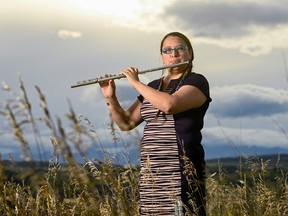
60s Scoop Adoptee Cree musician embraces culture for classical music album, Prairie Dusk

CALGARY, CANADA

In 2020, Jessica McMann and her husband moved to Cochrane, a shift that had more of an impact than the musician and composer had perhaps been anticipating.

The flautist holds a Bachelor of Music degree from the University of Calgary and was required to study composition as part of her course load. But it wasn’t until the pandemic that she began composing in earnest and delving into her culture, inspired by the view outside.

“Outside my studio window, I’m on the third floor, you can see the dusk happening from east to west because we are south-facing,” says McMann. “On the east, you have Cochrane, on the west, you have Morley and Star Ranch and the landscape of the reserve. In that moment of dusk – I just wrote it in that moment of seeing that change of colour. When I started working on the album, I started to reflect on what that meant. I looked at the pieces I already had written and I realized there was something about coming home, there’s something about my life as a Prairies person, as a Sixties Scoop adoptee, there is something about that journey. There is something about being from the Prairies and living on the Prairies and what does that mean to me as a Cree person.”

There is nothing on McMann’s new album, Prairie Dusk, to suggest she is a relative newbie to composing.  The recording features McMann on flute and voice, American Navajo pianist Connor Chee, violist Holly Bhattacharya and Metis baritone Jonathon Adams but the compositions all came from McMann. This lineup will also be featured in an upcoming tour of western Canada, which includes an Oct. 29 show at Found Books in Cochrane.

https://calgaryherald.com/entertainment/local-arts/cree-musician-embraces-culture-for-classical-music-album-prairie-dusk 


Placing Out: The Orphan Trains (2008)

Take time to read the comments after the video... very telling... Forced labor was common, as farmers used these children like slaves, not family members.... Trace


Native American teach-in November 18


 Director of First Nations Repatriation Institute is keynote speaker for Native American teach-in [USA]. The University of Minnesota Morris will hold a teach-in about the history and impact of Native American boarding schools, including the ones that operated on [the UMN Morris] campus site, on Saturday, November 18. The keynote speaker is Sandy White Hawk, Dakota adoptee.

For those unable to attend in person, the Teach-In will also be available via Zoom.  Registration is required: z.umn.edu/BoardingTeach2023

Wednesday, November 15, 2023

2023: Reject colonial holidays that perpetuate dangerous stereotypes and whitewashed history


LEARN MORE: https://www.truthsgiving.org/

About Truthsgiving

Decolonize and celebrate Truthsgiving

There are many colonial mythologies about Indigenous Peoples and the founding of the US and Canada. Thanksgiving is one of them, however, in the words of Wamsutta Frank James, Wampanoag, “the Pilgrims had hardly explored the shores of Cape Cod four days before they had robbed the graves of my ancestors, and stolen their corn, wheat, and beans.” The truth is that real history has been whitewashed and that Thanksgiving perpetuates white supremacy and romanticized notions about Indigenous Peoples. To celebrate the current Thanksgiving mythology is to celebrate the theft of land through ethnic cleansing and enslavement. It is a lie that overlooks the genocide of Native American Indigenous Peoples and the enslavement of African Indigenous Peoples in order for settler-vigilantes and colonial militias to steal land and labor--the legacy of which is still felt today.

Oh, hey! It's National Adoption Awareness Month and I'm adopted

CHECK OUT:

Oh, hey! It's National Adoption Awareness Month and I'm adopted. [USA] Adoptee United’s own Annette O’Connell is producing video shorts each day during National Adoption Awareness Month, with such titles as “Oh, hey! For today's National Adoption Awareness Month chat let's talk about return policies, ok?” and Let's talk about holidays and maybe birthdays too....


Tuesday, November 14, 2023

National Adoption Awareness Month stories #NAAM


  • ‘Mom, tell me the story of my adoption’ [USA]. My experience as an adoptee isn’t a monolith, nor is it isolated. It’s an important reminder that across the country, thousands of adoptees are navigating a one-sided narrative. Adoption has historically been framed as a beautiful method of family creation. This conveniently leaves out the separation from one’s birth family that occurs.

    A Community Call to Action

    November is National Adoption Awareness Month, and it’s an important time for diverse communities to unite around our people. Many of our community leaders, colleagues, friends, and even the friends of our children are impacted by adoption, and yet, they fail to get the community support they need to process, heal, and honor their stories. Which is why I invite you toward action.

    This November, through The Janchi Show and Conversation Piece, I’ll be elevating stories and voices that deserve to be heard, amplified, and validated. I’ll also be available to support Indianapolis’ corporate community as they look to properly understand and honor adoption within the workplace. I invite you to tune in, engage with these stories, and lean in to help contribute to a more inclusive, more supportive community. Schedule a conversation with me at https://www.patrickintheworld.me/.


  • We Are Grieving [USA]. I found out that I was adopted from a grade-school bully. Instead of offering emotional support, my parents said it was a lie and ignored it. Over the next few years, this information was used by my peers to humiliate me, as they knew my parents were lying to me.


    REMINDER: If you want to share on social media, please do... this information is important and should be shared... Trace 

    👇 you can use the little boxes below

CLICK OLDER POSTS (above) to see more news

CLICK OLDER POSTS  (above) to see more news

MEGWETCH THANK YOU

HUGE Thank you for visiting this blog and sharing this with your kin. It's appreciated. Contact Trace anytime! Use the form below.

BOOKSHOP

Please use BOOKSHOP to buy our titles. We will not be posting links to Amazon.

Popular Posts

To Veronica Brown

Veronica, we adult adoptees are thinking of you today and every day. We will be here when you need us. Your journey in the adopted life has begun, nothing can revoke that now, the damage cannot be undone. Be courageous, you have what no adoptee before you has had; a strong group of adult adoptees who know your story, who are behind you and will always be so.

OUR HISTORY

OUR HISTORY
BOOK 5: Lost Children of the Indian Adoption Projects