This blog was a backup for American Indian Adopteesblog
USE THE SEARCH BAR or SEARCH TOPICS at bottom of this blog
If you need support
Support Info: If you are a Survivor and need emotional support, a national crisis line is available 24 hours a day, seven days a week: Residential School Survivor Support Line: 1-866-925-4419. Additional Health Support Information: Emotional, cultural, and professional support services are also available to Survivors and their families through the Indian Residential Schools Resolution Health Support Program. Services can be accessed on an individual, family, or group basis.” These & regional support phone numbers are found at https://nctr.ca/contact/survivors/ .
MY EMAIL: tracelara@pm.me
In the United States
government’s long record of broken treaties, land theft, and genocide,
the taking of the Black Hills ranks as perhaps one of the most
disgraceful examples of imperial aggression against an Indigenous
people.
This is not just a historical episode; it is ongoing to this very
day. The magnificently illuminated and stunningly stellar documentary
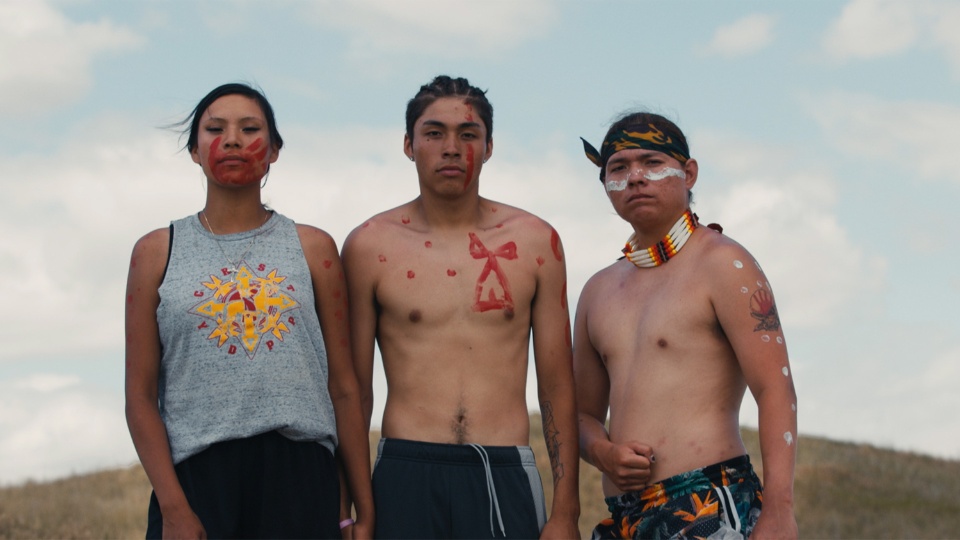
film Lakota Nation vs. United States tells the story. It was screened at the Belcourt Theater in Nashville from Sept. 1 to 6.
The film was picked up for the Belcourt by Allison Inman, Director of
Education and Engagements at the theater, who saw it at the Milwaukee
Film Festival in April of this year.
Some information on the theater is in order first of all. The
Belcourt is a unique Nashville institution with a historic past and deep
community ties. It is a non-profit cultural facility dedicated to
presenting the most notable of independent, documentary, world,
repertory, and classic cinema. The Belcourt believes in “the power of
film.”
The opening night program for this documentary began with a land
acknowledgment given by Annabelle Littlejohn-Bailey, American Samoan and
President of the Indigenous Scholars Organization of Vanderbilt
University.
Lakota Nation vs. United States kicked off the Doc Spotlight
Series for the fall at the Belcourt. The two-hour documentary
chronicled the perfidious treatment of the Lakota people by the federal
government. Underlying the brazen theft of the sacred Black Hills was
the drive of imperial greed for the resources, primarily gold, beneath
the hallowed earth there, which is regarded with reverence by the Lakota
people.
The documentary, written and directed by celebrated Lakota poet Layli
Long Soldier and co-directed by Jesse Short Bull, is a resounding
herald to the never-ending resistance of the Native people who hold the
Black Hills as a source of resonating identity and existence.
A historical perspective will give the uninitiated viewer a greater
appreciation of this heroic struggle by the Lakota over the decades in
the face-off against the most powerful and predatory enemy ever to trod
the earth, the United States government.
The background to the seizure of the Black Hills is the violation of
the Fort Laramie Treaty of 1868, which promised that the Great Sioux
Reservation, including the Black Hills, would be “set apart for the
absolute and undisturbed use and occupation of the Indians,” meaning, of
course, the Lakota. The treaty ended the conflict known as “Red Cloud’s
War,” in which Indigenous forces defeated the U.S. military.
Following another U.S. defeat in June 1876 at the Battle of the
Little Horn and the subsequent military reversal of the Lakota and their
allies, the U.S. government imposed the Act of February 28, 1877, which
stopped all food rations to the Lakota until they ceded the Black Hills
to the United States.
This infamous legislation, also termed the “Sell or Starve Act,” was a
direct breach of the 1868 Fort Laramie Treaty and became and remains
the main focal point of legal contention over possession of the Black
Hills. This is an ongoing and hideous cardinal treaty violation largely
unparalleled in the odious U.S. history of treaty-breaking.
In June 1979, the U.S. Court of Claims ruled that the 1877 Act that
seized the Black Hills was in violation of the Fifth Amendment
prohibition on taking property without just compensation (which also
implicitly meant that the taking was in violation of the Treaty of
1868). Money was awarded which the Lakota refused to accept because
acceptance would mean termination of the claim that the Black Hills be
returned to the Lakota. The United States appealed the Court of Claims
decision to the U.S. Supreme Court.
In March 1980, the Supreme Court ruled, in United States v. Sioux Nation of Indians,
that just compensation had not been paid for the taking of the land and
ordered that such compensation “be paid.” The Lakota again refused the
money and uncompromisingly demanded the return of the Black Hills to
tribal jurisdiction.
But back to the film. It is filled with historical material,
contemporary footage, and interviews with Indigenous leaders (some of
whom I recalled from being at the Standing Rock protests in 2016). It is
an inspiring reminder that the struggle for Indigenous liberation
continues gloriously, courageously, and brilliantly.
Jennifer Podemski on Little Bird, the Firecracker Blaze Award, & Indigenous Storytelling
Annemarie Cutruzzola September 7, 2023
Jennifer
Podemski is an unstoppable force in Canadian film and TV. Over her 30+
year career, the Anishinaabe/Ashkenazi actor, writer, director and
producer has broken barriers and pushed Indigenous storytelling and
meaningful representation further, both on-screen and off.
As well as starring in titles like Dance Me Outside, Degrassi TNG, Empire of Dirt, and Reservation Dogs, she’s led a variety of series through her production company Redcloud Studios Inc. Most recently,Jennifer blew us away with Little Bird, a breathtaking six-part series about the Sixties Scoop, that will soon be airing on PBS.
Her commitment to uplifting
Indigenous creatives led her to founding The Shine Network Institute, a
non-profit organization dedicated to dismantling systemic barriers
Indigenous women face in film and TV, by providing training, mentorship
and professional development.
To honour her ground-breaking creative work across platforms, Jennifer will be awarded the Blaze Award
this week, an annual award given out by The Firecracker Department, an
empowering community of women and non-binary artists founded by Naomi
Snieckus. “I was caught off guard when I got the call from Naomi,” says
Jennifer. “She has built a beautiful and deeply meaningful platform and I
was just so honoured to be recognized!” Jennifer joins a star-studded
list of previous recipients, including Amanda Brugel, Jo Vannicola, Jann
Arden and Michelle Buteau.
Ahead of her receiving the Blaze
Award at the Firecracker Department TIFF Brunch on Saturday, we asked
Jennifer some questions about Little Bird and her remarkable career.
Can you tell us about what making Little Bird meant to you?
In the long road of repairing the damage done since the beginning of screen stories, a story like Little Bird dismantles harmful narratives and introduces a truth never told before. For me, Little Bird
was devastating to tell and make but as I moved through it, it became
the most healing and transformative thing I have ever made.
We heard the incredible news about Little Bird coming to PBS! What do you hope this wider audience takes away from the series?
I hope it touches people so deeply
that they stop themselves before they write us off. I hope it moves
people to their core and reminds them of our humanity and sheds light on
some of their own history that has been erased. People deserve to know
the truth and we, Indigenous People, deserve to have the truth told.
What needs to be done to ensure authentic Indigenous stories are being told on screen?
Indigenous-led process and
Indigenous-led storytelling combined with culturally informed
non-Indigenous partners and teams. This is the only way.
What do you think is missing in Canadian TV & film right now? Which kinds of stories do we need to hear more of?
Our screens are still dominated by
white people and that simply doesn’t reflect our society. There is often
a BIPOC character, usually supporting, but the way our screens look is
not how our society looks. The industry as a whole is still largely
focused on non-BIPOC people and stories and the centering of these
perspectives is inauthentic and not reflective of who we are as a
society.
Can you tell us more about your vision for the Shine Network Institute?
I fought the urge to launch it for
months, but after much consideration I just came to terms with the need.
It was a massive undertaking and I wasn’t sure I had it in me but the
Shine Network Institute is filling a very specific need that didn’t
exist. It’s grown over the past three years and I am so blown away by
what we have done but at its core, it is a solution-driven organization,
dedicated to creating safer spaces, access to opportunity and training
for Indigenous people within the sector with a special focus on women.
What was the first film you saw that made you realize the power of film, or really made an impact on you?
Wizard of Oz…that
was the first movie I watched over and over and just sat there
awestruck at how this thing could inspire me so much and make me feel
things that I had never felt before. It definitely changed the way I
watched movies.
What is your best wisdom for someone new to the industry?
You must think about your career as a
whole, from now for 30 + years. I realize now how important it is to
play the long game. This business is not about instant gratification, it
may look like that from the outside, and it may happen to a few but for
the majority, it is all long game and big vision and sticktoitiveness
and relationships. Everything in this business is built on
relationships.
What is a memorable moment from your career that will always stick with you?
I have so many!!! Recently, I got to be with both of my sisters on Reservation Dogs,
that was epic because it had never happened before. When I got to train
with Franco Dragone from Cirque Du Soleil for two weeks for a movie
called Bogus, I was a clown and flew on airplane wire for ten days. It
was amazing. When I was shooting my first drama series Moccasin Flats
in Regina, the Chief of Police told me that crime in the neighborhood
went down during shooting because of our presence and training program.
There have been too many to count.
There once was a girl who lived in Corrales and loved collecting
butterflies. She would capture perhaps 20 or 30 of them at a time, take
them inside, then set them free to fly around her bedroom. Another thing
she noticed about herself: Whenever she happened to be on the verge of a
big life change, a coyote would appear. “Not like one running across
the road,” Veronica Krupnick, now 27 years old, recalled, “but like I’d
be out on a walk with my family, and a coyote would follow along close
behind us.”
For years, these uncanny animal connections struck her as mysterious
and sometimes unsettling. “I didn’t have anyone to teach me about them,”
Krupnick said, until she was reintroduced to her Hopi grandparents when
she was 19 or 20. It was then that she learned that the coyote and the
butterfly are among her clan affiliations. Suddenly, these aspects of
her life, along with others, began to make sense.
An enrolled member of the Hopi tribe, Krupnick’s lineage also
includes Jemez Pueblo and Navajo ancestry. She was adopted by a white
couple when she was 10 years old, after spending four years in seven
different foster placements. Though ultimately landing in a home where
she was physically safe and materially secure, she struggled throughout
her adolescence and was eventually admitted into a behavioral
residential treatment facility, where she completed her last two years
of high school. Coyote companions were the least of the things that
confused her.
For some 45 years, adoptions like Krupnick’s have been governed by a
landmark federal law, the Indian Child Welfare Act. Enacted in 1978,
ICWA regulates adoption and foster placement for Native American
children who don’t live on reservation lands — the vast majority, owing
to the fact that some 87 percent
of Native peoples have moved off those lands. The law was designed to
end the long and terrible history of involuntarily separating Native
children from their families and to do what’s in the best interest of
each child.
Veronica
Krupnick, outside the state capitol in Santa Fe, where she works today
as a Leadership Analyst. Michael Benanav/Searchlight New Mexico
ICWA strives to keep children within their families, clans, and
communities. Today, Native American tribes and child welfare
organizations hail its success with near unanimity. It is widely
regarded as the gold standard for child welfare regulations, and states
have modeled their own laws for non-Native kids after it to one degree
or another.
An upcoming U.S. Supreme Court decision is casting a shadow on all that. The high court will soon rule in Brackeen v. Haaland,
in which plaintiffs seek to strike down ICWA, alleging that it
discriminates on the basis of race and violates the Constitution in
other ways, as well. The case arose from the Texas court system, where
Jennifer and Chad Brackeen, a white couple seeking to adopt a Navajo
girl, sued to make it easier for non-Native families to adopt Native
American children. A decision is expected by the end of June.
Much is at stake. In the big picture, some of the legal challenges to ICWA strike at the very foundation of Indian law,
or Title 25 — a voluminous compilation of federal codes governing
nearly every aspect of life on tribal lands. Many of these laws are
rooted in centuries-old interpretations of the Constitution’s Commerce
Clause that, among other things, give Congress the power to regulate and
protect certain tribal activities. Lawyers for the Brackeens, along
with conservative groups such as the Goldwater Institute, argue that
Native American child custody issues are not among them.
Should the high court rule that it was indeed beyond the authority of
Congress to enact ICWA in the first place — by narrowing the
conventional understanding of the Commerce Clause — a swath of other
laws could fall, too.
A skeptical Justice Neil Gorsuch suggested during oral argument in
November that these could include Native American health care
provisions, religious liberties, rights to access sacred sites and
tribal environmental regulations. “There would be a lot that would be
bitten out of Title 25,” he said. “We’d be busy for the next many years
striking things down.”
The court could conclude that Congress didn’t violate the Commerce
Clause, but overreached in more limited ways, overturning ICWA without
the alarming ripple effects.
But if the justices rule that ICWA violates the Equal Protection
Clause of the Fourteenth Amendment — concluding that it is a “race-based
law” — the consequences could be catastrophic, many Native American
advocates fear.
“Indian law is based on the principle that tribes are sovereign
nations that have a government-to-government relationship with the
United States,” said Beth Wright, a staff attorney at the Native
American Rights Fund and an enrolled member of Laguna Pueblo. “If this
is reduced to a racial classification, all rights that tribes and tribal
people enjoy are also subject to attack. They’re attacking tribal
sovereignty at its core.”
Wright fears that this would spawn wholesale assaults on Indian
Country, such as environmental and economic exploitation by corporations
eager to tap into natural resources and casinos on Native land. She
points out that the law firm representing the Brackeens pro bono also
represents Chevron and some of the largest gaming companies in the world.
Opponents of ICWA dismiss such concerns as exaggerated. Their only targets, they say, are Native child welfare regulations.
In New Mexico, Native American adoptions and foster care are
regulated by an especially robust version of ICWA called the Indian
Family Protection Act. As a state law, the Act will remain intact unless
the Supreme Court strikes down ICWA as a violation of the Equal
Protection Clause – in which case it too would likely be thrown out as
race-based, according to attorneys on both sides of the debate.
“The
separation of Indigenous people has been used as a tool of genocide, a
form of violence against our community and our children,” said Angel
Charley, executive director of the Coalition to Stop Violence Against
Native Women. Charley is pictured here outside the San José de la Laguna
Mission Church, in Laguna Pueblo. Michael Benanav/Searchlight New
Mexico
A complex welter of issues
Beyond the tangle of legal matters, the Supreme Court case delves
into the evocative terrain of historical trauma, race, identity,
cultural biases — and the very meaning of family.
The moral heart of the Brackeens’ argument is that ICWA, despite its
good intentions, actually discriminates against Native children by
limiting their options for adoptive and foster families and making
“genetics and ancestry” the key criteria for placement. The Brackeens
themselves, who are evangelical Christians, fostered and ultimately
adopted a boy of Navajo and Cherokee parentage in 2018, following what
they described as a religious calling.
They have been fighting to adopt his younger half-sister, who they have
fostered for most of her four years, sharing custody with a great-aunt
who lives on the Navajo Nation.
ICWA mandates that child welfare agencies should first try to settle
Native children with other family members. If that’s not possible, they
should next try to place children with another family from their tribe,
then with a family from another tribe, and lastly in a non-Native
household. Exceptions are made on a case-by-case basis, when in the best
interest of the child. But the Brackeens contend that these preferences
harm Native children by steering them away from adoptive families that
might be optimal but are farther down the list.
Among the many who disagree are 497 tribes, dozens of children’s
rights organizations, 87 members of Congress, the ACLU, the American
Academy of Pediatrics, the American Psychological Association and other
groups that have filed or joined amicus briefs in support of ICWA.
There is ample evidence dating back decades that removing Native
children from Native society can cause “untold social and psychological
consequences,” according to the brief filed by 180 tribes. Another brief, filed by Casey Family Programs and 26 other child welfare and adoption organizations from around the country, highlights ICWA’s crucial benefits.
Citing outcomes data, the brief points out that, by favoring
placement with blood relatives, clan relations or close family friends,
Native foster children are less likely than non-Native children to be
shuffled around from one setting to another, resulting in “fewer mental
health disorders, and better well-being, while minimizing trauma.” They
also have a better chance than non-Native kids of landing a permanent
home.
A system “that does not prioritize family integrity and community
ties, invites a return to the days when courts unthinkingly presumed
that an Indian child’s best interests were served by placement with a
middle-class, non-Indian family,” the brief adds.
Wright, the lawyer with the Native American Rights Fund, put it
bluntly: “The other side doesn’t really care about Indian children.”
In
the late 1960s and early ’70s, studies found that up to 35 percent of
Native children were in Anglo foster homes, adoptive homes, or
institutions — typically removed from their families without due
process. Indigenous children were also forcibly placed in boarding
schools, including one on the Navajo Nation that opened in 1883. Its
stated goal: “To remove the Navajo child from the influence of his
savage parents.” Photo courtesy of the National Archives and Records
Administration
Who am I?
For Native child welfare advocates in New Mexico, the most important
feature of ICWA’s placement preferences is its attempt to address the
deep, existential questions faced by children who find themselves
separated from their parents.
“Where do I come from? Who are my people? Who am I? Anyone who has
interacted with the foster care system can identify with wondering about
these things,” said Angel Charley, of Laguna Pueblo. As executive
director of the Coalition to Stop Violence Against Native Women, Charley
provided input into the drafting of New Mexico’s Indian Family
Protection Act of 2022; she also works on improving communication
between Native foster families and the Children, Youth and Families
Department, the agency responsible for foster care in New Mexico.
“We need to insure ‘belonging’ for little ones who are removed from
families for circumstances that are beyond their control,” Charley said
in a phone interview. “Indigenous people have language, culture,
ceremony. We’re so grounded in belonging and to our ancestors and the
land. For a child not to have access to those ways of being is
detrimental.
“I know many adults who grew up with no connection to community and
are struggling to figure out how to connect. Kinship and culture can’t
be replicated outside of our communities. Belonging is more important
than material wealth.”
Veronica Krupnik’s complex story bears this out, though parts of it,
if taken in isolation, could bolster the argument against ICWA’s
placement preferences: At age nine, she was being fostered by a family
member, but the situation turned abusive. She was then placed with a
white couple, on an emergency basis, and they eventually adopted her.
Her adoptive parents were “wonderful providers,” sending her to top
private schools, she said. “They wanted me to be educated and have every
opportunity.” But she spiraled as she entered her teen years, rebelling
against a restrictive household where she never felt entirely at home.
“It wasn’t just their fault,” she reflected. “I was a traumatized kid.”
Exacerbating those traumas was her sense of being thrust into a world
in which she didn’t belong. “It’s not just one thing. It’s how you
speak, how you dress, how you wake up in the morning, how you eat
dinner,” Krupnick said. “In Native cultures, ways of life are more
abstract; in Western culture, everything needs to have an answer,
everything happens on a timeline, there’s a lot less grey.”
What’s more, leaving her community as a child, she didn’t know much about her own culture, leaving her ungrounded, unrooted.
Catherine Begaye, the ICWA court’s presiding judge, in New Mexico’s Second Judicial District.
State fails Indigenous children
Though New Mexico, with the passage of IFPA, has emerged as a leader
in Native American child welfare, it hasn’t yet lived up to its
aspirations. A 2021 survey by the Children, Youth and Families
Department found that the state has fallen far short
of meeting several of its obligations to Native kids in foster care.
Only about a quarter of them found preferred placements with family or
tribal members, the survey revealed.
The critical bottleneck is the shortage of licensed Native foster
families. While efforts are now being made to increase Native
participation — in part by employing more culturally sensitive ways of
communicating with and evaluating households — raising these numbers
will take time.
The major exception to these deficiencies is in Bernalillo County,
where a special ICWA court was established in 2020. Headed by Judge Catherine Begaye,
a member of the Navajo Nation, the court has seen more than 100
children come through its doors: 86 percent have gone into preferred
placements; 60 percent have been reunified with their parents; none of
the families that were reunified have come back before the court; and no
parental rights have been terminated, court data show.
Judge Begaye chokes up with emotion when speaking of her hopes and
dreams for the children she sees, and she uses the powers of the bench
to support each one. This can include helping extended family members
become licensed foster parents, working in tandem with tribes and
ordering the Children, Youth and Families Department to ensure that kids
have the opportunity to participate in dances and other ceremonies.
Begaye calls doing what’s best for Native children simply “following the
law.”
If ICWA is overturned on equal protection grounds, this special court
will likely cease to function, at least in its current form. Throughout
New Mexico and the nation, protocols for handling Native child welfare
cases will enter unknown territory. The state doesn’t have any backup
plans to address this possibility.
Krupnick hopes it won’t come to that. She knows the value of the very
things that ICWA was designed to protect and believes other Native
children do, too. “As a kid plopped from one community to another, that
took away a really essential part of my identity. I couldn’t figure out
where I was going until I found this core piece of myself.”
Reconnecting with her culture and her family of origin, and making
Native friends, has helped Krupnick heal. “When I go back to Hopi,
something in me knows I’m home. I have a physical response that I don’t
have anywhere else, except maybe at my great-grandma’s house in Jemez.
It’s like my body takes a great big sigh of relief,” she said. Being
around other Native people, she added, means “not having to explain.”
She now volunteers with and advocates for Native children who are in
the child welfare system and serves on the board of directors of CASA First
– which trains court-appointed advocates for foster children in the
First Judicial District. Recently, she also took a new job in the New
Mexico’s House Majority Office.
And she still has close encounters with coyotes from time to time,
she said. “But now I can lean on it, instead of it being weird and
confusing.”
Today
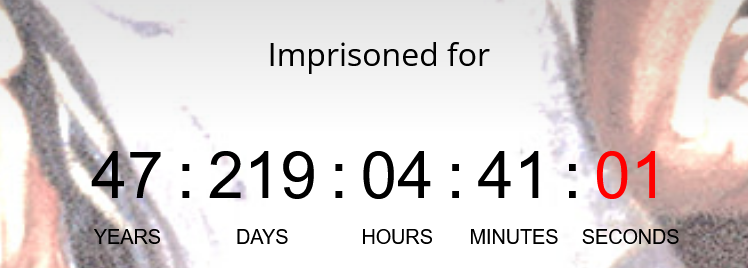
we join the global chorus demanding clemency for #LeonardPeltier on his
79th birthday! Sept. 12, 1944. Leonard has been politically imprisoned
for 47 years! The colonial oppression is sending a message to the rest
of us who have no choice but to stand up against corporate fascism.
Listen to the full podcast. The entire authorized podcast “Leonard: Political Prisoner” is here: https://leonard.buzzsprout.com
Watch, and share new video. This epic, never before seen, 1 minute video, is a powerful emotional call for clemency. It is available to download and repost to get the word out.
In
the ‘70s my father Wallace June Little was close with Leonard. It was a
friendship that was made even closer by the tragic events of June 26th,
which both were fortunate enough to survive, unlike their AIM brother,
Joseph Kills Right Stuntz.
I’m excited to announce that I will be officially joining the Leonard podcast
as an executive producer in Season 3, which will guide listeners
through Peltier’s prison escape and unsuccessful legal appeals up until
present day.
Every
June 26th we remember Leonard Peltier in a run for freedom. We remember
Joe Kills Right Stunts. And I even remember Ron Williams and Jack
Cohler. I don't think they intended to do what they were partaking in
that day.
This
is a long war. And Leonard Peltier is just one battle in that long war.
Just like Little Big Horn. Just like Wounded Knee One. Just like
Wounded Knee Two. Just like Standing Rock.
But
we've got to keep up the fight. And it's hard. Leonard Peltier cannot
die in prison. Leonard only wants to come home so he can make his
transition in his Homeland, which is waiting to embrace him, which loves
him.
I
don't know what to say about Leonard. I had the honor of visiting
Leonard inside Coleman US prison; I don't know how he keeps it together
in there, but he's strong. And we all benefit from that kind of
unconquerable dignity. All over the world, people are calling for
clemency for Leonard Peltier. We can never lose faith in knowing he
should be free. Leonard is paying the price of indigenous sovereignty
right now; he is doing our time.
Yéil
Yádi Olson is Lingít Raven from the Kaa Shaayi Hit (Severed Head House)
and is also of Nordic descent. He constructed this seclusion hut in
collaboration with curator and healer Meda DeWitt. Olson wanted to use
his skills as a carpenter to educate others about Indigenous cultures.
(Photo: Rachel Cassandra / Alaska Public Media)
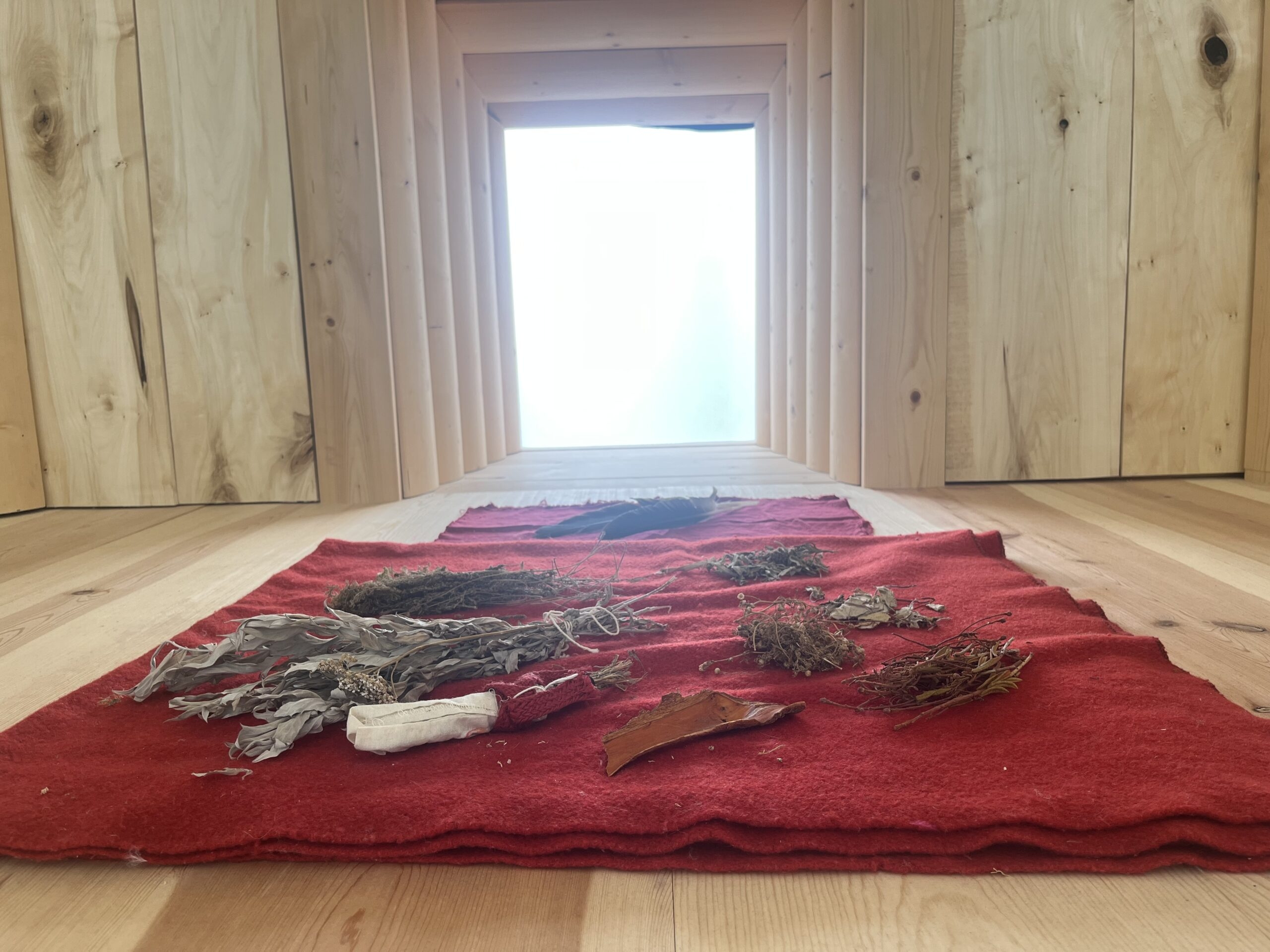
The knowledge work and art of Indigenous healers and medicine people in Alaska is being featured at the Anchorage Museum.
“Good Medicine” features paintings, illustrations, a women’s house, and a men’s house.
Those houses are traditionally used for healing, teaching, and meetings.
Meda DeWitt’s Lingít names are Khaat kłaat and Tśa Tsée Naakw.
She’s a healer and the curator.
DeWitt says the show is both about healing and is healing in itself.
She says it holds space for traditional healers to be seen and to speak.
That’s in contrast to colonization’s attempts at erasure of Alaska Native culture.
She says healers and spiritual leaders were targeted during colonization because of how they protected people.
“Many
folks were sent to insane asylums, or penitentiaries. Or they were just
taken out into the woods and, you know, just went missing, never came
back or out into the ocean.”
For decades, Alaska Native people
were forbidden from practicing traditional healing, so she says people
are choosing ways to adapt practices.
“We have to first fully
articulate who we were pre contact… to understand how to adapt it so
that we are… 21st century Indigenous people on our own terms.”
Ultimately, DeWitt says that acknowledging the trauma of colonization is part of cultural healing.
“Let’s
not… whitewash history, let’s… work as a community together to seek
healing and repair… so that way, our future generations don’t have to
carry on that burden any longer.”
The exhibit “Good Medicine” will be up through the spring.
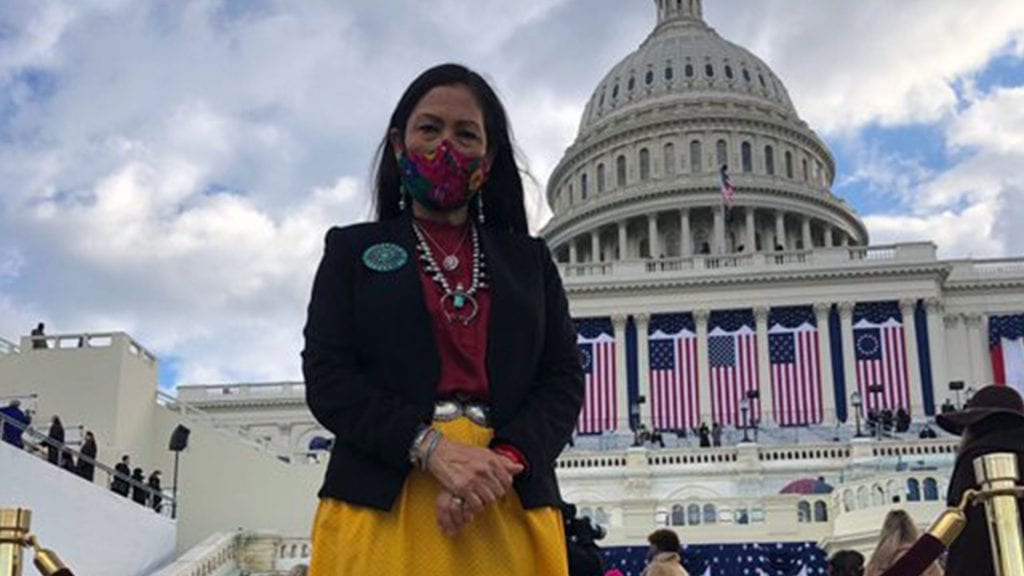
The first-ever Indigenous member of the U.S. cabinet is in Canada to
talk about how best to help First Nations, Inuit and Métis Inuit
communities across the continent.
Interior Secretary
Deb Haaland, a member of New Mexico’s Laguna Pueblo tribe, has made
missing and murdered Indigenous women and girls a top priority of her
department.
While in Ottawa, she will take part in a trilateral working group set
up in 2016 to address the problem, a crisis in all three countries in
North America.
Haaland is also
expected to meet with a number of federal officials and dignitaries in
the national capital, as well as David Cohen, the U.S. ambassador to
Canada.
Prince George – Education and awareness is what the new exhibit in the
Prince George Public Library is hoping to do. Open from now until the
end of September, the exhibit provides plenty of information on Murdered
and Missing Indigenous Women and Girls, and has loads of visual aspects
to go along with it, including red dresses along the stairway. When it
comes to the educational aspects of this exhibit, it’s important to
remember that the impact of the past has rippled into the present.
Songhees Nation hosts South Island Powwow on Orange Shirt Day
Public invited to free event
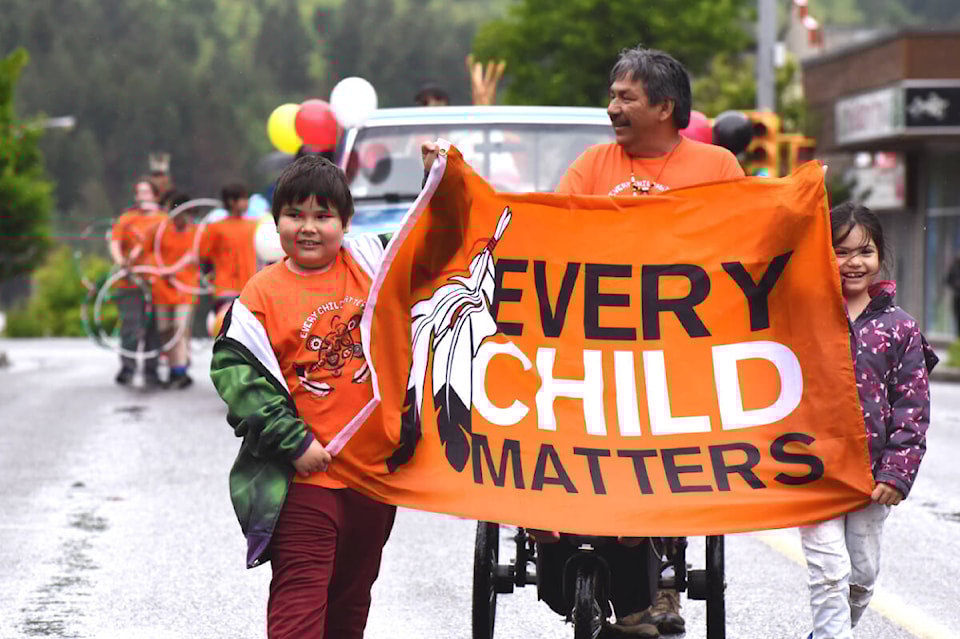
Chris CampbellEvery Child Matters is a vital message on Truth and Reconciliation Day. (Angie Mindus photo - Williams Lake Tribune)
The Songhees Nation is hosting the second-annual South Island Powwow with support from the City of Victoria.
The powwow takes place on Sept. 30 on the homelands of the Lekwungen
people at Royal Athletic Park. Sept. 30 is a federal statutory holiday
to mark the National Day for Truth and Reconciliation, also known as
Orange Shirt Day.
The powwow honours and recognizes survivors of residential and day
schools and their families, the Sixties Scoop and the children who never
made it home from these institutions. The powwow also celebrates
Indigenous cultures and resiliency and brings people together in
celebration to build bridges amongst all nations.
“The South Island Powwow has rekindled a piece of Songhees history,
while providing a safe space for healing, education and understanding,”
said Chief Ron Sam of the Songhees Nation, in a statement.
Local First Nations, along with nations from the mainland, have been
welcomed to participate in the time-honoured powwow. Last year’s
inaugural event attracted 10,000 people during the grand entry, with
more people expected to attend this year.
September 30 is the National Day for Truth and Reconciliation
September 11, 2023
September 30 is the National
Day for Truth and Reconciliation in Canada. It is a time to recognize
and commemorate the intergenerational harm that residential schools
caused to Indigenous families and communities, and to honour those who
have been affected by this injustice.
We urge our members,
staff and allies to take this opportunity to learn about, and reflect
on, our past and how we can meaningfully participate in reconciliation
in Canada.
The Truth and Reconciliation Commission and its Calls to Action
The Truth and Reconciliation Commission
ran from 2008 to 2015, providing those directly or indirectly affected
by the legacy of the Indian Residential Schools policy with an
opportunity to share their stories and experiences. The Commission
released its final report detailing 94 calls to action. The National Day
for Truth and Reconciliation responds to Call to Action 80 from the Truth and Reconciliation Commission of Canada: Calls to Action, which reads:
80. We call upon the federal
government, in collaboration with Aboriginal peoples, to establish, as a
statutory holiday, a National Day for Truth and Reconciliation to
honour Survivors, their families, and communities, and ensure that
public commemoration of the history and legacy of residential schools
remains a vital component of the reconciliation process.
The National Centre for Truth and Reconciliation
(NCTR) has become the permanent archive for the statements, documents
and other materials the Commission gathered, and its library and
collections are the foundation for ongoing learning and research.
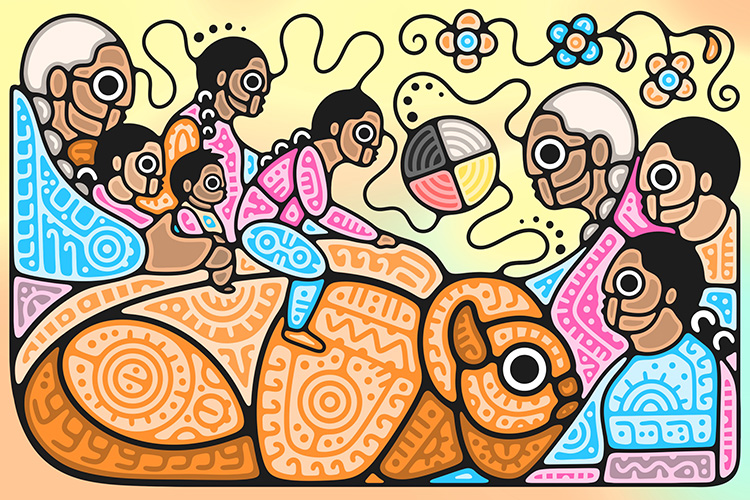
Our 2023 National Day for Truth and Reconciliation artwork was created by Anishinaabe Onyota’a:ka artist, Tsista Kennedy (https://hotdogwaterart.com/.)
When I first read
the theme of "healing and care", as well as the theme of "remembering
the children" being worked into this art, the image of this first draft
immediately came to mind.
The bison is a common image I
use in my artwork, and I often use it to portray healing, resiliency,
and strength, and wellness. When the buffalo were brought to near
extinction, we as Indigenous people struggled due to our diverse
relationships with these animals, and the nourishment, shelter, and
tools they provided us. Since colonization began, both the bison and we
as Indigenous people have maintained our strength and resiliency, and
now we both are growing in numbers once again. Because of this, I wanted
the bison to be a place for the past generations, the children and
elders, to rest upon.
The elder and children on the
bison fit the theme of "remembering the children", but also represent
the children and elders of the present day who will pass on and
receive the traditional knowledge our ancestors succeeded in passing
down to us. The individuals on the far right looking at these children
and the elder represent those that support the children and the elders
in any way they can, ensuring that they are doing their part in the
passing down of our culture, wellbeing, and way of life. This is all
connected by a medicine wheel, and some floral patterns in the top right
corner, which to me represents new life, and continuity.
Tsista Kennedy, Anishinaabe Onyota’a:ka artist
Orange Shirt Day
Orange Shirt Day
is a legacy of the St. Joseph Mission (SJM) Residential School
(1891-1981) Commemoration Project and Reunion events that took place in
Williams Lake, BC, Canada, in May 2013. The events were designed to
commemorate the residential school experience, to witness and honour the
healing journey of the survivors and their families, and to commit to
the ongoing process of reconciliation.
Each year on September 30,
people across Canada wear orange shirts to raise awareness of, and start
a conversation around, the history and legacies of the residential
school system in Canada. Watch the video at right to learn more about
how Orange Shirt Day came to be and to listen to Phyllis Webstad's
story.
Share your Orange Shirt Day photos with the ONA community. Submit them via email to digital@ona.org.
Learn More
The National Centre for Truth and Reconciliation
is the permanent archive for the statements, documents and other
materials the Commission gathered, and its library and collections are
the foundation for ongoing learning and research.
American public broadcaster PBS
has announced the premiere of Canadian drama Little Bird, which follows
the life of a First Nation woman who was forcefully removed from her
family as a child during Canada’s Sixties Scoop.
The six-part, one-hour limited series, created by Canadian First
Nations filmmaker Jennifer Podemski and playwright Hannah Moscovitch,
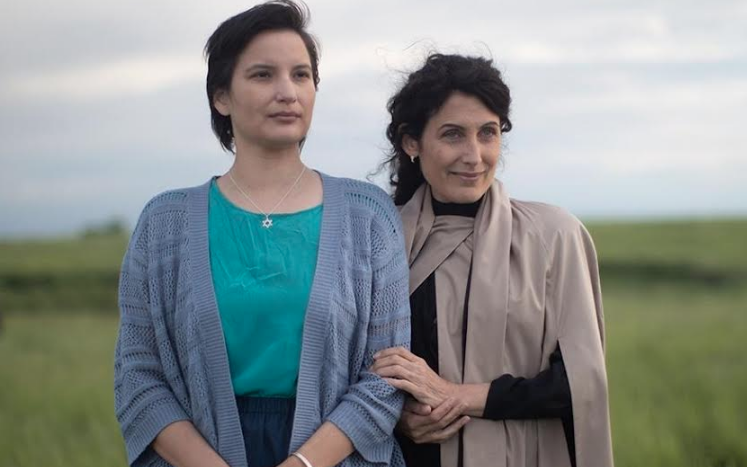
stars Darla Contois and Lisa Edelstein and follows the life of Bezhig
Little Bird, a victim of the Sixties Scoop in Saskatchewan during which
indigenous children were taken from their families and adopted by white
families.
Removed from her home in Long Pine Reservation, Bezhig Little Bird is
adopted into a Montreal Jewish family at age five. Now in her 20s,
Bezhig longs for the family she lost and is willing to sacrifice
everything to find them. Her search lands her in the Canadian Prairies. As she begins to track down her siblings, she unravels the mystery
behind her adoption and discovers that her apprehension is connected to a
racist government policy.
“It is a powerful narrative that not only engages and pulls on your
heartstrings but also educates on a profoundly disturbing time in North
American history that is rarely portrayed,” Germaine Sweet, Managing
Director, Content Acquisitions at PBS Distribution, said in a press
release.. “In addition to the creative brilliance of Jennifer Podemski
and Hannah Moscovitch, this series was delivered by a wealth of
Indigenous talent both in front of and behind the camera.”
The character-driven drama features Indigenous actors, including
Ellyn Jade, Osawa Muskwaa, and Joshua Odjick. Rounding out the cast is
award-winning actress Lisa Edelstein, playing Esther’s adoptive mother,
Golda Rosenblum.
PBS will also broadcast Coming Home, which is a 90-minute companion
documentary directed by Erica Daniels, which explores the connections
between the movement for Indigenous narrative sovereignty and the impact
of the child welfare system.
Little Bird and Coming Home will be available for streaming on
October 12, 9:00 E.T., on all station-branded PBS platforms, including
PBS.org and the PBS app, and on Apple T.V., Android T.V., Amazon Fire
T.V., Samsung Smart T.V., Chromecast, and VIZIO.
T he Métis National Council and the Government of Canada will be working collaboratively, Nation-to-Nation, to develop a process to engag...
To Veronica Brown
Veronica, we adult adoptees are thinking of you today and every day. We will be here when you need us. Your journey in the adopted life has begun, nothing can revoke that now, the damage cannot be undone. Be courageous, you have what no adoptee before you has had; a strong group of adult adoptees who know your story, who are behind you and will always be so.
OUR HISTORY
BOOK 5: Lost Children of the Indian Adoption Projects