BACK UP BLOG (no longer updating)

This blog was a backup for American Indian Adoptees blog
USE THE SEARCH BAR or SEARCH TOPICS at bottom of this blog

If you need support

Support Info: If you are a Survivor and need emotional support, a national crisis line is available 24 hours a day, seven days a week: Residential School Survivor Support Line: 1-866-925-4419. Additional Health Support Information: Emotional, cultural, and professional support services are also available to Survivors and their families through the Indian Residential Schools Resolution Health Support Program. Services can be accessed on an individual, family, or group basis.” These & regional support phone numbers are found at https://nctr.ca/contact/survivors/ . MY EMAIL: tracelara@pm.me

Search This Blog

Wednesday, September 13, 2023

A coyote would appear... Veronica Krupnick (Hopi)


There once was a girl who lived in Corrales and loved collecting butterflies. She would capture perhaps 20 or 30 of them at a time, take them inside, then set them free to fly around her bedroom. Another thing she noticed about herself: Whenever she happened to be on the verge of a big life change, a coyote would appear. “Not like one running across the road,” Veronica Krupnick, now 27 years old, recalled, “but like I’d be out on a walk with my family, and a coyote would follow along close behind us.” 

For years, these uncanny animal connections struck her as mysterious and sometimes unsettling. “I didn’t have anyone to teach me about them,” Krupnick said, until she was reintroduced to her Hopi grandparents when she was 19 or 20. It was then that she learned that the coyote and the butterfly are among her clan affiliations. Suddenly, these aspects of her life, along with others, began to make sense.

An enrolled member of the Hopi tribe, Krupnick’s lineage also includes Jemez Pueblo and Navajo ancestry.  She was adopted by a white couple when she was 10 years old, after spending four years in seven different foster placements.  Though ultimately landing in a home where she was physically safe and materially secure, she struggled throughout her adolescence and was eventually admitted into a behavioral residential treatment facility, where she completed her last two years of high school.  Coyote companions were the least of the things that confused her. 

For some 45 years, adoptions like Krupnick’s have been governed by a landmark federal law, the Indian Child Welfare Act. Enacted in 1978, ICWA regulates adoption and foster placement for Native American children who don’t live on reservation lands — the vast majority, owing to the fact that some 87 percent of Native peoples have moved off those lands. The law was designed to end the long and terrible history of involuntarily separating Native children from their families and to do what’s in the best interest of each child.

Veronica Krupnick, outside the state capitol in Santa Fe, where she works today as a Leadership Analyst. Michael Benanav/Searchlight New Mexico

ICWA strives to keep children within their families, clans, and communities. Today, Native American tribes and child welfare organizations hail its success with near unanimity. It is widely regarded as the gold standard for child welfare regulations, and states have modeled their own laws for non-Native kids after it to one degree or another.

An upcoming U.S. Supreme Court decision is casting a shadow on all that. The high court will soon rule in Brackeen v. Haaland, in which plaintiffs seek to strike down ICWA, alleging that it discriminates on the basis of race and violates the Constitution in other ways, as well. The case arose from the Texas court system, where Jennifer and Chad Brackeen, a white couple seeking to adopt a Navajo girl, sued to make it easier for non-Native families to adopt Native American children. A decision is expected by the end of June.

Much is at stake. In the big picture, some of the legal challenges to ICWA strike at the very foundation of Indian law, or Title 25 — a voluminous compilation of federal codes governing nearly every aspect of life on tribal lands. Many of these laws are rooted in centuries-old interpretations of the Constitution’s Commerce Clause that, among other things, give Congress the power to regulate and protect certain tribal activities. Lawyers for the Brackeens, along with conservative groups such as the Goldwater Institute, argue that Native American child custody issues are not among them.

Should the high court rule that it was indeed beyond the authority of Congress to enact ICWA in the first place — by narrowing the conventional understanding of the Commerce Clause — a swath of other laws could fall, too. 

A skeptical Justice Neil Gorsuch suggested during oral argument in November that these could include Native American health care provisions, religious liberties, rights to access sacred sites and tribal environmental regulations. “There would be a lot that would be bitten out of Title 25,” he said. “We’d be busy for the next many years striking things down.” 

The court could conclude that Congress didn’t violate the Commerce Clause, but overreached in more limited ways, overturning ICWA without the alarming ripple effects.

But if the justices rule that ICWA violates the Equal Protection Clause of the Fourteenth Amendment — concluding that it is a “race-based law” — the consequences could be catastrophic, many Native American advocates fear.

“Indian law is based on the principle that tribes are sovereign nations that have a government-to-government relationship with the United States,” said Beth Wright, a staff attorney at the Native American Rights Fund and an enrolled member of Laguna Pueblo. “If this is reduced to a racial classification, all rights that tribes and tribal people enjoy are also subject to attack. They’re attacking tribal sovereignty at its core.”

Wright fears that this would spawn wholesale assaults on Indian Country, such as environmental and economic exploitation by corporations eager to tap into natural resources and casinos on Native land. She points out that the law firm representing the Brackeens pro bono also represents Chevron and some of the largest gaming companies in the world. 

Opponents of ICWA dismiss such concerns as exaggerated. Their only targets, they say, are Native child welfare regulations.

In New Mexico, Native American adoptions and foster care are regulated by an especially robust version of ICWA called the Indian Family Protection Act. As a state law, the Act will remain intact unless the Supreme Court strikes down ICWA as a violation of the Equal Protection Clause – in which case it too would likely be thrown out as race-based, according to attorneys on both sides of the debate.

“The separation of Indigenous people has been used as a tool of genocide, a form of violence against our community and our children,” said Angel Charley, executive director of the Coalition to Stop Violence Against Native Women. Charley is pictured here outside the San José de la Laguna Mission Church, in Laguna Pueblo. Michael Benanav/Searchlight New Mexico

A complex welter of issues

Beyond the tangle of legal matters, the Supreme Court case delves into the evocative terrain of historical trauma, race, identity, cultural biases — and the very meaning of family. 

The moral heart of the Brackeens’ argument is that ICWA, despite its good intentions, actually discriminates against Native children by limiting their options for adoptive and foster families and making “genetics and ancestry” the key criteria for placement. The Brackeens themselves, who are evangelical Christians, fostered and ultimately adopted a boy of Navajo and Cherokee parentage in 2018, following what they described as a religious calling. They have been fighting to adopt his younger half-sister, who they have fostered for most of her four years, sharing custody with a great-aunt who lives on the Navajo Nation.

ICWA mandates that child welfare agencies should first try to settle Native children with other family members. If that’s not possible, they should next try to place children with another family from their tribe, then with a family from another tribe, and lastly in a non-Native household. Exceptions are made on a case-by-case basis, when in the best interest of the child. But the Brackeens contend that these preferences harm Native children by steering them away from adoptive families that might be optimal but are farther down the list.

Among the many who disagree are 497 tribes, dozens of children’s rights organizations, 87 members of Congress, the ACLU, the American Academy of Pediatrics, the American Psychological Association and other groups that have filed or joined amicus briefs in support of ICWA.

There is ample evidence dating back decades that removing Native children from Native society can cause “untold social and psychological consequences,” according to the brief filed by 180 tribes.  Another brief, filed by Casey Family Programs and 26 other child welfare and adoption organizations from around the country, highlights ICWA’s crucial benefits. 

Citing outcomes data, the brief points out that, by favoring placement with blood relatives, clan relations or close family friends, Native foster children are less likely than non-Native children to be shuffled around from one setting to another, resulting in “fewer mental health disorders, and better well-being, while minimizing trauma.” They also have a better chance than non-Native kids of landing a permanent home. 

A system “that does not prioritize family integrity and community ties, invites a return to the days when courts unthinkingly presumed that an Indian child’s best interests were served by placement with a middle-class, non-Indian family,” the brief adds. 

Wright, the lawyer with the Native American Rights Fund, put it bluntly: “The other side doesn’t really care about Indian children.”

In the late 1960s and early ’70s, studies found that up to 35 percent of Native children were in Anglo foster homes, adoptive homes, or institutions — typically removed from their families without due process. Indigenous children were also forcibly placed in boarding schools, including one on the Navajo Nation that opened in 1883. Its stated goal: “To remove the Navajo child from the influence of his savage parents.” Photo courtesy of the National Archives and Records Administration

Who am I?

For Native child welfare advocates in New Mexico, the most important feature of ICWA’s placement preferences is its attempt to address the deep, existential questions faced by children who find themselves separated from their parents. 

“Where do I come from? Who are my people? Who am I? Anyone who has interacted with the foster care system can identify with wondering about these things,” said Angel Charley, of Laguna Pueblo. As executive director of the Coalition to Stop Violence Against Native Women, Charley provided input into the drafting of New Mexico’s Indian Family Protection Act of 2022; she also works on improving communication between Native foster families and the Children, Youth and Families Department, the agency responsible for foster care in New Mexico.

“We need to insure ‘belonging’ for little ones who are removed from families for circumstances that are beyond their control,” Charley said in a phone interview. “Indigenous people have language, culture, ceremony. We’re so grounded in belonging and to our ancestors and the land. For a child not to have access to those ways of being is detrimental. 

“I know many adults who grew up with no connection to community and are struggling to figure out how to connect. Kinship and culture can’t be replicated outside of our communities. Belonging is more important than material wealth.”

Veronica Krupnik’s complex story bears this out, though parts of it, if taken in isolation, could bolster the argument against ICWA’s placement preferences: At age nine, she was being fostered by a family member, but the situation turned abusive. She was then placed with a white couple, on an emergency basis, and they eventually adopted her. 

Her adoptive parents were “wonderful providers,” sending her to top private schools, she said. “They wanted me to be educated and have every opportunity.” But she spiraled as she entered her teen years, rebelling against a restrictive household where she never felt entirely at home. “It wasn’t just their fault,” she reflected. “I was a traumatized kid.”

Exacerbating those traumas was her sense of being thrust into a world in which she didn’t belong. “It’s not just one thing. It’s how you speak, how you dress, how you wake up in the morning, how you eat dinner,” Krupnick said. “In Native cultures, ways of life are more abstract; in Western culture, everything needs to have an answer, everything happens on a timeline, there’s a lot less grey.” 

What’s more, leaving her community as a child, she didn’t know much about her own culture, leaving her ungrounded, unrooted.

Catherine Begaye, the ICWA court’s presiding judge, in New Mexico’s Second Judicial District.

State fails Indigenous children

Though New Mexico, with the passage of IFPA, has emerged as a leader in Native American child welfare, it hasn’t yet lived up to its aspirations. A 2021 survey by the Children, Youth and Families Department found that the state has fallen far short of meeting several of its obligations to Native kids in foster care. Only about a quarter of them found preferred placements with family or tribal members, the survey revealed.

The critical bottleneck is the shortage of licensed Native foster families. While efforts are now being made to increase Native participation — in part by employing more culturally sensitive ways of communicating with and evaluating households — raising these numbers will take time.

The major exception to these deficiencies is in Bernalillo County, where a special ICWA court was established in 2020. Headed by Judge Catherine Begaye, a member of the Navajo Nation, the court has seen more than 100 children come through its doors: 86 percent have gone into preferred placements; 60 percent have been reunified with their parents; none of the families that were reunified have come back before the court; and no parental rights have been terminated, court data show.

Judge Begaye chokes up with emotion when speaking of her hopes and dreams for the children she sees, and she uses the powers of the bench to support each one. This can include helping extended family members become licensed foster parents, working in tandem with tribes and ordering the Children, Youth and Families Department to ensure that kids have the opportunity to participate in dances and other ceremonies. Begaye calls doing what’s best for Native children simply “following the law.” 

If ICWA is overturned on equal protection grounds, this special court will likely cease to function, at least in its current form. Throughout New Mexico and the nation, protocols for handling Native child welfare cases will enter unknown territory. The state doesn’t have any backup plans to address this possibility. 

Krupnick hopes it won’t come to that. She knows the value of the very things that ICWA was designed to protect and believes other Native children do, too. “As a kid plopped from one community to another, that took away a really essential part of my identity. I couldn’t figure out where I was going until I found this core piece of myself.”

Reconnecting with her culture and her family of origin, and making Native friends, has helped Krupnick heal. “When I go back to Hopi, something in me knows I’m home. I have a physical response that I don’t have anywhere else, except maybe at my great-grandma’s house in Jemez. It’s like my body takes a great big sigh of relief,” she said. Being around other Native people, she added, means “not having to explain.” 

She now volunteers with and advocates for Native children who are in the child welfare system and serves on the board of directors of CASA First – which trains court-appointed advocates for foster children in the First Judicial District. Recently, she also took a new job in the New Mexico’s House Majority Office. 

And she still has close encounters with coyotes from time to time, she said. “But now I can lean on it, instead of it being weird and confusing.”


Michael Benanav is a writer, photographer and digital storyteller based in northern New Mexico.

Tuesday, September 12, 2023

Demanding clemency for #LeonardPeltier on his 79th birthday


Háu Mitákuyepi!

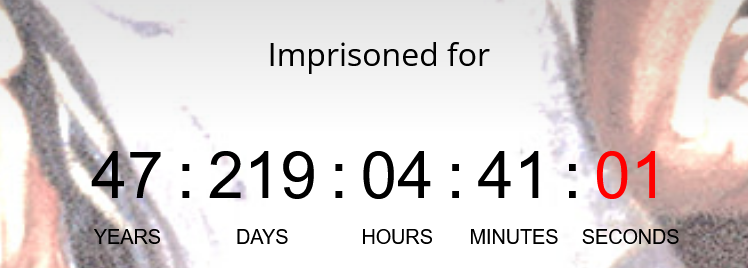
Today we join the global chorus demanding clemency for #LeonardPeltier on his 79th birthday! Sept. 12, 1944. Leonard has been politically imprisoned for 47 years! The colonial oppression is sending a message to the rest of us who have no choice but to stand up against corporate fascism.


Here’s how you can help to free Leonard:


Demand clemency for Leonard from the President and Attorney General via the online action at the Official Ad Hoc Committee. (Scroll down their home page to the action.)


Listen to the full podcast. The entire authorized podcast “Leonard: Political Prisoner” is here: https://leonard.buzzsprout.com


Watch, and share new video.
This epic, never before seen, 1 minute video, is a powerful emotional call for clemency. It is available to download and repost to get the word out.

In the ‘70s my father Wallace June Little was close with Leonard. It was a friendship that was made even closer by the tragic events of June 26th, which both were fortunate enough to survive, unlike their AIM brother, Joseph Kills Right Stuntz.

I’m excited to announce that I will be officially joining the Leonard podcast as an executive producer in Season 3, which will guide listeners through Peltier’s prison escape and unsuccessful legal appeals up until present day.

Every June 26th we remember Leonard Peltier in a run for freedom. We remember Joe Kills Right Stunts. And I even remember Ron Williams and Jack Cohler. I don't think they intended to do what they were partaking in that day.

This is a long war. And Leonard Peltier is just one battle in that long war. Just like Little Big Horn. Just like Wounded Knee One. Just like Wounded Knee Two. Just like Standing Rock.

But we've got to keep up the fight. And it's hard. Leonard Peltier cannot die in prison. Leonard only wants to come home so he can make his transition in his Homeland, which is waiting to embrace him, which loves him.

I don't know what to say about Leonard. I had the honor of visiting Leonard inside Coleman US prison; I don't know how he keeps it together in there, but he's strong. And we all benefit from that kind of unconquerable dignity. All over the world, people are calling for clemency for Leonard Peltier. We can never lose faith in knowing he should be free. Leonard is paying the price of indigenous sovereignty right now; he is doing our time.


#FreeLeonardPeltier

In honor,

Chase Iron Eyes, LRI President

Wanagi Oyate Itancan

Good Medicine

 National Native News

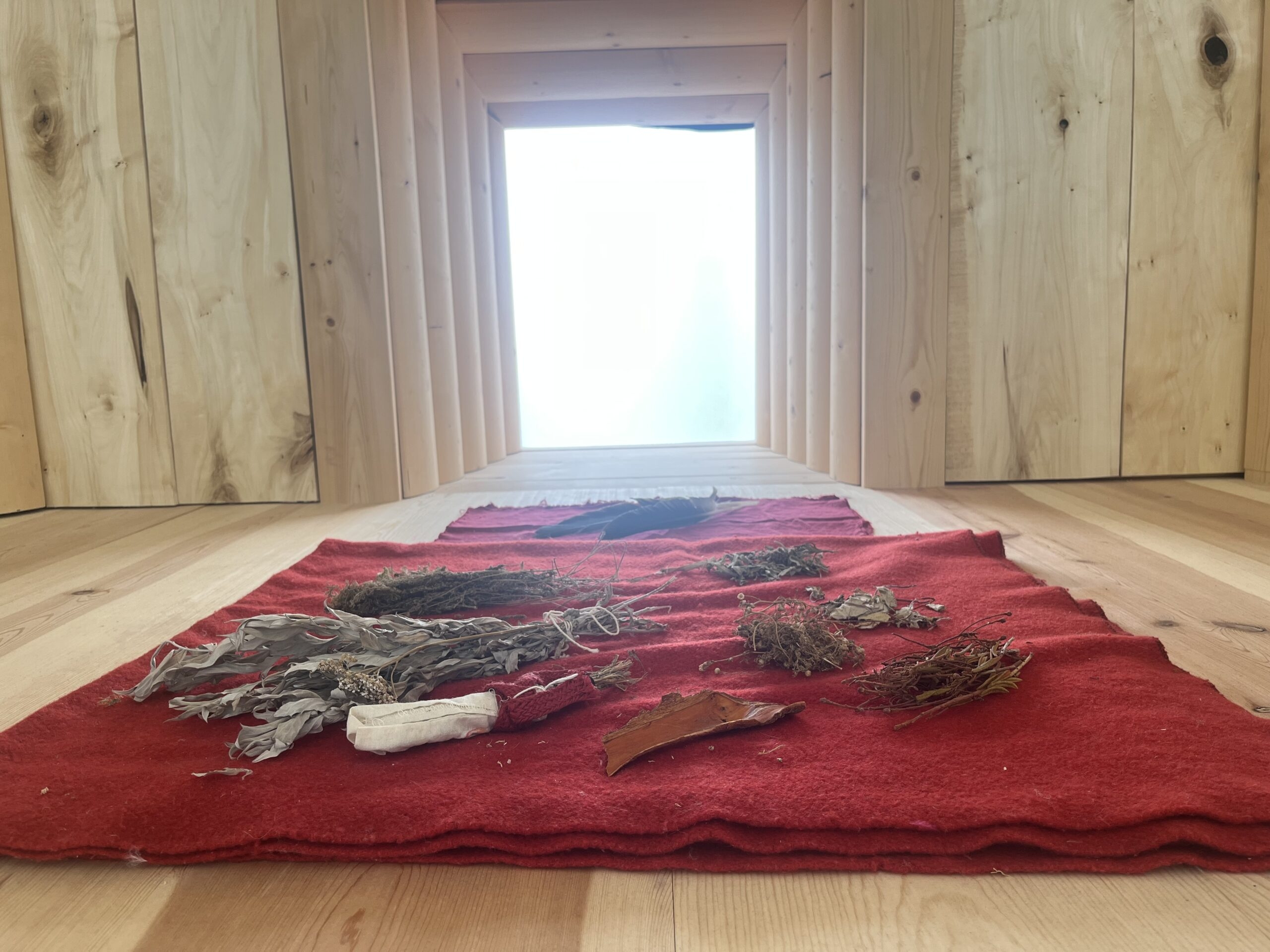
Yéil Yádi Olson is Lingít Raven from the Kaa Shaayi Hit (Severed Head House) and is also of Nordic descent. He constructed this seclusion hut in collaboration with curator and healer Meda DeWitt. Olson wanted to use his skills as a carpenter to educate others about Indigenous cultures. (Photo: Rachel Cassandra / Alaska Public Media)


The knowledge work and art of Indigenous healers and medicine people in Alaska is being featured at the Anchorage Museum.

“Good Medicine” is a multidisciplinary exhibit.

Alaska Public Media’s Rachel Cassandra has more.

“Good Medicine” features paintings, illustrations, a women’s house, and a men’s house.

Those houses are traditionally used for healing, teaching, and meetings.

Meda DeWitt’s Lingít names are Khaat kłaat and Tśa Tsée Naakw.

She’s a healer and the curator.

DeWitt says the show is both about healing and is healing in itself.

She says it holds space for traditional healers to be seen and to speak.

That’s in contrast to colonization’s attempts at erasure of Alaska Native culture.

She says healers and spiritual leaders were targeted during colonization because of how they protected people.

“Many folks were sent to insane asylums, or penitentiaries. Or they were just taken out into the woods and, you know, just went missing, never came back or out into the ocean.”

For decades, Alaska Native people were forbidden from practicing traditional healing, so she says people are choosing ways to adapt practices.

“We have to first fully articulate who we were pre contact… to understand how to adapt it so that we are… 21st century Indigenous people on our own terms.”

Ultimately, DeWitt says that acknowledging the trauma of colonization is part of cultural healing.

“Let’s not… whitewash history, let’s… work as a community together to seek healing and repair… so that way, our future generations don’t have to carry on that burden any longer.”

The exhibit “Good Medicine” will be up through the spring.

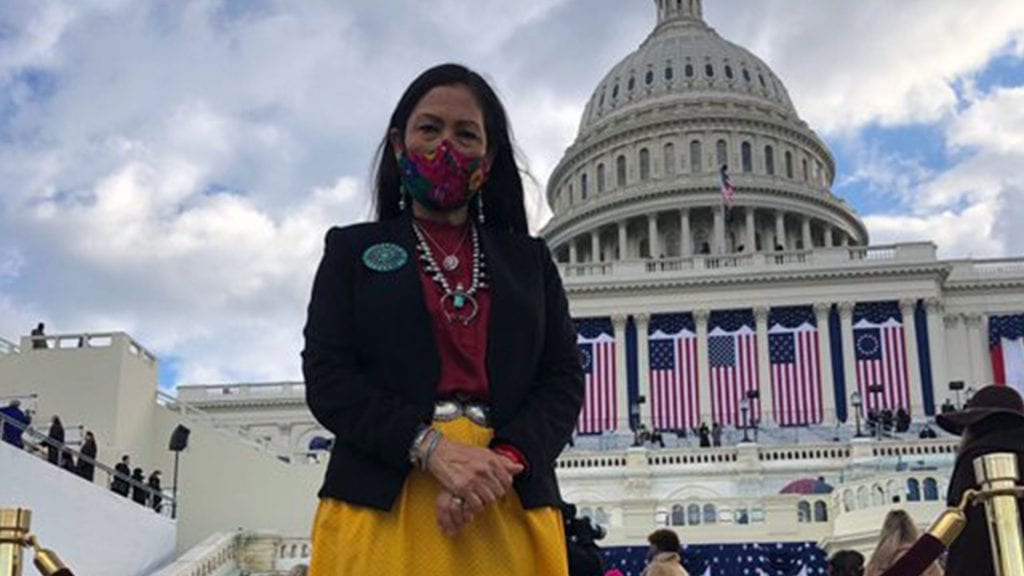
Deb Haaland, first Indigenous member of U.S. cabinet, meets counterparts in Ottawa


New exhibit to raise awareness about MMIWG2S

 VIDEO: https://ckpgtoday.ca/2023/09/09/new-exhibit-to-raise-awareness-about-mmiwg2s-at-pgpl/


Prince George – Education and awareness is what the new exhibit in the Prince George Public Library is hoping to do. Open from now until the end of September, the exhibit provides plenty of information on Murdered and Missing Indigenous Women and Girls, and has loads of visual aspects to go along with it, including red dresses along the stairway. When it comes to the educational aspects of this exhibit, it’s important to remember that the impact of the past has rippled into the present.

SEE MORE: https://ckpgtoday.ca/2023/09/09/new-exhibit-to-raise-awareness-about-mmiwg2s-at-pgpl/

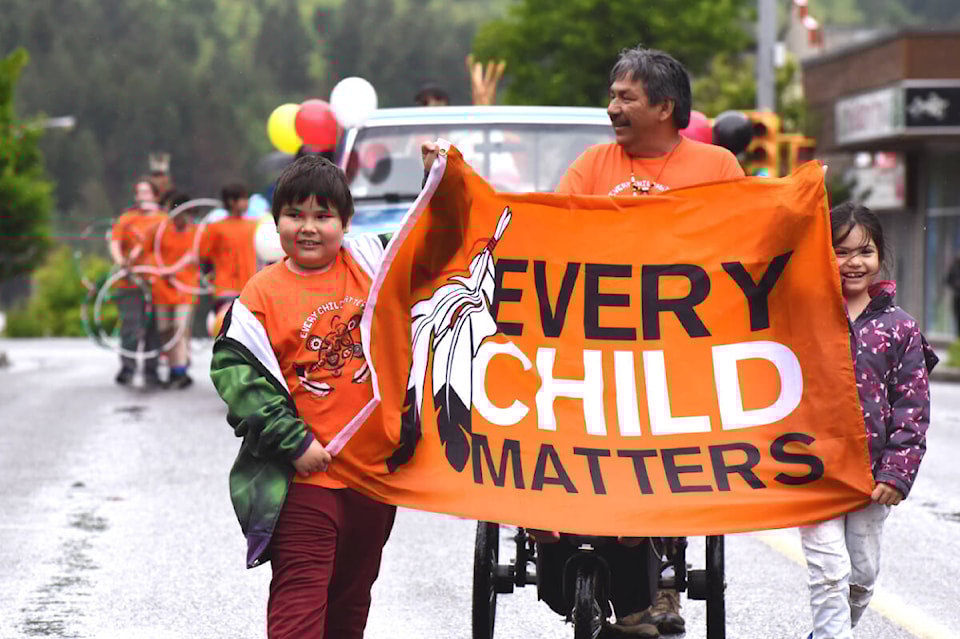
EVERY CHILD MATTERS

Songhees Nation hosts South Island Powwow on Orange Shirt Day

Public invited to free event

The Songhees Nation is hosting the second-annual South Island Powwow with support from the City of Victoria.

The powwow takes place on Sept. 30 on the homelands of the Lekwungen people at Royal Athletic Park.  Sept. 30 is a federal statutory holiday to mark the National Day for Truth and Reconciliation, also known as Orange Shirt Day.

The powwow honours and recognizes survivors of residential and day schools and their families, the Sixties Scoop and the children who never made it home from these institutions. The powwow also celebrates Indigenous cultures and resiliency and brings people together in celebration to build bridges amongst all nations.

“The South Island Powwow has rekindled a piece of Songhees history, while providing a safe space for healing, education and understanding,” said Chief Ron Sam of the Songhees Nation, in a statement.

Local First Nations, along with nations from the mainland, have been welcomed to participate in the time-honoured powwow. Last year’s inaugural event attracted 10,000 people during the grand entry, with more people expected to attend this year.

READ MORE: https://www.goldstreamgazette.com/community/songhees-nation-hosts-south-island-powwow-on-orange-shirt-day-3132278

September 30 Orange Shirt Day #TRC


September 30 is the National Day for Truth and Reconciliation

September 11, 2023

September 30 is the National Day for Truth and Reconciliation in Canada. It is a time to recognize and commemorate the intergenerational harm that residential schools caused to Indigenous families and communities, and to honour those who have been affected by this injustice.

We urge our members, staff and allies to take this opportunity to learn about, and reflect on, our past and how we can meaningfully participate in reconciliation in Canada.

The Truth and Reconciliation Commission and its Calls to Action

The Truth and Reconciliation Commission ran from 2008 to 2015, providing those directly or indirectly affected by the legacy of the Indian Residential Schools policy with an opportunity to share their stories and experiences. The Commission released its final report detailing 94 calls to action. The National Day for Truth and Reconciliation responds to Call to Action 80 from the Truth and Reconciliation Commission of Canada: Calls to Action, which reads:

80. We call upon the federal government, in collaboration with Aboriginal peoples, to establish, as a statutory holiday, a National Day for Truth and Reconciliation to honour Survivors, their families, and communities, and ensure that public commemoration of the history and legacy of residential schools remains a vital component of the reconciliation process.

The National Centre for Truth and Reconciliation (NCTR) has become the permanent archive for the statements, documents and other materials the Commission gathered, and its library and collections are the foundation for ongoing learning and research.

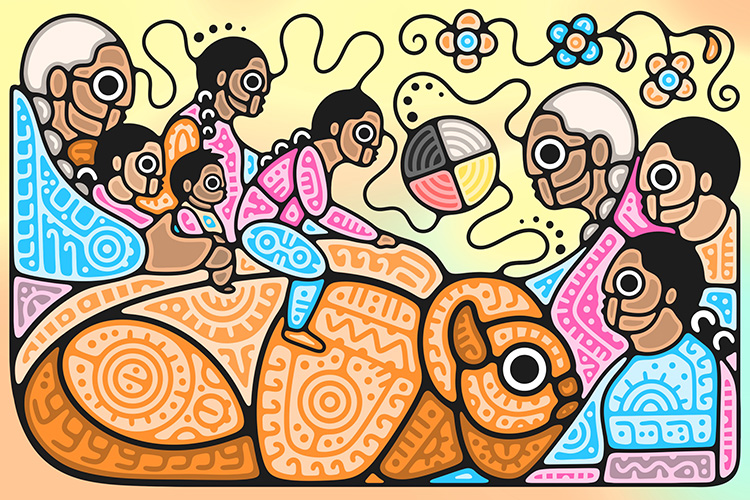
Our 2023 National Day for Truth and Reconciliation artwork was created by Anishinaabe Onyota’a:ka artist, Tsista Kennedy (https://hotdogwaterart.com/.)

When I first read the theme of "healing and care", as well as the theme of "remembering the children" being worked into this art, the image of this first draft immediately came to mind.

The bison is a common image I use in my artwork, and I often use it to portray healing, resiliency, and strength, and wellness. When the buffalo were brought to near extinction, we as Indigenous people struggled due to our diverse relationships with these animals, and the nourishment, shelter, and tools they provided us. Since colonization began, both the bison and we as Indigenous people have maintained our strength and resiliency, and now we both are growing in numbers once again. Because of this, I wanted the bison to be a place for the past generations, the children and elders, to rest upon.

The elder and children on the bison fit the theme of "remembering the children", but also represent the children and elders of the present day who will pass on and receive the traditional knowledge our ancestors succeeded in passing down to us. The individuals on the far right looking at these children and the elder represent those that support the children and the elders in any way they can, ensuring that they are doing their part in the passing down of our culture, wellbeing, and way of life. This is all connected by a medicine wheel, and some floral patterns in the top right corner, which to me represents new life, and continuity.

Tsista Kennedy, Anishinaabe Onyota’a:ka artist


Orange Shirt Day

Orange Shirt Day is a legacy of the St. Joseph Mission (SJM) Residential School (1891-1981) Commemoration Project and Reunion events that took place in Williams Lake, BC, Canada, in May 2013. The events were designed to commemorate the residential school experience, to witness and honour the healing journey of the survivors and their families, and to commit to the ongoing process of reconciliation.

Each year on September 30, people across Canada wear orange shirts to raise awareness of, and start a conversation around, the history and legacies of the residential school system in Canada. Watch the video at right to learn more about how Orange Shirt Day came to be and to listen to Phyllis Webstad's story.

Share your Orange Shirt Day photos with the ONA community. Submit them via email to digital@ona.org.

Learn More


Sunday, September 10, 2023

Little Bird


(courtesy photo)

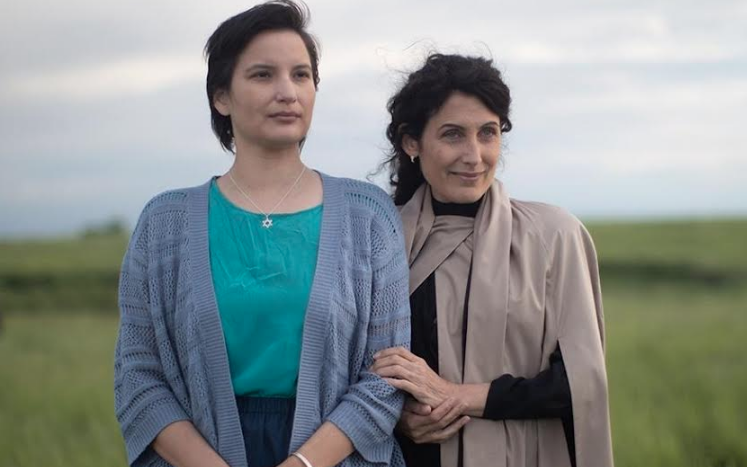
American public broadcaster PBS has announced the premiere of Canadian drama Little Bird, which follows the life of a First Nation woman who was forcefully removed from her family as a child during Canada’s Sixties Scoop.

The six-part, one-hour limited series, created by Canadian First Nations filmmaker Jennifer Podemski and playwright Hannah Moscovitch, stars Darla Contois and Lisa Edelstein and follows the life of Bezhig Little Bird, a victim of the Sixties Scoop in Saskatchewan during which indigenous children were taken from their families and adopted by white families.

Removed from her home in Long Pine Reservation, Bezhig Little Bird is adopted into a Montreal Jewish family at age five.  Now in her 20s, Bezhig longs for the family she lost and is willing to sacrifice everything to find them.  Her search lands her in the Canadian Prairies.  As she begins to track down her siblings, she unravels the mystery behind her adoption and discovers that her apprehension is connected to a racist government policy.

“It is a powerful narrative that not only engages and pulls on your heartstrings but also educates on a profoundly disturbing time in North American history that is rarely portrayed,” Germaine Sweet, Managing Director, Content Acquisitions at PBS Distribution, said in a press release.. “In addition to the creative brilliance of Jennifer Podemski and Hannah Moscovitch, this series was delivered by a wealth of Indigenous talent both in front of and behind the camera.”

The character-driven drama features Indigenous actors, including Ellyn Jade, Osawa Muskwaa, and Joshua Odjick. Rounding out the cast is award-winning actress Lisa Edelstein, playing Esther’s adoptive mother, Golda Rosenblum.

PBS will also broadcast Coming Home, which is a 90-minute companion documentary directed by Erica Daniels, which explores the connections between the movement for Indigenous narrative sovereignty and the impact of the child welfare system.

Little Bird and Coming Home will be available for streaming on October 12, 9:00 E.T., on all station-branded PBS platforms, including PBS.org and the PBS app, and on Apple T.V., Android T.V., Amazon Fire T.V., Samsung Smart T.V., Chromecast, and VIZIO.


Saturday, September 9, 2023

Assimilation Vacation?


In the 1960s, Zepeda’s grandmother protected her from being taken away on an “assimilation vacation” in the San Francisco Bay Area, where children would “learn how other families live” and potentially be adopted away from their rightful families.  Zepeda and her siblings lived with a constant fear of being taken from their home, often being told by their grandmother: “You better behave because if you don’t, white people are going to take you away.”  It wasn’t until 1978 that the Indian Child Welfare Act prohibited the removal of Indigenous children from their families.

Further alienating Indigenous people from their roots was the repression of their spiritual beliefs and practices going back to the 1850s.  Until the American Indian Religious Freedom Act passed in 1978, many people practiced secretly while participating in mainstream religion.  For example, Zepeda’s great grandfather was a tribal medicine person, but also an altar boy for a Catholic priest.

Owning land contributes to economic and societal stability as well as long term wealth. While the United States government was obliged for many generations to honor treaties and debts with native tribes, the Termination Act of 1953 sought to disband tribes, sell their lands, and relocate American Indians. For Zepeda, this meant that she was no longer Indian and was not eligible to receive services from the Indian health clinic.  The policy also had long-term and devastating economic consequences for tribal communities who lost their land.

In 1983 with Hardwick v. United States Government, Zepeda was considered Indian once again. “We have reorganized and reestablished ourselves.” Now, she lives again on the land that had been her grandma’s.

Understanding Indigenous Communities to Support Their Health Needs

READ MORE

VIDEO:  http://placemattersoregon.com/ 

For thousands of years, the Klamath Tribes have had a deep physical and spiritual connection to southern Oregon. But in 1954, the U.S. government took over their tribal lands there. The trauma of losing their land, and the racism and discrimination they confronted in the years after, are at the root of health challenges that still affect tribal members at higher rates than other ethnic and racial groups in Oregon.  Monica YellowOwl, a prevention specialist for Klamath Tribal Health and Family Services, and other tribal members are working to restore their people’s connection to the land in order to improve their physical and mental health. “We don’t always want to be seen as the traumatized Indians. We want to be seen as resilient Indians, powerful people, connected to our homeland, practicing our traditions and our cultures,” Monica says. 

Place Matters Oregon is an effort of the Oregon Health Authority to get people talking about how place affects our health—as individuals and as a community. Check out the link above to explore more connections between place and health and join the conversation. 


Friday, September 8, 2023

Protecting Alaska Native Children — Connections to Culture and the Environment

Research scientist Heather Sauyaq Jean Gordon calls subsistence ‘a preventive and protective cultural practice for well-being.’

Ivan Encelewski, executive director at Ninilchik Traditional Council, fishes for salmon with a gillnet on the Kenai River in Alaska. Provided photo.

Research released on September 5th highlights an issue rarely discussed in the field of child welfare, but vital to the health and well-being of Indigenous children and families: their stewardship of the natural environment. 

The unique study focuses on many generations of the Alaska Native Ninilchik Village Tribe, and the harmful impacts of colonization and federal and state mismanagement of traditional homelands. Tribal members contributed to the research, conducted over 12 months in South Central Alaska.

“Subsistence is a critical part of Alaska Native cultures and that the ability to pass subsistence practices to children is an important protective factor for their well-being,” reads a policy brief outlining the findings.

The report is authored by Heather Sauyaq Jean Gordon, a research scientist with the nonprofit research and policy institute Child Trends. Gordon, 38, is Iñupiaq and an enrolled member of the Nome Eskimo Community. She defines Indigenous subsistence as reaching far beyond hunting, fishing, and gathering food. 

KEEP READING


HUNT FISH GATHER - that is a treaty right too in North America.

Thursday, September 7, 2023

The real battle was in the mind: Cyclist crosses Canada

 60s Scoop |  Michael John Lo

He was determined to change his life, so he rode a bike from Moncton to Nanaimo

After 20 years living in Eastern Canada, Chris Aubichon is returning to Vancouver Island to finish his education, which he stopped pursuing at the age of 12. “This is part two of my life."
web1_chris1
Chris Aubichon’s two elder daughters and sister Jenn were waiting to welcome him at Bowen Park. From left, Nevaeh, Chris, Selenia, and Jenn. VIA JENN AUBICHON

Chris Aubichon has spent the past three months cycling across the country in a bid to raise awareness of post-foster-care life and men’s mental health — and to begin a second chapter of his own life. 

The 44-year-old father of three reached the finish line at Bowen Park in Nanaimo on Friday evening, where he was greeted by a cheering group of supporters. 

After 20 years living in Eastern Canada, he’s returning to finish his education, which he stopped pursuing at the age of 12. 

“This is part two of my life,” he said. 

Aubichon, born in Prince George and raised in Nanaimo, is of mixed Indigenous and Metís heritage; he was a ward of the court from the age of six to 18. 

His mother, who is of Tla’amin descent, was raised by a white Catholic family and was part of the Sixties Scoop. 

“She had her own demons,” he said, adding that her mother was born in a residential school. 

His grandmother died of a drug overdose in Vancouver’s Downtown Eastside after leaving residential school, he said. 

Aubichon said he has overcome his substance abuse and addiction issues, stemming from his upbringing, which involved experiences of sexual abuse in group homes. 

But his mental health remains a persistent challenge, one that has cost him jobs, relationships, and housing. 

“It doesn’t matter how badly you want to get up and go to work. You’re not getting up,” he said. 

It’s part of the reason why he chose to bike back to Nanaimo. 

“If I jumped on a plane and flew across the country, I’m going to be the same man that got there that left, and that man isn’t going to find success,” he said. 

But someone who’s able to bike across most of Canada? 

“The man that can do that can surely be successful at school,” he said. 

On May 11, Aubichon found a mountain bike that could hold his 320-pound frame, loaded it up with camping gear and started pedalling. 

He didn’t even inform his family until he was halfway to Fredericton. 

His sister Jenn, initially skeptical of the whole ordeal, had only one request: that he document his journey, both the highs and the lows. 

Aubichon agreed, even though he thought that no one would care. But his journey would be followed by ­thousands on social media, and even catch the eye of government ministers. 

The initial days were the hardest, a constant fight against severe cramps, back spasms, and shoulder pains resulting from a life of smoking, drinking and neglect, he said. 

“Physically, I was only making it 15 or 20 kilometres a day,” he said. “I could pedal for maybe 15 seconds and I would have to stop, and my legs would cramp up.” 

But the real battle was in the mind, he said. 

Aubichon has bipolar disorder, depression, and chemically-induced anxiety disorder, which has cost him jobs, relationships, and housing. 

“There were days where I’m just riding down the roads and just literally crying,” he said. 

But bit by bit, the gears felt lighter on his feet, and every day he would ride further until he was travelling 120 kilometres per day. 

That’s not to say there weren’t other challenges. 

Wildfires in Northern Ontario dogged his steps. Vicious headwinds and sweltering weather accompanied much of his journey through Western Canada. 

The Rockies were brutal, and he was forced to detour from the Coquihalla due to yet another wildfire, near Merritt. 

Twice, he was thrown off his bike in northern Ontario by the buffeting winds of camping vehicles passing him with only 12 inches of clearance. 

On the western outskirts of Winnipeg, his bike was stolen outside of a Tim Hortons. 

But an emotional dispatch on social media went viral and people donated money to replace his gear and supplies. 

There were many such instances of kindness on his journey, he said, adding that an older man in North Bay, Ont. slipped him $50 without knowing that Aubichon was starving that day and couldn’t afford to eat. 

People have invited him into homes, waited on the sides of a highway for hours just to encourage him on his journey, he said. 

“I’m still a big man, but I’m in great shape,” he said, adding that he’s probably lost 50 pounds since he started. “I have a clarity that I’ve never had in my life, and mentally I feel stronger than I ever have.” 

Aubichon now wants to help others through a bike support group and advocate for better supports for youth aging out of care, who are overrepresented in homeless populations. 

Many people living in tents right now are former wards of the state, sent out to fend for themselves at an early age, he said. 

“A lot of what they're dealing with is not their fault.” 

SOURCE

CLICK OLDER POSTS (above) to see more news

CLICK OLDER POSTS  (above) to see more news

MEGWETCH THANK YOU

HUGE Thank you for visiting this blog and sharing this with your kin. It's appreciated. Contact Trace anytime! Use the form below.

BOOKSHOP

Please use BOOKSHOP to buy our titles. We will not be posting links to Amazon.

Popular Posts

To Veronica Brown

Veronica, we adult adoptees are thinking of you today and every day. We will be here when you need us. Your journey in the adopted life has begun, nothing can revoke that now, the damage cannot be undone. Be courageous, you have what no adoptee before you has had; a strong group of adult adoptees who know your story, who are behind you and will always be so.

OUR HISTORY

OUR HISTORY
BOOK 5: Lost Children of the Indian Adoption Projects