BACK UP BLOG (no longer updating)

This blog was a backup for American Indian Adoptees blog
USE THE SEARCH BAR or SEARCH TOPICS at bottom of this blog

If you need support

Support Info: If you are a Survivor and need emotional support, a national crisis line is available 24 hours a day, seven days a week: Residential School Survivor Support Line: 1-866-925-4419. Additional Health Support Information: Emotional, cultural, and professional support services are also available to Survivors and their families through the Indian Residential Schools Resolution Health Support Program. Services can be accessed on an individual, family, or group basis.” These & regional support phone numbers are found at https://nctr.ca/contact/survivors/ . MY EMAIL: tracelara@pm.me

Search This Blog

Wednesday, May 31, 2023

My Two Aunties

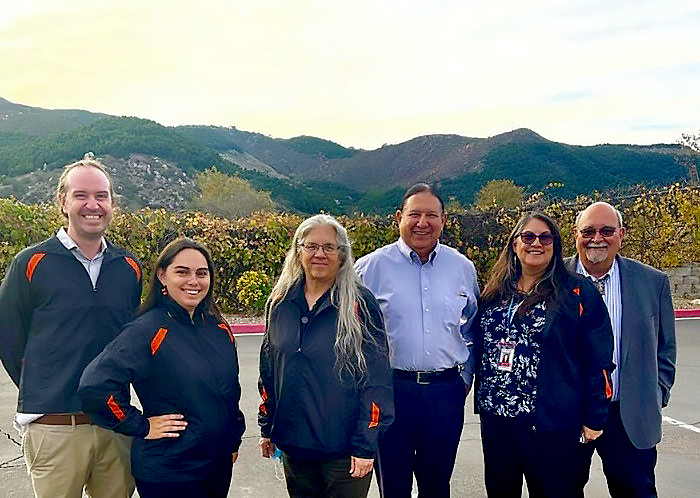
From left, Jeremy Braithwaite, Lizzie Lycett, Cori Biggs, Art Martinez,
Karan Thorne and Judge Bill Thorne during a training session with Indian
Health Council staff. Provided photo.
 Protecting Children and Healing Families, One Native Auntie at a Time


Twenty years ago, a group of Indigenous tribes in Southern California
had nearly 500 of their children in local foster care systems. Today,
according to Indian Health Council data, the number is closer to 30. 


A main driver in recent years is My Two Aunties, a program that draws on
family legacies and kinship traditions to wrap support and guidance
around vulnerable parents and children living in a consortium of nine
tribes.


Key to the approach is a pair of home-visiting workers, known as
aunties, who are as steeped in tribal customs as they are in mandated
reporting and making active efforts to reunify families after a foster
care separation. 


“Instead of ‘What’s wrong with you?’, they ask ‘What’s strong with
you?’”  said Karan Thorne, a member of the Rincon Band of Luiseño
Indians who developed the program. 

KEEP READING

Saturday, May 20, 2023

Unspoken: America's Native American Boarding Schools (2023)


KUED (now PBS Utah) takes a moving and insightful look into the dark chapter of American history, the federal Indian boarding school system. The goal was total assimilation into Anglo civilization at the cost of Native American culture, tradition, and language. The film story starts with pre-history and comes full circle to modern day. Much of the film is told in first person Native American voice by the people who continue to live it. 

Read More: www.pbsutah.org/unspoken

Osage Murders | Killers of the Flower Moon movie trailer


👇Based on David Grann’s broadly lauded best-selling book, Killers of the Flower Moon is set in 1920s Oklahoma and depicts the serial murder of members of the oil-wealthy Osage Nation, a string of brutal crimes that came to be known as the Reign of Terror.

Directed by Martin Scorsese and Screenplay by Eric Roth and Scorsese, the film stars Leonardo DiCaprio, Robert De Niro, Lily Gladstone, Jesse Plemons, Tantoo Cardinal, Cara Jade Myers, JaNae Collins, and Jillian Dion.

Hailing from Apple Studios, Killers of the Flower Moon was produced alongside Imperative Entertainment, Sikelia Productions and Appian Way. Producers are Scorsese, Dan Friedkin, Bradley Thomas and Daniel Lupi, with DiCaprio, Rick Yorn, Adam Somner, Marianne Bower, Lisa Frechette, John Atwood, Shea Kammer and Niels Juul serving as executive producers.

Friday, May 19, 2023

Estranged? | Adoption Illusions and Stockholm Syndrome


👇AN OLD POST from 2014/2021


Adoption Illusions and Stockholm Syndrome


By Trace - BLOG EDITOR


"...I’ve been thinking about this concept for a long time. Adopters,
when it comes right down to it, count on Stockholm Syndrome. Children
who don’t succumb are labelled RAD.

Whenever I encounter an
infertile woman so desperate to be a mother that she’ll bring home a
stranger’s baby and force it to live in her fantasy, I always secretly
wonder what she would do if she were single and desperate to be
married.

Would she drag some strange man home and force him to
watch the Notebook and cuddle? And if she did, would society think it
was beautiful and precious?  Or would they think she was delusional and
dangerous? 
Rhetorical question, of course.  But why? Why is what is
clearly a crime between adults viewed in such an overwhelmingly positive
way when one of the parties is a child?..."  - Renee Musgrove 


This comment by Renee has been in my head for over a year and I finally did research on Stockholm Syndrome! KEEP READING

Catholic-Operated Native Boarding Schools in the United States pre-1970


NEW Website :  https://ctah.archivistsacwr.org/


Compiled
by a group of archivists, historians, and concerned Catholics, the List
of Catholic-operated Native Boarding Schools in the United States,
pre-1978, represents the first and most comprehensive source for
information on Native boarding schools that were overseen or staffed by
the Catholic Church before 1978. Our motivation for assembling this data
was to provide a resource to help boarding school survivors, their
descendants, Tribal Nations, and the Church itself navigate the history
of Catholic involvement with Native boarding schools.

The
list has two primary objectives: first, to identify all
Catholic-operated boarding schools designated specifically to educate
Native American and Alaska Native children in the United States, and
second, to identify all Catholic entities that were involved in the
operation of each school. We are under no pretense that our list is
complete. We have done our best to offer the most accurate information
possible, but we also anticipate future revisions as additional
information is obtained.


By
bringing together basic information about Catholic-run Native boarding
schools and the various Catholic institutions involved in their
operation, the list responds to the clear request from Tribal Nations
for access to archival records in Catholic repositories. Families and
communities of boarding school survivors and their descendants deserve
prioritized access to information regarding their own histories. The
Catholic Church also has an obligation to understand the scope of its
own role in this history. Making basic facts about the history of
Catholic institutional involvement in the boarding schools more
transparent aids in that understanding and facilitates identification of
possible sources of archival records as one preliminary step to support
information access.

Our
goal is for Tribal Nations, families, and individuals to be able to use
the list to locate records for schools that members of their
communities attended. Our hope is that Catholic institutional
archives
and Tribal Nations will build relationships to increase understanding
about records for Catholic-operated Native boarding schools and further
develop the historical record. 


Email Contact: https://ctah.archivistsacwr.org/contact/


Thursday, May 18, 2023

BRUTAL PAST| Mental Impact of Cross-Cultural Adoptions

👉 The Brutal Past and Uncertain Future of Native Adoptions.
“It is our right as Indian nations to raise our children,” said Sandy
White Hawk, founder of the Minnesota-based First Nations Repatriation
Institute, which serves Native people affected by adoption and foster
care. 


In 1958, the Indian Adoption Project(s) were created “to stimulate
adoption of American Indian children by Caucasian families on a
nationwide basis.” 

See a 1967 portrait of a Long Island family,
the Zuckermans, who took part in the project.  The program was immensely popular in New York, which was already
the center of a robust and lucrative adoption marketplace.  

Such
treatment of Native parents and caretakers by white social workers
was not uncommon, but the Devils Lake Sioux were among the first to
fight back publicly.  Members of the tribe, which is now called the
Spirit Lake Tribe, traveled to New York for a news
conference
at the Indian Affairs office arranged that summer.  CLICK: [
https://turtletalk.files.wordpress.com/2018/11/proquestdocuments-2018-11-09.pdf.]


COMMENT:
kkseattle
Seattle May 17

The
entire argument for eradicating the Indian Child Welfare Act was
expressed in a white supremacist poem by Robert Louis Stevenson that I
expect Samuel Alito to quote in the opinion, with zero sense of irony: 

Little Indian, Sioux, or Crow, 

Little frosty Eskimo,
Little Turk or Japanee, 

Oh! don't you wish that you were me? 

You have seen the scarlet trees 

And the lions over seas; 

You have eaten ostrich eggs, 

And turned the turtle off their legs. 

 Such a life is very fine, 

But it's not so nice as mine: 

You must often as you trod, 

Have wearied NOT to be abroad. 

You have curious things to eat, 

I am fed on proper meat; 

You must dwell upon the foam,

 But I am safe and live at home. 

 Little Indian, Sioux or Crow,
Little frosty Eskimo,
Little Turk or Japanee, 

Oh! don't you wish that you were me? VIA

 (New York Times)

++

👇

Not Feeling “American Enough”: The Mental Impact of Cross-Cultural Adoption.
“For adoptees in the adoptee community, to move forward is to have
allies,” she explains. “The narrative [around cross-cultural adoption
tends to] lie with adoptive parents, and so we need them to elevate our
stories, to elevate us in order for people to know that there is another
narrative out there. It's not this fairy tale.”


👀Let's celebrate - over TWO MILLION VIEWS on our little website! THANK YOU! -TLH

Wednesday, May 10, 2023

Northern California County’s Child Welfare System Again Called out by Civil Grand Jury

  A report released Monday by a northern California
civil grand jury finds that the local child welfare system routinely
misses court deadlines, creating “an unnecessary amount of stress” for
children and families — particularly members of tribal communities who
are overrepresented in the foster care system.

In its report, Humboldt County Child Welfare Services and the Courts: Late Reports, Dysfunctional Systems, and Traumatized Children, the local watchdog group describes inefficiency and staff shortages as delaying family reunification for California families.


READ

Tuesday, May 9, 2023

The Morrill Family on National Television Summer 1981, 7 Ojibwe Adoptees placed in Mormon family...

By Leland P Morrill  (Navajo adoptee and contributor to the book series Lost Children of the Indian Adoption Projects) posted in 2013

"Today's Child" started in June 1964 when Helen Allen - a veteran reporter for the Toronto Telegram - was questioned at the time by a skeptical Children's Aid Societies, but supported by Ontario's provincial government. 

During its first few years, about 80% of the children featured in the column were adopted.
Helen Allen in this National Television show states that she personally adopted 10,000 to 11,000 children.  Who knows how many native and aboriginal children were adopted through her in Ontario, Canada?

Featured on this video are seven Ojibwe children, my adopted brothers and sisters, to a Mormon family who adopted 10 children. 

I was a Navajo "undocumented adoptee" before we moved to Ontario, Canada. 

Note on the video how many of my brothers and sisters are not white like our adopted parents. 

What is Genocide?  What constitutes Human Trafficking? 

Native Children who are deemed adoptable because of the 3rd world conditions forced on them through the Reservation system (Concentration Camps) may be labelled under "neglect", by Departments of Social Services that blur the lines between neglect and impoverishment; thus creating the definition of "abused or neglected" to encompass those "whose environment is injurious to the child's welfare." 

Genocide is the worst crime possible, undoubtedly the most serious crime that can be
committed under international law. 

The 1998 Rome Statute of the International Criminal Court
(hereinafter the Statute) testifies to the fact that this is the most serious of the crimes
within its jurisdiction.

It places Genocide first, followed by Crimes against Humanity,
War Crimes and the Crime of Aggression. 

The crime of genocide is defined in Article 6
of the Statute in the following terms:
[A]ny of the following acts committed with intent to destroy, in whole or in part,
a national, ethnic, racial or religious group, as such:
(a) Killing members of the group;
(b) Causing serious bodily or mental harm to members of the group;
(c) Deliberately inflicting on the group conditions of life calculated to bring
about its physical destruction in whole or in part;
(d) Imposing measures intended to prevent births within the group;
(e) Forcibly transferring children of the group to another group. 

United Nations defined genocide as the intentional "destruction of racial,
national, linguistic, religious or political groups," "with the purpose of destroying it in
whole or in part or of preventing its preservation or development,"either "causing the
death of members of a group or injuring their health or physical integrity" or interfering
with their biological reproduction or also "destroying the specific characteristics of the
group" through the "transfer of children." 

This video is evidence.  This is why ICWA and history matters. - Trace


Virtual Roundtable on the Indian Child Welfare Act (11am EASTERN)


WASHINGTON — In preparation for a fast-approaching U.S. Supreme Court decision on the fate of the Indian Child Welfare Act (ICWA), the U.S. House Natural Resources Committee Democratic minority members are holding a roundtable discussion this morning regarding the longstanding law that affirms tribal sovereignty in Indian child adoption cases. 

“House
Natural Resources Committee Ranking Member Raúl M. Grijalva (D-Ariz.)
will host a virtual roundtable to discuss the history and significance
of the Indian Child Welfare Act (ICWA),” according to a statement from
his office.

“ICWA
is a more than 40-year-old law that protects the well-being and best
interests of Native children and families in state child welfare
systems. In the past several years, ICWA has faced a series of legal
challenges, the most prominent being the
Brackeen v. Haaland Supreme Court case.

“The
virtual roundtable will feature expert panelists to discuss the history
of ICWA and the role Congress can play to strengthen ICWA and protect
Native children and families.”

Of
note, according to Grijalva: “This is the first congressional convening
to examine ICWA since the onset of recent litigation efforts.”

 RELATED: “Indian Child Welfare Act again reaches U.S. Supreme Court. The basics of ICWA and why the high court is reviewing it now.”

Thanks to Indigenous Wire for this update

Thursday, May 4, 2023

ONEIDA OP-ED: Protecting ICWA


It not only upholds Oneida’s vision of protecting families and
preserving our core values and traditional beliefs – it has promoted the
best interest of Oneida children for more than 40 years. 

READ

States Seek to Protect Tribes’ Rights in Child Custody Cases

Followers of the case say it’s unclear how the court will rule, or on which grounds the court might decide to overturn the law. Some states are making backup plans.

 https://stateline.org/2023/04/14/states-seek-to-protect-tribes-rights-in-child-custody-cases/

Wednesday, May 3, 2023

Friday, April 28, 2023

On Sacred Ground (2023) #NoDAPL


On Sacred Ground (2023)

Indigenous Studies Discussion Group, University of Cambridge, Cambridge/UK

May 3, 2023 / 18:00 h BST (UTC +1) /19:00h CEST

https://www.crassh.cam.ac.uk/events/38145/

https://www.crassh.cam.ac.uk/research/networks/indigenous-studies-discussion-network/#1-programme-2022-2023

(hybrid)

Dear All,

We
would like to invite you to the film screen of ‘On Sacred Ground’
(2023) at 18:00 on next Wednesday May 3rd in Room SG2, Alison Richard
Building. The film is based on the true events during the 2016
construction of the Dakota Access Pipeline that runs through the
Standing Rock Indian Reservation. The film follows Daniel (William
Mapother), a journalist and military veteran, and Elliot (David
Arquette), an oil company executive, who find themselves on opposite
sides of the fight during the construction of the contentious pipeline.
As the story unfolds, the two characters go down separate paths during
one of the most heated protests and confrontation with Native American
tribes in modern US history. You can watch film trailer here: https://youtu.be/F64dUVAaQV8. We look forward to seeing many of you there!

The screening will be hybrid, and please register here if you’d like to join online: https://zoom.us/meeting/register/tJIud-CupzktGt3htpkq_56K9TAiBtH4qTHP

Wednesday, April 26, 2023

The Repatriation Project


The Repatriation Project


A series investigating the return of Native American ancestral remains.

View the Full Series


Is the Metropolitan Museum of Art Displaying Objects That Belong to Native American Tribes?

by Kathleen Sharp for ProPublica

ProPublica is a Pulitzer Prize-winning investigative newsroom. Sign up for The Big Story newsletter to receive stories like this one in your inbox.

Series: The Repatriation Project

The Delayed Return of Native Remains

ProPublica is a nonprofit newsroom that investigates abuses of power. Sign up to receive our biggest stories as soon as they’re published.

Stepping into the Metropolitan Museum of Art, Shyanne Beatty was eager to view the Native American works that art collectors Charles and Valerie Diker had been accumulating for nearly half a century. But as she entered the museum’s American Wing that day in 2018, her excitement turned to shock as two wooden masks came into view.

Beatty, an Alaska Native, had worked on a radio documentary about the two Alutiiq objects and how they and others like them had been plundered from tribal land about 150 years ago. Now, the masks were on display in the biggest and most esteemed art museum in the Western Hemisphere. “It was super shocking to me,” she said.

The Met’s ownership history for the masks, also known as provenance, omits more than a century of their whereabouts. Historians say the masks were taken in 1871. But the museum’s timeline doesn’t start until 2003, when the Dikers bought them from a collector. Ownership was transferred to the Met in 2017.

The Dikers, who have amassed one of the most significant private collections of Native American works, have been donating or lending objects to the Met since 1993. In 2017, as other institutions grappled with returning colonial-era spoils, the Met announced the Dikers’ gift of another 91 Native American works.

A ProPublica review of records the museum has posted online found that only 15% of the 139 works donated or loaned by the Dikers over the years have solid or complete ownership histories, with some lacking any provenance at all. Most either have no histories listed, leave gaps in ownership ranging from 200 to 2,000 years or identify previous owners in such vague terms as an “English gentleman” and “a family in Scotland.”

Experts say a lack of documented histories is a red flag that objects could have been stolen or may be fake.

“That’s a lot of missing documentation, which is a problem,” said Kelley Hays-Gilpin, a curator at the Museum of Northern Arizona. The Arizona museum has documented about 80% of its collection, as has the Brooklyn Museum and other institutions that are considered less prestigious than the Met but that have substantial Native American collections. Some museums, such as one at the University of Denver, decline gifts that have poor provenance.

For centuries, Native Americans have decried the looting of the graves of their ancestors by pothunters and scientists and the display of their remains and belongings in museums. In 1990, Congress passed the Native American Graves Protection and Repatriation Act to facilitate the return of such items and human remains to the appropriate tribes, which the law declares are their rightful owners.

NAGPRA requires federally funded museums to notify a tribe within six months of receiving their holdings by contacting and consulting with that tribe’s chosen representative, often known as a Tribal Historic Preservation Officer, and giving them an opportunity to reclaim their objects. The law also mandates that museums file a copy of those notices with the National Park Service.

These interactions provide an opportunity for institutions to learn more about the history of objects, whether they are authentic or might have been stolen and if it’s appropriate to display them. But as ProPublica has reported this year, museums have often delayed such discussions while keeping human remains and objects that the law says should be returned.

Some pieces in the Diker Collection are sacred, such as a shaman’s rattle made of human or horse hair; some are funereal and were buried with the dead. (The Met recently returned the rattle to the Dikers, and there are “ongoing consultations” related to some other items, according to the museum.)

“Most of these items could only have ended up in private hands through trafficking and looting,” said Shannon O’Loughlin, director of the Association on American Indian Affairs, which advocates for tribal sovereignty and the protection of Native American cultures.

“The way that so many of these things wound up in museums is horrible,” said Rosita Worl, president of Sealaska Heritage and a Tlingit citizen. New York law goes by the principle of once stolen, always stolen, and she said the pieces are tainted. “The rightful thing is for these things to be returned home.”

Initially, many of the objects were loans; due to a loophole in NAGPRA, this meant the museum did not have to report them to tribes or to the NPS. To date, the museum has accepted the transfer of 77 of the promised gifts from the Diker Collection, according to the Met.

But ProPublica found that after assuming ownership the Met for years failed to consult the necessary tribal officials in a timely and consistent manner about objects in its collections. A year passed before the museum contacted someone at the Alutiiq tribe to inform them that it had their masks. (The Met declined to name the person it contacted.) Four years later, the NPS posted summaries that the Met had sent in September 2022 to 63 tribes connected to objects in the Diker Collection. The Met did so after ProPublica asked the museum about the masks and other sacred and culturally sensitive items.

All the while, the museum displayed some items with incorrect descriptions and omitted or minimized the wars, occupations, massacres and exploitation that dominated the tribes’ past.

The Met’s descriptions in its displays “are in the land of make-believe,” said Wendy Teeter, the former curator at the Fowler Museum at the University of California, Los Angeles. “The public won’t have a clue as to what a piece really is or how it got there.” This, Teeter said, “perpetuates stereotypes and bias against Native people.”

Dan Monroe, who helped draft NAGPRA and is a former director of the Association of Art Museum Directors, said the long delays in notifying tribal representatives and the NPS are a violation of the law: “They have a responsibility to follow the law and are subject to fines if they don’t.”

In a written statement, the museum said: “Although some progress has been made in updating the online catalog information and providing more complete provenance information, we recognize there is still much work to do and that this is an ongoing process that requires relationship building, patience, and great care. This is important work, and it is precisely one of the intentions of the Dikers to have a large, well-resourced institution such as The Met devote the time and scholarship to these Native items.”

The museum also stated that it is misleading to use “complete ownership histories as a standard for judging a collection,” noting that much of the Diker collection has previously been exhibited and researched by other major U.S. museums. “When new information about collection items comes to light, we openly share it (if advised by Indigenous leaders to do so), or remove culturally sensitive items from view as requested.”

During its investigation, ProPublica asked the Met to comment on statements about the collection. Some sources who had made on-the-record statements that were shared with the museum by ProPublica later asked to withdraw their statements. One indicated that they’d been contacted by a Met employee. (The Met said it constantly engages with a wide range of professionals and did not exert any pressure on sources for this story.)

The Dikers declined interview requests. In a written statement to ProPublica, they said: “For nearly 50 years, inspiring appreciation for the arts of Native America has been our greatest passion.” The couple also said that they had assessed “all available information relating to provenance” before acquiring the works.

If a museum can prove it has legal title, meaning that the object’s creator, their descendents or a tribal representative willingly transferred the piece, the museum doesn’t have to return an item. But if a tribal officer requests the return of an item, a museum must comply, unless it can prove it’s part of the chain of ownership, ideally going back to its origin. Complicating matters, thousands of Native American pieces at the Met have been in its collection since 1889, an era when many museums didn’t track the ownership histories of such works.

Questions about the legitimacy of the Met’s ownership of artwork extend beyond its American Wing. As part of a sweeping investigation into the trafficking of antiquities, the Manhattan District Attorney’s office has issued nine warrants over the past five years to seize about three dozen looted artifacts at the Met, as well as computers, memos and other material related to the objects.

Matthew Bogdanos, an assistant district attorney in Manhattan who leads the office’s antiquities trafficking unit, said he and his team found the sales histories of the seized antiquities were either fraudulent, incomplete or nonexistent. The D.A.’s office looked at filing charges for criminal possession of stolen property. “But their actions didn’t cross the threshold of ‘beyond a reasonable doubt,’” Bogdanos told ProPublica, so no charges were filed.

The Met said in its statement that it drafted a new Native American Arts Initiative in 2021 under the guidance of its “first-ever” curator of Native American Art Patricia Marroquin Norby (Purépecha, an indigenous community in Mexico). The initiative, said the museum, includes “creating an advisory committee and hiring a full-time staff position that will collaboratively focus on NAGPRA responsibilities and further prioritize the building of ongoing partnerships as well as the strengthening of community collaborations.” In March, the Met said it was also hiring a Native American art researcher whose responsibilities will include “some provenance research.”

What follows are the stories behind several Indigenous pieces that the Dikers have loaned or given to the Met. ProPublica interviewed experts and cultural officers at the affiliated tribes to learn how some of the Diker Collection objects survived brutality, theft and exploitation, little of which the visitors who pay to see them learn about from the museum.

The two carved masks that Beatty was shocked to see at the exhibit’s opening still hang in the museum. A description of them on the Met’s website says that “spirits communicate with people through whistling: these masks may be the faces of such supernatural beings.”

They may be sacred. But that’s only part of the story.

The Alutiit have lived on the Aleutian Islands in southwest Alaska for 7,500 years. In winter, people would once huddle indoors and create utensils, clothes and ceremonial objects. Using beaver-tooth tools, they would carve wood faces, painting them blue, green and red and adorning them with feathers and fur.

At a preordained time, the Alutiit would don their masks and dance and sing in ritual, said April G.L. Counceller, director of the Alutiiq Museum & Archaeological Repository in Kodiak, Alaska. A lot of the masks’ power was tied to those who had passed, she said: “For other ceremonies, the masks were a way to communicate with spirit helpers.” After the ceremony, people would hide the masks in caves to let the “sky creatures'' rest until the next rite.

In 1740, Russians invaded the area for its sea otter fur. They forced Alutiiq males as young as 12 to hunt and held Alutiiq women as ransom. People died of starvation, disease and abuse. After a century, the sea otter population had nearly collapsed, and the Russians left. The U.S. then arrived and set up schools that punished Native children for speaking their language. By the 1890s, the population of the Alutiit had dropped by 90% to 1,500.

Museums rushed to grab what was left of Alaskan cultures. When a Western Union expedition headed north, the Smithsonian Institution’s assistant manager, Spencer Baird, made sure that 20-year-old William Dall was on board to “salvage” tribal objects. Baird paid Dall $200 a year ($7,000 in today’s dollars) to ship his hoard to the museum. Baird also used “salvagers” on Army expeditions, Navy cutters and other quests, acquiring tens of thousands of pieces. The Met obtained Tsimshian rattles and Tlingit reed pipes from donors around this time.

“Almost everything that wasn’t nailed down or hidden was taken away,” said Worl, the Sealaska Heritage president.

The Met said it has provided “updated summaries to Alaskan Native communities” and “the Tsimshian and other Northwest Coast communities are on our list to receive new collection NAGPRA summaries.”

In 1871, 19-year-old Alphonse Pinart of France arrived. He spent months paddling a skin-covered kayak along the 600-mile Kodiak archipelago, stopping at islands where he found caves. Inside those caves, Pinart unearthed graves and helped himself to human remains, funeral items and masks, according to his journals.

That November, he stayed on Kodiak Island and learned the masks were used in Alutiiq rituals; he got to watch some ceremonies and published a paper about his findings.

After six months, he shipped the masks home to Pas-de-Calais and left. Before he died in 1911, he donated 87 artifacts to a small museum in a castle near Calais. They sat forgotten by the Alutiit for seven generations.

The Met’s provenance only lists owners from the past 20 years. The Dikers purchased the two masks in 2003 and donated them to the Met in 2017. The museum filed a summary with the NPS listing them in 2022, five years after the deadline.

The museum stated that in 2023, “it was recommended that the masks remain on view to provide community access.” Tribal members who live where the masks were made must travel 3,500 miles to reach the New York museum.

In 2019, the Met displayed this bag of arrows with a placard reading: “The painted and beaded patterns on this quiver symbolizes protective sacred powers.”

This description indicates the object is holy and, out of respect, should not be displayed, said Ramon Riley, the cultural resource and NAGPRA representative for the White Mountain Apache Tribe in Arizona. “But I need to see the documents showing how they escaped from their home,” he said, meaning their provenance.

The Met lists no such history. And because the Dikers loaned the quiver set to the Met in 2017 and didn’t transfer title to the museum, the Met wasn’t required to inform tribes that it possessed the item.

For the Met to list the piece merely as “Apache” shows a lack of due diligence, as there are more than 10 Apache tribes. If Met curators had contacted any of those tribes, they might have learned which group created the items. These pieces have a history that should be respected, said Riley: “The set could have been looted or taken at gunpoint.”

In the 1870s, one of the more ruthless leaders in U.S. military history, Gen. William Tecumseh Sherman, was pursuing the Apaches. During the Civil War, he had burned Atlanta. As commanding general of the Army and director of the Indian Wars, he was using similar scorched-earth methods, including devising the slaughter of 5 million buffalo to starve Native Americans.

At the time, the U.S. was planning its first world’s fair: the Centennial International Exhibition of 1876 in Philadelphia. The Smithsonian was asked to create an Indian “artifact” gallery to rival the antiquities in European museums.

In 1873, the Smithsonian’s director, Joseph Henry, wrote Sherman: “We are desirous of procuring large numbers” of Native American “dress, ornament, weapons.” He asked Sherman to tell his soldiers to send “specimens” from the battlefield. At Sherman’s request, Henry paid each uniformed “picker” up to $500 (the equivalent of $14,000 today).

The plan helped produce one of the fair’s more popular exhibits, which included Apache arrows. When the expo closed, Henry’s deputy packedthe collection onto 48 rail cars bound for Washington, D.C.

By 1878, the demand for “Indian” items had grown so large that the Smithsonian asked the public to unearth “American Aboriginal” artifacts from mounds, caves and cemeteries. Soon, the spoils of war and grave robbing filled America’s new museums like the Met, but few items had documentation or provenance.

Riley learned this while searching for the remains of his clan relative. His ancestor worked as an Army scout, carrying a government-issued rifle and his own bow and arrows. But during a massacre he was arrested for mutiny and hung, said Riley. The scout was buried with his possessions. Days later, his body was dug up and displayed in a cabinet inside Fort Grant, in what was then the Arizona Territory. Eventually, his remains were shipped to the Smithsonian.

Riley doesn’t think his relative’s quiver set was displayed by the Met; he believes that the set in the Diker Collection is a funerary item. “But to people like the Dikers, it’s all art,” he said. “It’s crazy.”

In March, after ProPublica had asked about it, the Met said it had been made aware that the quiver-and-arrow set was “potentially culturally sensitive” and had removed it from public display. The loaned item has not yet been returned to the Dikers.

When the Met displayed this item in 2019, the placard read: “During early reservation life, Plains people created objects such as this for sale to visiting military personnel, government officials” and “missionaries.”

“Sale?” said Peter Gibbs, an archivist in the Rosebud Sioux tribe’s historic preservation office. “The museum has got it wrong.”

What really occurred is that an “Indian Ring” of agents and politicians were taking bribes from people who wanted to do business on reservations. In 1886, the government hired a bankrupt 52-year-old from New York, L.F. Spencer, as an Indian agent.

Spencer arrived during hard times at the Rosebud reservation in what is now South Dakota. The U.S. sought to control the tribe by sending its children to the notorious Carlisle Indian Industrial School in Pennsylvania, where they endured harsh labor and abuse, sometimes leading to their death. The government stopped providing rations to parents who refused to give up their children.

Spencer befriended Spotted Tail Jr., son of Chief Spotted Tail, who held some of the tribe’s communal items, including the painted tipi. After Spotted Tail died in 1888, Spencer claimed the chief had signed an undated will giving Spencer many items, including the “great medicine pipe of the Sioux nation.”

Gibbs believes the will is a fraud. The pipe had been handed down to Spotted Tail by his father and his grandfather. “Junior would never have passed this pipe on to Spencer, nor the tipi,” Gibbs said. Spencer’s dishonesty was so well known that the Indian Rights Association urged the Army to fire him.

In 1889, Spencer gathered his haul and left. Back in New York, he lectured to parlor clubs about his “Wild West” exploits, showing off the tipi and other items.

After Spencer died, his daughter, Harriet Lund, bequeathed some of his spoils to relatives and to an unspecified museum. In 1963, Spencer’s granddaughter Vivian Backen sold Spotted Tail’s will and other items to a Denver art dealer, according to Spencer’s descendant Dick Miller. Correspondence between Backen and the Denver art dealer supports that history.

But the Met’s provenance doesn’t list these names. The art dealer sold a tipi from Spencer’s cache to the Denver Art Museum for $500, or about $5,000 today, even though it had mildew rot and patched holes.

In 1965, a curator at the museum sold the tipi. The Met’s record says the buyer was Larry Frank of New Mexico. After Frank died, the Dikers bought it in 1989. In 2018, they gave it to the Met, where it was displayed in pristine condition.

The Met has described it as a souvenir. But Ben Rhodd, the Rosebud Sioux tribe’s then-cultural officer, said it had another purpose entirely. The tipi shows triumphant warriors on horseback, holding up shields that represent their male societies. It was an educational tool meant to instill pride in Lakota children for their relatives’ achievements — and to teach them how to erect a tipi, he said.

“This inaccuracy is the result of a lack of consultation,” Rhodd told ProPublica. “And I think the piece has been looted.”

It’s been five years since the Met accepted this gift, and tribal officials say they still haven’t heard from the museum. The item is no longer on display; the Met said it intends to contact the tribe and file a summary as part of “our ongoing NAGPRA work.”

“Nampeyo was the first Southwest potter to become recognized by name outside her Hopi community and is renowned for her technical skills and aesthetic sensibility,” states the Met’s website. She was also one of the first Native American women to control her own work by selling directly to buyers.

The Met’s history of the jar is missing dates, but there’s enough documentation to show it was probably obtained legally. It’s an example of a commercial work of art in the Diker Collection that is appropriate to display. (In its statement, the Met said it “recognizes the sensitivity of some items in its historical Native American collection” and as a result is prioritizing the acquisition of “more modern and contemporary works by Indigenous artists.”)

In 1874, Nampeyo was a shy 15-year-old who sometimes wore a traditional manta, a type of shawl. A surveyor snapped her picture, which wound up on ads to lure tourists to the Arizona Territory. Unwittingly, Nampeyo became an iconic image of the Southwest.

It was a mixed blessing, said Leigh Kuwanwisiwma, a former Hopi Tribal Historic Preservation Officer. For centuries, the Hopi have lived on remote mesas that tower more than a mile over the surrounding landscape, allowing them to freely practice their language, religion and culture.

In the 1880s, however, a flood of dignitaries, artifact “pickers” and scholars arrived to glimpse the Hopi’s “exotic” culture. Seeing an opportunity, an old soldier from Kit Carson’s Army brigade, Thomas Keam, set up a trading post near the mesas. He plundered graves and ruins for pots and jars to sell.

In 1889, Keam sold 3,000 Hopi pieces to the Smithsonian for $10,000 — or $350,000 today. When Keam ran out of plundered pots, he turned to Hopi women, including Nampeyo, to produce them. Her mother was a Tewa, her father a Hopi, and she’d grown up near an abandoned ancient village. Playing with designs, Nampeyo made pots with yellow-orange clay and painted figures on them using black, red and white mineral pigments. Then, she polished the surface to a high sheen.

Keam sent some of her pieces to the World's Columbian Exposition held in Chicago in 1893. Collectors took notice, and Keam sold them her work. According to some scholars, Nampeyo received a fraction of the profits. By the late 1890s, she was selling directly to customers.

An ex-mayor of Chicago, Carter Harrison Jr., acquired one of Nampeyo’s works. The burnt-amber pot had a stylized face of a dancing kachina. In the 1930s, Harrison gave the object to his men’s club named the Cliff Dwellers. It sat in the foyer for decades.

The Met’s provenance says the piece was sold in 2010 by Bonhams auction house. Bidding was intense. When the gavel came down, the Dikers had bought it for $350,000, a record for Southwest American Indian pottery.

The Dikers gave the jar in 2017 to the Met, where it is currently on display. Since it’s not a sacred or funerary item and was made for commercial use, the museum is not required to file a NAGPRA summary.

“The Objects are Not Well Documented”

Midway through the Diker exhibit’s setup and development, the Met hired some advisers. But this group did not have time to contact the appropriate tribal officers, said one of the advisers, Brian Vallo, the then-director of the Indian Arts Research Center at the School for Advanced Research in Santa Fe and a former governor of Acoma Pueblo in New Mexico. Vallo stressed that he was not a tribal leader at the time but said it was important to educate the Met “on issues of cultural sensitivities and representation.”

(ProPublica spoke to Vallo several times for this story. The Met also invited the news organization to interview him, describing Vallo as an expert in “Native arts and culture” and “familiar with the field.”)

This advisory group learned the Met didn’t have a procedure for properly curating, consulting, documenting and displaying Native American objects. They insisted that the museum hire an indigenous curator.

“The Diker collection is quite beautiful, but many of the objects are not well documented.,” Vallo said. “There needs to be an informed process that should be followed so the museum doesn’t take in items protected by federal laws, including NAGPRA.”

Soon after the Diker exhibit opened at the Met in 2018, O’Loughlin, the Association of American Indian Affairs director, heard complaints about the show from members of her organization. She contacted the curator of the Met’s American Wing, Sylvia Yount, hoping to connect her with cultural officers of the tribes that had made the objects in the collection.

“I offered to bring them to New York so they could give their perspective on the display,” O’Loughlin said, but Yount declined.

Yount said publicly that she had consulted with tribal “leaders.” The museum had hired Indigenous and nonnative academics and consultants — advisers who were not chosen by the tribes to represent them, as required by NAGPRA.

Of the meeting with O’Loughlin, Yount said in a statement that they had a “productive” session in which they discussed the Met’s “ongoing NAGPRA efforts and potential future collaborations.”

As a nonprofit with $5.58 billion in assets, the Met should have hired the staff needed to provide accurate information about its works years ago, experts said. “It could set an example about the importance of combating illegal trade and the need to protect cultural heritage,” said Tess Davis, director of Antiquities Coalition, which fights cultural trafficking. “But it seems they are doing the opposite.”

Tribal members are skeptical of many museums’ willingness to consult with them. As a result, the Department of Interior in January announced proposals to improve NAGPRA by, among other things, emphasizing that museums consult with tribes at every step of the process and defer to the customs and knowledge of tribes and their lineal descendants.

When Riley, of the White Mountain Apache Tribe, learned the Met was displaying the quiver set, he grew upset. “I wanted the museum to take it down, but I didn’t know who to ask,” he recalled.

He understood the limits of NAGPRA, having been rebuffed in a previous attempt to reclaim “four of our sacred objects” held by another East Coast museum. “We had to prove that it belongs to us, that it was stolen and that it should be returned. And the museum didn’t have to prove a thing,” he said.

And those looted masks? In 2002, Sven Haakanson Jr., then-director of the Alutiiq Museum, stumbled upon some of his people’s carvings at the Château-Musée de Boulogne-Sur-Mer in Pas-de-Calais. The French looter Pinart had given the masks to the museum a century earlier. Stunned, Haakanson met the facility’s then-director and spent the next six years cultivating a relationship with the museum. Finally, in 2008 the French shipped 34 masks to the Aluttiq Museum as a temporary loan.

Haakanson mounted a groundbreaking exhibition. “We wanted people to see that the masks were not only striking, but part of an Alutiiq tradition of sharing 7,000 years of history,” he told ProPublica. The exhibit brought some people to tears. “It helped heal the unspoken wounds of the tribe,” he said.

Now, the Alutiit are relearning how to make masks as their ancestors once did.

Such successes inspire Gibbs and the Rosebud Sioux tribe. “There should be a Cultural Repatriation Day when it’s safe for everybody and anybody who has something to give it back to tribes, no questions asked,” he said.

That includes the Dikers, he said, and the Metropolitan Museum of Art.
Monday, April 24, 2023

Petitioning the Court to Open Your Adoption File (for adoptees adopted in the United States) | Old Papers and the NARA


2023: The states of Alabama, Alaska, Connecticut,Colorado, Kansas,
Louisiana,Oregon, Maine, Massachusetts, New Hampshire, New York, Rhode
Island, and Vermont (July 1, 2023) are the only U.S. states where adult
adoptees have unrestricted access to their own original birth records!  Check out Bastard Nation

The late Karen Vigneault always told adoptees to not be afraid of using the courts to open your adoption records.  And she used NARA, a federal program that has files on everyone. Read more below:  Trace

Petitioning the Court to Open Your Adoption
File (for adoptees adopted in the United States)


Why you should consider a petition:


Petitioning the court to open your records is something every
adoptee should try. Even the most restrictive states allow the
sealed adoption file to be open via court order, and petitioning
the court is usually not a difficult nor terribly expensive
proposition, and your odds are slightly better than winning the
lottery.


As is detailed in my search series article, "Documents",
the court file contains a variety of documents related to one's
adoption, often including the original birth certificate. The
most likely occurrence is that when petitioned, the judge will
instruct that only non- or de-identified information be compiled
from the file and given to you, but in a few instances, judges
have been known to open the entire file. A very few judges will
open files to every adoptee who asks, regardless of the reason.
It pays to research how the particular judge you will be
appearing in front of usually responds to petitions to open the
file.  Local search groups often have this information, or you can
post an inquiry on an email list or Usenet newsgroup, as
discussed in previous parts of this Search
Series.


The details of petitioning:


Petitioning the court does not require the services of a
lawyer although it can help your chances of success to use one.
The first step will be determining what court has your file. You
probably have already obtained this information if you followed
the steps detailed in the other documents of this series. The court that has your file will
be the court that finalized the adoption. In the States, this is
usually a county Family court, located in the county where your
adoptive parents resided at the time of your adoption. Most
courts will have the proper forms for petitioning available to
you on request, and you do not need to be physically present at a
hearing date in order for the judge to read and respond to your
petition, although appearing in person can greatly enhance your
chances of success. Along with the petition, you should include
the reason for your request. You may simply believe the
information belongs to you, and you can state this, but the sad
truth is that you are more likely to be successful if there are
extenuating circumstances. If you have a medical condition that
could be eased with the information or with finding your
birthparents, proof and explanation of that condition should be
included in your petition. If there were unusual circumstances
involved in your adoption, if you know your birthparents are
deceased, if you already know the identity of your birthfamily,
or if your adoptive parents are deceased, you should include a
statement to that effect, along with proof of your claims.
However, even if you do not have any unusual circumstances, and
simply want the information, you should still try a petition. As
stated above, some judges will release the file to adoptees just
for the asking.


Using The Indian Child Welfare Act in a petition:


The Indian Child Welfare Act is little-used, but it can be the
key to a successful petition to open a sealed file if you are
adopted, and are some or all Native American. The ICWA was passed
in 1978 to address congressional findings that "an
alarmingly high percentage of Indian families are broken up by
the removal, often unwarranted, of their children from them by
nontribal public and private agencies and that an alarmingly high
percentage of such children are placed in non-Indian foster and
adoptive homes and institutions; and..... that the States,
exercising their recognized jurisdiction over Indian child
custody proceedings through administrative and judicial bodies,
have often failed to recognize the essential tribal relations of
Indian people and the cultural and social standards prevailing in
Indian communities and families."


One section of the ICWA is of particular interest to adoptees.
Section 1951b states "Upon the request of the adopted Indian
child over the age of eighteen, the adoptive or foster parents of
an Indian child, or an Indian tribe, the Secretary shall disclose
such information as may be necessary for the enrollment of an
Indian child in the tribe in which the child may be eligible for
enrollment or for determining any rights or benefits associated
with that membership. Where the documents relating to such child
contain an affidavit from the biological parent or parents
requesting anonymity, the Secretary shall certify to the Indian
child's tribe, where the information warrants, that the child's
parentage and other circumstances of birth entitle the child to
enrollment under the criteria established by such tribe."


Essentially this section directs the State to give adult
adoptees of Native American heritage who request it, their birth
information, so that they may enroll in their tribes. The section
does allow for birthparents to file a veto, but even then the
adoptee is entitled to tribal notification so that they may
process their tribal rights and privileges. You can read the entire ICWA on
the Web.


There are a few problem areas with using the ICWA. Many
adoptees are of enough Native American blood to qualify for
enrollment in their tribes, but there is nothing documented that
verifies that information. Before a judge will open a file under
ICWA s/he will often demand some sort of proof that the adoptee
is NA at all, proof that most adoptees will simply not have. But
in other instances, the agency that handled the adoption, or the
court file itself, will contain notations that you, the adoptee,
do have NA ancestry. If you have received non-ID from a source
that states this, include a copy with your court petition. You
will also need to include a copy of the ICWA in order to make the
judge's work easier and predispose him/her to wanting to help
you. If you have any information at all that you are even the
smallest bit Native American, you should use the ICWA in your
petition. Include affidavits from family members (adoptive and
birth) who have told you that you have Native American blood, as
well as any 'official' agency or other documents to support your
claims. Remember that most tribes have small blood quantum
requirements, and you should not feel guilty about using the
ICWA. The intent of this law is to ensure that those of us who
are entitled to tribal membership by birthright, have the
*choice* to join our Native American communities.


What to Expect:


Your petition will have several possible outcomes. It can be
denied outright, and you will receive nothing.  Or, you might be
denied identifying information, but receive censored copies of
documents, or merely a summary of non-ID compiled from the
documents themselves.  The judge might also choose to appoint an
intermediary. The intermediary will be given the file, and will
conduct a search for your birthparents, usually the birthmother
if you have not already found her.  She will then be asked for
permission to release identifying information to you.  The irony
is that in many cases, you still will not be given the court file
or the documents contained within it, even if your birthparent(s)
agrees to exchange identifying information.  You will usually be
required to pay for the intermediary service
. In the case of the
ICWA, sometimes the Court will appoint a tribal intermediary who
will process your tribal enrollment in addition to seeking
permission from your birthparent(s) to exchange identifying
information.  This is in contravention of the mandates of the
Federal Act, but that does not seem to have stopped judges from
doing it.  Lastly, copies of parts of or your entire file might be
turned over to you, unaltered.


This is a work in progress. Adoptees with experience in
petitioning the court for their adoption file are encouraged to
email me with the details of their experiences for use in this
document.


This post was authored by Shea Grimm, sheag@oz.net, except
where otherwise indicated. It may be copied and distributed
freely, in whole or in part, as long as it is not sold, and as
long as this notice is kept intact.


Back to Shea's Search Series:
The Definitive Guide to Self-Empowered Adoptee Search

Editor Note: The government has files on everyone, going way back.  My sister Teresa and I found a marriage license from 1901 and got copies.  If you do have a name of an ancestor who was adopted, try using the NARA.

 Find an office near you

Toll-free number


1-86-NARA-NARA (1-866-272-6272)

I have a name!
Now what?
 

If you have a name, and an indication from your non-ID or
other sources that members of your birthfamily served in the
military, there are sources on and offline that can provide you
with other crucial bits of information. The Freedom of
Information Act allows individuals to request certain records on
both living and decased military personnel regardless of their
relationship to the individual, or reason for the request.
Information obtainable under the FOIA includes Name, Service
Number, Rank, Dates of Service, Awards and decorations and City/town
and state of last known address including date of the address.  If
the veteran is deceased you are entitled to Place of birth,
Geographical location of death, and Place of burial. To find out
where to write for records, visit the National Archives
and Records Administration site
dealing with military
personnel records.


For those searching in Canada, The National
Archives of Canada
has personnel files of over 5,500,000
former military and civilian employees of the Canadian Armed
Forces and the Federal Public Service.  Documents in these records
contain information about the individual's employment history
with Federal Departments, the military units with which he or she
served, pension details, and more.

 Read my earlier articles:

How to Open an Adoption Part One (UPDATED)

http://registry.adoption.com/ –FREE, Reunion registry for adoptees, adoptee blogs and information.


Thursday, April 20, 2023

THEY ARE NOT ARTIFACTS: HUMAN REMAINS

EXCERPT:

Serpent Mounds repatriation stalled

The Michi Saagig
of Hiawatha First Nation have been working for several years on the
repatriation of about 200 ancestral remains and ancestral artifacts
removed from the Serpent Mounds national historic site, about 150km
northeast of Toronto.

The park is home to ancient burial mounds
that date back about 2,000 years. There are 10 mounds in total.  The
largest is 60 metres long and 8 metres wide, shaped like a snake, that
contains the remains of 150-200 individuals.  It's surrounded by eight
smaller round mounds, each containing the remains of between 50 and 80
individuals.

The site was excavated in the late 1950s by an
archeologist affiliated with the Royal Ontario Museum (ROM). Hiawatha
First Nation has been wanting the ancestral remains and artifacts that
are at the ROM repatriated for decades, although the formal process was
only started a few years ago. 

Richard Johnston's excavation at Serpent Mounds, near Peterborough, Ont., took place from 1957-1960. (Royal Ontario Museum)

While
the First Nation received approval to have the remains and items from
the mounds returned, not everything from the park is included.

Near
the mounds, three burial pits were also excavated.  The Huron-Wendat
nation has made a claim to the remains and artifacts removed from the
pits.

Chief Laurie Carr of Hiawatha First Nation says this has stalled the repatriation process.

"It's
very frustrating that our ancestors are still sitting at the ROM
because Huron-Wendat believe that they have claims to them and there's
no archeological proof of any Huron-Wendat villages in our area," said
Carr.

"There are a few sites around Rice Lake that are said to be Huron-Wendat, however they need to be substantiated." 

Carr said the Huron Wendat haven't come forward to meet with them, "which leaves us stuck."

There
are ten mounds in total at Serpent Mounds national historic site, the
largest being 60 metres long and shaped like a serpent. (Royal Ontario Museum)

"If they really cared about the ancestors they should be having discussions with us and they're not."

The Conseil de la Nation Huronne-Wendat did not respond to a request for comment. 

The Royal Ontario Museum declined to comment.

The
ROM's board policy regarding repatriation of Indigenous human
remains says "The ROM will not arbitrarily decide contested cases, i.e.,
cases in which more than one Indigenous group claim the same
ancestors."

SOURCE

CLICK OLDER POSTS (above) to see more news

CLICK OLDER POSTS  (above) to see more news

MEGWETCH THANK YOU

HUGE Thank you for visiting this blog and sharing this with your kin. It's appreciated. Contact Trace anytime! Use the form below.

BOOKSHOP

Please use BOOKSHOP to buy our titles. We will not be posting links to Amazon.

Popular Posts

To Veronica Brown

Veronica, we adult adoptees are thinking of you today and every day. We will be here when you need us. Your journey in the adopted life has begun, nothing can revoke that now, the damage cannot be undone. Be courageous, you have what no adoptee before you has had; a strong group of adult adoptees who know your story, who are behind you and will always be so.

OUR HISTORY

OUR HISTORY
BOOK 5: Lost Children of the Indian Adoption Projects