This blog was a backup for American Indian Adopteesblog
USE THE SEARCH BAR or SEARCH TOPICS at bottom of this blog
If you need support
Support Info: If you are a Survivor and need emotional support, a national crisis line is available 24 hours a day, seven days a week: Residential School Survivor Support Line: 1-866-925-4419. Additional Health Support Information: Emotional, cultural, and professional support services are also available to Survivors and their families through the Indian Residential Schools Resolution Health Support Program. Services can be accessed on an individual, family, or group basis.” These & regional support phone numbers are found at https://nctr.ca/contact/survivors/ .
MY EMAIL: tracelara@pm.me
ADOPTEES UNITED are launching a series of programs on searching, with the first one this month focusing on search angels, birth searches, and the difference between domestic and intercountry adoptees in finding their origins. Join us for Search 101: A Primer and More, on Tuesday, December 13, 2022, at 3pm Pacific/5pm Central/6pm Eastern (USA and Canada).
We will be with Lynelle Long of Intercountry Adoptee Voices (ICAV) and Annette O’Connell of Adoptees United as they introduce the basics of searching, not only for US-born adoptees but also for intercountry adoptees. We’ll discuss as many questions that we can fit in, plus take on a few we have teed up already. Register today for this AU-produced event.
We’ll discuss many questions:
What should I know about the process even if I wanted to search?
What are the differences between a domestic (US-based) search and one involving a specific country and intercountry adoption?
What’s a Search Angel and how do I find one? What do they charge, or aren’t they supposed to be free?
What is an intercountry adoptee birth search and what does it involve? Are there resources to help?
What can DNA do for me and what are the limitations of it, especially across the globe?
How do I handle cultural and language differences?
What are the ethics of searching and what should I be careful about?
Who makes contact with a possible birth relative and how should that be handled?
Global times are December 14, 2022, at 12:00am (Amsterdam); 4:30am (Mumbai) and 10:00am (Sydney). This event will be recorded, though we would still love to see you there. -Gregory Luce
Kimberly Murray says an impending bill making Indigenous policing an essential service could make the process of searching burial sites much safer for Indigenous communities.
OTTAWA—For Kimberly Murray, many challenges lie behind the difficult work of crafting a legal framework that would seek justice for children who faced abuse and lost their lives at Canada’s residential schools.
In June, Murray was appointed the country’s independent special interlocutor for missing children, unmarked graves and burial sites.
For two years, Murray is taking on the heavy task of liaising with Indigenous communities to examine how Ottawa, provinces and territories protect and investigate these sites, with the aim of improving Canadian laws and making recommendations for a new federal legal framework.
Nearly five months into the job in October, Murray says some of those challenges are more sprawling than she first believed.
“The records are proving (to be) a larger concern than originally I thought,” she told the Star.
While obtaining and accessing residential school records held by churches and the federal government have long been considered a barrier to achieving reconciliation, Murray said the issue extends far beyond those entities.
She’s encountered cases of children sent to the schools, apprehended by municipal police for running away, entered into the court system and sent to reformatories, before being shuttled back to the institutions they first fled.
“This systemic interconnection of all these organizations and entities and institutions is much larger than I thought,” said Murray, of attempts to lay out a clear paper trail in each of those cases.
The role of special interlocutor was first announced last summer, after ground searches confirmed the existence of hundreds of unmarked graves at the sites of several former residential schools. At the time, the federal government earmarked $83 million, on top of other investments, to research and locate burial sites, and to commemorate children who died at the institutions.
Since then, Indigenous communities have grappled with how to go about conducting searches of their own. As of September, 88 communities have received federal funding to begin that work, Murray said.
The former executive director of the Truth and Reconciliation Commission said the ongoing battle to access records — including those from local police services, hospitals and universities — is mirrored in the challenges accessing potential burial sites.
She referenced the recent example involving Sioux Valley Dakota Nation in southwestern Manitoba, whose radar survey at a campground in Brandon was stalled after the site’s owner blocked access to the area.
“There’s also issues with other sites that aren’t necessarily where the residential school was located, but was associated with a residential school, or we know that Indigenous children got sent to these places,” Murray said.
“Our legislation and our legal framework doesn’t adequately address those concerns.”
These are issues Murray raised at a meeting with federal, provincial and territorial ministers of justice two weeks ago, where she was able to discuss her mandate with government officials for the first time.
Murray said she hopes to conduct similar meetings with Indigenous relations ministers across the country as part of a wider effort to improve co-ordination between hundreds of Indigenous communities.
One of the topics raised in her discussion with justice ministers was enshrining Indigenous policing as an essential service — a topic Ottawa is hoping to address in the form of new legislation this year.
At present, Indigenous police services are funded through the First Nations and Inuit Policing Program, which was established in 1991. While costs are split between provinces, territories, and the federal government, police services are still regularly underfunded.
Ottawa had initially hoped to table legislation on the matter as early as this fall, a deadline that has now been pushed back to this winter. The legislation is expected to help reform the way Indigenous police services are funded, which would provide communities with full-time, culturally-sensitive services.
Murray said having a safe policing alternative is critical for communities wrestling with how to bring law enforcement into their searches.
Such police services could fundamentally change the way investigations are conducted, Murray said, including allowing families and survivors to actively take part in the process.
“I am always offended when I hear a Crown attorney or a police officer say, ‘Well, we have to protect the integrity of the investigation. To me, that’s very demeaning and disrespectful to the families and their communities because nobody wants to interfere with the integrity of the police investigation,” Murray said.
“That to me is a buzzword, a white people buzzword, for ‘Get out of our way.’”
Having legislation in place as quickly as possible would eradicate some of that mistrust, Murray said.
“(Indigenous police) weren’t the ones taking the kids when they ran away and bringing them back. They weren’t the ones that did the failed investigation when survivors were coming forward about sexual abuse,” Murray said. “If we have First Nations police services, trained, properly resourced, with the ability to do this investigation, that could be the solution.”
— a mote of dust, suspended on a sunbeam (@CarlaHolley) December 2, 2022
Sadly, as @r_bergen reports in this piece in June, Jeremy Skibicki was already on the police radar for domestic violence charges. https://t.co/pgS7NdAEht
Alleged serial killer in custody and charged in killings of 4 Indigenous women in Canada, police say
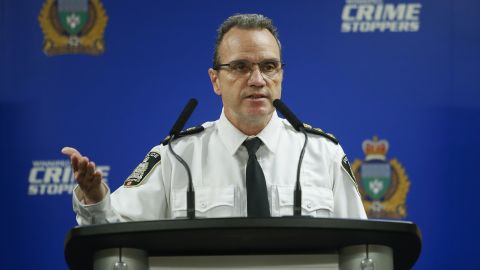
Winnipeg Police Chief Danny Smyth provides an update Thursday to the homicide investigation. John Woods/AP
CNN —
Authorities in Winnipeg, Manitoba, believe the murders of four Indigenous women came at the hands of an alleged serial killer now in custody in Canada.
Jeremy Anthony Michael Skibicki, 35, of Winnipeg, has been charged with four counts of first-degree murder for the deaths of the women, a news release from the Winnipeg Police Service states. It is not clear if he has an attorney.
The investigation dates to May 16, when Winnipeg police shared information on the murder of 24-year-old Rebecca Contois, of the Crane River First Nation, after her partial remains were discovered.
Skibicki was arrested May 18 by the agency’sHomicide Unit and charged with first-degree murder, the release says.
During the investigation, detectives established three more victims murdered between March and May – before Contois’ death.
Morgan Beatrice Harris, 39, is believed to have been killed on or around May 1, and Marcedes Myran, 26, is believed to have been killed on or around May 4. Both women were members of the Long Plain First Nation, according to the release.
A fourth victim also is confirmed but not yet identified. She is believed to be an Indigenous female killed on or around March 15, police said.
And the investigation is not over, Winnipeg Police Inspector Shawn Pike said Thursday during a news conference.
Bodies of those three new victims haven’t been recovered, said Winnipeg Police Chief Danny Smyth, noting police have enough evidence to charge Skibicki in their killings.
“Our officers will continue to search for information with the goal of identifying this fourth unknown victim,” Pike said, adding DNA has helped in their probe without saying how.
Meantime, Winnipeg must better address the safety concerns of the community, Mayor Scott Gillingham said at Thursday’s news conference.
“As a city, we must all grieve their loss and recognize that we have much more work to do to protect the lives of Indigenous women and girls,” Gillingham said.
Skibicki is being held at the Milner Ridge Correctional Centre in Manitoba.
In his Facebook bio, Skibicki described himself as an "official member of 'Holy Europe,'" which is a small faction of a broader far-right movement, an anti-facism expert told CBC last June.
Jeremy Skibicki is now facing four first-degree murder charges in connection with the deaths of four women, including Rebecca Contois, Morgan Beatrice Harris and Marcedes Myran. (Jeremy Skibicki/Facebook)
Support is available for anyone affected by details of this case. If you require support, you can contact Ka Ni Kanichihk's Medicine Bear Counselling, Support and Elder Services at 204-594-6500, ext. 102 or 104, (within Winnipeg) or 1-888-953-5264 (outside Winnipeg).
Support is also available via Manitoba Keewatinowi Okimakanak's Missing and Murdered Indigenous Women and Girls Liaison unit at 1-800-442-0488 or 204-677-1648.
June 1900, Phoenix. (U.S. National Archives and Records Administration)
Red Cloud Indian School is taking the lead among Christian-run schools in coming to terms with its assimilationist past.
The Jesuits have given Red Cloud a $20,000 grant to help in the work, including conducting searches with ground-penetrating radar for unmarked graves, and have allocated $50,000 to hire an archivist for one year to examine the order’s boarding school history at its archives in St. Louis.
School leaders are also working with tribal representatives about searching the school grounds on the Pine Ridge Reservation in South Dakota for remains of students who died there.
“The Catholic Church needs to recognize that honesty, being forthright and vulnerable are far more powerful and more healing than being reticent, restrictive and closed,” said Maka Black Elk, Oglala Lakota, executive director for Truth and Healing at Red Cloud Indian School.
Churches are joining the U.S. federal government in facing the often-brutal history of Native boarding schools, which forced children from their families into schools where they were often abused, underfed and used as virtual slave labor. Some died there without ever going home.
U.S. Interior Secretary Deb Haaland (Laguna) launched the Federal Boarding School Initiative in June directing the agency to prepare a report detailing historical records of schools operated by the U.S. government.
Secretary of the Interior Deb Haaland (Laguna). (Photo by Leigh Vogel / Getty Images)
The Initiative, however, has no authority over Christian denominations, which operated about one-third of the approximately 400 Indian boarding schools in the U.S.
With more than 100 schools, various Catholic orders operated most of the Christian Indian boarding schools, some long before President Ulyssis Grant’s 1869 Peace Policy formally created the federal school system.
Christians began operating boarding schools as early as the 1600s when Jesuits and Puritans separated Native children from their families in order to receive “civilizing” Christian instruction.
Christian missionaries were paid by the federal government to operate Indian schools beginning in 1819 with the Indian Civilization Fund Act. But the heyday of federal Indian boarding schools came under Grant’s policy.
Indian Country Today reached out to leadership in the Catholic, Methodist, Presbyterian, Episcopal and Quaker churches, denominations that operated most of the schools, asking what they are doing now to address the history.
Murals on the rear side of the abandoned Concho Indian Boarding School in El Reno, Oklahoma, were painted by Steven Grounds of the Navajo and Euchee tribes. (Photo by Mary Annette Pember / ICT)
WARNING: This story has disturbing details about residential and boarding schools. If you are feeling triggered, here is a resource list for trauma responses from the National Native American Boarding School Healing Coalition in the US. The National Indian Residential School Crisis Hotline in Canada can be reached at 1-866-925-4419.
Tucked in hundreds of envelopes is the hair cut from Native children as they arrived at boarding schools. Hidden away for nearly 100 years in the recesses of the Peabody Museum at Harvard University, the collection of hair samples offers tangible evidence of the trauma of assimilation.
According to the hygiene of the day, cropping hair was the surest way to avoid lice among the crowded populations of children coerced to attend the nation’s Indian boarding schools.
For boarding school survivors, however, the haircuts came to symbolize the harsh introduction to the process of assimilation, a gesture disregarding their culture and families wishes.
Denise Lajimodiere, Turtle Mountain Band of Chippewa, wept as she described her reaction to hearing about the museum’s findings.
Some of those sampled could still be alive today, Lajimodiere said.
The Peabody Museum recently discovered the box of human hair among its holdings. Gathered nearly a century ago, the hair was taken by an anthropologist from the heads of hundreds of Native children who attended Indian boarding schools between 1930 and 1933.
Museum leaders released a public announcement on Nov. 10 about the findings.
“I imagine that many people, especially non-Natives, hardly gave it a second thought,” said Jamie Azure, chairman of the Turtle Mountain Band of Chippewa tribe.
“But for Native people hair represents cultural and spiritual connections to family and place. Our hair is part of our strength.”
The United States is trailing Canada in addressing its history of government- and church-run Indian boarding schools.
Although the Department of the Interior under Secretary Deb Haaland’s leadership recently released the Federal Indian Boarding School Investigative Report, there are currently no services or support for survivors in the U.S. Haaland is the first Indigenous person in a presidential cabinet.
But more needs to be done.
“There’s no mental health support for our survivors in the U.S. unlike in Canada,” Lajimodiere said. “How do we begin to heal when the trauma doesn’t stop?”
‘A spiritual violation’
When children first arrived at boarding schools, authorities would routinely cut their long hair into short, uniform styles, an experience that has left many survivors as well as their descendants suffering from negative physical and mental impacts, according to researchers.
Basil Braveheart, Oglala Lakota Nation, still vividly recalls the shock of having his long hair cut more than 80 years ago, when he first entered the Holy Rosary Indian Mission on the Pine Ridge reservation.
“They cut my hair, a spiritual violation,” Braveheart told ICT and Revealin an earlier interview. “In our culture, only the maternal grandmother had the right to cut our hair. When they let my hair fall to the floor and stepped on it, I felt disrespected.”
No hair samples from Holy Rosary were among those discovered at the Peabody Museum, and the names of those whose samples were discovered have not been released. Holy Rosary has now been renamed Red Cloud Indian School and is no longer a boarding school.
The Peabody Museum published an apology from Director Jane Pickering and a promise to return the hair to families and tribal nations.
The museum also created a website dedicated to describing its process in addressing the hair samples, which were originally collected by George Edward Woodbury, curator of the State Historical Society of Colorado.
The acknowledgement section of the website reads, “It is impossible to talk about hair taken from Indigenous people and its possession by the Peabody Museum without acknowledging the ties between early anthropological practices and colonialism, imperialism, and scientific racism — the very same systems of dispossession and assimilation that led to the establishment of Indian boarding schools.”
Woodbury and his wife Edna collected more than 1,500 samples of Indigenous peoples’ hair between 1930 and 1933 from North and South America as well as Asia and Oceania. They donated the collection to Harvard in 1935.
A spokesperson for the museum told the The New York Times that the collection has never been displayed. The samples include about 700 clippings of hair taken from students at Indian boarding schools and have been stored in envelopes labeled with names, tribal affiliation and locations of collection.
Although the museum has released information about tribal affiliation and location, it has not yet published the names of the owners of the hair.
According to its website, the museum has reached out to some tribal leaders regarding the process of repatriation and is waiting for feedback before releasing individuals’ names.
The Harvard University Native American Program wrote an email offering emotional support to the school’s Native students the day before the museum publicly announced information about the collection of hair. According to the email, shared with ICT, “There are over 90 community members (students, staff and faculty) who have family names or tribes associated with this list of relatives.”
In the only article published from the research, “Differences Between Certain of the North American Indian Tribes: As shown by a microscopical study of their head hair,” Woodbury described texture and color differences among the samples and noted “when these North American Indian hair specimens were compared with Mongoloid and White (European) hair specimens it appears that the Indian exhibits a stronger affinity toward the Mongoloid group.”
Regarding the scientific practice at the time the hair was collected, the museum wrote, “Much of this work was carried out to support, directly or indirectly, scientific racism.”
Descriptions and measurements of hair types were used to justify racial categories and hierarchies.
– George Edward Woodbury
NAGPRA regulations
Although several Native people contacted by ICT lauded Harvard for its repatriation efforts as a good start, many were critical of the process and questioned why the institution had waited so long to take action.
“The website is a good starting point; it helps us understand a little bit of the history of the researcher and the collection,” said Meredith McCoy, Turtle Mountain Band of Chippewa tribe descendant and assistant professor of American Studies and history at Carleton College in Northfield, Minnesota.
“But there’s so much more we need to know; clearly the researcher had an extensive network of boarding school employees willing to send him samples of children’s hair without parental permission,” she said.
“This type of research is deeply unethical.”
Deborah Parker, Tulalip Tribes, executive director of the Native American Boarding School Healing Coalition, believes that Harvard has known about the Woodbury collection for a long time.
“I believe they’ve known about it for years but just didn’t know what to do about it,” she said.
It’s so sad that institutions like Harvard would hold onto and support this type of thing.
– Deborah Parker, Tulalip Tribes, executive director of the Native American Boarding School Healing Coalition
After the remains of 19 enslaved people of African descent were discovered in the museum’s collection, Harvard created a Steering Committee on Human Remains in University Museum Collections in June 2021. A report by the committee, leaked to media in June 2022, states that the school holds the remains of nearly 7,000 Native Americans in its collections.
Although some of the remains fall under the Native American Graves Protection and Repatriation Act, known as NAGPRA, Rachel Dane, spokesperson for Harvard, wrote in an email to ICT that the hair in the Woodbury collection does not fall under the federal regulation.
Shannon O’Loughlin, Choctaw, attorney and chief executive for the Association on American Indian Affairs, disagrees.
“Under NAGPRA regulations, human remains are defined as the remains of a body of a person of Native American ancestry,” O’Loughlin said.
“Although the law doesn’t apply to portions of remains shed naturally or freely given, children didn’t have agency to consent to the hair collecting; they weren’t at boarding schools of their own free will.”
O’Loughlin also criticized Harvard’s stated intentions of collaborating with tribes in determining how the collection will be handled. She noted that a process is already in place under NAGPRA that clearly outlines how institutions are to collaborate with tribes in repatriating or transferring human remains and other cultural items to appropriate parties.
“There is little transparency,” she said. “I don’t hear Harvard say they are going to work with tribes and determine what tribes want to do. Instead they announce they’re going to start a whole other process and do it themselves.”
The Northern Arapaho Business Council issued a statement on Nov. 21 demanding that Harvard and the Peabody Museum return hair samples improperly taken from Native children, including some from the Northern Arapaho Tribe in Wyoming.
“It is impossible to undo atrocities committed against Native children ripped away from their families as part of the federal government’s forced boarding program,” the tribe said in a statement, “but Peabody Museum can and must cease its role in this abuse by returning to appropriate tribes any hair samples taken from these children.”
The statement continued, “It’s long past time that museums, universities and other institutions apologize for their objectification of Native people and culture and return to rightful owners the sacred artifacts stolen from Indian Country.”
Boarding schools as laboratories
In 2018, a class-action lawsuit was filed in Canada on behalf of thousands of Indigenous children used as research subjects between the 1930s and 1950s in that country’s Indian residential school system. The suit also accused the government of “discriminatory and inadequate” medical care at Indian health institutions.
Ian Mosby, assistant professor at Toronto’s Ryerson University, has published research showing numerous examples of Indigenous children being used as subjects of experiments to test tuberculosis vaccines. Mosby also found that government agencies conducted nutritional experiments in which children were systematically starved in order to provide a baseline reading in testing the impact of vitamin and mineral supplements and enriched flours and milk. Dental services were also withheld in some schools to provide test data.
The Canadian lawsuit also includes other medical experiments performed on Indigenous populations without their consent, including skin grafting among the Inuit in the 1960s and 1970s, birth control and forced sterilization of women from the 1920s to the 1970s.
So far, there are only a handful of verified examples of similar research and testing have been found on Native populations here in the U.S.
In 1976, a Government Accountability Office investigation found that Native children in government boarding schools were used as subjects in researching trachoma, an eye disease, without parental consent. The investigation, ordered by U.S. Sen. James Abourezk, chairman of the Senate Committee on Indian Affairs, also showed that more than 3,000 women were sterilized at Indian Health Service facilities without adequate consent.
As the investigation into U.S. boarding school history moves forward, many predict that more examples of government sanctioned research and experimentation will come to light.
Native people have long been the subject of research influenced by colonialism, race-science or eugenics, including Samuel Morton’s infamous 19th century Cranial Collection consisting of the skulls of around 1,300 people from around the world. According to the Smithsonian Magazine, there are an estimated 500,000 Native American remains and nearly 1 million associated funerary objects currently held in U.S. museums.
“We weren’t considered to be human to white settlers,” said Lajimodiere. “Our bodies were just part of the fauna, available for exploitation.”
The museum shared information about the collection with leadership at the Turtle Mountain Band of Chippewa, and Lajimodiere and Azure report that they recognize several of the names listed among the Woodbury collection.
“I can say that the museum has been extremely helpful and willing to do whatever we feel is right to get the remains back to the family,” Azure said. “There is a little bit of a silver lining to this; it’s bringing people together to talk about not only the significance of the hair but also finding a way to bring it back to the community in a good way.”
Azure noted, however, that tribal leadership has been unprepared for the mental health challenges associated with growing awareness about the boarding school era.
“Some survivors have opted not to attend our events and commemorations,” Azure said. “They find it too triggering.”
Where are the resources?
The lack of mental health resources for boarding school survivors and their descendants continues to be a problem.
I wonder how many other institutions are digging around in their dark basements and will find similar things in the future.
– Denise Lajimodiere, Turtle Mountain Band of Chippewa
Parker, with the boarding school coalition, noted that although the coalition can direct survivors toward mental health resources, there aren’t nearly enough. She noted that according to a 2018 GAO study, the federal government allocates twice as much money per Medicaid recipient as it does for Indian Health Service patients.
“In Canada they have the residential school healing line; I think that’s something we need here as well,” she said.
Parker and the coalition are also pushing for passage of a federal boarding school truth and healing bill, which would create a commission to investigate the history of schools and provide trauma-informed resources for survivors and descendants.
“The government and institutions like Harvard should bear responsibility for the harm inflicted at boarding schools,” she said.
Stacey Montooth, Walker River Paiute Nation, executive director of the State of Nevada Indian Commission, agreed.
“How many times do we have to be traumatized by news like this?” she asked during an interview with ICT.
Montooth’s office is located in the Stewart Indian School Cultural Center and Museum in Carson City, Nevada. The federal school operated from 1890 to 1980 serving children primarily from Nevada’s Great Basin tribes — Washoes, Paiutes and Shoshones.
According to its website, the organization’s mission, which opened in 2020, is to tell the story of the thousands of American Indian children who were educated at Stewart. The campus is also a hub for Native art, lectures and other public programming and educational activities.
Montooth expressed surprise that Harvard did not reach out to the center and museum about the collection of hair. Stewart Indian School is listed among the collection locations and many of Nevada’s tribes are among sources listed for the hair samples. She heard about the collection from a colleague in another state.
“Harvard needs to open up their checkbook and not only pay for, but help us identify, the very best psychologists, counselors and others who are best equipped to help our people,” Montooth said.
ICT asked Harvard officials if the university had any plans to provide such funding or services.
“We do not have a comment,” was the reply.
This story was originally published by ICT. It is republished here with permission.
“Keep Our Families Together”: A Law That Protects Native Families is at Risk
Two Native people share how the Indian Child Welfare Act impacted their lives as the law faces a challenge at the Supreme Court.
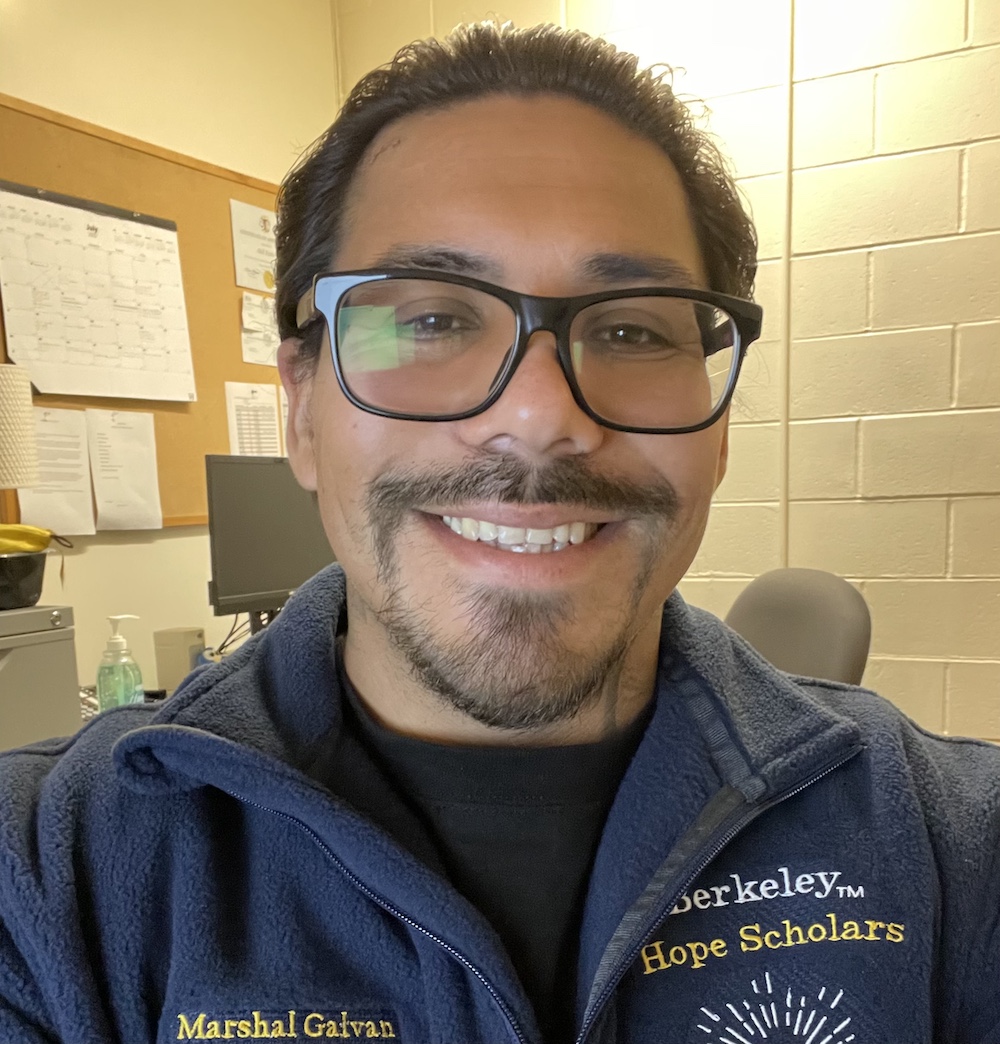
Marshal Galvan Jr., Little Shell Chippewa
Marshal Galvan Jr.
Credit: Marshal Galvan Jr.
When I was a child, I remember going to powwows. I remember seeing Native people. I remember being happy in these spaces with my family, and in my eyes and in my sisters’ eyes, my parents could do no wrong. But for whatever reason, the child welfare system decided that my parents weren’t good parents, and they decided to take that right of parenthood away from them.
When my sisters and I were placed in the child welfare system, we were initially placed together, but we got split up and placed into different homes over the years. They said we were bad kids and no one would take all of us on because we were a handful to deal with. Looking back now, we were just kids who were traumatized. We were kids that just wanted to go back to the safety of our parents.
My first placement was in a foster home with a white family. I didn’t learn about Catholicism or Christianity until I entered foster care. As I went through the system, I started landing in different homes with different cultures and languages being spoken, in different cities, schools, and neighborhoods. Everything constantly changed, and it constantly reinforced an identity crisis in my life.
By the time I was a teenager, I was gravitating towards anything and everything that I felt was going to connect me to something — whether it was the gang, drugs, or alcohol. It gave me a false sense of pride, ego, and meaning to life. I was putting myself in risky situations so that I could feel a part of my community. In my young adult life, things started shifting for me. I started getting incarcerated. I turned 18 and became homeless immediately. My addiction took a turn for the worse. Suicidal ideation and hopelessness started setting in. All along, I was grappling with my identity and just really seeking to know my roots.
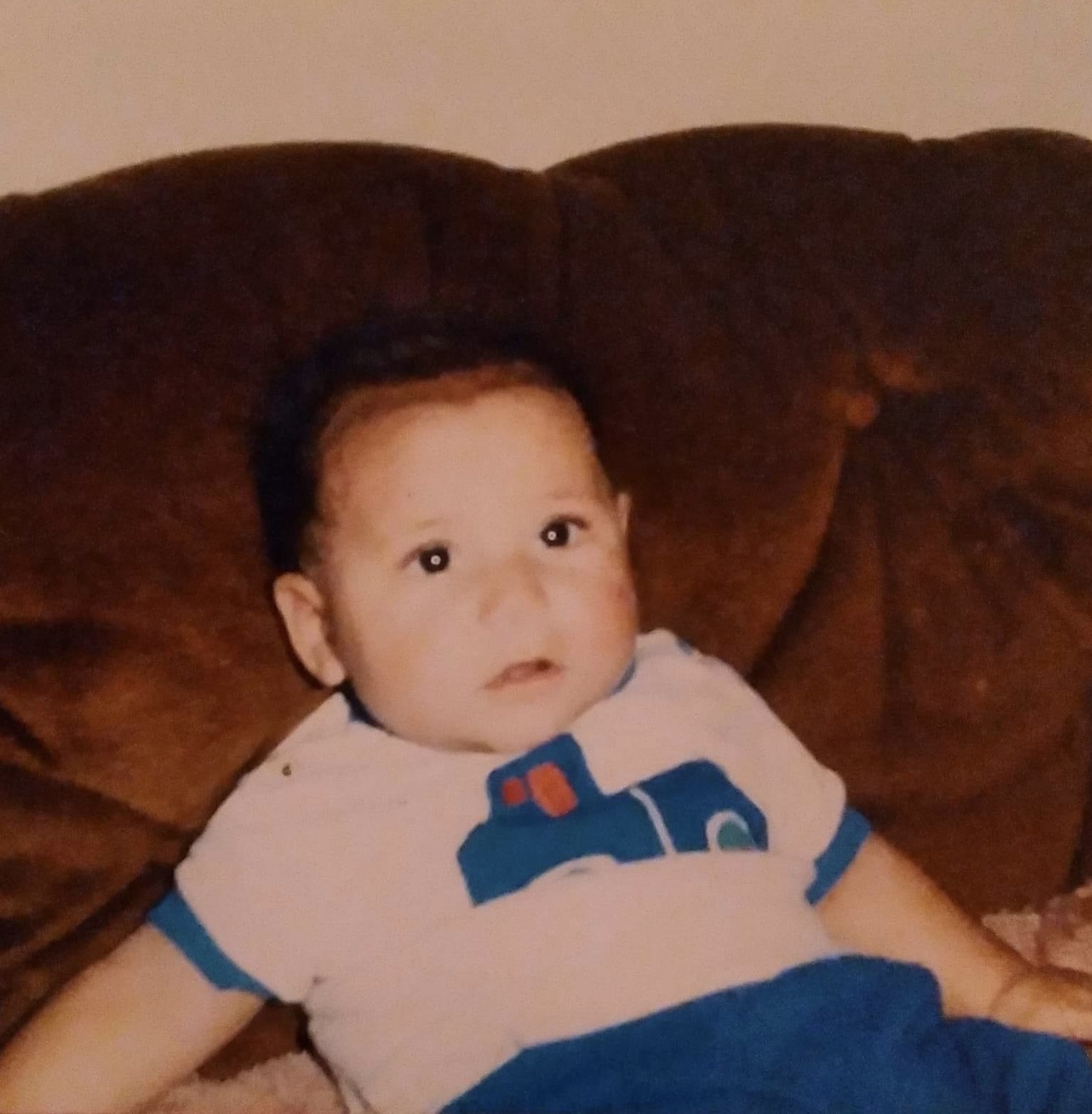
Marshal Galvan Jr. as a child.
Credit: Marshal Galvan Jr.
In 1997, when my parents lost their rights, there was no support and there certainly wasn’t any communication between our tribe and our family or the courts. At the time, the social workers and courts weren’t making active efforts to help our family bridge those gaps. My family’s tribe, Little Shell, wasn’t federally recognized until 2019. Because of that lack of federal recognition, my family was glossed over and wasn’t protected under ICWA.
My tribe allowed me enrollment membership into the tribe on August 23, 2022, but I’ve never lived in Montana and I don’t know the practices of my tribe. I acknowledge that. But through my enrollment, I am learning and rediscovering things about my tribe, and it has given me the ability to share that with my family. I started to reconnect with my family, and my enrollment is helping 16 other family members reconnect with the tribe, including my dad who wants to relearn his roots. I think it’s a beautiful thing.
It’s been a journey to unlearn, decolonize myself, and decolonize my mind. It’s an ongoing process, and I still have to do a lot of healing. To this day, as a tribal person, I still am facing an identity crisis. But no one should ever feel like they’re not Native enough, or enough, period.
It’s been a journey to unlearn, decolonize myself, and decolonize my mind.
Now, my passion is helping people that have similar stories to mine. Currently, I’m a counselor and work with youth in the Berkeley area. I would like social workers that are working in the child welfare system to continue to educate themselves on their own biases, because we’re hurting families. We’re keeping kids away from their parents and families when they don’t need to be.
The Indian Child Welfare Act is important because it keeps people like myself connected to our cultural roots, our family lineage, and our birthright. Not only does it respect tribal sovereignty, it also gives Native kids an opportunity to choose whether or not they want to embark on a journey that’s a birthright. To have the opportunity to have community, to be able to have folks that I can look around at and say, these are my people. That’s the most important thing — family, community, and cultural roots.
Mondae Vanderwalker, Rosebud Sioux Tribe
Mondae Vanderwalker
Credit: Mondae Vanderwalker
It took me three and a half years of jumping through hoops and dealing with wrongdoings from the Department of Social Services (DSS) and the court system to adopt my two nephews.
My oldest nephew was taken away from my brother when he was around 3 years old. He was put in the system, and I called the local DSS office and told them that I wanted to get custody and adopt my nephew. The DSS representative told me “No, we’re not going any further or moving forward with this case,” just because they heard some hearsay about me. But they never looked into the allegations. I asked DSS, “Well, how come you won’t do a background investigation or whatever you have to do so that I can get my nephew? He’s an important part of my life.” And they just kept saying, no, we’re done here.
I had no money to fight this, and didn’t know what to do. A few years later, my younger nephew was born, and he was also taken away from my brother when he was just a few months old. After he was taken, a woman from a different DSS office contacted me and asked, “Would you be interested in taking him?” and I said, “Yes,” in a heartbeat. I was waiting for that phone call for many years.
DSS had me and my husband go through a program to get a foster parent certificate to start the process of adopting our nephews. Once we were finalized for the adoption process, DSS finally let us go see my nephews at their foster family’s home. We had to drive from Sioux Falls two and a half hours away each weekend to go see them. But on our third visit, the foster family tried to keep us from visiting. I thought the agreement was that we were working on getting these children placed back with us, but the foster family kept trying to block our visits. DSS representatives warned me: “You’re going to have a battle on your hands — the foster family wants to adopt these children.”
I kept thinking, “I need to do something about this, because I’m going to lose my nephews.” I talked to someone I knew on our tribal council and then to our tribal president and told them what was going on. I told them I was afraid I was going to lose my nephews, because we were coming down to the wire, and the foster family got a lawyer to try to keep our nephews from us. They even tried to argue that my oldest nephew was not an enrolled tribal member, which would have made him ineligible for protection under ICWA. If that had happened, the foster family would have been able to adopt him right away. But thankfully, my brother did fill out tribal enrollment papers for my older nephew years ago — it turned out that DSS just had never turned them into the court.
Our tribal president ended up hiring a lawyer to help me fight for my nephews and we went to court. ICWA ended up saving us. If one of my nephews was not a Native American child, a non-Native person would have been able to adopt them without any question, and I would have lost them. But after a three and a half year battle, I was finally able to legally adopt my nephews under ICWA.
My two nephews are now 8 and 4 years old. Once we were reunited, I felt relieved, like a lot of pressure was taken off my shoulders. I was happy that the fight was finally over and that we could finally just live our lives. I want to help more people to understand ICWA and to tell them to not give up. If I didn’t talk to somebody and try to get help, they would have been gone. But I fought and fought and never gave up. It makes you think — how many more people, how many children who are sacred to Native American people, do you think we lost like that, in this system?
My nephews love me for what I’ve done because now they know a lot about powwows, everything to do with the tribe, and our ancestors. Before, they didn’t know any of that. They didn’t know what a powwow was. They didn’t know what fry bread was, or what Indian tacos were. But they do now. Now, they can have a better understanding of their culture and where they came from.
If ICWA was not put in place, I would have lost my nephews. The ICWA guidelines are important, but the state has to follow them. When my nephews were first placed in the system, my tribe was supposed to be involved from the get go, but they weren’t. Under ICWA, it was the responsibility of a DSS worker to call our family and tribe to let them know that these children were placed in a foster home with non-Native American families, but that didn’t happen. Our tribe needs to know that these children are in this system. And they should have known about it a long time ago.
If ICWA was not put in place, I would have lost my nephews.
When government workers don’t follow the ICWA guidelines, it hurts our people by allowing our children to be adopted out to other families and away from their tribe. ICWA is there to protect us, and DSS needs to do more to help these Native American children be placed back with their families.
ICWA helps us keep our children with their families like they should be. Our children need to stay with us, and we need to keep our families together.
Like many Indigenous siblings separated by adoptions, half-sisters
Raelene Recksiedler and Helene Rosenzweig-Schmidt always felt like
something was missing.
They met for the first time in Winnipeg on June 29, 2022. They are
just 44 days apart in age and didn’t know each other despite sharing the
same father.
T he Métis National Council and the Government of Canada will be working collaboratively, Nation-to-Nation, to develop a process to engag...
To Veronica Brown
Veronica, we adult adoptees are thinking of you today and every day. We will be here when you need us. Your journey in the adopted life has begun, nothing can revoke that now, the damage cannot be undone. Be courageous, you have what no adoptee before you has had; a strong group of adult adoptees who know your story, who are behind you and will always be so.
OUR HISTORY
BOOK 5: Lost Children of the Indian Adoption Projects


:format(webp)/https://www.thestar.com/content/dam/thestar/politics/federal/2022/10/30/seeking-justice-for-missing-children-and-unmarked-graves-has-uncovered-larger-concerns-special-interlocutor-says/kimberly_murray.jpg)