BACK UP BLOG (no longer updating)

This blog was a backup for American Indian Adoptees blog
USE THE SEARCH BAR or SEARCH TOPICS at bottom of this blog

If you need support

Support Info: If you are a Survivor and need emotional support, a national crisis line is available 24 hours a day, seven days a week: Residential School Survivor Support Line: 1-866-925-4419. Additional Health Support Information: Emotional, cultural, and professional support services are also available to Survivors and their families through the Indian Residential Schools Resolution Health Support Program. Services can be accessed on an individual, family, or group basis.” These & regional support phone numbers are found at https://nctr.ca/contact/survivors/ . MY EMAIL: tracelara@pm.me

Search This Blog

Wednesday, January 19, 2022

New Mexico needs to act to protect Native children #ICWA

OPINION


As governor of Tesuque Pueblo, I know firsthand how vitally important it is to keep Native children in Native communities.

For generations, federal policies aimed at the erasure of Native culture focused on forcibly separating our children from their families and communities. These horrendous policies effectively disrupted the continuity of our Native culture by severing our connection to coming generations.

Despite these attacks, our communities have resisted and fought to protect our children through the centuries; we are still here. This year we are hopeful the New Mexico Legislature will protect Native families and communities and correct these historic injustices by creating a New Mexico state Indian Child Welfare Act.

After years of advocacy, the federal Indian Child Welfare Act was signed into law in 1978. The federal law was a response to the alarming rates of removal of Indian children from their communities. This act put into law minimum standards for the removal of Indian children from their families and placement in foster or adoptive homes outside their communities. These standards include a requirement for the child welfare system to engage with the child’s tribe, identify potential family or community foster care when necessary, and provide active efforts toward the child’s reunification with their parents or caretakers.

Through the years, federal law has ensured thousands of Native children could remain in their communities, surrounded by extended family and brought up in their own traditional culture. This law provides added protections against systems-level abuses directed at Indian children and puts an emphasis on placement with relatives or tribal community members.

But despite the protections the federal law has provided, New Mexico’s tribal nations still have some of the highest numbers of children and families impacted by the child welfare system. In addition, legal challenges to the federal law threaten the safety and well-being of Native families by undermining tribal sovereignty and the right to self-determination.

Responding to these challenges, representatives from all 23 tribal nations of the state, tribal ICWA workers, tribal-serving nonprofits, the Children, Youth and Families Department, and other advocates and stakeholders have worked for over two years to craft New Mexico state Indian Child Welfare Act policy. The result of this work is legislation that will provide lasting protection for our tribal nations and our children. Moreover, it will stand as an example of how New Mexico is dismantling systemic injustice by centering our Native children, family and communities first.

The goal of state ICWA policy is to ensure that we have legal protections at the state level regardless of what happens at the federal level and at the same time exceed the minimum standards established in 1978. We can take this opportunity to improve on those minimal standards by enacting best practices for Native families in ways that are unique to our state. We know that when we elevate the most vulnerable populations, we elevate the level of services for everyone involved in the system. By working across government systems, we can pave the way for our families to be healthy and whole.

As we head into the new year, I call on the Legislature and Gov. Michelle Lujan Grisham to advance this policy and correct the historical injustices against our children and Indigenous communities.

Our children are precious, and we must do everything possible to keep them in our communities surrounded by Indigenous culture and language. Together, we can build a lasting legacy that uplifts our children and ensures they will grow up to be our future ancestors.

Robert A. Mora Sr. is the governor of the Pueblo of Tesuque.

Tuesday, January 18, 2022

Meet Indigenous podcasters who are decolonizing the airwaves

CBC Radio ·

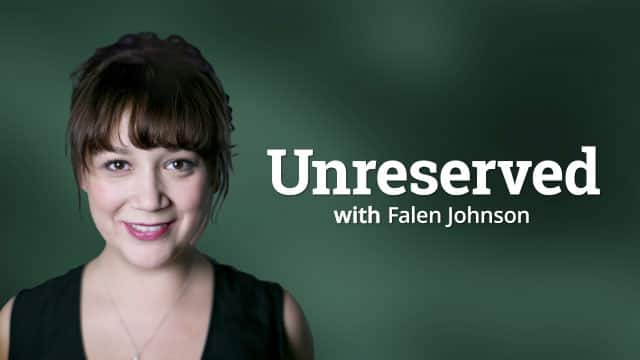
On Unreserved, Indigenous people are decolonizing our podcast feeds with four great projects. Host Falen Johnson's dog, Reg, enjoys each one equally. (Falen Johnson/CBC, podcast covers submitted)

More and more Indigenous creatives are turning to podcasting as a way to share stories. On Unreserved, we're talking with Indigenous podcasters who are decolonizing the airwaves. 

In 2021, former CBC host, Waubgeshig Rice, sent out a tweet.  It read, "So...who'd be interested in a podcast about Indigenous literature?"  That tweet got more than 8,000 likes, and was enough to support the creation of the Storykeepers Podcast.  The podcast, launched in March in 2021, is hosted by Waubgeshig Rice and writer Jennifer David and is all about Indigenous literature.

Connie Walker was on CBC's airwaves for more than 20 years. Her most recent work focused on telling the stories of Missing and Murdered Indigenous women. Her latest podcast, Stolen: The Search for Jermain, is available through Gimlet Media. 

Glenn Wheeler, a member of the Qalipu Mi'kmaq First Nation, serves as host for the podcast called Mi'kmaq Matters. The podcast was Wheeler's way of keeping in touch with his community despite living in Toronto.

Dene Talk is a brand-new podcast from Cassidy Villebrun-Buracas, who describes it as Indigenous people talking about a wide range of topics. Guests have included writers and burlesque dancers, to psychologists and birth workers.

Career in journalism helps ’60s Scoop survivor reconnect with culture


As a child of the ’60s Scoop
who was beginning to re-discover her birth family, Betty Ann Adam
thought journalism was a good profession to pursue. Adam, who was raised
in a non-Indigenous home, was looking to discover who she was as an
Indigenous person and learn more about Indigenous people.


But, Adam didn’t just want to be the “Indigenous reporter” in the
newsroom, despite being the only Indigenous person reporting for the
Saskatoon Star Phoenix at the time.


“I felt a bit like they wanted to assign me to the Indigenous stories
and I didn’t feel ready to do that at that point,” says Adam on the
latest episode of Face to Face. “I hadn’t trained as a journalist. I had
done some work and they saw some potential, so they gave me that
opportunity.


“But, I didn’t feel comfortable doing Indigenous stories,
exclusively, because I just felt at a disadvantage and I sometimes felt
as though Indigenous people that I interviewed expected me to understand
them, more than I did at that time.”


In 1989, Indigenous representation in newsrooms in Canada was pretty
sparse says Adam who felt she didn’t have a lot of power to influence
the way stories about Indigenous Peoples were being told.


Adam says she noticed things beginning to change following the
criticism newsrooms received over coverage of the crimes of Saskatoon
serial killer, John Crawford.


That criticism was documented in Warren Goulding’s 2001 book, Just Another Indian: A Serial Killer and Canada’s Indifference.


Adam worked at the Star Phoenix for three decades covering a range of issues.


Many big stories stick with her including the Neil Stonechild
inquest, the Saskatchewan Treaty Land Entitlement framework agreement,
the so-called Spiritwood Incident where two RCMP officers were shot and
killed by Curtis Dagenais, and the wrongful conviction of David
Milgaard.


Adam broke the story on the practice of coerced sterilization of
Indigenous women without free and informed consent. The practice is now
the focus of a class-action lawsuit.


Despite stepping away from the daily news grind, Adam has not slowed
down. She has taken on the role of associate editor with Eagle Feather
News.


Adam, who is a member of Fond Du Lac Denesuline First Nation, is also working on the latest season of Connie Walker’s podcast, Stolen.


Adam is also the chair of the Sixties Scoop Indigenous Society of Saskatchewan that recently released Everything is Connected,
a documentary that highlights how intergenerational trauma and the
separation of Indigenous children from their families are connected to
the issue Missing and Murdered Indigenous Women and Girls.


“It starts with the residential schools and that was often leading to
former students whose children got scooped. And then those same
families would have people who were dying in this terrible scourge of
MMIW. And we thought it was important for Canadians to understand that
these things don’t happen in silos,” says Adam.


“All of the negative issues that face Indigenous people can be linked to government policy.”


Everything is Connected is not the first documentary Adam has worked on. Filmmaker Tasha Hubbard’s 2016 film, Birth of a Family documents Adam and her birth siblings, meeting together for the very first time.


“Birth of a Family was a great experience. When I see it, it’s like
seeing the best ever family holiday album that you ever saw but it was
our family being together for the first time. And in fact, this past
Christmas, my sister Rose came to Saskatoon and it was the first
Christmas in any of our lives where two of us at least ever got to be
together for Christmas and she stayed through New Years.


“You know, Sixties Scoop people are surviving and thriving and we’re
trying to find our way back to family and community. And there are
stories of happiness, joy and hope too.”

Monday, January 17, 2022

Coming Up: Supreme Court ICWA cases

SCOTUS BLOG

There are also four cases challenging the constitutionality of the Indian Child Welfare Act of 1978. Congress passed ICWA to respond to concerns that state child-welfare practices were causing large numbers of Native American children to be inappropriately removed from their families and tribes and placed with non-Native foster families or adoptive parents. ICWA established minimum federal standards for most child-custody proceedings involving Native American children. The en banc U.S. Court of Appeals for the 5th Circuit struck down some provisions of ICWA as unconstitutional. According to the 5th Circuit, some provisions violate the 10th Amendment because they impermissibly “commandeer” the states. Those provisions, it concluded, include a requirement that state agencies bear the cost and burden of providing expert testimony to support placing Native children in foster care, a requirement that state agencies provide remedial services to Native families, and a requirement that state agencies maintain certain child-placement records.

The 5th Circuit also affirmed the district court’s judgment that ICWA’s preference for adoptive placement with “other Indian families” and “Indian foster home[s]” violates the equal-protection component of the Fifth Amendment. The 5th Circuit upheld other provisions of the act. The court has relisted a total of four petitions, two filed by the federal government and a group of Native American tribes seeking to revisit 5th Circuit holdings invalidating provisions, and two filed by the state of Texas and private challengers seeking to overturn parts of the 5th Circuit decision upholding other ICWA provisions. The petitions are Haaland v. Brackeen, 21-376, Cherokee Nation v. Brackeen, 21-377, Texas v. Haaland, 21-378, and Brackeen v. Haaland, 21-380.

REFRAME FILM FESTIVAL
What does blood have to do with identity? Kendra Mylnechuk, an adult Indigenous adoptee, born in 1980 at the cusp of the enactment of the Indian Child Welfare Act, is on a journey to reconnect with her birth family and discover her Lummi heritage.
 

Renewed Debate over U.S. Indian boarding schools


Oney M. Roubedeaux

As tribes wait for investigation to conclude, debate over Indian schools continues

Tribes across the Southwest dread the possibility that thousands of unmarked graves might be uncovered by a federal investigation into abandoned Native American boarding schools expected to wrap up early this year.

The investigation, ordered by U.S. Interior Secretary Deb Haaland, came in the wake of the discovery this year of more than 1,200 unmarked graves at two long-shuttered boarding schools in Canada’s British Columbia and Saskatchewan provinces.

The probe also has renewed debate over Indian boarding schools, which were established in the 19th and 20th centuries with the primary objective of assimilating Indigenous youth into white culture by denying the use of their languages, dress and other cultural aspects.

Most boarding schools were closed in the 1980s and early 1990s, but dozens of schools remain open, with 15 still boarding students as of 2020, according to the National Native American Boarding School Healing Coalition. Some are controlled by local tribes, while others are operated by the Bureau of Indian Education, a division of the Department of the Interior.

Boarding school alumni are widespread among Indigenous communities, and their thoughts about their experiences vary widely.

“She’s brought awareness for our Native people, for our children,” retired elementary school teacher Oney M. Roubedeaux said of Haaland. “I feel like that is opening up a box of worms. I mean, just a whole big old span of our people that nobody paid attention to.”

Roubedeaux, who is Ponca and Otoe-Missouria, was 6 in 1971, when she rode a Greyhound bus from Stillwater, Oklahoma, to Concho Indian Boarding School in El Reno with her brother, who was 8. She is the youngest of 17 siblings, many of whom attended boarding schools.

After her mother’s death in 1973, Roubedeaux was separated from her brother when she transferred from Concho to the Seneca Boarding School.

She said one of her other brothers was beaten to death in his room in Chilocco Indian School, 20 miles north of Ponca City, in 1980, the year it closed down. By the time she left Concho, there had been three student deaths, one being her best friend’s brother.

After her mother’s death, Roubedeaux was placed in foster care.

She went through 10 foster homes before one foster mother realized Roubedeaux – who was 16 – could not read or write. The teachers at the public and boarding schools she attended had never taken the time to teach her, Roubedeaux said.

She caught up, she said, with help from her foster mother, and eventually obtained a degree in special education from the University of Central Oklahoma. Roubedeaux, who lives in Pawnee, concluded her 20-year teaching career in March 2020.

Although “not everything was good,” she said, boarding schools gave her self-reliance, which was her biggest reclamation of agency.

“Boarding schools were a learning experience for me as a young child … it took me through life, to be able to rely on myself,” Roubedeaux said. “To this day, at the age of 57, I can still do that.”

According to the Boarding School Healing Coalition, 367 Indian boarding schools operated in 29 states, from Alabama to Alaska. Seventy-three were operating in 2020, and 15 of them still boarded students. Oklahoma had the most, with 83 schools, some of which still are operating. Arizona was second with 51 schools, 25 of which are open and three of which board students; New Mexico was fourth with 26 boarding schools.

Riverside Indian School in Anadarko, Oklahoma, organized in 1871, is the oldest of four federally operated boarding schools in the nation.

Today’s boarding schools are a good thing, said Constance Fox, who is Cheyenne and Arapaho and graduated high school from Riverside in 1984.

“I think they’re a good thing because of the uniqueness Native students have,” said Fox, who’s a self-determination adviser for the Bureau of Indian Affairs in Oklahoma. “For many, it was all they had, good and bad. I hope they continue. I know there’s been a lot of positive strides made … I go back to Riverside and it’s a whole different place.”

Fox said Riverside has upgraded its buildings and athletics department over the years. When she attended Riverside, Fox said, no advanced courses were offered, but teachers now are recruited for such courses.

“I have friends that have kids and grandkids that go to boarding schools and it’s because they want to … because there is still discrimination in public schools,” Fox said. “Being around their Native people makes them want to do better and want to succeed. So, I think that’s a dynamic that has changed over the years.”

Fox attended Concho from grades 3 through 8 and graduated from Riverside as valedictorian. She holds a bachelor’s degree in tourism management from Northeastern State in Tahlequah, Oklahoma, and a master’s degree in education from the University of Oklahoma.

Fox, who lives in Yukon, has worked for the BIA for nearly three decades, mostly in the area of self-determination.

Fox said boarding schools – specifically the adults who worked at them, who she says practically raised her – helped shape her passion for self-determination and her career working to better tribes.

“What at the time was negative to me ended up really being positive,” Fox said. “I learned so much about self-responsibility, and that came from the dorm parents, teachers, and other people who worked at both Concho and Riverside.”

Fox said she fully supports Haaland’s efforts and thinks her investigation shows goodwill to create an understanding of the traumas her ancestors suffered and the impact it has in 2022. Although closure can’t begin without acknowledging the history, she said it is hopeful to begin the healing process for the families and tribes impacted.

Hopi journalist Patty Talahongva got her start in journalism at Phoenix Indian High School in the 1978-79 school year. She is the executive producer of newscasts by Indian Country Today, a national nonprofit digital news publication focusing on Indigenous issues.

Although Talahongva, who lives in Phoenix, knows about the brutal history of her grandparents’ boarding school experiences, her year at Phoenix Indian School was different.

“People want to cling to this idea that it was always, always bad,” Talahongva said. “I would say there’s always good in whatever story, no matter how bad it got.”

By the time she was in school, Talahongva said, children were allowed to speak their languages freely, and cultural customs were celebrated, not suppressed. The overall experience, she said, made her more independent. The school, which opened in 1891, shut down in 1990.

Even the launch of Indian Country Today’s newscast in April 2020 has roots in boarding schools.

Talahongva said the newscast began a month after the pandemic was declared, so studio options were few. The solution? The former grammar building of Phoenix Indian School, built in 1935 and now used as a visitors center. Indian Country Today used it for seven months before moving into a studio at Arizona PBS.

“Those kids who went to school in that building were never encouraged to go to college, get a degree, or do whatever they wanted to do,” Talahongva said. “They were certainly never encouraged to become (television) anchors and producers. I can hear our relatives laughing. It’s like, ‘Take that, government. We’re using the building you put up to hold us down, and we’re broadcasting to the world.’”

This story was originally published by Gaylord News, a reporting project of the University of Oklahoma Gaylord College of Journalism and Mass Communication. Nancy Marie Spears, a Gaylord News reporter based in Washington, D.C., is an enrolled member of the Cherokee Nation of Oklahoma. Cronkite News contributed to this story.
Alberta not included in ‘Sixties Scoop’ Healing Foundation inaugural grant funding


WEBSITE


The Sixties Scoop Indigenous Society of Alberta (SSISA) feels it was left out when it comes to accessing new funding.


In December 2021, the Sixties Scoop Healing Foundation
announced eight Indigenous organizations will get just over $1 million
in funding under the foundation’s 2021 Pilot Grant Program.

The SSISA, however, was not one of them.

“We’re
talking about thousands of people in Alberta shut out of a process that
nobody was aware of,” said Sandra Relling, president of the SSISA.

“We
thought that perhaps it might be upcoming, so we were waiting for some
sort of feedback either on their website or through the emails we sent
to the organization looking for information on the process.”


Read more:

Indigenous organizations call for national inquiry into ’60s Scoop


Records Could Shed Light on Canada Residential Schools for Indigenous Children, Settlements


 READ

Canada's Truth and Reconciliation Commission said in 2015 that it had identified about 3,200 deaths of indigenous children at the school... 

WATCH:

Canada’s Indigenous Services Minister discusses deals to settle child welfare claims

The federal government, First Nations organizations and class-action lawyers announced details of two agreements in principle that, if ratified, could end a nearly 15-year-old legal battle over the racist underfunding of child welfare services on reserves and in the Yukon. Indigenous Services Minister Patty Hajdu joins APTN National News to talk about the deal. 


Largest settlement in Canadian history: Feds release details of $40B deal

 SOURCE


The federal government has unveiled its $40-billion agreement in principle to provide compensation to First Nations children and their families harmed by an underfunded child welfare system and establish long-term reform.

As a result of the largest class action lawsuit in Canadian history, Ottawa will provide $20 billion to children on reserve and in the Yukon who were unnecessarily removed from their homes between April 1, 1991 and March 31, 2022. This extends to their parents and caregivers. Compensation will also be provided to those impacted by the narrow definition of Jordan’s Principle between Dec. 12, 2007 and Nov. 2, 2017.

Children who didn’t receive essential public services between April 1, 1991 and Dec. 11, 2007 will also be eligible for financial reparation.

The second half of the funding will go towards reform of the First Nations Child and Family Services Program, to be spread out over five years.

Approximately $20 billion will support young First Nations adults transitioning out of the child welfare system, as well as bolster prevention mechanisms to keep children at home, in their communities – work that’s expected to start in April, 2022.

KEEP READING 

**

Indigenous child welfare settlement leaves out Sixties Scoop survivors: advocate

Reaction to $40B settlement not all positive
A settlement that may become the largest ever in the history of Canada is raising concern among some over the specific date of April 1, 1991 being the cut-off point for Indigenous people to be eligible for compensation. Mark Neufeld reports.

By Mark Neufeld

Summary

  • Ottawa secured agreements in principle to compensate First Nations children harmed by its underfunding of child welfare
  • If the $40 billion agreement is approved, it would represent the largest settlement in Canadian history
  • But an advocate says the cut-off dates for the potential settlement excludes Sixties Scoop survivors

While welcoming an agreement in principle to compensate children harmed by Canada’s underfunding of child welfare, an Indigenous organization says it also excludes many Indigenous people – specifically Sixties Scoop survivors.

The federal Liberal government says of the $40 billion earmarked to be spent on the matter, $20 billion will pay for compensation and the other $20 billion will be spent on reforming the system over five years.

It says First Nations children living on reserve and in the Yukon who were removed from their homes between April 1, 1991, and Mar. 21, 2022, are set to be compensated, along with their parents and caregivers.

If the agreement is approved, it would represent the largest settlement in Canadian history.

But not everyone agrees with the cut-off dates for the potential settlement.

“I feel like they could have expanded it a little bit more to include those of us taken before 1991 and those of us taken off reserve,” said Katherine Legrange, the director of 60s Scoop Legacy of Canada.

“I think overall it’s a good thing, I just wish they had consulted with Sixties Scoop survivors and our families to include us if possible.”


RELATED:


The Sixties Scoop is when an estimated 20,000 Indigenous children were taken from their families and placed in non-Indigenous homes over a period of about three decades.

The Canadian government maintained it was acting in the best interests of the children.

Some survivors remain displaced and disconnected from families and their home communities to this day.

For First Nations children and families that are included in the settlement, Legrange cautions there could be a reopening of old wounds and relived traumas over the historical harms done to them.

She believes the guidance of First Nations elders and caregivers will be needed to prevent more pain as people come forward in the settlement.

“We need to, as Indigenous people, need to lead what that looks like,” said Legrange. “Have an advisory committee and figure out what’s the best way. How do we do this while mitigating the risks and harm to people?”


“I’m no longer a lost child. My story matters. That’s what I’m taking home: I matter.”


Burden of proof

After the residential school in Nova Scotia closed in the late ‘60s, Debbie Paul was kidnapped by a nun and brought to a white family in the U.S. She always told people this, but was missing the evidence. Until now.

WARNING: This story contains distressing details.

Standing at the site of the former Shubenacadie Indian Residential School in Nova Scotia, Debbie Paul clutches a black and white picture of herself taken when it shut down in June 1967.

Paul was the last Mi’kmaw student to leave.

“This picture was taken to give to my mother and my mother never received it,” said Paul, who lives in the Sipekne’katik First Nation, just five kilometres away from the former residential school.

In the photo, she is 12 years old, wearing new shoes and a new watch, unaware her life was about to take an incredible turn. Rather than return Paul to her mother, a nun with the Sisters of Charity – Halifax took her without consent to live with a white family in the United States.

When Paul pushed for answers years later, her mother said she just never came home when the school closed. “She signed no papers for me to be adopted out or taken across the United States border,” said Paul.

Debbie Paul, age 12, outside the Shubenacadie Indian Residential School on the day it closed in June 1967. (Submitted by Debbie Paul)

After the residential school closed and the rest of the students left, that nun, Sister Mary Gilberta, kept Paul back at the institution. Paul says she told her to keep out of sight. Within days, they left for the airport.

Paul would spend the next year with Sister Gilberta’s brother, John Wentworth, and his wife, Mary, in Massachusetts.

“They took me without permission,” said Paul. “And all that family did was abuse me.”

Debbie Paul survived the residential school only to become part of the Sixties Scoop, the practice of adopting or fostering Indigenous kids to white families.

Canada signed a class-action settlement agreement in 2017 and within a year, survivors of the Sixties Scoop, like Paul, were able to apply for compensation.

“I think I deserve it, to live the end of my life,” said Paul, who is now 66. “Because I went through hell.”

But in March 2020, her claim was rejected. She wasn’t told why, but she has a strong suspicion. Collectiva, the administrator for the Sixties Scoop class action settlement, can access adoption and foster records, which for the most part are held by the provinces. But Sister Gilberta acted on her own, leaving no apparent paper trail.

KEEP READING


Saturday, January 15, 2022

The 1950s plan to erase Indian Country

 Yes, this happened...

APM Reports: “Uprooted: The 1950s plan to erase Indian Country”

A really interesting look at the BIA Urban Relocation project.

BIA pamphlet from the Chicago Relocation Office. Edward E. Ayer Collection at Newberry Library.

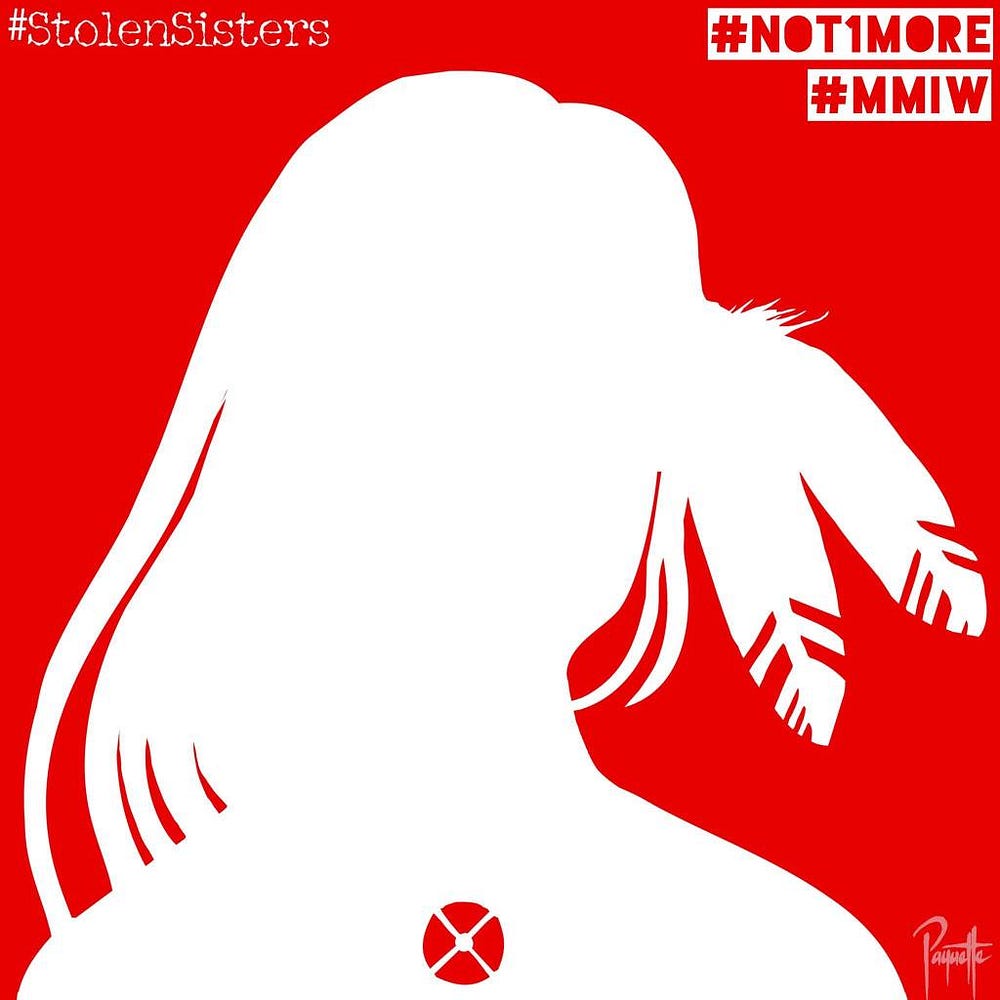
Murdered and Missing Indigenous Women in the United States #StolenSisters


Violence is the third leading cause of death for native women between 10 and 24 years of age and the fifth leading cause of death for women 25 to 34 years (Simpson 5). Today American Indian women face murder 10 times the national average according to the Department of Justice. The government has failed to address the violence against Native women despite staggering statistics that provide evidence for the high rates of violence perpetrated against this marginalized group (Simpson 5). In 2015, the federal government approved an act that would provide additional resources to improve tribes’ access to databases that had data of MMIW but have not followed through. In response to the lack of a database that includes all the MMIW, I have created a web map that will visualize the Indigenous women that have been reported missing and murdered. The ultimate goal is to try to understand what is unique about the situation that causes Native American women to experience higher rates of violence. In the future I hope to be able to provide statistical analysis for my theory about the relation between map camps and missing women.

Keep Reading 

The MMIWG2 Database logs cases of missing and murdered indigenous women, girls, and two spirit people, from 1900 to the present.

There are many lists and sources of information online, but no central database that is routinely updated, spans beyond colonial borders, and thoroughly logs important aspects of the data, and overall, there is a chronic lack of data on this violence. The Database works to address that need, by maintaining a comprehensive resource to support community members, advocates, activists, and researchers in their work towards justice for our stolen sisters.

 The Database originally included cases from the US and Canada, but starting in 2019, we have expanded its reach to include all Indigenous women, girls, and two spirit people. We will continue to pursue archival research in the US and Canada, and will rely on partnerships with Indigenous women’s collectives and organizations in other regions to include our sisters indigenous to lands occupied by other colonial entities.

The kind of information the Database cares for is determined by ongoing consultation with Indigenous communities. The Database currently logs the following:

​About Victims:

Name, Indigenous name and translation, tribal affiliation(s), birth date, age, if they were a mother, if they have other MMIWG2 cases in their family

​About Perpetrators:

Race, gender, relationship to the victim

​About the Violence:

Missing or murdered, incident date, violence perpetrated against murder victims after they are deceased, relevant issues (domestic violence, sexual assault, sex work/sex trafficking, foster care, police brutality, trans victim, death in custody, unsheltered, residential/boarding school)

​About Police & Court Response:

Reward amount (if any), case classification, conviction status, which entities located deceased individuals

​About Geography:

City, state/province, country, location type (tribal land, rural, urban)


Friday, January 7, 2022

Canada does it first, is America next?


I don't know about you but I saw this coming - that the Truth and Reconciliation (TRC) in Canada would end with money paid to victims. Canada is first. Will America be next? Or Australia?... Blog Editor TLH

In Largest Settlement in its History, Canada Comes to Agreement in Principle in Child Welfare Lawsuit

NY Times Coverage here

The Canadian government announced Tuesday that it had reached what it called the largest settlement in Canada’s history, paying $31.5 billion to fix the nation’s discriminatory child welfare system and compensate the Indigenous people harmed by it.

Agreement in principle/press release here

For those who were following this case, it involves the First Nations Child and Family Caring Society, which is led by Cindy Blackstock. The settlement attempts to reform Child and Family Services and address Jordan’s Principle. This is a major settlement and significant milestone for Native children and families in Canada.

Wednesday, January 5, 2022

Another class action for Indigenous children off reserve #EveryChildMatters


This proposed class action alleges that Canada failed to take reasonable
steps to protect and preserve the aboriginal identity of the Indigenous
children and youth who were apprehended. Canada denied Indigenous
children and youth any reasonable opportunity to maintain connections to
the language and territory of the Indigenous community, group or people
to which they belonged. Canada’s actions also denied Indigenous
peoples’ their inherent right to jurisdiction over child and family
services. This lawsuit alleges that Canada should have taken steps to
safeguard the wellbeing of apprehended Indigenous youth and children and
ensure that Indigenous youth and children, and their families, were
advised of any federal financial benefits to which they may have been
entitled; this lawsuit alleges that Canada failed to do so. 

This conduct
was systemic, lasted for decades, and eradicated the language, culture,
and heritage of Metis, Inuit, and Status and Non-Status Indian (First
Nations) children and youth in care. The parents and grandparents of
apprehended children and youth were also harmed; in my cases, these
parents and grandparents never saw their children and grandchildren
again.


Sunday, January 2, 2022

'I had to be prayed home'

Thousands of Native children were adopted in the 1960s as a government plan of forced assimilation. This woman was one of them.

Kelley Bashew was adopted at the age of 3 months and taken from South Dakota to Glenside. She is shown on a hillside near her Meadowbrook home in April 2021.CHARLES FOX / Staff Photographer

While visiting the Tekakwitha Nursing Home to sing for residents, 13-year-old Denise Owen was led away from the rest of her boarding school group by a nun. A special surprise awaited her.

There, in another room in the Sisseton, S.D., facility, was her newborn sister, Rose Anne. Denise got only a glimpse of the infant, lying in a bassinet in a long-sleeve shirt and a diaper, before another nun ordered her to leave. Denise was not supposed to see her sibling, soon to be adopted.

It would be 50 years before they saw each other again.

Rose Anne, who would be raised by a Glenside dentist and his wife, became a child of the country’s American Indian adoption era, a decades-long forced assimilation of Native children first established under the Indian Adoption Project, which started in 1958 and evolved to include 50 private and public placement agencies across the United States and Canada, where the so-called Sixties Scoop was coined to describe the mass removal of children from Native homes. During the next 20 years, almost 13,000 Native children would be adopted.

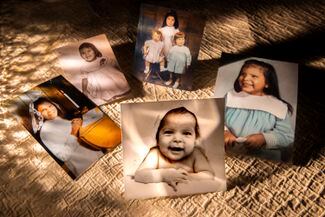
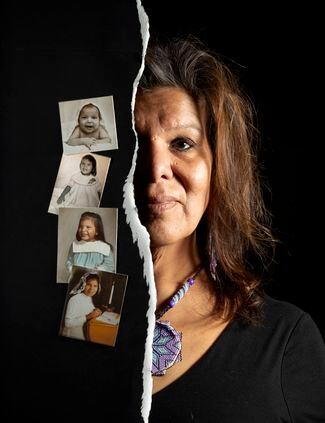
Bashew experienced a loving childhood. But she always knew she was different, and felt isolated in white suburbia. Here, a series of photos from those times.CHARLES FOX / Staff Photographer

According to a 1969 report by the Association on American Indian Affairs, between 25% and 35% of all Native children were placed in adoptive homes, foster homes, or institutions; and about 90% of those children were being raised by non-Natives.

That was the case for Rose Anne, who, at the age of 3 months, was handed over to Salvatore and André Petrilli. The white couple of Italian and Irish descent had struggled to have their own biological children, and it was André's interest in American history and a phone conversation with a priest from St. Joseph’s Indian School in Chamberlain, S.D., that led her to seek a Native adoption through Catholic Charities.

Eventually, a new birth certificate reflected the new name of Kelley Elizabeth Petrilli, the child of two Caucasian parents. Her American Indian heritage was wiped away on paper. A Montgomery County Orphans Court clerk with the last name of Custer gave the final stamp of approval to the adoption.

“When I was younger, I wanted to be white. I still feel guilt about that,” said Bashew, who lives in Meadowbrook. “I just wanted to fit in and be like my sisters. … I did not like being tall and brown and different.”

Kelley Bashew was born Rose Anne Owen in Sisseton, S.D., but was adopted by Salvatore and André Petrilli, a suburban Philadelphia dentist and his wife.CHARLES FOX / Staff Photographer

 PLEASE SHARE THIS POST with other American Indian Adoptees... TLH

KEEP READING

Thursday, December 30, 2021

N'we Jinan Artists - "WHEN THE DUST SETTLES" // Oxford House, Manitoba

It's almost time to change the calendar.

Let's dance the NEW YEAR so the earth can feel us!

The earth loves us, remember. We belong to her. 

Settle in and celebrate 2022. 

I love you all. Be well. Be kind.

Trace Lara Hentz

Tuesday, December 14, 2021

Compensation in Canada


OTTAWA, Dec 13 (Reuters) - Canada is setting aside C$40 billion ($31.2 billion) to compensate Indigenous children and families in foster care for suffering discrimination, and will start paying out once a protracted lawsuit is settled, officials said on Monday.

The compensation decision affects some 55,000 children.

READ


Friday, December 10, 2021

STOLEN: The Search for Jermain (podcast) #MMIWG

In 2018, a young Indigenous mother named Jermain Charlo left a bar in Missoula, Montana, and was never seen again. After two years and thousands of hours of investigative work, police believe they are close to solving the mystery of what happened to her. We go inside the investigation, tracking down leads and joining search parties through the dense mountains of the Flathead Reservation. As we unravel this mystery, the show examines what it means to be an Indigenous woman in America.

Stolen is hosted by Connie Walker.
LISTEN


Thursday, December 9, 2021

A Gathering of the Tribe | POWERFUL Short Film by Charles Eisenstein

Taking back control of child welfare services is a turning point for the Inuvialuit


Opinion

Growing up in Inuvik, in the Inuvialuit Settlement Region in Canada’s Western Arctic, I lived next to a group home.

The children – Inuvialuit like me – were in the care of Northwest Territories social services, separated from their families, sometimes far from their home communities, with no connection to their identity.

Even as a child, I could see how hard it was for them, going through life and school without any people, without any sense of who they were in the world.

This week, the Inuvialuit Regional Corporation, which was established in 1984 to represent the Inuvialuit under one of Canada’s oldest and most comprehensive land claim agreements, passed our first law: Inuvialuit Qitunrariit Inuuniarnikkun Maligaksat.

This law re-establishes our jurisdiction over child and family services, and in doing so, makes us the first Inuit region to assert this important right.

KEEP READING

Writer:

Duane Ningaqsiq Smith is the chair and CEO of Inuvialuit Regional Corporation, which represents the communities of Aklavik, Inuvik, Paulatuk, Sachs Harbour, Tuktoyaktuk and Ulukhaktok in the Northwest Territories.

Wednesday, December 8, 2021

AFN postpones trip to meet Pope, plans to file complaint with UN

A trip that Indigenous leaders were supposed to take to Rome later this month for a meeting with the Pope has been postponed because of the pandemic, said RoseAnne Archibald, National Chief for the Assembly of First Nations, on Tuesday.

Leaders with the Assembly of First Nations (AFN) were scheduled to meet with Pope Francis on Dec. 20 to seek an apology for the Roman Catholic Church’s role in running residential schools. The Métis and Inuit were supposed to meet the Pope earlier that week.

Hundreds of unmarked graves were discovered earlier this year at former residential schools across the country. The schools — sponsored by the government and mostly run by the Catholic Church — were set up to assimilate Indigenous youth into Canadian culture by removing them from their families and communities. Many Indigenous children were abused and/or died at the schools.

In September, the Canadian Conference of Catholic Bishops apologized for “grave abuses that were committed by some members of (the) Catholic community” at the schools.

Archibald told First Nations leaders who’d gathered virtually for three days that the AFN has asked the church to: return diocese lands to Indigenous Peoples; increase the $30 million the church announced in September for long-term healing; and encourage the Pope to meet with Indigenous leaders on traditional lands when he visits Canada. The Pope has agreed to meet with Indigenous Peoples when he travels to Canada, but no date has been set for his visit.

Archibald went on to tell attendees that the AFN plans to hold the government to account for forcing Indigenous children to attend residential schools.

“We continue to call for accountability,” she said. “Someone must be charged for the deaths of our children. There must be examinations to determine if our children were murdered. Canada must be held to account, and they have to be held responsible for their genocidal laws and policies.”

Archibald said Canada shouldn’t be allowed to investigate itself, and that the AFN would be reaching out to the Special Rapporteur on the Rights of Indigenous Peoples to file a human-rights complaint, and to pursue remedies “for the victims of genocide.”

“We need to know the truth before we can walk the road to reconciliation,” she said.

SOURCE

Water Protectors (truthout podcast)


Enough Colonial Pageantry. Let’s Rally Behind Criminalized Water Protectors.

transcript


Tuesday, December 7, 2021

Sweden to Investigate International Adoptions

The government of Sweden is the most recent to announce that it will investigate “irregularities” in the last 60 years of international adoptions, focusing in particular on China and Chile.

Around 60,000 children have been adopted to Sweden, most originally from South Korea, India, Colombia, and Sri Lanka.

Results of the investigation are expected to be released in November 2023.

In February 2021, The Netherlands froze international adoptions after adult adoptees raised concerns about adoptions from Bangladesh, Brazil, Colombia, Indonesia, and Sri Lanka. A government commission found some adoptions, dating back to the 1960’s and through the 1990’s, where children had been stolen or bought.

An additional article about Sweden’s investigations from February 2021 is available here.

Harrington Lecturer reflects on Indian Adoption Project


USD’s 69th Harrington Lecture was led by Beth Boyd, director and professor in the USD clinical psychology program, presenting “Mitákuye Oyás ‘iŋ (We Are All Related): Reflections to Learning to Become a Relative.” 

The Harrington Lecture is an annual event featuring a USD professor established on campus within the College of Arts and Sciences. Featured speakers are recommended by a faculty committee. The lecture is based on the speaker’s scholarly work.

Boyd is a member of the Turtle Clan of the Seneca Nation and the USD Disaster Mental Health Institute (DHMI). 

“I aspire to honor and respect the indigenous peoples who were forcibly removed from here and are still connected to this territory. By owning my part in their continued displacement, I am incorporating indigenous knowledge into my work and establishing meaningful reciprocal relationships with indigenous peoples and communities,” Boyd said

Boyd participated in the Board for the Advancement of Psychology in the Public Interest, the Presidential Task Force on PTSD and Trauma in Children and Adolescents, the Commission on Ethnic Minority Recruitment, Retention & Training and the Minority Fellowship Program Training Advisory Committee. She was also president of the APA Society for the Psychological Study of Culture, Ethnicity and Race and the Society for the Clinical Psychology of Ethnic Minorities.

“Over the years, I’ve watched many of my colleagues reflect on liberal arts education, on what they’ve learned, the work they have done over the years, the contributions and their hopes about the future of their fields. And so I have also done a lot of reflection over this last year,” Boyd said. 

Boyd said that looking through a lens of liberation psychology at the past fosters healing and awareness of inequality.

“Liberation psychology encourages empowerment, healing and transformation that fosters an awareness of discrimination and inequality, and fortifies individuals strengths. It affirms cultural identities and promotes change to attenuate human suffering and improve people’s lives in multiple contexts, including cultural-historical, gender, sexual orientation, socio-political, geopolitical and other intersecting factors,” Boyd said.

Boyd’s lecture covered the removal of Native children from their homes. Boyd said over 80,000 native children were separated from their families, and said some children were put into foster care, while others were put into residential schools.

“Between 1867 and 1990, thousands of Native American children were taken from their homes and families by the U.S. and Canadian governments. Most of them were taken to Indian residential schools,” Boyd said. “Both, regardless of where they were, had the same goal in mind: to assimilate Native American children into U.S. or Canadian society and to obliterate their familiarity with their native heritage.”

In 1958, the Bureau of Indian Affairs created the Indian Adoption Act in an attempt to assimilate Native children and end tribes, Boyd said. The act took Native children away from their families as they were adopted by white families. In 1966, the Adoption Resource Exchange, including private agencies and churches, took over. By the end of the 1970s, one-third of all Native children, estimated at 80,000 to 100,000 children, were separated from their families. 

“No one by the late 1950s imagined a solution to the care of Indian children that involved strengthening Indian families and keeping Indian children in their homes. Most government officials deemed Native families inherently and irreparably unfit… Native American spirituality was outlawed at this period of time. It was not legal again until 1978. A child of someone who might have gone to jail for practicing traditional spirituality would be a reason for removal,” Boyd said

Native children were alienated from their culture and often did not have people to look up to within their culture, Boyd said.

“Many adopted families denied the children’s Indian heritage, a change that will change their children’s names and caused them to grow up in communities where they were few of or there were a few of any others who looked like them held similar beliefs, spoke the same language or shared the same culture,” Boyd said.

A study done in 2017 by the Centers for American Indian Alaskan Native Health at the Colorado School of Public Health found that native children adopted away from their families are more likely than their white counterparts to struggle with drug abuse, alcohol addiction, suicide, self harm and other mental health issues, Boyd said. 

When the Indian Child Welfare Act was put into place, it set standards for child custody proceedings involving native children to be eligible for membership of federally recognized tribes, Boyd said.

“This came about because tribes started to understand how a large proportion of the children were affected by losing the tribes,” Boyd said. “There was a lot of pressure and congressional testimony documenting the devastating impact that this was having on native children, families and tribes.”

Gary Cheeseman, associate USD professor of curriculum and instruction and American Indian education, presented Boyd with a star blanket and ended the lecture with an honor song. 

“This is an unbelievable woman… I am incredibly proud to be native and to be a colleague of hers,” Cheeseman said.

Boyd was born in 1958 and adopted at nine months of age. 

“My mother and I lived with my grandmother and my great grandmother in Cattaraugus, one of the two Seneca Nation of Indians reservations in Western New York,” Boyd said. “I was removed from this home and went to several foster homes and the county orphanage. Around the age of three, I was adopted by my adoptive family, a couple who had not been able to have biological children.”

Boyd grew up with her adopted family on an island between Buffalo and Niagara Falls, a mile upstream from the falls, which was Seneca territory no longer in the possession of the nation. 

There was a great deal of racism toward Native people in the area, Boyd said.

“All of these experiences made me hate that I was different, because all I really wanted was to fit in to belong and to be one of them, but I did not have the words to explain that to my family. I didn’t have the words to explain to them how this discrimination hurt me, and they did not have the experience to realize how I felt or helped me cope with it,” Boyd said. 

In Boyd’s teen years, she was reconnected with her culture for a moment. She felt seen, Boyd said. She again felt seen when her son was born. 

“In that moment, I understood what it felt like to be a relative,” Boyd said. 

Again, in 1992 when Boyd first came to USD, she felt seen as a Native person. 

“For many Native adoptees to process the socialization with white culture tends to produce a negative self image, limiting self concept, low self esteem and a lack of self love, so with all of that, how could you know how to become a good relative?” Boyd said. 

The Lakota concept of wellness illustrated in the medicine wheel involves a balance between the natural world and the physical, spiritual and emotional world, along with the spiritual concept of the self, Boyd said. Separation from this causes communal illness.

“Healing in native ways is a communal process of rediscovering balance within self and the harmony between self, the Creator and the natural world in the context of family and community,” Boyd said. “In order to ask for help, I had to realize my connection to others, and accept the help of family and community. I had to recognize I am no more and no less than anyone else.” 

Boyd said through the lens of liberation psychology, knowledge is anchored in lived experience and historical experience, and power dynamics of oppression can be challenged and the strength of marginalized and oppressed people can be recognized. This encourages personal agency and engagement in social justice, she said. 

“A decolonial psychology would mean moving away from the assumption that the individual is the central unit of analysis in ways that overlook people’s social, economic and political context,” Boyd said. “It’s important to recognize these contexts from the oppression we experience and the healing we take part in… Who I am is relative to those around me.” SOURCE

Opinion: The Other Reparation Debate

U.S. Interior Secretary Deb Haaland becomes emotional during a visit to Alcatraz on Saturday to commemorate the anniversary of the island’s occupation by Native American protesters.

By the early 20th century, more than 80% of all Native children attended Indian boarding schools. In California, the largest were the Fort Bidwell Indian School near Upper Alkali Lake in Modoc County, the St. Boniface Indian Industrial School in Banning, in Riverside County 85 miles east of Los Angeles, and the Sherman Institute in Riverside. In addition to the poor education that was geared toward the service industry, there was a summer “outing program” where students worked throughout Southern California. Many boys would spend their summers working on citrus farms in the Riverside area. Girls would work as domestic servants for people in Anaheim and other cities. 

The opportunities for abuse and exploitation of these children were enormous and to this day have not been documented.

KEEP READING

Monday, December 6, 2021

In Loving Memory of Joanne Shenandoah

Rest in Peace Joanne Shenandoah: Lifting the Spirit

I met Joanne in the mid 1990s - and interviewed her for News From Indian Country. I am devastated by this news she has passed.

Joanne Shenandoah-Tekaliwakwa, 1957-2021 

Legendary Oneida Singer, Songwriter and Peace Humanitarian 

OBIT

52nd National Day of Mourning 2021 (updated)


Evangelicals and right-wing organizations like the Goldwater Institute, have been leading the charge to get rid of the Indian Child Welfare Act. That’s the only thing preventing our children from being wholesale adopted out of their own communities. These groups want to push us back to the 1960s when at least a third of Indigenous children were stolen from their families and put into white homes, losing their tribal connections and cultures.”  STORY and PHOTOS


2021 National Day of Mourning 11.25.21 12 noon Cole's Hill, Plymouth, MA (hill above Plymouth Rock)

**Starts at 14:45**


Increase in Native American children entering the system + tweets

NEW MEXICO: There was an increase in Native American children entering the system—from 134 or 6.1 percent in 2019 to 147 or 7.4 percent in 2020. The increase of Native children in the foster care system happened after children’s biological or legal guardians have passed. Native American families often live with several generations in one house, and we saw that, tragically, many family members in one household would contract COVID. 


CLICK OLDER POSTS (above) to see more news

CLICK OLDER POSTS  (above) to see more news

MEGWETCH THANK YOU

HUGE Thank you for visiting this blog and sharing this with your kin. It's appreciated. Contact Trace anytime! Use the form below.

BOOKSHOP

Please use BOOKSHOP to buy our titles. We will not be posting links to Amazon.

Popular Posts

To Veronica Brown

Veronica, we adult adoptees are thinking of you today and every day. We will be here when you need us. Your journey in the adopted life has begun, nothing can revoke that now, the damage cannot be undone. Be courageous, you have what no adoptee before you has had; a strong group of adult adoptees who know your story, who are behind you and will always be so.

OUR HISTORY

OUR HISTORY
BOOK 5: Lost Children of the Indian Adoption Projects